After a busy week getting to grips with my new routine in Florida and getting stuck into all sorts of exciting work at the SEZARC lab, I was invited onto a tour of the White Oak site. Having only had glimpses up until now – mainly the white rhinos whose enclosure runs alongside the road to the lab – I was eager to see all of the animals that live at White Oak.
Our first stop was the greater one-horned rhino, and I was thrilled to see one of the females had a calf. The clue to the most immediate difference between these individuals and white rhinos was in the name; white rhinos, from Africa, have one more horn than the greater one horned, and they’re typically larger. To compensate for a shorter horn, these rhinos – from India and Nepal – have very long lower incisors that are used during fights and can grow up to 8cm long in males.
The armour-like skin gives these rhinos the appearance of a prehistoric creature. It is deeply folded to increase the surface area for water absorption, and especially thick around the neck to protect this vulnerable area. Greater one-horned rhinos have a prehensile lip that they use to forage in scrub and foliage.
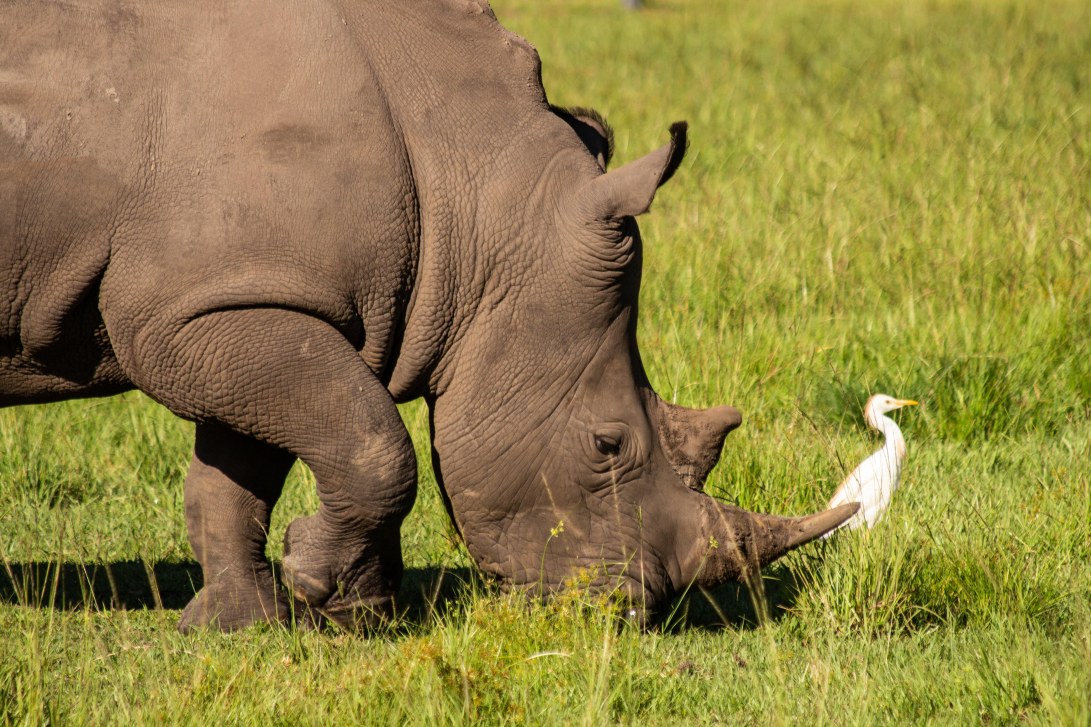
White rhinos, on the other hand, are known as square-lipped rhinos and shed grass like a lawnmower. As we watched them graze we saw they were surrounded by cattle egrets, a common sight at White Oak. These white, gangly birds follow large mammals around their enclosures, as their weighty footsteps disturb insects hidden in the ground below, which the egrets take full advantage of.
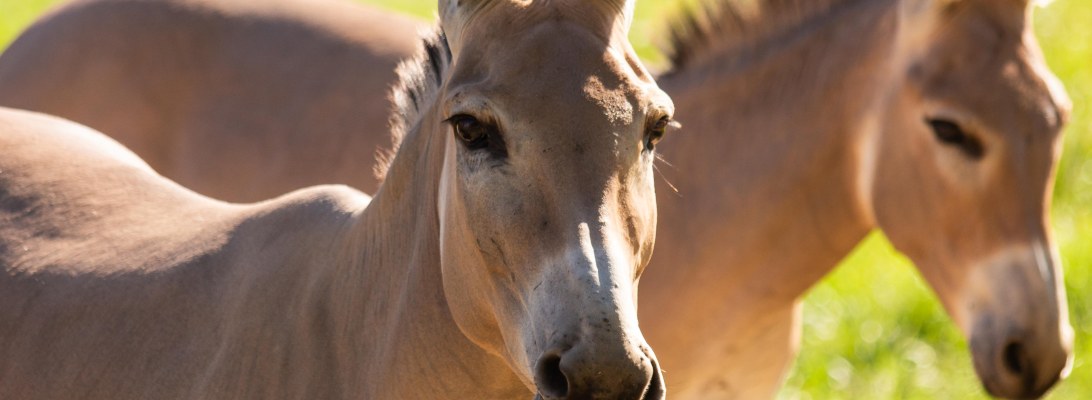
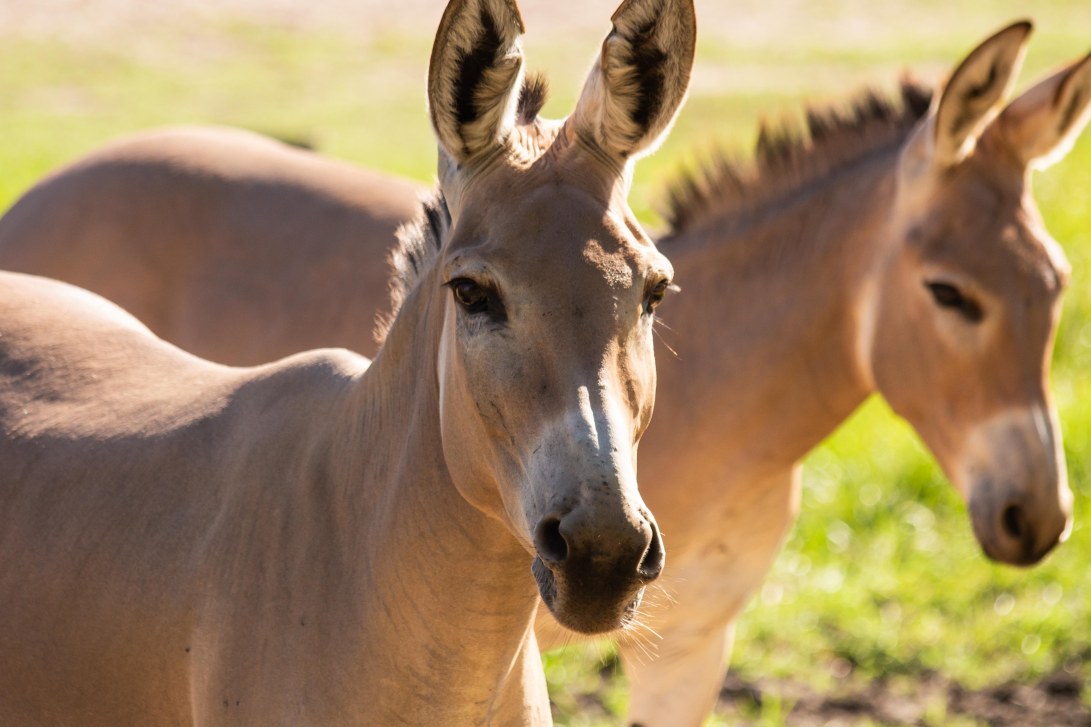
Next we headed off to find the Somali wild ass, a species I had never heard of but fell completely in love with. Found in East Africa, Somali wild ass are the smallest and also the rarest wild horses (equids) in the world, with fewer than 2000 left in the wild. They have a beautiful grey coat that almost appears purple in a certain light. Reminiscent of their relative the zebra, these wild ass have characteristically striped legs. Due to competition with domestic farm animals for grass and water, these animals have become critically endangered. In response, White Oak obtained a herd in 2008, and since then have raised twenty foals.
Nearby to the Somali wild ass was another species I hadn’t come across before: the gerenuk, meaning “giraffe-necked” in Somali. These slender antelope are golden in colour with extraordinarily large necks, ears and eyes. Interestingly, these antelope rear up onto their hind legs to get to even higher places.
One of the final stops on our tour was an unforgettable moment for me: the giraffes. I’ve always had a soft spot for giraffes, and today I had the extraordinary surprise of being told I could hand-feed one. His name was Griffin, and as soon as the bus stopped he came striding over, keenly peering in through the window. One by one, we took a piece of browse and lifted it high, and Griffin gently took it. It was such a treat and a moment I will treasure for a long time.
As we got back onto the bus and made our bumpy way back to the car park, I felt honoured to have seen first-hand what an amazing place White Oak is for conserving and protecting wildlife. While I commend many zoos for their conservation work, I was so pleased with how much space these animals had, giving them the freedom to behave as naturally as possible. It made me so excited to continue my internship and I looked forward to getting even more involved as the weeks progress.
After sharing the waves with a herd of very curious seals, it was now time to get changed on a boat with thirty other people. This was a challenge, especially as getting a wet wetsuit off required the flexibility and strength of a contortionist. I teamed up with another girl to make a temporary changing cubicle, which made it somewhat easier.
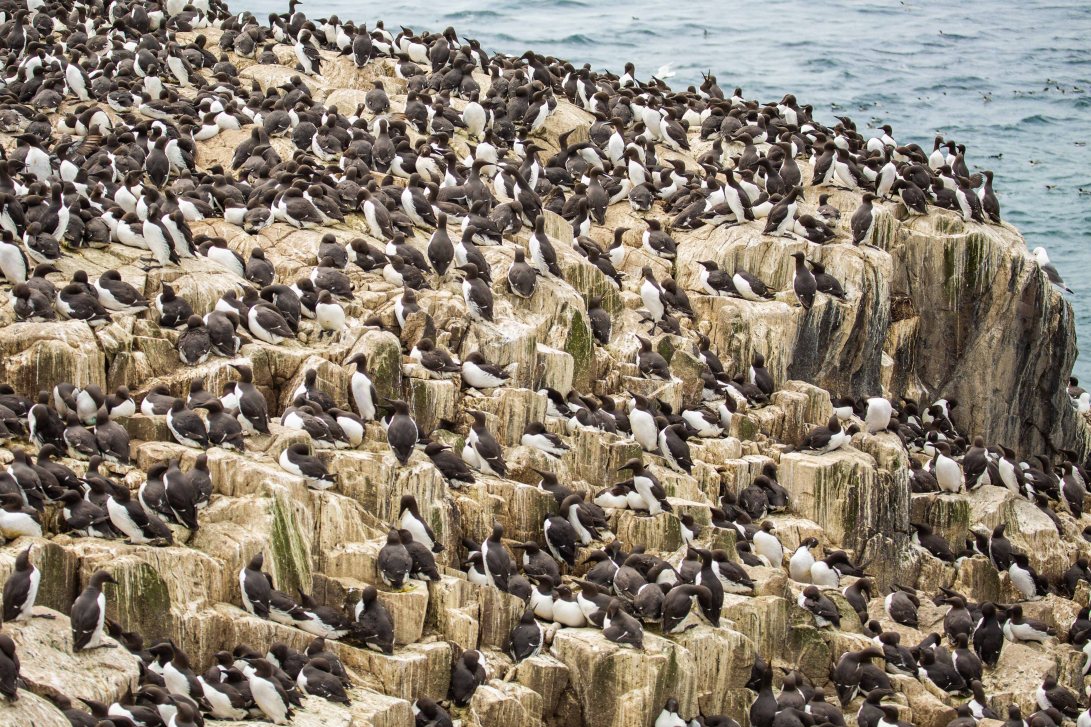
Once everyone was back in dry clothes, the boat headed to Staple Island for a spot of birdwatching. On the approach, all we could see and hear was guillemots, a blanket of birds completely covering the rock. People were dotted amongst them but vastly outnumbered. It was the kind of ratio I liked to see.
On dry land, it was impossible to decide where to start. I was used to choosing a spot to sit and wait for the wildlife to appear. Here, we had joined a metropolis of seabirds all going about their business without blinking an eye at what we were doing. Red posts were stuck into the ground at places, and as we passed I notice each one signalled the presence of a nest, some situated almost on top of the path that threaded through. Shags watched nonchalantly as we passed, eyes half closed.
Some of the guillemots looked different to others. While most had completely brown heads, a select few had bright white rings around their eyes. I asked Cain, who told me they were bridled guillemots. Back at home I looked them up, and discovered that these individuals are an example of dimorphism. Usually relating to variety in plumage colour, dimorphism is the existence of two distinct forms within a single species. This is different from two subspecies, as both guillemots and bridled guillemots have the same Latin binomial: Uria aalge. Were they subspecies, they would have an additional subspecies name. Furthermore, subspecies tend to be permanently geographically isolated from one another.
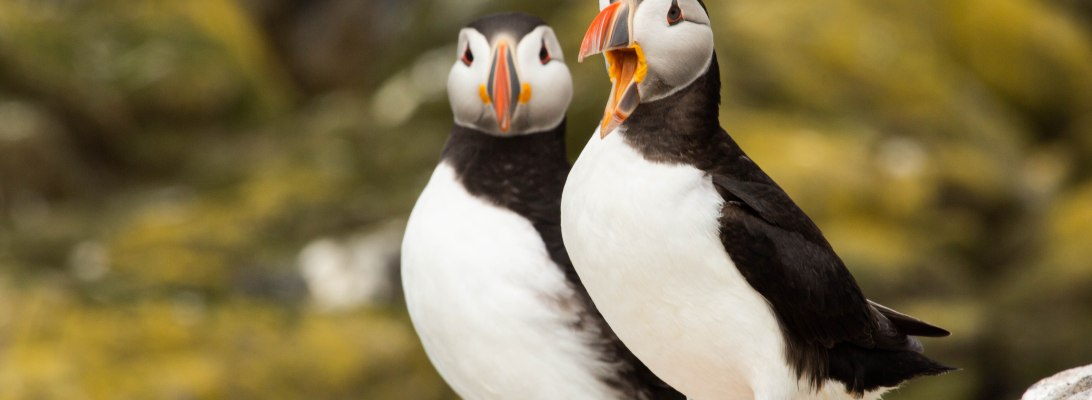
After watching the guillemots for a while, I found where the puffin clique spent their time. Away from the larger birds, there were countless burrows in the grassy banks, and after a while puffins would pop into view or land and duck inside, sometimes carrying large mouthfuls of sandeels in their vibrant bills.
I had been so excited to see my first puffins on the Isles of Scilly, and while I still treasured the memories, those had been distant sightings compared to now. Here on the Farnes, puffins sat twenty feet from two-tiered photographers, lying on the rock or glancing from side to side with their sad clown eyes. They were a joy to watch, and so much smaller than people think!
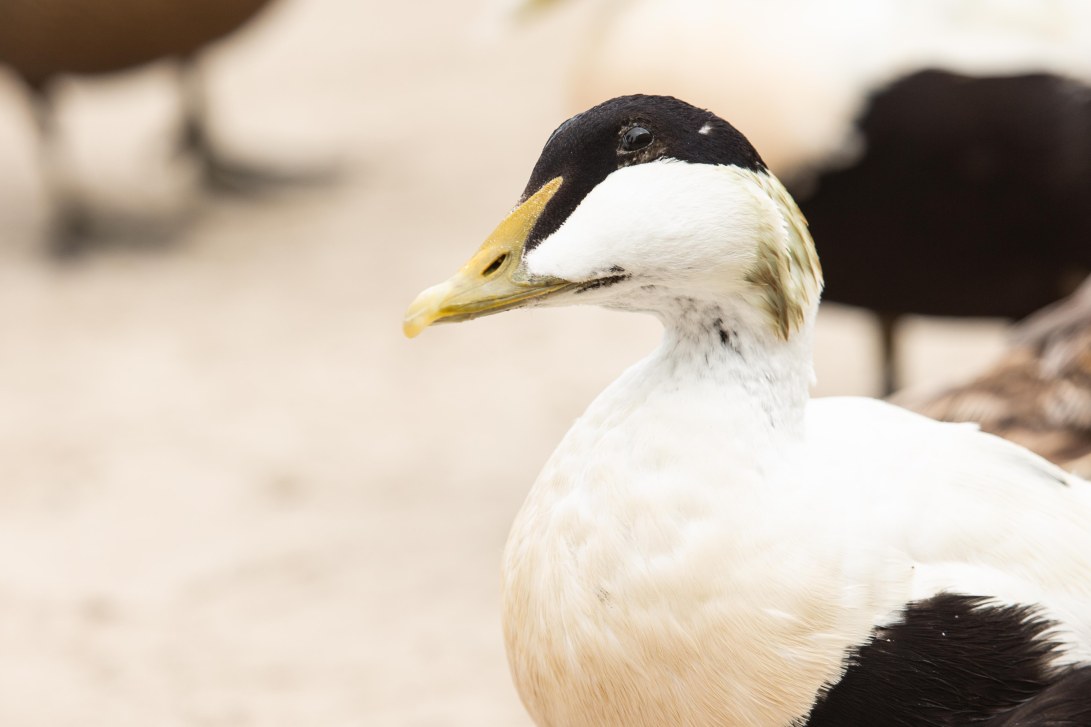
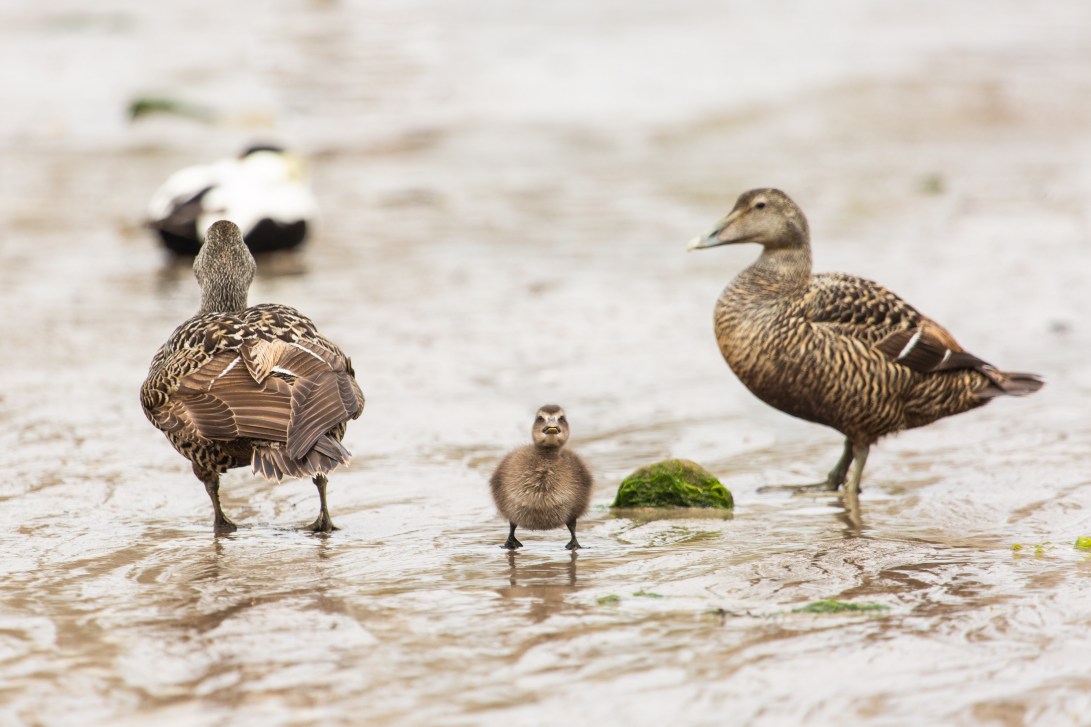
Sadly, the time flew by and before I knew it I was back on the boat and leaving Staple Island behind. When we arrived into Seahouses, I caught the irresistible smell of fresh doughnuts on the breeze. Tired after the swim, I made a beeline for the van and bought a bag to sit and eat on the bay. A group of very tame eider ducks approached, eyeing my bag with enthusiasm. Unfortunately for them, I wasn’t sharing my doughnuts with anyone, but I did make use of the opportunity to photograph the beauties so close.
I was thrilled to see ducklings accompanying some of the females, perhaps one of the cutest baby animals there is. As the females lowered their bills into puddles of seawater, the ducklings copied, mirroring the adults’ every move. Watching such intimate family behaviour while I devoured my doughnuts was a perfect way to end such a dramatic and unforgettable day at sea.
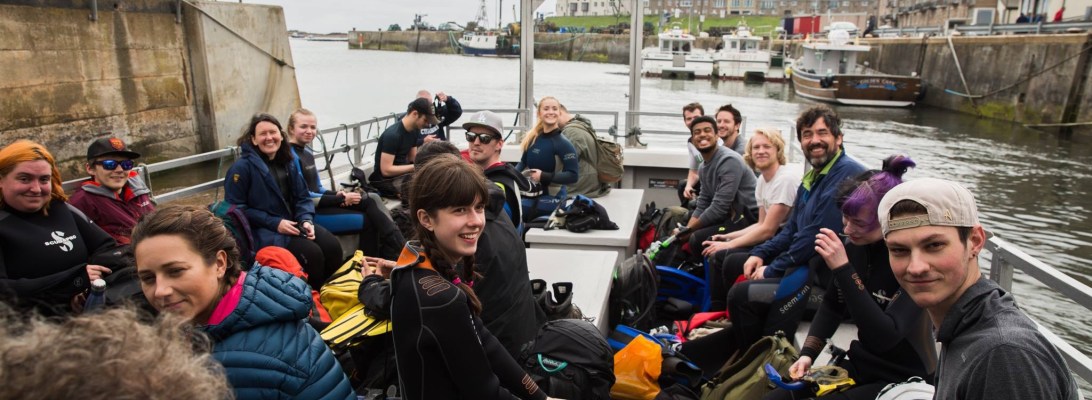
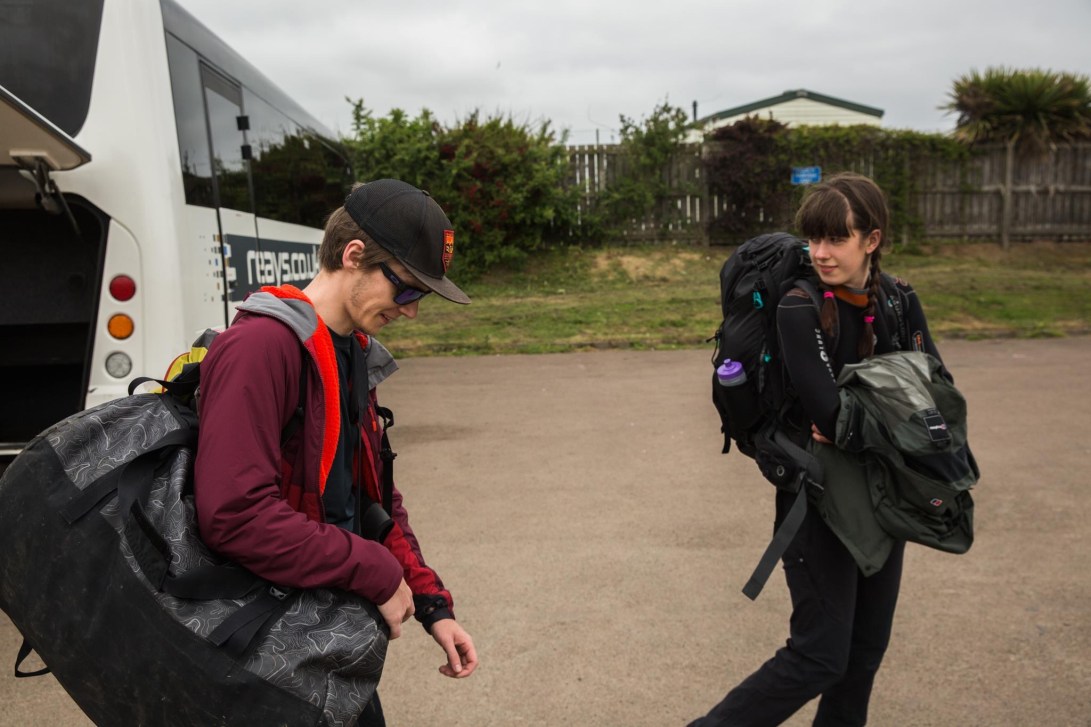
Our trip to the Farne Islands was looking like it would be a day of unforgettable wildlife encounters. We boarded the boat at Seahouses kitted out in wetsuits, boots, hoods and clutching snorkels in gloved hands. The clouds were light in colour and I had faith that the sun would soon break out.
En route to the boat (Photo: Cain Scrimgeour)
There was a buzz of excited conversation as we moved out into open water, scanning the surface for wildlife. Cain, sharp-eyed as always, spotted the first puffin, as well as razorbill, guillemot, and a Manx shearwater. I twisted in my seat to spot everything he pointed out, but as usual, I was perplexed how Cain could identify such small, distant birds with immediate certainty. I could easily see the gannets though, a group of four that glided low over the water past the boat. I’ve said it many times before, but gannets are one of the best birds out there, and I never tire of watching them.
Before long we reached a widespread rocky outcrop where the boat would stop and let us jump out into the sea. One by one, we pulled on fins and adjusted facemasks. When it was my turn, I waddled ungainly to the back of the boat and took a somewhat hesitant jump off.
Taking the plunge! (Photo: Cain Scrimgeour)
Cold water hit me like a fist and I suddenly couldn’t breathe. I was filled with a very unfamiliar panic that I’d never felt in water before. I was lifted back onto the boat and it was then that the skipper told me my over-sized hood had risen up over my mouth and my mask had filled with water. Feeling very sheepish, I calmed my breathing and tried again. My second attempt was more successful, but I was very unaccustomed to wearing fins when swimming. They were two dead weights on my feet that pulled my legs to the surface and completely threw off my balance. Having only ever worn a swimming costume in the ocean before, it now took real effort to get used to all this additional kit.
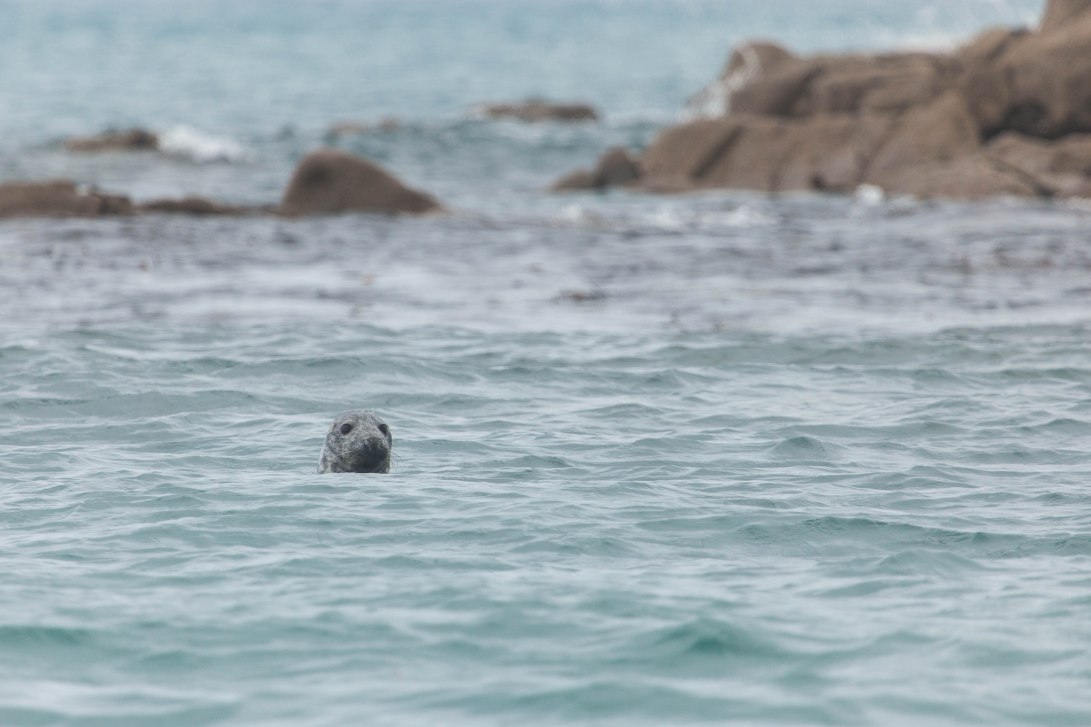
I glanced up and saw another of our group bobbing up and down in the water, but then I looked properly and saw it was in fact a grey seal. I experienced a combination of surprise and elation, and when I looked around I realised I was surrounded. Seals were everywhere, gazing with inquisitive expressions. One ducked under the water so I copied, watching it glide out of the kelp with an astonishing grace that it didn’t bring with it onto land. Water seeped into my mask again, and once I’d tightened it and put my face back under, there was a jellyfish right in front of me. I’d seen dead ones on the beach, but to see a live jellyfish propelling itself effortlessly through the water was truly beautiful.
I reached the rocks and rested for a while, watching the snorkels of other students in every direction. Suddenly another seal appeared, an arm’s length away. It flared its nostrils and snorted, staring directly at me, then ducked underwater. Once again, I followed its direction and watched with amazement as it brushed against me. Then, it held out his flippers and wrapped them around my leg. It was a surreal and incredible experience, feeling a wild grey seal squeeze my leg in what the anthropomorphist in me liked to think was a hug. It was nothing like it of course, but the seal reminded me of an excited puppy, and even nibbled my wetsuit like my dog would do. Before long it swam away and disappeared into the gloom, and I was left feeling ecstatic. Any encounter with a wild animal in its natural habitat was special, but to me it was even more exciting to share a completely new world with one, a world I never normally got the chance to be a part of.
A curious face
As much as I hated to admit it, my hands were beginning to grow numb, so I waved to the skipper and got back on the boat. As I warmed up, I felt niggles of regret that I hadn’t tried to film my encounter on the GoPro I’d brought with me. But as I reflected on what had happened beneath the surface, I was glad that I hadn’t. In that moment I hadn’t been distracted by technology; I’d simply been there.
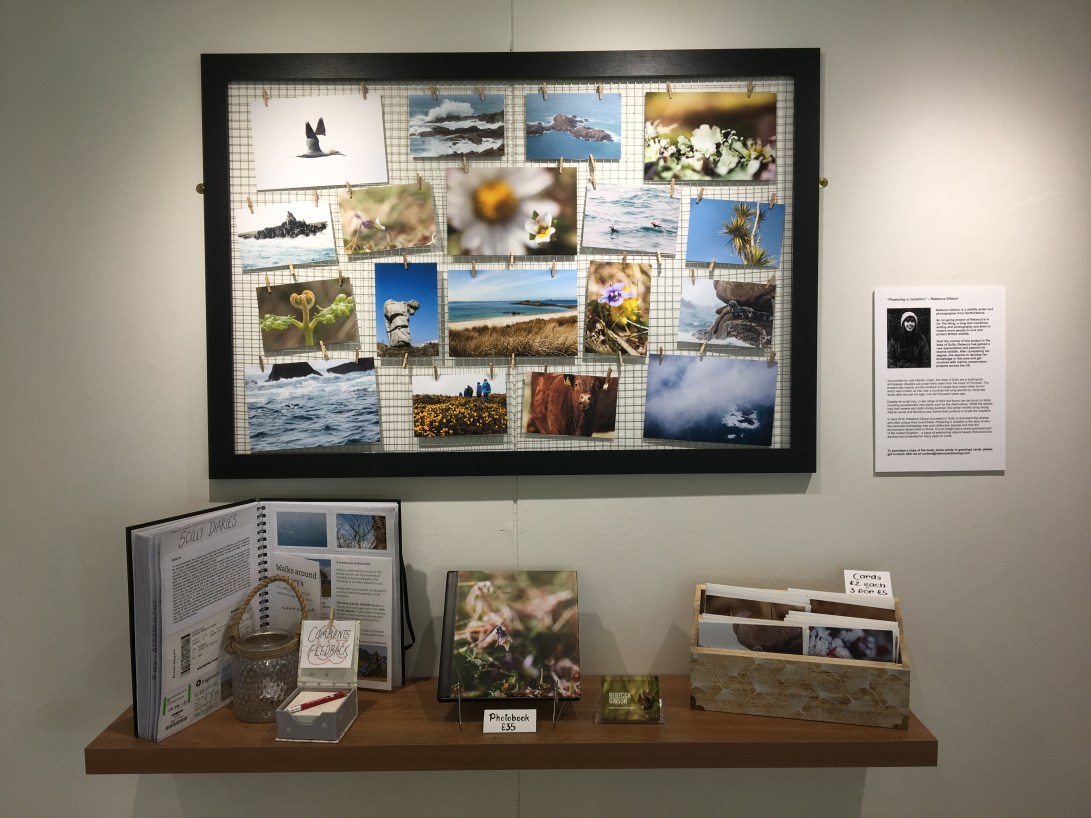
The past few weeks have been fairly frantic, with preparations for my final showcase in full swing. Campus has been a buzz of activity as we all work on exhibiting our major projects and making them look their absolute best. After creative brainstorming and purchasing countless items and decorative pieces, I have finally finished my display and couldn’t be more proud of it.
The exhibition will be held at the Vallum Gallery in Carlisle, Cumbria from the 1st to 8th of June. It’s a beautiful space to display work, especially photography where good lighting is so important. As the main part of my project was a printed photo book, I have also mounted a collage frame of snapshots from my expedition to the Isles of Scilly. To find out what I got up to during my time on Scilly, have a read of the start of my journey to this stunning archipelago.
A peek into the finished photo bookSome greetings card for sale
If you are interested in purchasing a copy of the photo book, or perhaps a few greetings cards of my photography, please don’t hesitate to get in touch with me at contact@rebeccaonthewing.com and I would be more than happy to provide more information.
The trains to Glasgow and Largs and the ferry to the Isle of Cumbrae were all fine. It was when I boarded the bus to the Millport Field Centre that it dawned on me: what on earth had I let myself in for?! I’d booked onto a weekend course run by the Field Studies Council called ‘Marine Species and Habitats: The Biotope Approach’. After volunteering at an aquarium had sparked a new fascination for marine wildlife, I wanted to learn more about what could be found on British shores. I’d done a bit of research using the course’s suggested reading list, and had half an idea what a biotope was, but as I dragged my bags off the bus I wondered if I’d booked myself onto something that would sail completely over my head. I imagined working alongside a team of marine biologists with decades of experience in the field, and here I was with a newborn interest in fish. I was suddenly terrified, and literally marooned on an island for the weekend.
Blue Mussels(Mytilus edulis)
As I was mulling this over in my head, a girl my age carrying a black hold-all asked me if I was attending the Biotopes course. I was thrilled; fate had brought us together on the same ferry and meant I didn’t have to amble around alone wondering where I needed to be. Our rooms weren’t ready yet so we went for a wander towards the town of Millport. Her name was Abbie, and she was currently part-way through a PhD in non-native seaweeds. This was something I knew literally nothing about, but we chatted about uni and wildlife and all things in between. Meanwhile, it was a chance to see where we’d be spending the weekend, and it was beautiful. Of course, almost everywhere is beautiful in bright sunlight, but even so the Isle of Cumbrae promised a fascinating chance to survey marine wildlife.
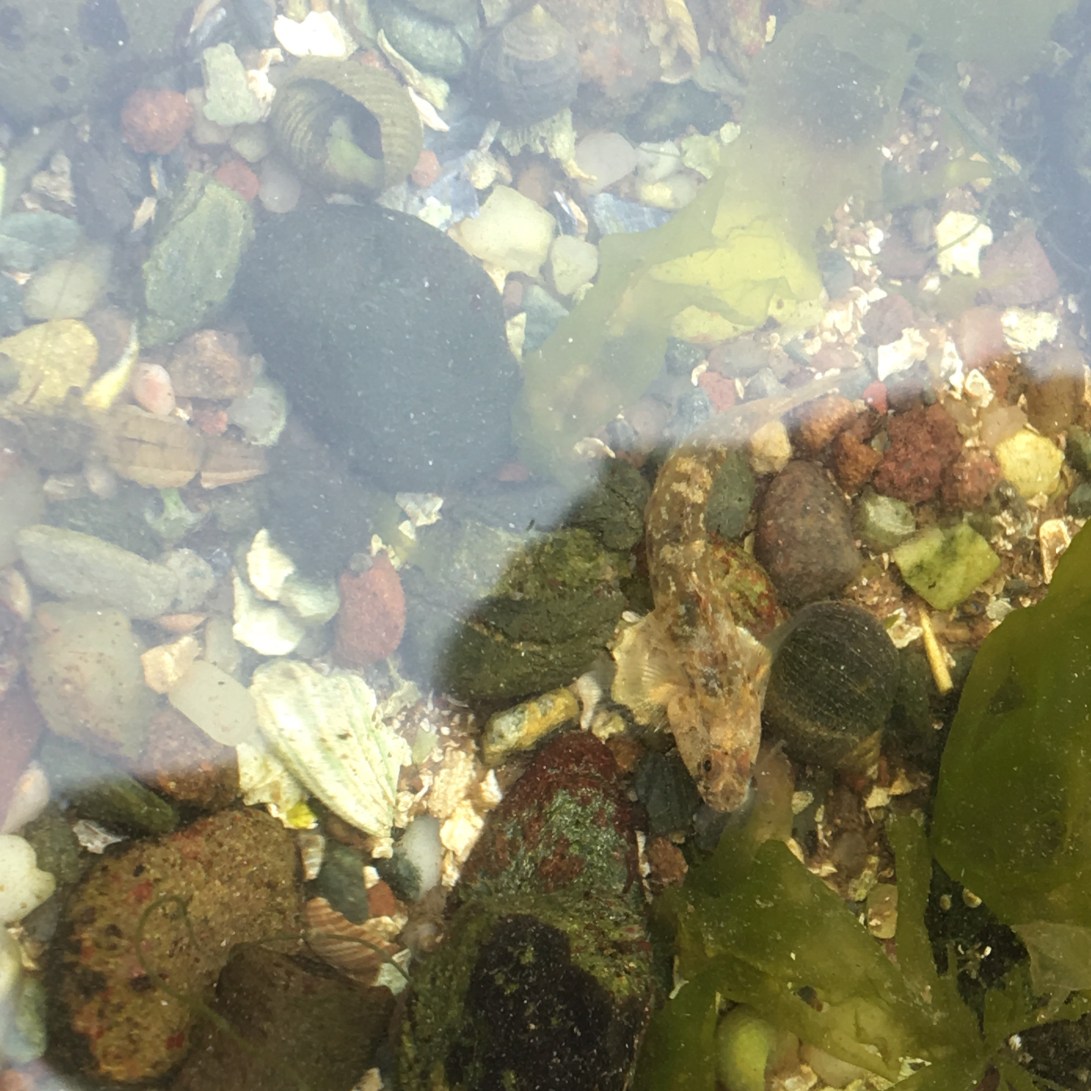
A well camouflaged Sand Goby(Pomatoschistus minutus)
After a loop around the bay we headed back to the Field Centre and took our bags to our rooms. I had feared with some trepidation what the washing facilities would be like, but was very pleasantly surprised to discover a large ensuite shower, not to mention a bed like a cloud. I hastily unpacked then met the rest of the group for our first briefing. Here I met Emily who worked at the Lancashire Wildlife Trust, and before dinner Abbie and I went for a walk with her to the shore to soak up the last sun of the day.
Dinner was macaroni cheese and apple crumble, perhaps one of the most perfect combinations of courses there can be. Then it was time for our first lecture: an introduction to biotopes. My research had prepared me well – a biotope is the combination of a physical habitat and the biological community found living there. Although some of the lecture’s content was lost on me, I left feeling inspired and ready to face new challenges over the weekend. I’d already met lovely people, and all my earlier worries began to feel very insignificant.
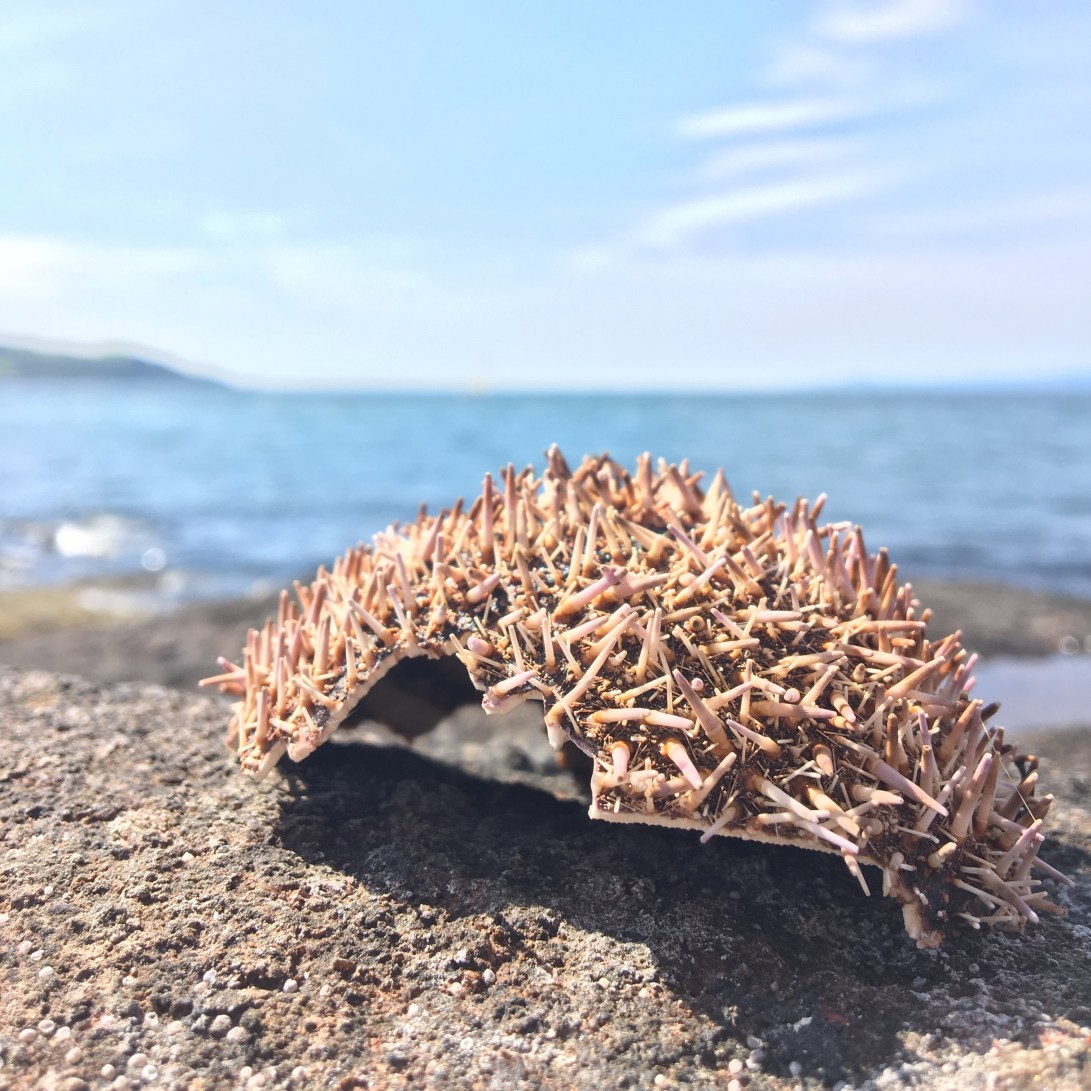
A fragment of broken sea urchin shell
Saturday
Today began early, and by 9am we were down on the beach beginning our first biotope survey. It was a beautiful day for it, and we wasted no time getting stuck in, in my case literally getting my wellies wedged in rock crevices and clinging desperately to my balance. Common species included beadlet anemones, dog whelks and acorn barnacles, but we also found common starfish, hermit crabs, a star ascidian (type of sea squirt) and plenty of seaweed. My knowledge of seaweed species was even smaller than my knowledge of seashore vertebrates, but as Abbie was doing her PhD on them I had a source of very valuable information.
Star Ascidian(Botryllus schlosseri)Common Brittlestar upside down (Ophiothrix fragilis)
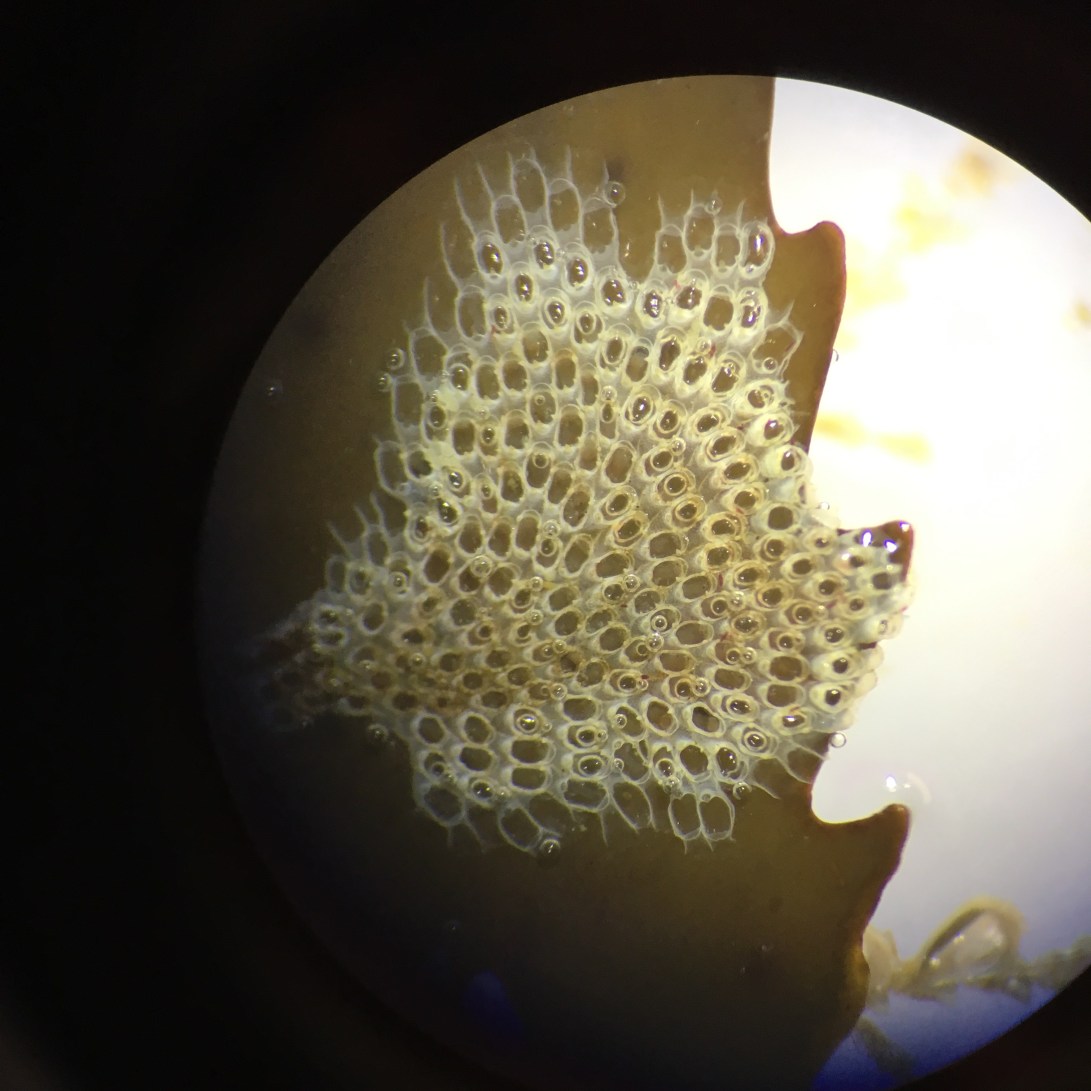
Once we’d covered as much of the bay as we could we ate lunch out in the sun (an excuse for some of the group to catch up with the goings on at the royal wedding) and then headed back to analyse our results and try to determine which biotopes we’d found. This was also an opportunity to play with lab equipment, which I haven’t been able to do since A Level Biology. I had good look at the bryozoa I’d found on a strand of seaweed (below). Bryozoa means “moss animal” and viewed up close reveals an intricate lattice of animals situated closely together. I studied these individuals for a while but couldn’t decide between Sea Mat or Hairy Sea Mat.
A cluster of bryozoa: either Sea Mat(Membranipora membranacea) or Hairy Sea Mat(Electra pilosa)
After beating the queue and getting served dinner almost first, I went back to my room for much-needed downtime before bed.
Sunday 20th
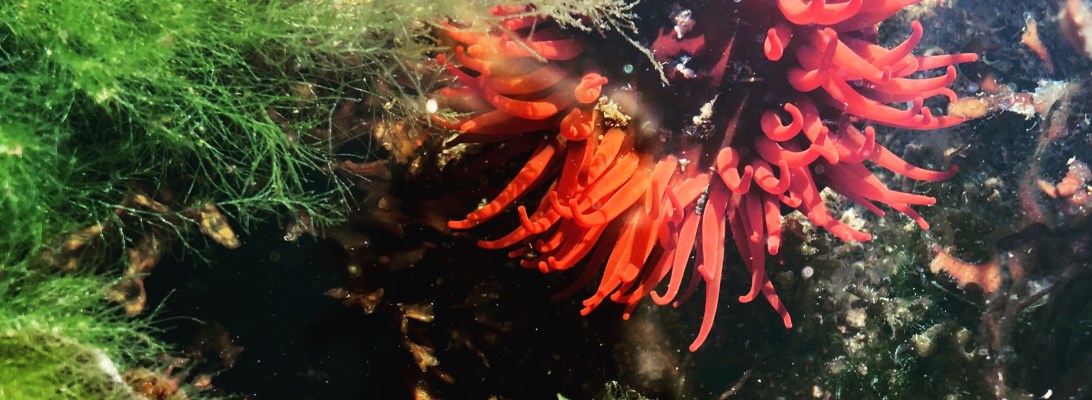
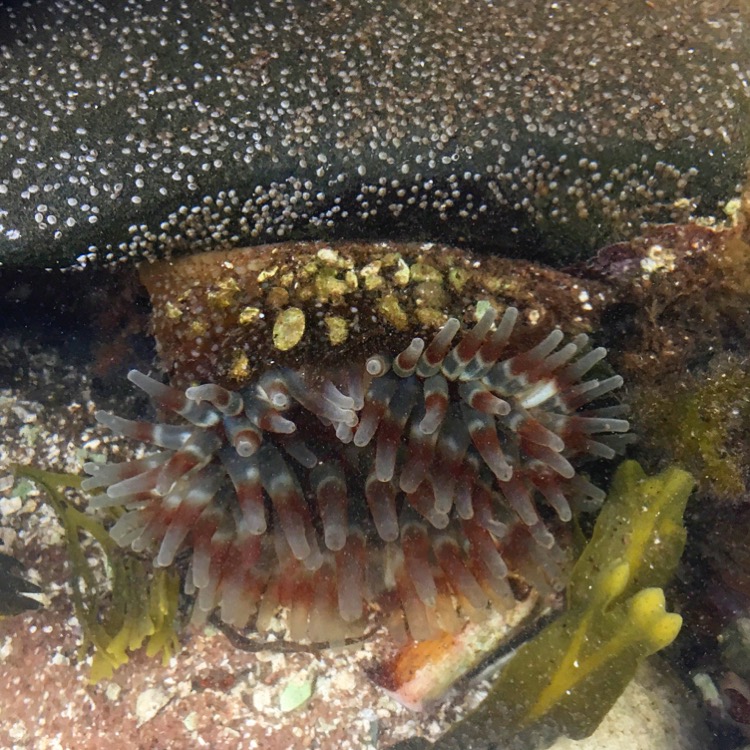
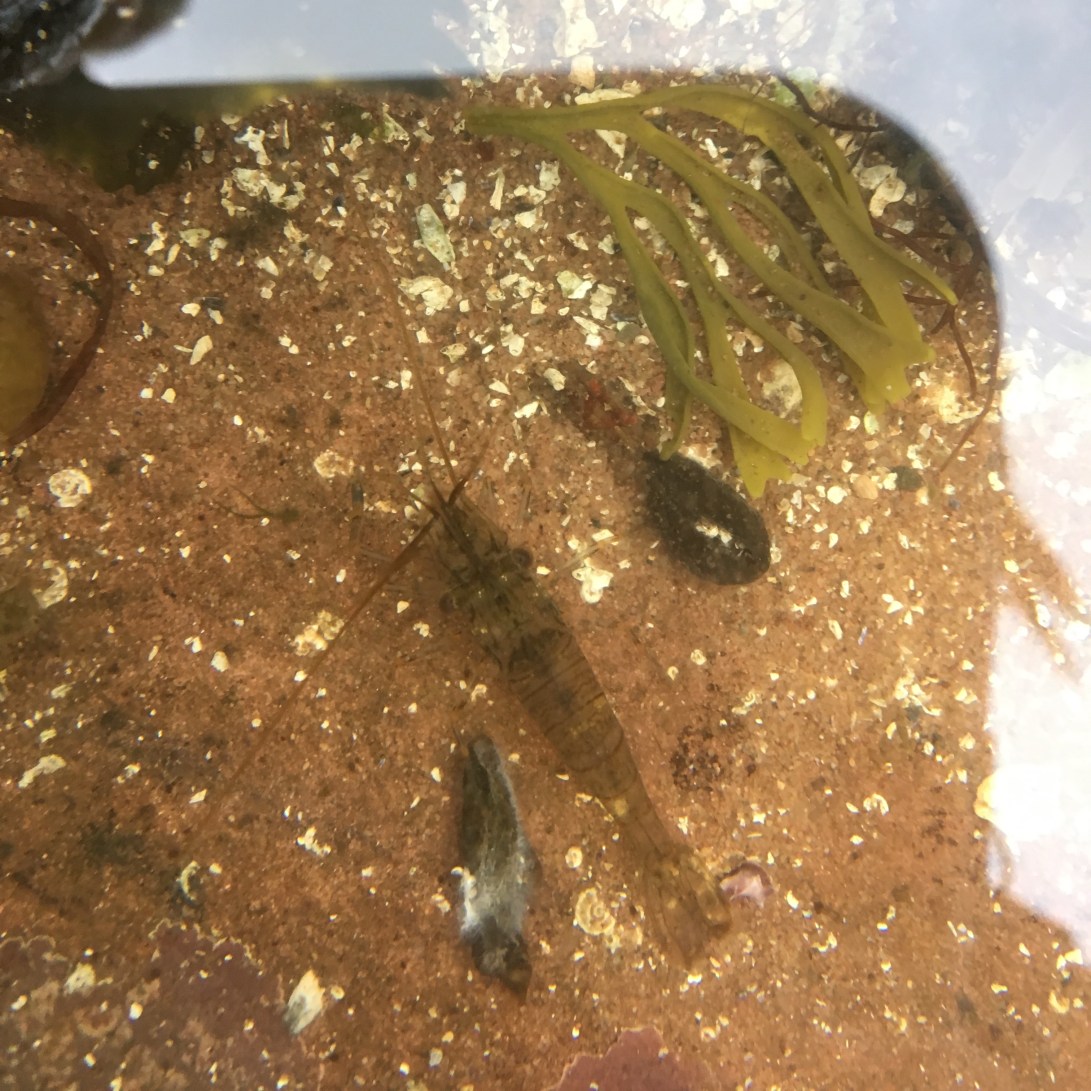
Today was another early start, and this time we drove the short distance to the northern end of Great Cumbrae to a much larger site. The weather was a little dreary but armed with quadrats, transects and clipboards we began to survey the biotopes. Findings started off slowly but once we reached the rock pools things really got exciting. Our course leader Paula found a slug species called a sea lemon – a very pretty blob – and a butterfish. Abbie, Alex and I found a sand goby, sand mason worm, lots of brittlestars, more hermits and beadlets, and my favourite from today: a dahlia anemone. It was the largest anemone I’d seen before, and had beautiful striated and brightly coloured tentacles that slowly emerged again once we’d calmed down to watch it properly. Just as I was squatting to try and get a decent picture, two common prawns appeared underneath a nearby rock. I didn’t know if maybe these were boring sightings but I recognised them from my volunteering at the aquarium so was thrilled to be able to confidently identify something in the field.
Back at the lab, Abbie got to work identifying her seaweeds and Alex had an ID test to do for his assignment, so I had a bash at identifying today’s biotopes by myself. Once I’d done that, I realised I’d accidentally brought a tiny brittlestar home with my sea urchin shells. With Paula’s help, I identified it as Amphipholis squamata. Later, Paula asked us what we’d found, and Alex and I had got the exact same biotopes! I was so pleased with myself.
Dinner was Sunday roast and sticky toffee pudding. I must have put on about eight stone this weekend – I’ve been fed like a queen and although my brain has been working overtime, my body hasn’t done so much. After dinner we had our last round-up lecture and went to the bar for drinks. I ended up talking to the two guys from Belfast about Father Ted – it was pretty funny talking to Irishmen about it. I would have stayed longer but I was absolutely shattered. So I headed to bed, falling asleep almost instantly.
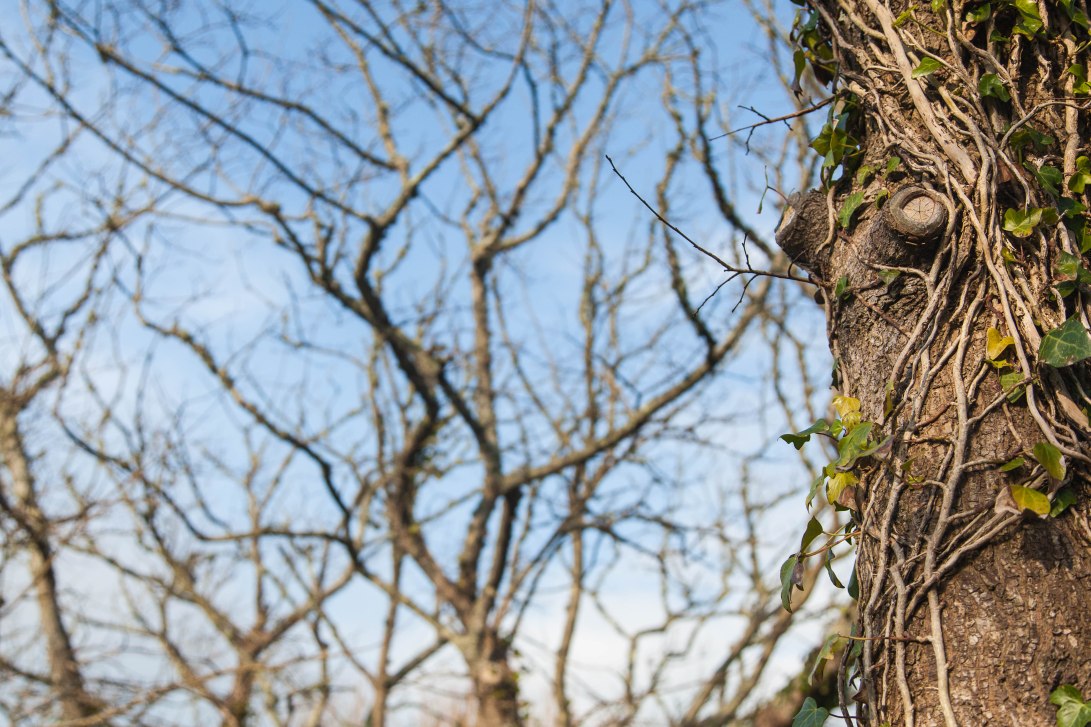
Today was slightly less eventful but still productive. I went for a walk to the Lower Moors of St Mary’s to find elm trees. Being so isolated, the elms on Scilly have successfully avoided Dutch elm disease, which has claimed all living elms on the British mainland. When I arrived at the spot on the map, I was quite shocked to see that although the elms were free of disease, they were covered from top to root in a thick coat of ivy. It was quite a disconcerting sight, but I had come to photograph live elms and here they were, so I experimented with different angles – shooting right against the trunk and looking up, focussing on a close section in the foreground and so on.
I also found some beautiful patches of lichen so spent a lot of time photographing them too. Abundance of lichen was a good indicator of clean air. There is a distinct lack of dust and pollution on Scilly, and as a result there are forty different species of lichen on the islands. It can be seen growing on almost every surface, whether that’s tree, rock or garden fence. Lichen is what’s known as a composite organism, consisting of a fungal element for structure and an algal element for photosynthesis. This combination allows lichens to grow in a diverse range of habitats and environmental conditions. Sea ivory (Ramalina siliquosa) is a branched lichen – known as fruticose – that is one of the more common varieties, but there are also crustose lichens that form a tightly-clinging crust on rocks and foliose lichens which appear leaf-like, growing in lobes that are more-or-less parallel to the substrate on which they are found. Although I had no hope of identifying the lichen species I found on Lower Moors, it was fascinating to photograph them and see just how diverse they could be.
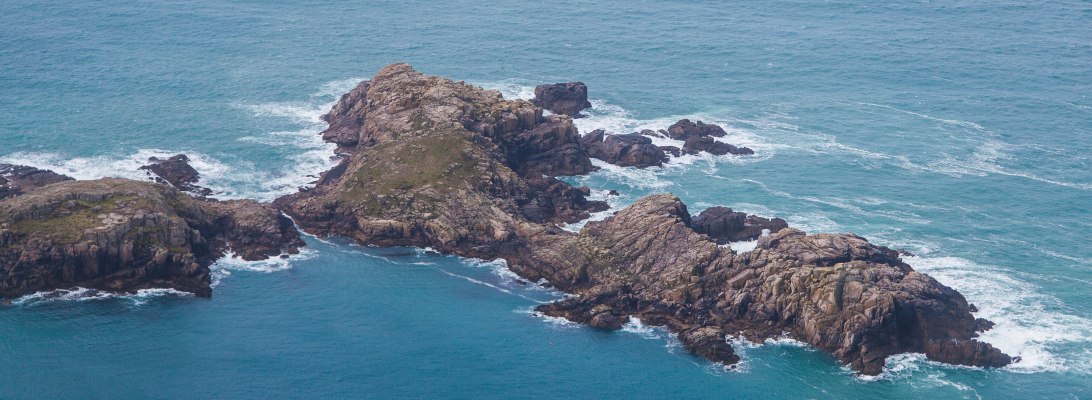
To truly comprehend how isolated and tucked away the Isles of Scilly are, you have to get there. My travelling began at 4:30am, and after using four modes of transport I arrived on St Mary’s at 1pm. It was a complicated and fiddly excursion but when I finally arrived, eating chips overlooking a vast expanse of ocean, I knew I was really at the edge of Britain.
Passionate gusts of wind blew the smells of salt and seaweed off the coast. The air was alive with birds. If I closed my eyes it was the same as home – wrens belting out their embellished trills, blackbirds speeding underfoot with shrieks of alarm – but as I was watching a dunnock I heard something that I thought at first to be a great tit, but the two syllables were the same pitch. Then, confirming my suspicions, a tiny brown, featureless bird appeared. My first chiffchaff in the flesh.
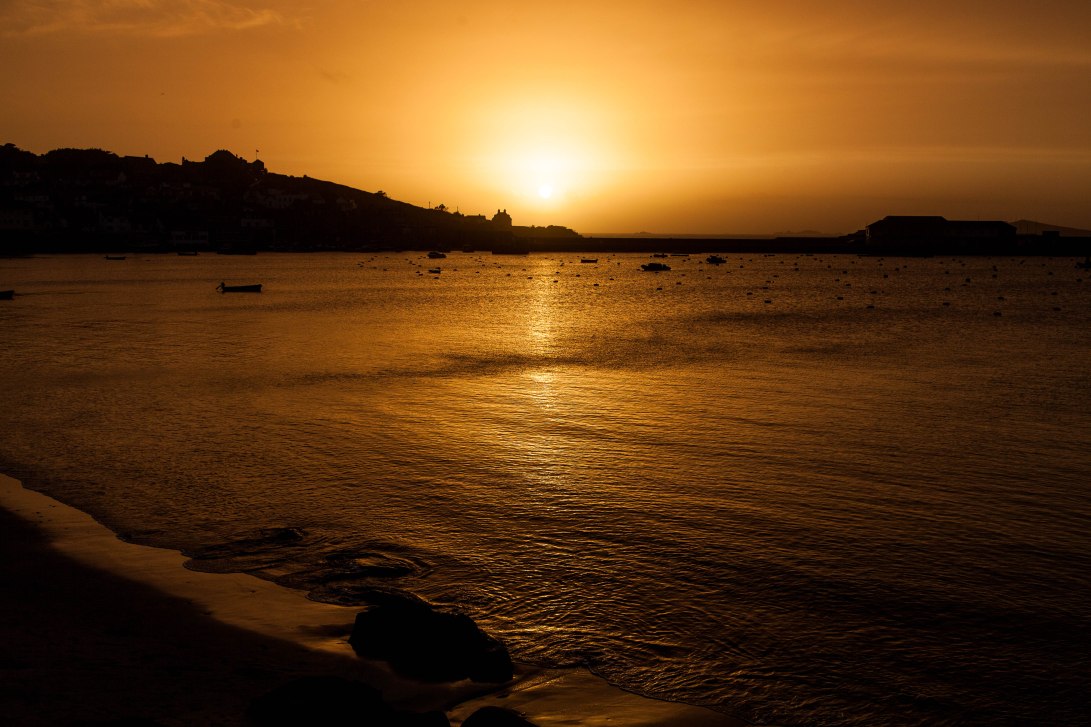
Later in the day I was struck with another bout of stress and worry. What if the flowers I wanted to photograph weren’t there? What if it rained every day this week? And as I stewed in paranoia I got a sign. I normally pulled faces at signs but this had to be something of an existential signal. As the sun went down the sky was alight with rich colour so I took my camera and headed down to the beach – only about twenty paces from the flat – and started taking photos of the foliage silhouetted against the sky. The sun sank so quickly that in minutes it had completely disappeared, but it was one of the most stunning sunsets I’d seen in months. There were other people taking photos too, and I heard one woman say “This is the best I’ve seen so far this year.” I arrived on Scilly this afternoon, and the day ended with a sky like that. I still felt apprehensive about this week, but my worry was also mixed with a little more optimism than before.
There is an overwhelming quiet that comes with winter; a hush descends over the landscape that only adds to the bracing chill. As the season turns, the first few tentative voices break the spell of silence and before long there is an overpowering variety of diverse voices filling the air. While in the height of spring there can be hundreds of songs reverberating through the trees, there are a select few who can be heard again and again, reliable as the seasons. I took it upon myself to begin to tune in to this soundscape, a treat for the ears. Learning to birdlisten not only unlocks the ability to distinguish birds by song, but is also very useful as advanced warning for the reveal of the bird itself.
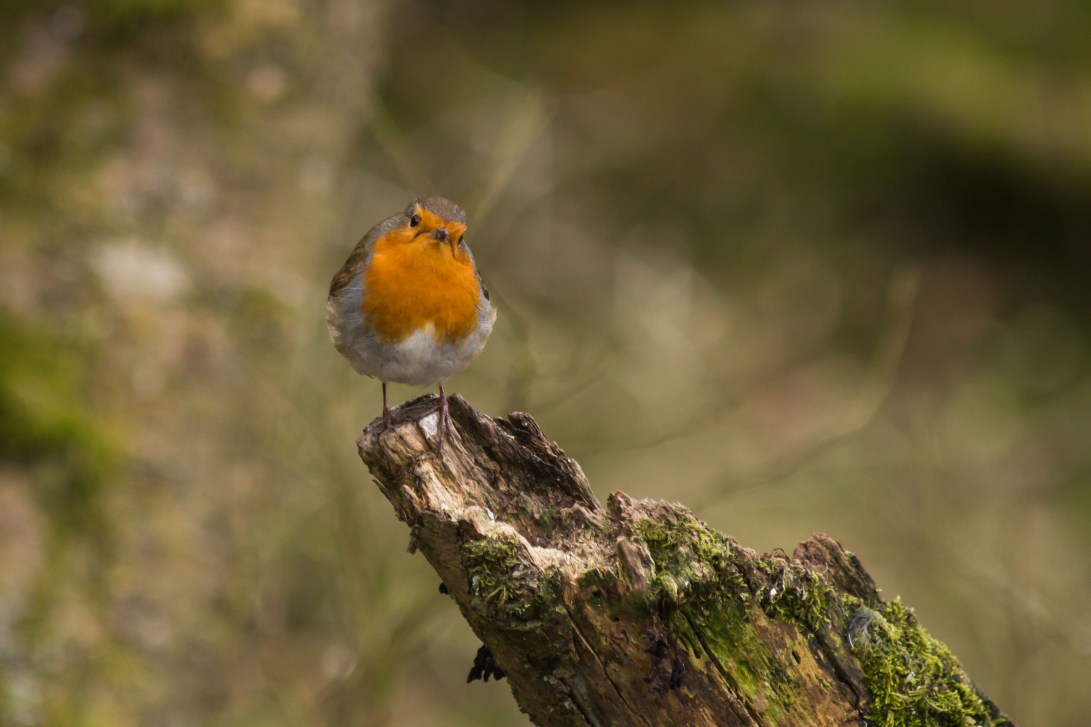
Robin (Erithacus rubecula)
Perhaps the most significant voice is that of the robin, mainly because he never left the scene when other, less hardy birds took off for warmer climes. Even through the dark, bitter winter the robin endures, his lone song often the only consistent sound during the colder months. In spring males and females pair up and defend their breeding territory, often the first to start singing and the last to finish.
The robin’s song is a delightful melody; a high, twittering burble heard from all around. Although varied in its range and tempo, the robin’s voice is almost unmistakable – high, thin and soft but still richly diverse. Hear the robin and he won’t be far away, perching in plain sight and puffing up his red breast as he fills it with air. He is a proud bird, often chasing other robins from his patch, but with a voice as pretty as his, who can blame him?
Wren (Troglodytes troglodytes)
Another commonly heard voice belongs to a rowdy bird that makes up for small size by belting out a piercing song for everyone to hear. The wren can often be seen speeding bullet-like through knee-high bushes. The wren sings like it’s scolding somebody; a furious round of high, loud chirrups with a distinctive trill at the end of some phrases that sounds like a miniscule machine gun. If you hear a very loud song wait for the trill, as it will inevitably come sooner or later and you’ll know you have your wren. Scan the lower branches and before long a stout brown bird holding its tail up like a stiff flag will appear, giving you a fierce reprimanding for something or other.
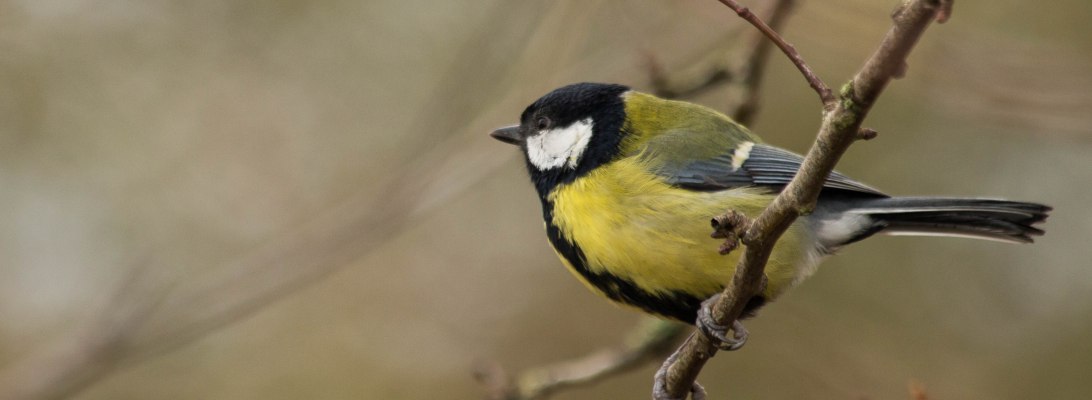
Great Tit (Parus major)
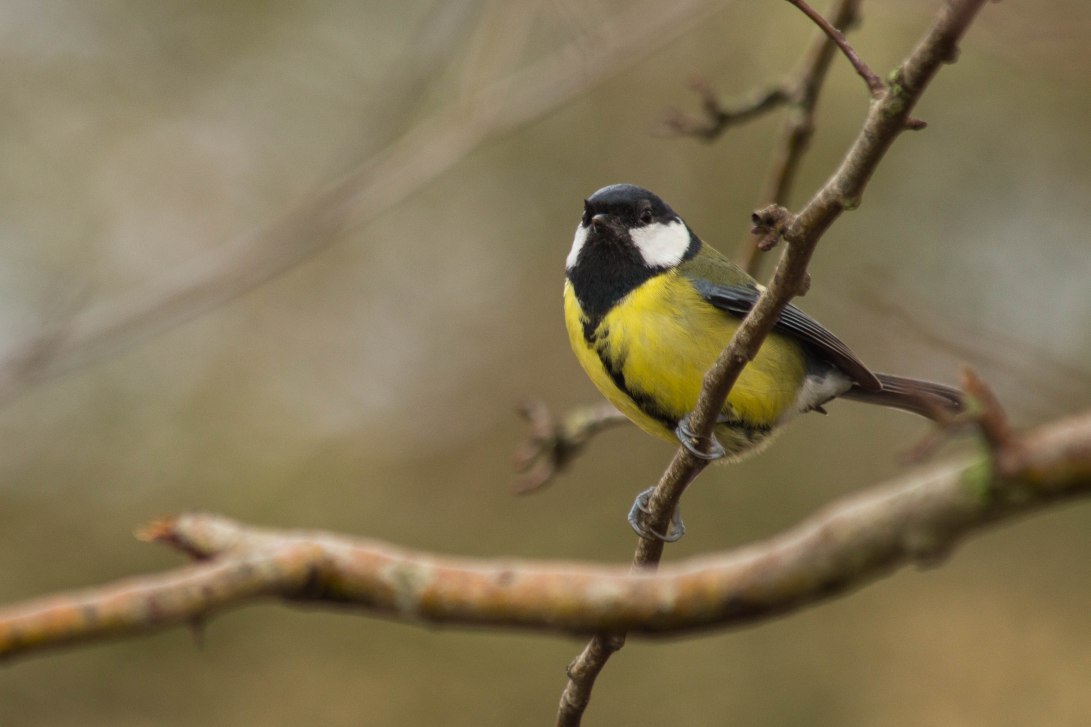
If robins and wrens are violins in the avian orchestra, the great tit is percussion; not quite as dazzling but just as important. In early spring, a two-toned call can be heard among the other singers, with emphasis on the first syllable. I like to think of it as the sound of a saw – effort on the forward stroke, then quieter on the draw back. After a few strokes of the squeaky saw there is a pause, and then the great tit sings it again, very resiliently as if rousing the troops to join in.
The great tit has other songs in its repertoire, including a “churr” call that reminds me of the chatter of a magpie, but a little faster and far gentler. This is the great tit’s alarm call, a sign of agitation that indicates something has disturbed it.
Blue Tit (Cyanistes caeruleus)
With a lot of birdsong, it can help to adopt a Morse code approach when it comes to deciphering the rhythms of some particular species. Take the blue tit. A common little bird with splashes of blue, green, yellow and white with a fetching black goatee. The blue tit’s song is similar in tone to the great tit but gentler. Among its quite varied repertoire is a particularly distinctive melody, consisting of two clearly separated notes followed by two or three much faster ones. In dots and dashes it would look something like this:
– – . . .
Imagine, perhaps, that the bird is saying “I’m. A. Pretty Bird”, putting particular emphasis on the first two words.
If you like this, have a read of this post and find out where my inspiration to start birdlistening began.
After our great grey shrike stood us up last week, I was determined to tick a bird off my wishlist. I did some digging and found there were a few good spots for hawfinches down in Kendal. Zahrah and I picked the best day of the week and headed down, this time with Kacper. As usual, when the alarm sounded I was struck by an overwhelming urge to leave the hawfinches to their business and dive back under the covers, but when I snuck a glimpse out the window and saw the bright promise of a beautiful day, I knew we had to go for it.
Despite the rather vibrant sun, a sharp chill met us as we left the warmth of the car, reminding us it was still February. Clutching my fists together in my Sealskinz gloves, we made our way up the track, away from people and towards wilderness. The path wound through a small wood, dappled by sunlight filtering through overhead. What had been squelchy mud was now frozen hard as concrete, and crunched under our footsteps. We were initially prevented from entering the open field due to a very restrictive swing gate. My bulging rucksack got wedged and I had to hold my tripod flush to my chest and reverse through – far from a sophisticated entrance.
The frozen ground stretched further, blades of grass as solid as real blades, and it was strange not to feel the gentle give of soft earth. The sun was trying to warm the landscape, taking every opportunity the clouds allowed it to reach us. Once back in the woods, it was shadier. Muffled conversations sounded in every direction; the proud song of a robin and the chatterings of crows all mingling together. We tried to ignore all of these and listen solely for a piercing whistle. This was the call of our target: the hawfinch.
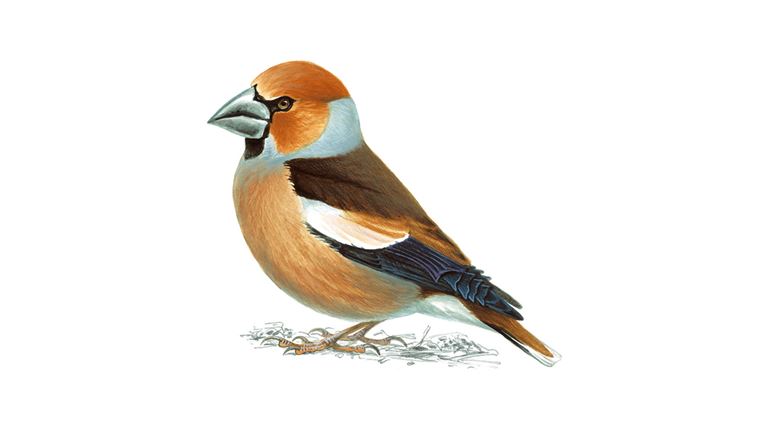
Hawfinches are beautiful and unmistakable birds with striking colouring and formidable conical bills. Usually secretive and shy, they spend most of their time in the topmost branches, making the UK’s largest finch difficult to spot. Typically found in mature deciduous and mixed woodland, hawfinches regularly frequent hornbeam trees. The bill of a hawfinch is highly specialised to cope with the hard seeds and cherry stones that form much of its diet. Once a bird reaches maturity, its skull ossifies and two hard knobs form within each mandible, which are essential for holding a seed still while it is cracked. Findings from an experiment showed that hawfinches can exert a pressure of 60-90 pounds of force, which isn’t bad for a bird smaller than a blackbird.
Hawfinch (RSPB)
As hawfinches frequent the tops of trees, spotting them can be a challenge, not to mention their timid calls are often lost among those of the more plucky birds. Although I never want to criticise the sun, it was shining at a rather inconvenient angle, so gazing up meant we could barely see the treetops, let alone brown birds. So, we tried to climb as high as possible to get a better vantage point. Soon we found a large clearing that gave us a 360° perspective of the forest. Seeming like a good place to set up shop for a while, we perched on a fallen tree and scanned with our binoculars.
There’s nothing quite like sitting in silence, listening to wildlife. Upon arrival you think the forest is a quiet and secluded place, and it would be to a person used to the thrum of cities and traffic. But to sit still and listen in a wild place is to hear a whole new language. I don’t understand it yet – something I’m hoping to soon rectify – but I could listen to its lyrical beats and rhythms all day. Understanding birdsong brings a whole new dimension to bird watching. Cain Scrimgeour, someone I consider a bird connoisseur, can hear the slightest chirrup up in the trees and tell you who made the sound. Sure enough, moments later that bird emerges. To me it’s magic. I consider my knowledge of British birds to be competent, but to know their sounds as well as their appearances is a truly incredible skill.
I heard a soft crunching of leaves as Kacper made his way towards me.
“What’s this?” He whispered, holding his camera up for me to look at the image on the screen.
My eyes popped and I bit back a loud gasp, “That’s a hawfinch! Where is it?”
He led me back to where he’d been standing and pointed up. Now began the near-impossible task of explaining to a person which tree in a hundred trees you are looking at. After a painfully long-winded ordeal I found where he was pointing, and with binoculars trained I saw my first hawfinch. Females are only slightly less brightly coloured than males, so to my eye I couldn’t tell which this one was. The bird was perched looking straight towards us, feathers hunched up. It was foraging, and I saw it pick a seed from its branch and arrange it in its bill to crunch down with that extraordinary force. The bill almost seemed too big for the bird’s body. It was like a person with a party hat positioned over their nose and mouth, almost comical.
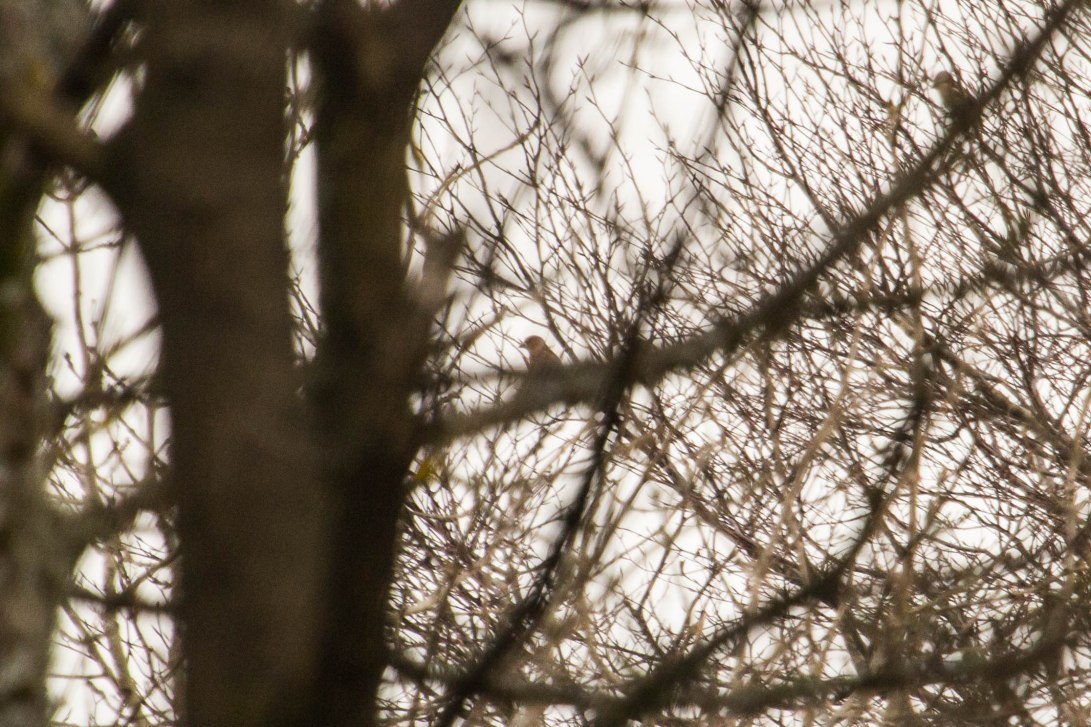
Zahrah was a way off, so I was incredibly patronising (though I believed it was necessary in this occasion) and made several hasty finger clicks to get her attention. Once she’d arrived Kacper explained the bird’s location again and we all watched. I made the mistake of retrieving my camera from its resting place by the log, and when I returned the bird had retreated to a tree further off. It was joined by three more, and although I tried they were too far off to photograph. This, to my shame, was the result.
Not exactly Bird Photographer of the Year
There was another rustling of leaves and we turned to see an elderly man making his way down the bank.
“Seen any?” He asked, knowing exactly why we were gathered there.
“A few!” I replied excitedly, and once again Kacper directed the man’s view to the right tree.
“There were 43 here yesterday, so I’m told,” the man said, “The reserve ranger and volunteers saw them, couldn’t believe their eyes.”
Forty-three hawfinches. For a moment I cursed myself for not thinking to come a day earlier, but as I watched a pair perched way up in the topmost branches I was grateful we’d seen any at all, even if the photos were incredibly dodgy.
After a while the finches flew off. I glanced up in our immediate surroundings, wondering if the elusive birds had gathered directly over our heads – it’s something I would do to birdwatchers if I were a pretty finch – but the branches were bare.
“There’s another good spot back the way you came,” the man told us, “In the clearing. I’m walking back home that way I’ll show you.”
So we headed up the track, which by now had begun to thaw, the mud regaining its sticking power. Back in the open field, we were reminded again of the chilly February breeze, and willed the sun to make a reappearance.
We thanked the man as he went on his way, then we settled down to eat our lunch overlooking the open fields. Every time one of us spotted a dark patch in the treetops, we hastily studied it through the bins. But the hawfinches had headed off, submerged once again in their woodland domain.


















 rebeccaonthewing.com