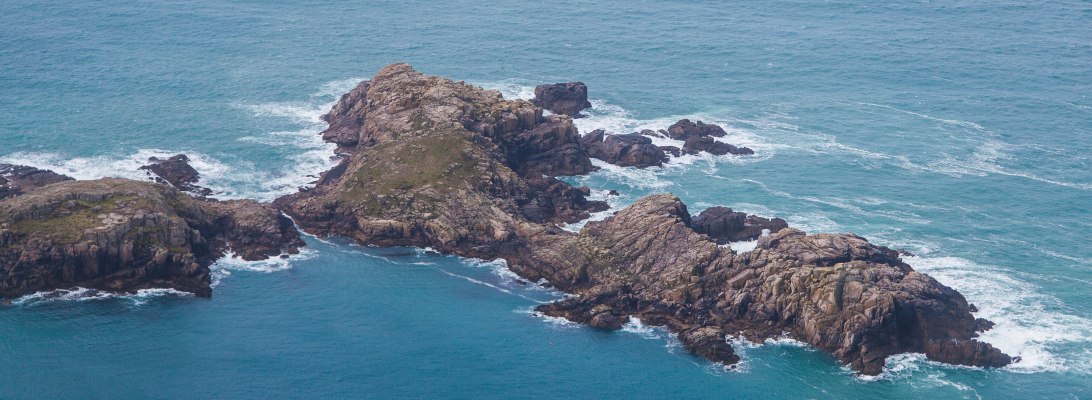
To truly comprehend how isolated and tucked away the Isles of Scilly are, you have to get there. My travelling began at 4:30am, and after using four modes of transport I arrived on St Mary’s at 1pm. It was a complicated and fiddly excursion but when I finally arrived, eating chips overlooking a vast expanse of ocean, I knew I was really at the edge of Britain.
Passionate gusts of wind blew the smells of salt and seaweed off the coast. The air was alive with birds. If I closed my eyes it was the same as home – wrens belting out their embellished trills, blackbirds speeding underfoot with shrieks of alarm – but as I was watching a dunnock I heard something that I thought at first to be a great tit, but the two syllables were the same pitch. Then, confirming my suspicions, a tiny brown, featureless bird appeared. My first chiffchaff in the flesh.
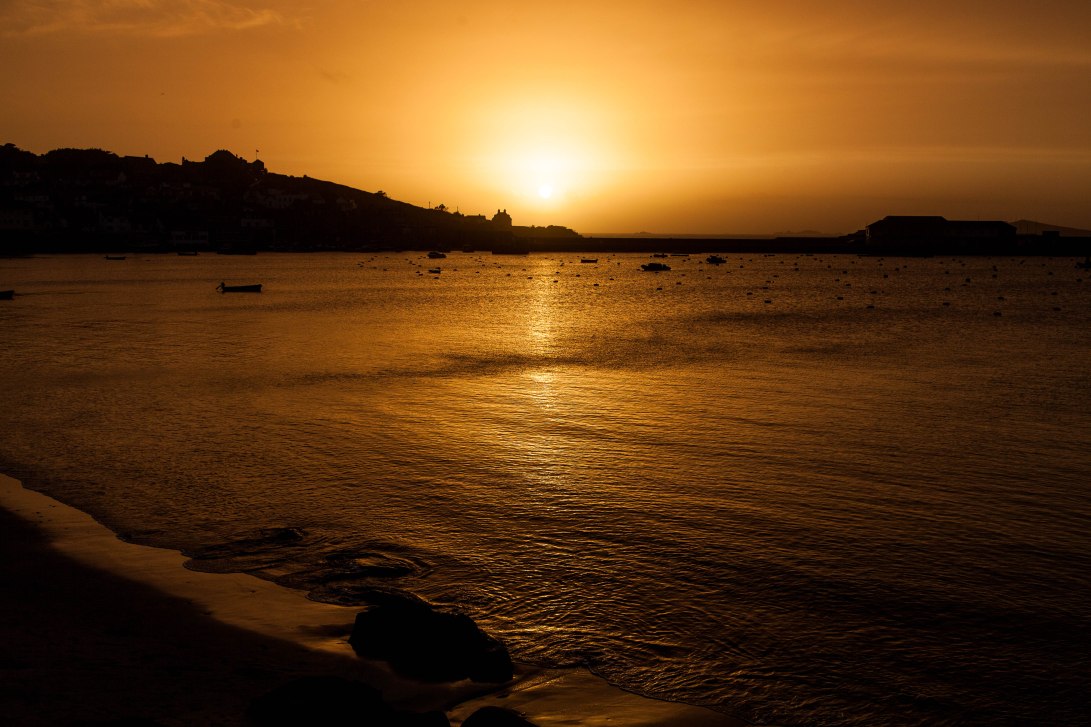
Later in the day I was struck with another bout of stress and worry. What if the flowers I wanted to photograph weren’t there? What if it rained every day this week? And as I stewed in paranoia I got a sign. I normally pulled faces at signs but this had to be something of an existential signal. As the sun went down the sky was alight with rich colour so I took my camera and headed down to the beach – only about twenty paces from the flat – and started taking photos of the foliage silhouetted against the sky. The sun sank so quickly that in minutes it had completely disappeared, but it was one of the most stunning sunsets I’d seen in months. There were other people taking photos too, and I heard one woman say “This is the best I’ve seen so far this year.” I arrived on Scilly this afternoon, and the day ended with a sky like that. I still felt apprehensive about this week, but my worry was also mixed with a little more optimism than before.
After watching Chris and Michaela hunt for great grey shrikes on Winterwatch, I realised what stunning birds they were and that I’d quite like to find one for myself. I asked Cain if he knew of any recent sightings and of course, he did. There was one of these beautiful shrikes in a patch of rural Newcastle that had remained in the area all winter. So, early on Friday morning, Zahrah and I set off to try and track the bird down.
As we made our way east towards Newcastle, the combination of pouring rain and sleet filled me with dread. As usual, the weather forecast had gone awry, and I hoped the grisly sleet would clear up by the time we arrived. Luckily it did, and once parked and heading down the track with eyes peeled, we stayed dry. We were looking for a patch of stark white at the tops of the bare trees. Every so often we would stop and peer across the field, binoculars meticulously scanning each tree. Unfortunately, great grey shrikes are not vocal birds, so there was no telltale call we could listen out for. This would be a case of sharp eyes.
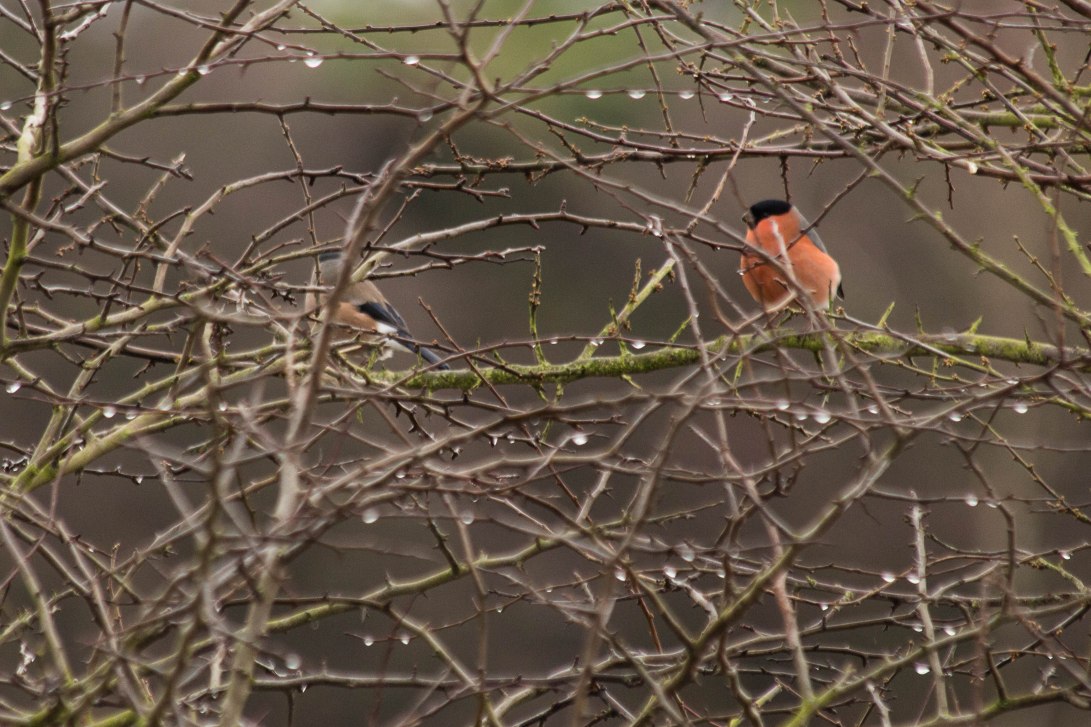
We came across a group of bullfinches – a handsome male and two females – as they foraged in the bushes. I have a soft spot for these vibrantly coloured birds, so stopped to take photos, trying to manoeuvre myself to sneak a clear glimpse of the male through a break in the tangle of twigs. This was only partially successful.
Bullfinch pair
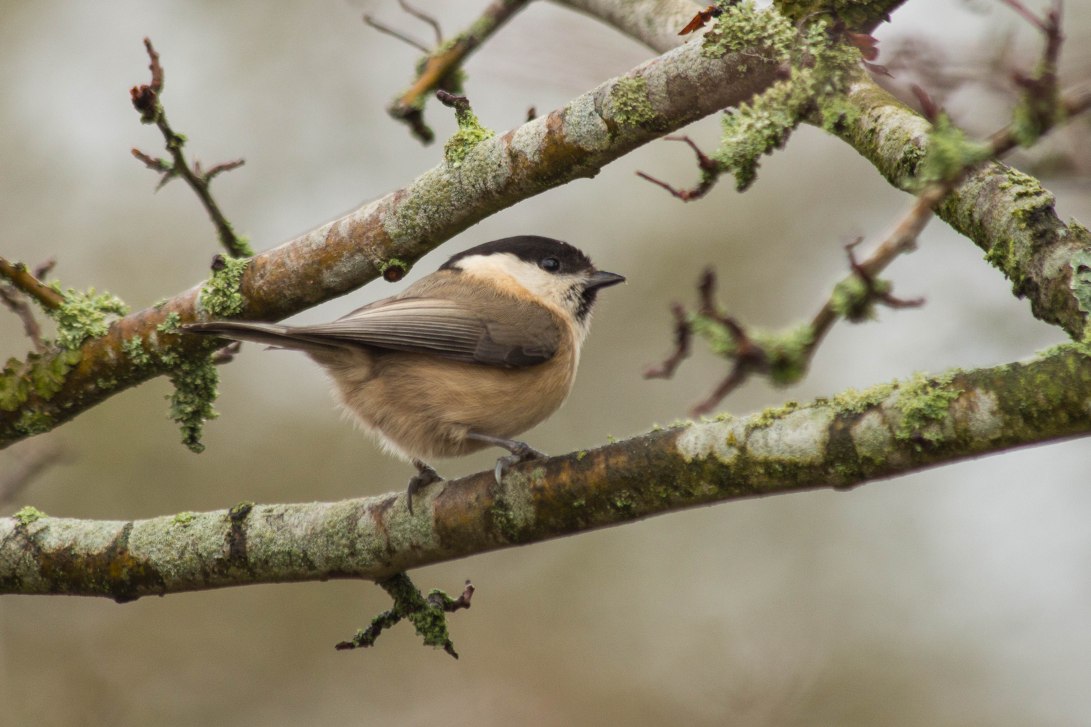
As we trudged up the track, the only sound to be heard was the mud as it sucked on our boots. I found it a challenge to survey the trees for signs of movement while keeping an eye on where my feet were landing. After no sign of the shrike, we decided to try the other stretch of track that hugged the same field. At the crossroads we encountered a vast flooded patch of grass. At first glance it seemed empty, but a look through the binoculars revealed a large gathering of lapwing and golden plover huddled together. Further up the track, a hubbub of activity surrounded the bird feeders hanging from a tree. Great tits, blue tits, robins, a ground-foraging blackbird and a special sighting: a willow tit. I’d never seen one so close – a bird that I find indistinguishable from the marsh tit. According to the BTO, the most reliable way of telling these two species apart is by listening to them, as the birds’ most common calls are quite distinctive from each other. While marsh tits make a sneeze-like “pitchu” call, willow tits have a nasal “chay chay” sound.
Willow titGreat tit
We had come to the joint decision that our shrike would sadly not be making an appearance today. The needle was well hidden in the haystack, and we made our way back to the car. A little way further out was another reserve that we decided to visit. By this time, unexpected sunlight was filtering through the dissolving clouds, and gleamed on the pond, illuminating a flock of wigeon. They chatted to each other but were otherwise motionless. High up in the trees was a buzz of excitement, and yet more beautiful bullfinches! These ones were silhouetted against the sky, so their smart plumage was diluted in the sun. Accompanying them were great tits, siskin and a few goldfinches. A magpie was perched in the topmost branches, feathers ruffling as the wind caught him.
Magpie
Before long it was golden hour, where the sun began to vanish behind the pond. The trees took on a shimmering glow, every hue heightened. A group of blue tits fluttered around, barely perching for a moment before swooping in another direction. I thought I saw the fluffy brush of a red squirrel’s tail disappearing between two boughs, but after waiting stock-still for it to emerge, I thought perhaps it was just a trick of the golden light.
On our last day, we drove out of Burghead into Hopeman, a nearby seaside village. Once again, the sun was shining and the sky was almost cloudless, coating the sand in a shimmering golden glow. Jas couldn’t contain herself, and pulled eagerly on the lead to get down to the seafront.
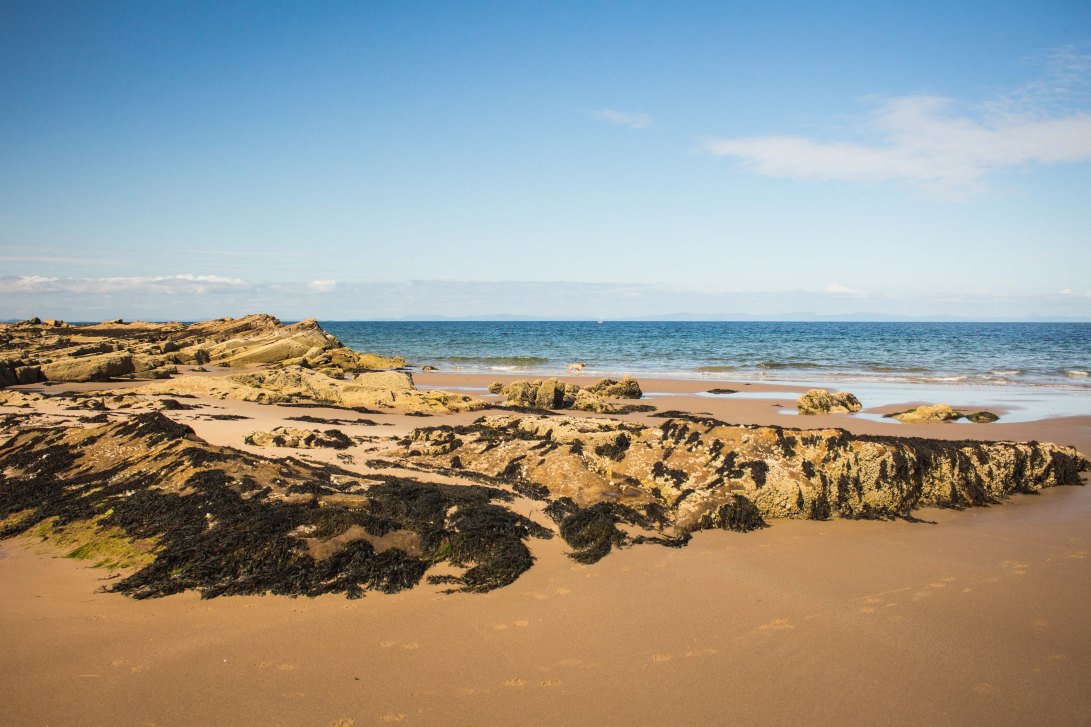
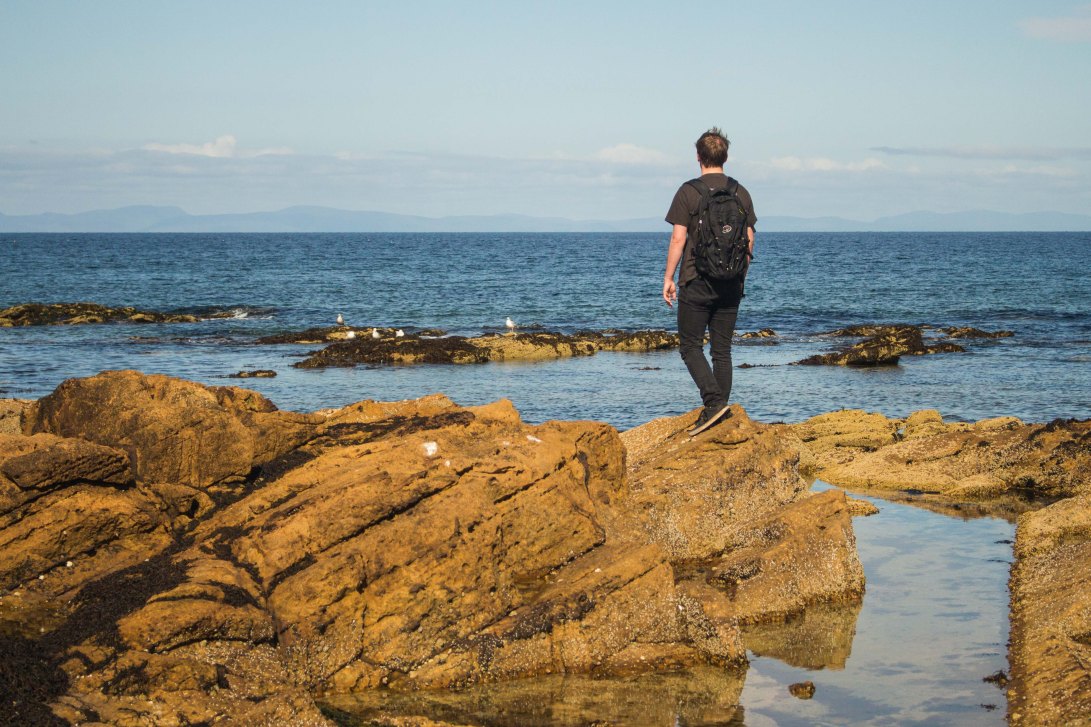
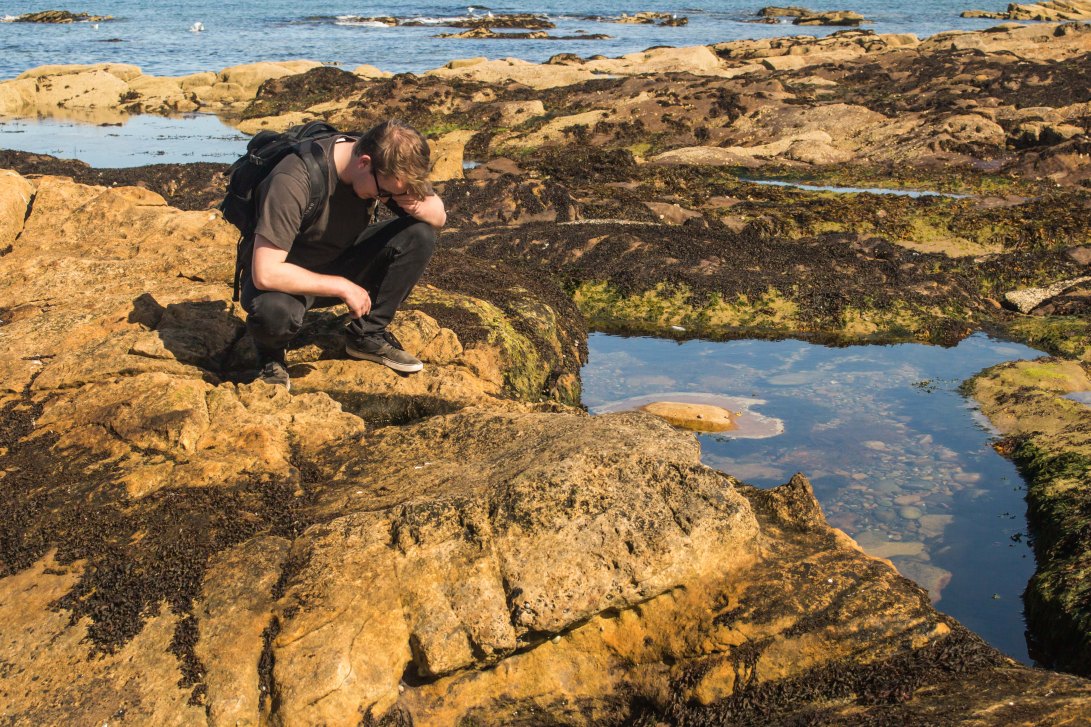
I began snapping immediately. The beach was a patchwork of fine, flat sand and weed-coated rocks where puddles of seawater were trapped from returning to the ocean until the tide swelled again. Kerr and I began to wander – rock pooling is one of those timeless summer activities that nobody is ever too old for. We stepped slowly from one rock to the next. A combination of slick seaweed and soft moss made me take extra care; although it was a beautifully warm day, I feared a dip in this water would still be a chilly one.
Another reason to watch your feet was the abundance of common limpets (Patella vulgata) clamped firmly to the rocks. We kept an eye out for any crabs lurking in the shadows, but perhaps the day was too hot for them. However, there were plenty of hollowed-out crab shells and discarded legs; remains of somebody’s breakfast no doubt.
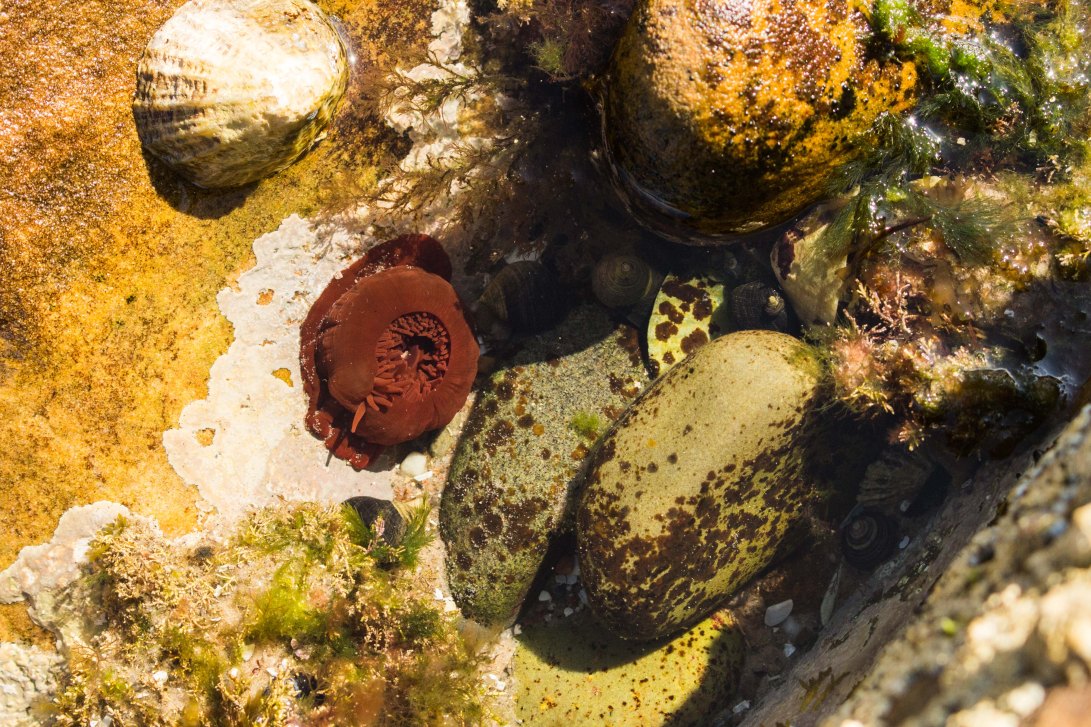
There were also several rusty red spherical bodies with tiny tentacles tucked up tight. After a little research I discovered that they were beadlet anemones (Actinia equina), an extremely territorial anemone that nudges and attacks rivals with stinging cells that act like harpoons, injecting the unfortunate neighbour with venom to clear them off their patch. Baby beadlet anemones are kept in the parents’ body cavity – which conveniently serves as both mouth and anus – and when they are ready to be born, the parents eject them through the water, where they find a rock to make their home.
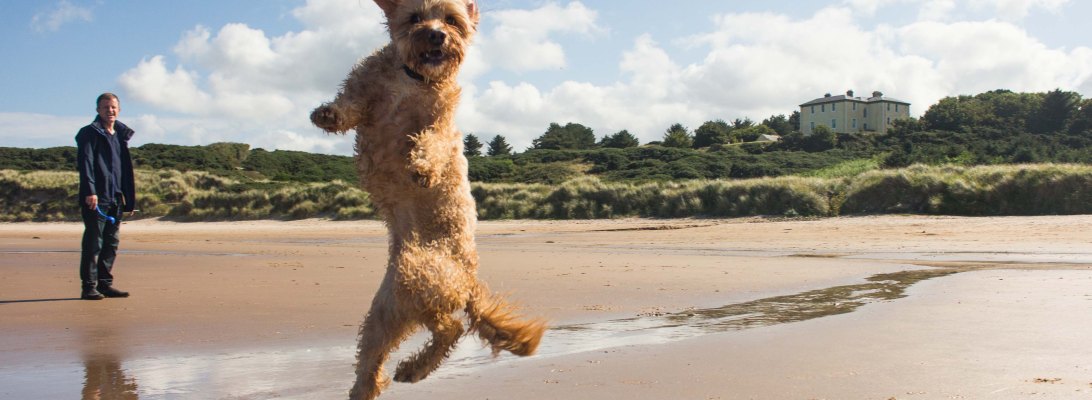
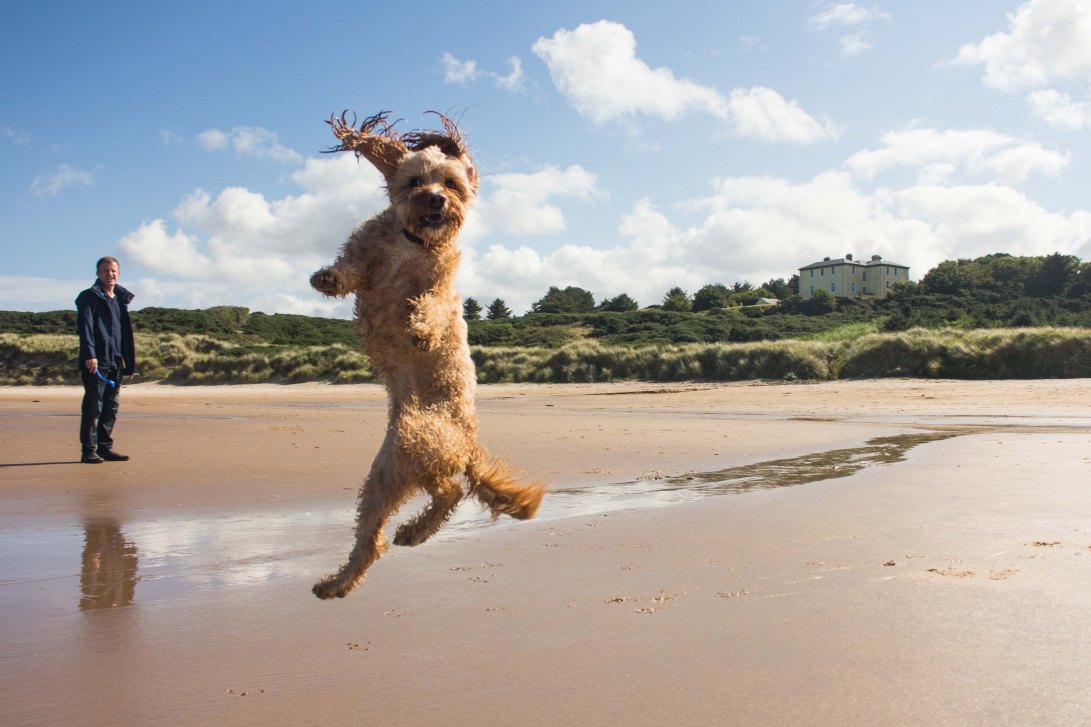
After a long time spent gazing into the pools and wondering what else could be lurking just out of sight, we joined the frantic game of fetch that was in full swing back on the beach. I couldn’t resist an opportunity to test my reflexes and see if I could photograph the fluffy torpedo in any mighty poses. I captured some absolute corkers but this was by far the best. Never has a dog loved the beach more than at this moment.
It had been way too long since Zahrah and I last went on an adventure, so on a grey, cloudy Friday morning we headed out to Kingmoor South and North nature reserves for a wander. The aim was to train our senses and become expert animal trackers. We had our hopes on finding owl pellets and maybe even the fabled “Beast of Cumbria” – I share George Monbiot’s rather pessimistic opinion on a black panther stalking sheep in the Lakes but that’s a whole other blog post.
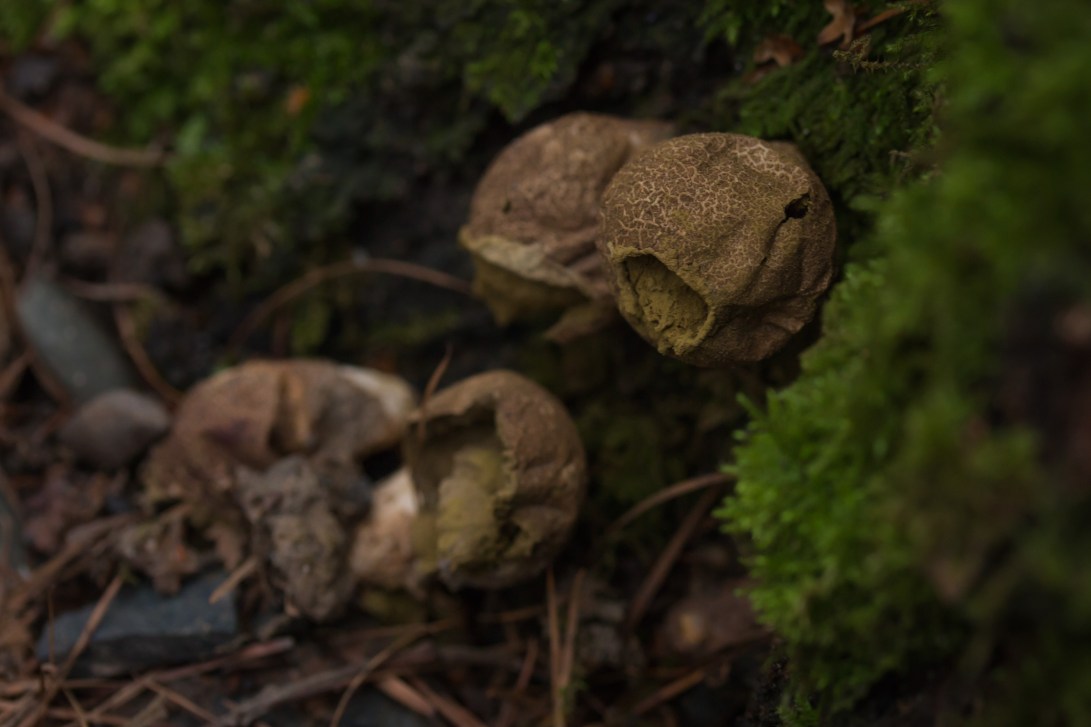
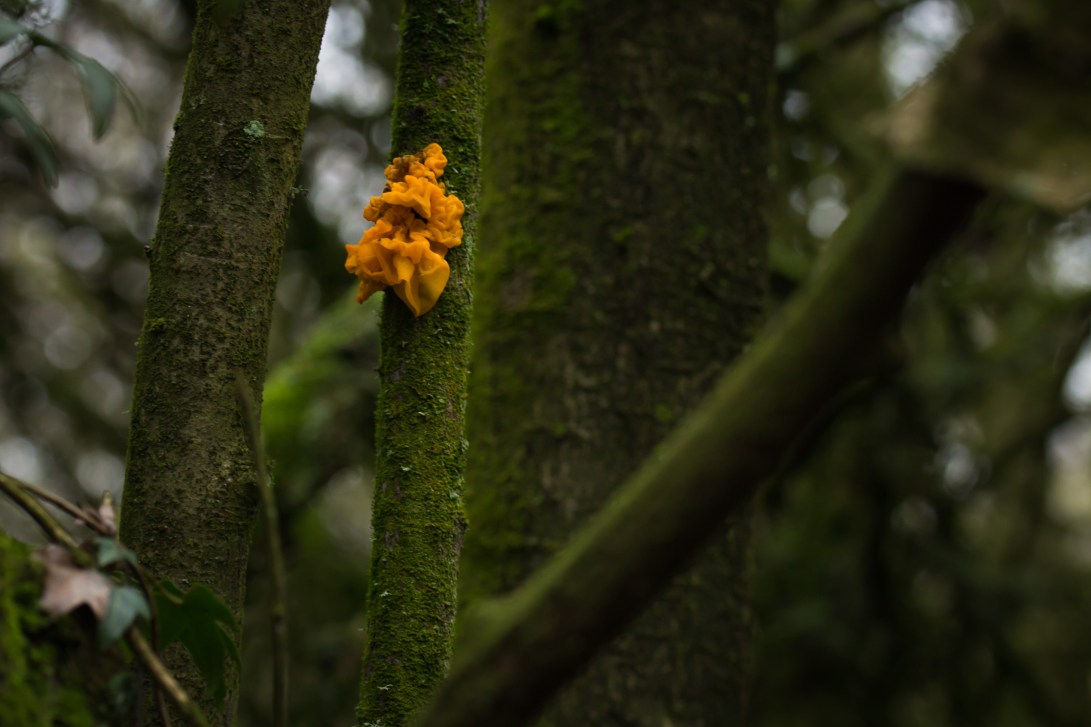
Common Puffball(Lycoperdon perlatum)Frothy Porecrust(Oxyporus latemarginatus)Yellow Brain(Tremella mesenterica)
Sadly our adventure was pellet-less, but what we did find was a lot of fungi. I’ve been really interested in macro photography recently, and have subsequently been spending a lot more time crawling on the floor finding tiny things to photograph. I never realised quite how extraordinary fungi could be – so many shapes, sizes and colours. Like every naturalist I’d love to be a wild forager and have a nibble on the safe varieties, but after trying to name the ones I’d found I discovered it was dangerous territory. Take Morel (Morchella esculenta) for example, an egg-shaped cup fungus that apparently tastes wonderful. Then take its almost-twin, False Morel (Gyromitra esculenta), which can be fatal and even after careful preparation is believed to cause cancer. Nature is a cruel mistress indeed!
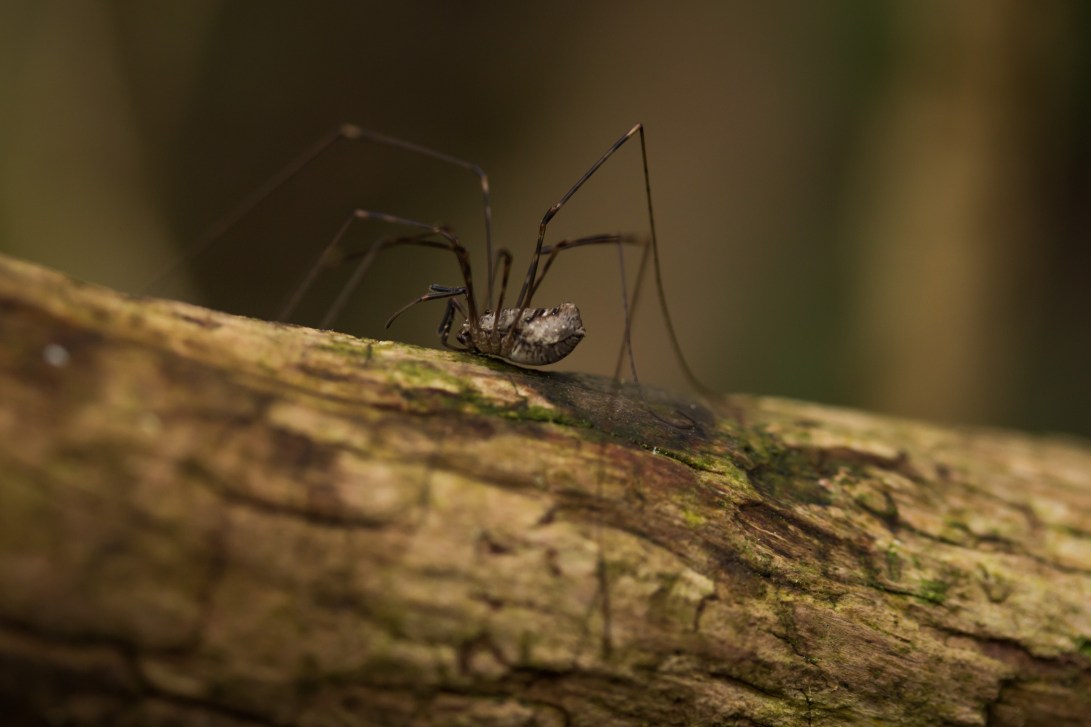
So we decided against finding a snack and stuck to taking photos of the fungi we found. Zahrah graciously held a branch up while I crawled underneath to photograph a group of Jelly Ears. I was mid shot when I heard “aw look at this little spider” over my head and regretted every decision I’d made getting to the Jelly Ears. The little critter was a harvestman (Opilione), and luckily he was only small so I was even brave enough to take a shot of him before he scuttled away.
We ate our lunch on a bench nestled amongst the vast oak trees, the forest floor covered in a crunchy bed of orange and brown. It was eerily quiet, even for a forest landscape. I can’t wait for the spring when the air will be alive with birdsong again. Winter has its own magic, but it can’t be denied that spring is when nature truly shines.
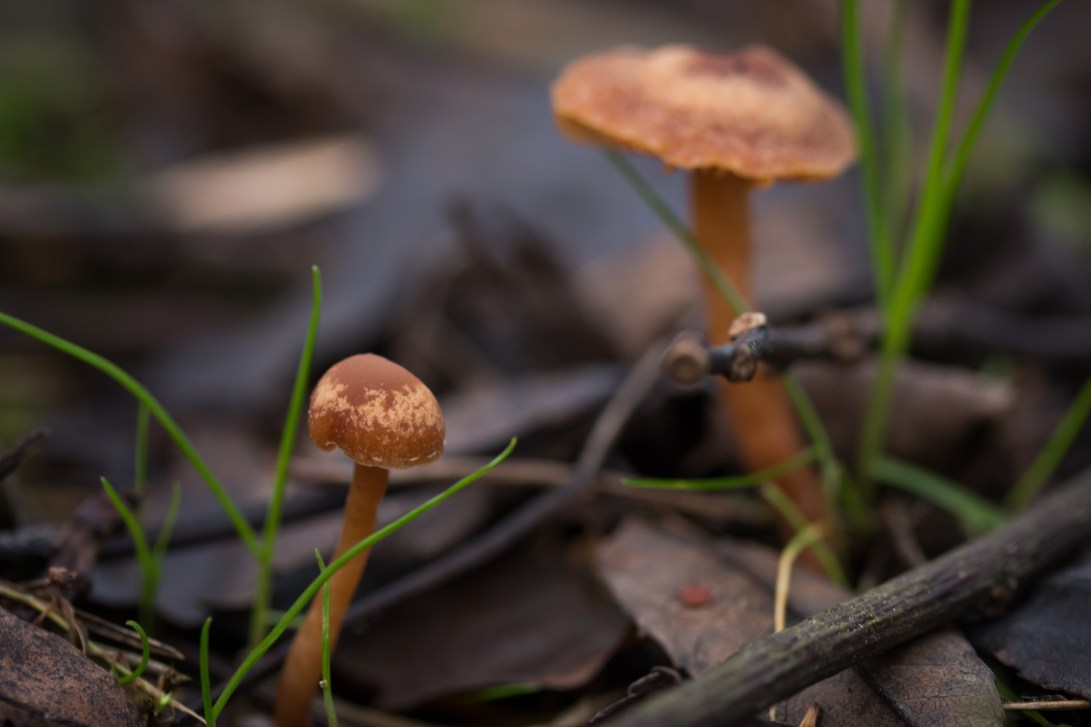
Brown Mottlegill(Panaeolina foenisecii)Candlesnuff Fungus (Xylaria hypoxylon)







 rebeccaonthewing.com