Recently I’ve become a writer who doesn’t write much. I have ideas, many a day, of what to write, but somehow I never get round to making them a reality. I’m blaming this latest case of writer’s block on my new occupation, so I’ve decided to write about that. I have been accepted as a volunteer at Paradise Wildlife Park in Broxbourne, Hertfordshire. It was the longest application process for a voluntary position I’d ever experienced, but after interview, induction and trail day I was successful.
Volunteering in a small aquarium in Cumbria could not have prepared me for work in a zoo. Although far from large with only around 400 animals (in comparison with Chester Zoo’s 20,000), Paradise Park still requires plenty of hard work and for me it’s a physically demanding and challenging role. I anticipated this beforehand and should have been ready, and yet I still came home from my first day with aches in every limb, rashes on my arms from the hay and mysterious scratches from the day’s manual labour. As is expected of all volunteers, I spent most of my time with what the animals left behind (you cannot believe how heavy camel poo is) and in the July heat I worked up a significant sweat.
And the funny thing? I loved it. Three years of university has been a mental workout but not so much a physical one. My arms are little more than jointed matchsticks, and just as strong. Volunteering at a zoo will be such a great opportunity to build up some strength. There is also something immensely satisfying about scrubbing a paddock clean, even though the moment the animals are let back in they completely rearrange the fresh bedding and christen it with droppings.
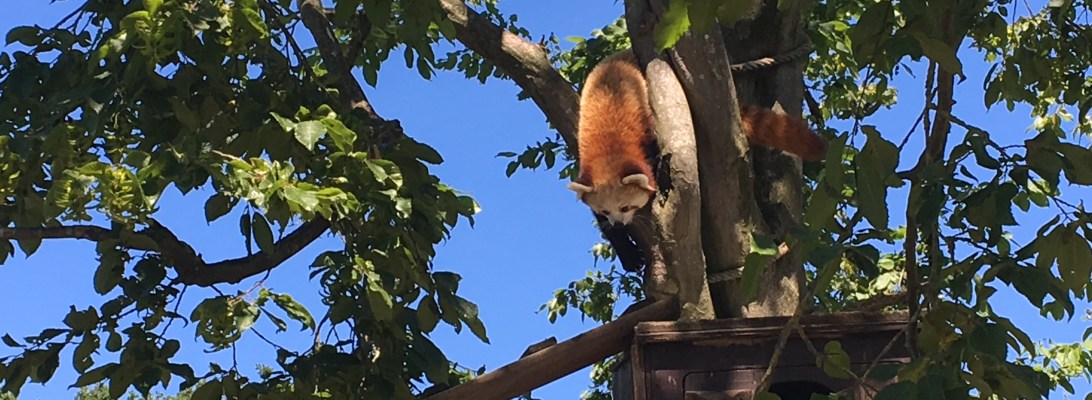
If I had a pound for every time I’ve been asked “So what’s next?” since I came back from university, I could retire without having started a career. I still don’t know what I want to do or where I want to be. While I still love writing and photography, I feel a pull in a new direction – the daily grind of contributing towards a successful and high quality zoo. There is something very appealing to me about caring for wild animals in a place that values them (that’s the important bit) and sharing my passion with other people. I watched the Small Mammals keeper giving a talk as she fed the red pandas and I had an urge to join her, but my knowledge of red pandas is really quite limited. I want to study them, I want to know everything there is to know about these animals, and share that with people. And I believe I can do that by writing but also by being there among them.
I’m fully aware that becoming a zookeeper is an incredibly gruelling and challenging process. I’m also aware that my current academic background will not help me in that mission. Every keeper I’ve spoken to so far has begun by volunteering, and worked their way up the ladder. So I have joined Paradise at the very bottom, and the only way to go is up. I’m inspired by this, and know that I have to pursue it.
The trains to Glasgow and Largs and the ferry to the Isle of Cumbrae were all fine. It was when I boarded the bus to the Millport Field Centre that it dawned on me: what on earth had I let myself in for?! I’d booked onto a weekend course run by the Field Studies Council called ‘Marine Species and Habitats: The Biotope Approach’. After volunteering at an aquarium had sparked a new fascination for marine wildlife, I wanted to learn more about what could be found on British shores. I’d done a bit of research using the course’s suggested reading list, and had half an idea what a biotope was, but as I dragged my bags off the bus I wondered if I’d booked myself onto something that would sail completely over my head. I imagined working alongside a team of marine biologists with decades of experience in the field, and here I was with a newborn interest in fish. I was suddenly terrified, and literally marooned on an island for the weekend.
Blue Mussels(Mytilus edulis)
As I was mulling this over in my head, a girl my age carrying a black hold-all asked me if I was attending the Biotopes course. I was thrilled; fate had brought us together on the same ferry and meant I didn’t have to amble around alone wondering where I needed to be. Our rooms weren’t ready yet so we went for a wander towards the town of Millport. Her name was Abbie, and she was currently part-way through a PhD in non-native seaweeds. This was something I knew literally nothing about, but we chatted about uni and wildlife and all things in between. Meanwhile, it was a chance to see where we’d be spending the weekend, and it was beautiful. Of course, almost everywhere is beautiful in bright sunlight, but even so the Isle of Cumbrae promised a fascinating chance to survey marine wildlife.
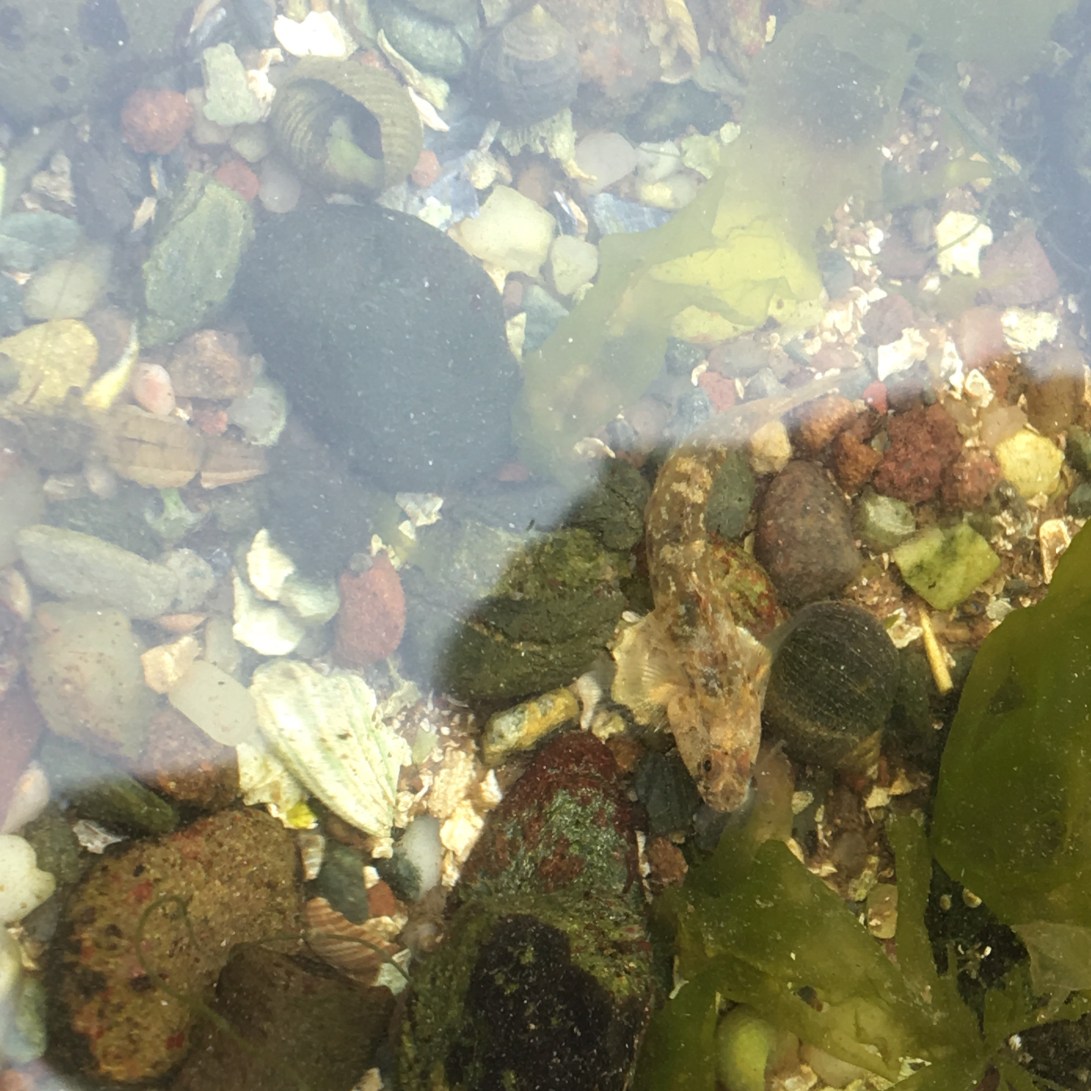
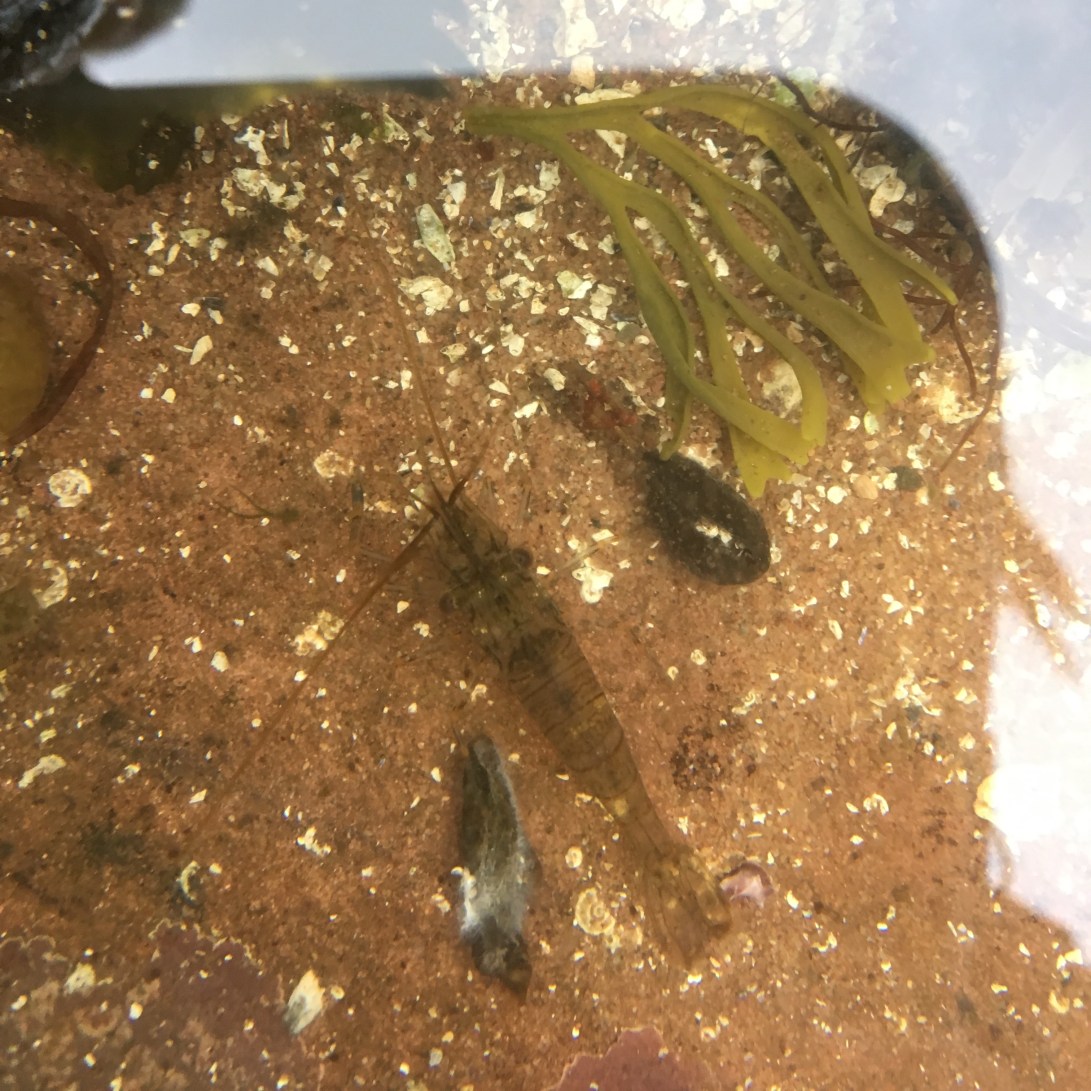
A well camouflaged Sand Goby(Pomatoschistus minutus)
After a loop around the bay we headed back to the Field Centre and took our bags to our rooms. I had feared with some trepidation what the washing facilities would be like, but was very pleasantly surprised to discover a large ensuite shower, not to mention a bed like a cloud. I hastily unpacked then met the rest of the group for our first briefing. Here I met Emily who worked at the Lancashire Wildlife Trust, and before dinner Abbie and I went for a walk with her to the shore to soak up the last sun of the day.
Dinner was macaroni cheese and apple crumble, perhaps one of the most perfect combinations of courses there can be. Then it was time for our first lecture: an introduction to biotopes. My research had prepared me well – a biotope is the combination of a physical habitat and the biological community found living there. Although some of the lecture’s content was lost on me, I left feeling inspired and ready to face new challenges over the weekend. I’d already met lovely people, and all my earlier worries began to feel very insignificant.
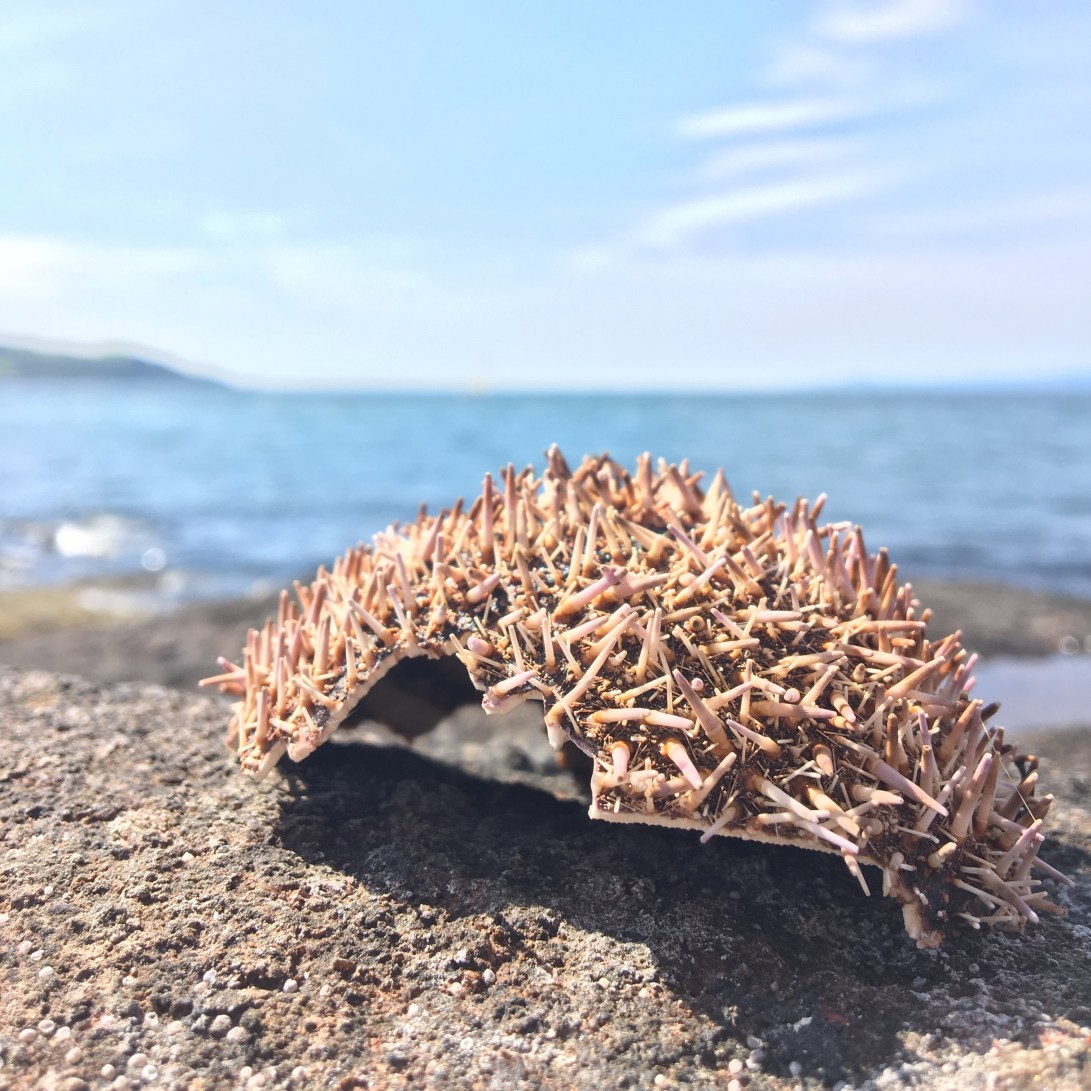
A fragment of broken sea urchin shell
Saturday
Today began early, and by 9am we were down on the beach beginning our first biotope survey. It was a beautiful day for it, and we wasted no time getting stuck in, in my case literally getting my wellies wedged in rock crevices and clinging desperately to my balance. Common species included beadlet anemones, dog whelks and acorn barnacles, but we also found common starfish, hermit crabs, a star ascidian (type of sea squirt) and plenty of seaweed. My knowledge of seaweed species was even smaller than my knowledge of seashore vertebrates, but as Abbie was doing her PhD on them I had a source of very valuable information.
Star Ascidian(Botryllus schlosseri)Common Brittlestar upside down (Ophiothrix fragilis)
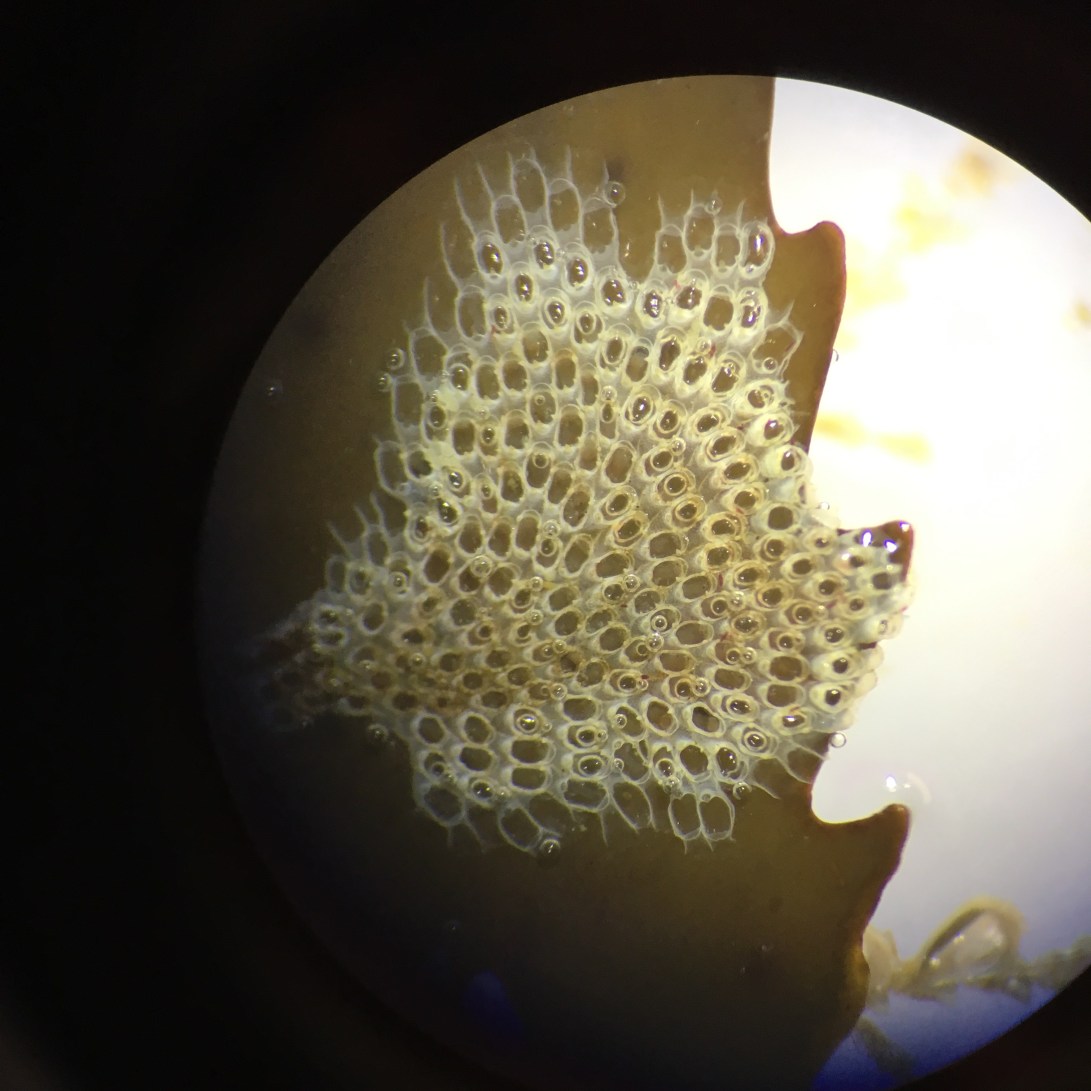
Once we’d covered as much of the bay as we could we ate lunch out in the sun (an excuse for some of the group to catch up with the goings on at the royal wedding) and then headed back to analyse our results and try to determine which biotopes we’d found. This was also an opportunity to play with lab equipment, which I haven’t been able to do since A Level Biology. I had good look at the bryozoa I’d found on a strand of seaweed (below). Bryozoa means “moss animal” and viewed up close reveals an intricate lattice of animals situated closely together. I studied these individuals for a while but couldn’t decide between Sea Mat or Hairy Sea Mat.
A cluster of bryozoa: either Sea Mat(Membranipora membranacea) or Hairy Sea Mat(Electra pilosa)
After beating the queue and getting served dinner almost first, I went back to my room for much-needed downtime before bed.
Sunday 20th
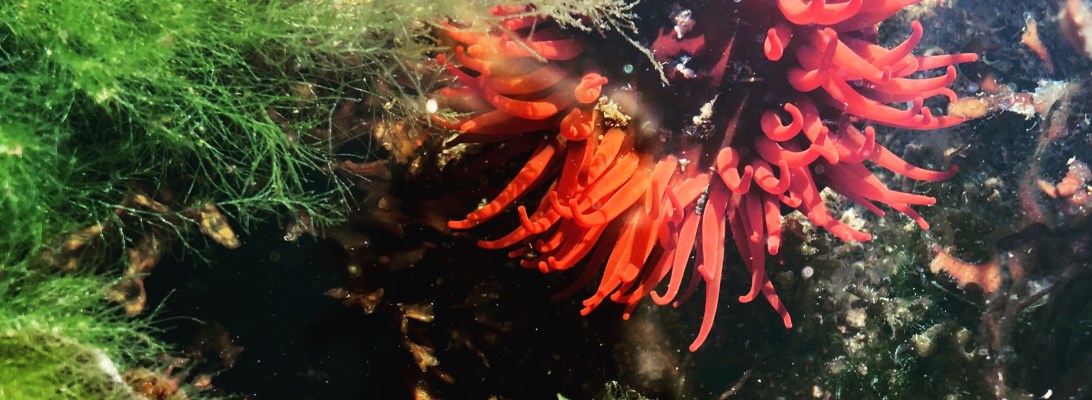
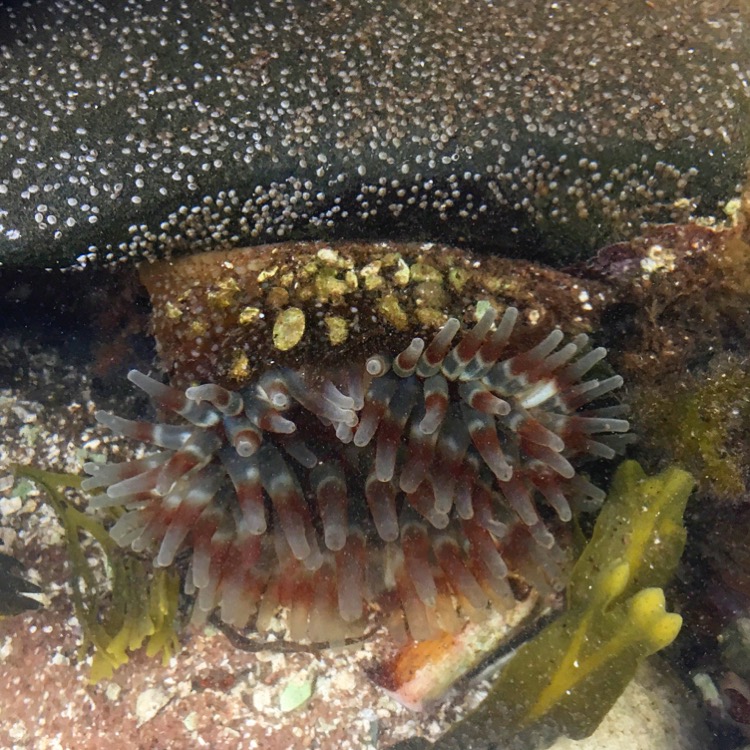
Today was another early start, and this time we drove the short distance to the northern end of Great Cumbrae to a much larger site. The weather was a little dreary but armed with quadrats, transects and clipboards we began to survey the biotopes. Findings started off slowly but once we reached the rock pools things really got exciting. Our course leader Paula found a slug species called a sea lemon – a very pretty blob – and a butterfish. Abbie, Alex and I found a sand goby, sand mason worm, lots of brittlestars, more hermits and beadlets, and my favourite from today: a dahlia anemone. It was the largest anemone I’d seen before, and had beautiful striated and brightly coloured tentacles that slowly emerged again once we’d calmed down to watch it properly. Just as I was squatting to try and get a decent picture, two common prawns appeared underneath a nearby rock. I didn’t know if maybe these were boring sightings but I recognised them from my volunteering at the aquarium so was thrilled to be able to confidently identify something in the field.
Back at the lab, Abbie got to work identifying her seaweeds and Alex had an ID test to do for his assignment, so I had a bash at identifying today’s biotopes by myself. Once I’d done that, I realised I’d accidentally brought a tiny brittlestar home with my sea urchin shells. With Paula’s help, I identified it as Amphipholis squamata. Later, Paula asked us what we’d found, and Alex and I had got the exact same biotopes! I was so pleased with myself.
Dinner was Sunday roast and sticky toffee pudding. I must have put on about eight stone this weekend – I’ve been fed like a queen and although my brain has been working overtime, my body hasn’t done so much. After dinner we had our last round-up lecture and went to the bar for drinks. I ended up talking to the two guys from Belfast about Father Ted – it was pretty funny talking to Irishmen about it. I would have stayed longer but I was absolutely shattered. So I headed to bed, falling asleep almost instantly.
According to Red Squirrels Northern England (RSNE), there are approximately 138,000 red squirrels in the UK. For some people this may sound like a lot, but the grey squirrel population currently stands at 2.5 million. Due to the difficulty of monitoring these animals accurately, this number could be even greater.
Undoubtedly a much-loved aspect of British wildlife, red squirrels have faced many challenges in recent years, predominantly the impact of invasive grey squirrels and the subsequent squirrel pox that has decimated populations. While grey squirrels are immune to the disease, reds have a mortality rate of 100%. The virus causes skin ulcers, swelling and scabbing, and after contracting it, most animals die within two weeks.
However, our native reds still have strongholds in northern England, including Northumberland, North Yorkshire and several sites in Cumbria. For a chance of seeing this elusive mammal, it is important to know where exactly to look. Two particularly good spots for Cumbrian red squirrels are Aira Force on the Glencoyne Farm trail and Grasmere. There was an outbreak of squirrel pox at Grasmere in 2016, with more than ten confirmed cases in the valley. However, as a result of the hard work of the Grasmere Red Squirrel Group, the population of reds pulled through.
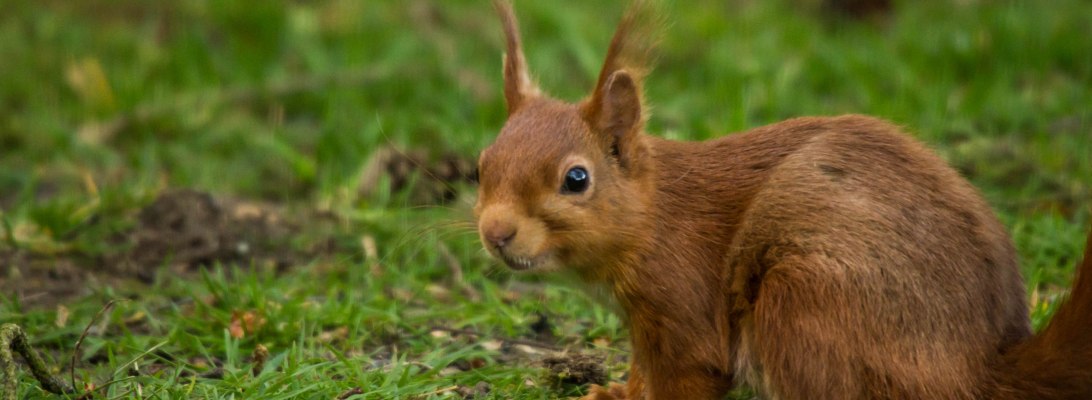
Feeding red squirrel (photographed in Lockerbie)
With the squirrel pox virus having such drastic consequences, it can be difficult to know what the best solution is. In 2012, RSNE established a monitoring programme that samples 300 forests and gardens in northern England each spring, using trail cameras to record where red squirrels can be found. The Wildlife Trusts are working to improve the red squirrel’s favoured habitat of coniferous woodland, initiating reintroduction schemes and combating the presence of grey squirrels in a few carefully selected areas where red squirrels face the greatest risk.
If you are interested in the red squirrels of northern England and want to learn more about their status in Cumbria, Red Squirrels Northern England Project Officer Simon O’Hare is doing a talk on Monday 5th February and will be sharing updates on how red squirrels are faring and explaining why it is so important to protect them. The event is taking place at Kirkby Stephen Friends Meeting House. For more information take a look at the Cumbria Wildlife Trust.
Like this?
Have a read of my post about filming red squirrels in Lockerbie here.
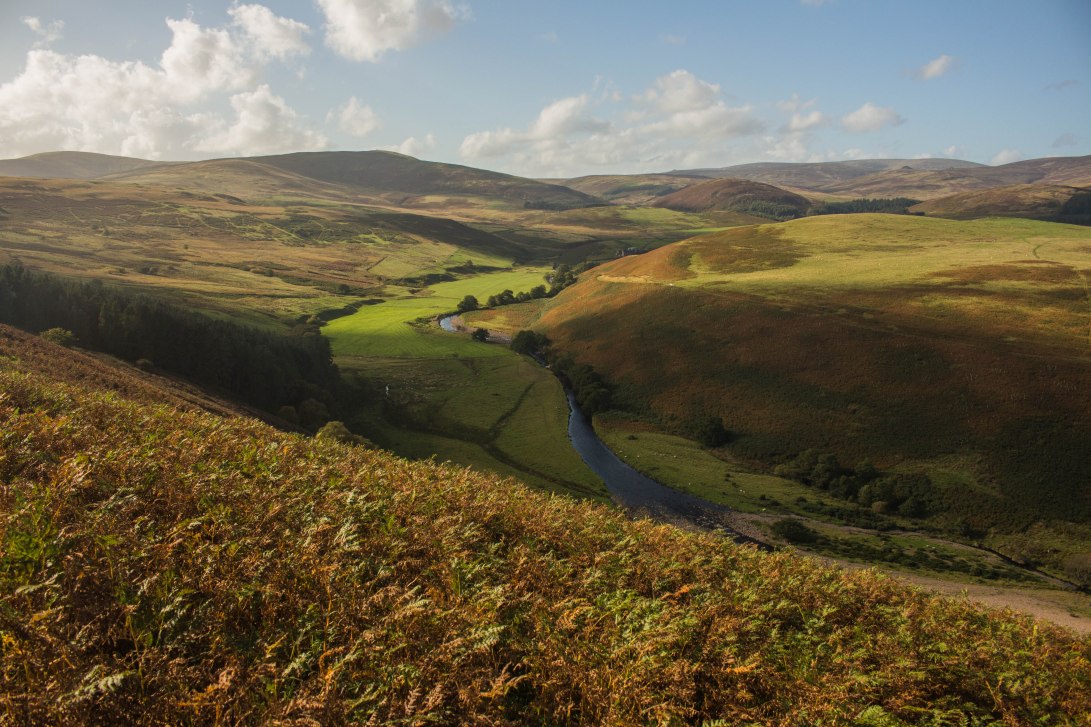
The rain was lashing on the windscreen as we made our bumpy way up the hill to Chesters. Sheep shook their sodden wool and watched the car with quizzical expressions as it grumbled over rocky grass. Before long the bothy came into view, nestled amongst the rolling bracken hills. I was just scanning the ground for darting pheasants when a pair of beady brown eyes made me call out for Cain to stop the car. Slowly reversing, we just caught a glimpse of the hare’s face before it turned tail and scarpered back through the bracken. I saw this as a very good wildlife omen for the rest of the weekend.
After settling in and enjoying some lunch, we headed through the Breamish Valley to meet the expeditioneers. I had a scan with the binoculars and spotted a kestrel hovering, drifting and hovering again. Heather told me she’d seen a pair of ravens swooping around yesterday, so it would be fantastic to hear some ‘kronking’ this weekend.
The weather couldn’t seem to make up its mind. Rain drummed on our heads one minute, then the sun was shining and turning the hills gold. Skylarks zoomed above, filling the air with their high-pitched chirruping, while pheasants screamed down in the valley, darting in and out of view like a Scooby Doo villain chase.
Once the expeditioneers had unpacked, we headed out for a wander. A breeze whistled in the grass but the sun still fought with the clouds for a good view. We ducked into the nearest conifer plantation to see if there were any good spots to set a camera trap. After following a trodden track that trailed through the trees – a sure sign that there were creatures using this route, perhaps a group of roe deer or even a badger – we positioned the trap with a good vantage point down the trail.
Further on through the plantation was a Scots pine peppered with deep, spherical holes. The tree was dead, and had become the perfect sculpting project for great-spotted woodpeckers, who had transformed it into a wooden honeycomb. It was extraordinary to see tough, dead bark being carved and moulded so easily by blackbird-sized creatures. Although we did hear their sharp ‘kik’ call somewhere in the plantation, we didn’t meet any possible culprits, so couldn’t be sure if it was the work of a single bird or perhaps multiple competing for such a valuable pecking post.
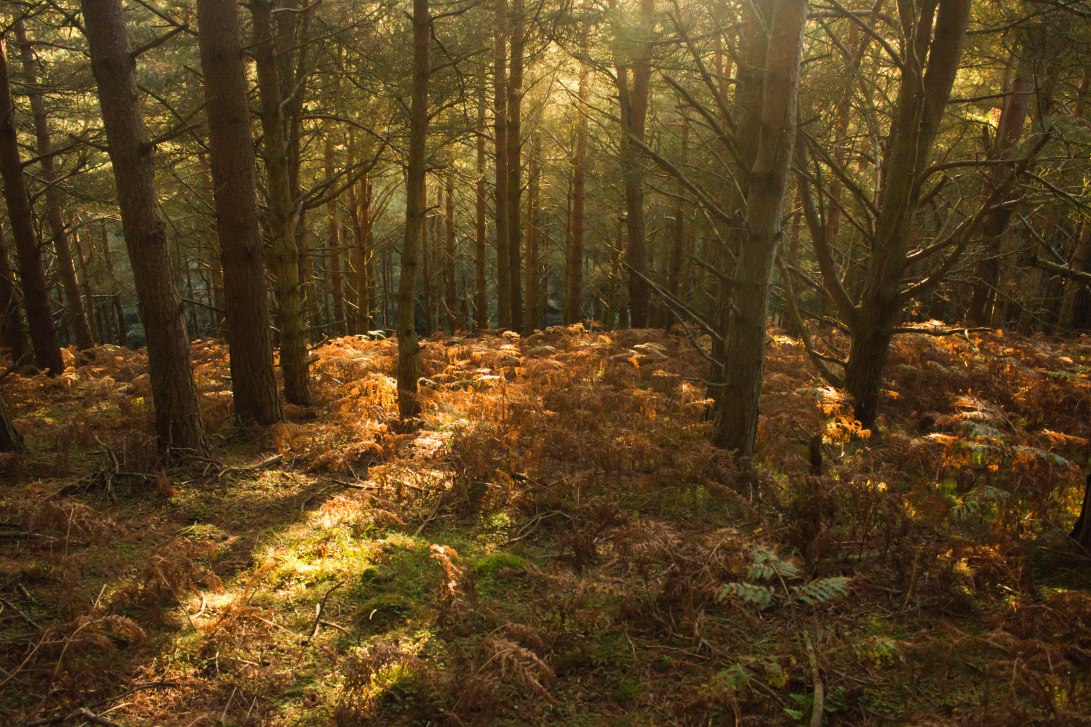
The sun was slowly setting. As the light faded, a hazy glow settled over the Cheviot Hills, illuminating the uppermost branches. Every colour was intensified; russet orange, army green, lime green, all blending together and criss-crossed with conifer needles. Spots of bright light broke through gaps in the canopy, playing tricks on my eyes when I thought a hyper-lit brown leaf was a luminous orange mushroom.
After a while we broke out of the plantation and wandered along the Chesters Burn as it bubbled downstream. The water was a vivid blue, frothing white as it crashed over rocks. A piercing ‘zrik!’ cut through the rush of the river and we all turned to spot the white-breasted bullet speeding down the watercourse. Sure enough, a dipper zoomed into view, wings a frantic blur. Perhaps less regally dressed than its neighbour the kingfisher, but still a charismatic and highly specialised little fisherman.
By now the sun had sunk out of view and the landscape dulled in colour, the familiar dusky haze settling over our surroundings. Heather told us about an expression that perfectly described this time of day: entre chien et loup, meaning “between dog and wolf”. In dim twilight, our eyes have to work harder to distinguish shapes, perhaps mistaking a harmless dog for a slightly more intimidating canine! Up in the Cheviots though, there were no monsters hiding, so it was enlightening to see what was venturing out at this time of day.
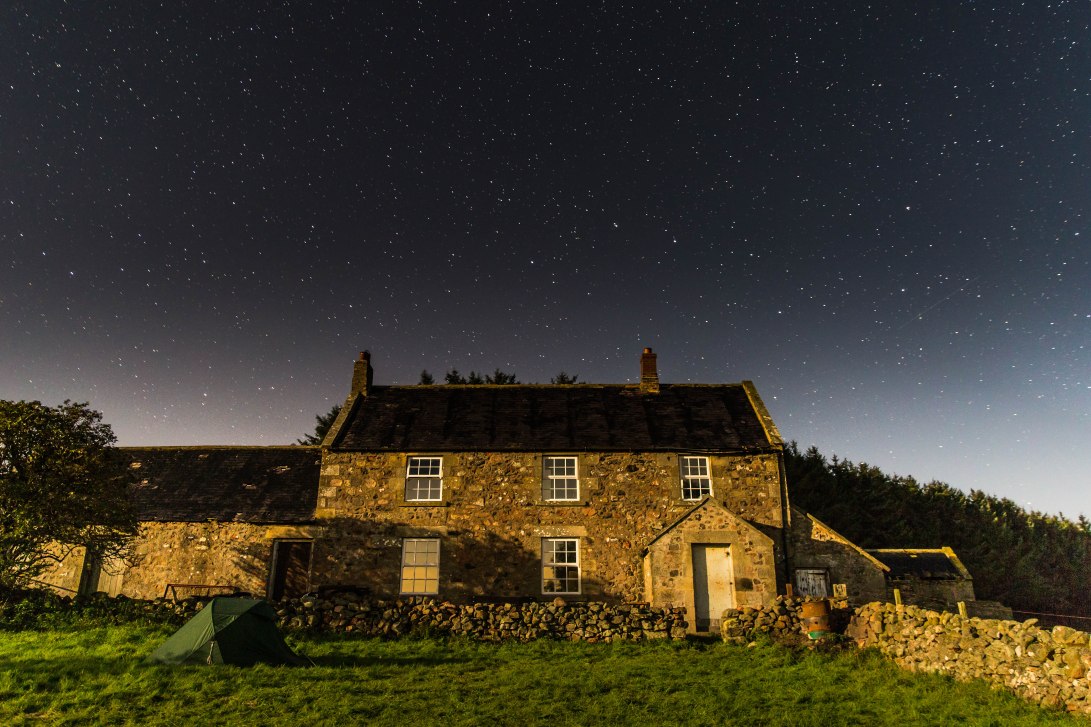
Once we’d made the ascent back up the hill to the bothy, the moon and stars had dominance of the sky. There were a few wispy clouds, but mostly the horizon was clear, so we all retrieved hats and gloves and set up tripods in the garden for some star photography. I hadn’t had a lot of practice shooting at night, so was pleased to capture some shots of the bothy backed by the entire night sky. Getting such good views of stars was a breathtaking end to our first day in the wilderness.
Two weeks ago, Birdfair was held at Rutland Water Nature Reserve from Friday to Sunday. As we were on holiday in Scotland, we could only make the third and final day, but I am so glad we managed to experience this fantastic event.
Upon arrival we were greeted by an explosion of colour and noise. I bought a map and discovered I was in one of eight marquees lined on both sides with stalls and things to buy. A lot of them were selling wildlife holidays, so I couldn’t help but enter a few competitions, as well as buy some wildlife art.
One talk we attended was ‘Building a Naturalist’ by Nick Baker, a naturalist I’ve admired for many years. His topic of discussion was getting more children interested in the natural world. In a way, he was preaching to the converted by delivering his speech to an audience of wildlife enthusiasts, but it appears as if the responsibility of making nature a focus for children lies with us, the people who understand its importance.
What I love about Baker is his heart-warming enthusiasm for wildlife. He described his first white plume moth (Pterophorus pentadactyla) sighting as “like looking at fairies at the bottom of the garden”. He learnt a great deal about newts by collecting them and watching them in tanks – he made a point of saying that this was long before the Wildlife and Countryside Act 1981 when the handling of British newts became illegal – and read up on them to broaden his knowledge.
“Experience is everything,” he explained, and I agree entirely. The only way to understand the natural world is to be out in it. As much as it pains me to say, reading books will only get a naturalist so far; by spending hours searching the coast or wandering through the forest, they can become a part of the world they’re passionate about.
Baker shared some alarming statistics. In a study of 8-15 year-olds, 53% had never seen a flock of starlings (Sturnus vulgaris) in the UK. Baker described this as “extinction of experience”. Our mentors are becoming an endangered species; with less interest in nature, where are the passionate naturalists who will teach and inspire the next generation? Baker’s mentor was his dad, without whom he may not have had the experiences that brought about his interest in wildlife. For me, my mentor was my mum, and for her it was my grandad. There must be a link between each generation to keep the passion alive.
There will come a time when I get to show my children how incredible the natural world is. I will buy them all the books I can afford and take them on walks through woodland and meadows. We will sit silently in hides and lay on our fronts watching aquatic life in ponds. All this brings such joy to my life, and to the lives of many others. Unfortunately, we are the rare few. It means a great deal to me to watch and study wildlife, but I am no longer the youngest generation. Children are walking sponges and will soak up everything around them; it’s up to us nature folk to ignite their imaginations with trees and birds, as well as TVs and computers.
“It’s innate in all of us. We are born curious… all it takes is a spark of curiosity.” Nick Baker
When the May Princess left Anstruther harbour the sun was at its highest, so as we headed out into open water we were slowly baking but not daring to complain in case the rain came back. As I watched my fellow passengers slap on the sun cream, I was geographically disorientated, not quite believing I was in Scotland and not Spain.
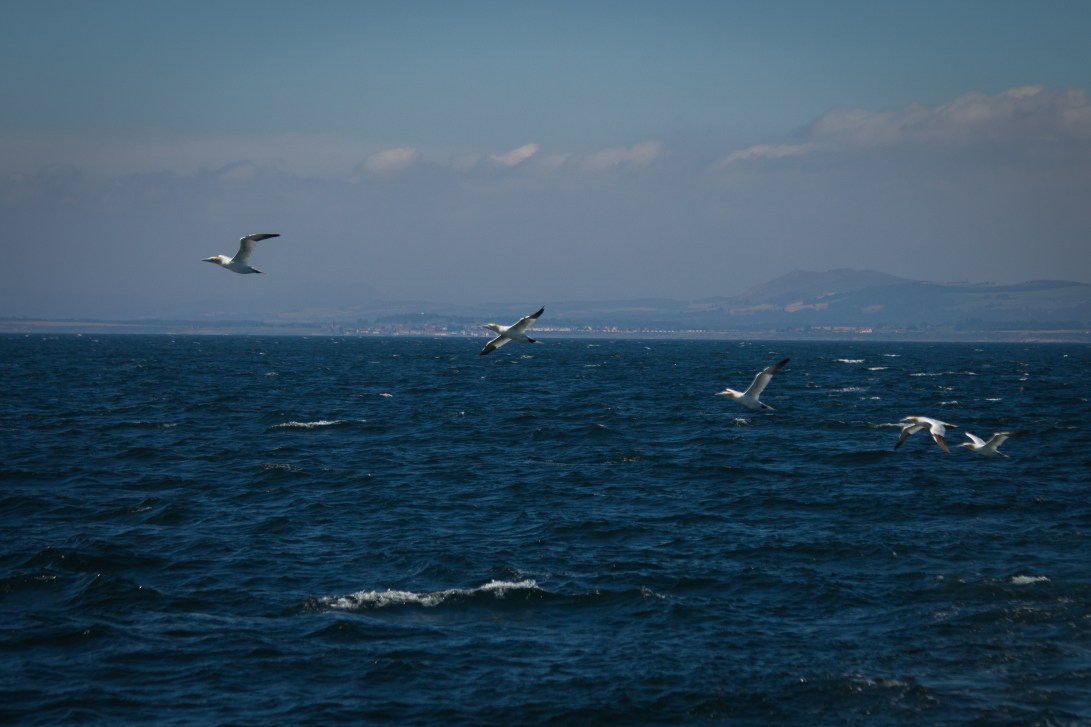
The water was choppy but that added to the fun. I was once again having to negotiate a tumbling boat and a telephoto lens to desperately try and capture the moving seabirds in focus. Many of my attempts were 96% sapphire sky and 4% wing tip in the corners of the frame. With gritty determination, I managed to photograph a few gannets (Morus bassanus) alone and in their strings of multiple individuals. Gannets happen to be my favourite seabirds. Capable of diving at speeds of 60mph, they hit the water with incredible force in their attempts to catch fish. When I saw my first gannet on the voyage to the Isle of Arran I fell in love with their striking face stripes and lightly tinted brown heads. To me they’re the coolest bird in British seas.
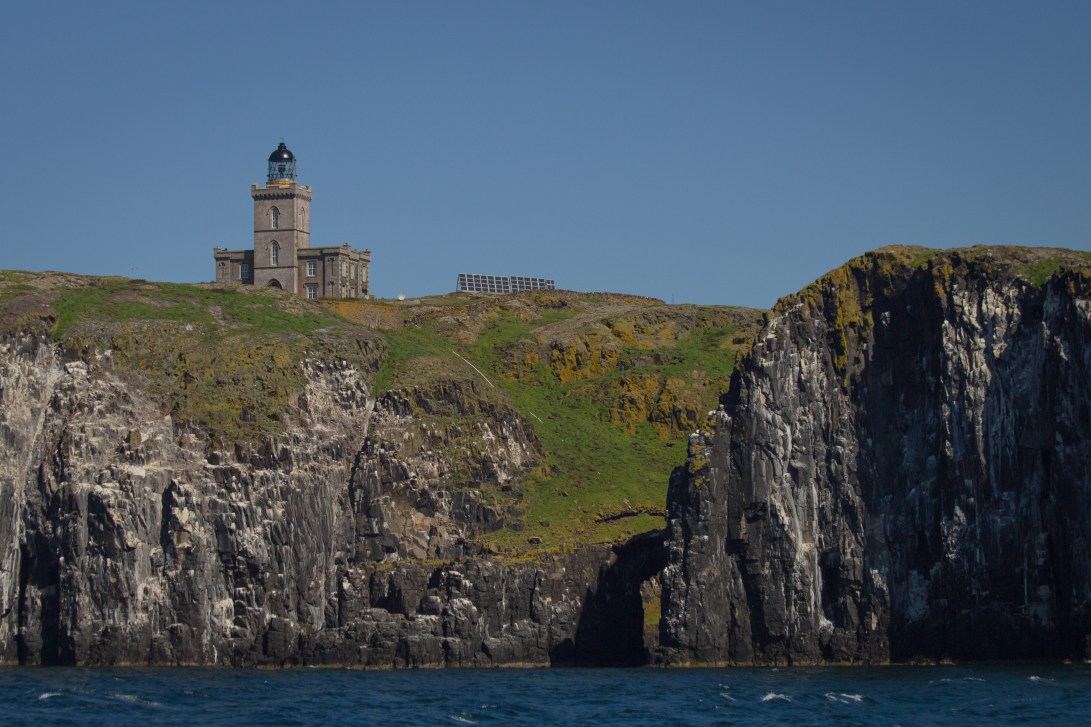
Before long the Isle of May appeared on the horizon, illuminated beautifully under the intense sun. The cliffs and crag faces oozed drama with their harsh black and white, thrown into sharp relief by the light. The few buildings were dotted around and looked very out of place amongst the grass and rocky shores, just how I liked it.
Once we’d all disembarked and received a welcoming talk by a volunteer from Scottish Natural Heritage, we were allowed to explore. Visitors branched off in different directions; we decided to head up Fluke Street, past the Bath House and Main Light to the very tip of the crag. Beyond was Rona and North Ness, areas closed to the public for research. While we admired the view, we spotted a lone grey seal (Halichoerus grypus) wallowing in the shallows, snout resting on the rocks as it dozed.
The seal was accompanied by the odd gull swooping through, but otherwise the island was mainly deserted. We hadn’t timed our trip quite right as most of the seabirds had left, including the elusive puffin (Fratercula arctica) that is high on my tick list. However, aside from the beautiful gannets we still managed to see a few kittiwakes (Rissa tridactyla), cormorants (Phalacrocorax carbo) and a lone juvenile guillemot (Uria aalge), a new bird for me.
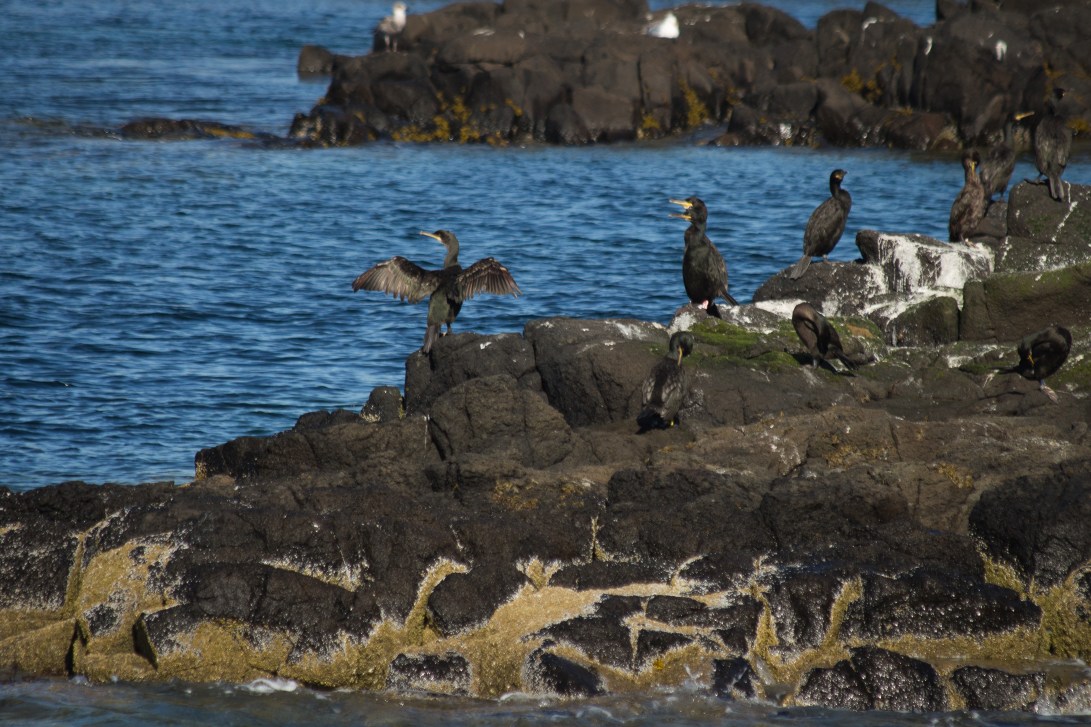
All too soon our time on the island was at an end, and we made our way back to the boat. Just as we were leaving, a grey seal – perhaps the one we’d seen earlier – bobbed out of the water as if waving us off. We thought he’d been our only seal sighting that day, but around the corner we were treated by a large colony, splashing each other and gazing at us with huge black eyes. Cormorants basked in the sun, wings spread as if inviting a hug, and once again the gannets swept over our heads. As the Isle of May grew smaller, my nose grew redder, and when I got home I realised I’d acquired a vicious sunburn. It was worth every moment!
Last Wednesday, I caught the train to Hammersmith to meet up with Zahrah and embark on another of our wildlife excursions. Today we visited the London Wetland Centre, something I’d heard lots of good things about but never been.
Canada geese(Branta canadensis)
Upon arrival we were greeted by a lovely volunteer who explained the site map to us. Taking her advice, we began on the south route which would take us to various hides that we could spend time in. Halfway down the foliage-lined path Zahrah spotted a warbler, but neither of us could be certain which species the bird was. As we stood stock still squinting into the dense undergrowth another volunteer passed. We told him what we were studying at university and explained how much we loved birds. It must have been refreshing for a wildlife veteran to stumble across two young people with the same interest. He began telling us all about the wildlife at the site, and the best places to view it. He showed us the WWF hide, where sand martins (Riparia riparia) performed an avian display for us, swooping down to the water’s edge and snatching midges from the surface. At this time of year, with no courtship taking place, the water was relatively calm with little activity. A lone mute swan (Cygnus olor) foraged in the shallows while a female mallard (Anas platyrhynchos) shepherded her young back to the nest. A lone moorhen (Gallinula chloropus) waded through the lily pads, pausing beside the pearly white buds.
Moorhen(Gallinula chloropus)Coot(Fulica atra)
As the scene here was subdued, Bryn showed us the Peacock Tower, where we met up with another volunteer with a profound knowledge and passion for birds. Apparently a pair of peregrine falcons (Falco peregrinus) were nesting in a building nearby, and had been seen flying over the site. While we sat overlooking the lake with our lunch, the volunteer let us borrow his telescope to watch a family of tufted ducks (Aythya fuligula) and a lone gadwall (Anas strepera). Unsurprisingly, Zahrah had the lens trained on a pair of herons (Ardea cinerea), shoulders hunched like sulking old men. Grey herons hold a particularly special place in Zahrah’s heart; it never ceases to amaze me how touched she is by these gangly lake dwellers.
The fountain of knowledge that was our telescope-bearer told us one of his favourite birds was the long-tailed tit (Aegithalos caudatus). What I didn’t know was that in each group of these beautiful little birds, only the dominant female breeds. All other females act as child minders, sacrificing their own reproductive ability to care for another’s young.
Before long it was nearly two o’clock and the otters were about to be fed on the south route. We left the Peacock Tower with plenty of time, but ended up speed walking after a sharp-eyed photographer pointed out a common lizard (Zootoca vivipara) basking in the hot city sunshine. This naturally required us to stop and snap away for a few minutes, as our model was posing so beautifully.
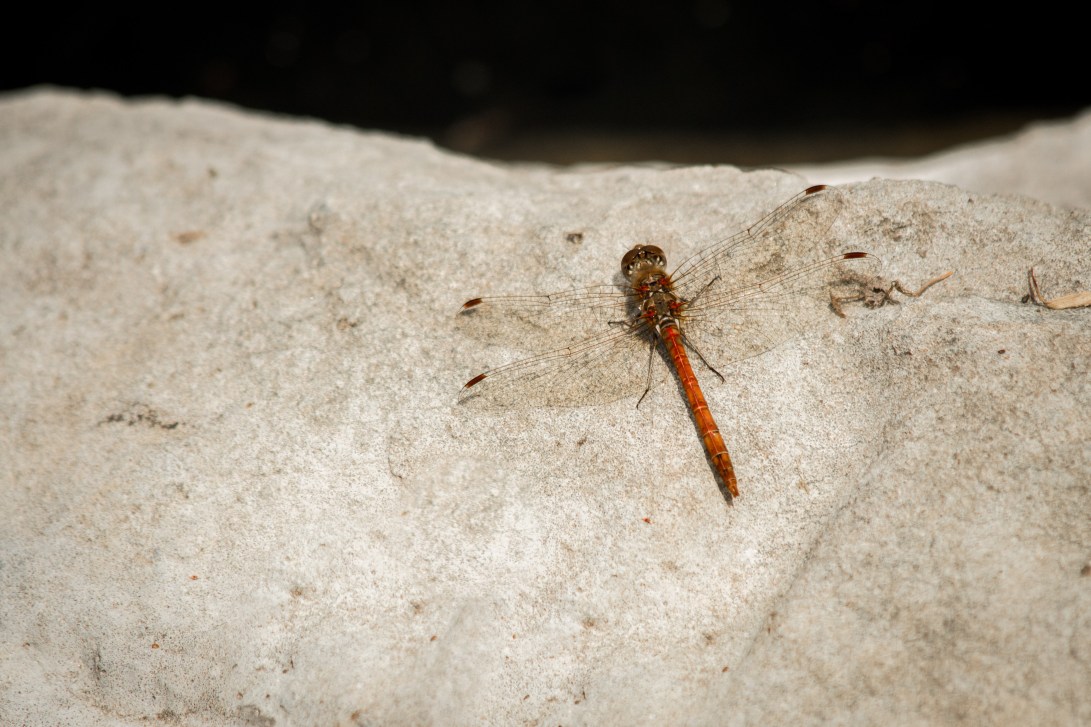
Common Lizard(Zootoca vivipara)Common Darter(Sympetrum striolatum)
The above invertebrate is a dragonfly, as its wings are positioned perpendicular to its body. A damselfly’s wings are parallel along its body. The individual I photographed is a male; the female is yellow with black markings.
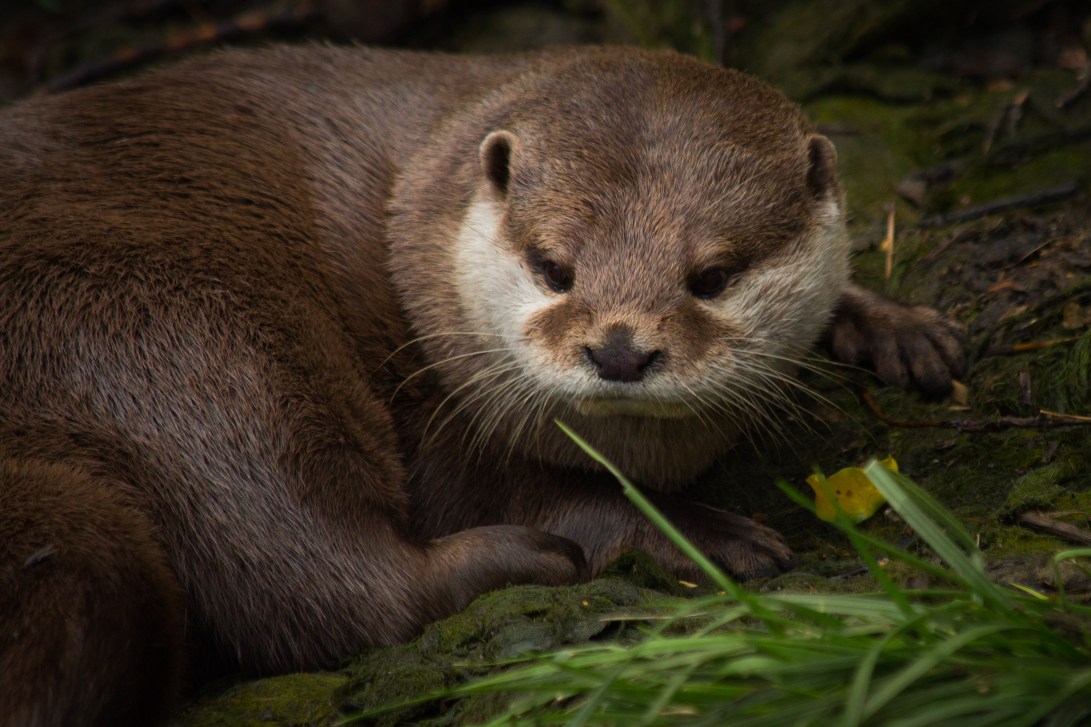
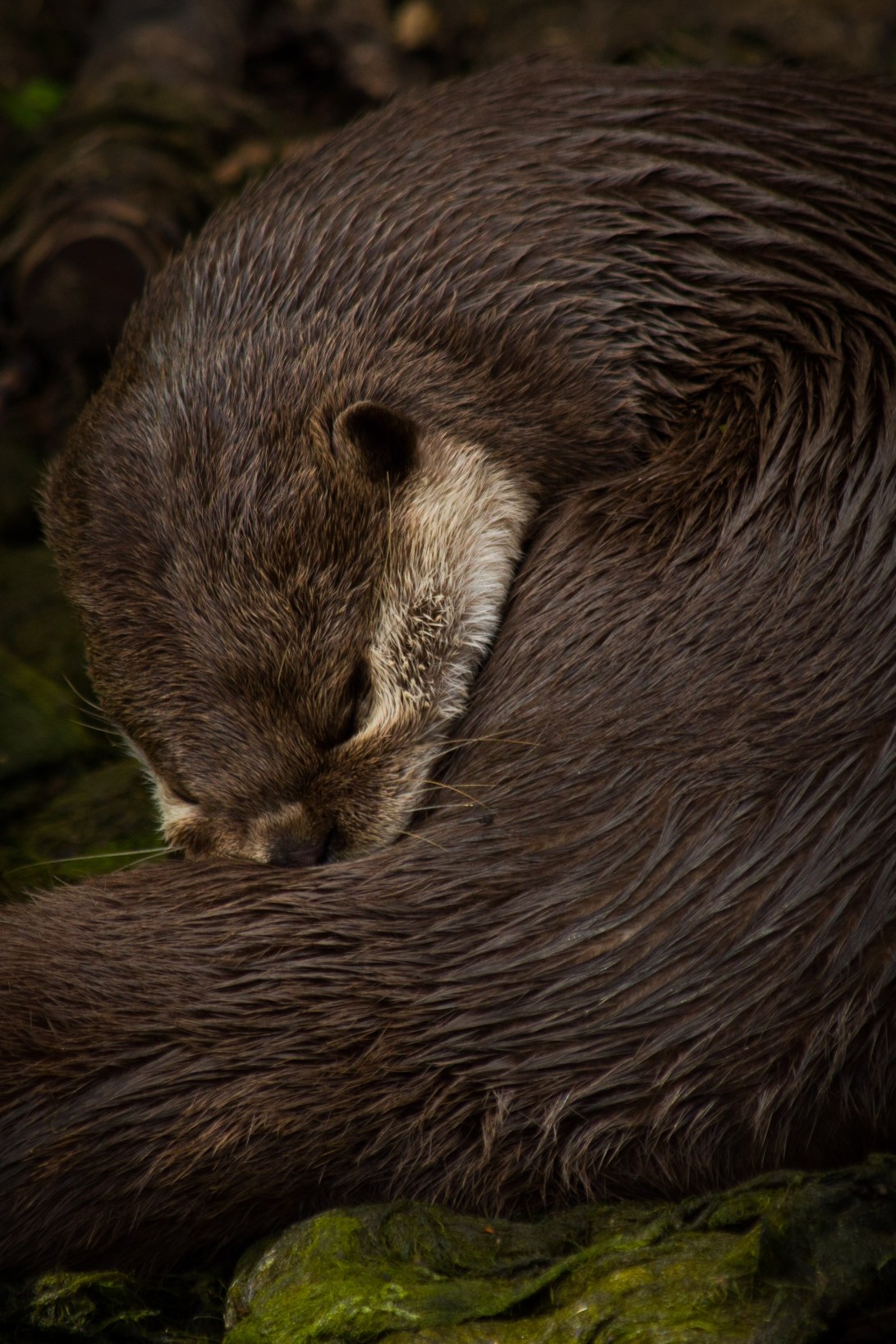
The otters were Asian short-clawed (Amblonyx cinereus), the smallest species of otter in the world weighing less than 5kg. In addition to its size, this species differs from the Eurasian otter (Lutra lutra) in that it has blunt claws on some toes, if any. We watched them feed for a while, diving into the water of their enclosure for scraps of fish. After feasting, they rolled in the soil to dry their fur and proceeded to grip fragments of shell in their paws, looking painfully adorable.
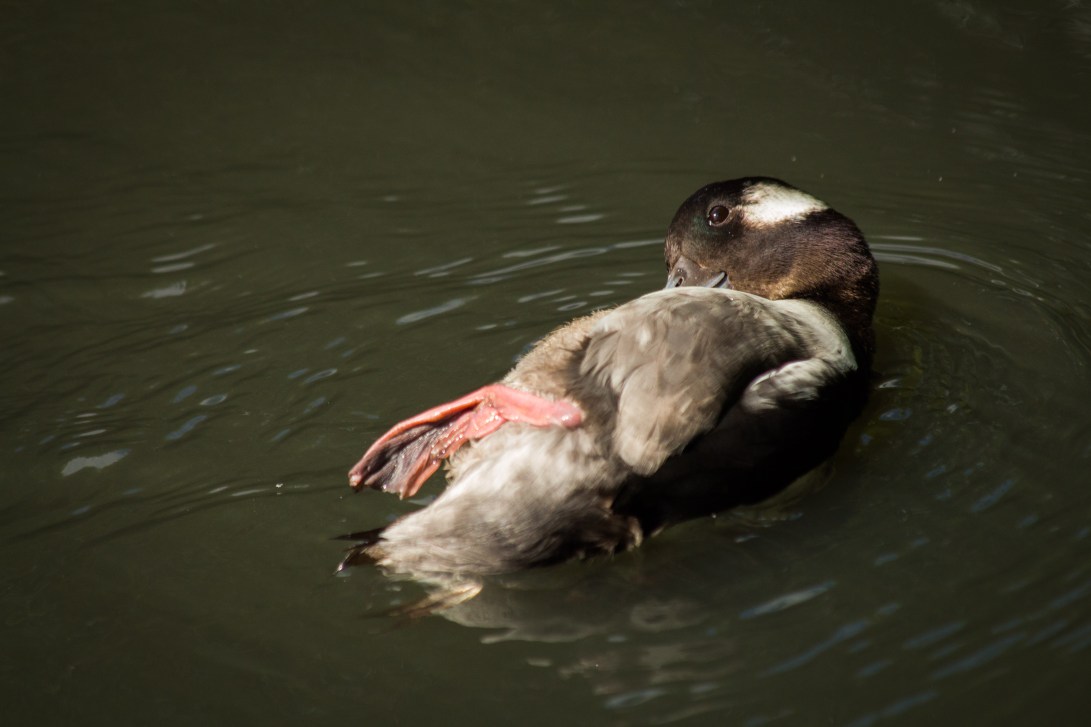
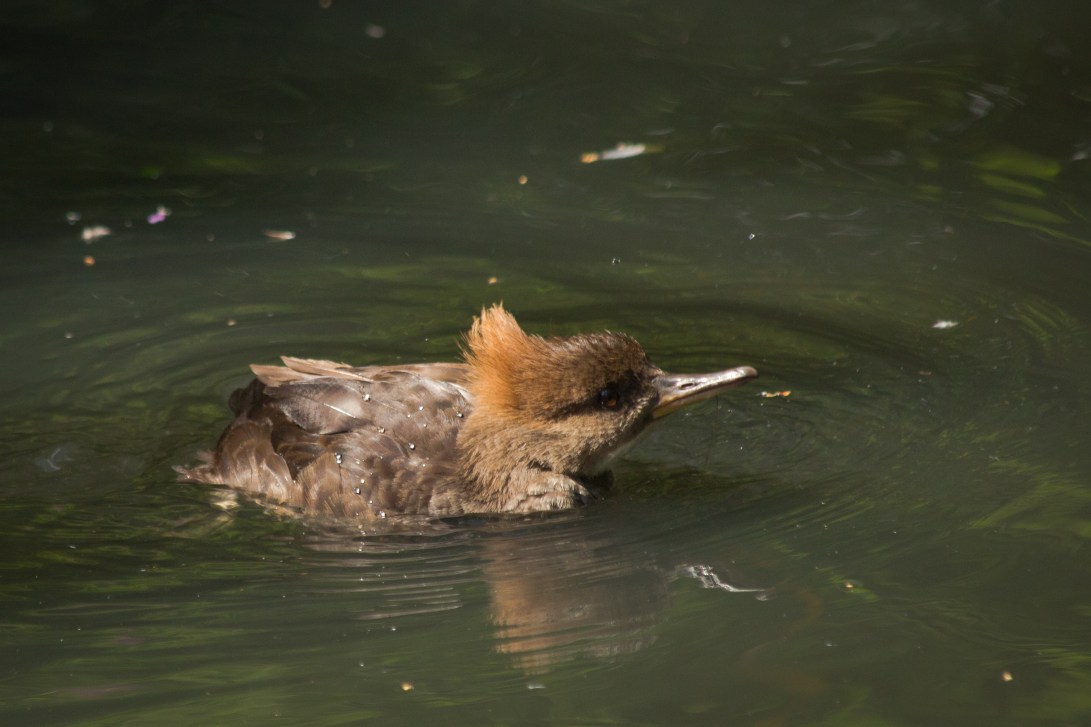
By now the sun was high in the sky and the day was sweltering. After watching the otters slip into their holt and out of sight, we wandered around the rest of the wetland centre and visited the more exotic species that inhabited the site. We sat for a while and watched buffleheads, hooded mergansers and more. While they all looked extravagant, the humble moorhen stole the show with its characteristic screech that made me jump on several occasions. I must say, British species will always fascinate me just as much as their foreign relatives. The weather was perfect for our visit to the London Wetland Centre, and I was thrilled to find a new wildlife hotspot.
This morning Heather woke us all up with a real treat; last night the Longworth trap had caught a wood mouse. As quietly as we could, we took some brief photos then sexed the animal. The nipples were clearly visible, meaning our mouse was a breeding female.
Heather assured us the use of a plastic bag was standard procedure and it was held open for the very short time the mouse was inside. After releasing the animal back at the trap site, it scuttled away safely and unharmed.
After a few more hours sleep we visited what Heather described as a ‘sweet shop’. The shed beside the house was full of barn owl pellets which we had the opportunity to dissect. After some initial apprehension we got to work and I found myself enjoying pulling apart what a barn owl regurgitated many months previously. In my pellet I found both a mouse skull and a vole’s skull, as well as numerous minuscule jaws and ribs. It was yet another new experience for me and it was fantastic to analyse what an owl on Carna had been eating.
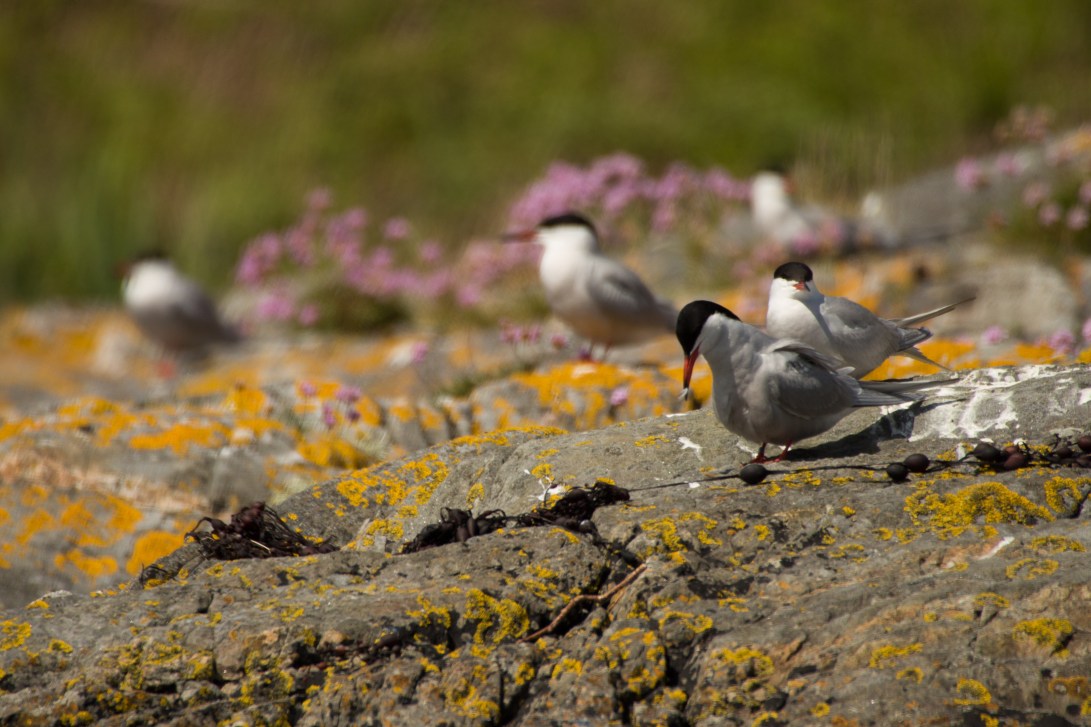
Shortly after we’d finished with the pellets Andy came to pick us up on the boat for a trip around the islands. Unbelievably we had another fantastic day of sunshine, so conditions were great for photography. For a while we watched common terns mating, and their stark white feathers contrasted with the rich colours of the moss clinging to the rock.
Once in open water we saw two more porpoises breaking through the waves. The tide was choppy and negotiating tripods and telephoto lenses while the boat tilted from side to side was a challenge we had to overcome. Once again Lequane was first to notice the white-tailed eagle far up in the sky, but almost immediately after we noticed a different bird above the hills. As it descended and came within binocular range we saw the rich hazel hue of the golden eagle’s wingspan. It dipped low and landed amongst the trees so we lost it, but this bird was near the top of my wish list and it was so satisfying ticking it off.
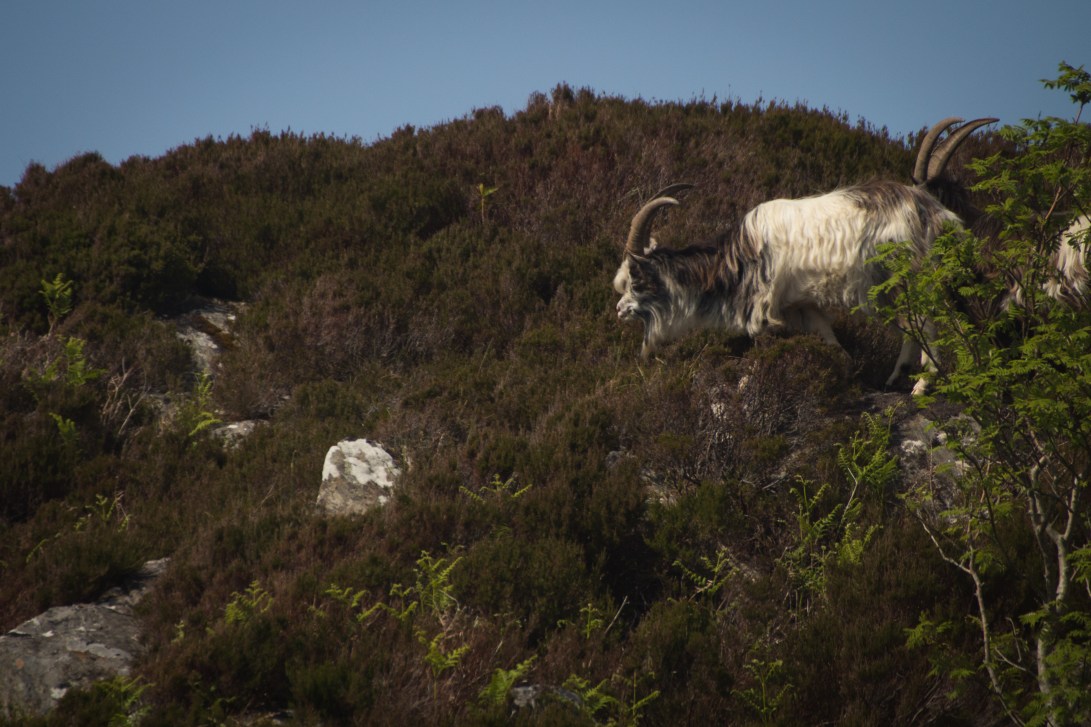
On the way back to the house we spotted some of the wild goats that had made the rocky coast of Carna their home. We also stopped off at the shag’s nesting site again. Not many people are aware of these birds but I find them extremely handsome with their sharp yellow eyes and the green sheen in their feathers.
When we got back Cain and Heather had gone to pick up the camera traps and we all gathered at the kitchen table to see what we’d captured. It was nothing short of a success. In the first trap we had several clips of an otter trotting in and out of a small cave mouth and sprainting at the entrance. In the same spot a few hours later the whole frame was filled with two pricked up ears and a pair of antlers that were unmistakably a roe deer’s. Heather and Cain informed us that this was the first official footage of a roe deer on Carna so this was fantastic news. By using the camera traps we can find out new information about just how diverse Carna is.
Footage from the next trap showed a vole that we were unable to identify. It could have been either a bank vole or field vole sub-species. Either way, it was great watching the rodent feast on the apple and seeds we’d left, although it did manage to shift the trap so we could no longer see anything but out of focus rock.
Yet more treats were to follow. The next trap had been set in the bluebell wood and a fox had visited late one night. Though it didn’t linger, we still got to see the mammal’s gorgeous fluffy tail as it trotted through the bracken.
Seeing the wildlife on the Isle of Carna on the camera traps was a great end to an unforgettable experience. In only four and a half days I have learnt so much about tracking and field craft and got an insight into the ecology of an island rich in wildlife. It was so refreshing being around people who get as excited as I do when I hear a cuckoo or glimpse an otter swimming across the loch. By being separated from technology I have had the chance to enjoy the outdoors even more. I’ve been out of breath on numerous occasions during our hikes and scrambles but it’s been worth it every time. I even did some sketching, a pastime I haven’t enjoyed in years.
Everybody should spend time in a place like Carna, especially those who don’t fully appreciate the natural world. Sharing a loch with seals, otters and porpoises is something everybody should experience. While I am the last person to criticise books, sometimes the best way to learn about wildlife is to be a part of it. Get your hands dirty lifting rocks to see the starfish underneath, wade ankle deep in mud to set a camera trap and get a crick in your neck gazing at eagles. It really does change you.
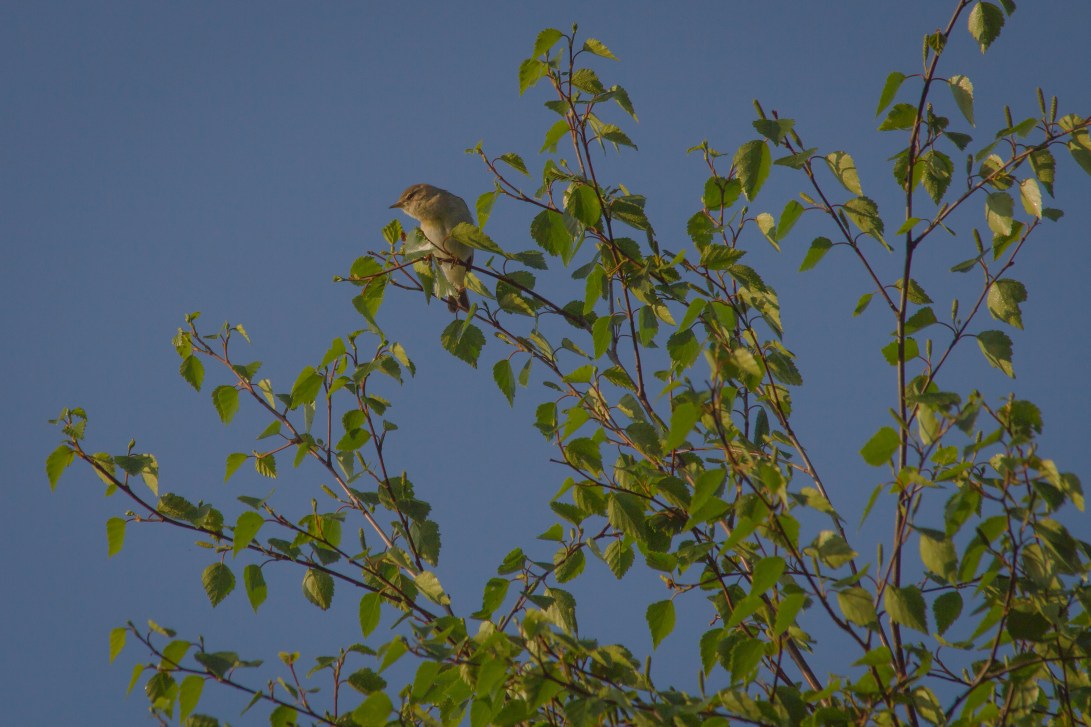
We were woken at the tender hour of 5am this morning for a wander through the dew-soaked grass. Tiny droplets clung to the hare’s tail and made them look like teasels instead of their usual fluffy tops. There was a fine mist rolling over the hills which looked beautiful with the weak sunlight shining through. We spent some time listening to birdsong and trying to untangle the many different voices. Cain described the descending tone of the willow warbler and the drilling call of the lesser redpoll. I would love to improve my knowledge of birdsong; it’s at the very centre of the morning routine for all wildlife.
A willow warbler high in the trees
After a break we began the scramble up Crachan Chárna, the tallest hill on Carna standing 170m tall. Once again the sun was shining, which we certainly shouldn’t be ungrateful for, but the heat made the climb just that little bit more challenging. Luckily the path up was well trodden, so we didn’t have to battle through knee high bracken or wade through too many sodden swamps.
Partway up we came across a muddy puddle stuffed with grey and black feathers, clearly the scene of a crime. Cain explained how he knew the culprit was a bird not a mammal. When foxes feed they chew the feathers off the carcass, splintering the feather shafts. Birds of prey pluck the feathers so leave them relatively undamaged. It was then a case of determining the exact species; this involved identifying the prey. When viewed in direct sunlight the black feathers glimmered, the dark green sheen of a shag. The size of this bird meant the predator had to be an eagle; a buzzard wouldn’t have the size over seabirds such as shags. It was so interesting deducing what happened based on the evidence; I’m noticing so much more now I’ve got some field knowledge.
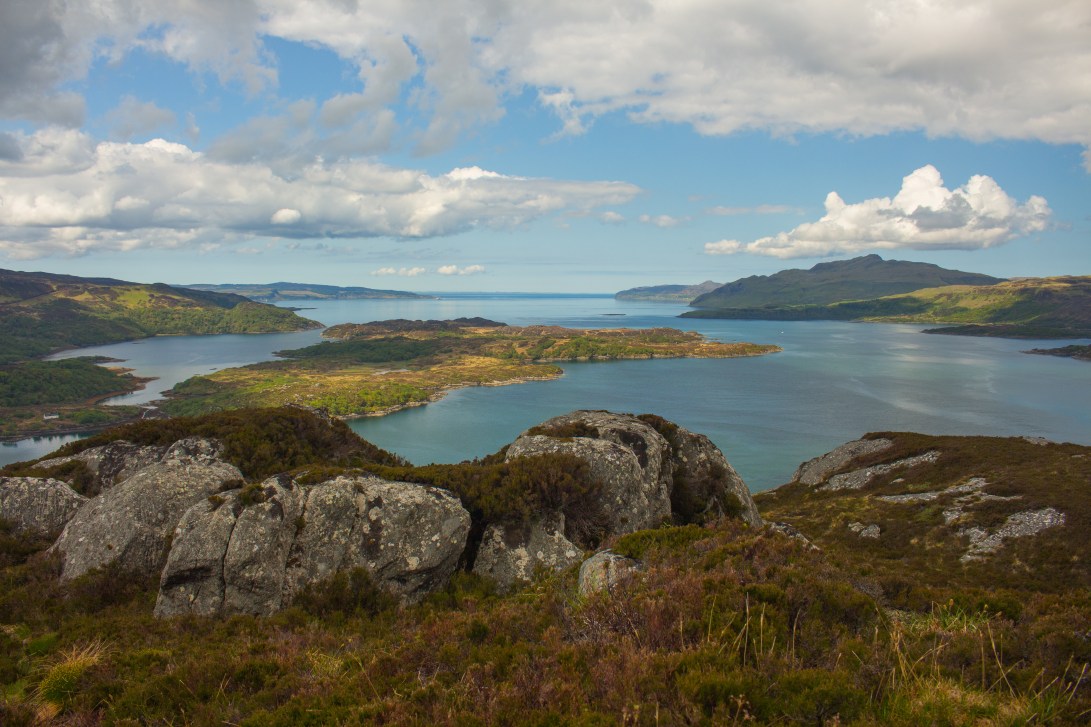
In less than half an hour we’d reached the summit, only stumbling a handful of times. After we’d caught our breath we could fully appreciate the beauty of the island. For miles in every direction sprawled the surrounding isles, smaller patches of rocky terrain jutting out of the loch and the open sea to the west. We spent a long time at the summit, eating lunch and twisting and turning to see every view. Common terns swept overhead, turning into the wind and flapping furiously. Far down below a heron stood poised, neck braced to strike. After enjoying some lunch we made our slow descent back to the ground.
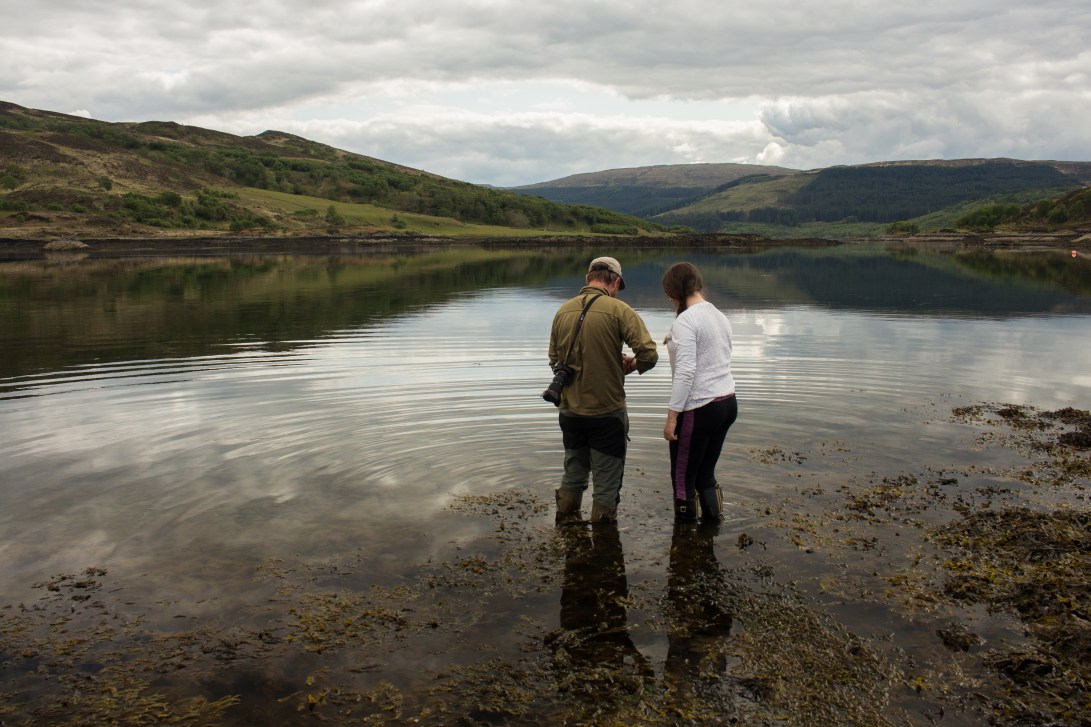
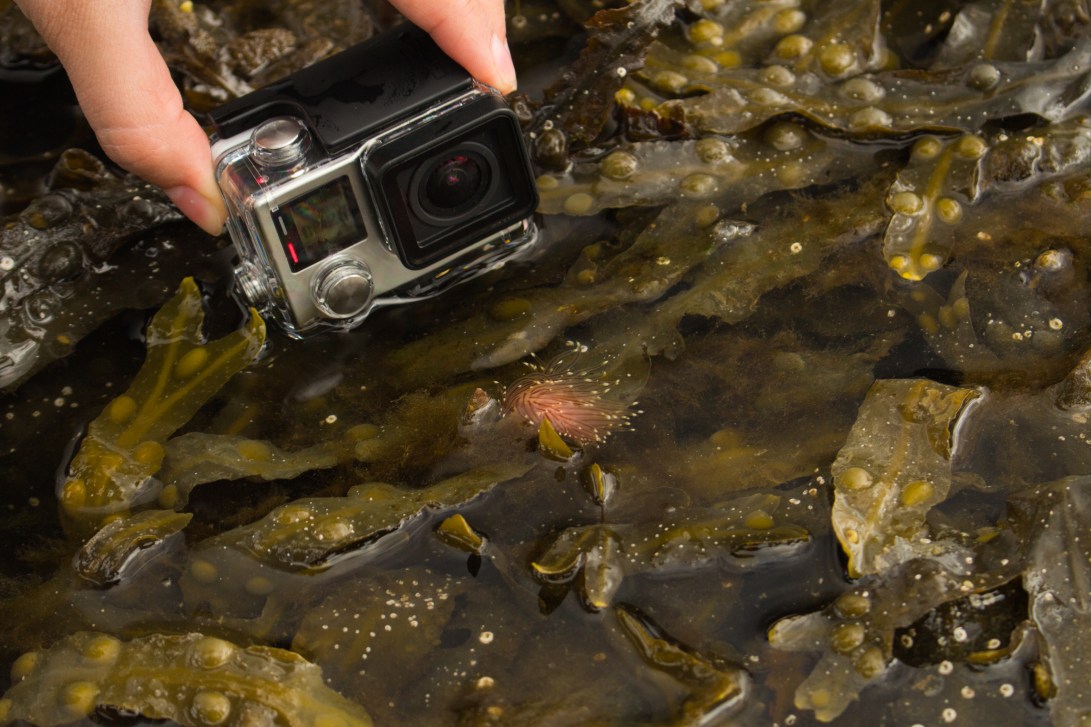
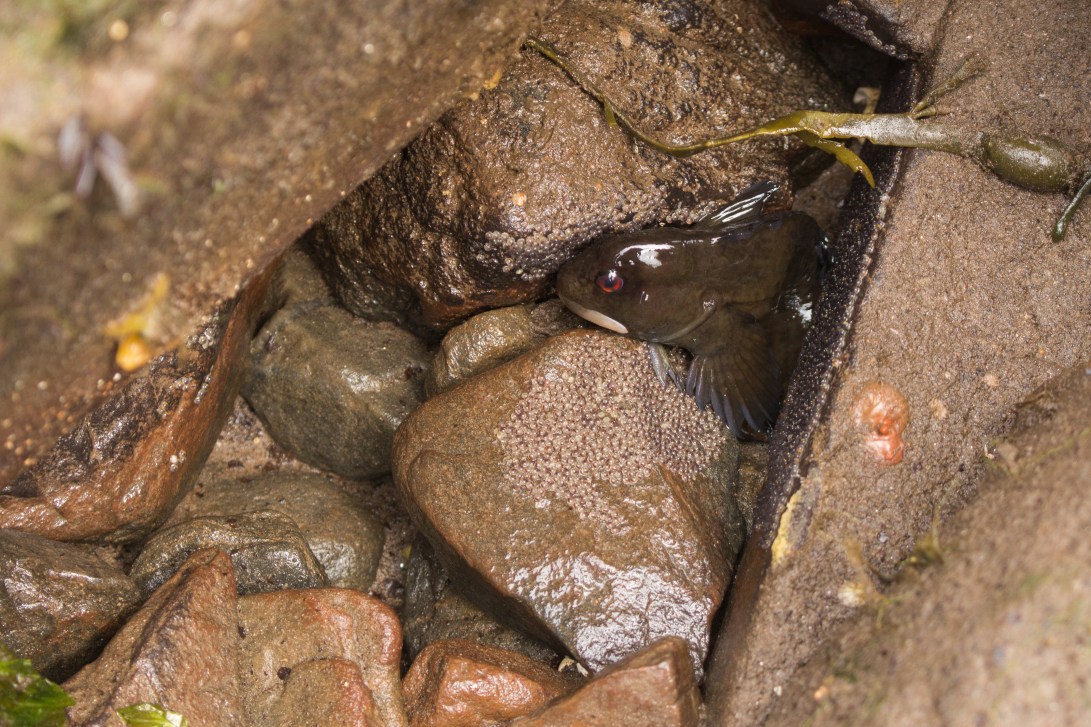
In the afternoon we spent time exploring the coast outside the house. While the tide was out we could forage the seaweed to our heart’s content. I discovered many different species including bladder wrack, sea mat and flat-wrack. In addition we saw many creatures beneath the weed-choked rocks such as edible winkles, barnacles and shore crabs. As well as this we saw butterfish, common blennies, whelks and starfish. We all lay on our fronts on the pontoon and watched a common hermit crab creep along the lakebed.
ButterfishA species in the mollusc family, specifically NudibranchiaA whelk feeding on a crab carcass
A common blenny with eggs
Later, once the sun had finally set, we headed out to see if we could pick up any bat calls on the detector. We could determine the species by what frequency their call was recorded at. After only a short walk the detector picked up a series of clicking calls at 45Hz, and sure enough a tiny black bullet shot through the night, leathery wings beating the air. Once we’d consulted the identification key we discovered that the common pipistrelle was picked up at 45Hz, so concluded that this was the bat we’d found.
We wandered on and picked up another common pipistrelle further down the path, then suddenly Verity noticed a flash of white above and we all celebrated in hushed tones as the barn owl swept over our heads. By now it was late so we headed back to the house, pleased we’d got the opportunity to use such great tracking equipment.























 rebeccaonthewing.com