Despite the cocktail of sun, rain, hail and snow all in four days I managed to have an excellent Easter weekend of wildlife watching. I heard my first chiffchaff this week, which can only mean spring is on its way despite the occasional blizzard!
Osprey season has begun and I spotted my first of the year on Saturday. That was the hottest day in a long time and sunglasses were essential for squinting up at the sky. As well as seeing this stunning male osprey hovering over the estuary, I saw my first sand martin of the year (too nippy for a photo) and my first ever grey plover, which was a rare visitor to the area.
Grey plover
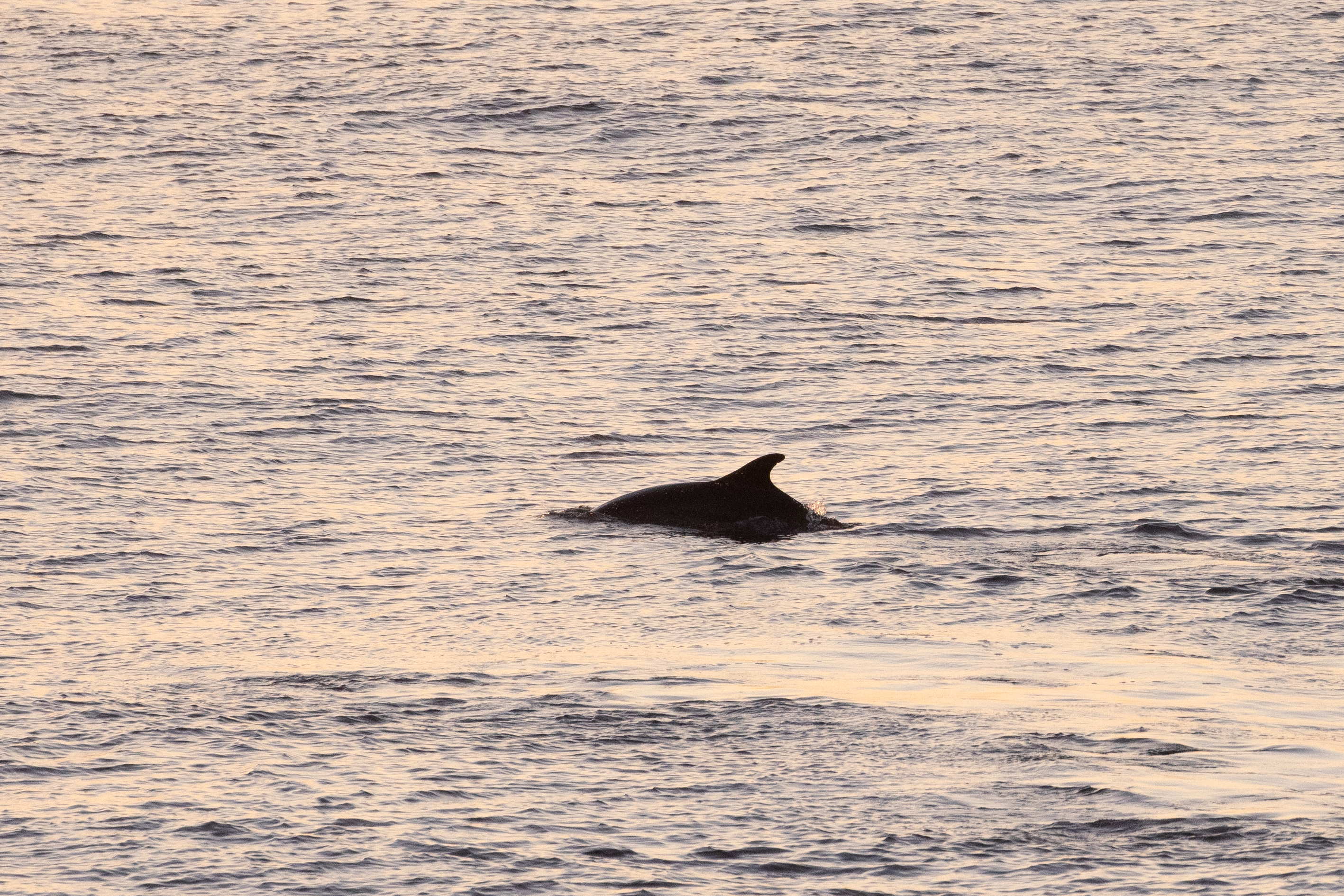
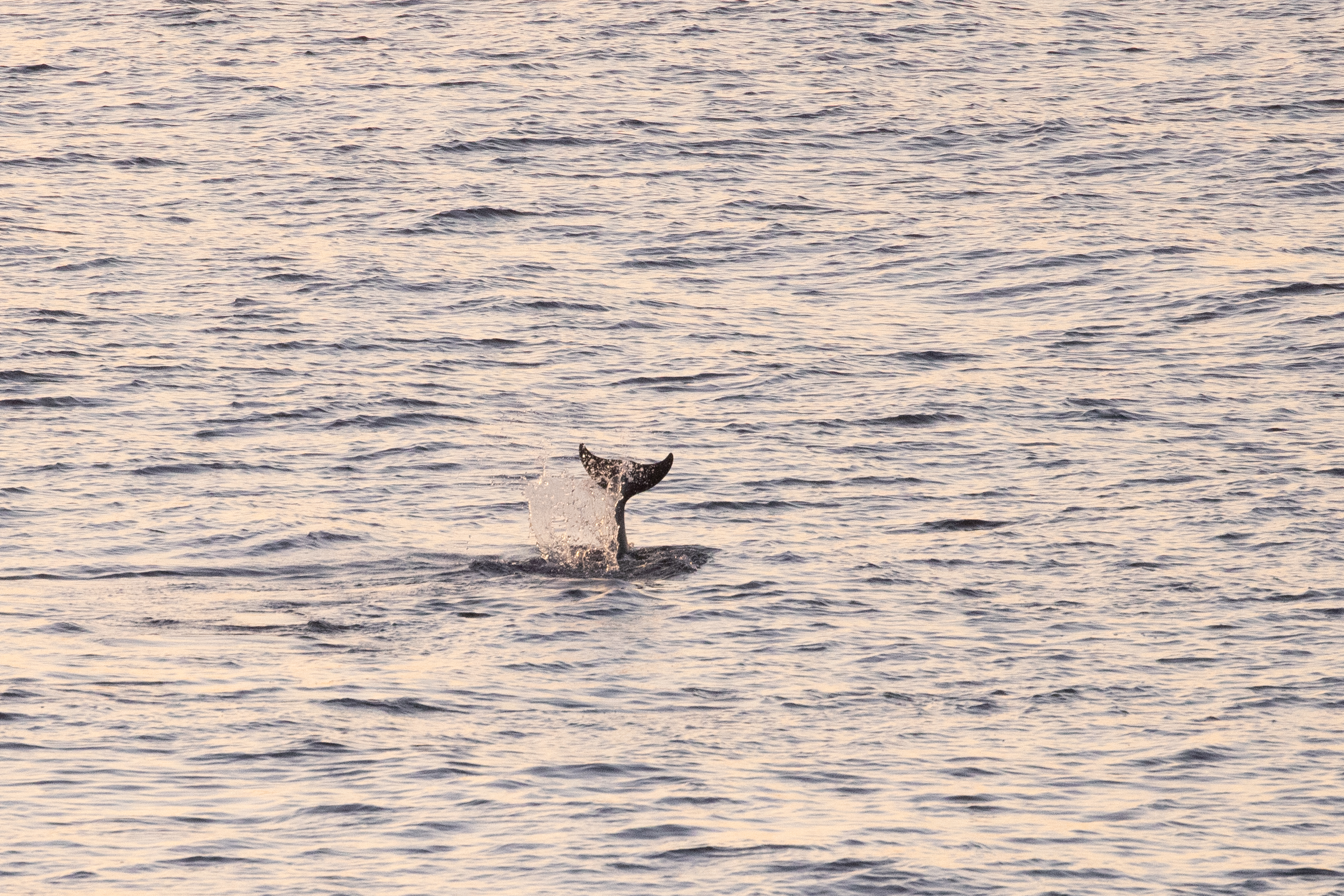
That evening the excitement continued with my first gannets and bottlenose dolphins of the year! It was a gorgeous evening with a cracking sunset, made even prettier by the appearance of three dolphins that cruised all the way around the headland. There were a couple of distant breaches too far away for a photo but it was so lovely to see dolphins again. I can’t wait for the season to kick off properly when there will be sightings on most days!
But the most exciting encounter happened on dry land.
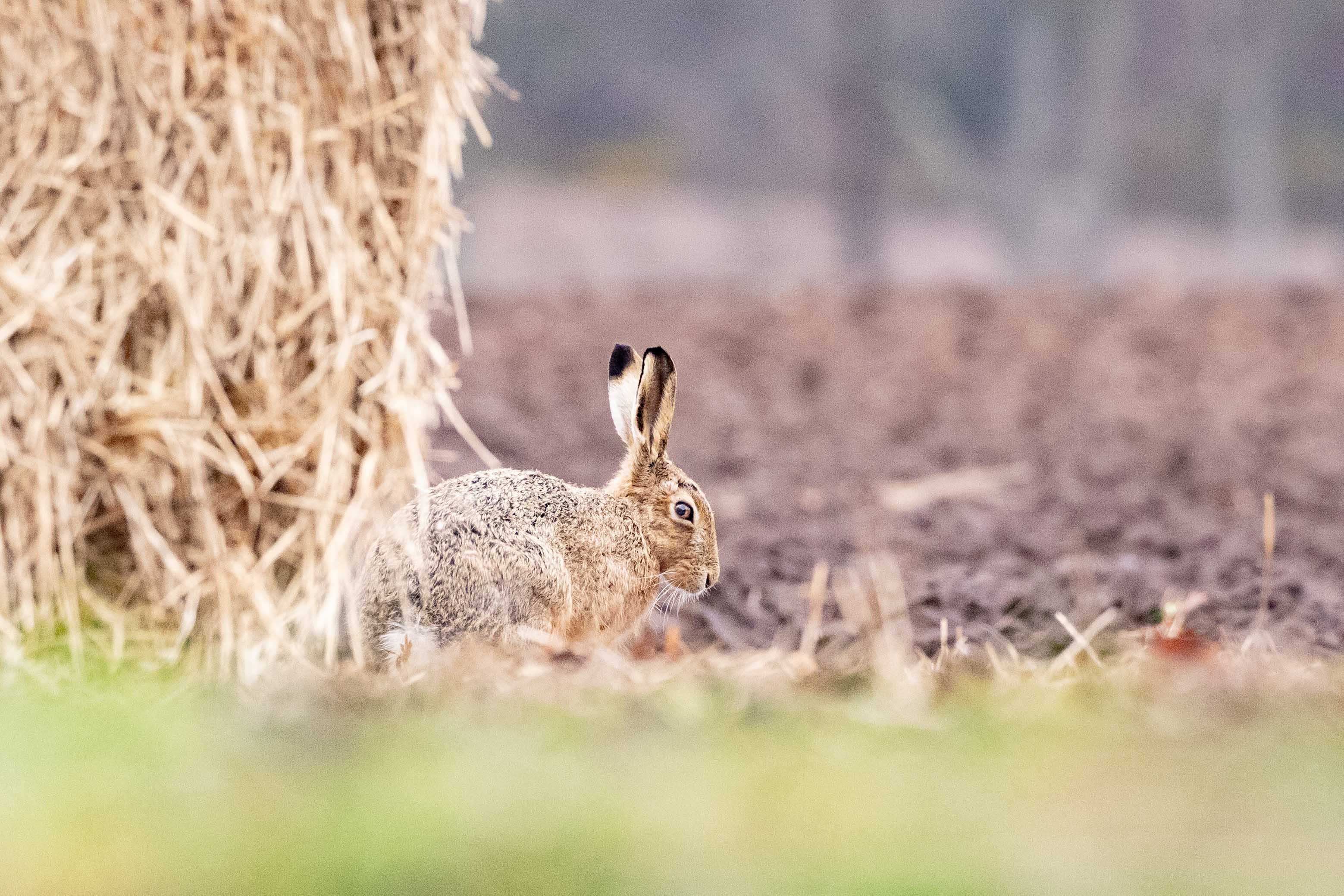
I knew there were hares nearby as I often saw them dashing across the open fields, too fast and far away for a photo. I wondered if I pulled up with the windows down safari style whether they might appear a bit closer. For a photographer, a car can be an excellent wildlife hide.
I passed the time watching pheasants foraging. Every now and then the male would do his screech call and flap his wings, which looked lovely in the early morning light.
I waited for him to do it again but he wasn’t playing ball. My hands were going numb and I was just about to put the camera down when a hare appeared behind him.
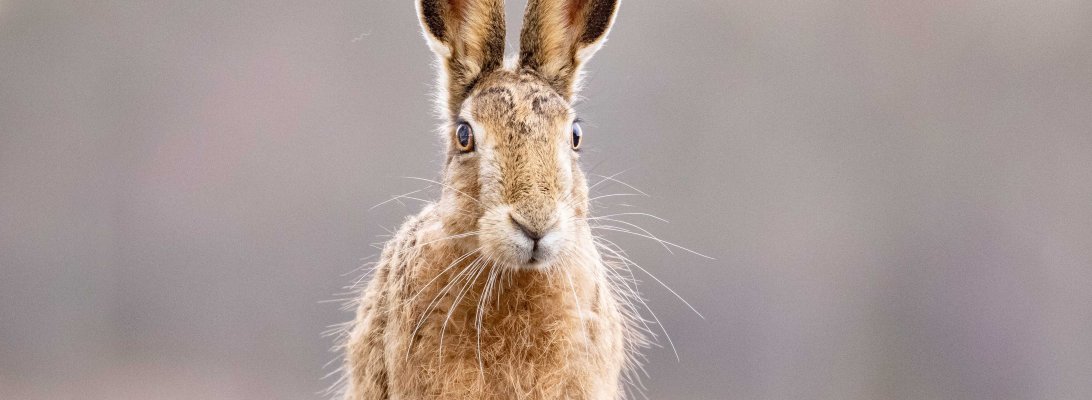
I froze, actually hearing my heart thud as it padded towards me. Once it was ten feet from my lens it sat and stared right at me before lolloping back behind the bales. Even though it could see me, there was something about me being in the car that had relaxed it enough to check me out.
Once I was sure it had gone I checked the photos and actually cried looking at them, which has never happened before. The combination of shock, joy and relief was overwhelming and I almost couldn’t believe what had happened.
It’s been an Easter weekend full of treats, from soaring ospreys to sunlit dolphins to breathtaking views of one of the most iconic Easter animals: the gorgeous hare. Thank you Mother Nature!
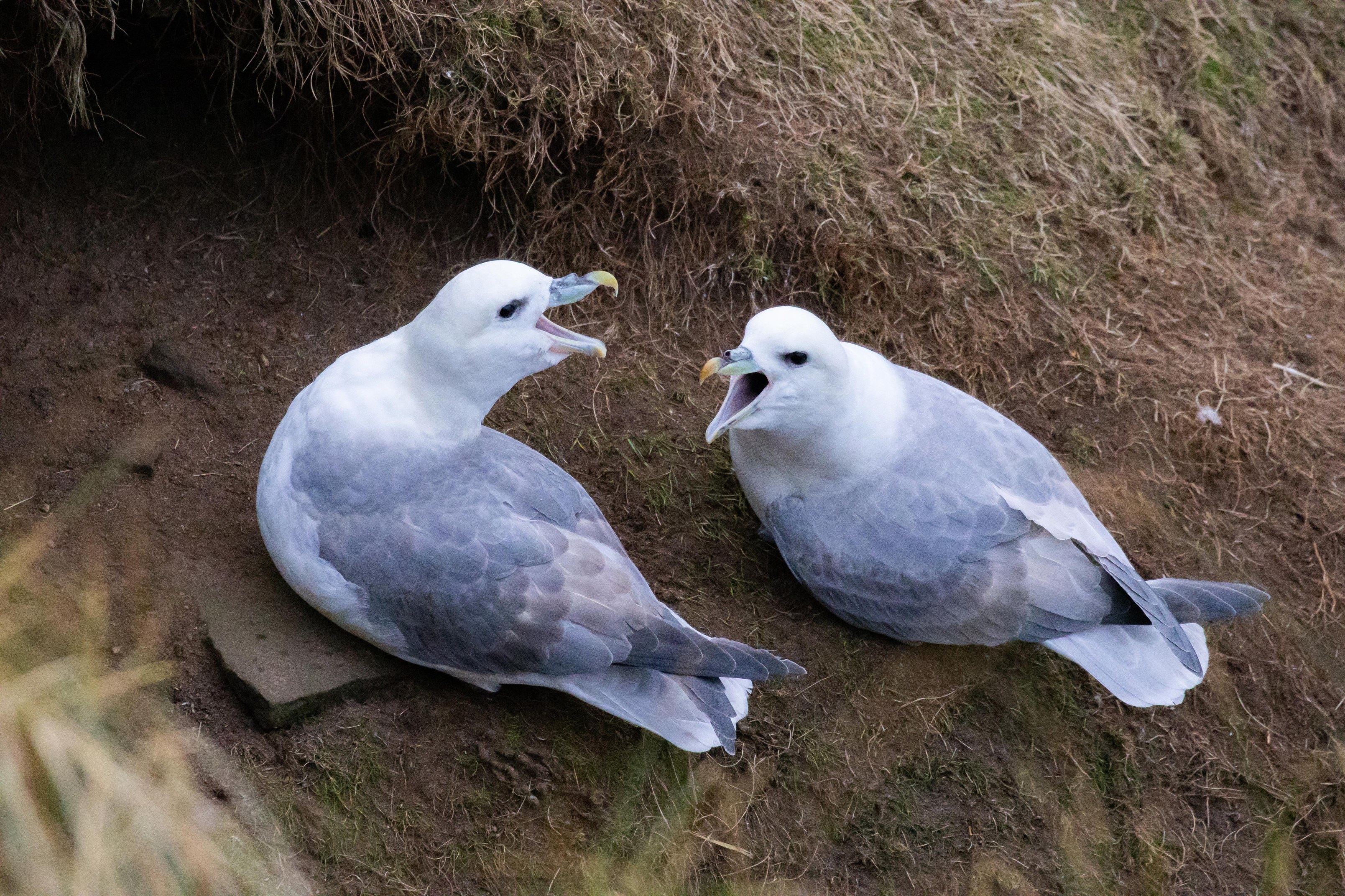
Last week on one of my many coastal walks I glanced down to see a pair of fulmars perched on an earthy shelf on the headland. Fulmars are one of my favourite seabirds so I was delighted that there was a possible mating pair setting up shop on my daily walking route. They were cackling to each other and looking like adorable mini albatrosses. I got a couple of shots but the light was fading so I decided to return when I had a little more sun.
The next day I wandered back to the spot but they were gone, perhaps on a fishing trip or maybe they’d decided on another nesting spot. Not wanting to waste the trip out, I scanned the water for dolphins and birds. Just at the mouth of the harbour was a group of dots too small for herring gulls. On closer inspection through the binos I discovered they were long tailed ducks – another favourite of mine!
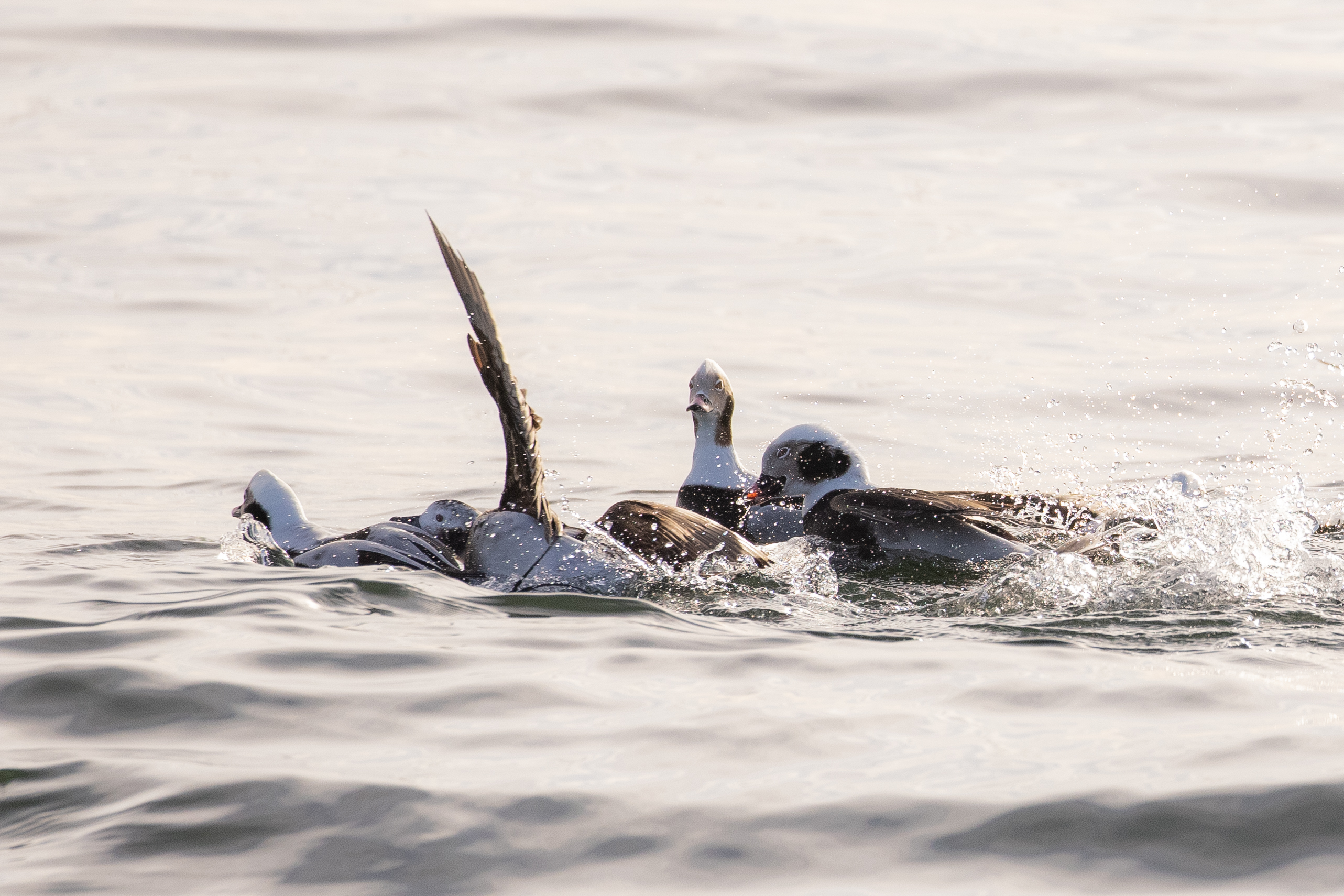
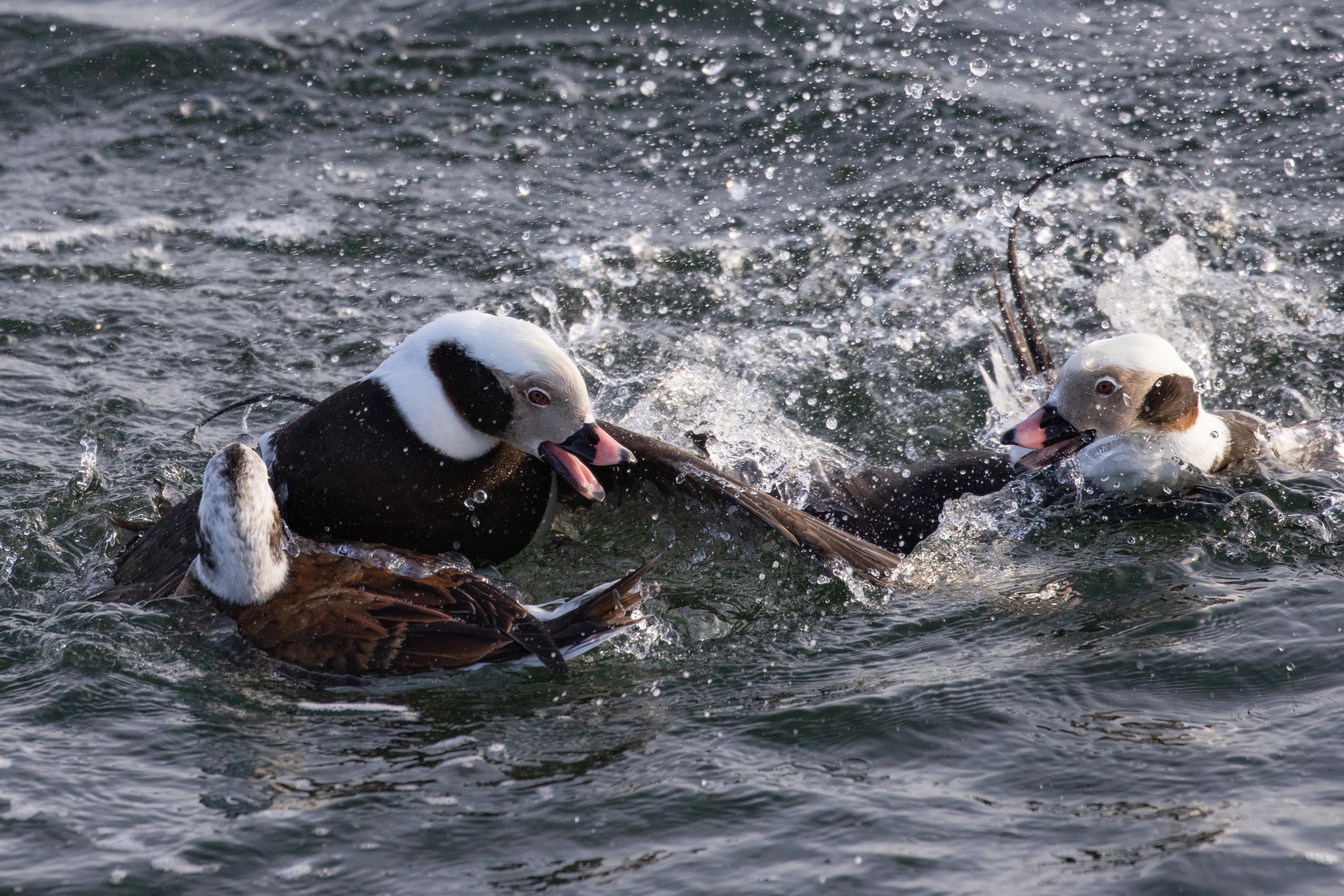
I hurried down from the headland and made a hasty loop around the harbour, peeping over the wall to see where they’d got to. I’d never seen more than a pair together before, and now I was out of the wind I realised they were making an absolute racket! There was a single female among all the males and she was flapping her wings and whipping the males into a frenzy. All the while a constant stream of three-note quack calls overlapped each other as the males jostled and squabbled around this one female.
The long tailed ducks near me are usually shy little cuties, but today there really was something in the water. By the looks of the female’s upturned bill and the twinkle in her eye it seemed as though she was egging the boys on! Well, we all need to let our hair down every now and then, and at least the long tails are allowed to have a party right now…
Elsewhere in the harbour there was more activity. Up until very recently the only redshanks I’d seen were far out and nearly impossible to photograph without the risk of breaking my leg on the slippy rocks – something I actually saw happen last year! I noticed a gathering of both redshanks and turnstones hanging out on top of the sea wall. Knowing they could be skittish, I stayed still and watched.
After a while another redshank popped up from behind the wall, surprising both me and the gang already stood on the edge. There was a great flurry of wings and I had the camera pointed at just the right spot to capture the near collision!
My intention had been to look for fulmars and I’d nearly headed in the other direction to walk further along the coast path, but after such a dramatic (and noisy) display I was relieved I’d stayed where I was! I love those surprises in nature.
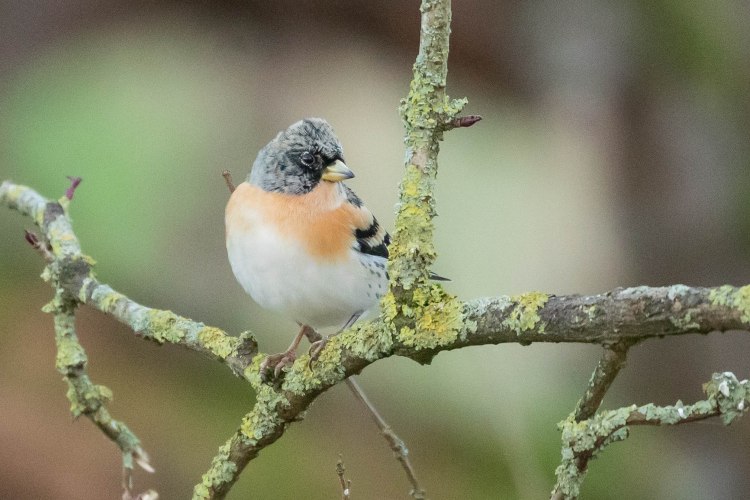
I was sorry to see winter go – for over a week I trudged through ankle deep snow and captured some really magical wildlife. But now the snow has gone and all the lovely fieldfares, redwings and bramblings have gone with it. While everyone was looking forward to spring, I was looking back to the winter I loved most.
At the weekend I went for my usual walk and instead of the serene silence that I usually hear in coniferous woodland, I heard birdsong. I picked out robins, coal tits, blue tits and a distant yellowhammer in the gorse fringing the forest. Perhaps most special of all though was the trill of one of my absolute favourite birds: the crested tit. I think I’ll always feel that little jolt of joy when I spot a crestie – they’re just so rare and special and I feel privileged to be able to see them quite easily where I live. The sun was shining so brightly I wished I’d dusted off my sunglasses, and although there was still a chill in the air, I began to embrace spring a little more.
Today my phone made an exciting sound – it was the jingle I’d set especially for local bottlenose dolphin sightings. If the dolphins had returned then spring was really kicking off. It was another glorious day so during a work break I walked up to a particularly good sea vantage point near my house and scanned the perfectly still water. No fins this time, but I watched dozens of birds criss-crossing the horizon from zippy turnstones to bulky cormorants. There was a group of twelve long tailed ducks too, which was a familiar winter sight among the spring buzz. I’ve felt a significant shift in my natural surroundings this week and although I still miss the snow, I’m really looking forward to those gorgeous dolphins coming back.
As someone who likes to potter around outside for hours while I write and watch the world go by, I’ve had to adjust drastically to my new lockdown routine. I describe my writing style as “immersive storytelling” – I go out and write about what I see to inspire other people to connect with their local wildlife. Over the past few weeks, it’s safe to say that I’ve struggled to stay creative. Although the restrictions are starting to ease in various locations, it is still difficult to get the access to nature that we all want and need.
It has been proven that being in green space benefits all aspects of our wellbeing. In 2018, a team from the University of East Anglia studied how the health of people living in urban areas compared to those who had more access to green spaces. They found that spending more time in nature “reduces the risk of type II diabetes, cardiovascular disease, stress and high blood pressure”.
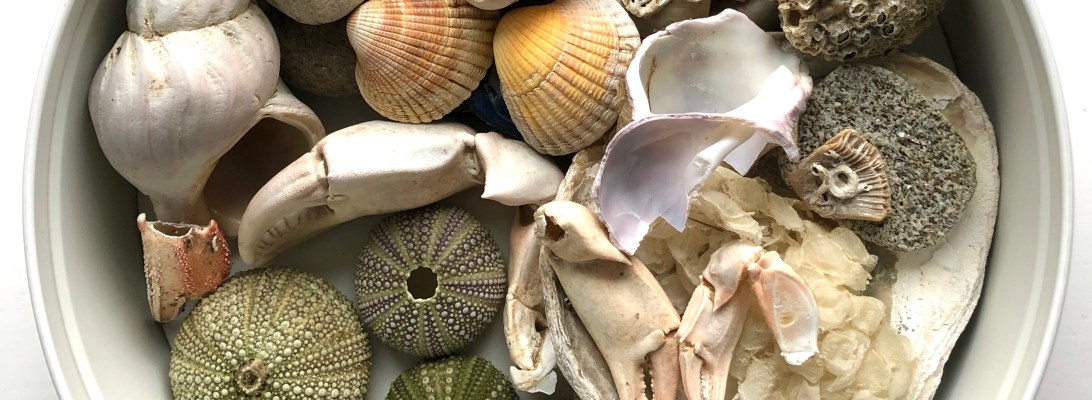
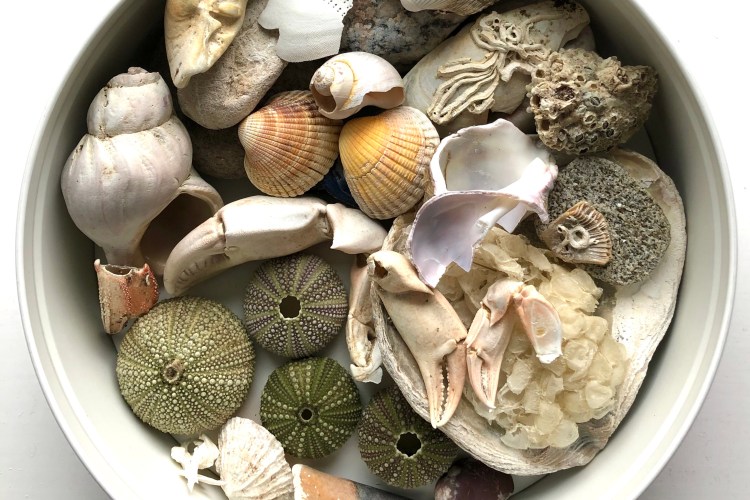
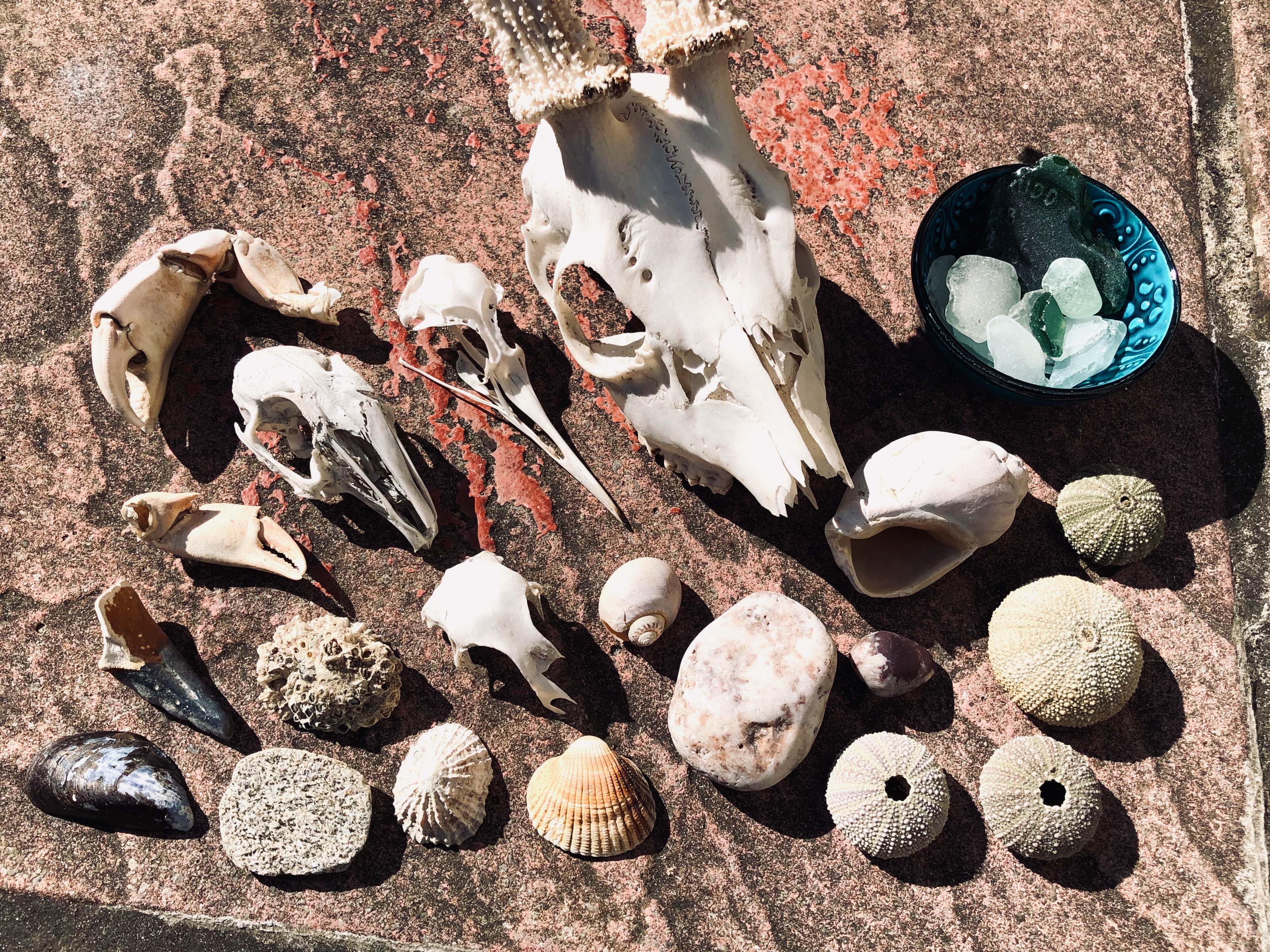
While cooped up indoors, I began to think of ways to stay connected to nature despite having to spend the majority of my time away from it. I’ve found that one of the best ways to do this is by bringing it indoors. I don’t mean catching birds or dragging in trees, but gathering small mementos. I’m lucky enough to live by the coast and I make a habit of collecting natural objects that I find on my daily walks. Together with other bits and pieces that I’ve collected from different habitats over time, I’ve made a nature table in my home that brightens up a room and provides a bit of wildness while I’m indoors.
Whatever habitats you have access to, there will be something that would make a good addition to a nature table. The great thing about wildlife is that everyone has a different relationship with it. My favourite things to collect are animal skulls – a male roe deer skull is pride of place on my nature table. Every item jogs a different memory in my mind. As well as being pretty to look at, a nature table is great for other senses too. I enjoy the tactile textures of frosted sea glass and rough sea urchin shells. Simply picking up these objects lifts my mood.
Author and illustrator of “The Wild Remedy” Emma Mitchell has struggled with anxiety and depression for most of her life, but insists that nature plays a huge part in helping her feel better. In a recent Instagram TV upload she shared the surprising healing power of plants for improving mental health. Plants produce oils called phytoncides which help the plant fight pathogens, but these same oils can benefit us too. When we inhale or touch these oils, our blood pressure, pulse rate and levels of cortisol (a stress hormone) go down. These small reductions can help us feel more relaxed and lift our mood. As well as house plants and garden flora, this also works with pots of supermarket herbs on the windowsill!
While plants appeal to our senses of smell and touch, one of the best senses for exploring nature is sound. A study at King’s College London found that listening to natural sounds such as birdsong improves mental wellbeing for over four hours. Recording snippets of audio on a phone during a daily walk is a great way to bring nature inside. Whether it’s woodland birdsong or crashing waves, natural sounds provide a relaxing background soundscape and, in my case, inspire creative thinking. For writers, it’s also useful to record any thoughts and observations you have while outside, so the details are fresh when you come to write them down later.
For those who can’t leave the house but have access to a garden, setting up some feeders will encourage more birds to visit and fill the air with their songs and calls. Another option is the brilliant Birdsong Radio app from the RSPB. This was launched after the huge success of the single “Let Nature Sing”, which for those who haven’t heard is a musical arrangement of some of Britain’s most loved but also threatened birds. As well as providing peaceful background noise, it’s a great tool for learning different bird calls. To listen to what specific species sound like, the RSPB website has small recordings on each bird’s profile.
The lockdown has forced us to change our usual routines and this has certainly brought its challenges. However, there is great enjoyment to be found in aligning ourselves to nature’s slower pace and exploring our local surroundings more closely. Despite the uncertainty, nature provides an opportunity to look after ourselves.
This article was originally published on Bloom in Doom magazine as part of my role as Nature Editor.
I had just finished dinner after a fairly uneventful day when I received a tip off from Steve – wildlife photographer, skipper and all-round marine mammal wizard – who told me there were bottlenoses on the way. I jumped into a down jacket and grabbed my camera. Luckily my daily walk can include a long stretch of rocky shoreline, which is infamous for its wildlife including the Moray Firth dolphins. Half a minute later I was slammed by an unexpected wind and I regretted not grabbing a hat on my way out. Although, I wasn’t sure how fast the dolphins were going and another half minute could be the make or break.
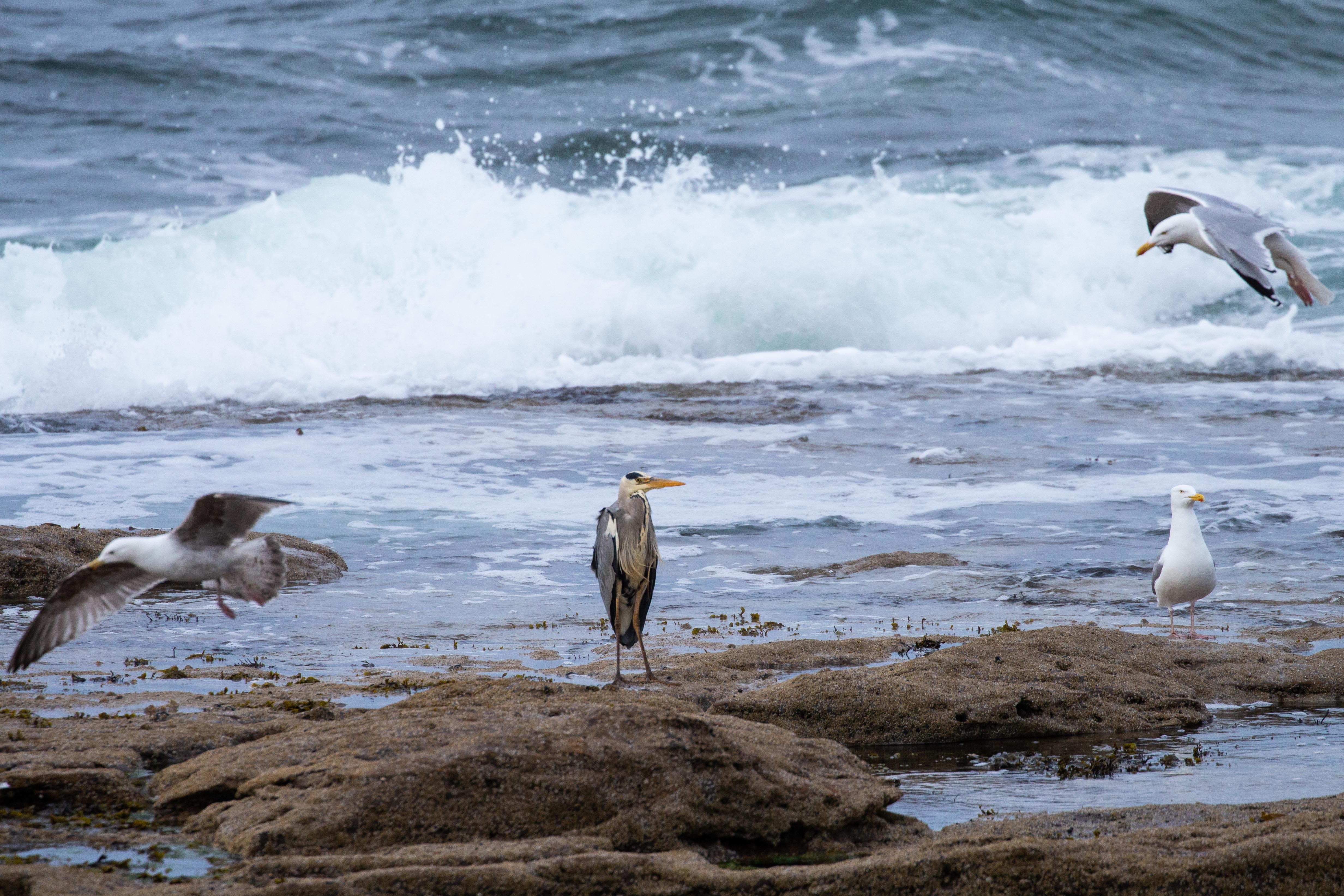
Keeping my two metre distance from Steve, we started scanning the water. He spied them far out, almost level with the next town, but we stayed put. If they didn’t turn north and swim further away, they would follow the coast and come straight past us. There was still lots to photograph while we waited. Groups of gannets – easily one of my favourite birds – were diving just offshore and a grey heron was settled hunch-shouldered on the rocks, surrounded by the usual mob of herring gulls and oystercatchers.
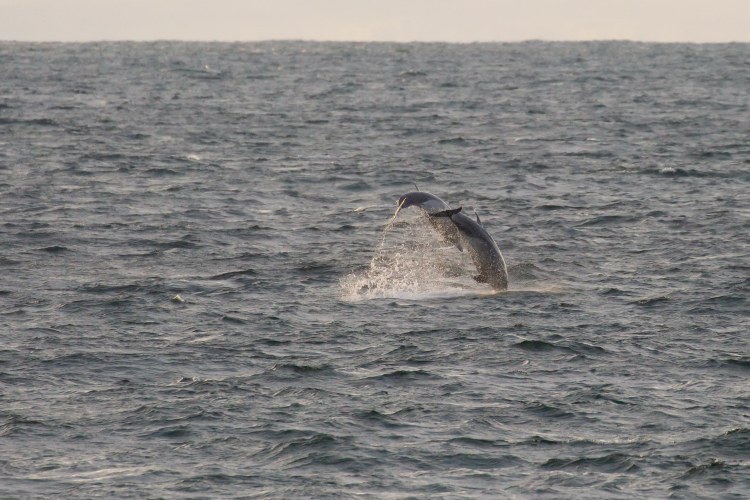
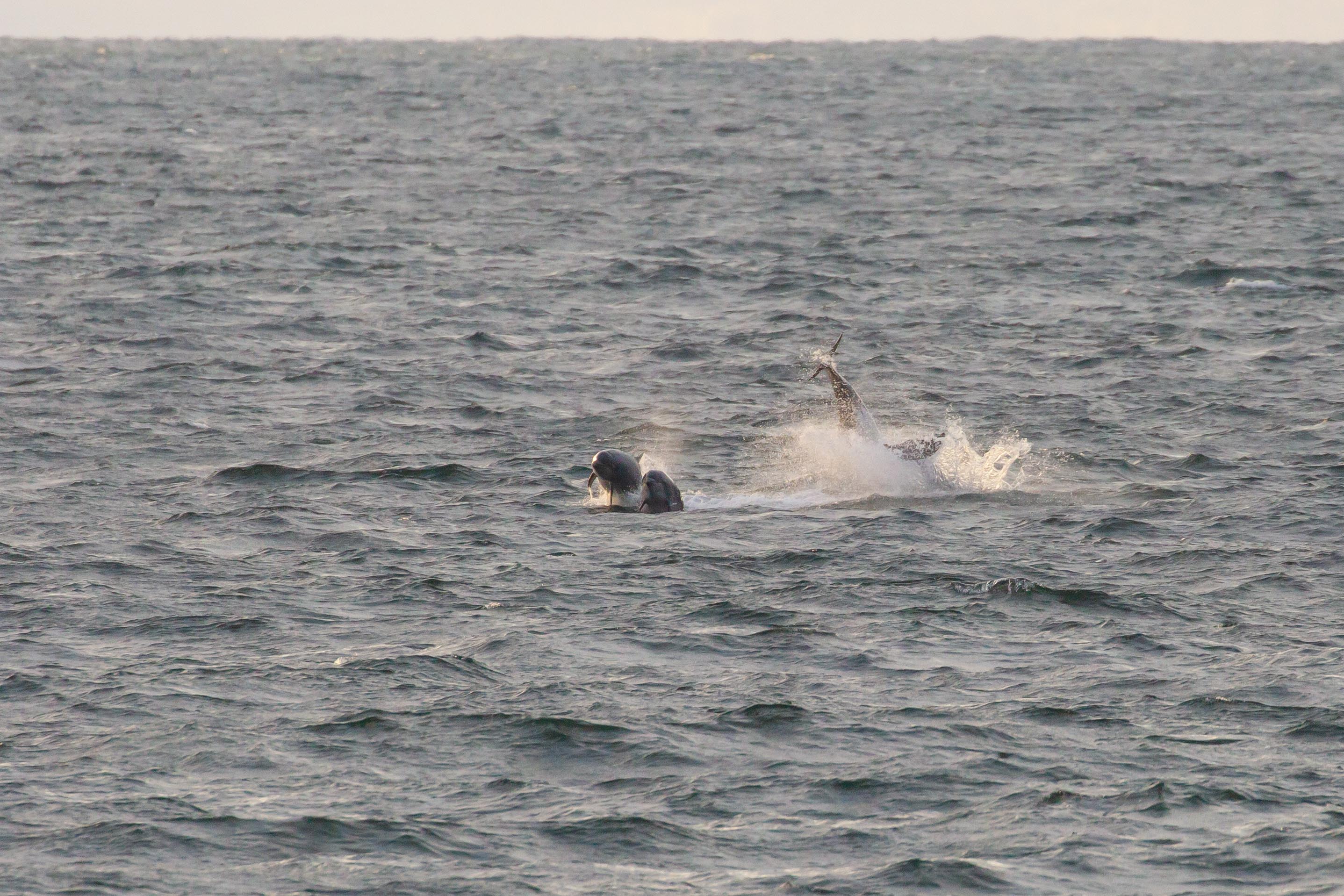
Suddenly the dolphins appeared again, much closer this time. They began to breach, leaping one, two or even three at a time. Photographing them felt a bit like playing Whack-a-mole – just when I thought I’d caught one, it had already landed with a splash and another had sprung up somewhere else. Once, two jumped together in perfect synchronicity, and no sooner had they landed than another pair took their place in the air. As so often happens, I was trying so hard to get the shot that I occasionally missed some of the action. But, when animals bigger than most grown humans are flinging themselves out of the water and performing acrobatic stunts, it’s almost impossible not to lift the camera and watch through the viewfinder. I find there’s nothing more enjoyable about wildlife photography than the unpredictability.
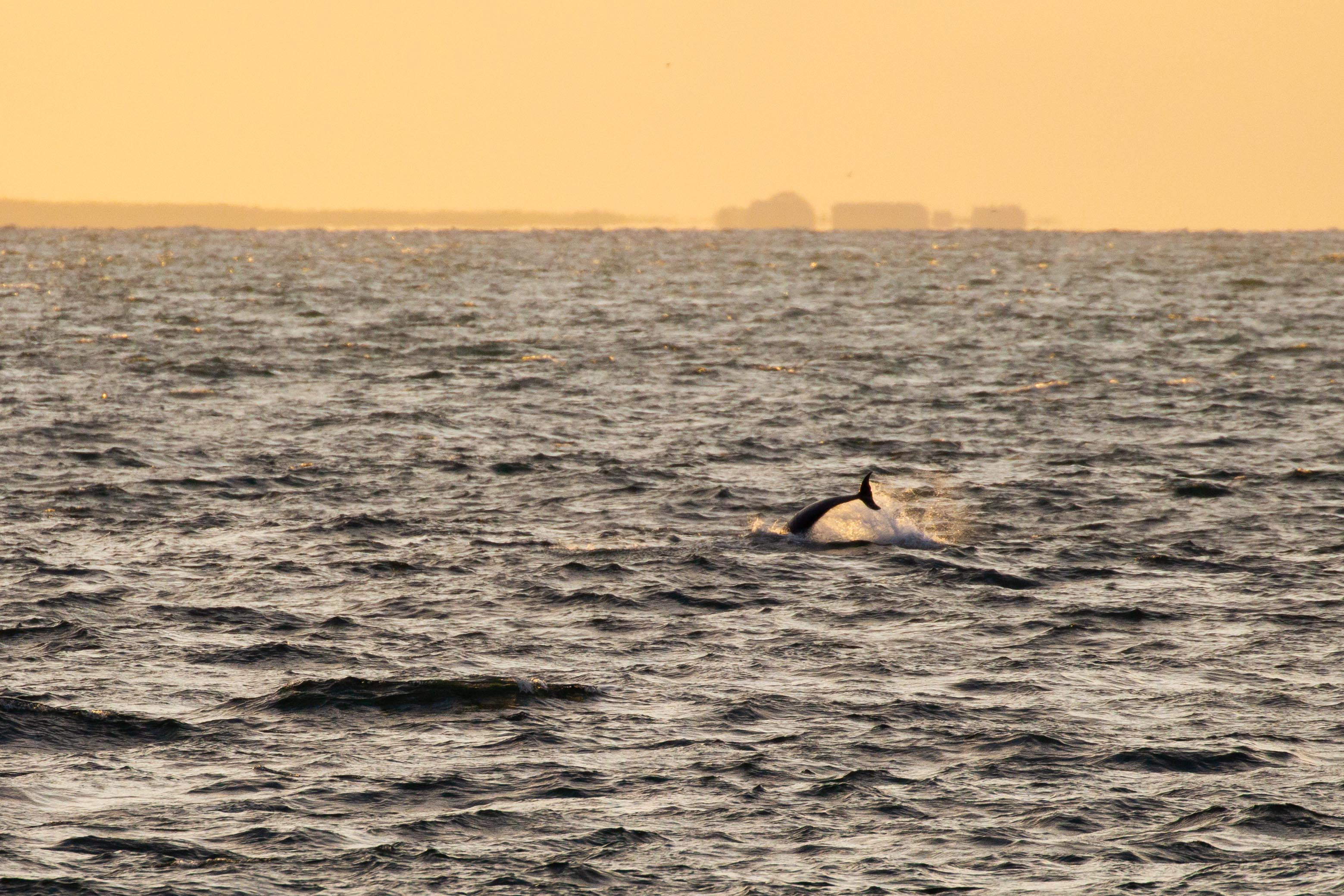
The cold was nibbling my face but there was no way I’d go home for my hat now. Dolphins were jumping in multiple directions, and all of them heading towards the sunset. We hiked up to the headland for a higher vantage point. As the dolphins got closer to the sun, the water streaming from their bellies mid-leap turned golden. Even with the naked eye you could spot them between waves from the clouds of shimmery spray erupting from their blow holes. Every so often there’d be a breach, but they were gradually heading further out. Still, Steve had never known them to linger for so long in one place. I was pleased not just to watch them but to know there was plenty of food to keep them there.
The sun finally set, casting a bright orange glow over the water. It was moments like that when I knew I’d made the right decision to move to Scotland. Sitting on the grass, shivering in the cold and watching dolphins breaching out at sea.
Although I’m naturally quite an introverted person and love having time to myself, I’ve still struggled to adapt to the lockdown routine. I like to potter around outside for hours while I write or just watch the world go by, so it goes without saying that I’ve missed wildlife far more than the pub. Alerts have hit my local Facebook groups about ospreys just a few miles away from me and orcas (orcas!) further along the coast, but lockdown measures have kept me stuck in one spot.
Still, it’s a beautiful spot to be stuck in, and there have been some new visitors to my local patch over the past few weeks. Before the clocks went forward, the daily sightings always included goldeneyes, long-tailed ducks and red-breasted mergansers. Now, as the spring wildflowers emerge and the days grow longer, I’m seeing some new faces on the backshore.
Willow Warbler
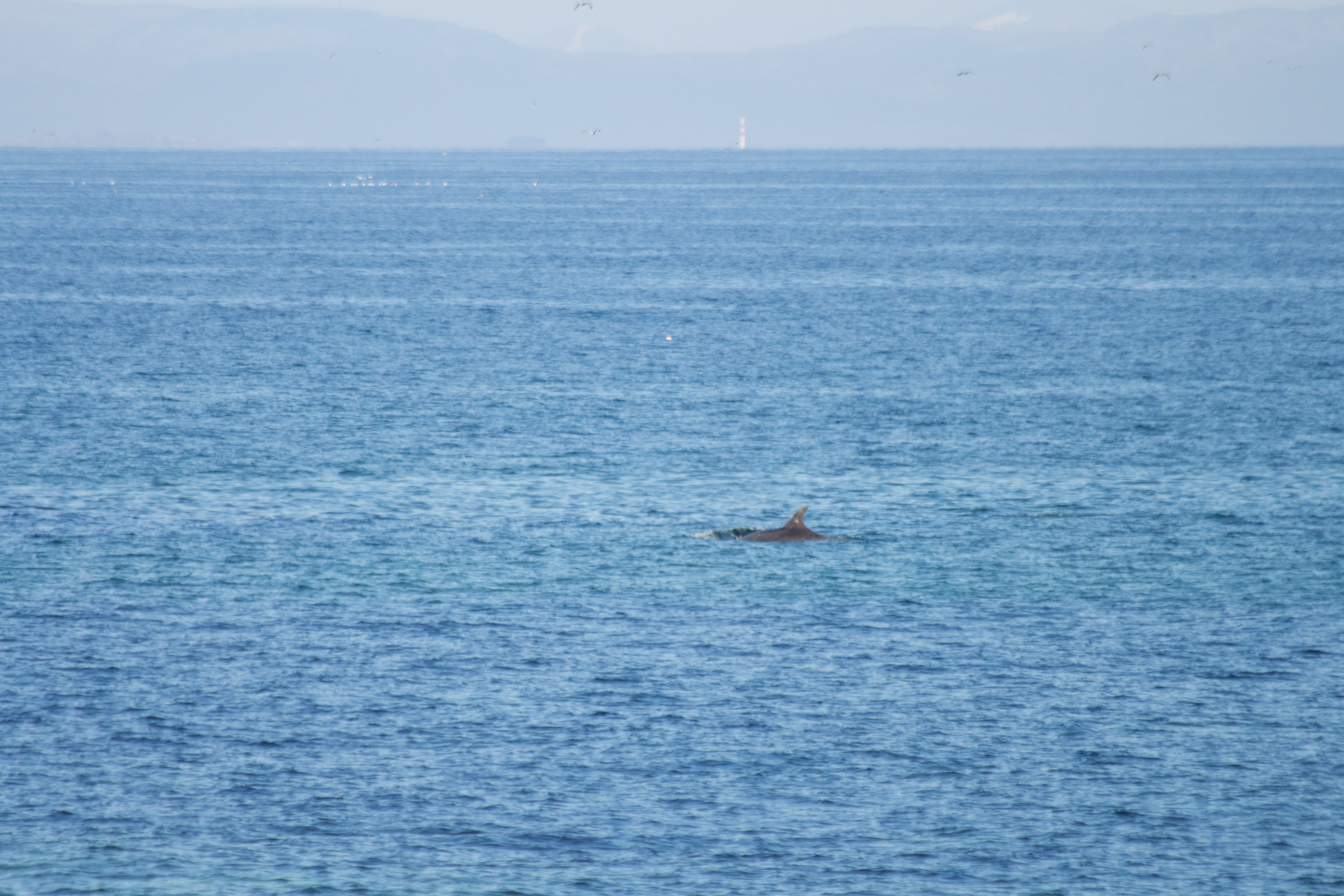
When I arrived in Scotland I was told that May was the true start of the bottlenose dolphin season, but I’ve already been spotting dorsal fins on the water. I’ve had three different sightings so far, and on the second I managed to photograph some for the first time. Even from a distance and with most of their bodies submerged, it’s easy to see just how large these marine mammals are. In fact, the bottlenose dolphins in the Moray Firth are the largest and most northerly in the world.
Bottlenose Dolphin
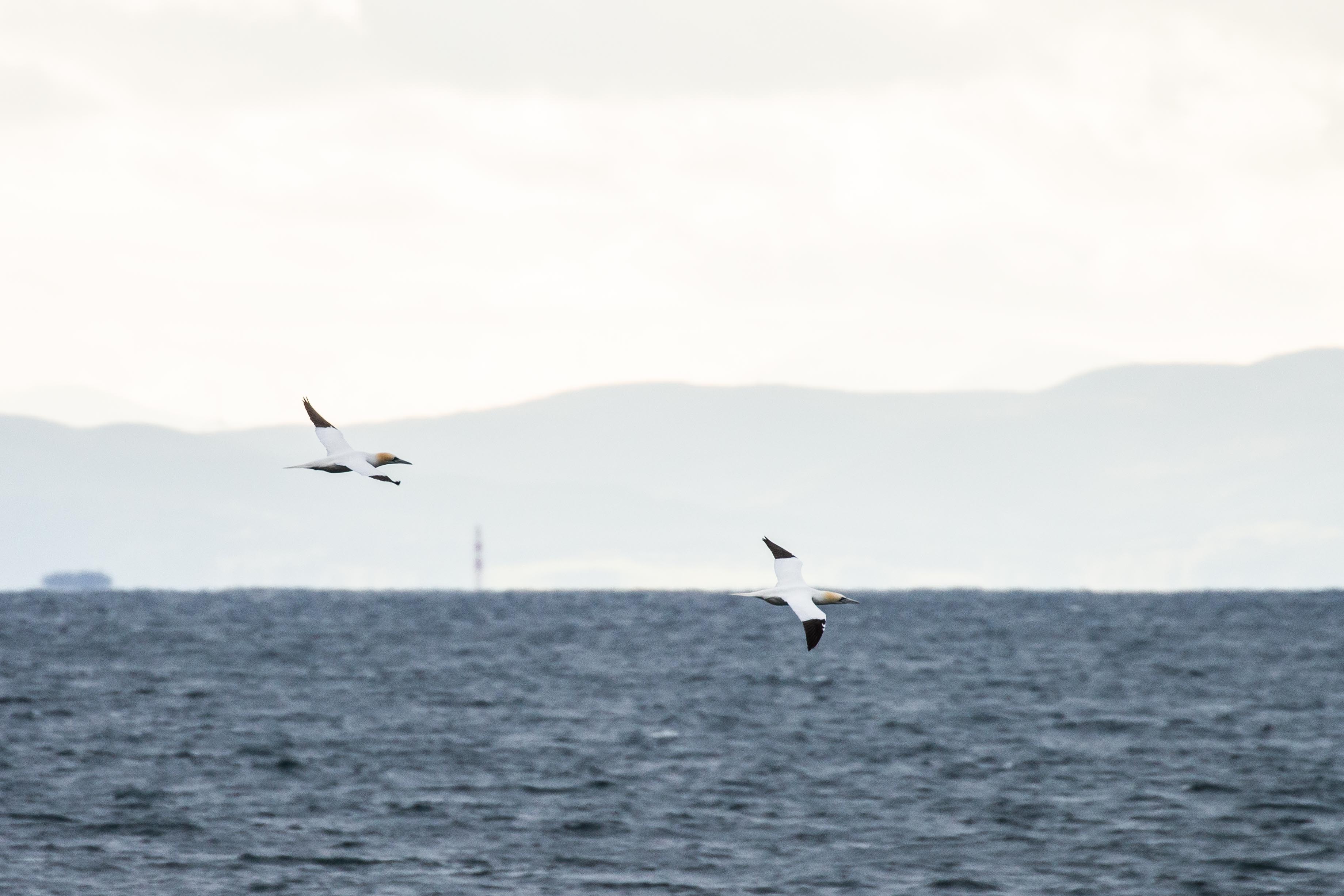
As well as cetaceans, there’s been some avian excitement too. My absolute favourite birds have arrived in my patch: gannets! I glimpsed a white wingspan last week but wasn’t sure if it was just another herring gull, but since then I’ve had indisputable views of these vast and beautiful seabirds. As well as flyovers, I had the privilege of watching a dozen gannets diving for fish just offshore – twisting their bodies and tucking in their wings at the last moment before hitting the water like feathered torpedoes. I’ve always been drawn to gannets’ subtle plumage and dramatic facial markings and it’s been such a treat to watch them in my patch.
Gannet
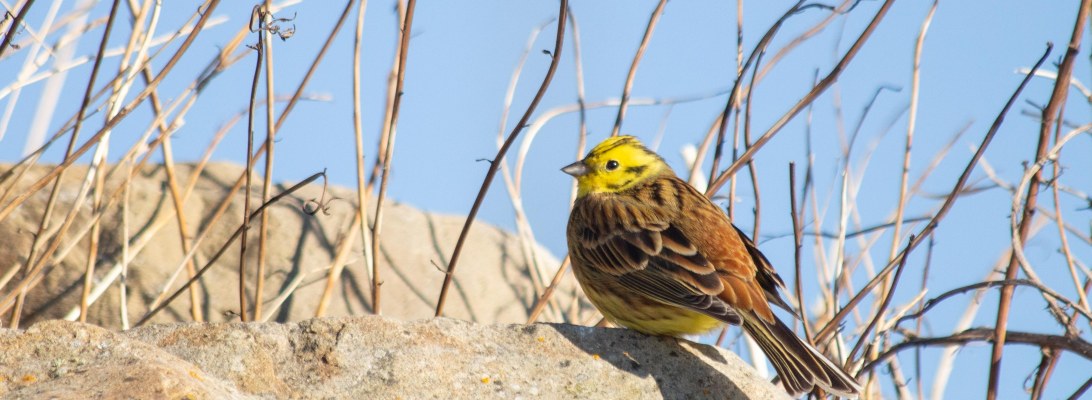
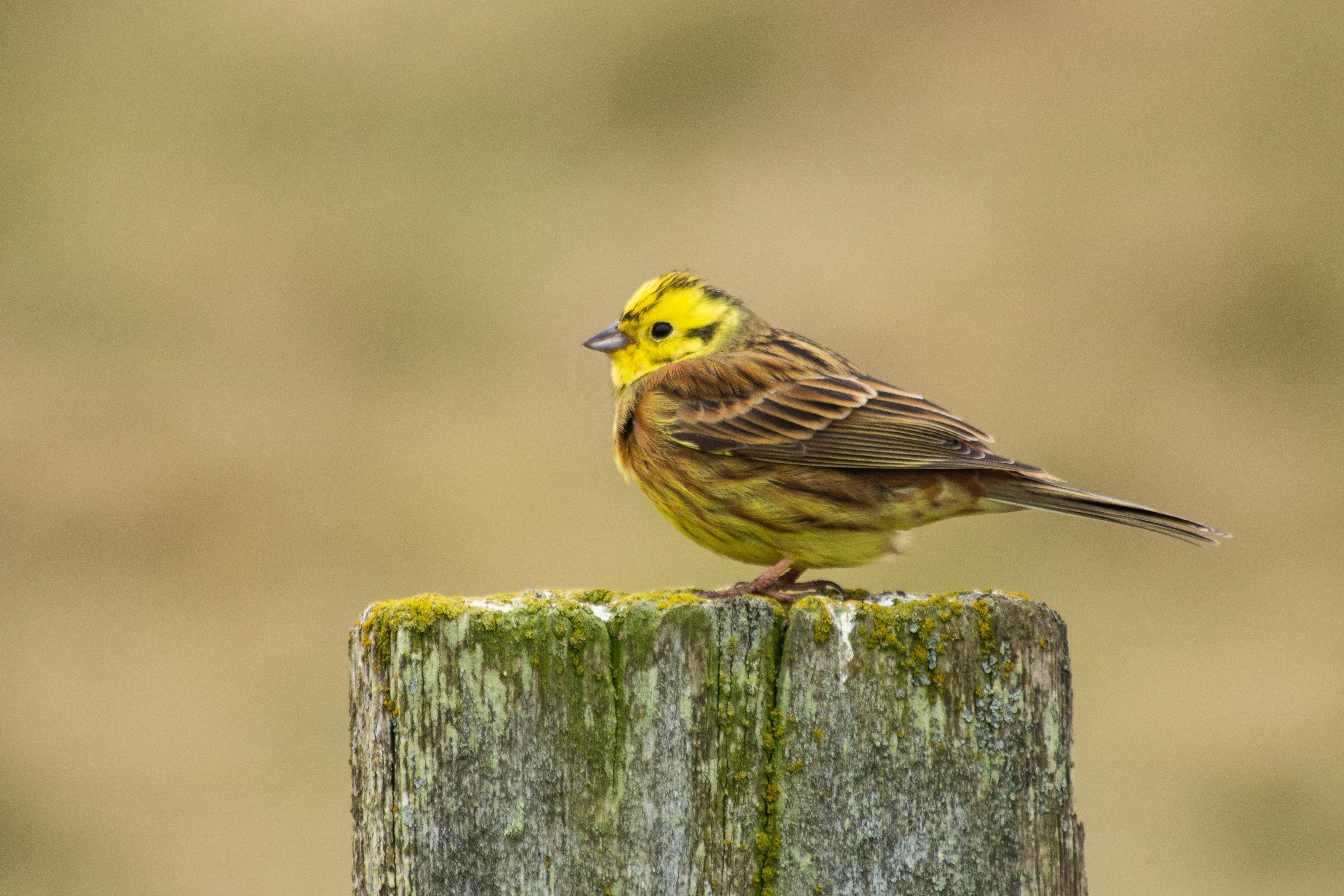
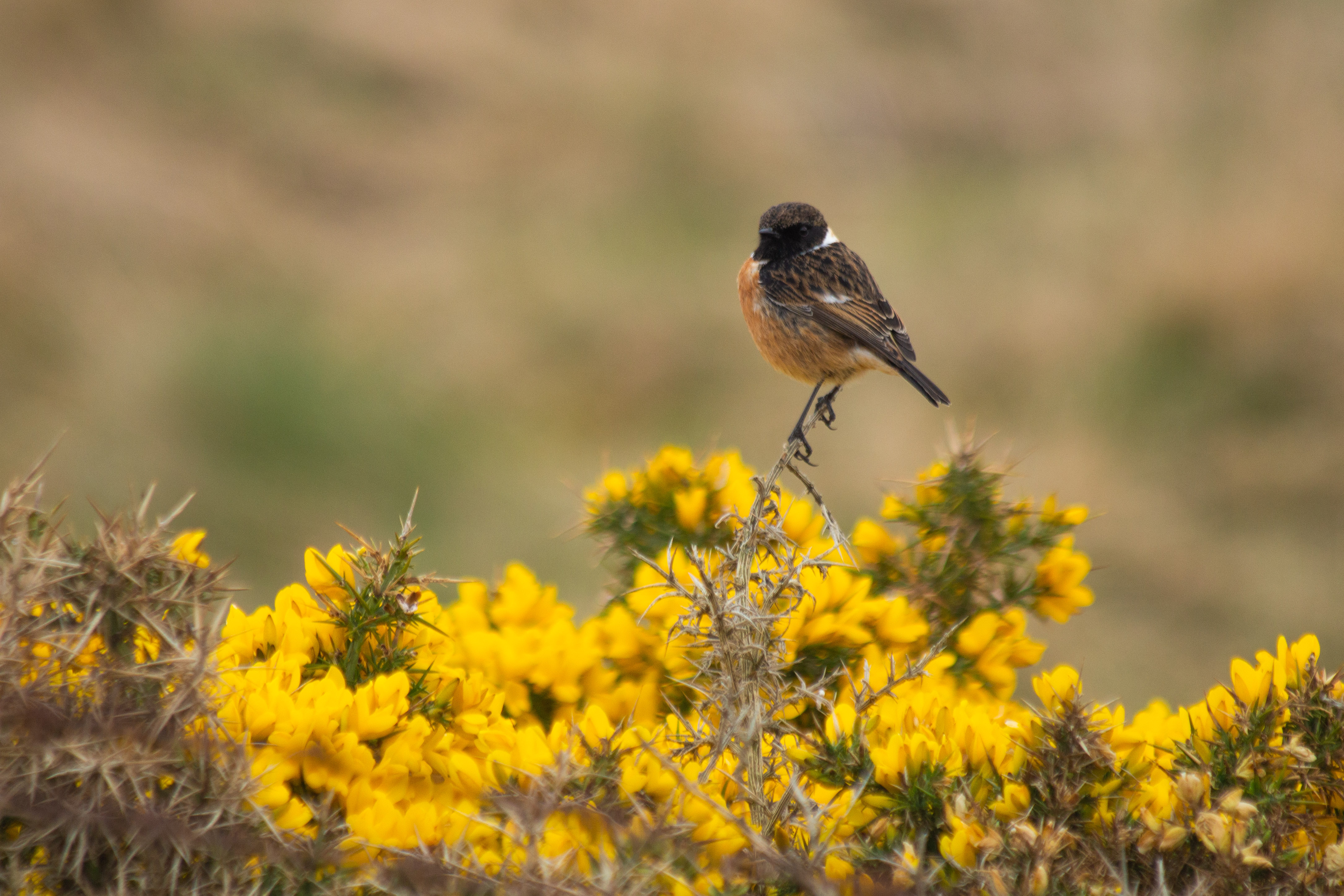
As I walk along the shore, I have the option of looking left to the ocean or right to dense clouds of gorse. As well as infusing the air with a beautiful coconut smell, the gorse provides excellent shelter for lots of different birds. Over the last week I’ve seen willow warblers, stonechats, linnets, skylarks, hooded crows, swallows, swifts and yellowhammers in just a small area. The charm of the gorse forest is that you never know what you’re going to spot and I’m almost always surprised by something.
Yellowhammer (male)Stonechat (male)
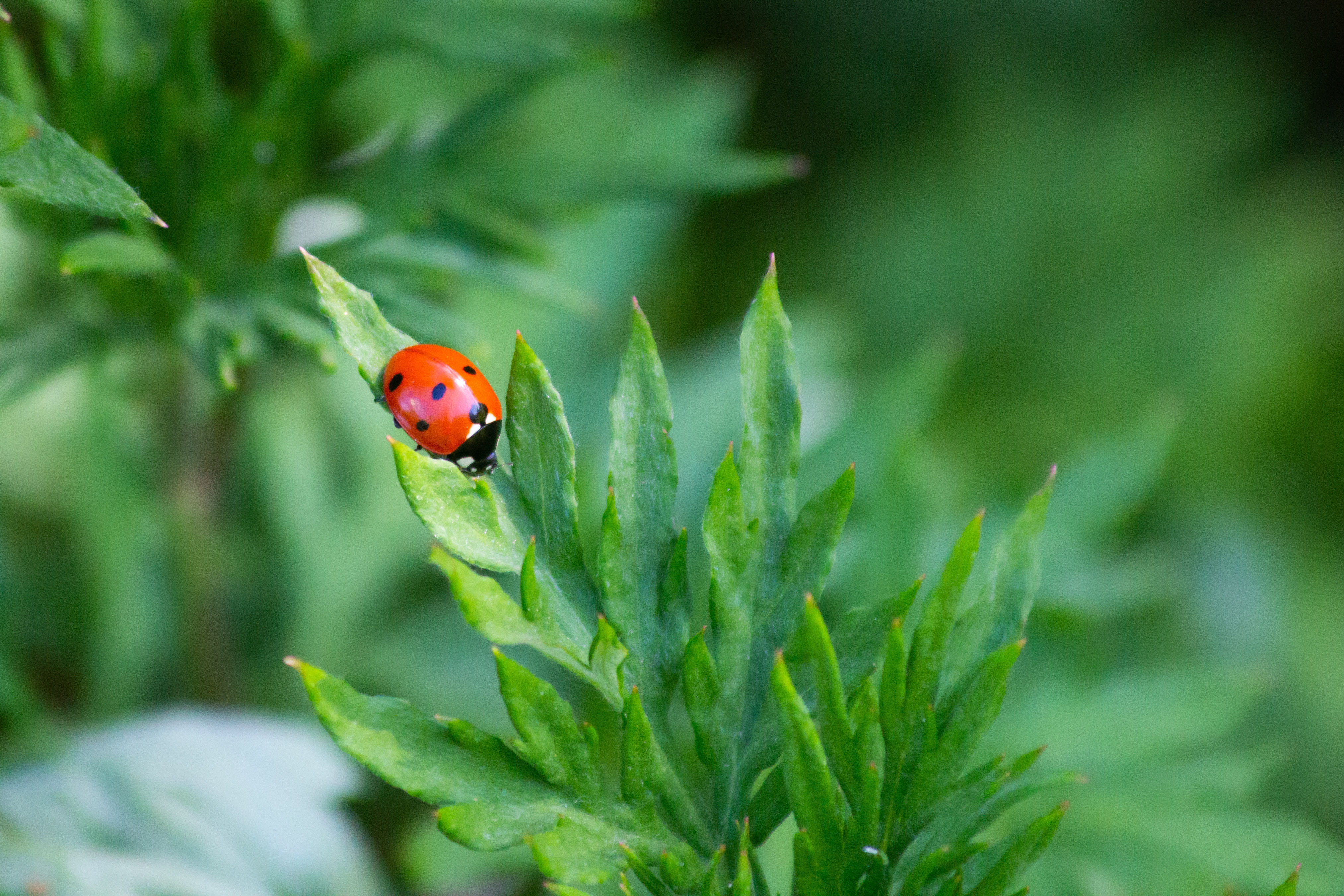
Although I’m usually drawn towards birds and mammals, I can’t help but notice emerging insects as the temperature climbs. Just along from the town allotments I’ve seen bees, peacock and red admiral butterflies and green foliage that’s speckled with ladybirds.
It’s been difficult for us all to stay connected to the natural world during the lockdown, but seeing snippets of spring visitors on my daily walks has really lifted my mood. Nature never fails to make me feel better, and it’s during these challenging times that our time spent outdoors is the most important. Stay safe and stay wild everyone.
Christmas is here again, which means it’s time to reflect on what I’ve achieved in 2019. I still have a long way to go before I can really call myself a freelance writer, but I’m so proud of the progress I’ve made this year.
A particularly significant event was the Grant Arms Wildlife Book Festival in April, where I travelled to the beautiful Cairngorms National Park to stay in what is undoubtedly the coolest hotel in the UK for wildlife lovers like me. I attended some fascinating talks, met many established writers and was thrilled to see my first pine marten. However, perhaps the most influential moment was meeting author Stephen Moss, who runs the MA in Travel and Nature Writing at Bath Spa University. We sat down for a chat and spoke about my work so far, and after our talk I began to think seriously about doing a masters. I was sad to leave the beautiful wilderness of Grantown-on-Spey behind, but I was also intrigued by the possibility of further study and what it could do for me.
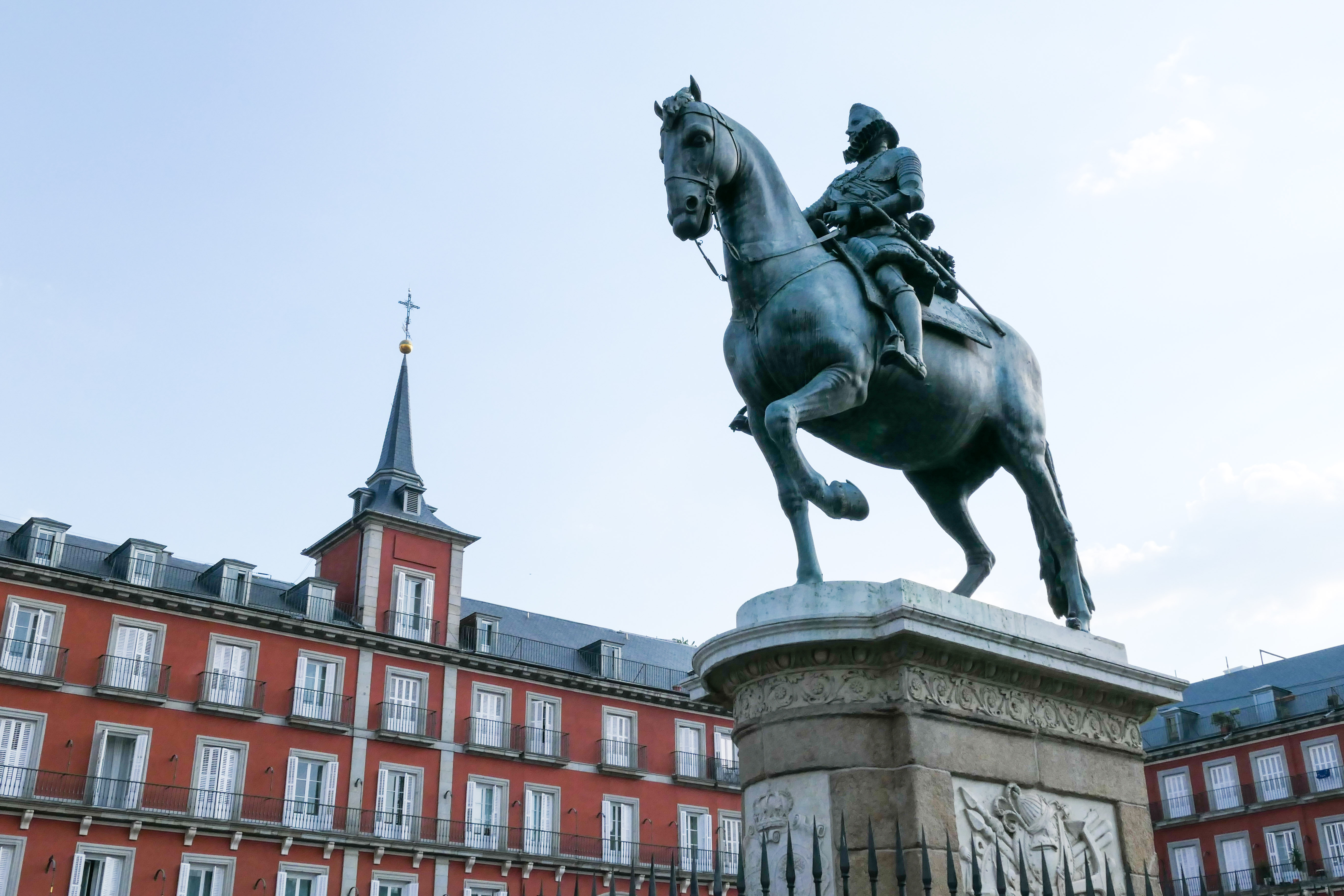
In the summer I visited Madrid – my first solo trip to a non-English speaking country. I don’t think it occurred to me how daunting that prospect could be until I arrived and realised that my A Level Spanish was a lot rustier than I had anticipated. Nonetheless, despite the language barrier and the most intense heat I have ever experienced, I really enjoyed my stay and learnt a lot about my resilience when travelling alone. Madrid is a beautiful city that I would love to return to some day, just in a slightly cooler season! The highlight was undoubtedly the flamenco show on my last night – that experience will stay with me for a very long time.
Not long after Madrid it was time to drive up to Rutland Water nature reserve for Birdfair, which has now become a yearly tradition. I caught up with good friends from uni, met the lovely Lucy McRobert and finally christened my new tent in the campsite. As always, Birdfair was a fantastic networking opportunity and I met some lovely authors and conservationists who were keen to share their advice. I also saw Stephen Moss again and bought rather too much wildlife art…
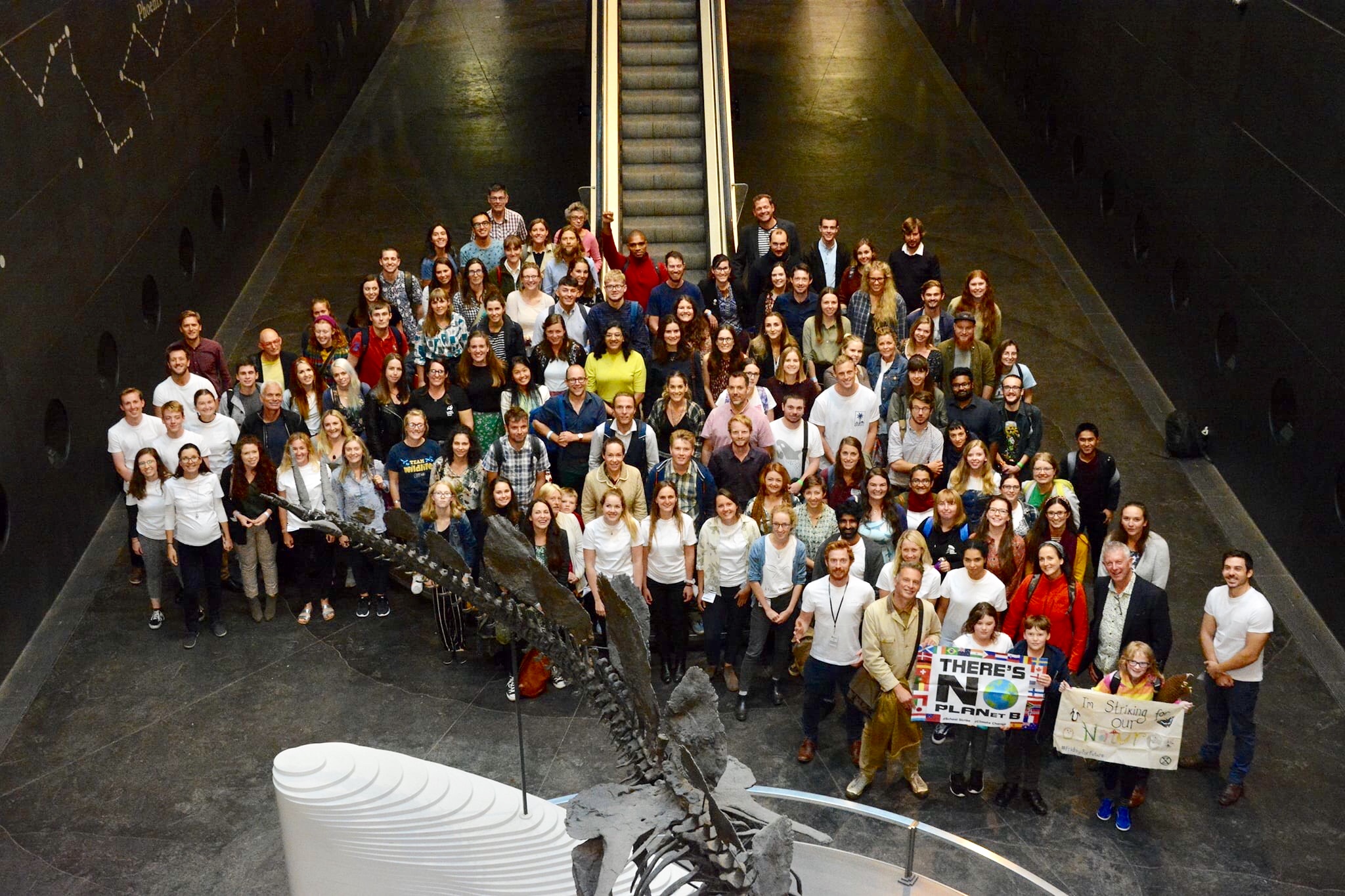
September saw some more networking at the AFON conference – I’d never seen so many young naturalists in one place and I felt proud to be part of that community. During the weekend I introduced myself to author and illustrator Tiffany Francis, who is one of the loveliest people I’ve ever met. I swapped Instagrams with lots of inspiring writers and conservationists, many of whom I’ve stayed in contact with since. Events like the AFON conference are such a great way of reaching out to like-minded people and I was so happy to build my network further.
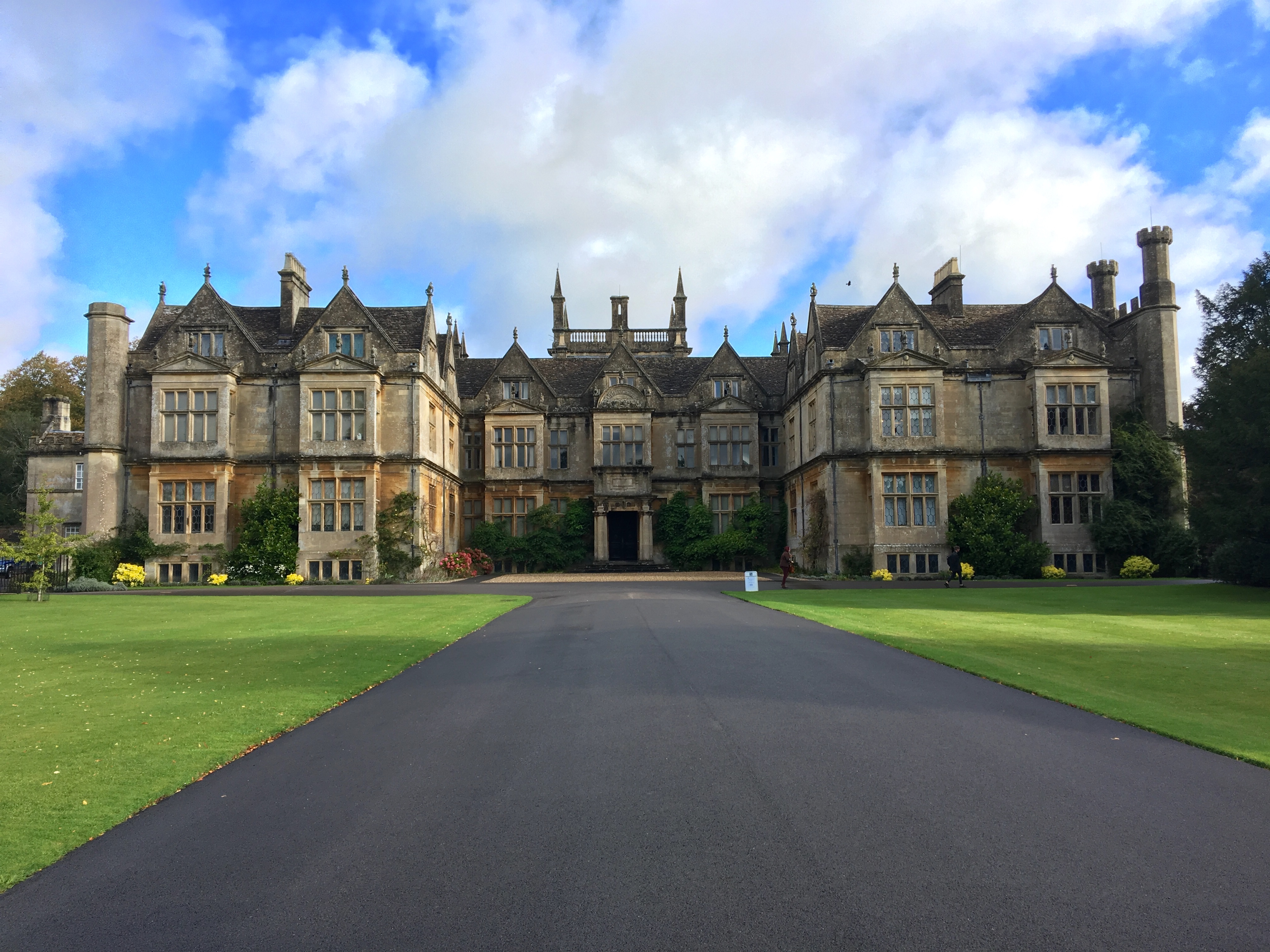
In October there was a very big change: beginning the MA. The week-long residential in Corsham was a chance to meet my fellow students and be introduced to the way the degree was run. I’m sharing the year with a diverse and enthusiastic group of people and I already feel close to them after so little time. An unexpected achievement has been my rekindled love for drawing and painting, which has proven to be a great tool for inspiration. So far I have submitted two assignments for the course and have been really pleased with my results. The second term will begin in the new year and I can’t wait to tackle the next module – a trip completely organised and funded by me where I need to try and get writing commissions from professional publications. Naturally I’m apprehensive about it, but I’ve done this before with the Isles of Scilly so I know once I begin my research I’ll be away.
Finally, the end of 2019 saw my first official commissions – two for Blue Sky Wildlife, two in Hertfordshire Life magazine and the completed annual report for SEZARC. The team in Florida loved what I’d done and have now asked me to make the next report for 2019, which I can’t wait to get started on. In fact, I’m excited to announce that I shall be visiting Florida again in 2020. Not only will it be a chance to see my friends and work colleagues, but also a fantastic opportunity to gather new images to use in the next report. I don’t know when it will be yet, but I’m so excited to get the details in place.
Hertfordshire Life Magazine
I began this year feeling a little shaky and unsure of exactly where I planned to go. I still don’t have everything figured out, but the commissions have given me a real boost of confidence. It has been great meeting other naturalists including young women like Tiffany Francis and Lucy McRobert, as well as everyone on my course who are all making amazing contributions to wildlife writing. I have a great feeling about 2020, and I can’t wait to see where I am this time next year.
The gloom that had settled over the Cairngorms earlier in the week was long gone. As we pulled into the car park I leant forward and saw sunlight pouring through the coniferous canopy in diagonal slants, turning green needles shimmering gold. Another forest to explore! I couldn’t wait.
Once all members of the convoy had arrived, we gathered around the notice board. Abernethy was the second largest nature reserve owned by the RSPB, spanning 140 square kilometres. It was home to around 5000 species – a list that grows every year. Our guide, Simon Pawsey from the Bird Watching Wildlife Club, looked up the crested tit on his Collins Bird app – something I definitely need to get at some point – and quietly played us the bird’s call: a rapid trilling that I was sure I would be able to distinguish above the chaffinch’s constant rambling, as lovely as that was.
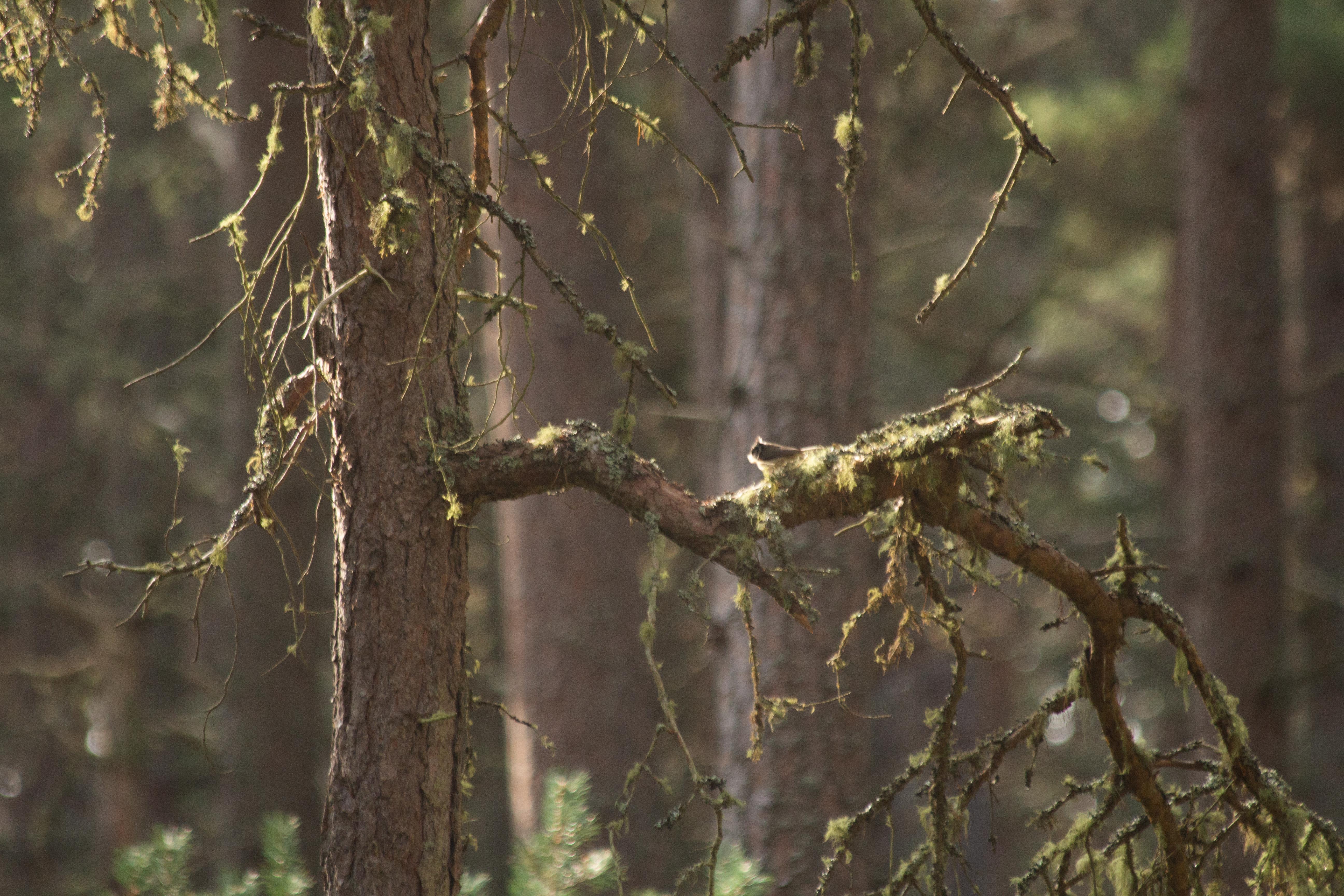
As Simon continued to tell us all about cresties, a small bird caught my eye a few dozen feet away. Lifting my binoculars, I focussed in and nearly disregarded the bird as a coal tit, which was exceptionally common in the local area. But then I noticed a peculiar tuft of feathers on the bird’s head. Surely not… A halo of light fringed the bird’s body and I squinted to make sure, keen not to make a fool of myself in front of all the other birders. But it was! It really was a crested tit! I exclaimed this to the group, embarrassed about interrupting Simon but deciding it was well worth it.
Not a great photograph, but an amazing sighting!
There was a flurry of excitement as we all pinpointed the crestie for those who hadn’t spotted it. The bird was perched on an obvious branch in a relatively open clearing, sitting at eye level in a car park full of human voices and slamming doors. It was such a good view of a species that I thought I’d only get a snatching glimpse of at the very top of a huge Scots pine, if that. The crestie stayed for a few minutes, allowing us all to admire him before he took off and disappeared. Our guide had been talking about crested tits and a crested tit appeared for us all to see, almost like a “Here’s one I prepared earlier” moment. What an extraordinary start to the day!
Buzzing after our first sighting, we set off into the forest, keeping an eye out for crossbills or red squirrels that might be foraging above. Several times a pair of dark wings high above had us briefly excited that we’d spotted an eagle, but each time it was a buzzard, or “tourist eagle” as it was often referred to in the Highlands.
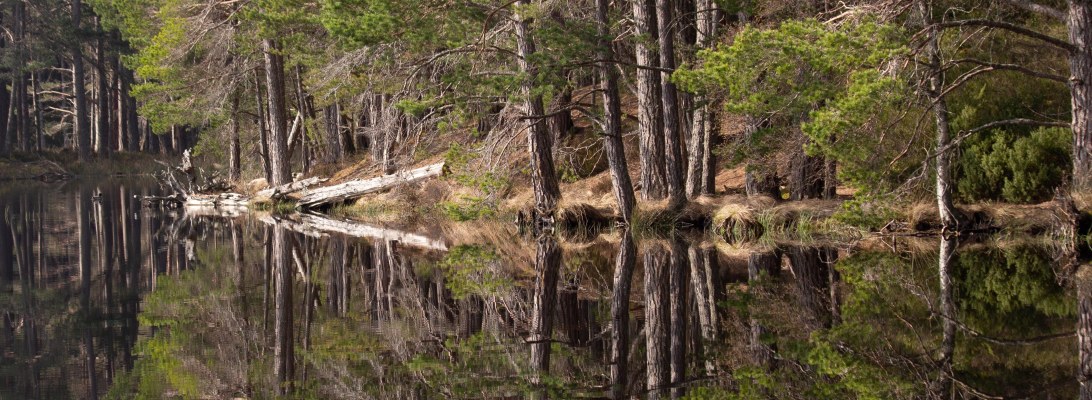
Before long Loch Garten came into view, and even with just a glimpse through the trees I knew it was going to be impressive. There was no breeze to stir the water so the loch lay as flat and still as a mirror, casting a perfect reflection of the trees along the margins and the blue hills in the distance. The only disturbance to the glassy surface was a lone mallard swimming far out in the loch, scratching a line across the water. Not a sound could be heard. As I stood on the bank absorbing the view, I thought how Loch Garten could be the perfect setting for an elaborate fantasy story. It was such a wild, beautiful place: seemingly tranquil and calm but with the power to turn at a moment’s notice.
If I’d been alone, I would have sat by the loch all day, but I was here for birding with the group so reluctantly took my last few photos and followed them further along the trail, skirting the edge of the water. Sure enough, we found a red squirrel, although the animal was trickier to see than on the feeders in Anagach Woods back at the hotel. A bright orange mammal is surprisingly difficult to spot in dense green foliage, and it was only its sudden movements that gave it away.
After a while another loch came into view: Loch Mallachie. Here we were met by a gaggle of greylag geese as they glided across the water. This part of the reserve was marshier, and not far from the land we were stood on was a smaller island with far shorter trees. Simon explained that they were the exact same type as the giants that surrounded us on dry land, but because of the variation in soil quality and nutrients, the same species was half the size only a few metres away.
Suddenly one member of the group pointed out two dark specks on the horizon. I prepared myself for the inevitability of more buzzards, but once Simon had set up his scope I heard some very satisfying words: “Those are eagles”.
Everyone rushed towards the bank for a better view. The birds were very far off – tiny pinpricks on a white horizon – but sharp-eyed Simon could make out white patches on one of the eagles, suggesting it was a juvenile. After a while scanning empty sky I managed to locate them in my binoculars. They glided seemingly effortlessly at a dizzying height, barely moving their wings as they soared through the thermal currents. It was such composed flight: the movement of a creature that dominated its landscape. Fortunately, the eagles were flying closer, so one by one we had a peek through Simon’s scope. When it was my turn, I was thrilled to make out the bird’s head and beak even from such a distance. I’d seen a golden eagle once before on the west coast, but this was by far the clearer sighting. Eagles were the true celebrities of Scottish wildlife, and to see two at once was so special.
The eagles soared in large circles for a while before gliding further out of reach of our scopes and binoculars. Once again the group was buzzing. I couldn’t believe how lucky I’d been this week. After only four days in the Highlands I’d seen crested tits, crossbills, red squirrels, a pine marten and now two golden eagles. It reminded me of the importance of patience but also of luck; how being in the right spot at the right moment can bring unforgettable experiences. Being from the southeast where wildlife is far less abundant, I would treasure the sightings I’d had this week for a long time.
After one day of the Grant Arms Wildlife Book Festival, I had already ticked off 27 species. The morning started off gloomy so I wrapped up knowing that the Highland air would bite without a little sunshine. After a delicious breakfast I met my guide Sue and we set off. Our destination was Anagach Woods, only a five minute walk from the hotel. I knew it was my kind of place from the first glimpse: dense evergreen trees, a winding trail and the lyrical murmuring of birdsong. The harsh, icy breeze that made the eyes squint and the neck shorten completely disappeared once we strolled past the first few trees.
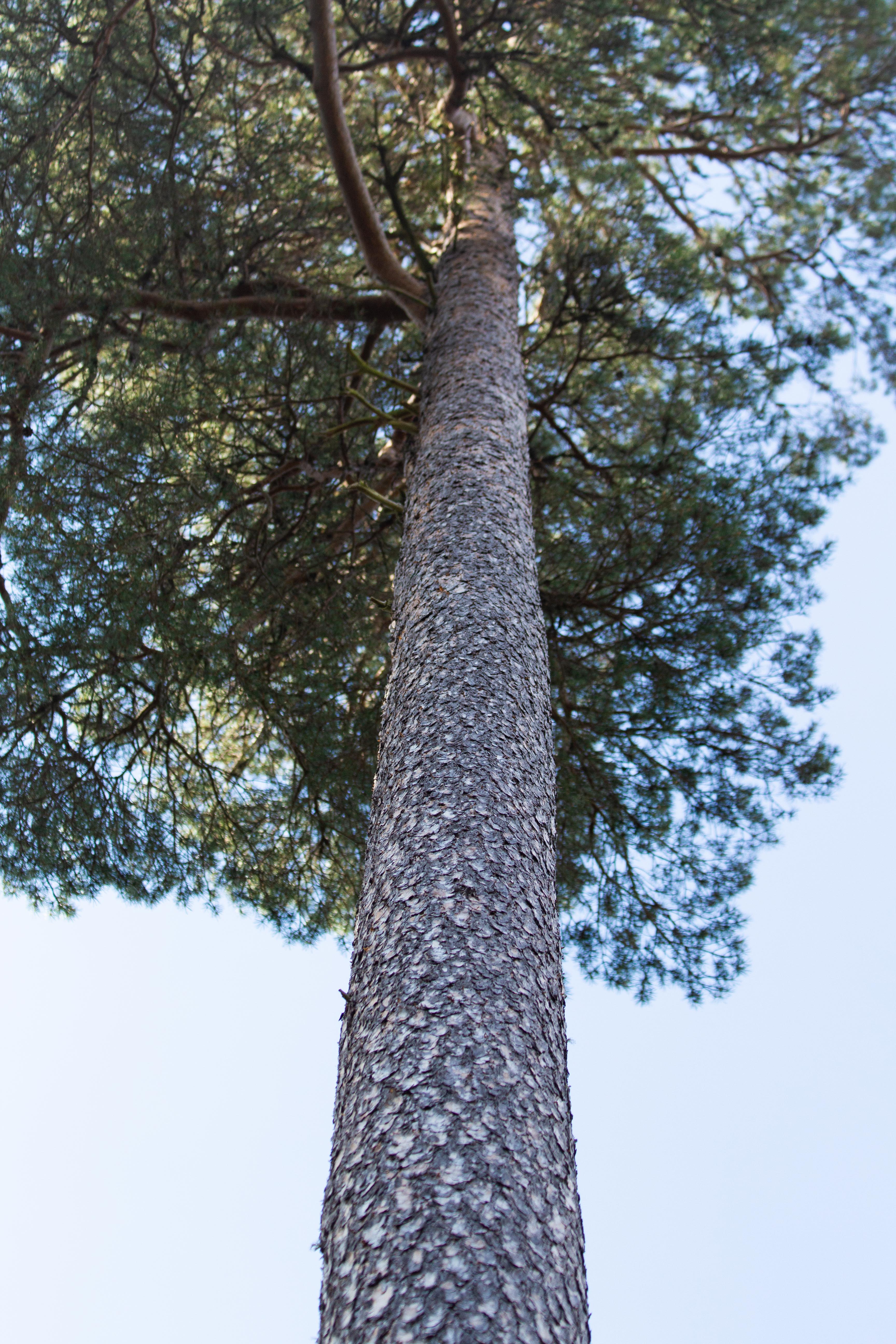
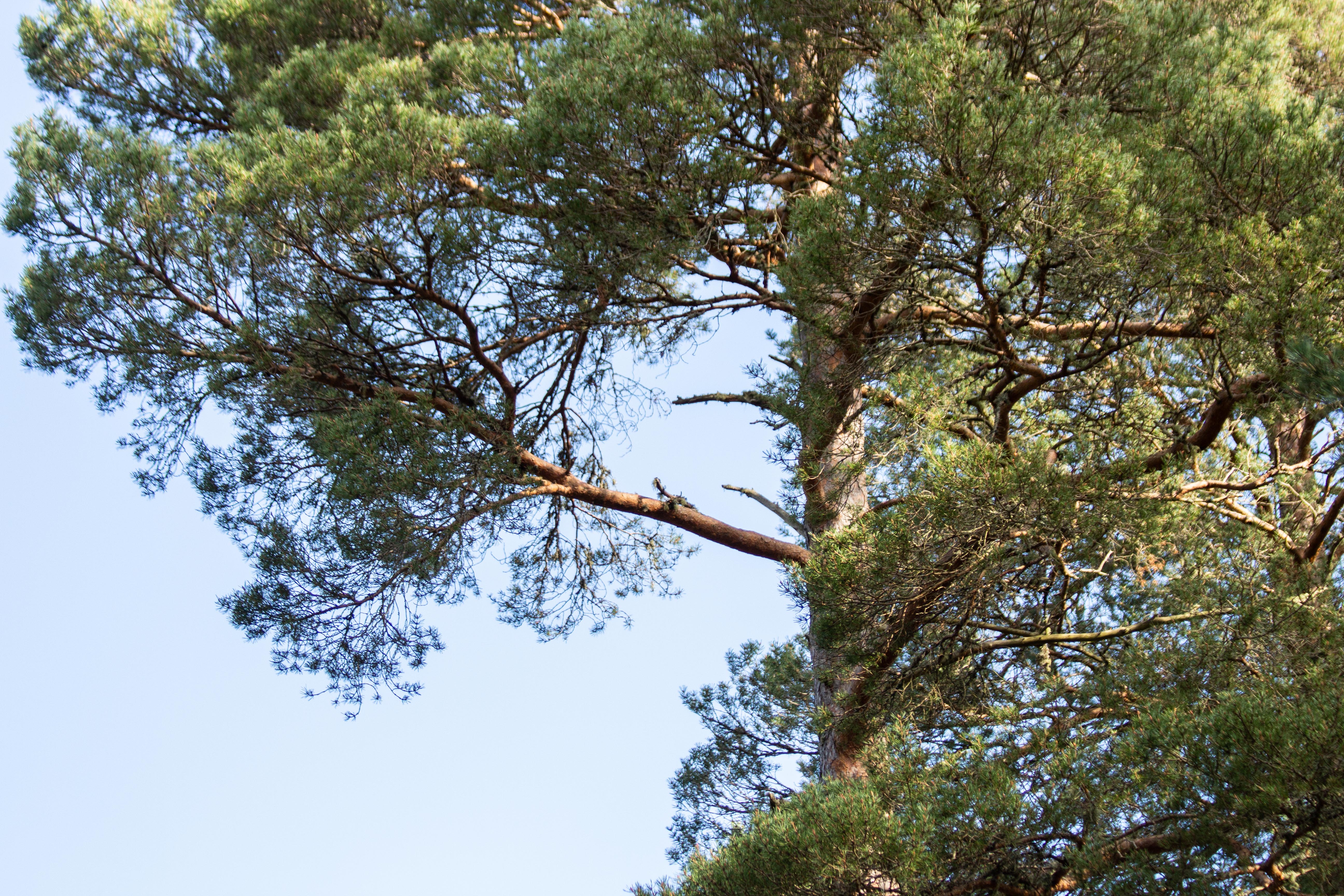
Anagach Woods were planted in 1766 using young pine trees dug up and transported from the old Caledonian pine forest of Abernethy. A few of these original trees are still standing today; wizened goliaths surrounded by waxy saplings. Throughout Anagach are deposits in the form of fluvio-glacial ridges, raised beach sands and gravel deposits dating back 10,000 years to the Ice Age. “Fluvio-glacial” refers to the meltwater created when a glacier melts.
Within ten minutes of entering the woods, I had my binoculars trained on a red squirrel -tail and hands poised in the classic pose as it nibbled on a peanut. A completely peanut-based diet causes a deficiency in red squirrels, so the rangers fill their feeders with a special mix to keep the squirrels’ diet balanced. Whether the animals follow the regime is another thing entirely, and they don’t. They prefer to pick out the peanuts with the steely determination of a child eating around their vegetables.
It’s impossible to dislike red squirrels. (Personally, I have no quibbles with greys either – they’re not inflicting reds with the pox with any malicious intent, nor did they ask to be brought here.) Reds have the eye-watering cuteness of babies their entire lives, coupled with boundless energy. We watched two up in the tree, neither tolerating the other’s presence. After a brief, silent stare-down, a ferocious squabble broke out. In the blink of an eye, two orange flashes flew up the tree, twirling around the trunk with scrabbling claws. The victor was soon perched proudly on the feeder shelf – stuffing head, front legs and one back leg inside to grasp the prize.
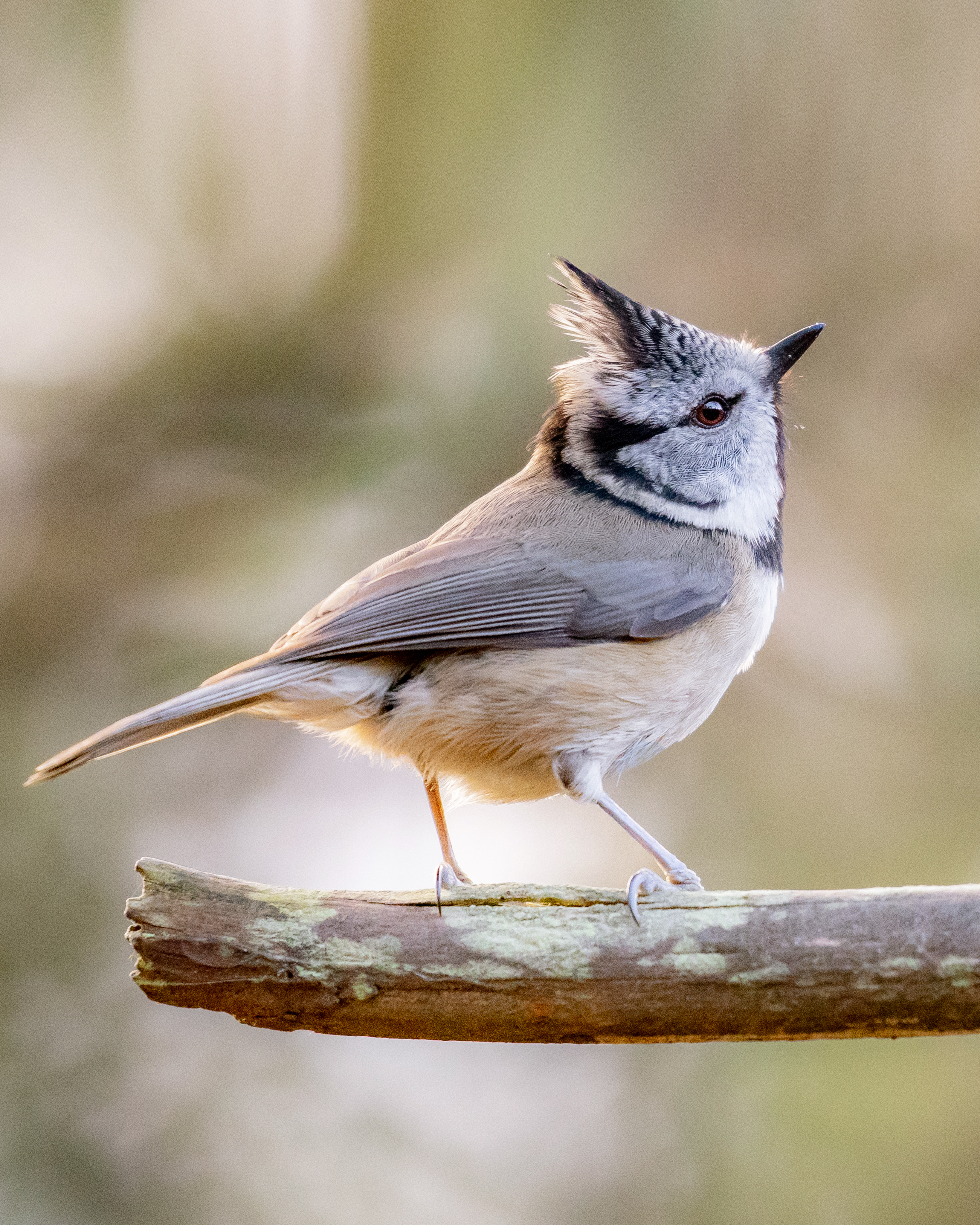
We ventured further into the forest. Each time a branch quivered or a chirrup sounded, I scoured the canopy for a particular little bird with a very impressive Latin name. Lophophanes cristatus is mostly confined to ancient Caledonian pine forests and Scots pine plantations. On the RSPB map of the UK, this bird’s presence is indicated by only a small patch in the Highlands of Scotland. A member of the tit family, it sports a magnificent punk hairdo.
Photo: RSPB
I had my sights set on the crested tit. As small as the far more common blue tit, the “crestie” is a firm favourite among Grant Arms guests and features on many wish lists including my own. My main objective during my time in the Cairngorms was to see a pine marten (dream big, I say). Or, if that dream turns out to be a little too big, I will happily settle for any new species. I kept my eyes peeled for cresties but sadly they eluded us that morning. Sue said that at this time of year they would be right at the top of the trees gathering nest material. When those trees stretch to dizzying heights of around twenty metres, spotting a tiny bird in the dense canopy would certainly be a challenge.
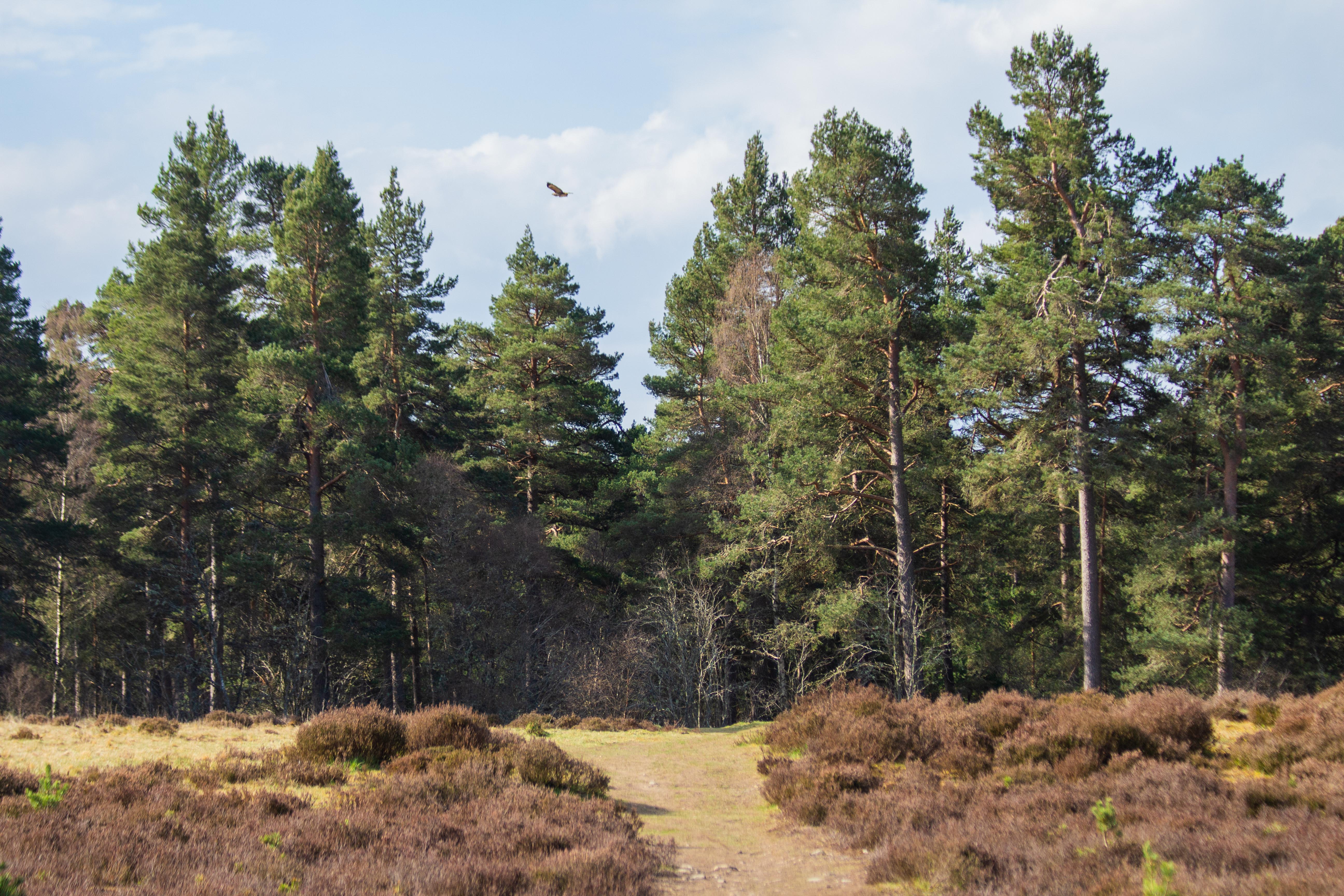
Despite the crested tit playing coy, we were treated to a lovely showing of a buzzard. Buzzards are one of those species that I sometimes underestimate. They don’t tend to get me too excited – especially for that one split second when you think you may have found an eagle – but that morning in Anagach I saw a buzzard land for the first time. Up in the air and bleached out by the sun, it can be hard to make out specific detail, but as the raptor perched in the pines, I could admire its snowy white chest – as soft as an owl’s – with speckled markings that gave it the air of a regal monarch’s gown. The buzzard preened its feathers for a while before taking to the air and melting into the trees. It was a fitting way to summarise the forest habitat: a creature can be there one moment, and vanish the next. Forests are irresistible to me, and Anagach easily became my new favourite.





















 rebeccaonthewing.com