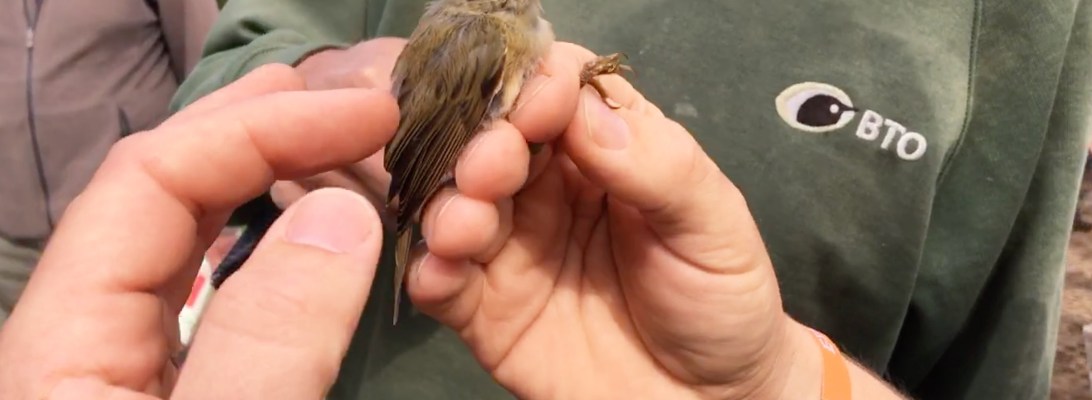
On the last day of Birdfair, I was keen to escape the bustle and crowds of the marquees and explore the surrounding reserve. On my way out to one of Rutland Water’s many hides, I was drawn to a small crowd gathered around the BTO bird ringing tent, where a demonstration was in full swing. As I got closer, I saw two chiffchaffs poking their tiny heads out of the ringers’ gentle hands. One was a mature adult with smart plumage; the other was a scruffy juvenile, two thirds of the size of its companion. The ringers held out the birds’ wings, displaying a delicate and powerful fan of primary feathers. Both chiffchaffs sat still and quiet in the hand – if it hadn’t been for their blinking beady eyes they could have easily been mistaken for taxidermy specimens.
After all the measurements had been taken, the ringers asked for two volunteers to release the birds. To my surprise only two hands went up, one of which was mine, so I followed the ringer to an open spot away from the marquee. He told me to hold my hand in a loose claw then he gently placed the juvenile chiffchaff into my palm, its tiny head nestled between my index and middle finger. I closed my hand slowly and the bird wriggled. I couldn’t believe I was holding something alive and yet so small. Its body was warm and unbelievably soft. Carefully, I put the hand holding the chiffchaff down onto my other open palm and slowly released. For a moment the bird rested there and then launched itself into the air, disappearing almost immediately over the trees.
I felt what could only be described as a surge of pure joy as I released the chiffchaff back into the wild. It was a real Snow White moment and in that fraction of time I felt exceptionally close to nature. Getting to hold such a tiny and wild thing in my hand was such a privilege. As I made my way to the hide I noticed there was a minuscule downy feather stuck to the tip of my finger and I quickly stashed it in my phone case. Wherever that chiffchaff wandered now, I had a small piece of it with me.
Lucy McRobert lost her mother to cancer when she was sixteen. Although it wasn’t as easily recognised at the time, she feels she suffered from some form of anxiety or depression, which she unconsciously suppressed until university when she rediscovered her love of nature. It was this passion for wildlife that helped her overcome the grief she had kept concealed for all those years.
It’s been proven that spending time outside and connecting with nature improves mental state and wellbeing. “Just like eating a balanced diet and exercising helps our minds and bodies”, Lucy writes, “Wildlife and wild places help us to get active, encourage us to be more social, improve our confidence and creativity and help us cope with stressful life events”. It’s true that nature is free therapy, but it’s also true that with hectic schedules and mundane commitments it can be difficult to get outside, or sometimes even find the motivation to do so.
That’s where 30 Days Wild came in. During her time working for the Wildlife Trusts, Lucy set up the 30 Days Wild campaign to encourage people to do “random acts of wildness” for every day in June. Involvement has grown exponentially since the campaign began five years ago and encourages everyone to take part in wildlife-based activities, whether that’s noticing something new, sharing experiences with others or taking a more practical approach and making positive changes to the environment.
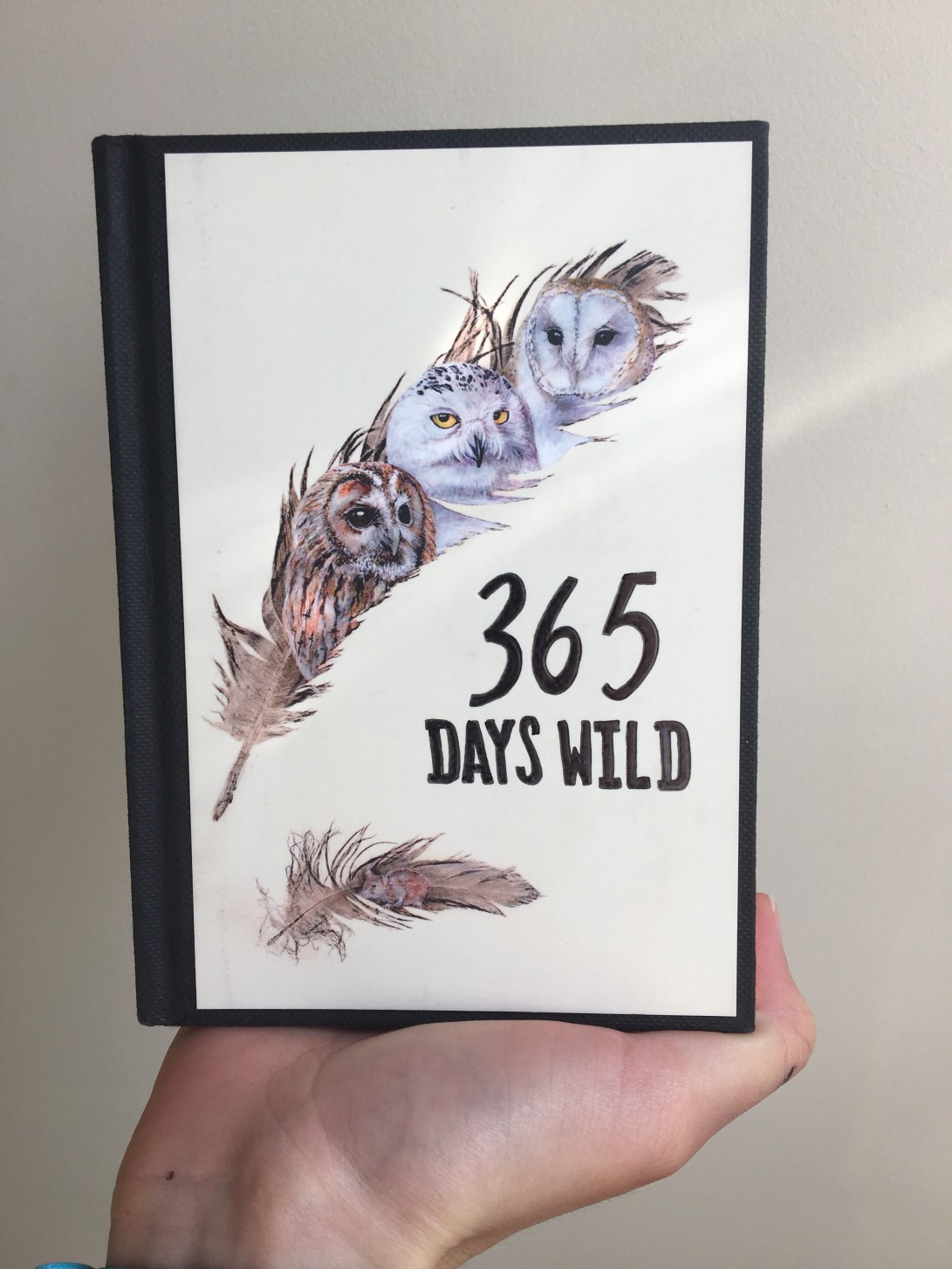
The campaign led to Lucy expanding 30 days into 365 and so came her beautiful new book, published earlier this year. The concept isn’t to climb a mountain or build a pond each day, but instead encourages us to take part in ways as simple as making a daisy chain or buying a reusable coffee cup. When broken down into small steps and prompted by useful hints and ideas, Lucy’s book shows that it’s easy to stay wild even in a technological world.
I’m embarrassed to admit that I signed up for 30 Days Wild a few years ago and abandoned ship within the first week. Now I see that I’d had my sights set too high. Sometimes it’s impossible to walk outside every day, so Lucy recommends stashing back-up plans up your sleeve, such as buying a new field guide or queuing up a Netflix documentary when you’re feeling lacklustre or just lacking the time.
Inspired by Lucy’s passion and eager to give the project another go, I purchased something I’d seen earlier at Birdfair but couldn’t think of anything to use it for. I’d spotted a beautiful hardback sketchbook with stunning artwork from Mandi Baykaa-Murray AKA “The Feather Lady” on the front, who paints extraordinarily detailed bird portraits onto feathers (side note: check out Mandi’s art it’s truly incredible!) Now I had the perfect reason to buy it. Day one: Start a wild diary.
Once I’d pushed my belongings through the campsite in a wheelbarrow, I began the head-scratching task of setting up my tent. I didn’t have much camping experience, but after a practice in the garden earlier in the week I was feeling confident. There was a brief tussle with a stiff breeze, but soon I had everything pegged down and in location. I was in business.
I straightened up to admire my handiwork and locked eyes with a cow twenty feet away, separated from me by a wire-thin fence. I wasn’t entirely thrilled with my neighbour for the weekend and eyed her suspiciously. I’d always been a little wary around cows – a few years ago I’d been crossing a field full of them, which had unfortunately been unavoidable, and when I was halfway across the herd started lumbering towards me at full speed. They say you shouldn’t run from cows, but I had vaulted over that fence with the steely determination of a long jumper. Luckily, this one didn’t seem like she had it in for me, and only stopped long enough to urinate before plodding back towards the herd.
Once everything was in order, I sat in my camping chair and admired the view. The setting sun cast a pink blush over Rutland Water. Although this campsite was slightly further away from Birdfair than the main site, this one had far superior views, not to mention it was blissfully quiet. House martins were out in force, plucking insects from the air and plunging in graceful loops. A little further away a kestrel was hunting, body suspended motionless between two rapidly beating wings. In the stillness, a gaggle of chattering geese passed overhead, but they were too far up for me to recognise the species.
I couldn’t wait for Birdfair to begin. This year would be my third, and I loved being a part of such a prestigious and important event in the wildlife calendar. It’s wonderfully indulgent for bird nerds like me – an impressive gathering of thousands of naturalists, conservationists, photographers and more, not to mention a dizzying range of things to see and do.
Once the sun had set, leaving behind an evening chill, I retreated to the warmth of my tent, snuggling up in my sleeping bag to get a good night’s shut eye in preparation for the first day of the fair.
As diluted sunlight comes streaming through the window I’m awoken by the squalling of gulls – a tangled symphony of disgruntled burbles, high-pitched cheeps and open-throated cackles from chimney top perches.
The weather in the Scottish Highlands is always a lucky dip. Some days I wake up to driving rain and moody skies. Today the sky is bright, streaked only by wispy cirrus clouds. Despite the sunshine, there’s a bracing wind skirting up over the waves and whipping them up into frothy white peaks.
A gaggle has assembled on the beach while the tide is far back. Common sandpipers hurry across the sand, weaving their way between bunches of seaweed strewn around like abandoned clothes. A handsome oystercatcher kicks up a fuss, its shrill piping call spreading far along the beach. House martins swoop like missiles over puddles left behind by the tide, their inky blue plumage gleaming in the sun.
There isn’t a soul here. On a warm, sunny day like this in the south, the beach would be clogged with sun-bathers and a garish patchwork of multi-coloured towels. Here, the beach is my solitary refuge. The water may be icy, but the views are stunning.
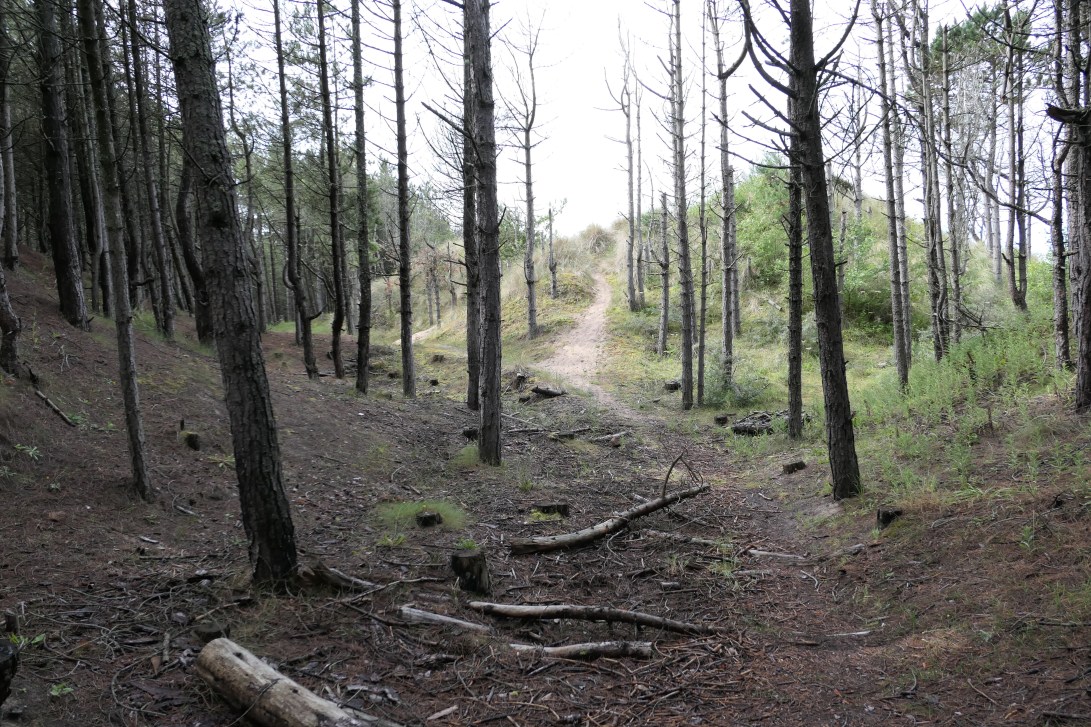
After weaving my way through assorted rocks worn smooth by the ocean and abandoned shells lying chipped and half-buried, I clamber up the steep dune running the length of the beach. My boots sink and sharp grass brushes my legs but I finally reach the summit and slide down the other side. The coastal wind instantly dies like a door has been slammed against it. The forest is sheltered and muffled against outside noise. Seclusion is one of the habitat’s best qualities. There is a feeling of anticipation upon entering a forest. It’s full of surprises.
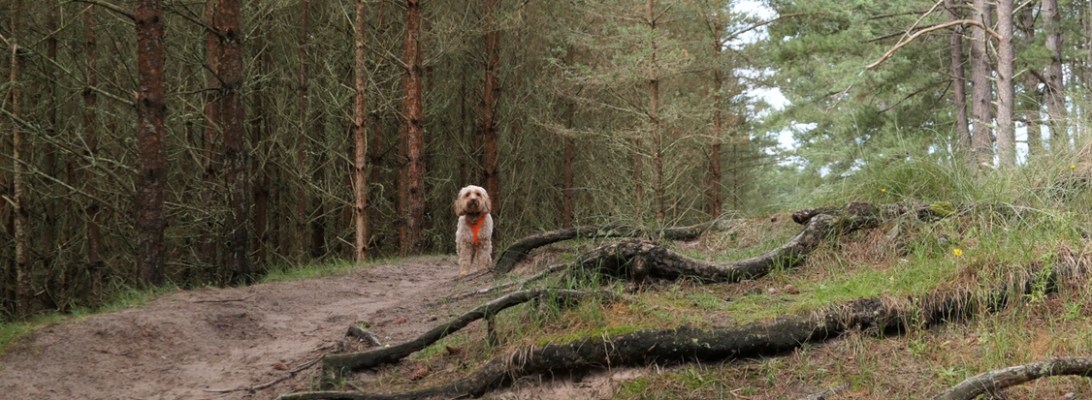
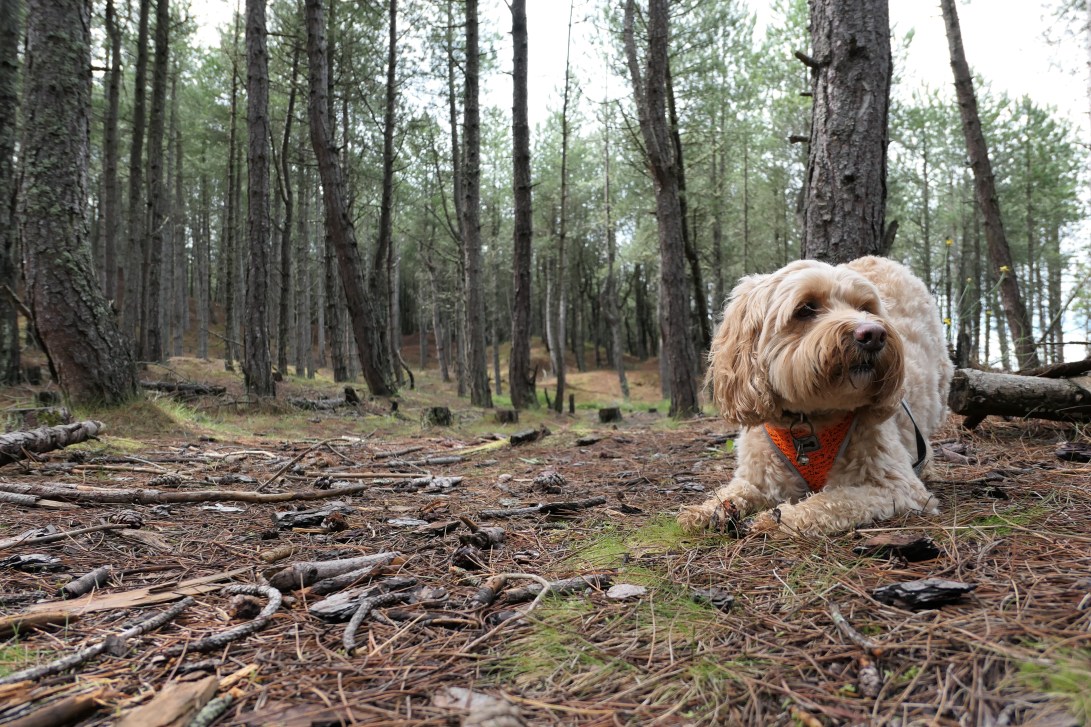
The dog wanders off by herself, true to form. The forest fragrance is too hard to resist. Her light fur flashes in and out of view behind the trees, their trunks as straight as the lines on a barcode.
I know there must be red squirrels in this forest, perhaps even pine martens. So far I haven’t seen either, but that is no guarantee of absence. It’s what I love about wildlife: it can never be rushed.
We pass another dog walker and for a while the only movement in the forest is the flurry of fur in a rambunctious chase. There will be no wild sightings this morning – martens are sleeping and squirrels are out of sight in the enclosed canopy. The dogs dash around blissfully, but eventually we pull them apart and I loop back towards town. Sounds of civilisation begin to permeate through the trees; car doors slamming, human voices, a distant bus. It’s like the sensation of ears popping and I’m back in the open, leaving the forest behind me. Until tomorrow morning.
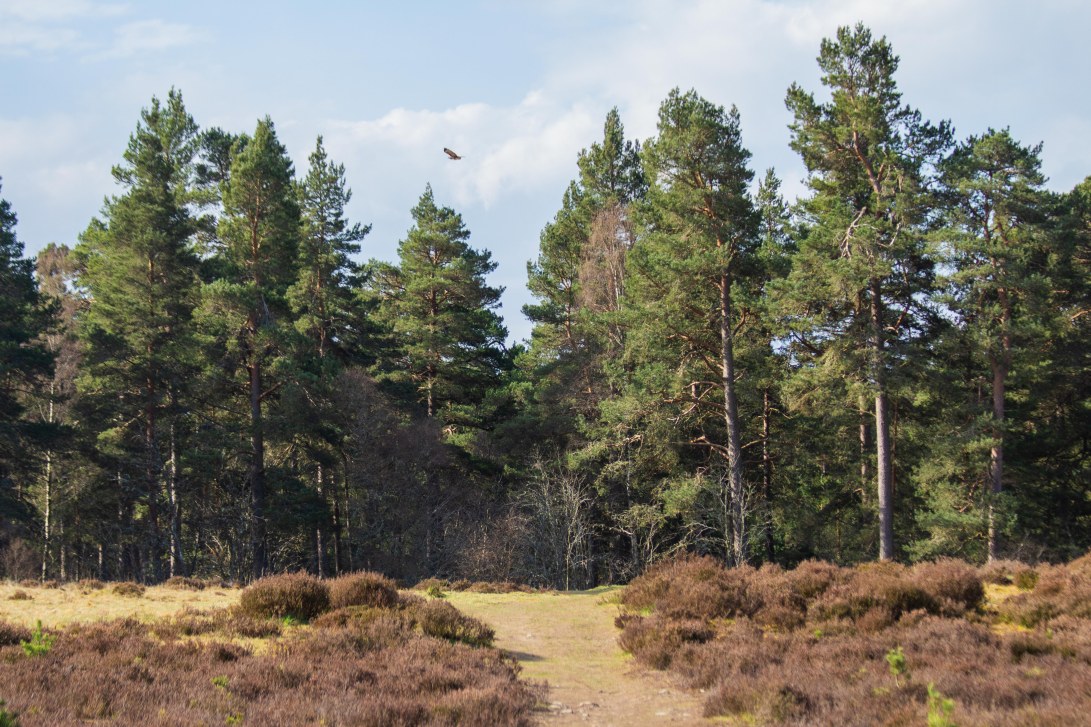
The gloom that had settled over the Cairngorms earlier in the week was long gone. As we pulled into the car park I leant forward and saw sunlight pouring through the coniferous canopy in diagonal slants, turning green needles shimmering gold. Another forest to explore! I couldn’t wait.
Once all members of the convoy had arrived, we gathered around the notice board. Abernethy was the second largest nature reserve owned by the RSPB, spanning 140 square kilometres. It was home to around 5000 species – a list that grows every year. Our guide, Simon Pawsey from the Bird Watching Wildlife Club, looked up the crested tit on his Collins Bird app – something I definitely need to get at some point – and quietly played us the bird’s call: a rapid trilling that I was sure I would be able to distinguish above the chaffinch’s constant rambling, as lovely as that was.
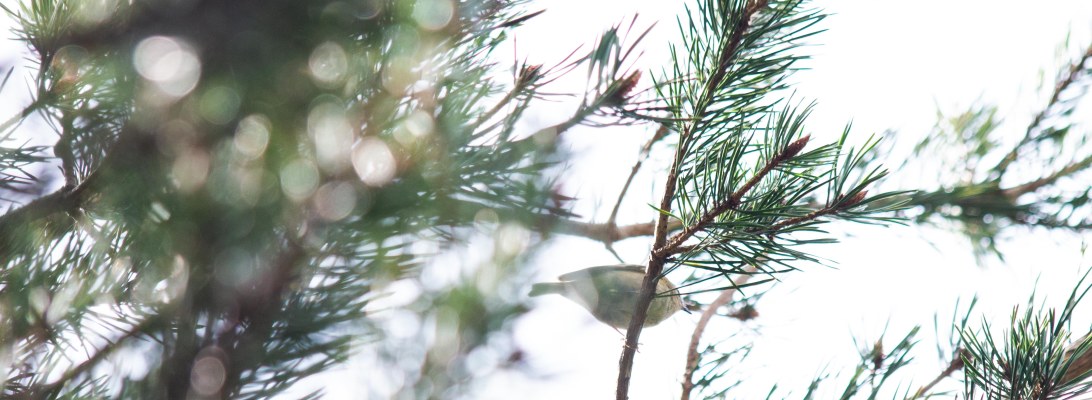
As Simon continued to tell us all about cresties, a small bird caught my eye a few dozen feet away. Lifting my binoculars, I focussed in and nearly disregarded the bird as a coal tit, which was exceptionally common in the local area. But then I noticed a peculiar tuft of feathers on the bird’s head. Surely not… A halo of light fringed the bird’s body and I squinted to make sure, keen not to make a fool of myself in front of all the other birders. But it was! It really was a crested tit! I exclaimed this to the group, embarrassed about interrupting Simon but deciding it was well worth it.
Not a great photograph, but an amazing sighting!
There was a flurry of excitement as we all pinpointed the crestie for those who hadn’t spotted it. The bird was perched on an obvious branch in a relatively open clearing, sitting at eye level in a car park full of human voices and slamming doors. It was such a good view of a species that I thought I’d only get a snatching glimpse of at the very top of a huge Scots pine, if that. The crestie stayed for a few minutes, allowing us all to admire him before he took off and disappeared. Our guide had been talking about crested tits and a crested tit appeared for us all to see, almost like a “Here’s one I prepared earlier” moment. What an extraordinary start to the day!
Buzzing after our first sighting, we set off into the forest, keeping an eye out for crossbills or red squirrels that might be foraging above. Several times a pair of dark wings high above had us briefly excited that we’d spotted an eagle, but each time it was a buzzard, or “tourist eagle” as it was often referred to in the Highlands.
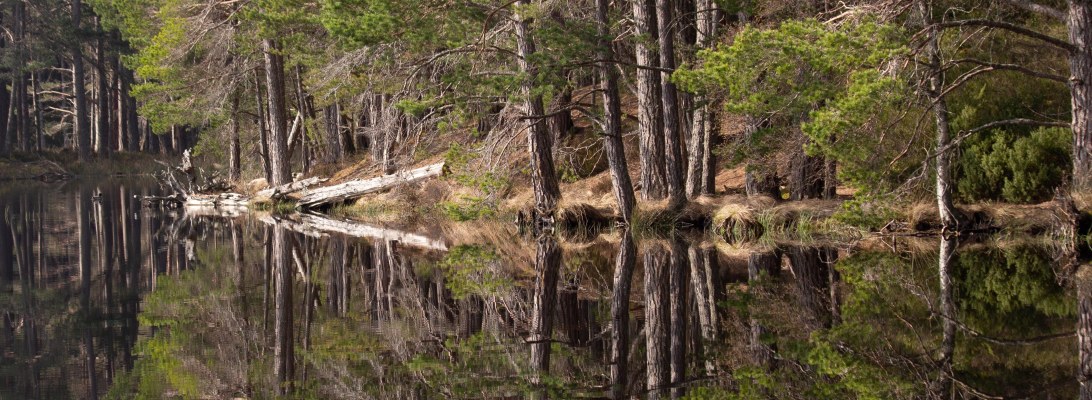
Before long Loch Garten came into view, and even with just a glimpse through the trees I knew it was going to be impressive. There was no breeze to stir the water so the loch lay as flat and still as a mirror, casting a perfect reflection of the trees along the margins and the blue hills in the distance. The only disturbance to the glassy surface was a lone mallard swimming far out in the loch, scratching a line across the water. Not a sound could be heard. As I stood on the bank absorbing the view, I thought how Loch Garten could be the perfect setting for an elaborate fantasy story. It was such a wild, beautiful place: seemingly tranquil and calm but with the power to turn at a moment’s notice.
If I’d been alone, I would have sat by the loch all day, but I was here for birding with the group so reluctantly took my last few photos and followed them further along the trail, skirting the edge of the water. Sure enough, we found a red squirrel, although the animal was trickier to see than on the feeders in Anagach Woods back at the hotel. A bright orange mammal is surprisingly difficult to spot in dense green foliage, and it was only its sudden movements that gave it away.
After a while another loch came into view: Loch Mallachie. Here we were met by a gaggle of greylag geese as they glided across the water. This part of the reserve was marshier, and not far from the land we were stood on was a smaller island with far shorter trees. Simon explained that they were the exact same type as the giants that surrounded us on dry land, but because of the variation in soil quality and nutrients, the same species was half the size only a few metres away.
Suddenly one member of the group pointed out two dark specks on the horizon. I prepared myself for the inevitability of more buzzards, but once Simon had set up his scope I heard some very satisfying words: “Those are eagles”.
Everyone rushed towards the bank for a better view. The birds were very far off – tiny pinpricks on a white horizon – but sharp-eyed Simon could make out white patches on one of the eagles, suggesting it was a juvenile. After a while scanning empty sky I managed to locate them in my binoculars. They glided seemingly effortlessly at a dizzying height, barely moving their wings as they soared through the thermal currents. It was such composed flight: the movement of a creature that dominated its landscape. Fortunately, the eagles were flying closer, so one by one we had a peek through Simon’s scope. When it was my turn, I was thrilled to make out the bird’s head and beak even from such a distance. I’d seen a golden eagle once before on the west coast, but this was by far the clearer sighting. Eagles were the true celebrities of Scottish wildlife, and to see two at once was so special.
The eagles soared in large circles for a while before gliding further out of reach of our scopes and binoculars. Once again the group was buzzing. I couldn’t believe how lucky I’d been this week. After only four days in the Highlands I’d seen crested tits, crossbills, red squirrels, a pine marten and now two golden eagles. It reminded me of the importance of patience but also of luck; how being in the right spot at the right moment can bring unforgettable experiences. Being from the southeast where wildlife is far less abundant, I would treasure the sightings I’d had this week for a long time.
Our meeting point was a narrow track just outside Aviemore. The light was beginning to fade and the moon shone in a clear sky, fringed by a sprinkling of stars. We threaded our way up the track, keeping an eye out for roe deer in the surrounding fields, and eventually reached the hide: an impressive building with large windows running along each side. The interior was luxurious; carpeted flooring, posters adorning the walls and above all, heating! It was indulgence that I hadn’t had the fortune of experiencing in a lot of hides. This one was positively posh.
Once inside, there was the habitual jostling for the best space as politely as possible. The guide always says that the animals may come from any direction, but we all know some spots are usually better than others. After we were all settled, our guide James left the hide to distribute the food. He explained the importance of only providing a supplement to the animals’ diet to make sure they didn’t become reliant on human assistance. On the menu tonight was a selection of peanuts, raisins, dollops of peanut butter and the ultimate prize: an egg.
So what were we hoping to see at this time of night? To Victorian gamekeepers, they were the “scourge of the glen”, known for stealing the eggs and chicks of ground-nesting birds. In my opinion, they were on par with the unicorn – a creature so stealthy and elusive that although they’re relatively common in Scotland and doing well there, they are very rarely seen. Coming to a hide dedicated to seeing them is your only semi-reliable chance, but of course nothing about wildlife is ever guaranteed. I’m talking about the pine marten.
Photo: Jai Redman
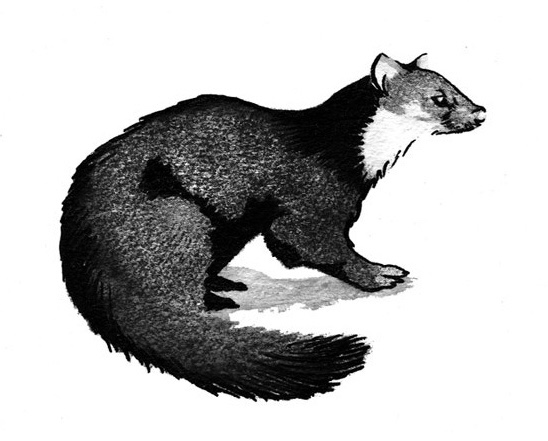
A member of the mustelid family with otters, stoats and weasels, pine martens are cat-like and forest-dwelling. Their coats are a rich, chocolate-brown and each animal has a unique pattern on their bib ranging in colour from yolky yellow to almost white. Pine martens are adept at dispatching grey squirrels, which are slower and less agile than reds. The latter have evolved alongside martens and know how to evade them, which is why there are no grey squirrels in the Highlands and plenty of reds. It’s interesting to think that if pine martens had been abundant across the whole of the UK when grey squirrels were introduced in the 1870s, would we have such a drastic problem with this invasive rodent today?
Once the food was in place, the wait began. Not only were we hoping for martens but also badgers, owls, a deer perhaps. It was a complete lottery, which made the whole thing incredibly exciting. The light was fading fast and my camera struggled to cope. Cranking up the ISO caused a sandstorm of grain to fill the screen, but I wasn’t planning on prize-winning photos on this occasion. This was one of those times when, more than anything, I wanted to watch.
After a short while we had our first visitor. Out of a knot of tree roots came a wood mouse. It appeared as though time had been sped up – the mouse zoomed out into the open, seized a peanut and retreated into its shelter within what seemed to be the blink of an eye. He or she entertained us for a while but before long it was quiet again.
Gazing outside into the dark clearing roused a slight feeling of unease. The longer I looked, the more my eyes played tricks on me. Shadows took on the appearance of strange shapes appearing to move on their own. Coupled with the expectant silence in the hide, the scene was close to eerie.
My eyes kept flicking to a shadowy patch just out of reach of the yellow spotlights. Beyond it the ground dipped into a shallow hill that plunged into complete darkness. I kept picturing a marten cresting the hill and trotting along the track for the tempting egg. I thought if I imagined this hard enough, it just might happen. I appreciated this fantasy had an undeniable whiff of desperation about it.
Suddenly, a flash of pale wings caught my eye. I glanced up and watched a scene unfold in slow motion. A bird catapulted through the air, wheeled tightly around the mouse’s tree and swept straight past the window. A blink-and-miss-it moment. For a few seconds I was stunned. I’d never seen a tawny owl before, and couldn’t believe how small they seemed! Small, yet incredibly skilled hunters. It really was a privilege to get nocturnal wildlife encounters, especially scenes as dramatic as a high-speed fly-by from a tawny.
After that exciting moment, there was a distinct lack of life for quite some time. It was still early days, I reminded myself, eyes flicking once more to the shadowy patch, there was time yet. I leant forwards on my stool, peering so close to the window that my breath fogged up the glass. Martens could approach from anywhere, and being so dark they would be completely concealed apart from their trademark bib.
The other visitors coughed, switched seats, paced up and down and chatted in hushed whispers. Meanwhile, I was glued to my stool. Far from blessed with social prowess at the best of times, I refrained from making conversation and kept my eyes planted firmly outside – there was no way I was missing anything.
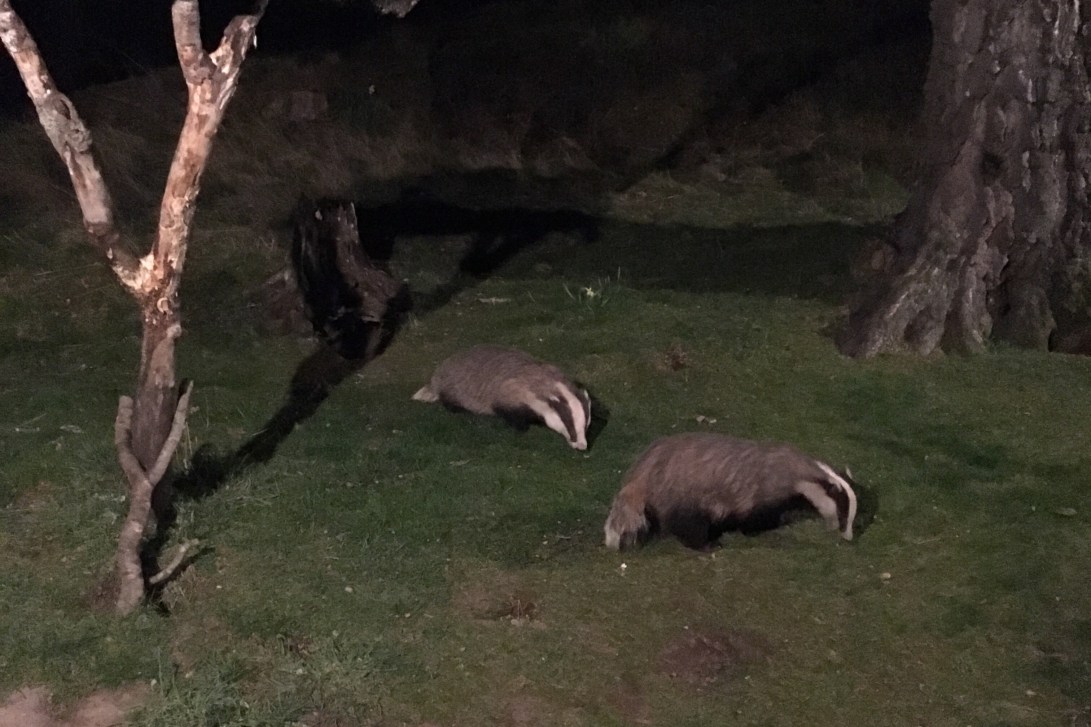
There was a sudden, hushed commotion in the hide and I peered to the side to see a badger had appeared. Badgers have terrible eyesight but an exceptional nose, and mainly use smell to discern their surroundings. The animal picked her way across the grass, fanning her snout over the ground like a metal detector. Tragically, my previous badger experience consisted of road kill and one that I had nearly killed myself when it ran out in front of my car, so to watch a real, live badger going about her nightly business mere feet away was such a treat.
After she’d polished off most of the nuts, the female was joined by a male. He was the same size, suggesting he was also the same age if not younger. Adult male badgers typically weigh a kilo more than females and are noticeably more muscular. The two animals completely ignored each other so there was no doubt that they belonged to the same clan. If they hadn’t, there would have been a serious standoff. The male cleared up what the female hadn’t found and one by one they left the way they’d come. The only evidence of their visit was a distinct lack of peanuts.
An hour and a half later, my enduring optimism was beginning to turn. I was conscious of the time and that our evening would eventually come to a close, marten or no marten. I started seeing more and more phantom animals out in the gloom. The moon was radiant and my eyes were drawn to its pure white hue. A lone bat darted over the roof of the hide, silhouetted briefly against the lighter sky before disappearing. How anyone got a decent photograph of a bat eluded me. To capture such erratic and rapid flight was seriously impressive.
I glanced over at the shadowy patch again and saw a pine marten staring back at me, beady eyes glinting in the light. My insides jolted and as quietly as could I exclaimed, “There’s one!” Everyone knew exactly what I meant and came hurrying in my direction with barely restrained urgency. I couldn’t quite believe what I was watching on the other side of a pane of glass.
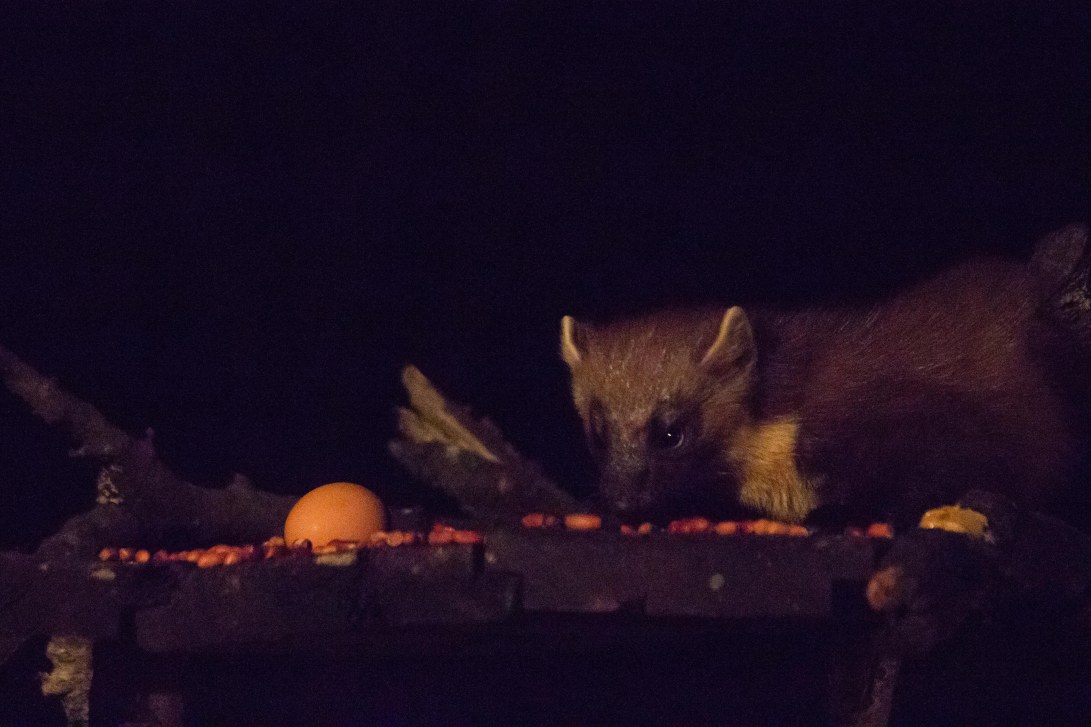
James told us the marten was a female. Similar to badgers, males were larger and typically had broader faces. Many people underestimate a marten’s size when they see one, imagining something along the lines of a weasel or stoat. I was quite the opposite; the marten was smaller than I’d expected, smaller than most house cats. What couldn’t be disputed was how beautiful she was with her long bushy tail, sleek mocha fur, tiny button nose and white-rimmed ears. I fell instantly in love.
The marten crossed to the other window and we swiftly followed suit. She climbed up onto the table and munched through the peanuts. As stunning as she was, she certainly wasn’t the most ladylike when it came to eating. She took the egg in her mouth and, despite her sharp teeth, carried it delicately down the table onto the grass. After a quick readjustment, she lolloped out of sight.
We’d spent two hours in darkness and experienced less than a minute of what we’d travelled here to see, but the atmosphere in the hide could only be described as barely contained hysteria, in my corner at least. We made the unanimous decision to end our evening on a fantastic high. Not only had I had my first proper badger sighting, but I’d also seen a Scottish icon. I couldn’t have hoped for better.
After one day of the Grant Arms Wildlife Book Festival, I had already ticked off 27 species. The morning started off gloomy so I wrapped up knowing that the Highland air would bite without a little sunshine. After a delicious breakfast I met my guide Sue and we set off. Our destination was Anagach Woods, only a five minute walk from the hotel. I knew it was my kind of place from the first glimpse: dense evergreen trees, a winding trail and the lyrical murmuring of birdsong. The harsh, icy breeze that made the eyes squint and the neck shorten completely disappeared once we strolled past the first few trees.
Anagach Woods were planted in 1766 using young pine trees dug up and transported from the old Caledonian pine forest of Abernethy. A few of these original trees are still standing today; wizened goliaths surrounded by waxy saplings. Throughout Anagach are deposits in the form of fluvio-glacial ridges, raised beach sands and gravel deposits dating back 10,000 years to the Ice Age. “Fluvio-glacial” refers to the meltwater created when a glacier melts.
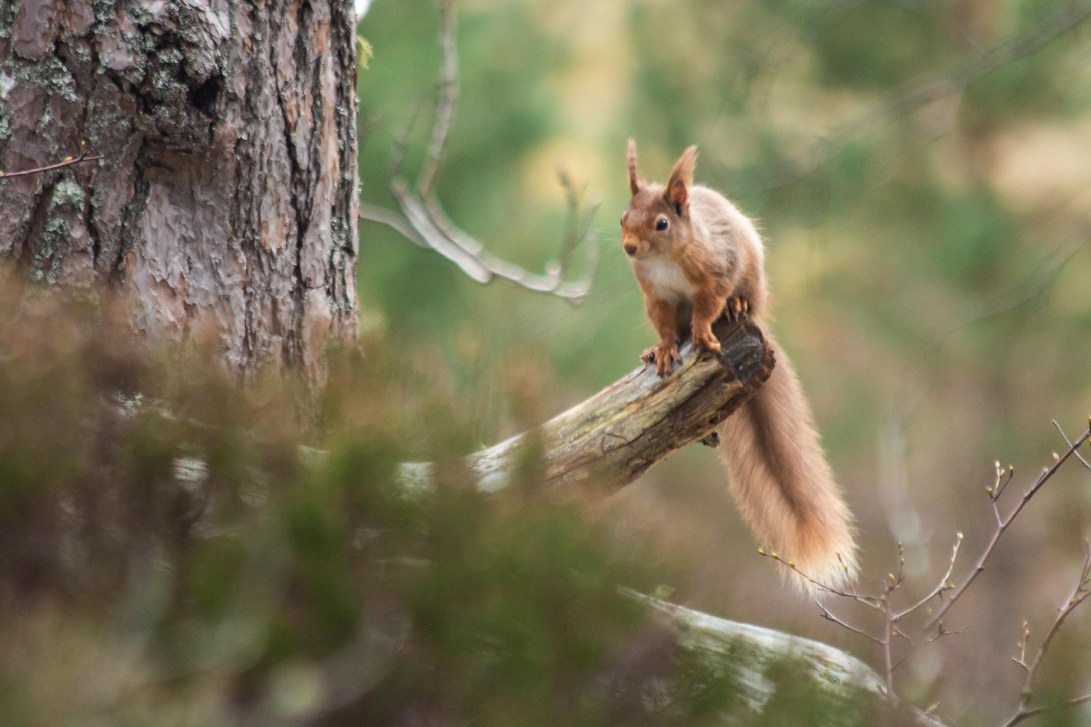
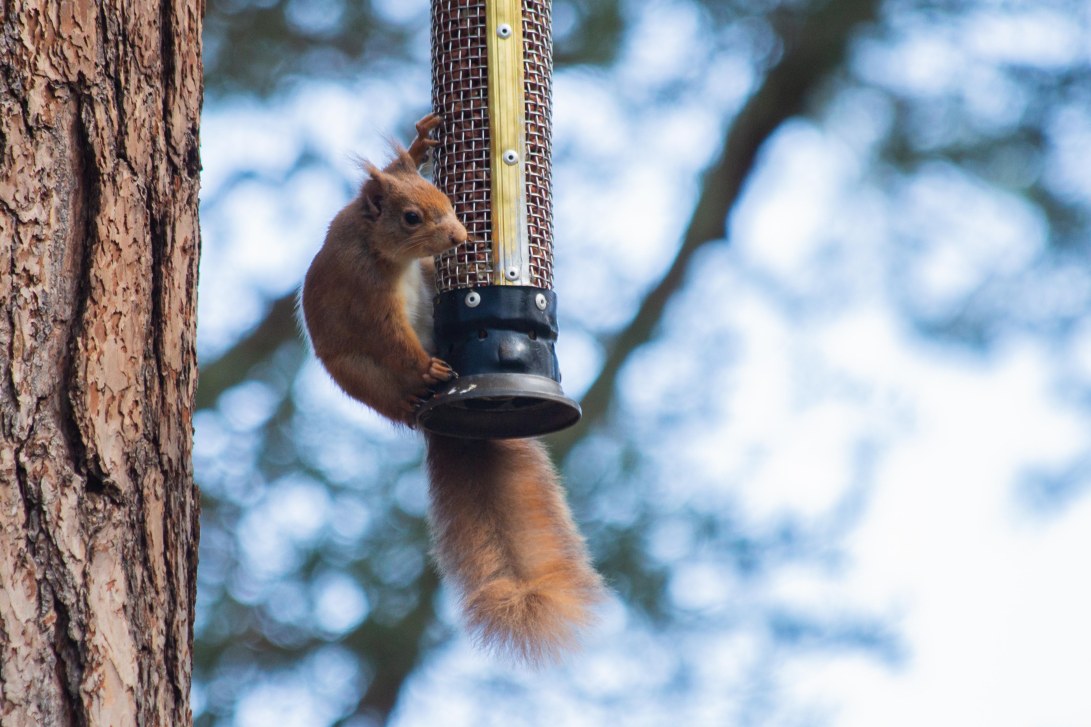
Within ten minutes of entering the woods, I had my binoculars trained on a red squirrel -tail and hands poised in the classic pose as it nibbled on a peanut. A completely peanut-based diet causes a deficiency in red squirrels, so the rangers fill their feeders with a special mix to keep the squirrels’ diet balanced. Whether the animals follow the regime is another thing entirely, and they don’t. They prefer to pick out the peanuts with the steely determination of a child eating around their vegetables.
It’s impossible to dislike red squirrels. (Personally, I have no quibbles with greys either – they’re not inflicting reds with the pox with any malicious intent, nor did they ask to be brought here.) Reds have the eye-watering cuteness of babies their entire lives, coupled with boundless energy. We watched two up in the tree, neither tolerating the other’s presence. After a brief, silent stare-down, a ferocious squabble broke out. In the blink of an eye, two orange flashes flew up the tree, twirling around the trunk with scrabbling claws. The victor was soon perched proudly on the feeder shelf – stuffing head, front legs and one back leg inside to grasp the prize.
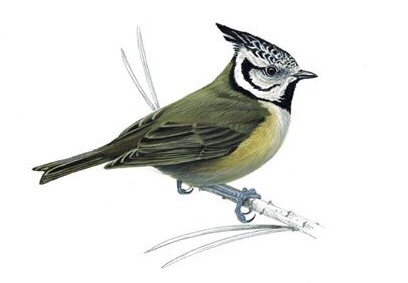
We ventured further into the forest. Each time a branch quivered or a chirrup sounded, I scoured the canopy for a particular little bird with a very impressive Latin name. Lophophanes cristatus is mostly confined to ancient Caledonian pine forests and Scots pine plantations. On the RSPB map of the UK, this bird’s presence is indicated by only a small patch in the Highlands of Scotland. A member of the tit family, it sports a magnificent punk hairdo.
Photo: RSPB
I had my sights set on the crested tit. As small as the far more common blue tit, the “crestie” is a firm favourite among Grant Arms guests and features on many wish lists including my own. My main objective during my time in the Cairngorms was to see a pine marten (dream big, I say). Or, if that dream turns out to be a little too big, I will happily settle for any new species. I kept my eyes peeled for cresties but sadly they eluded us that morning. Sue said that at this time of year they would be right at the top of the trees gathering nest material. When those trees stretch to dizzying heights of around twenty metres, spotting a tiny bird in the dense canopy would certainly be a challenge.
Despite the crested tit playing coy, we were treated to a lovely showing of a buzzard. Buzzards are one of those species that I sometimes underestimate. They don’t tend to get me too excited – especially for that one split second when you think you may have found an eagle – but that morning in Anagach I saw a buzzard land for the first time. Up in the air and bleached out by the sun, it can be hard to make out specific detail, but as the raptor perched in the pines, I could admire its snowy white chest – as soft as an owl’s – with speckled markings that gave it the air of a regal monarch’s gown. The buzzard preened its feathers for a while before taking to the air and melting into the trees. It was a fitting way to summarise the forest habitat: a creature can be there one moment, and vanish the next. Forests are irresistible to me, and Anagach easily became my new favourite.
I arrived in Grantown-on-Spey at night, so couldn’t see much of the Cairngorms wilderness that pressed heavily on both sides of the winding road. I glimpsed darting rabbits and the elegant form of a pair of deer, but there must have been dozens of other creatures concealed by the dense evergreens.
My accommodation, the Grant Arms Hotel, was beautiful; a formidable building of stone and wide sash windows that could easily be the set for an elaborate period drama. Also called the Wildlife Hotel, the Grant Arms provides guests with easy access to a range of reserves of all different habitats. When I checked in, a large notice board stood pride of place in the foyer, full of lists of upcoming events, guidance on watching wildlife – including the magnificent capercaillie – and sign-up sheets for the week’s guided walks and field trips. An impressive puzzle adorned with a picturesque nature scene lay finished nearby. On the walls were images of puffins, ospreys, black grouse and, in my room, a beautiful fieldfare. I’d never seen so much wildlife-related decor and I absolutely loved it.
As I unpacked, I felt a thrill of eager anticipation for the week to come. I’d never stopped in the Cairngorms before but only passed through, so I couldn’t wait to sample some of the incredible wildlife. I had my sights set in particular on the pine marten – an elusive and nocturnal member of the mustelid family. If I was going to fulfil my New Year’s Resolution and see one in 2019, the Grant Arms Wildlife Book Festival was my best chance.
On The Wing has been quiet recently, not for lack of inspiration but for lack of time. Over the past few months I’ve been busy with a few different projects. I’m close to finishing an annual report for SEZARC, outlining the highlights of their work in 2018. I’ve also moved part-time into the library where I’m filling notebooks with scribblings about Siberia, Russian megafauna, native tribes and the mysteries of shamanism. All this is for my book idea and the more I read, the more I need to read. It’s a constant cycle of finding a book, reading something fascinating and looking up similar books to find out more. I’d love to eventually start the actual writing process, but so far I’m waist-deep in other people’s books and loving every minute.
All of this work has meant that I’ve neglected my camera and seen most of my local wildlife from behind glass recently. However, this week brought the perfect opportunity to get back outside and into nature. It’s the Wildlife Book Festival at the Grant Arms in the Cairngorms. Also called the Wildlife Hotel, the Grant Arms is a beautiful Victorian building within easy reach of dense pine forests, boulder-studded rivers and sweeping mountain valleys. In other words, the perfect place to celebrate British wildlife.
It feels fantastic to be back out there with binoculars around my neck and a crumpled notebook in my hand. It also helps to be in such a stunning location. St Albans is nice, but when you’re woken to the sound of squealing oystercatchers and only need to walk for five minutes before hitting a thousand acre wood (check mate Winnie the Pooh), there is simply no contest.
It’s so easy for me to get caught up in work. I get so engrossed that I forget to ever switch off, which makes this week a very important break. It’s a little telling that I need to travel five hundred miles from home to take that break, but when the scenery is this pretty, I’ve figured it’s alright.














 rebeccaonthewing.com