Reptiles in the Park

I bought a ticket for the Madrid City Bus Tour from hotel reception and hopped on at Plaza Mayor. With such intense heat, I thought it would be a good idea to explore the city in the comfort of an open-top bus, where I could jump on and off wherever I pleased. First stop was Puerta del Sol with the bear and strawberry tree statue, and then we headed east into the Retiro district, which was probably best known for its trio of world-famous museums. As I’d anticipated, the queues to get inside were eye-watering even at late morning, so once again I was content just admiring the exterior. As much as I quite liked wandering through art galleries, I wasn’t willing to spend an hour waiting to get in. Besides, on a weekend day you wouldn’t have seen the art for the tourists anyway.

P1000388

I was far more interested in what lay beside the museums and I hopped off the bus. El Parque de Buen Retiro was a vast and beautiful park spanning 350 acres. I began at the north end and made my way leisurely past elaborate fountains and sprawling trees. One of the trees was the oldest in Madrid, but there was no shortage of vast leaved giants, which provided much-needed shade for tourists and locals alike. While some people were lolling on the grass with food or books, others were jogging and walking dogs. It was a hive of activity and yet seemed extremely tranquil, similar to how I felt in Plaza Mayor. Despite a population of several million, the city didn’t feel cramped or overcrowded the way London does. The pace of life in Madrid was far more relaxed and I was keen to savour it. The only signs of congestion were from the parakeets perched in every treetop, whose disgruntled calls sounded like trainers on a squeaky floor.

P1000241

In almost the very centre of the park was El Palacio Cristal – a beautiful glass building overlooking a lake where ducks and a lone black swan were swimming in lazy circles. Surrounding the water were dramatic sprays of white blooms, rosebushes as tall as trees and a miniature waterfall cascading over a rocky outcrop into the lake below. I sat down on the stone steps of the palace to see the ducks a little closer and was surprised to find the water full of tiny terrapins. While their shells remained submerged, their black and yellow-striped heads poked out of the water, eyes blinking up at the child beside me who was throwing popcorn. On the steps, feral pigeons and sparrows tussled for the prizes, while in the water the terrapins were joined by ducks and the occasional gaping lips of a fish. The black swan came gliding over for a look too.

P1000282

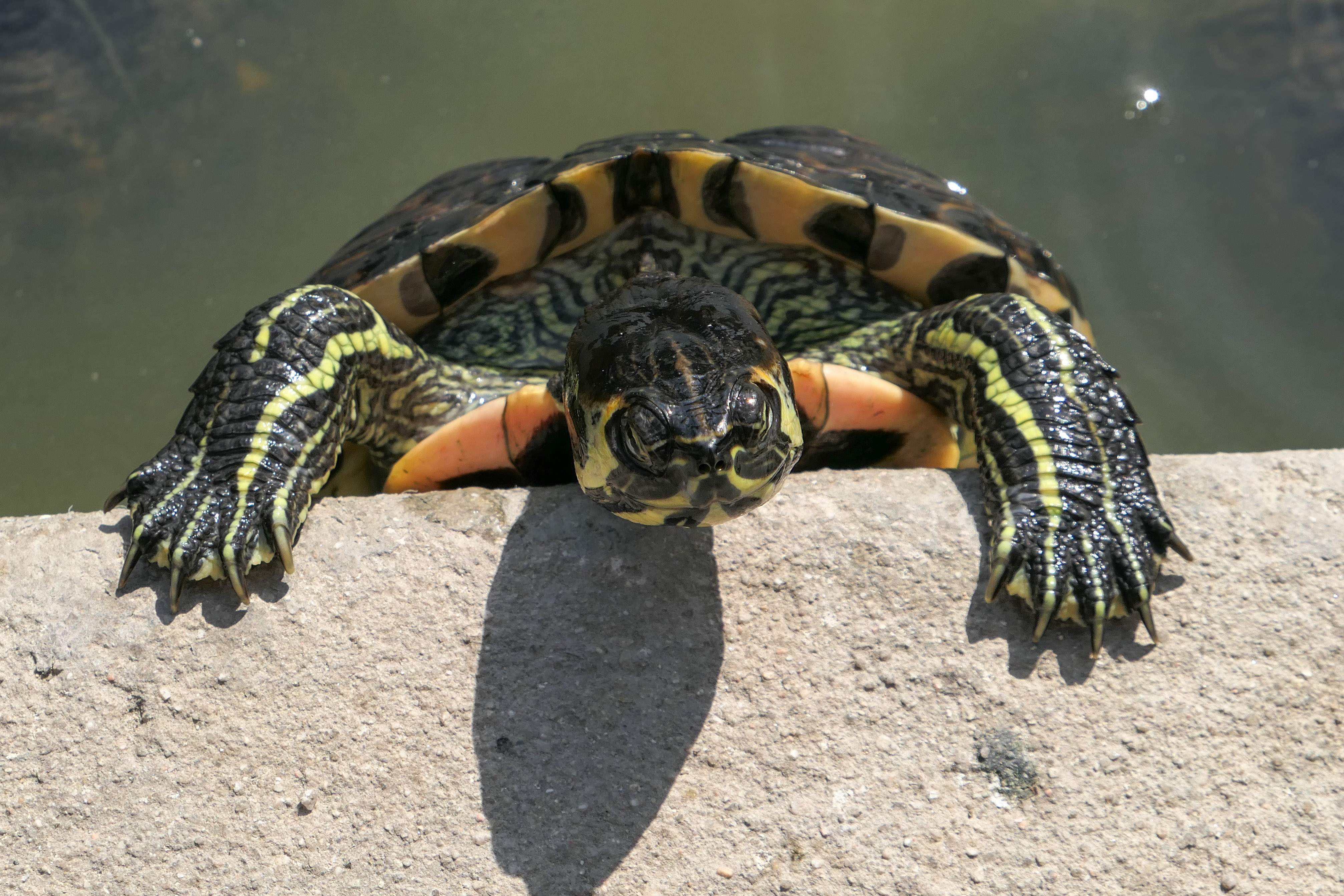
One terrapin made the monumental effort of grasping the side with its broad claws and heaving itself up. For a few surreal moments we gazed at each other before it realised I wasn’t the one with food and plopped back underwater. Meanwhile, a pigeon strolled nonchalantly across my foot in pursuit of an unclaimed kernel, while others exploded into flight around my head, their wing beats sending a welcome burst of fresh air.

P1000293
P1000278
Terrapin v pigeon face-off!

Beside me on the step I could hear the child with the popcorn munching. “One for you, one for me” was obviously in play. When the bag was empty, birds and reptiles slowly dissipated until the next snack arrived.

I wanted to sit and watch the terrapins a bit longer, but the steps were in direct sunlight and I was beginning to fry. I left the diverse gaggle of creatures behind and headed out of the park, but not before passing through La Rosaleda (rose garden) for a few photos. A dozen other young female tourists were posing for shots, no doubt gathering new ammunition for Instagram.

P1000325
La Rosaleda

All along the downward slope leading back to the museums were small wooden huts overflowing with books, which I made a beeline for. It was La Cuesta de Claudio Moyano bookstalls. Nearly all were in Spanish but there were a couple of titles I recognised. I couldn’t help buying “Harry Potter y la piedra filosofal”, which would probably be challenging enough for my rusty Spanish.

For lunch I had a bocadillo de calamari (squid ring sandwich) from El Brillante – another Lonely Planet recommendation that fell short of the mark for me. The calamari itself was good, with just a thin layer of batter, but when sandwiched in a dry baguette it had me gasping for a drink. It seemed that the Spanish didn’t use sauces much in their cooking. The bacon bits and bare bread at Casa Revuelta had been the same. Perhaps the locals just washed it all down with a few cervezas, but I was left wanting after El Brillante.

P1000342
Gran Vía

Later in the evening, after a full circuit on the bus and hopping off on Gran Vía, the hub of central Madrid, I walked back towards Plaza Mayor and a sign for “Tapa Tapa” caught my eye. I ignored the guidebooks and had dinner in a place I knew nothing about, which was an excellent decision. I chose four cheese croquettes, mini portions of Iberian ham and mozzarella toasted sandwiches and langoustine skewers, which were all absolutely delicious. To drink I had a mocktail called San Francisco, which was bursting with the flavours of orange, peach, pineapple and blackcurrant juices. It was an extremely satisfying end to a long day exploring the park. Tomorrow I had a real Madrid tradition to look forward to: the infamous El Rastro flea market.

Paella and the Palace

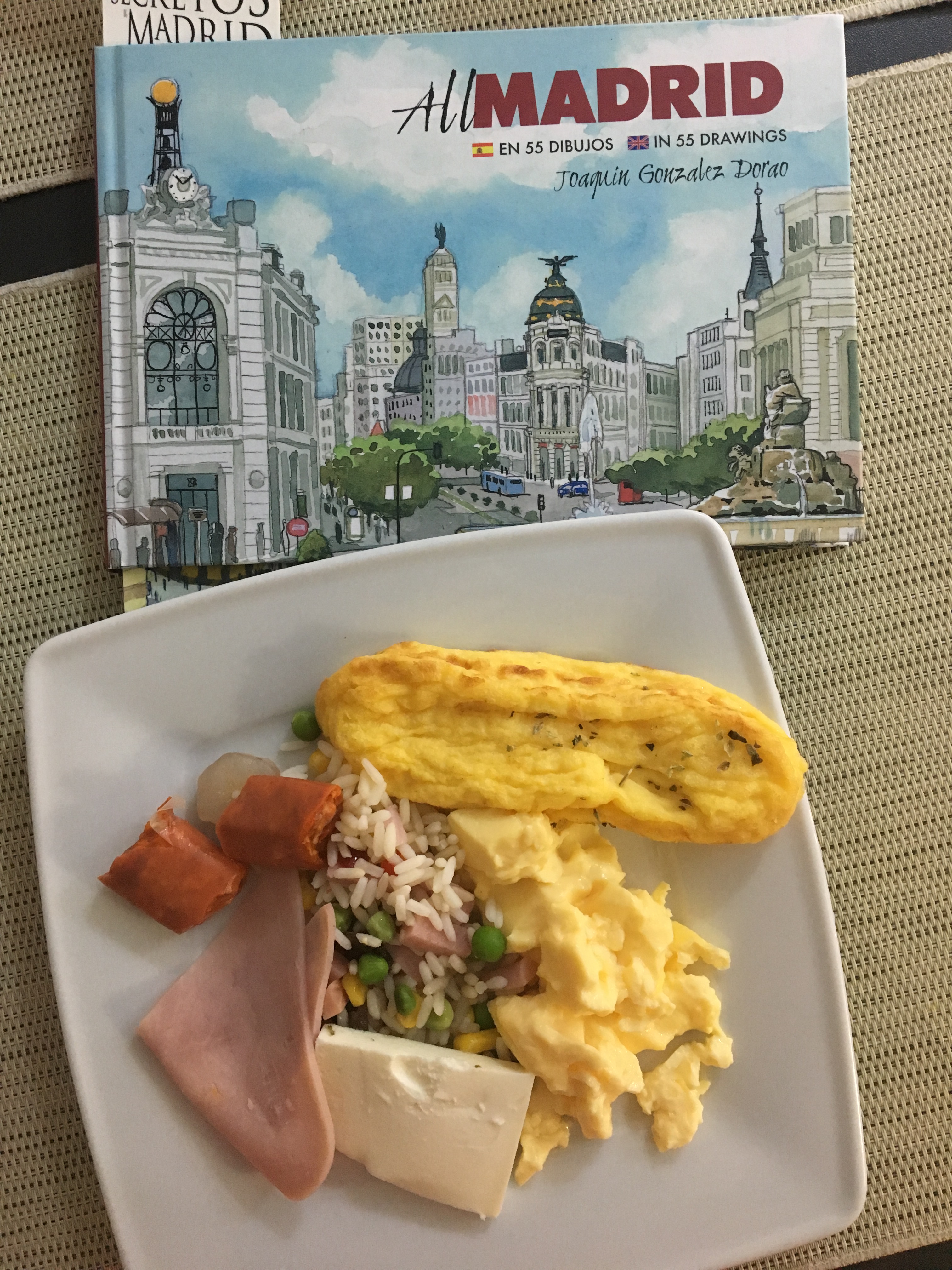
Breakfast was an undeniably Spanish affair. There were potato omelettes, sausages the size of grapes, large fans of hams and cheeses as well as a broad assortment of condiments in small glass jars: sesame seeds, cashew nuts, dates and some things I didn’t even recognise. There were fruit and vegetable smoothies in slim shot glasses as well as long plates filled with pineapple, kiwi, orange, grapefruit and pizza slices of watermelon. There was also cake, and when the opportunity arose to eat cake at breakfast I took it without hesitation. In addition to maple pastries, croissants, mini muffins and wafer-thin slices of marble cake, there was Tarta de Santiago; a delicious almond cake dusted in icing sugar and cut into narrow wedges.

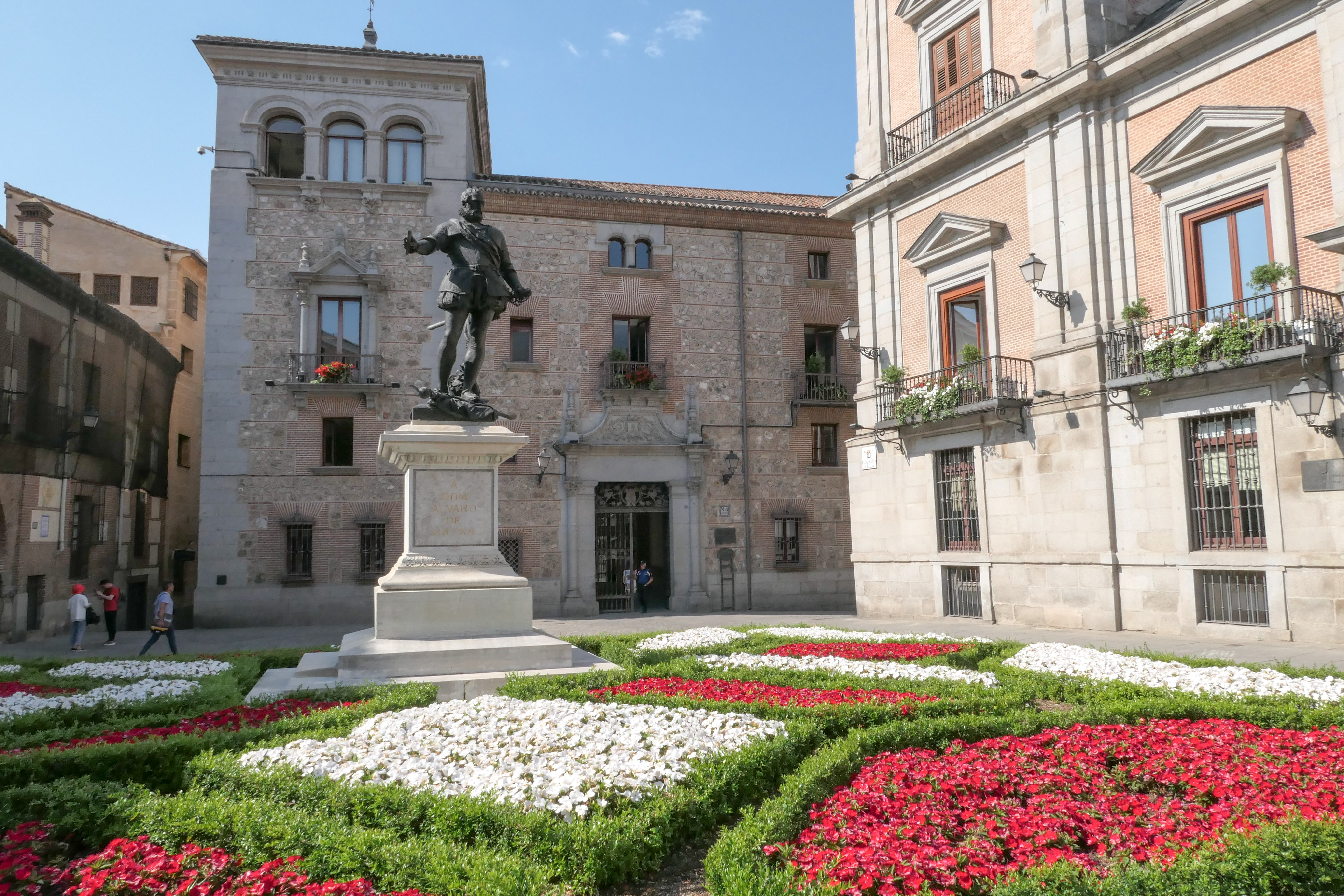
After all that, I was definitely fuelled to start the day. I began by walking west to my second plaza of the week: Plaza de la Villa. Although a fraction of the size of Plaza Mayor, this quaint little square was just as pretty. The architecture was 17th century Madrid style baroque: a picturesque combination of stone, brick and the same wrought-iron balconies I’ve seen on many other buildings in Madrid so far. The statue in the centre of the square was Don Álvaro de Bazán – a famous Spanish admiral who was never defeated in battle. The Madrid City Council chose to commemorate his memory by constructing the monument on the three hundredth anniversary of his death in 1888. The statue is surrounded by a richly coloured flower garden.

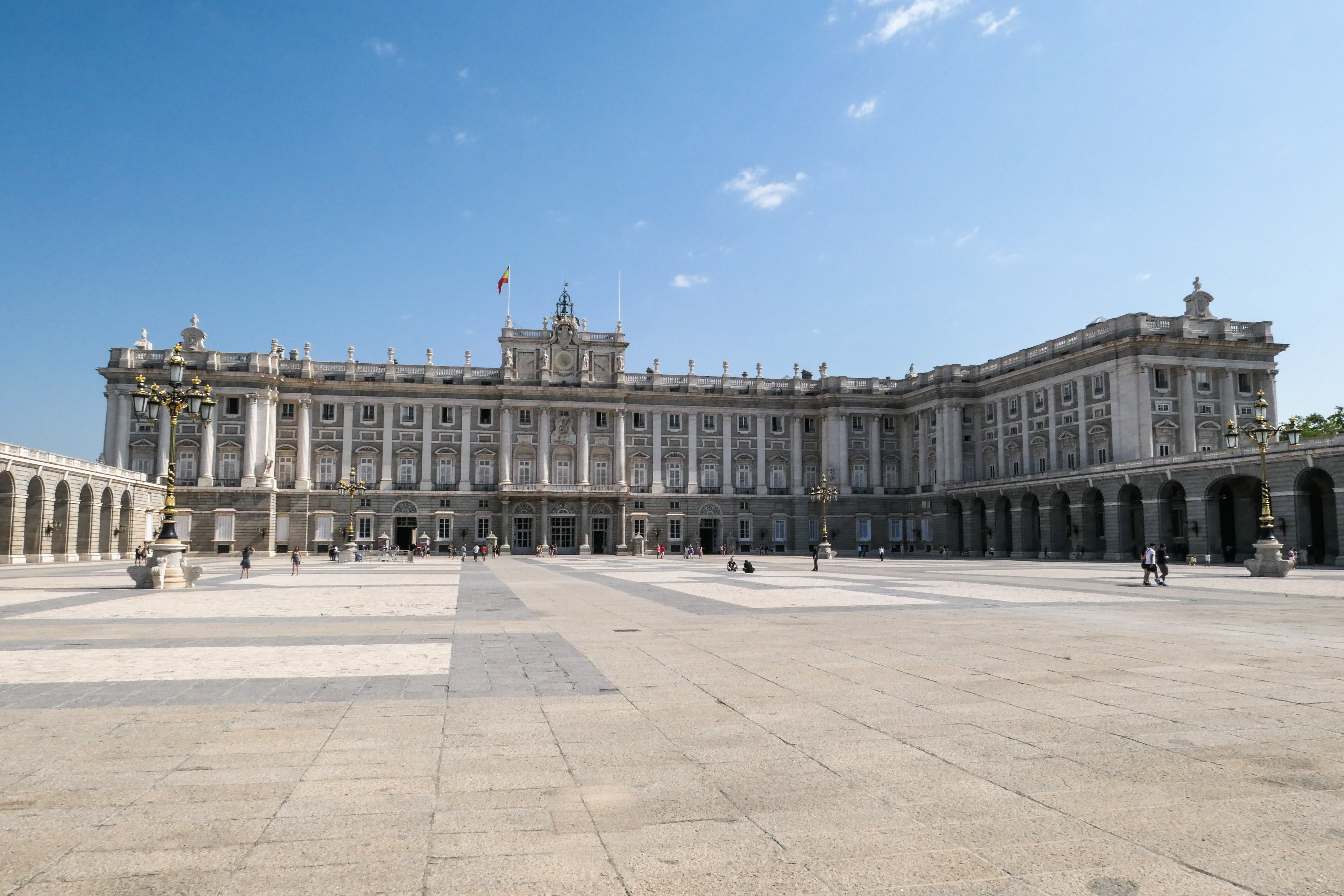
Next I paid El Palacio Real a visit. Although still used for state ceremonies, the palace is not the king’s official residence. He and his family live in the smaller Palacio de la Zarzuela just outside the city. I’d toyed with the idea of going into the palace, but when I saw the queues waiting in the baking sun I decided against it. After all, the line for those with tickets was nearly as long as the line for those without. I could still admire the palace through the gates, though.

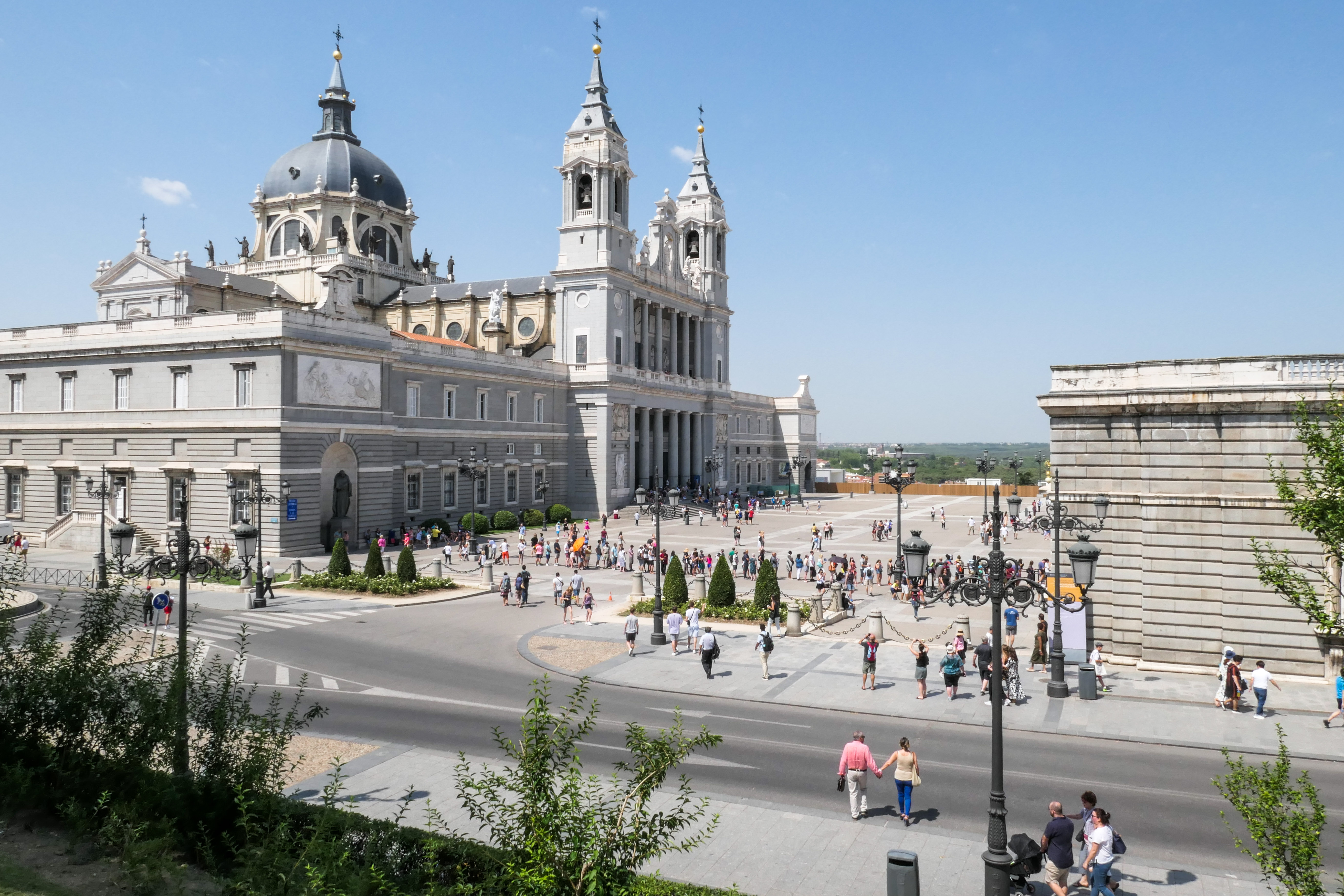
Opposite was La Catedral de Nuestra Señora de la Almudena: a Madrid landmark that could easily rival other cities’ grand cathedrals. In many churches in the city there was a strong religious presence among those who attended. There were no touristy parts to these buildings – while they were all intricately decorated the style was very subdued. The few I visited were full of praying madrileños and I often saw nuns strolling down the corridors. Although I didn’t feel unwelcome, I didn’t stay long out of respect for those using the cathedral for worship. Visitors should never go to cathedrals in Spain during mass, but even between these times it seemed that tourists were tolerated more than welcomed, and I respected that.

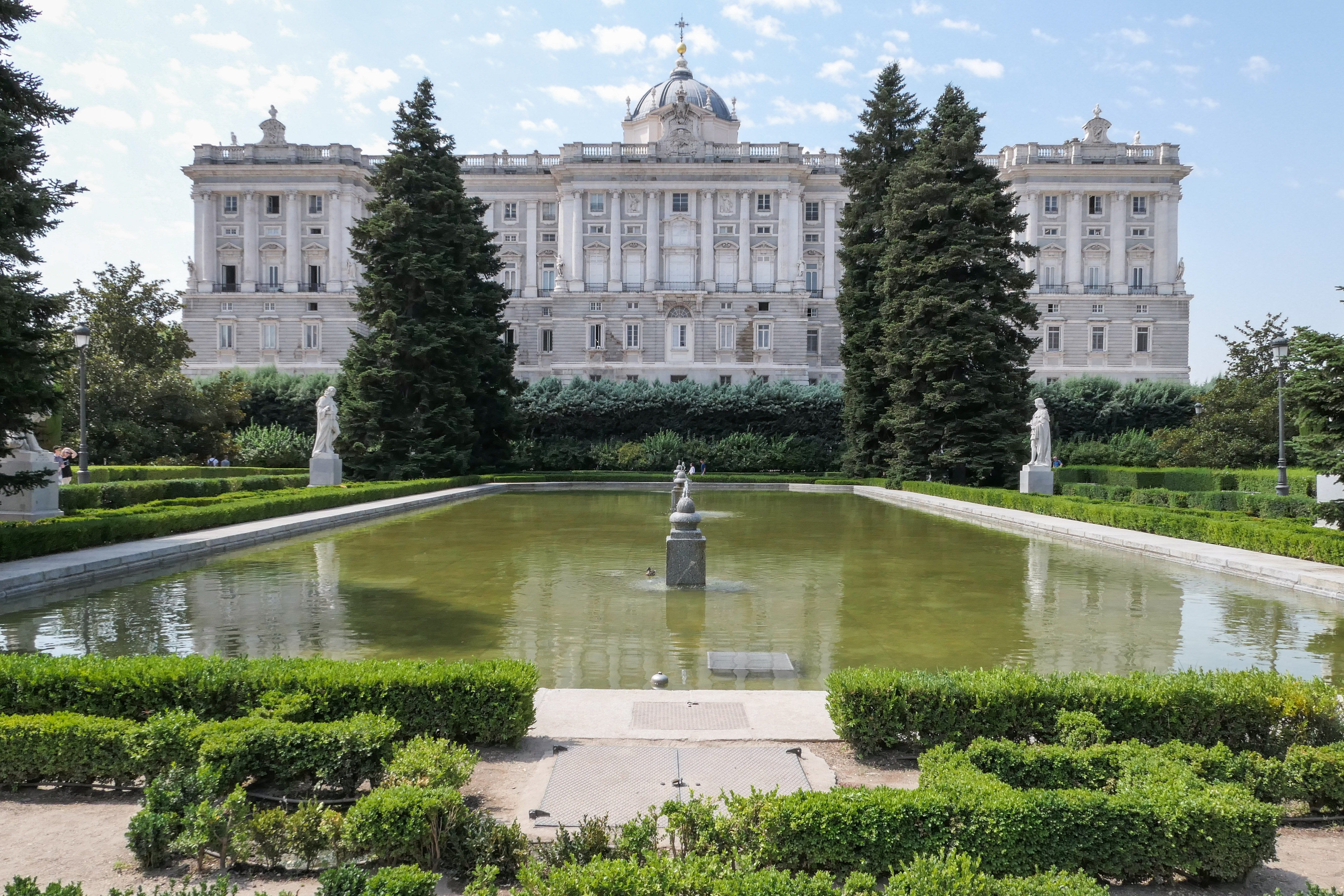
Soon I turned my attention to finding a shady spot to rest. The Jardines de Sabatini were just what I needed. Take away the denim-clad tourists and it wasn’t difficult to imagine ladies in Elizabethan dress wafting fans as they strolled past pruned hedges and thick-limbed trees with bunches of waxy leaves hanging from their boughs. The area was established as a garden in the 1930s as a replacement of the royal stables that were once found there. Now, instead of braying horses, all that could be heard was the crunch of gravel, the chirrup of birds and the lilt of an accordion.

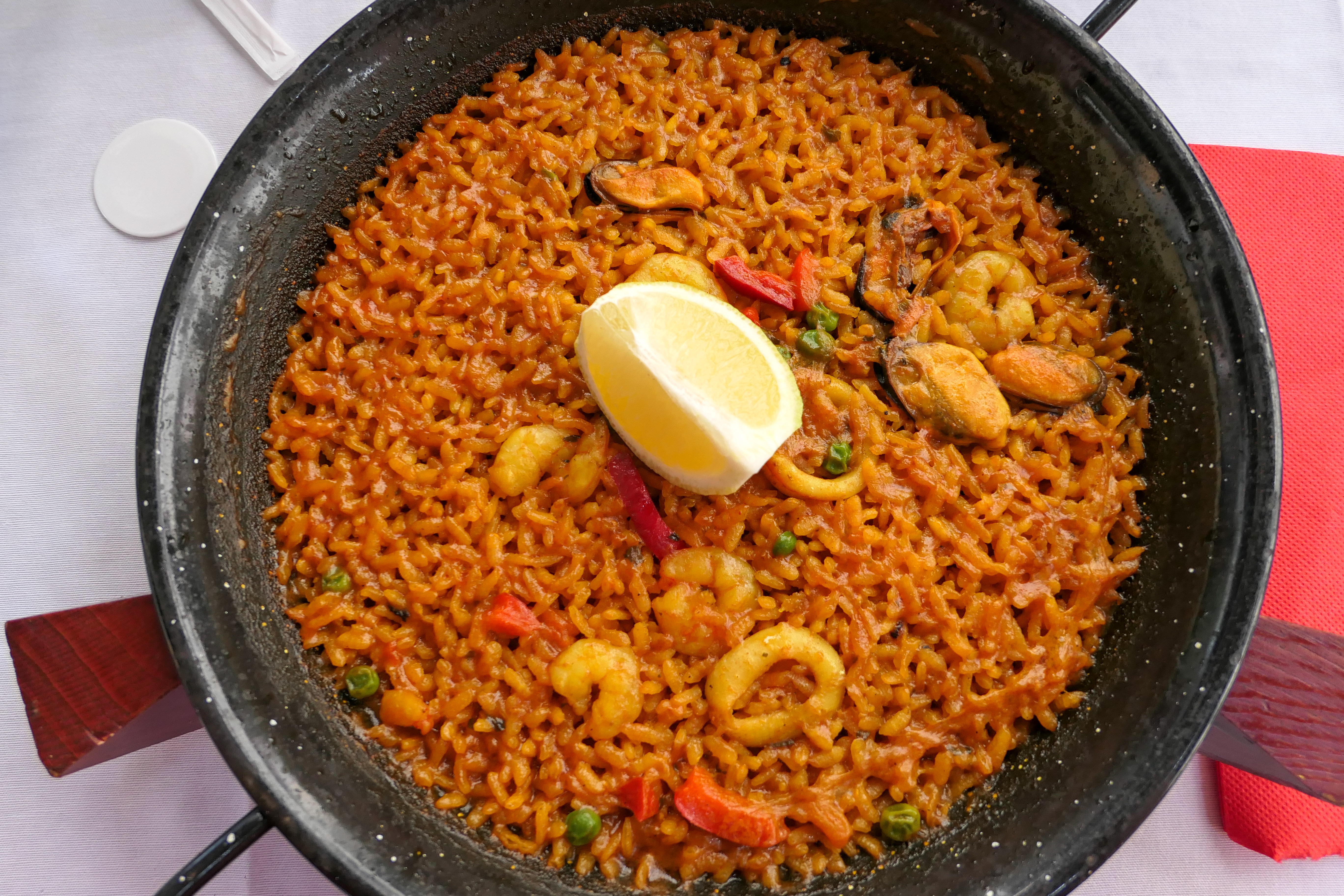
I had lunch at Toro Tapas and ordered a cuttlefish paella. The word “paella” derives from the Latin patella for pan, so the infamous dish is actually named for the black, handled pan that it is served in. When in Spain, you should always eat paella and this one was delicious, popping with juicy prawns, mussels and squid. To drink I chose granizado de limón, which is the Spanish answer to a slush puppy. It was wonderful after the heat of the afternoon and just as refreshing as it sounds.

On my way back from the palace I dropped into La Chocolatería de San Gines, which I’d been told was the place to go for churros – a timeless unravelled doughnut that has planted itself firmly into British culture as well as Spanish. I couldn’t wait to sample what I hoped would be the best and most authentic churros I’d had, but sadly I came away disappointed. The churros were hard and dry, as if they’d already gone stale. I’m not sure if adding cinnamon sugar was a British twist, but I really missed that extra sweetness here. Perhaps I’d been unlucky with a bad batch, but I’d had far nicer churros back home!

I cheered myself up by visiting a few librerias (bookshops) and found some lovely items. In “Desperate Literature” in Calle de Campomanes there was a copy of “Alicia y El País de las Maravillas”, although this classic by Lewis Carroll is confusing enough in English let alone Spanish.

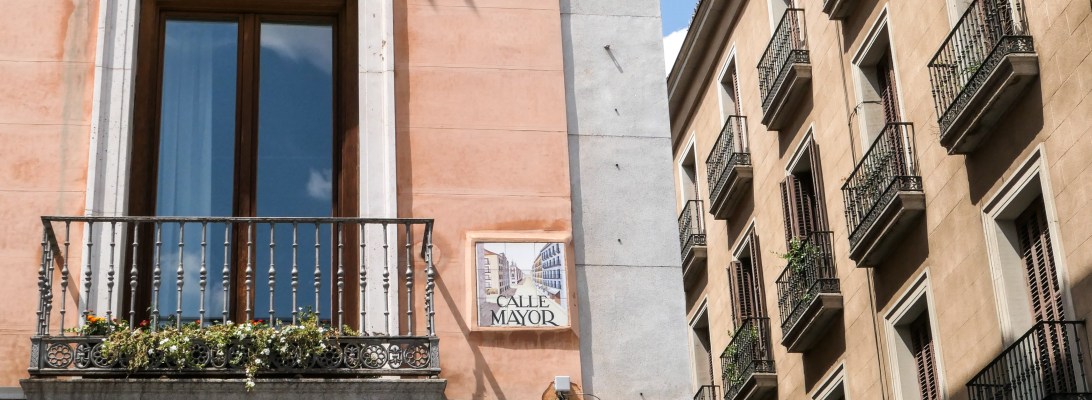
In pride of place on busy Calle Mayor was a shop named La Librería, which had every book on Madrid you could ever want. I bought “Madrid en 55 Dibujos”, which was a gorgeous little hardback full of paintings of Madrid scenes, a lot of which I’d already seen.

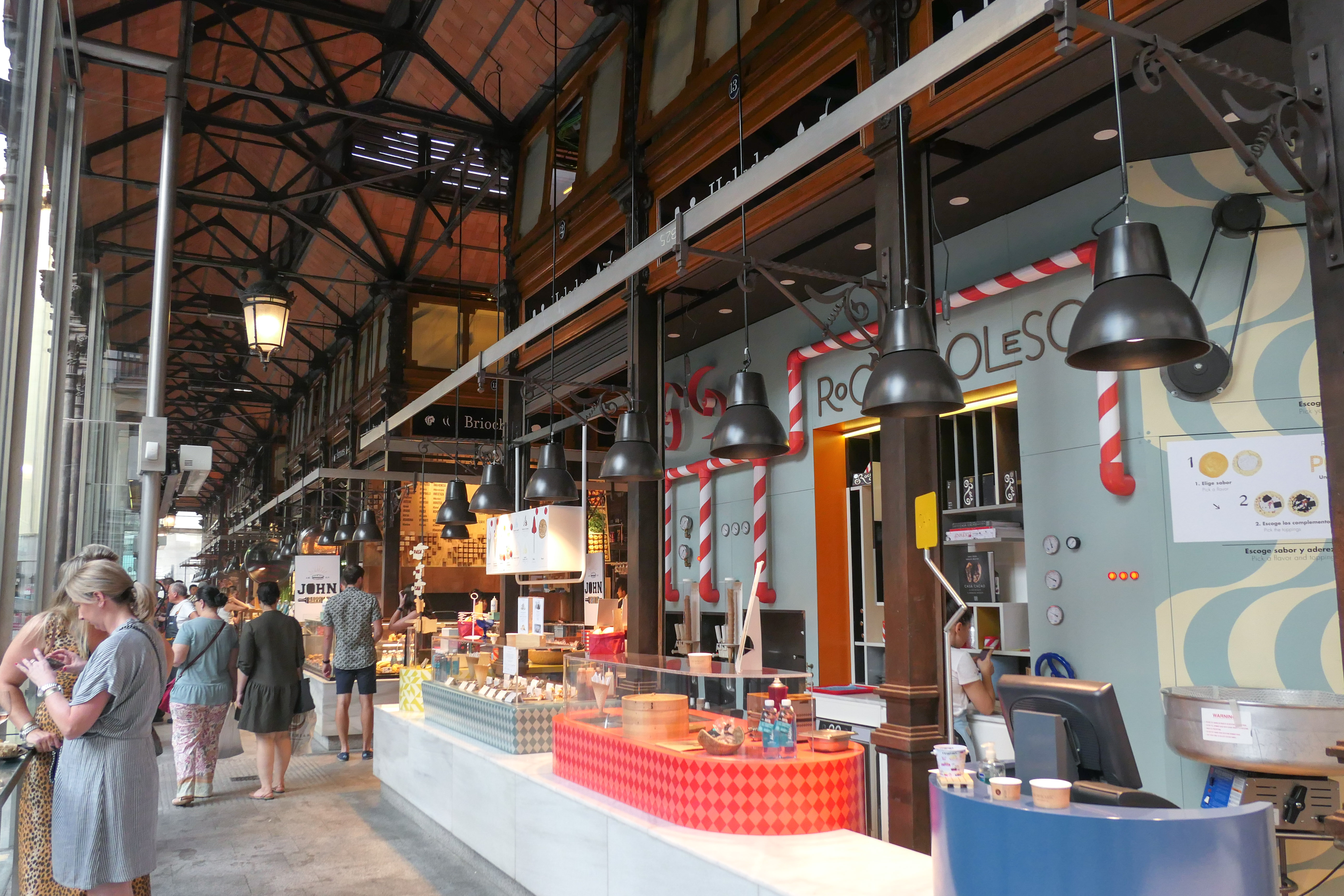
By then I was truly exhausted, so I retreated back to the far more tolerable temperature of my hotel room and wrote for a while before heading out for dinner. I sampled the broad range of tapas available at El Mercado de San Miguel, one of Madrid’s oldest and most popular food markets. I forced myself to browse before choosing anything, and I eventually plumped for two crab tapas. In one, the crabmeat was sandwiched between a neon pink burger that had a similar consistency and appearance to a macaroon but was doughier and less crumbly. The other was a miniature pot of crab, which was a slight disillusion as underneath the first inch the pot was filled the rest of the way with straw fries, but the crab itself was delicious. I was also very happy to find a stall laden with sweet treats, so I bought the largest marshmallow pastry I’ve ever seen.

After a good night’s sleep, I planned to explore a part of Madrid that I’d been excited about for weeks: a park stretching across 350 acres that I could just see myself getting wonderfully lost in.

Arriving in Madrid

I thought I was reasonably calm about staying in Madrid by myself, but on the train to Gatwick I felt sick to my stomach. After the stressful ordeal of flying to Florida I thought this would be a doddle, but then again I always panic when I travel. I lost count of how times I checked my camera, purse and passport were still in my bag. I knew I wouldn’t be truly relaxed until I checked into the hotel.

I wanted to make this trip the best it could be. Initially I had designed an elaborate agenda for each of the four full days I was in Madrid, pretty much hour by hour, but on reflection I decided just to list a few things in each district that I wanted to see and keep the rest of the time free for happy accidents. Ultimately it was supposed to be a holiday and if I dashed around cramming everything in I would come back needing to book another. There was also the heat. It was over 30°C all week, day and night, and the last thing I wanted to be doing was frogmarching around Madrid ticking off my wish list. I was embracing a little spontaneous.

The flight was delayed by nearly an hour. While we were sat in our seats, the pilot announced that another plane had been parked in their spot and Gatwick’s announcements had been “a mess”. It was nice to hear he was frustrated too. At least I didn’t have a connecting flight, but it meant I had to gaze outside at muggy drizzle for a while longer.

Eventually we took off and it soon became too bright to look out the window. When the clouds parted, the landscape stretched out in a never-ending blanket of blue; ocean blended seamlessly into sky with the horizon nowhere to be seen. A plane passed us, which was a bizarre sight that I’d never experienced before. It looked minuscule and quite surreal as it zoomed back the way we’d come, soon disappearing out of sight. It seemed as small as a bird flying alongside a car.

P1000116

Soon we left the ocean behind and land took its place: a spectrum of browns and pinks swirled in patterns like a gigantic marbled ink painting. Pockets of civilisation sat amongst a jumbled jigsaw of fields, their winding roads linking them in a complex web.

We sank lower and my ears popped. The sandy browns transformed into the greens of a vast expanse of forest, split into dead straight and uniform blocks by white boundary lines. All the while, bulging cumulus clouds slid slowly by. At times they covered the ground completely, puffing up like a worldwide bath full of soapy suds, their dark shadows blooming below them.

After so much open countryside, Madrid sprang up unexpectedly. Large tower blocks loomed over car parks and long bustling streets. I only managed to snatch a quick glimpse before the plane reached the runway and touched down. Once we’d disembarked, we crossed the bridge into the entirety of Madrid–Barajas Airport. Departures and Arrivals were all combined into one chaotic space. Passengers were amassing by the passport check kiosks so I followed, but when it was my turn my passport wasn’t recognised. I was sent to another queue, this one about two hundred-strong. By then I was getting anxious about my case arriving without me, not to mention my poor taxi driver who’d already suffered as a result of my flight’s delay.

The queue inched forwards. A woman in uniform asked to see my passport and told me I needed the other queue. I explained I’d already been rejected there, despite another attendant saying it was for European passports. The woman took me out of the queue and bumped me right to the front. Apparently I’d been in the right place but the machine didn’t recognise a passport if you pressed it down on the sensor, despite the natural instinct to do so.

Eventually I was through and hurried to Baggage Reclaim where I was quite alarmed to see that I shared a luggage belt with two other flights. Luckily my case appeared after only a minute’s wait so I dashed off to meet my driver Santiago, who was all smiles when I spotted him. He took my case, gave me a bottle of water and once we’d reached his car, pointed out the best shopping and tapas on a map. I was pleased to find out that I’d read about most of them during my research, so it was reassuring that a man born in the city recommended the same places.

We left the stress of the airport behind and I finally began to relax. Santiago showed me several landmarks on the way. There was the Wanda Metropolitano Stadium where Madrid-based football team Atlético Madrid play, and the Cuatro Torres Business Area – a business district with the tallest skyscrapers in Spain.

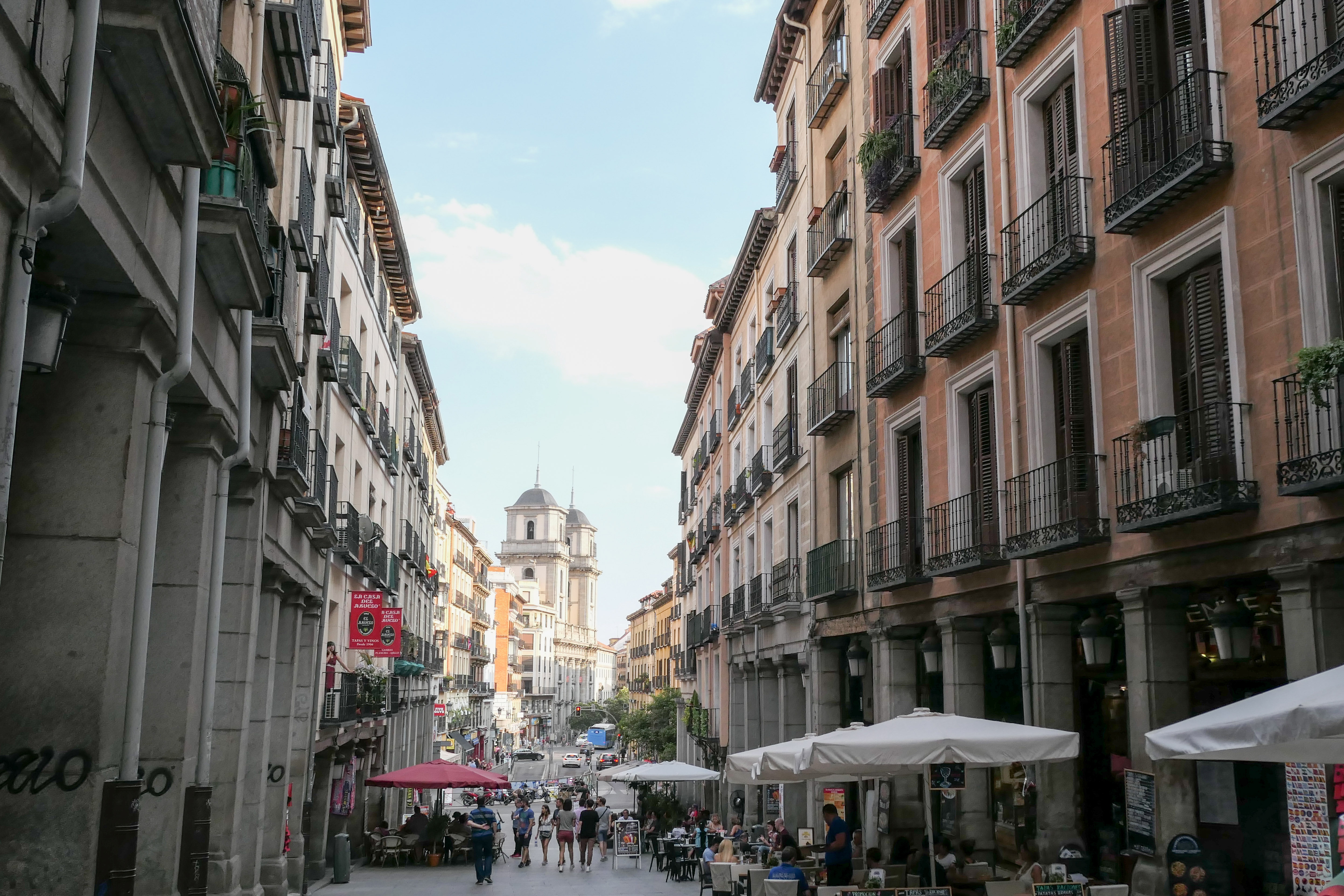
As we drove further into Madrid, the buildings closed in and soon the city had a similar feel to bustling London. I glimpsed zapaterias (shoe shops), panaderias (bakeries) and lots of tapas bars. We dipped down into an underground tunnel and Santiago told me that we were right beneath Plaza Mayor, arguably the heart of Madrid and where I would be staying. When we emerged back into daylight, the architecture changed drastically. In place of the drab, sombre buildings I’d seen on the approach were quaint apartment blocks in pastel shades with tiny wrought-iron balconies and pinstriped awnings. We had suddenly arrived at my hotel: the Petit Palace Plaza Mayor, one of a chain of Petit Palaces found in six other cities across Spain: Barcelona, Bilbao, Valencia, Mallorca, Málaga and Seville.
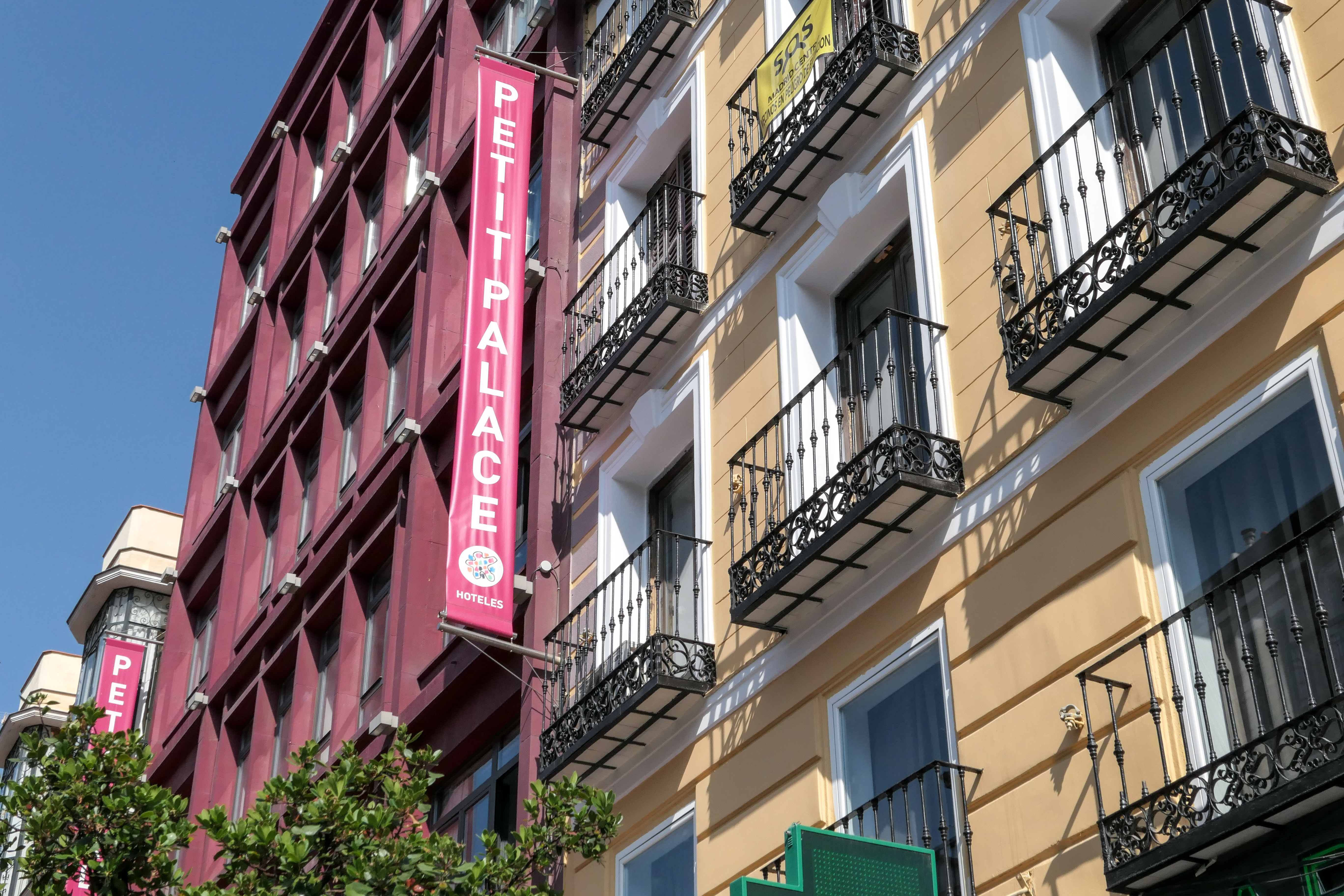
P1000156

In stark contrast to the bright and gracefully aged Plaza Mayor, the boutique-style hotel’s interior was subdued in colour with a significantly futuristic feel. I told the receptionist in Spanish that I had a reservation in the name of Rebecca Gibson and he proceeded to reply solely in English, which was a shame. One of the main reasons I had chosen Madrid for my destination was to brush up on my rusty Spanish. I knew a lot of tourists weren’t too keen to attempt the language, but I was very eager to talk in Spanish and I hoped that the locals would give me that chance.

P1000125

My first trip out was to Plaza Mayor itself, which was only a minute’s walk from the hotel. There were numerous people milling around but the square was spacious and tranquil in the early evening. The plaza was built in the sixteenth century when Madrid became Spain’s capital. It was used for state occasions including executions and bullfights, where the spectators would be crammed into the square and royalty would watch from the balconies. Luckily, the plaza is now filled with restaurants and cafes instead, and hosts a stamp and coin market on Sunday mornings.

On three sides the buildings were terracotta in colour with prim white balconies and shutters. On the fourth side – a building called La Casa de la Panadería (Bakery House) – the bricks were covered with intensely detailed frescoes dating back to only 1988, when the Madrid City Council launched a competition for the design covering the wall. The winner was Carlos Franco, whose artwork incorporating mythological characters was completed in 1992. Each part of the fresco was rich in colour with shocks of marigold yellow, rose pink and dusky orange.

P1000120

Standing pride of place in the centre of the plaza was King Felipe III on horseback – the subject of hundreds of photos found in Madrid guidebooks. I’d seen him at most angles before I even arrived, but I couldn’t resist taking my own version.
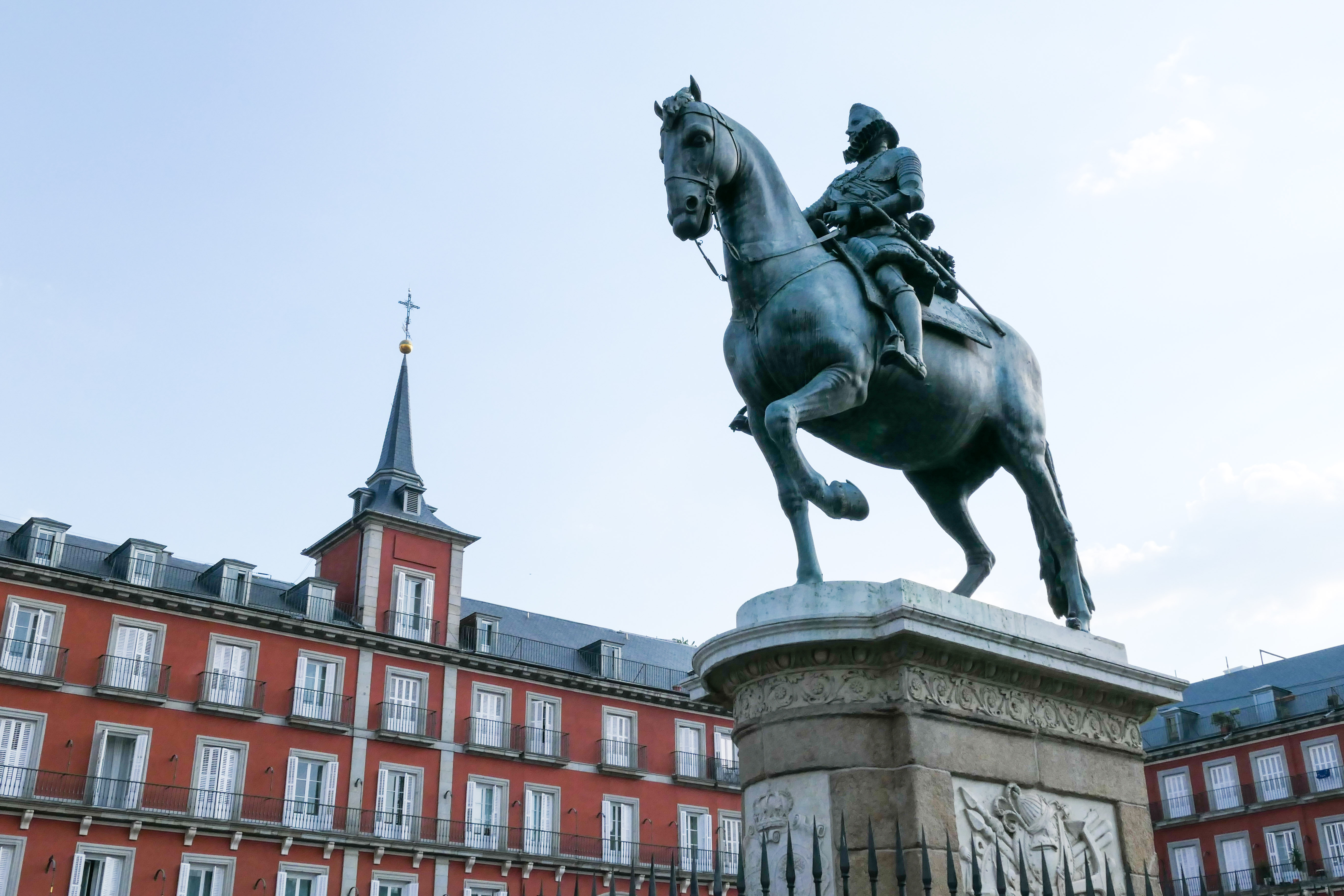
P1000122

It really was as hot in Madrid as I’d been told. At nearly 8pm, the temperature easily reached the most blistering of summer days in England. I perched on a stone seat to write and had to move to the shady side almost immediately to avoid burnt thighs. I vowed to definitely look into using the metro during my stay, as it was far too hot to walk any considerable distance.

Along with the glamorous architecture were splashes of kitsch, as with any city location that tourists have access to. Headless mannequins donning flamenco dresses stood in lines while people peered from behind them in Madrid’s answer to the Brighton beach scenes you could stick your face through. Mickey Mouse and Pikachu stood idly for no obvious reason, and several traders ambled around selling light-up toys and novelty whistles. All that aside, Plaza Mayor had undeniable charm. Restaurants and cafes lined the entire square’s border, but I’d been warned against their extortionate prices. I’d read that if I ventured only a few streets further afield I would find high-quality and authentic tapas at a fraction of the price.

I unintentionally threw myself in at the deep end by going to Casa Revuelta for dinner. It had come highly recommended for its bacalao (cod) tapas, but I soon realised it wasn’t your typical restaurant. There weren’t any menus – a waiter came over and you told him what you wanted. Every bit of food vocabulary flew out of my head and all I could utter was pescado (fish). Luckily, I was brought some of the bacalao, which really was delicious. With no bones, the meat was beautifully smooth and with only a thin covering of batter. I ordered something I saw on my neighbour’s table, which turned out to be bite-sized pieces of pork crackling, which I wasn’t a fan of. It was my fault for not brushing up on my vocab beforehand, but by happy accident (the first of many I hoped!) I had tried my first Spanish delicacy in the bacalao.

After settling up at Casa Revuelta, which was already swelling with hungry customers including many native Spanish speakers – I strolled back through Plaza Mayor. Street entertainers were in full swing and Pikachu now had a throng of children around him. I passed El Restaurante Sobrino de Botín, the oldest restaurant in the world, which already had a queue out the door. The dramatic soundtrack of a flamenco show drifted out of a dimly lit doorway.
P1000129

I wandered further on and found myself in Puerta del Sol, which was buzzing with activity. One of the busiest places in Madrid, Puerta del Sol (Gate of the Sun) is home to the clock that chimes during the traditional eating of the twelve grapes and signals the start of the New Year. At the far end was a fun little statue that many people had flocked to for photographs: El Oso y el Madroño (the Bear and the Strawberry Tree). Although reasonably small in size, this intriguing bronze statue weighs twenty tonnes and replicates the similar emblem shown on the Madrid coat of arms. The determined bear stretching for the fruit symbolises the resilience and tenacity of madrileños (people from Madrid). Bears used to be found in many of Madrid’s forests, as well as trees bearing fruit that closely resembled strawberries. Madrid was thought to have once been named Ursa, Latin for bear. You wouldn’t find many foraging bears in Madrid nowadays, but Antonio Navarro Santafé’s sculpture in Puerta del Sol was lively enough.

P1000137

I decided to get an early night after a long day of travelling so as most madrileños were heading out for the night, I made my way back to the hotel. Casa Revuelta was a bit of a shaky start, but as time went on I knew I would start to find my feet.
Salty Paws

As diluted sunlight comes streaming through the window I’m awoken by the squalling of gulls – a tangled symphony of disgruntled burbles, high-pitched cheeps and open-throated cackles from chimney top perches.

The weather in the Scottish Highlands is always a lucky dip. Some days I wake up to driving rain and moody skies. Today the sky is bright, streaked only by wispy cirrus clouds. Despite the sunshine, there’s a bracing wind skirting up over the waves and whipping them up into frothy white peaks.

A gaggle has assembled on the beach while the tide is far back. Common sandpipers hurry across the sand, weaving their way between bunches of seaweed strewn around like abandoned clothes. A handsome oystercatcher kicks up a fuss, its shrill piping call spreading far along the beach. House martins swoop like missiles over puddles left behind by the tide, their inky blue plumage gleaming in the sun.

There isn’t a soul here. On a warm, sunny day like this in the south, the beach would be clogged with sun-bathers and a garish patchwork of multi-coloured towels. Here, the beach is my solitary refuge. The water may be icy, but the views are stunning.

After weaving my way through assorted rocks worn smooth by the ocean and abandoned shells lying chipped and half-buried, I clamber up the steep dune running the length of the beach. My boots sink and sharp grass brushes my legs but I finally reach the summit and slide down the other side. The coastal wind instantly dies like a door has been slammed against it. The forest is sheltered and muffled against outside noise. Seclusion is one of the habitat’s best qualities. There is a feeling of anticipation upon entering a forest. It’s full of surprises.

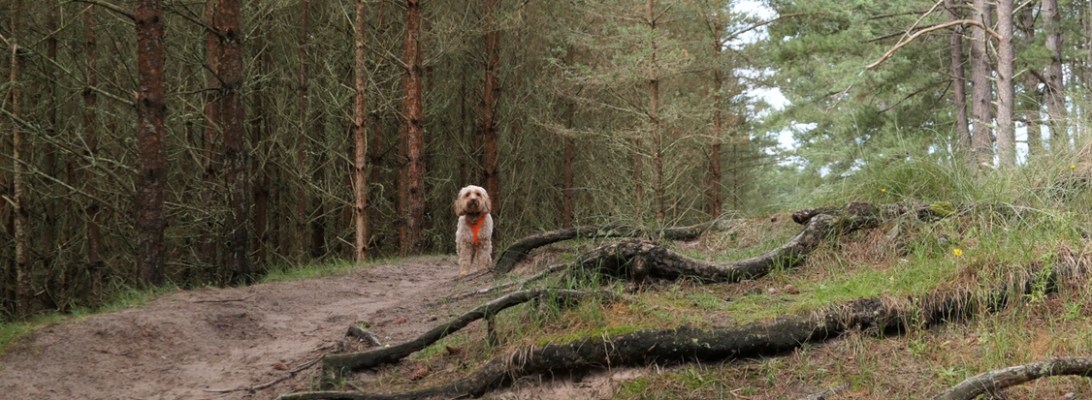
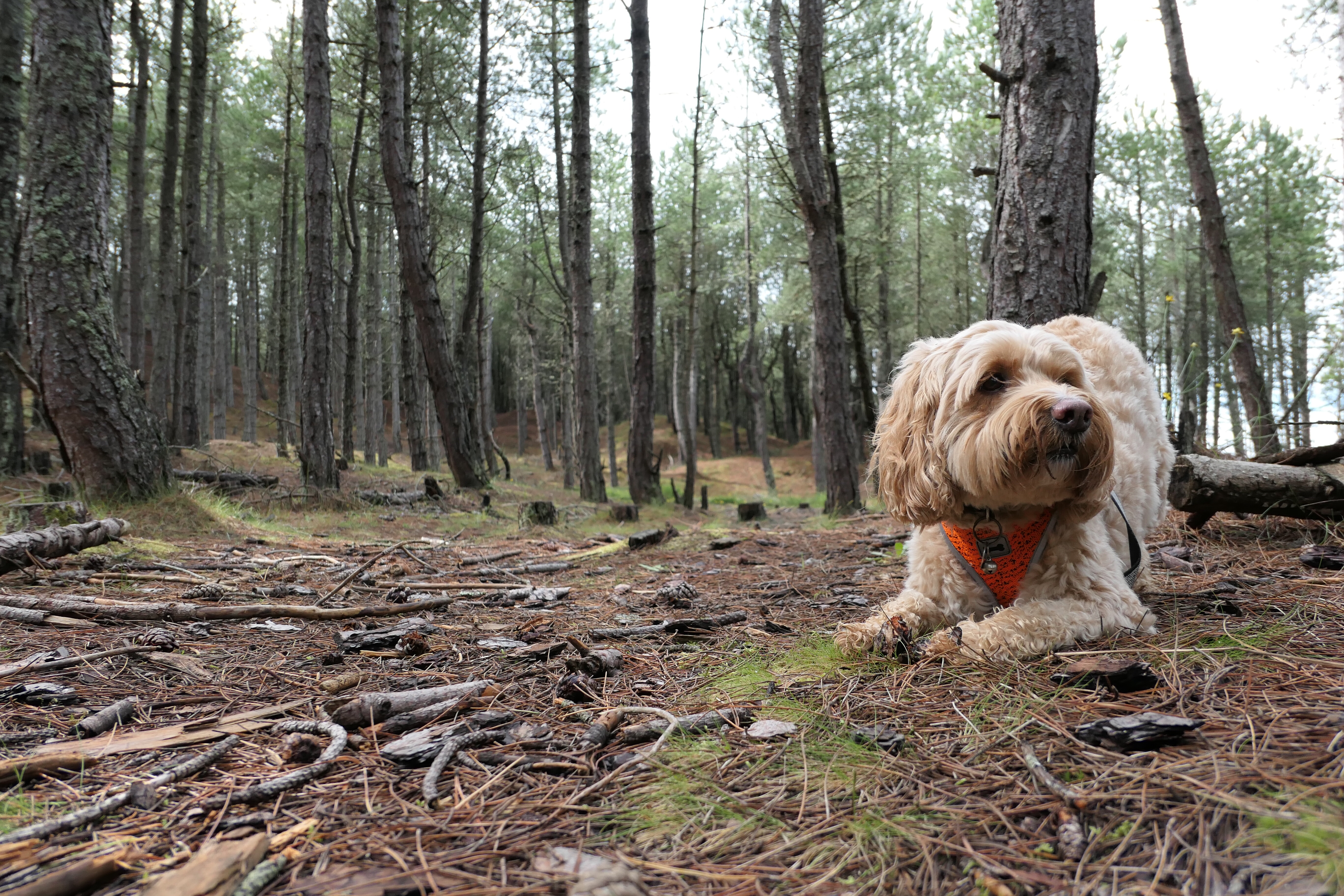
The dog wanders off by herself, true to form. The forest fragrance is too hard to resist. Her light fur flashes in and out of view behind the trees, their trunks as straight as the lines on a barcode.

I know there must be red squirrels in this forest, perhaps even pine martens. So far I haven’t seen either, but that is no guarantee of absence. It’s what I love about wildlife: it can never be rushed.

We pass another dog walker and for a while the only movement in the forest is the flurry of fur in a rambunctious chase. There will be no wild sightings this morning – martens are sleeping and squirrels are out of sight in the enclosed canopy. The dogs dash around blissfully, but eventually we pull them apart and I loop back towards town. Sounds of civilisation begin to permeate through the trees; car doors slamming, human voices, a distant bus. It’s like the sensation of ears popping and I’m back in the open, leaving the forest behind me. Until tomorrow morning.

Over the Loch

The gloom that had settled over the Cairngorms earlier in the week was long gone. As we pulled into the car park I leant forward and saw sunlight pouring through the coniferous canopy in diagonal slants, turning green needles shimmering gold. Another forest to explore! I couldn’t wait.

Once all members of the convoy had arrived, we gathered around the notice board. Abernethy was the second largest nature reserve owned by the RSPB, spanning 140 square kilometres. It was home to around 5000 species – a list that grows every year. Our guide, Simon Pawsey from the Bird Watching Wildlife Club, looked up the crested tit on his Collins Bird app – something I definitely need to get at some point – and quietly played us the bird’s call: a rapid trilling that I was sure I would be able to distinguish above the chaffinch’s constant rambling, as lovely as that was.

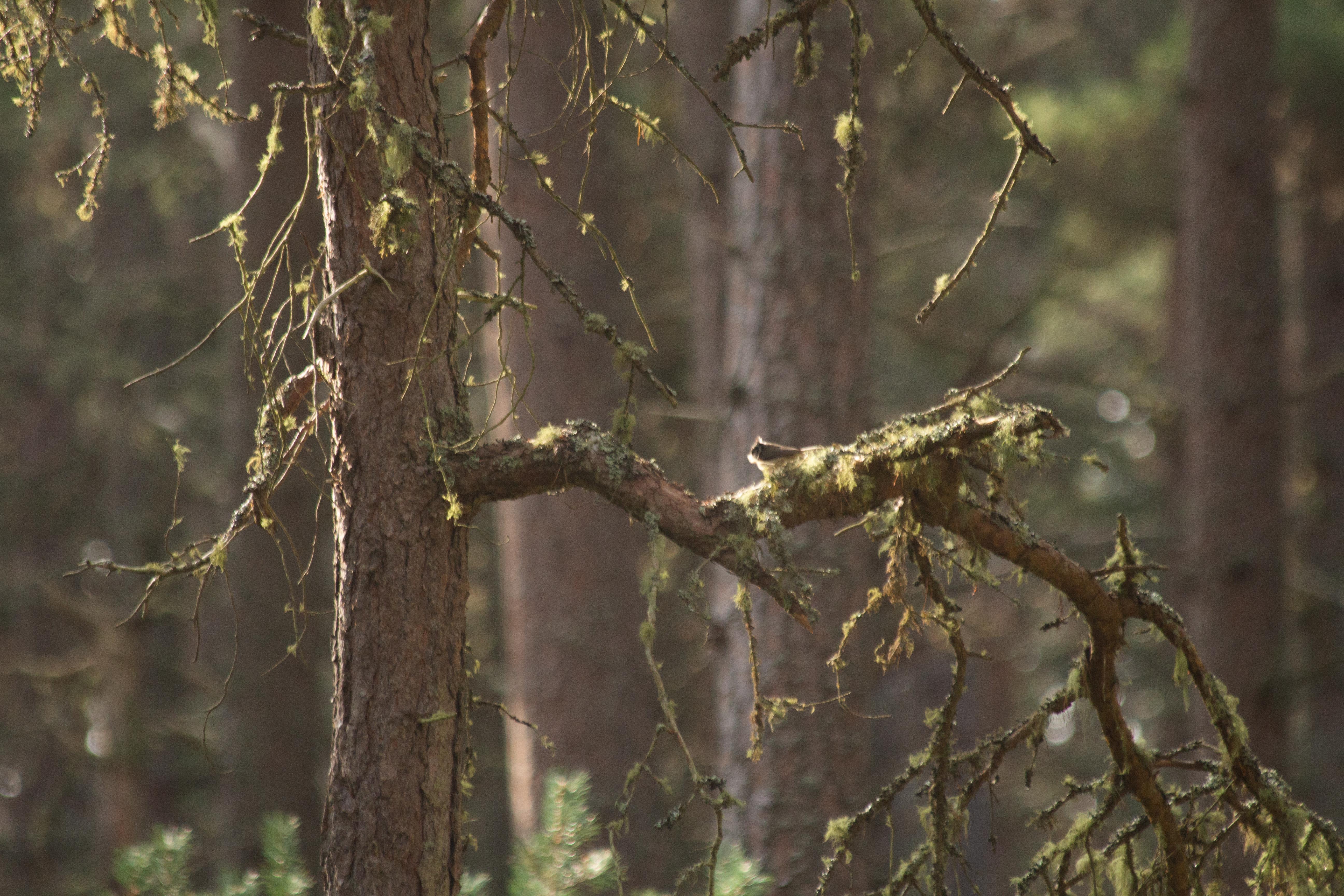
As Simon continued to tell us all about cresties, a small bird caught my eye a few dozen feet away. Lifting my binoculars, I focussed in and nearly disregarded the bird as a coal tit, which was exceptionally common in the local area. But then I noticed a peculiar tuft of feathers on the bird’s head. Surely not… A halo of light fringed the bird’s body and I squinted to make sure, keen not to make a fool of myself in front of all the other birders. But it was! It really was a crested tit! I exclaimed this to the group, embarrassed about interrupting Simon but deciding it was well worth it.

IMG_1596
Not a great photograph, but an amazing sighting!

There was a flurry of excitement as we all pinpointed the crestie for those who hadn’t spotted it. The bird was perched on an obvious branch in a relatively open clearing, sitting at eye level in a car park full of human voices and slamming doors. It was such a good view of a species that I thought I’d only get a snatching glimpse of at the very top of a huge Scots pine, if that. The crestie stayed for a few minutes, allowing us all to admire him before he took off and disappeared. Our guide had been talking about crested tits and a crested tit appeared for us all to see, almost like a “Here’s one I prepared earlier” moment. What an extraordinary start to the day!

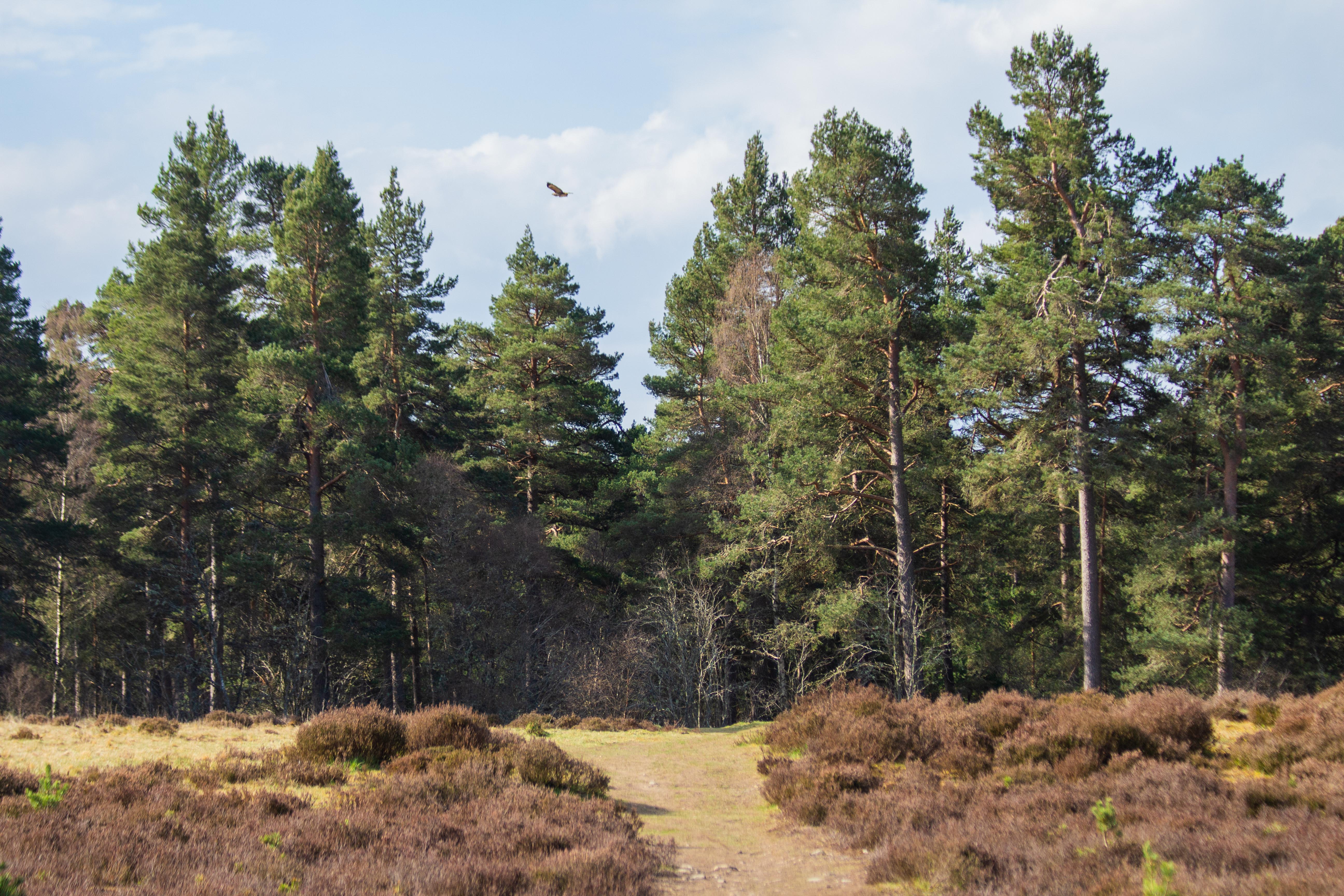
Buzzing after our first sighting, we set off into the forest, keeping an eye out for crossbills or red squirrels that might be foraging above. Several times a pair of dark wings high above had us briefly excited that we’d spotted an eagle, but each time it was a buzzard, or “tourist eagle” as it was often referred to in the Highlands.

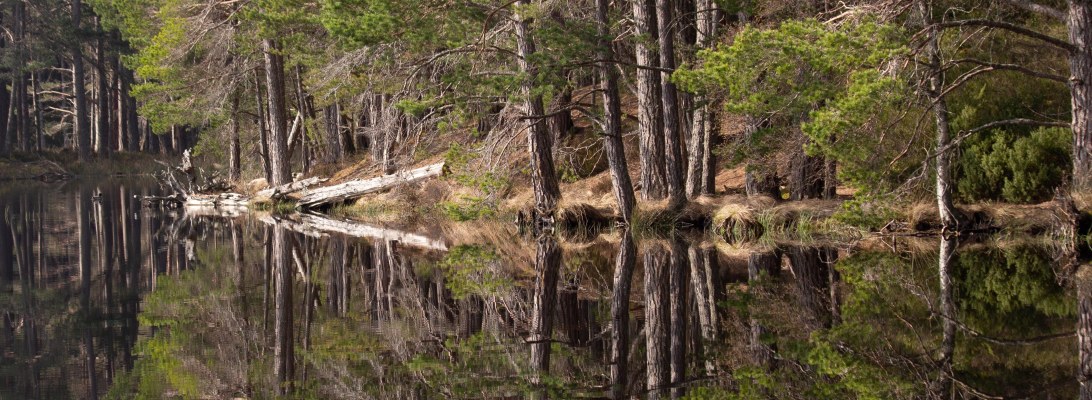
Before long Loch Garten came into view, and even with just a glimpse through the trees I knew it was going to be impressive. There was no breeze to stir the water so the loch lay as flat and still as a mirror, casting a perfect reflection of the trees along the margins and the blue hills in the distance. The only disturbance to the glassy surface was a lone mallard swimming far out in the loch, scratching a line across the water. Not a sound could be heard. As I stood on the bank absorbing the view, I thought how Loch Garten could be the perfect setting for an elaborate fantasy story. It was such a wild, beautiful place: seemingly tranquil and calm but with the power to turn at a moment’s notice.

IMG_1603IMG_1616

If I’d been alone, I would have sat by the loch all day, but I was here for birding with the group so reluctantly took my last few photos and followed them further along the trail, skirting the edge of the water. Sure enough, we found a red squirrel, although the animal was trickier to see than on the feeders in Anagach Woods back at the hotel. A bright orange mammal is surprisingly difficult to spot in dense green foliage, and it was only its sudden movements that gave it away.

IMG_1498

After a while another loch came into view: Loch Mallachie. Here we were met by a gaggle of greylag geese as they glided across the water. This part of the reserve was marshier, and not far from the land we were stood on was a smaller island with far shorter trees. Simon explained that they were the exact same type as the giants that surrounded us on dry land, but because of the variation in soil quality and nutrients, the same species was half the size only a few metres away.

IMG_1539

Suddenly one member of the group pointed out two dark specks on the horizon. I prepared myself for the inevitability of more buzzards, but once Simon had set up his scope I heard some very satisfying words: “Those are eagles”.

Everyone rushed towards the bank for a better view. The birds were very far off – tiny pinpricks on a white horizon – but sharp-eyed Simon could make out white patches on one of the eagles, suggesting it was a juvenile. After a while scanning empty sky I managed to locate them in my binoculars. They glided seemingly effortlessly at a dizzying height, barely moving their wings as they soared through the thermal currents. It was such composed flight: the movement of a creature that dominated its landscape. Fortunately, the eagles were flying closer, so one by one we had a peek through Simon’s scope. When it was my turn, I was thrilled to make out the bird’s head and beak even from such a distance. I’d seen a golden eagle once before on the west coast, but this was by far the clearer sighting. Eagles were the true celebrities of Scottish wildlife, and to see two at once was so special.

The eagles soared in large circles for a while before gliding further out of reach of our scopes and binoculars. Once again the group was buzzing. I couldn’t believe how lucky I’d been this week. After only four days in the Highlands I’d seen crested tits, crossbills, red squirrels, a pine marten and now two golden eagles. It reminded me of the importance of patience but also of luck; how being in the right spot at the right moment can bring unforgettable experiences. Being from the southeast where wildlife is far less abundant, I would treasure the sightings I’d had this week for a long time.

IMG_1626

Anagach Woods

After one day of the Grant Arms Wildlife Book Festival, I had already ticked off 27 species. The morning started off gloomy so I wrapped up knowing that the Highland air would bite without a little sunshine. After a delicious breakfast I met my guide Sue and we set off. Our destination was Anagach Woods, only a five minute walk from the hotel. I knew it was my kind of place from the first glimpse: dense evergreen trees, a winding trail and the lyrical murmuring of birdsong. The harsh, icy breeze that made the eyes squint and the neck shorten completely disappeared once we strolled past the first few trees.

IMG_1493

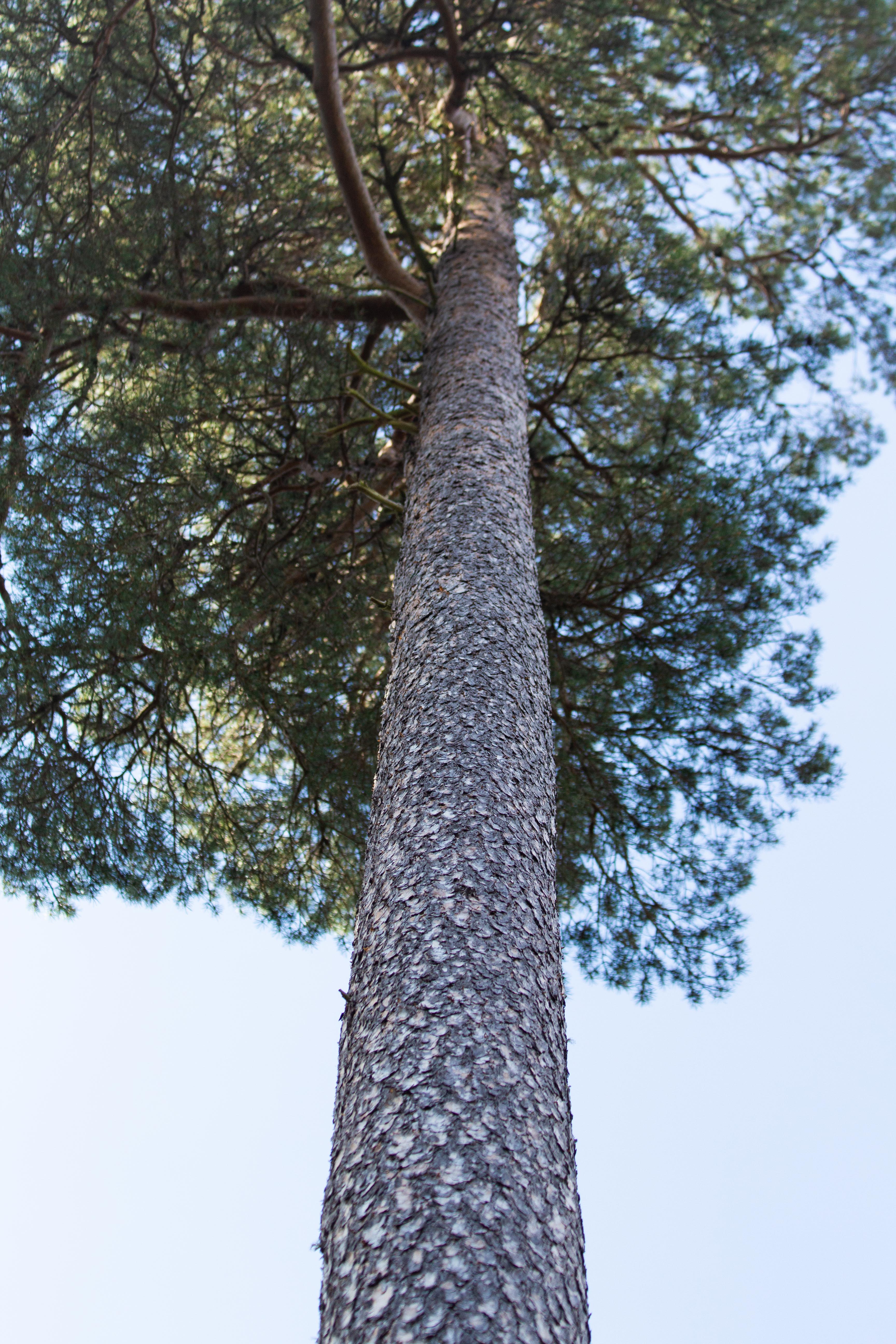
Anagach Woods were planted in 1766 using young pine trees dug up and transported from the old Caledonian pine forest of Abernethy. A few of these original trees are still standing today; wizened goliaths surrounded by waxy saplings. Throughout Anagach are deposits in the form of fluvio-glacial ridges, raised beach sands and gravel deposits dating back 10,000 years to the Ice Age. “Fluvio-glacial” refers to the meltwater created when a glacier melts.

Within ten minutes of entering the woods, I had my binoculars trained on a red squirrel -tail and hands poised in the classic pose as it nibbled on a peanut. A completely peanut-based diet causes a deficiency in red squirrels, so the rangers fill their feeders with a special mix to keep the squirrels’ diet balanced. Whether the animals follow the regime is another thing entirely, and they don’t. They prefer to pick out the peanuts with the steely determination of a child eating around their vegetables.

IMG_1484

It’s impossible to dislike red squirrels. (Personally, I have no quibbles with greys either – they’re not inflicting reds with the pox with any malicious intent, nor did they ask to be brought here.) Reds have the eye-watering cuteness of babies their entire lives, coupled with boundless energy. We watched two up in the tree, neither tolerating the other’s presence. After a brief, silent stare-down, a ferocious squabble broke out. In the blink of an eye, two orange flashes flew up the tree, twirling around the trunk with scrabbling claws. The victor was soon perched proudly on the feeder shelf – stuffing head, front legs and one back leg inside to grasp the prize.

We ventured further into the forest. Each time a branch quivered or a chirrup sounded, I scoured the canopy for a particular little bird with a very impressive Latin name. Lophophanes cristatus is mostly confined to ancient Caledonian pine forests and Scots pine plantations. On the RSPB map of the UK, this bird’s presence is indicated by only a small patch in the Highlands of Scotland. A member of the tit family, it sports a magnificent punk hairdo.

Photo: RSPB

I had my sights set on the crested tit. As small as the far more common blue tit, the “crestie” is a firm favourite among Grant Arms guests and features on many wish lists including my own. My main objective during my time in the Cairngorms was to see a pine marten (dream big, I say). Or, if that dream turns out to be a little too big, I will happily settle for any new species.  I kept my eyes peeled for cresties but sadly they eluded us that morning. Sue said that at this time of year they would be right at the top of the trees gathering nest material. When those trees stretch to dizzying heights of around twenty metres, spotting a tiny bird in the dense canopy would certainly be a challenge.

IMG_1486

Despite the crested tit playing coy, we were treated to a lovely showing of a buzzard. Buzzards are one of those species that I sometimes underestimate. They don’t tend to get me too excited – especially for that one split second when you think you may have found an eagle – but that morning in Anagach I saw a buzzard land for the first time. Up in the air and bleached out by the sun, it can be hard to make out specific detail, but as the raptor perched in the pines, I could admire its snowy white chest – as soft as an owl’s – with speckled markings that gave it the air of a regal monarch’s gown. The buzzard preened its feathers for a while before taking to the air and melting into the trees. It was a fitting way to summarise the forest habitat: a creature can be there one moment, and vanish the next. Forests are irresistible to me, and Anagach easily became my new favourite.

IMG_1489


Checking in

I arrived in Grantown-on-Spey at night, so couldn’t see much of the Cairngorms wilderness that pressed heavily on both sides of the winding road. I glimpsed darting rabbits and the elegant form of a pair of deer, but there must have been dozens of other creatures concealed by the dense evergreens.

My accommodation, the Grant Arms Hotel, was beautiful; a formidable building of stone and wide sash windows that could easily be the set for an elaborate period drama. Also called the Wildlife Hotel, the Grant Arms provides guests with easy access to a range of reserves of all different habitats. When I checked in, a large notice board stood pride of place in the foyer, full of lists of upcoming events, guidance on watching wildlife – including the magnificent capercaillie – and sign-up sheets for the week’s guided walks and field trips. An impressive puzzle adorned with a picturesque nature scene lay finished nearby. On the walls were images of puffins, ospreys, black grouse and, in my room, a beautiful fieldfare. I’d never seen so much wildlife-related decor and I absolutely loved it.

As I unpacked, I felt a thrill of eager anticipation for the week to come. I’d never stopped in the Cairngorms before but only passed through, so I couldn’t wait to sample some of the incredible wildlife. I had my sights set in particular on the pine marten – an elusive and nocturnal member of the mustelid family. If I was going to fulfil my New Year’s Resolution and see one in 2019, the Grant Arms Wildlife Book Festival was my best chance.

The Wildlife Hotel

On The Wing has been quiet recently, not for lack of inspiration but for lack of time. Over the past few months I’ve been busy with a few different projects. I’m close to finishing an annual report for SEZARC, outlining the highlights of their work in 2018. I’ve also moved part-time into the library where I’m filling notebooks with scribblings about Siberia, Russian megafauna, native tribes and the mysteries of shamanism. All this is for my book idea and the more I read, the more I need to read. It’s a constant cycle of finding a book, reading something fascinating and looking up similar books to find out more. I’d love to eventually start the actual writing process, but so far I’m waist-deep in other people’s books and loving every minute.

All of this work has meant that I’ve neglected my camera and seen most of my local wildlife from behind glass recently. However, this week brought the perfect opportunity to get back outside and into nature. It’s the Wildlife Book Festival at the Grant Arms in the Cairngorms. Also called the Wildlife Hotel, the Grant Arms is a beautiful Victorian building within easy reach of dense pine forests, boulder-studded rivers and sweeping mountain valleys. In other words, the perfect place to celebrate British wildlife.

It feels fantastic to be back out there with binoculars around my neck and a crumpled notebook in my hand. It also helps to be in such a stunning location. St Albans is nice, but when you’re woken to the sound of squealing oystercatchers and only need to walk for five minutes before hitting a thousand acre wood (check mate Winnie the Pooh), there is simply no contest.

It’s so easy for me to get caught up in work. I get so engrossed that I forget to ever switch off, which makes this week a very important break. It’s a little telling that I need to travel five hundred miles from home to take that break, but when the scenery is this pretty, I’ve figured it’s alright.

New Leaves

This year I am dedicating a lot of my time to something I have wanted to do for many years: write a novel. I often write fictional scenes and enjoy creating characters and I wanted to set myself the enormous challenge of extending those elements into a book. I’ve read that while many authors swear by detailed outlines and believe that spontaneity is recipe for disaster, others encourage new writers to see where their imagination takes them. I’m trying the latter technique. I have a protagonist and several themes I would like to focus on, but so far my plot is far from finalised. The following is a passage I’ve written as a scene-setter that introduces both the location and my leading lady. 

  ____________________

The snow fell heavier than it had in a hundred years. There was no wind – the land lay still, muffled under six inches of brilliant white. Evergreens buckled beneath the weight of their silvery coats. Even the river had succumbed to winter; it lay motionless beneath a slab of ice, arranged in a winding, serpentine fashion between hills and mountains. It was late February – there was just over a month left of the winter that spanned half the year, but the coldest season still had a firm grip over the land. In March, the climbing temperatures would start to melt the snow into large freshwater pools and reawaken sleeping giants eager for the salmon run in July.

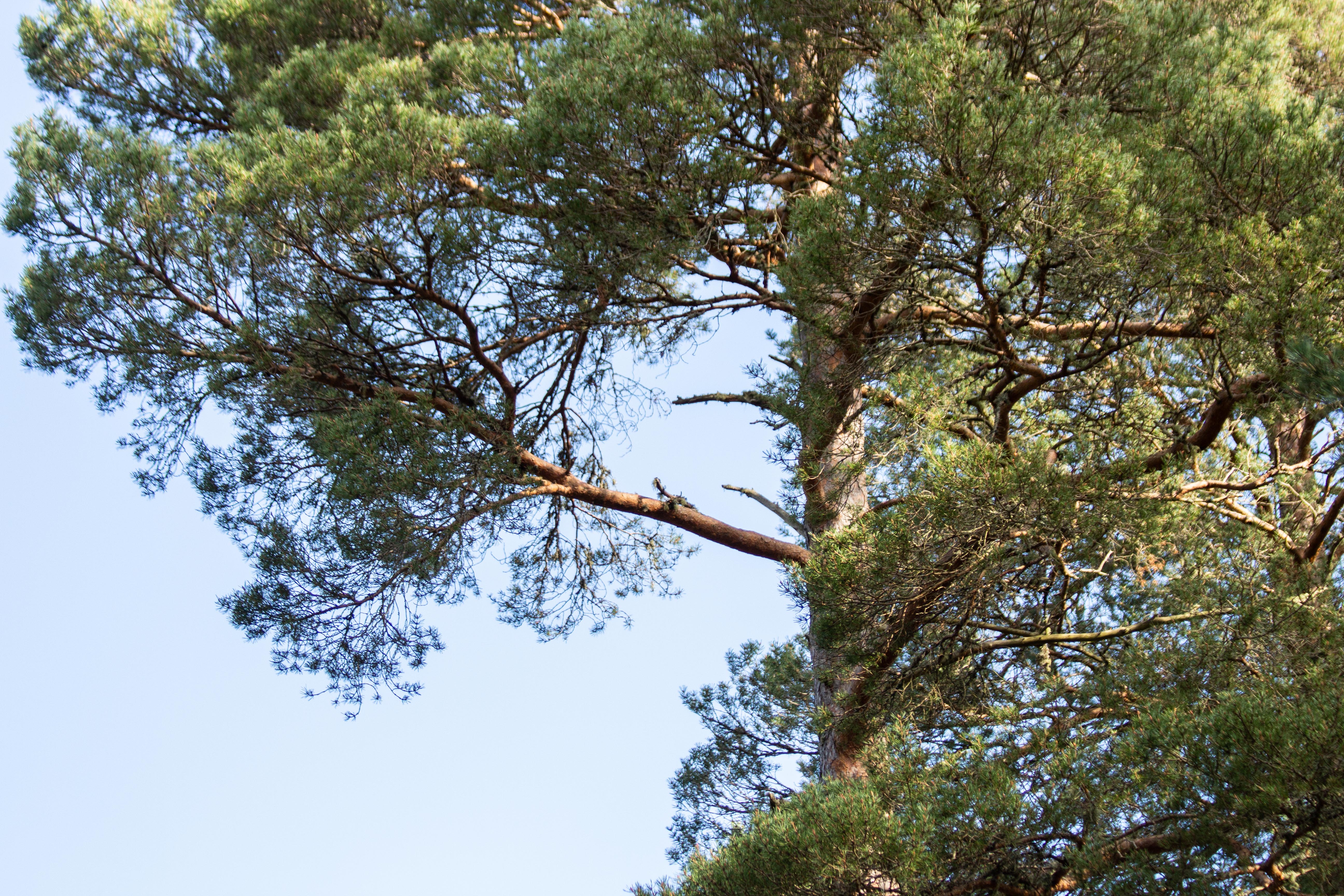
Halfway up a sprawling larch tree perched a teenage girl. She was small for her age, but agile and nimble. With her back pressed against the trunk, she had the perfect vantage point over the land. Before her the forest sprawled as far as the eye could see. Thousands of trees stood beneath snow and ice, their skeletal branches brittle in the cold.

Vanya’s breath rose from her lungs in icy shards, tumbling from her mouth in clouds of grey mist that swirled upwards into the sky. An eagle cried far away, her voice transported many miles over the sleeping land. Vanya had lived in the taiga forest her entire life, but gazed upon its sweeping scenery with the same wonder as the first time she saw it. It was a paradise of silver beauty. The silence was so thick she could feel it, heavy and palpable in the air. It was an anticipative silence that made the hairs on her neck stand on end. There was change in that silence – something new just beyond the horizon.

Despite her thick furs, Vanya soon began to feel the cold as the sun weakened. While she still had the light to see, she descended from her tree, scrabbling down the trunk with impressive confidence before dropping the last six feet to the soft ground. She padded down the hill, sinking into the snow with each step. Behind her lay a long trail of boot prints, already softened at the edges by fresh flakes. Frost clung to her eyelashes, brushing her cheeks with cold strokes and fringing her vision with a white vignette. Snow rustled in the folds of her coat and crunched beneath her feet. If undisturbed, the snow would fall and rest in utter silence. Only when it was touched did it begin to whisper and crackle. In the heavy air, the sounds were deafening.

When she reached a dense thicket of pine trees, Vanya slowed her pace and gazed skywards, scouring the canopy for birds. Snow clogged the gaps in the branches, concealing all manner of wild creatures. A sudden commotion cut through the silence like a knife. Vanya’s eyes flicked to the sound, freezing on the spot as a flurry of fine powder drifted down. The branch trembled, sending more snow to tumble from within its stiff needles. In moments the raid was over and the culprit emerged at the trunk. It was a young male sable, perhaps from last year’s litter, with dark brown fur and a splash of dusky orange on his neck. A small, carnivorous mammal, the sable belonged to the marten family. The animal cascaded deftly down the tree with agile limbs and keen claws.

Landing with a soft thud on the forest floor, he immediately looked up at Vanya, who had sunk down onto her knees to watch. The sable was clutching a stolen egg in his mouth, razor sharp teeth sunk into the shell for a better grip. Confidently, he trotted over to Vanya, dropped the egg and began sniffing her coat. Vanya extended a hand to the animal, noting the way his sleek fur rippled with each movement. The sable studied the girl’s face briefly before clambering onto the open hand, his nose twitching furiously. Vanya ran the backs of her fingers along his fur, delighting in its buttery softness. After a few more moments in her hands, she set the animal back down onto the snow, where he snatched up his egg. With a brief backward glance, the sable lolloped away to cache his prize.
To anyone else, this behaviour was unheard of. Sables, like many mustelids, could be notoriously aggressive towards humans, especially when food or kits were involved. Vanya was an exception to the rule. Since birth, she had truly understood animals. They were not stupid or cruel, like humans, but sensitive and respectful. Vanya saw no reason not to behave equally, and in response any animal she interacted with was fascinated by her. They sensed goodness in her; a quality that they had learned was absent in most humans. Instead of fearing her, they immediately trusted her.

Vanya studied the sable’s prints in the snow. In less than a minute, the snow obscured the impressions the tiny pads had made. In five minutes, they had disappeared completely. Her interaction with a wild sable might never have happened. Vanya was alone, and yet surrounded with life.