Micrarium

Recently I was accepted onto the Travel and Nature Writing MA at Bath Spa University, which I’ll be starting later this month. In preparation for this exciting new challenge, I signed up for a travel writing workshop run by Peter Carty, who regularly writes for publications such as The Guardian. Although my focus will definitely be more on the nature half of my MA, there is a lot of overlap with travel and I would love to develop my portfolio in this area.

Peter’s workshop was extremely useful, especially the postcard exercise. Over lunch, we were let loose into London with a blank postcard. The challenge was to find a new and intriguing place and write a short travel piece about it on the postcard, including quotes from people we met along the way. As a wildlife writer I’ve had very little experience with interviews, so approaching strangers and getting quotes was daunting but rewarding. I decided to visit the Grant Museum of Zoology in Fitzrovia, which turned out to be a treasure trove of taxidermy and scientific specimens.

________________

Micrarium

A jar of moles, a penis worm and a dissected rat. These are just some of the specimens on display at the Grant Museum of Zoology. But past the imposing elephant skulls and ominous, pickled jars is an intriguing display of alien-like creatures nobody would notice in the wild.

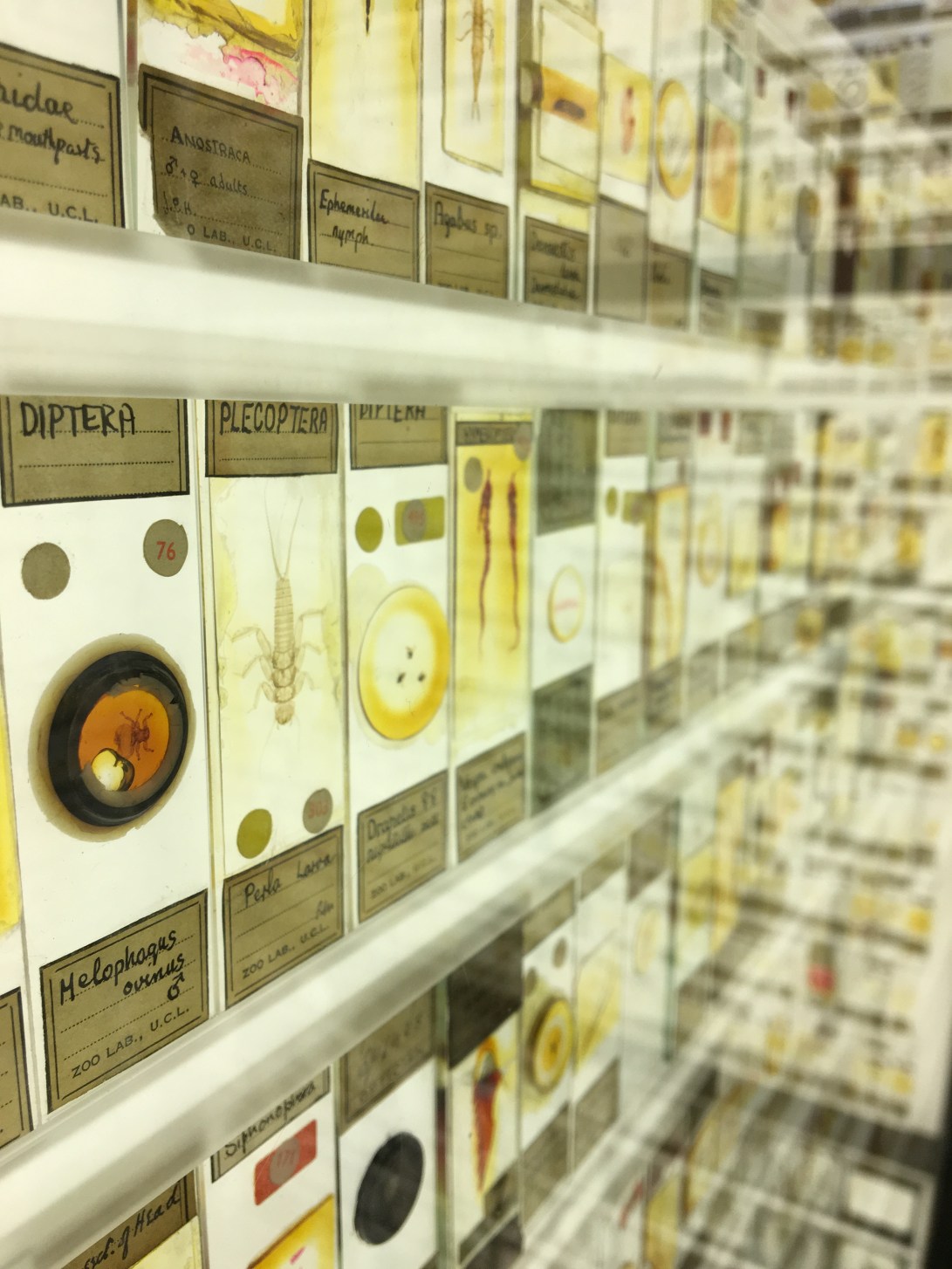
It’s said that 95% of known species of animals are smaller than a human thumb. The Grant Museum, named after British anatomist and zoologist Robert Edmond Grant, sheds light on the mysterious and microscopic in its Micrarium: a seemingly infinite display of backlit microscope slides that are creatively reflected in a mirror mounted on the ceiling. There are 20,000 slides in the whole museum, but the selection of 2000 in the Micrarium exhibit alone is impressive enough.
IMG_3974

“It’s probably one of our more popular exhibits,” explained volunteer Margaret, “We get lots of people taking photos for Instagram.”

I can see why. Step inside this bizarre taxidermic phone box and you can observe minute insects and cross sections of tissues in astonishing and multicolour detail, painstakingly plastered across three walls. Among the specimens are the muscly leg of a flea and a whole squid measuring less than a centimetre long.

“While public displays very much focus on larger animals,” said Jack Ashby, manager of the Grant Museum, “Most natural history collections have thousands of very small specimens kept in their storerooms which are rarely shown to the public.”

Once used for research at UCL, the neighbouring university, the Micrarium now enthuses the general public instead, uncovering secrets of the miniature monsters that crawl well out of human sight. It’s not quite the blue whale at the Natural History Museum, but it’s an insight into 95% of animals on our planet, which definitely deserves a second look.
Fresh Inspiration

Recently I’ve become a writer who doesn’t write much. I have ideas, many a day, of what to write, but somehow I never get round to making them a reality. I’m blaming this latest case of writer’s block on my new occupation, so I’ve decided to write about that. I have been accepted as a volunteer at Paradise Wildlife Park in Broxbourne, Hertfordshire. It was the longest application process for a voluntary position I’d ever experienced, but after interview, induction and trail day I was successful.

Volunteering in a small aquarium in Cumbria could not have prepared me for work in a zoo. Although far from large with only around 400 animals (in comparison with Chester Zoo’s 20,000), Paradise Park still requires plenty of hard work and for me it’s a physically demanding and challenging role. I anticipated this beforehand and should have been ready, and yet I still came home from my first day with aches in every limb, rashes on my arms from the hay and mysterious scratches from the day’s manual labour. As is expected of all volunteers, I spent most of my time with what the animals left behind (you cannot believe how heavy camel poo is) and in the July heat I worked up a significant sweat.

And the funny thing? I loved it. Three years of university has been a mental workout but not so much a physical one. My arms are little more than jointed matchsticks, and just as strong. Volunteering at a zoo will be such a great opportunity to build up some strength. There is also something immensely satisfying about scrubbing a paddock clean, even though the moment the animals are let back in they completely rearrange the fresh bedding and christen it with droppings.

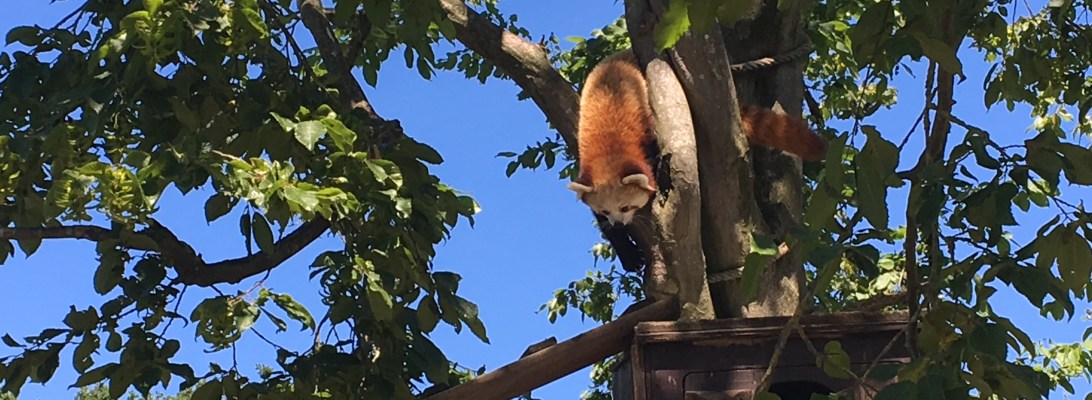
If I had a pound for every time I’ve been asked “So what’s next?” since I came back from university, I could retire without having started a career. I still don’t know what I want to do or where I want to be. While I still love writing and photography, I feel a pull in a new direction – the daily grind of contributing towards a successful and high quality zoo. There is something very appealing to me about caring for wild animals in a place that values them (that’s the important bit) and sharing my passion with other people. I watched the Small Mammals keeper giving a talk as she fed the red pandas and I had an urge to join her, but my knowledge of red pandas is really quite limited. I want to study them, I want to know everything there is to know about these animals, and share that with people. And I believe I can do that by writing but also by being there among them.

I’m fully aware that becoming a zookeeper is an incredibly gruelling and challenging process. I’m also aware that my current academic background will not help me in that mission. Every keeper I’ve spoken to so far has begun by volunteering, and worked their way up the ladder. So I have joined Paradise at the very bottom, and the only way to go is up. I’m inspired by this, and know that I have to pursue it.