This summer is zooming by! I’ve been spending the past few months travelling and writing my book, which is now due in three months. That’s quite a terrifying thought actually…
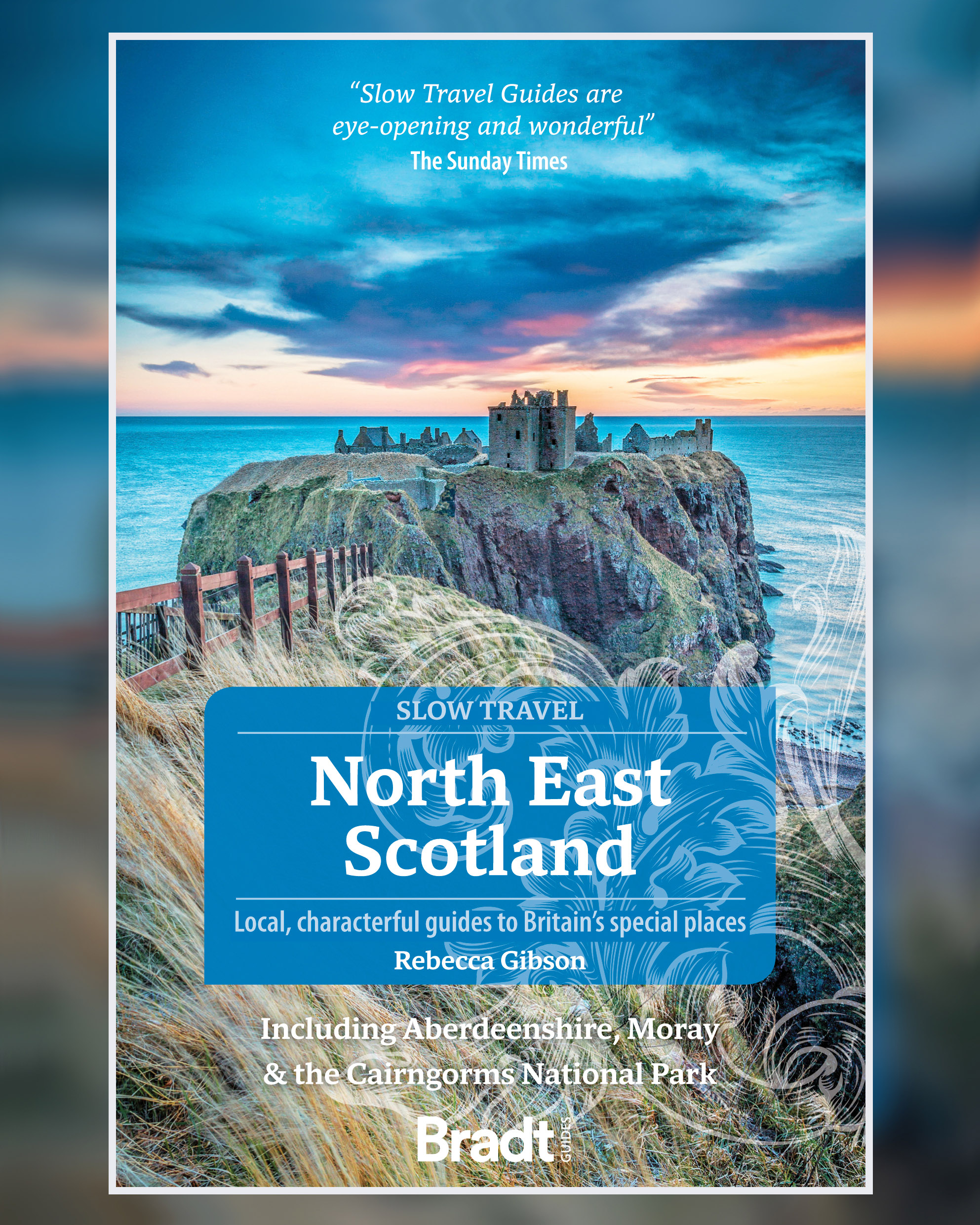
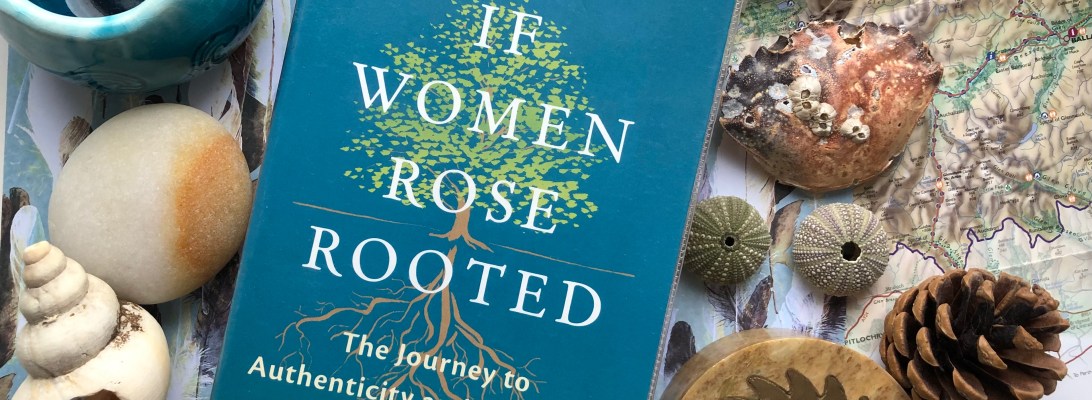
My research trips have involved stomping through Caledonian pinewood, sampling local whiskies and searching for hidden stone circles. I’m absolutely loving this challenging yet rewarding project and can’t wait to see the finished product on the shelves. Here’s a sneak preview of the front cover.
As well as book writing, I’ve been putting together my 2023 calendar. Like last time, it features a range of Scottish birds and mammals that I’ve photographed this year including snow buntings, badgers and even a goshawk!
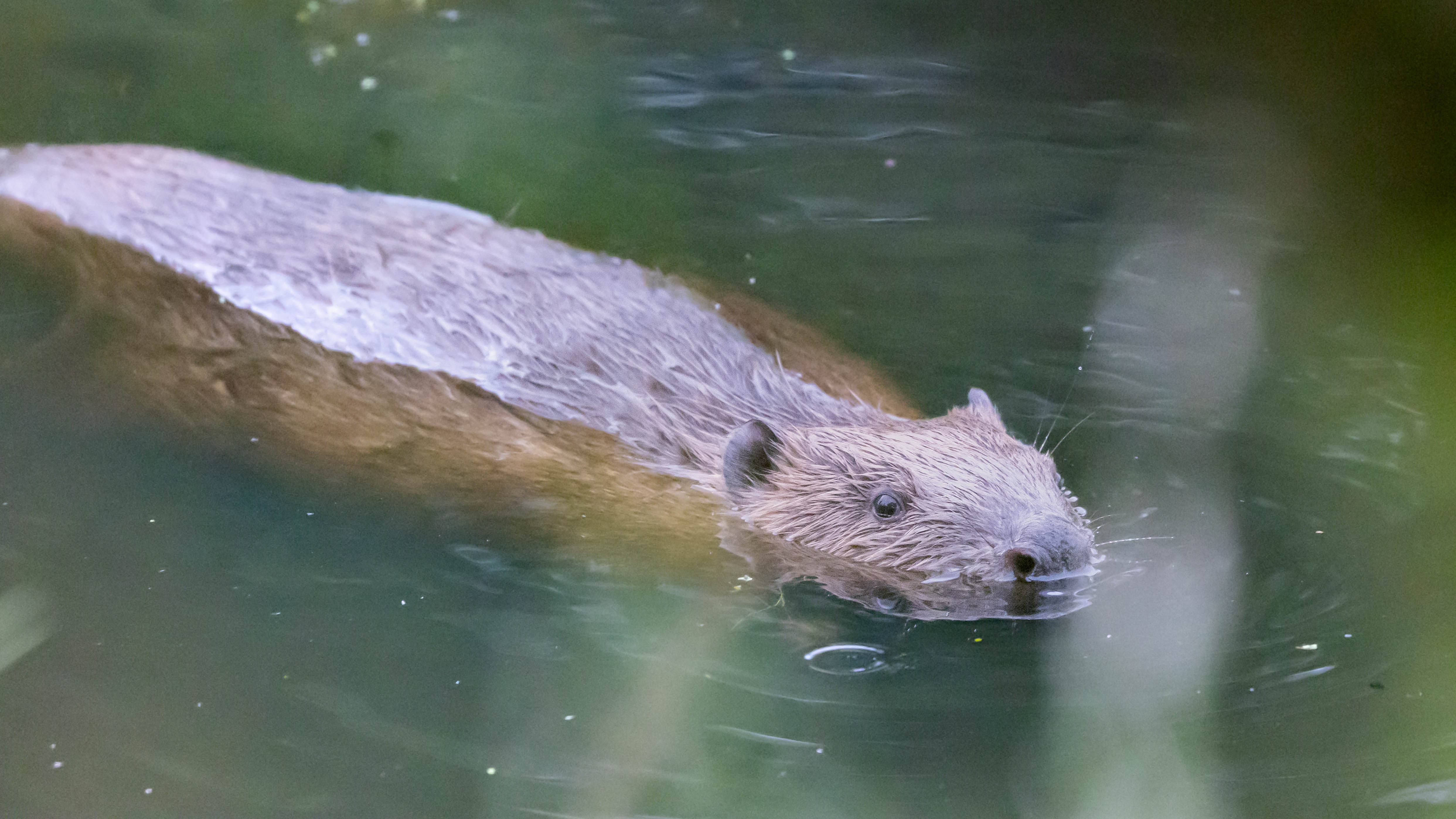
And finally, I took some time away from the north east recently and headed down to Perthshire to photograph beavers. These incredible animals completely transform their surroundings and it was a privilege to spend so much time with them.
I’m currently writing a Slow Travel Guide to North East Scotland, which will be out next spring. The thing about writing this book is I’m spending every working moment on it but won’t have anything to show for my efforts until it’s published. Until then it looks like I’ve fallen off the face of the earth. As we’re almost at the end of spring, I thought I’d finally resurface and reflect on what I’ve been up to over the past couple of months.
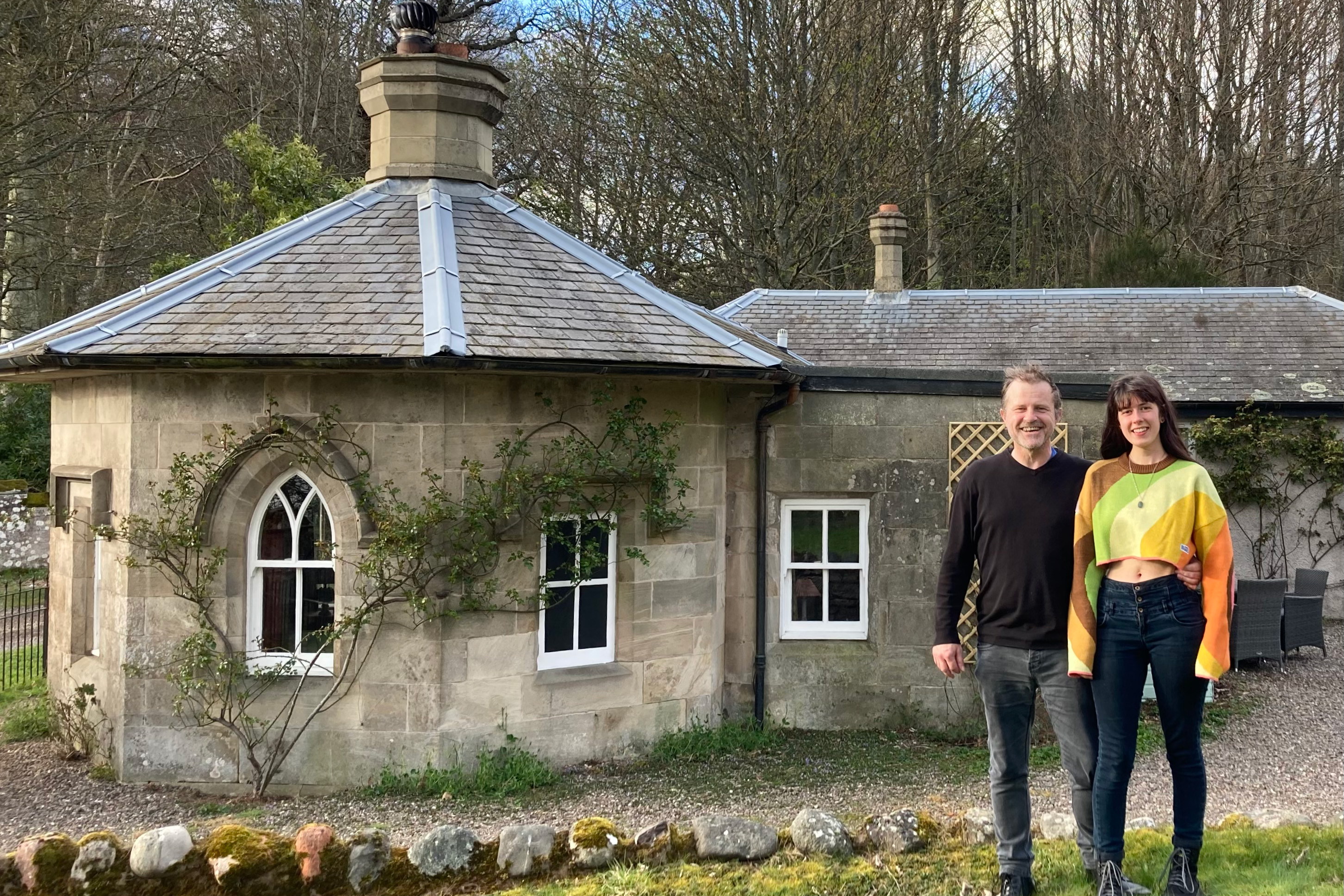
Inchrye Lodge
At the start of April I travelled down to Fife for a week. This was a particularly special holiday as I returned to the same cottage in the first part of Scotland I ever visited, back when I was eight years old. It was fantastic to be back and I realised just how much my wildlife knowledge has improved since that first visit. During my time in Fife I also visited the Audubon exhibition in Edinburgh, one of my favourite cites, and the incredible Topping bookshop in St Andrews.
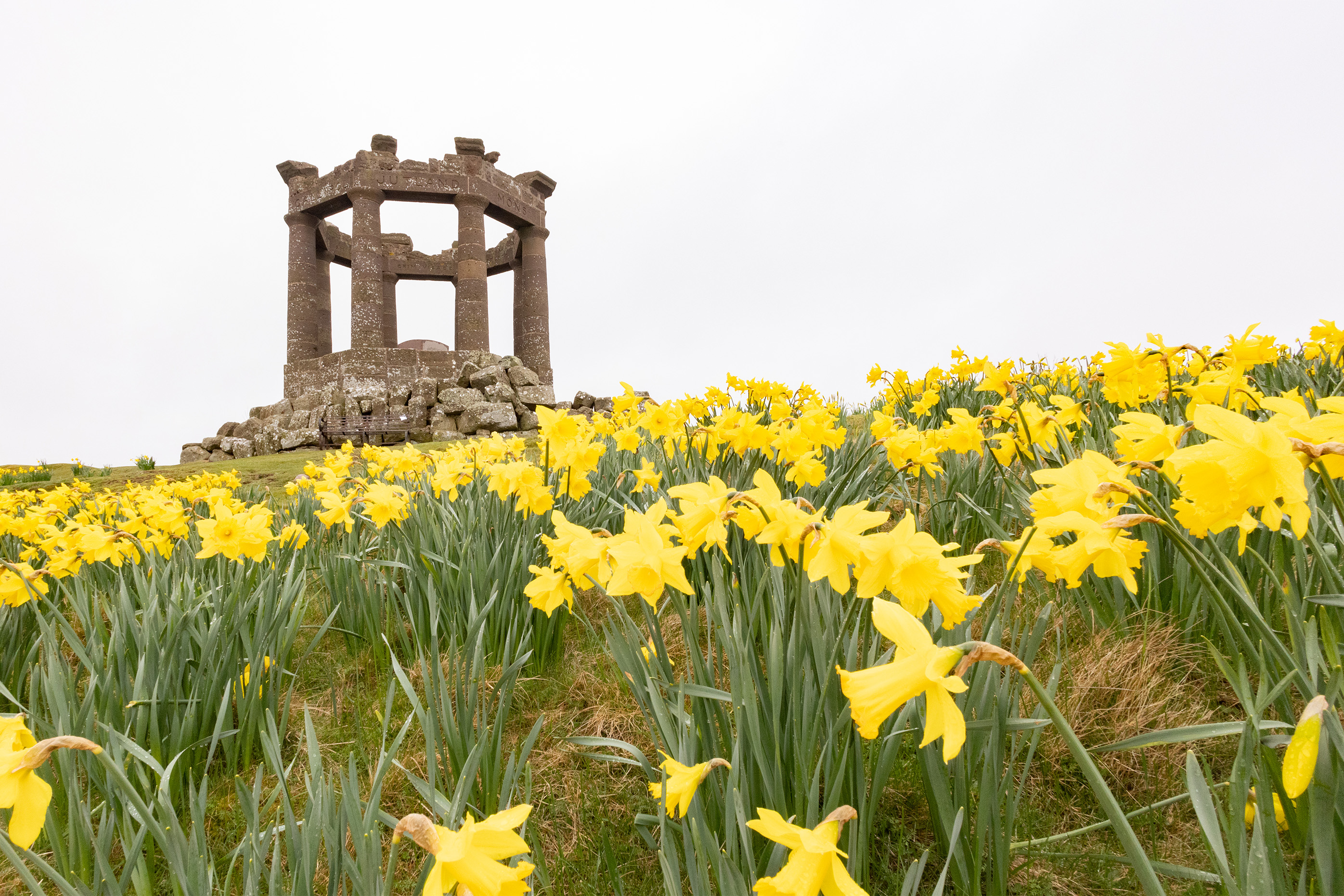
Stonehaven
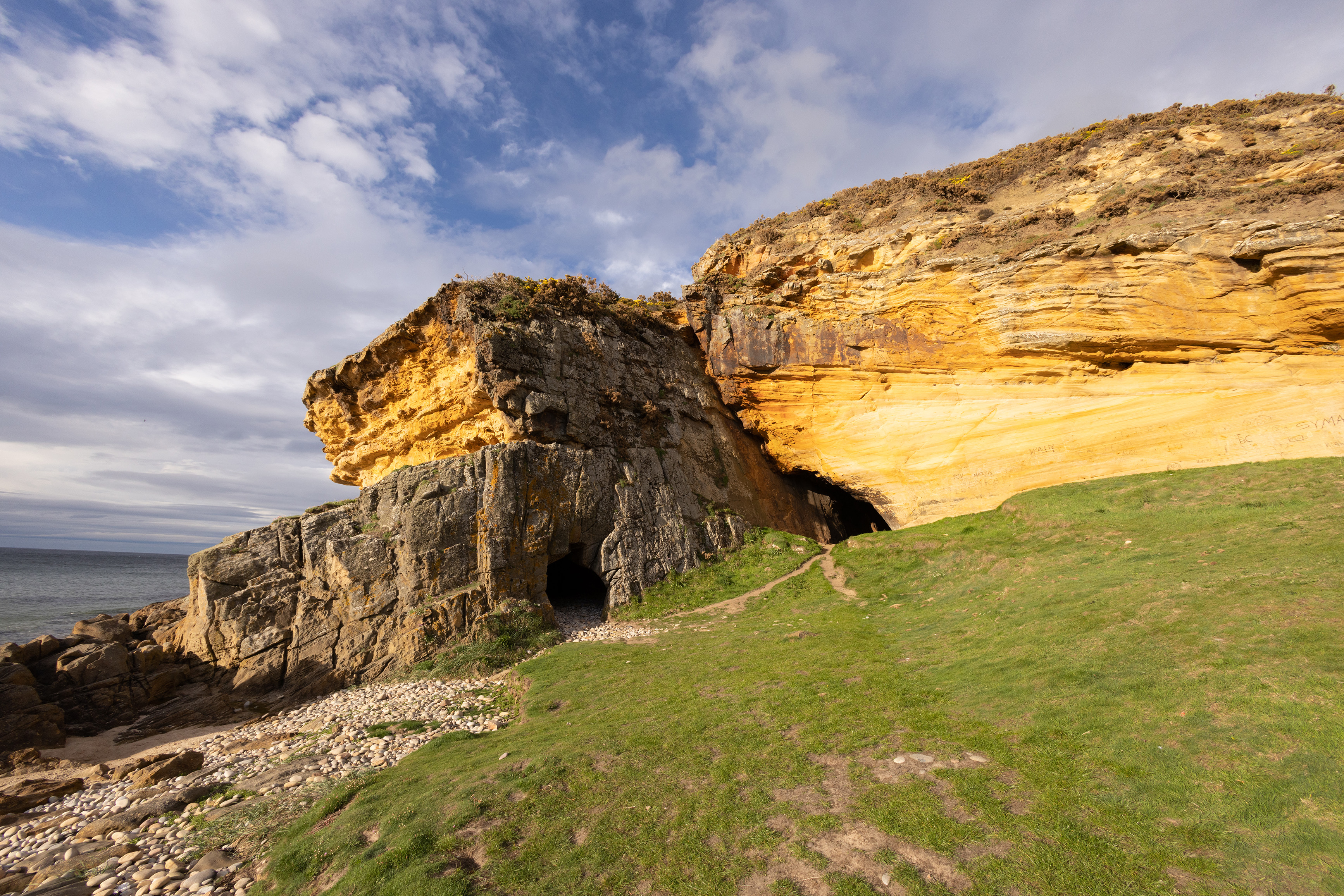
On my drive back up from Fife I got into Book Mode again and stopped off in Stonehaven, a beautiful harbour town south of Aberdeen. I walked around the harbour and along the coast path and found a stone igloo decorated with thousands of shells hidden within Dunnottar woods.
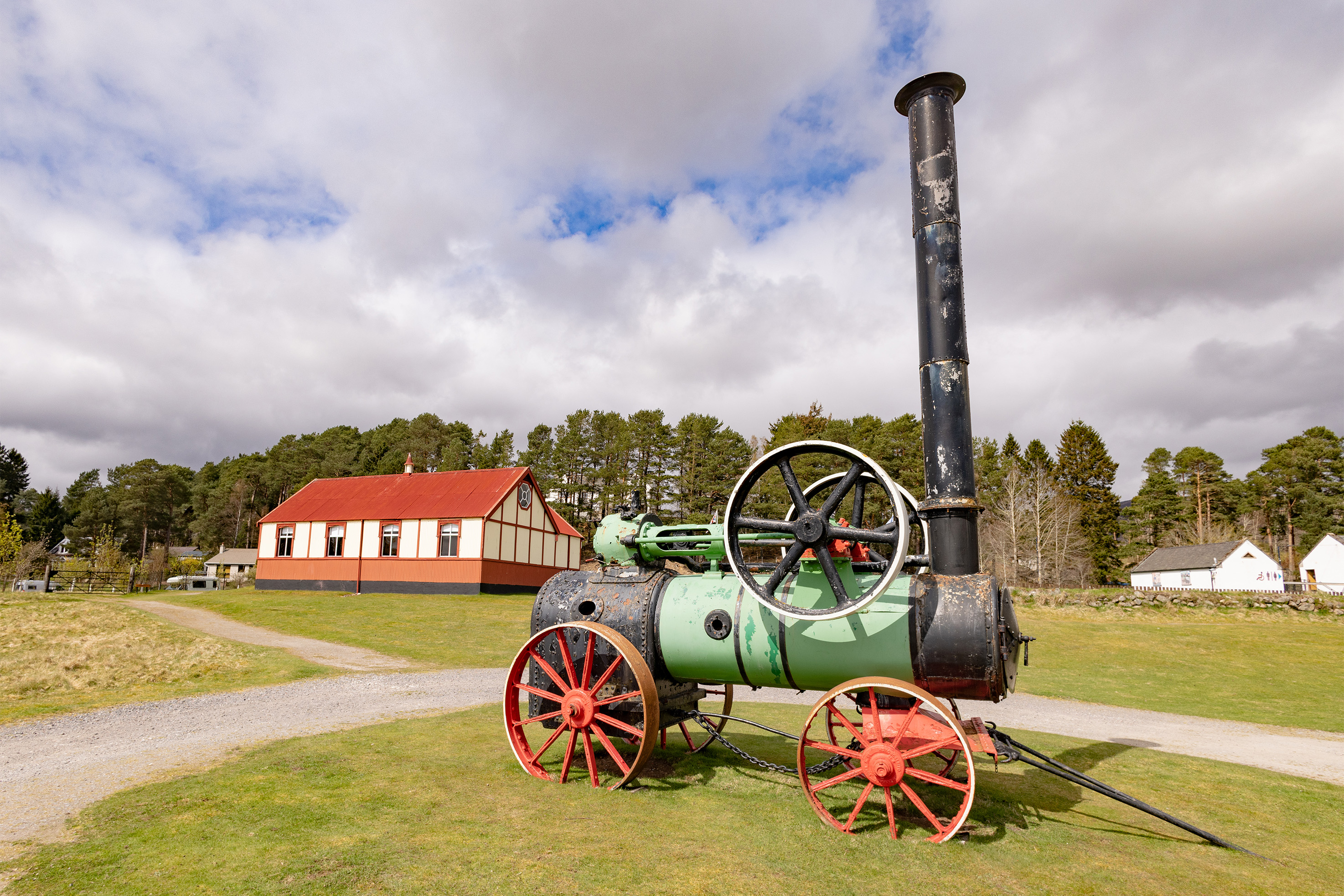
Cairngorms Trip
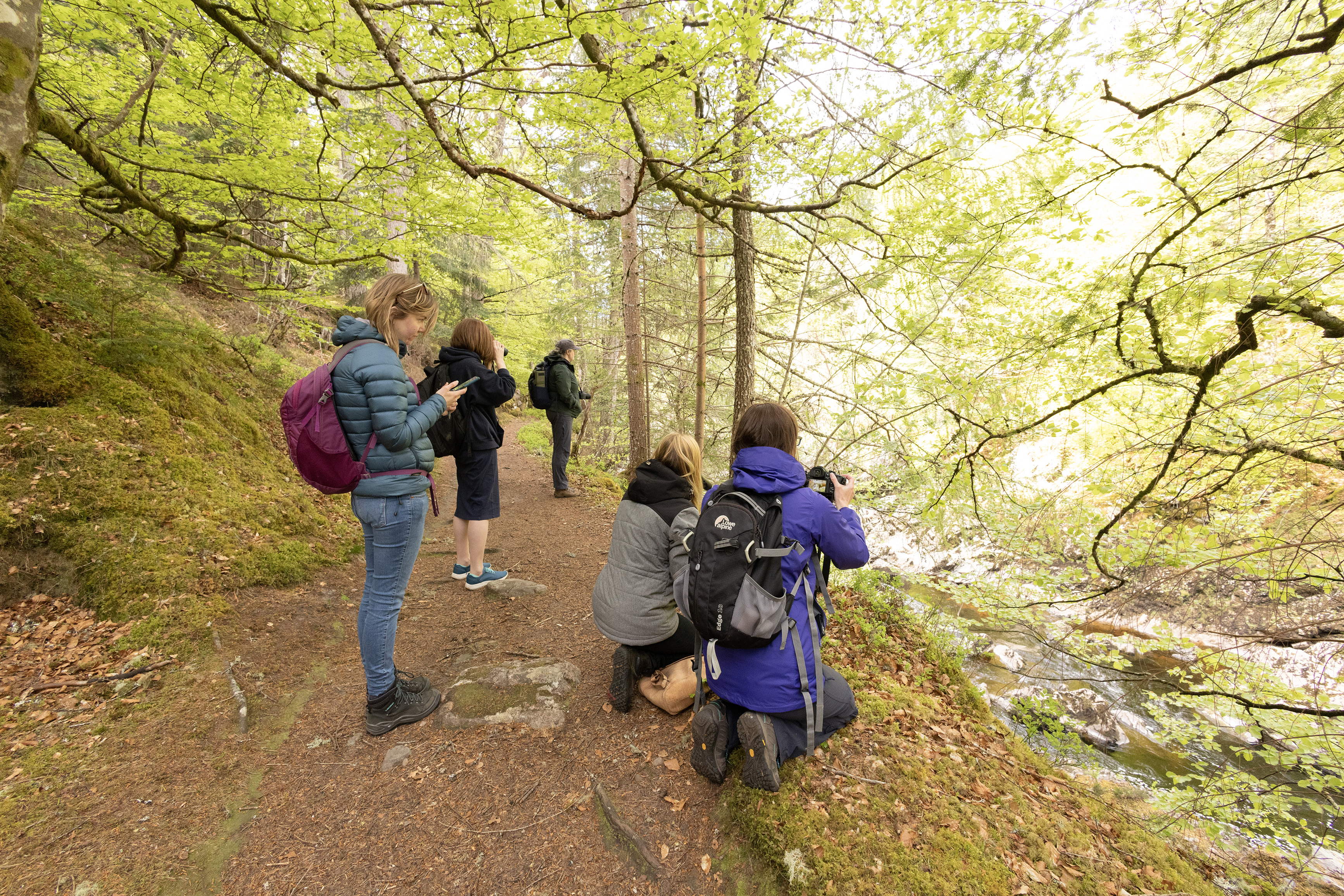
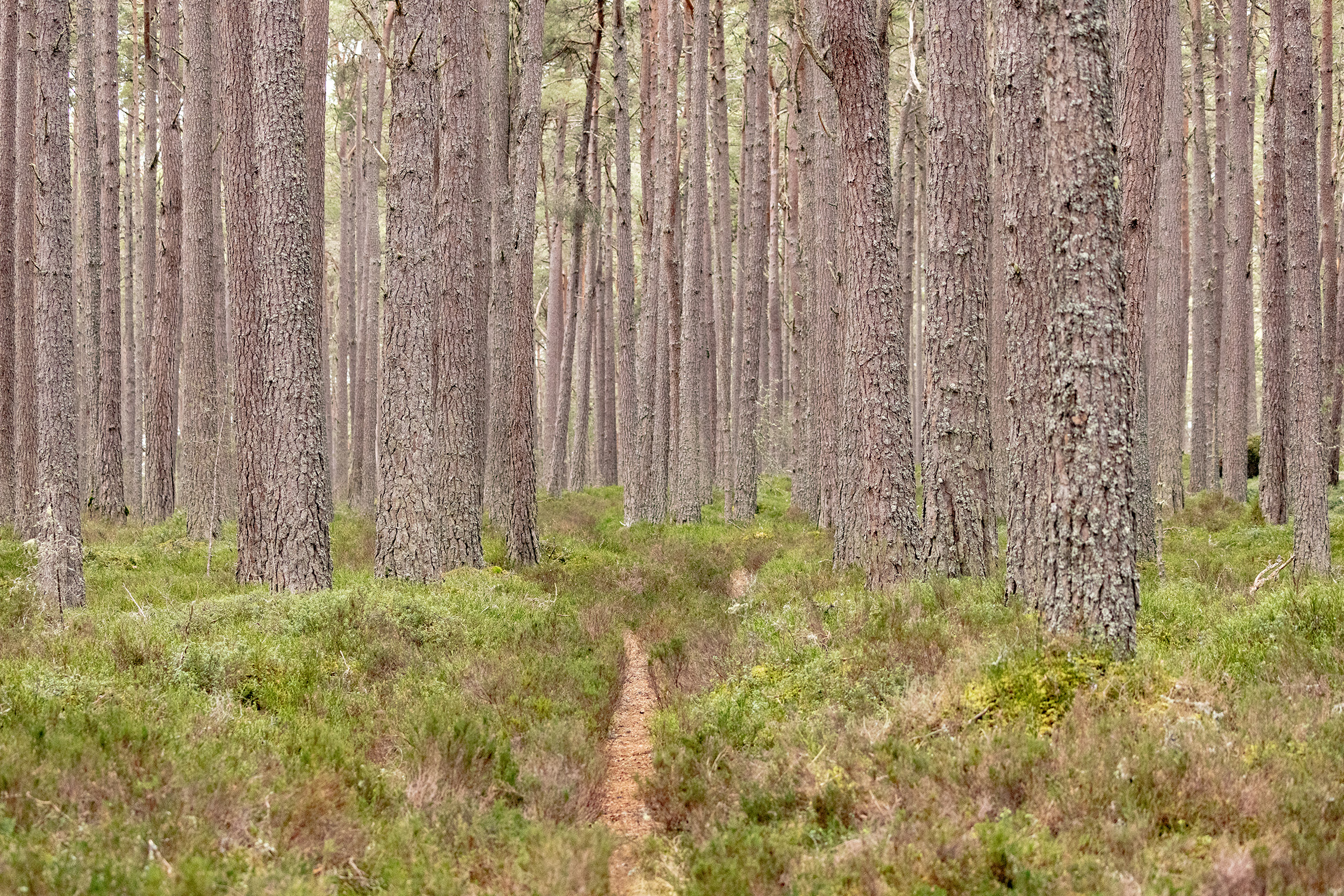
At the end of April I was off on another book trip, this time back to the Cairngorms. This has been my favourite section to visit and write about so far. Although I’m very attached to my home in Moray and have been so impressed by Aberdeenshire’s coastline, it’s the ancient Caledonian pine forests of the Cairngorms that have really taken hold of me. During my time in Boat of Garten and Newtonmore I visited the amazing Highland Folk Museum, discovered the Green Lochan – so named because the fairies wash their green clothes in the water – and had an incredible hide encounter with four badgers!
Mindful Creative Retreat
At the start of May I had a brief break from book writing to take on another exciting project. Last summer I co-hosted a Mindful Creative Retreat on the Moray Coast. It was a great success so we held another one this year. The guests really enjoyed unwinding from their own work and commitments and dedicating time to nature writing, mindful photography, breath work and even outdoor yoga each morning. I benefitted from the experience too and found the process of slowing down and being in the present moment so rewarding.
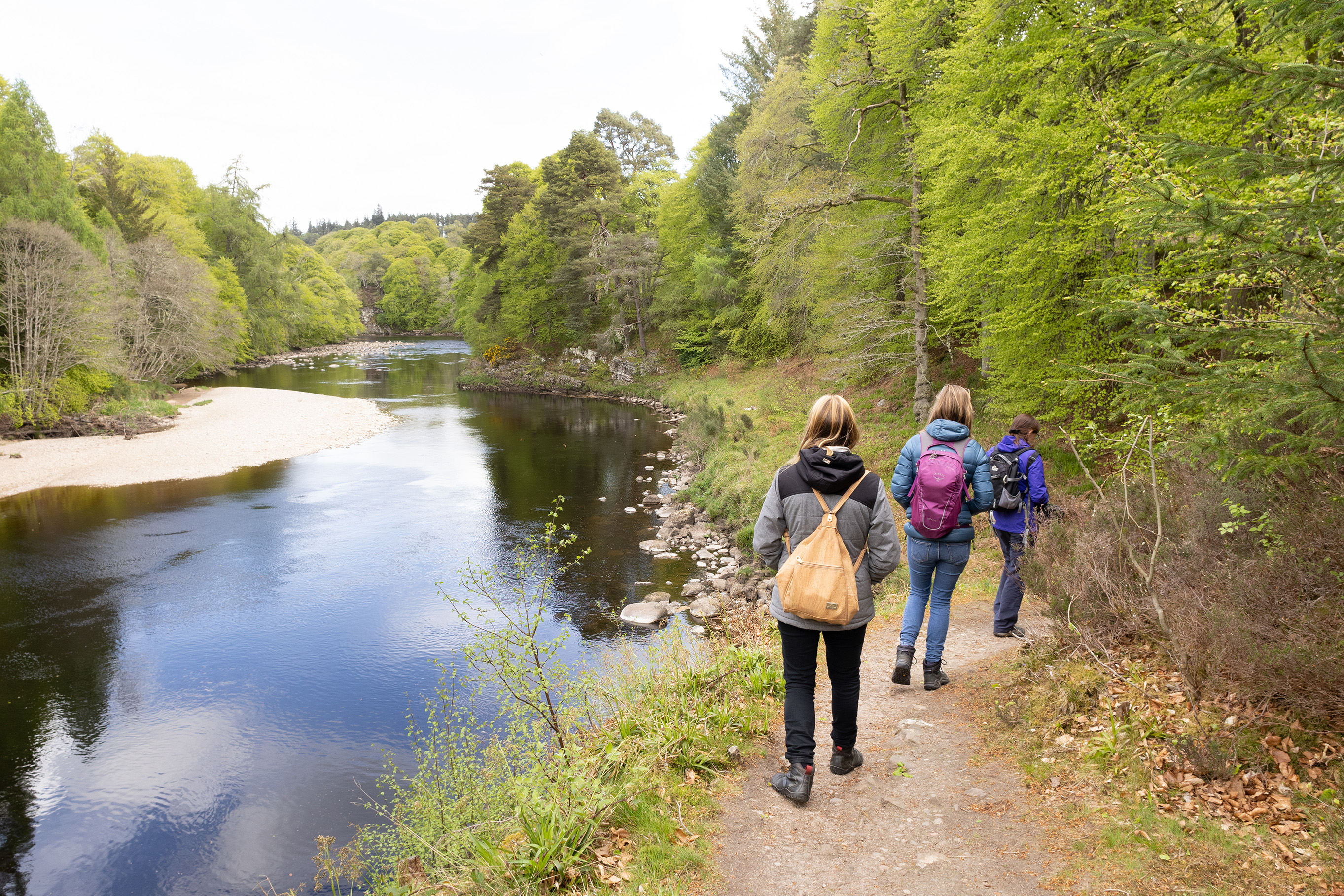
Peterhead
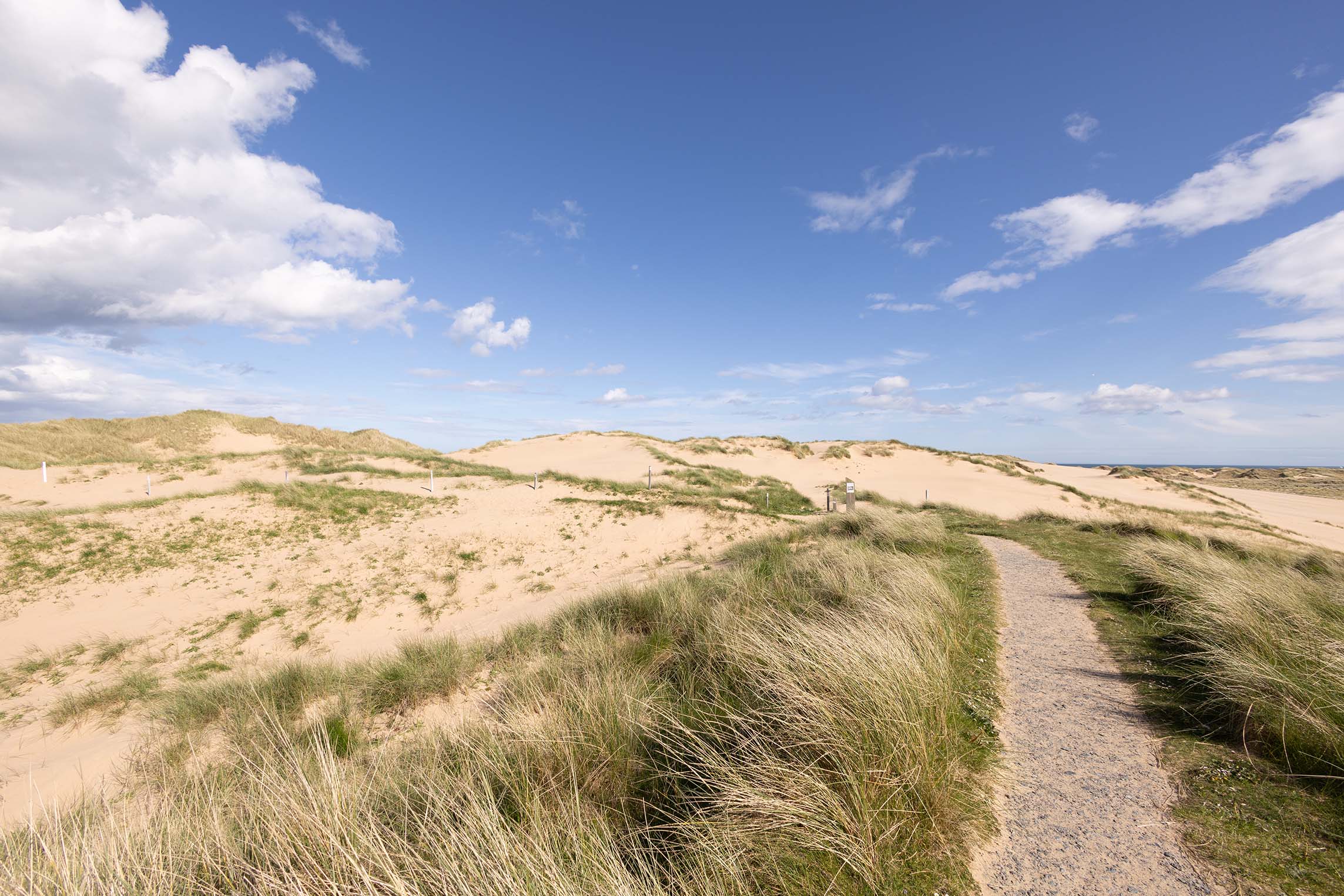
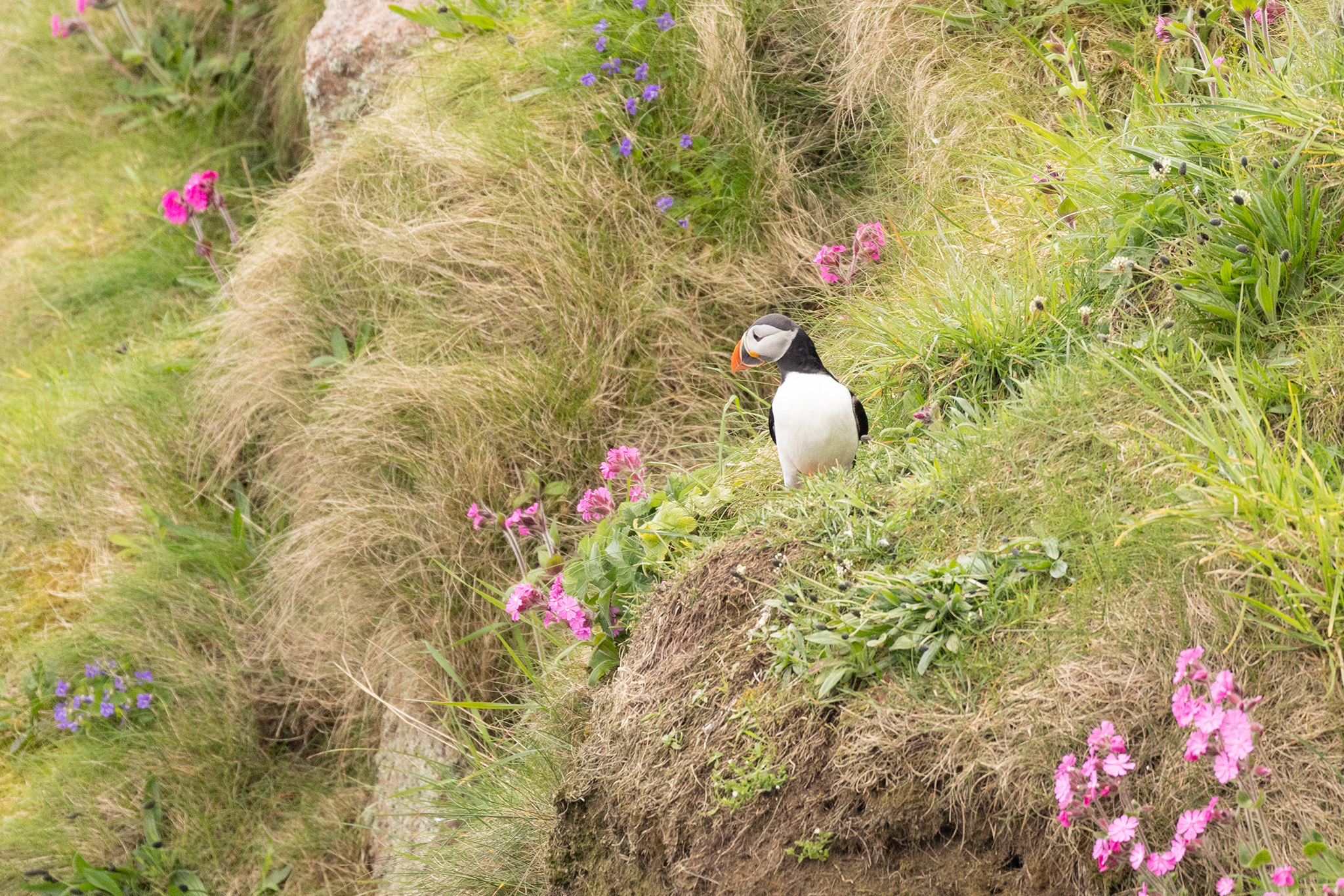
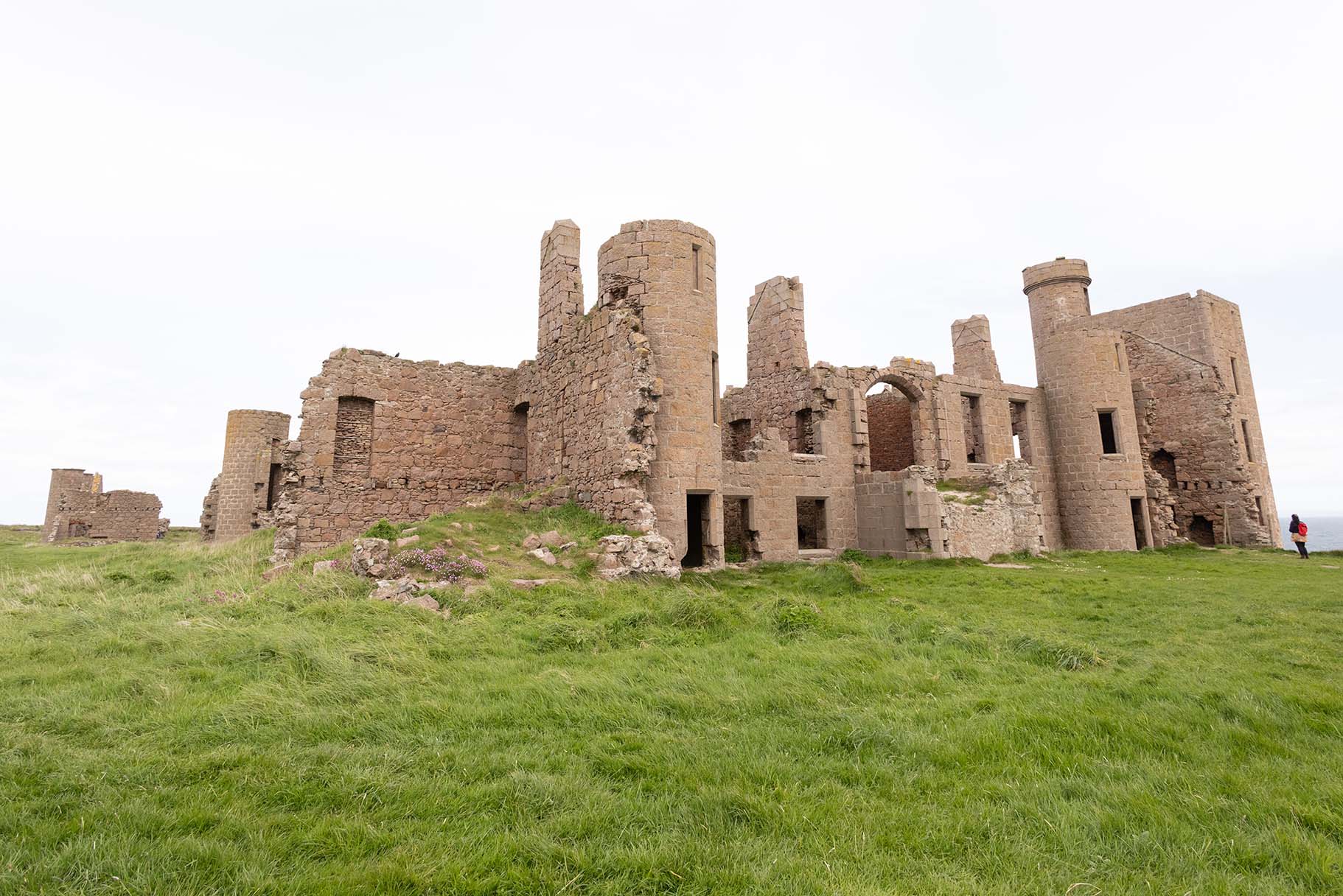
And finally, last week I had another book trip back to Aberdeenshire. My friend Kim, who I co-hosted the retreat with, kindly offered me a place to stay in Peterhead, which was a great base for exploring more of my new favourite coastline. I visited Peterhead Prison Museum and Slains Castle (which was inspiration for Bram Stoker’s Dracula castle), walked barefoot through the wind-sculpted dunes of Forvie and even managed to see a couple of distant puffins.
As we move into summer and I carry on beavering away with my book, I hope I can maintain the mindful practices I explored during the retreat and make them a regular part of my routine.
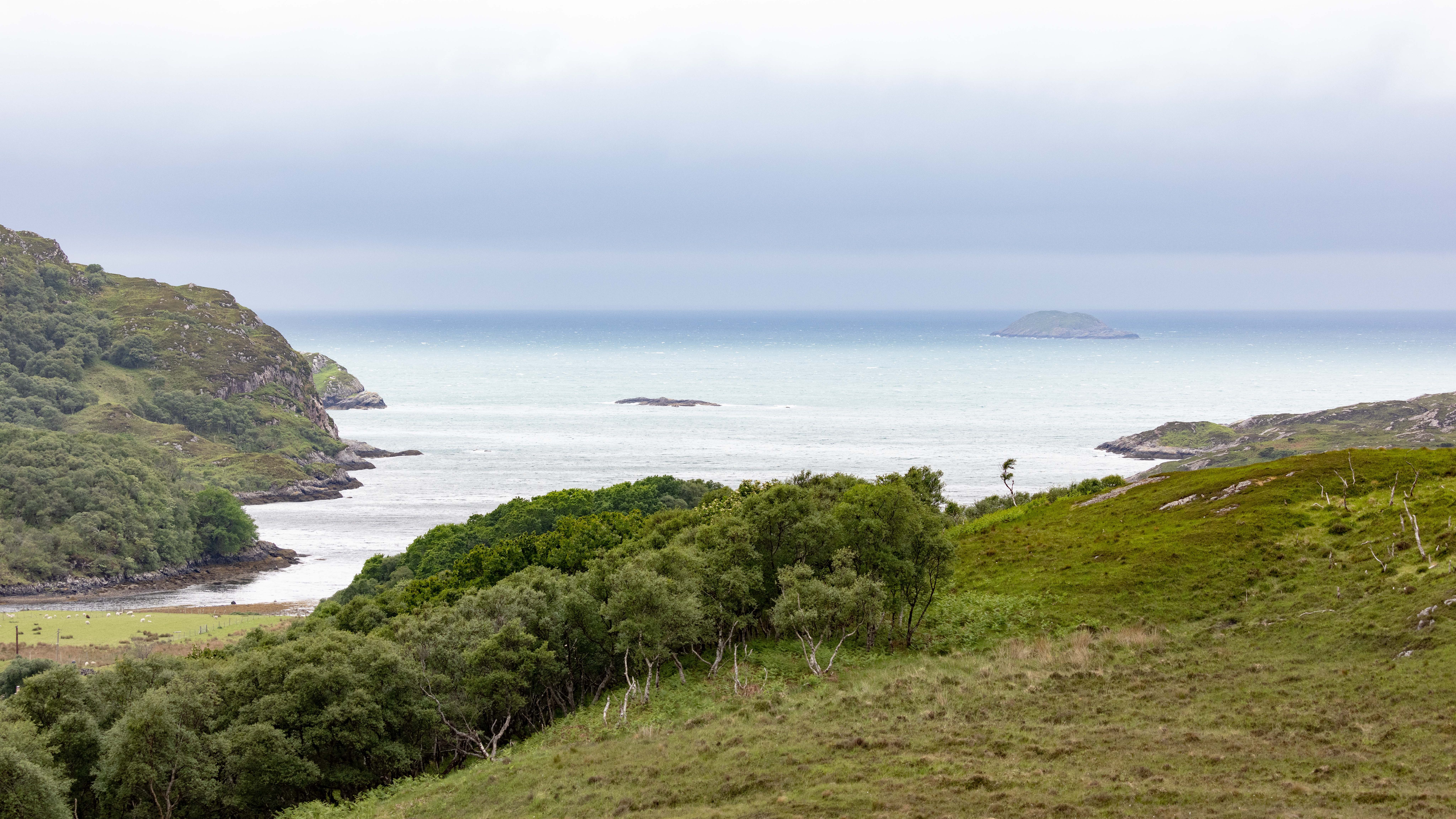
It was time to go back to Assynt on the west coast this week. Friends of mine own a wood cabin on the edge of aloch – with no phone service and barely anyone else around, it’s one of my favourite places to stay.
The weather has been unpredictable for weeks where I am. One minute we have torrential downpours and the next radiant sunshine. I was a little dubious what I’d be faced with at the chalet, and as my friend Steve and I headed west towards Inverness it soon became apparent that we’d be battling the elements again. The hills were hidden behind mist and the rain was falling sideways.
It turned out that I would only photograph two species during the trip but they were two crackers: red deer and pine martens.
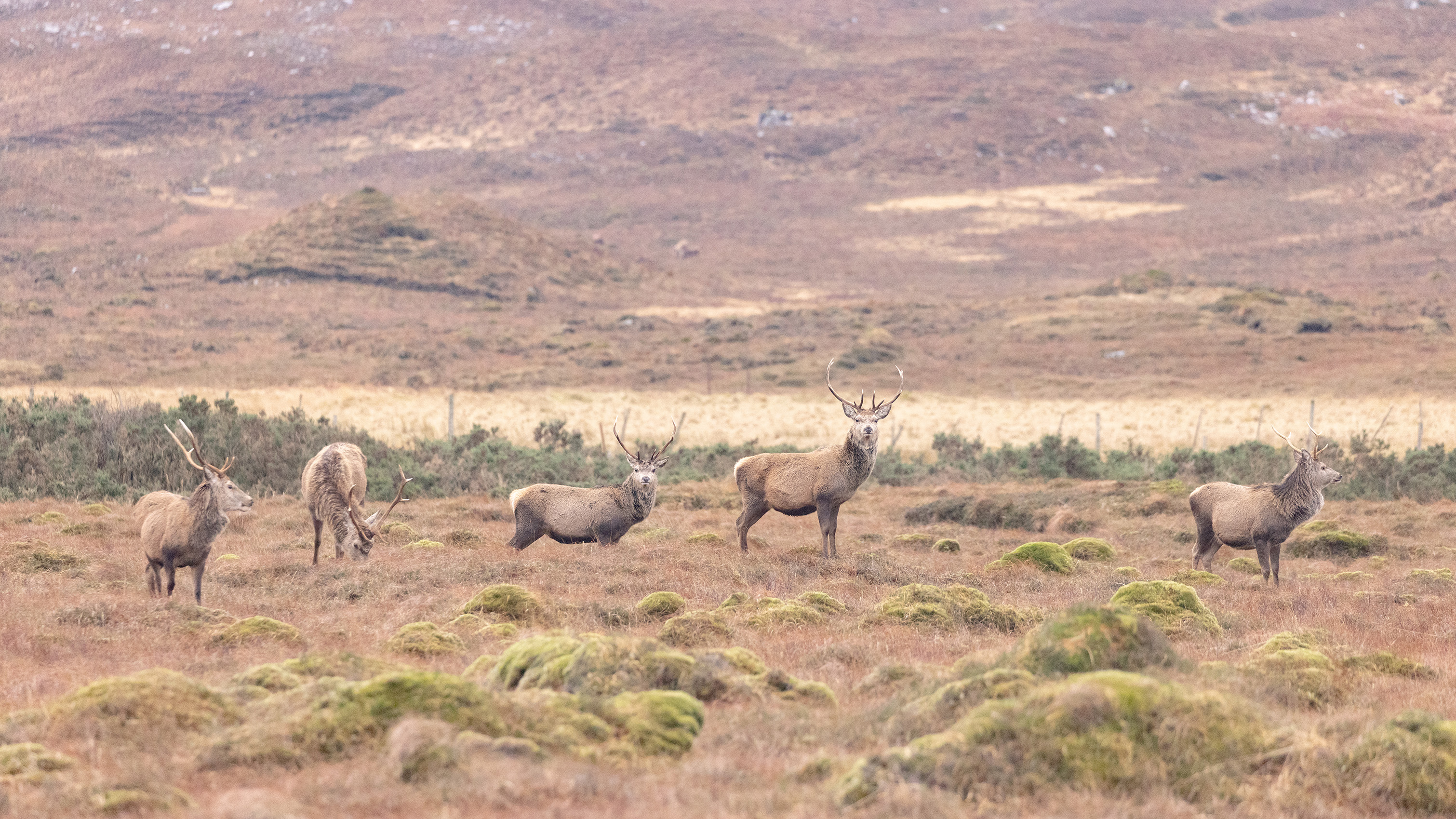
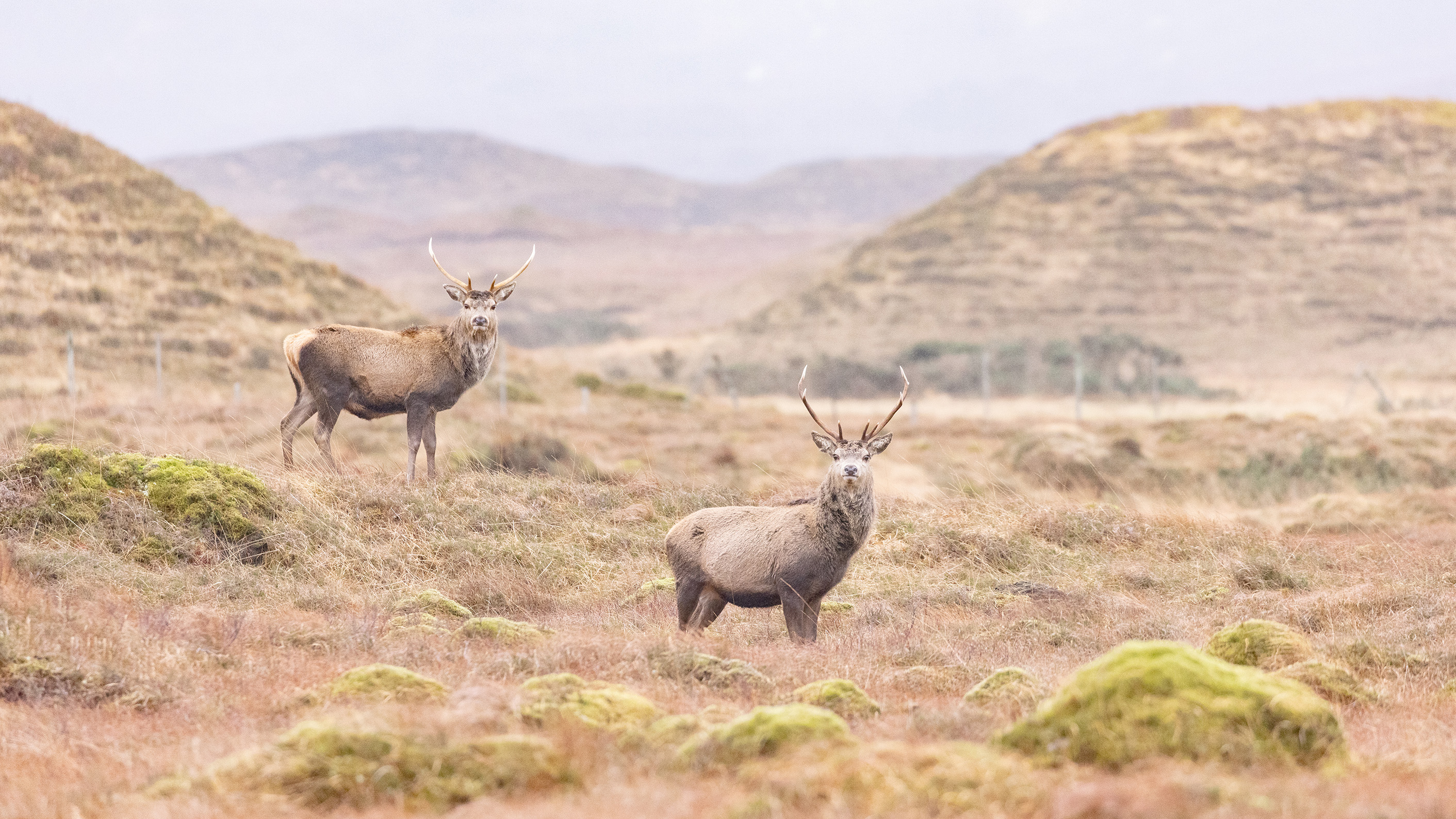
In Inchnadamph, a small hamlet about fifteen miles from the cabin, there were red deer everywhere. The name of the hamlet comes from the Gaelic Innis nan Damh, which means ‘meadow of the stags’. Deer are drawn to this particular area because of the limestone, which makes the grass sweeter.
I was grateful for that sweet grass because I got to see dozens of deer, both stags and hinds, as they foraged with the mountainous Assynt landscape all around them. I also found a fragmented antler in the heather. It’s less than a hand’s length but it’s got the sunflower-shaped face that once attached it to the stag’s skull. I took it as a good luck omen for the week.
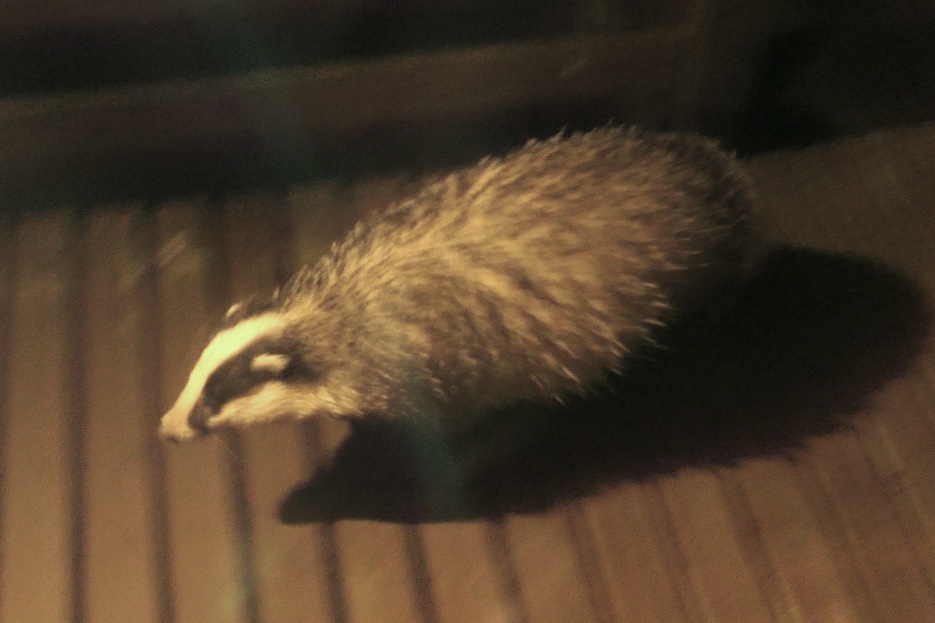
When we arrived at the cabin we began setting up for our first night watch. On previous visits we’ve sat in the dark watching pine martens and badgers right outside the window, but the light’s always been too poor for photos. This time we upped our game and brought along two small freestanding lights to point onto a mossy log perch. Once the peanuts had been sprinkled it was time for the long wait to begin.
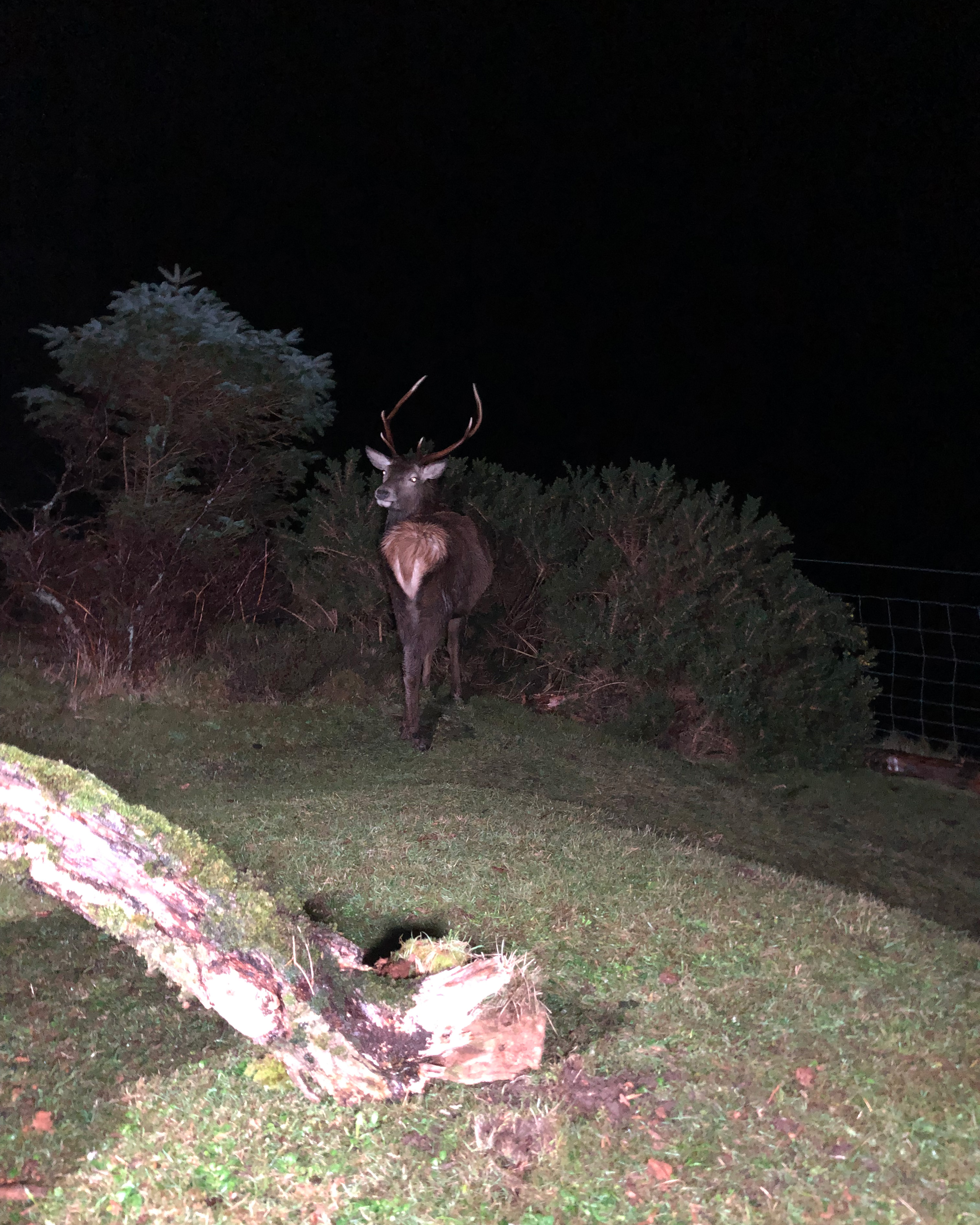
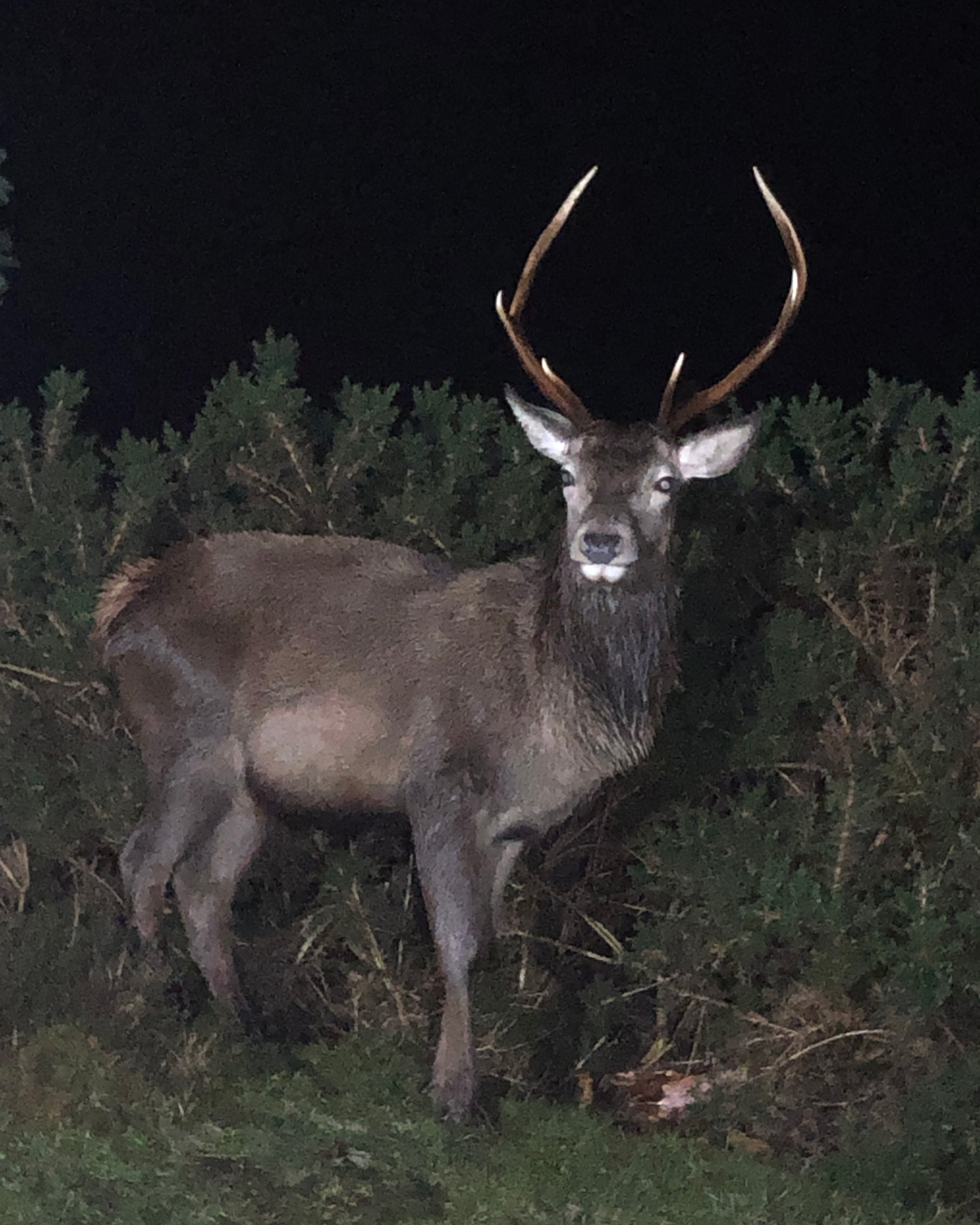
That first night was probably the most successful wildlife session I’ve ever had. From 9pm until we gave into exhaustion at 4:30am, we were visited seven times by a pine marten and twice from a huge stag, who scared the life out of me when his shining white eyes appeared in the dark. I hoped this was Stig, who often browses in the chalet garden and has been watched by lots of visitors to the chalet.
Stig stayed for half an hour on two separate occasions. Both times he made a beeline for the gorse bush closest to the chalet steps. I couldn’t imagine putting gorse anywhere near my face let alone in my mouth, but the stag couldn’t munch it quick enough.
Phone photos from our “hide” in the chalet
Although it was great to see a stag so closely, the pine marten was spectacular. Every time it appeared it would pop its head up from behind the square wire fence, then most times after that we would spot its shining eyes and pale bib from the bottom of the gorse bush that the stag had been munching on.
After a brief sniff and glance both ways, it lolloped into the open and leapt straight onto the perch, claiming its prize and gifting us with fantastic views.
For the next three nights we stayed up waiting for the pine martens. We knew there were two because one of them only had one flashing eye on the trail camera footage. We’d already named that individual Misty on our previous visit. Misty was far more elusive than Rex, our other visitor. We’d chosen this name because of the mark on its bib that looked like a T-Rex claw.
Rex came multiple times a night – on the second night we were slightly peeved that we had a tactical nap right when she/he dropped by, so we were fast asleep while a pine marten was munching a metre from our heads… Misty really challenged our nocturnal abilities but Steve managed to see her/him once on the last night.
Pine martens are one of my favourite animals, so to be able to watch them from the comfort of the cabin and at such close range was a real treat.
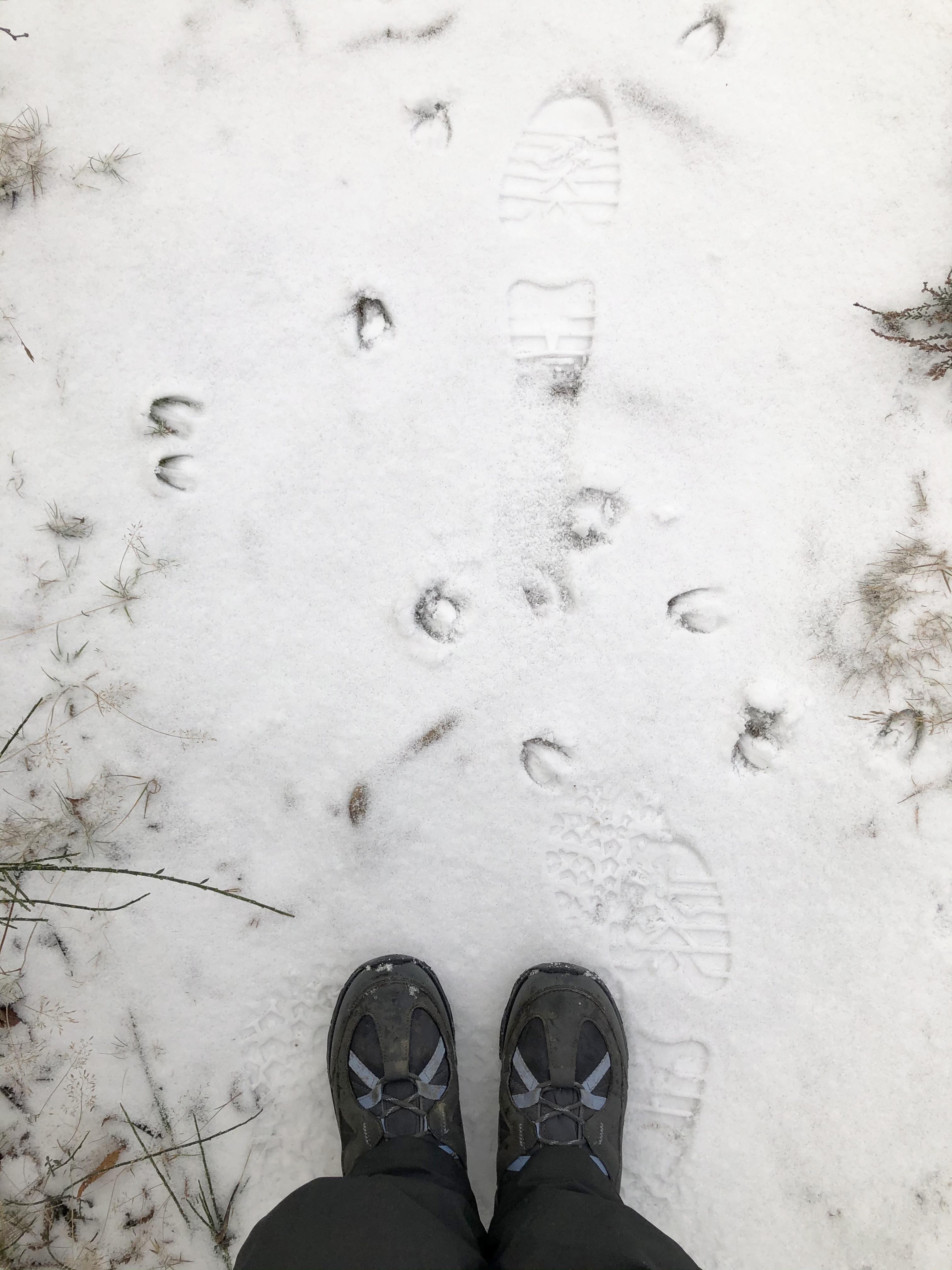
Once our time on the west coast was over, we passed through Inchnadamph again on our way back east. This time there was some lying snow, which made photographing the deer even more special.
Each time I return from the chalet I’m wondering when I’ll be back. I love living in the northeast and there’s some incredible wildlife here too, but there’s something so addictive about that cabin in Assynt.
We’re one month into the year already! As usual I’ve been beavering away and forgetting to update my blog, so here’s a summary of what I’ve been up to in January.
My 2022 started with my best mate Luke coming to visit for the first time since I’ve moved to Scotland. This year we celebrate our 20th anniversary of being friends – we’ve known each so long I can’t remember a time without him!
I took Luke to many of my favourite wildlife haunts. It’s funny how seeing familiar places with someone who’s never visited them before makes them fresh all over again. Although he’s definitely not a birder, I pestered Luke into looking through binoculars at eider ducks in the harbour and a dipper hunting on the river. I actually think some of my enthusiasm rubbed off on him.
Burning of the Clavie
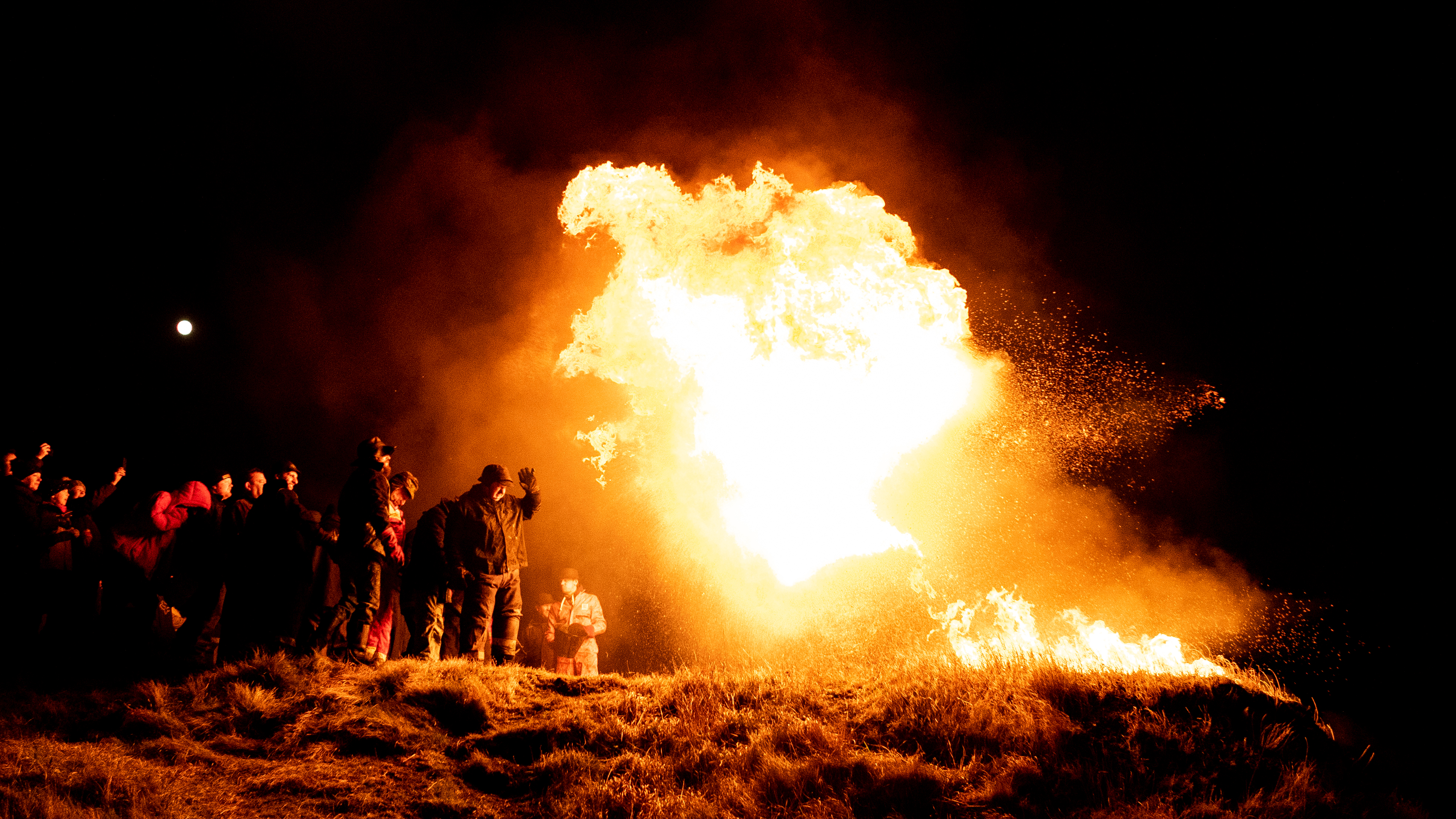
By happy coincidence, my friend was here when the annual Burning of the Clavie festival took place in Burghead. Although usually held on the 11th January, this year the festival was delayed a week because of changing Covid crowd rules. The festival was cancelled in 2020 and I missed it by a week the year before, so I was relieved to finally be able to experience it for myself. And it was totally worth the wait – the sights, sounds and intense feel of the mighty Clavie fire were extraordinary. It really has to be seen to be believed!
Carrbridge
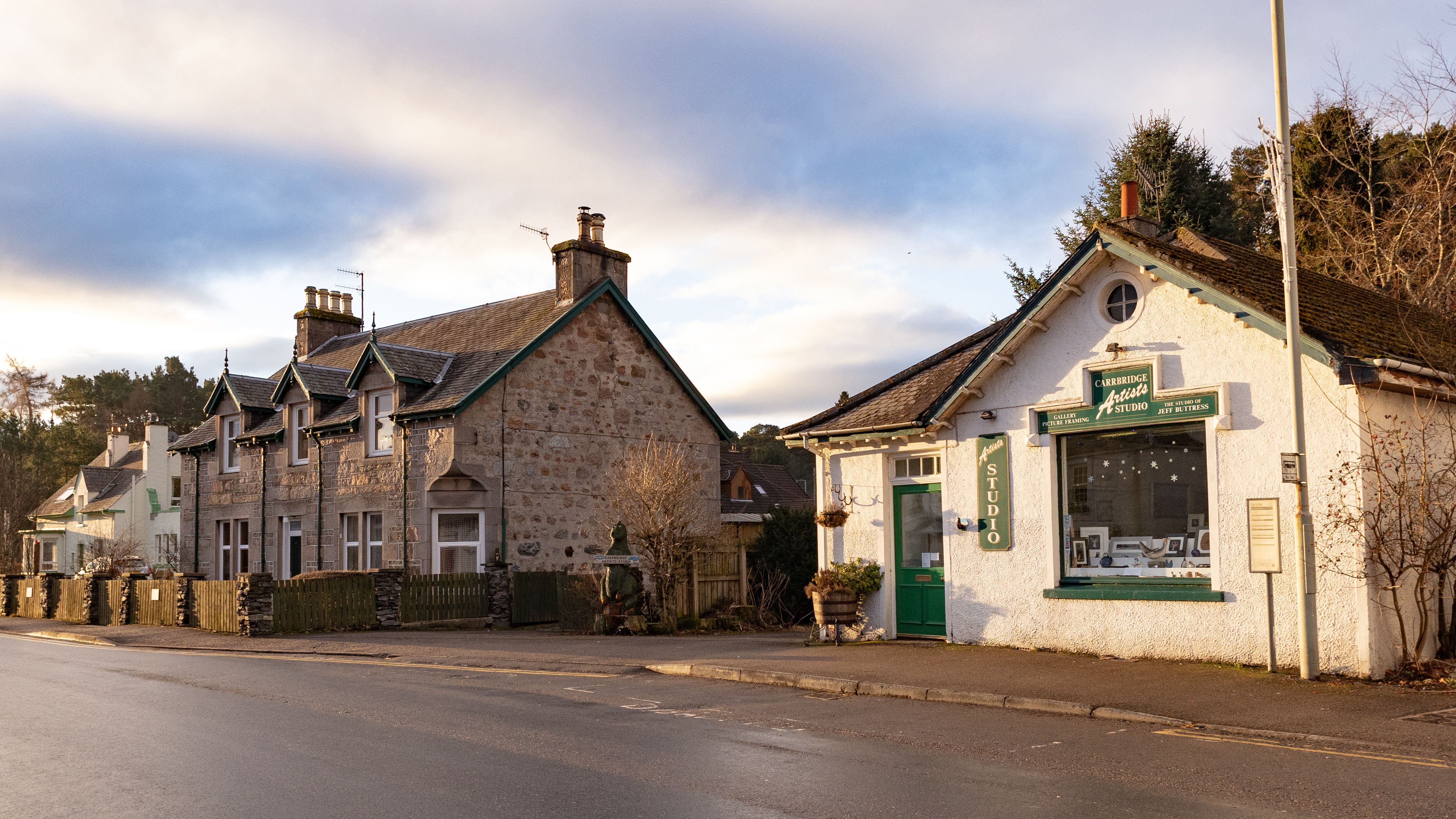
I’m currently hard at work writing my Slow Travel Guide to Northeast Scotland, which will be published by Bradt in 2023. Although some places on my list are closed until spring, there’s lots to enjoy in winter too. This month I spent a long morning in the village of Carrbridge, seven miles north of Aviemore in the Cairngorms National Park.
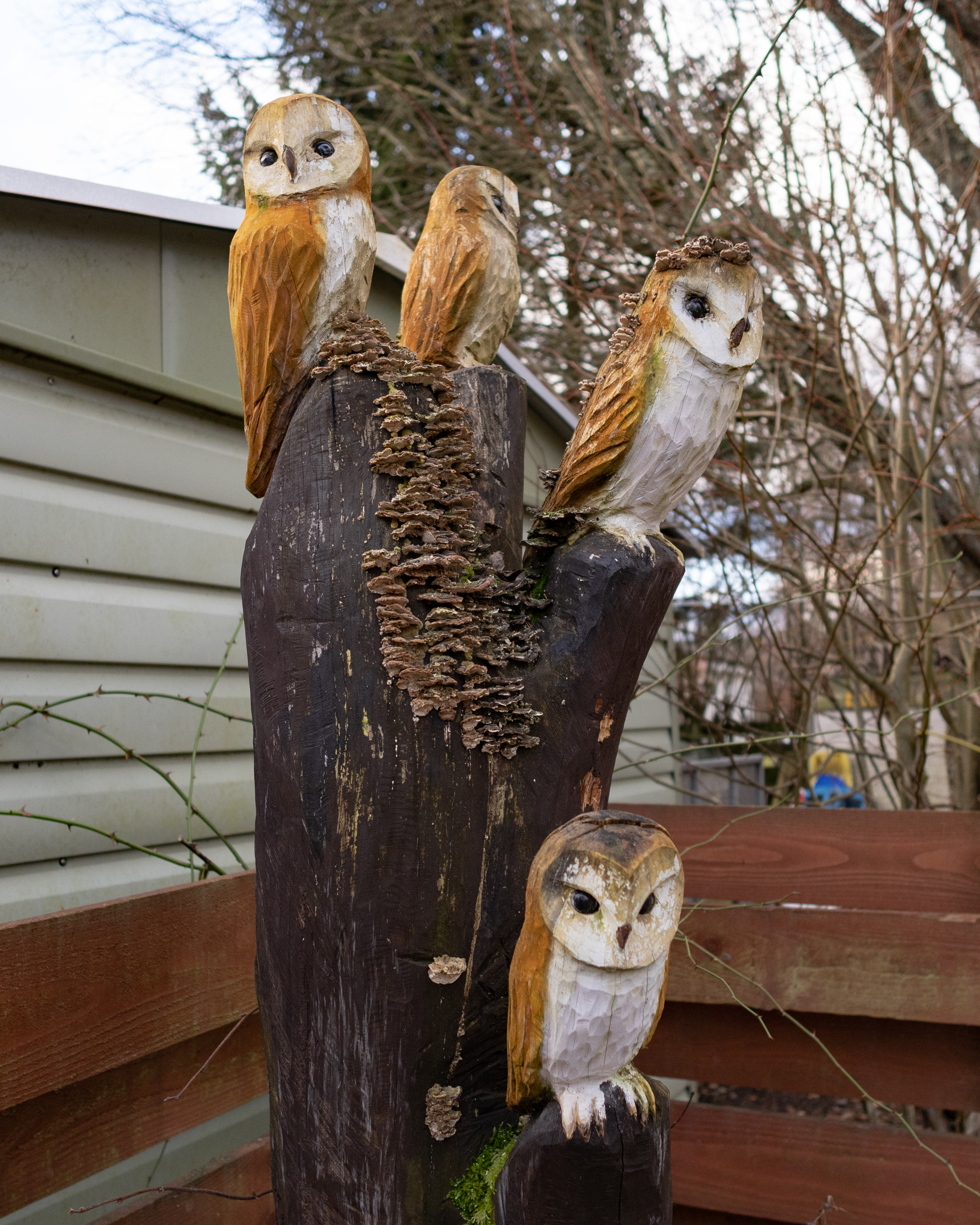
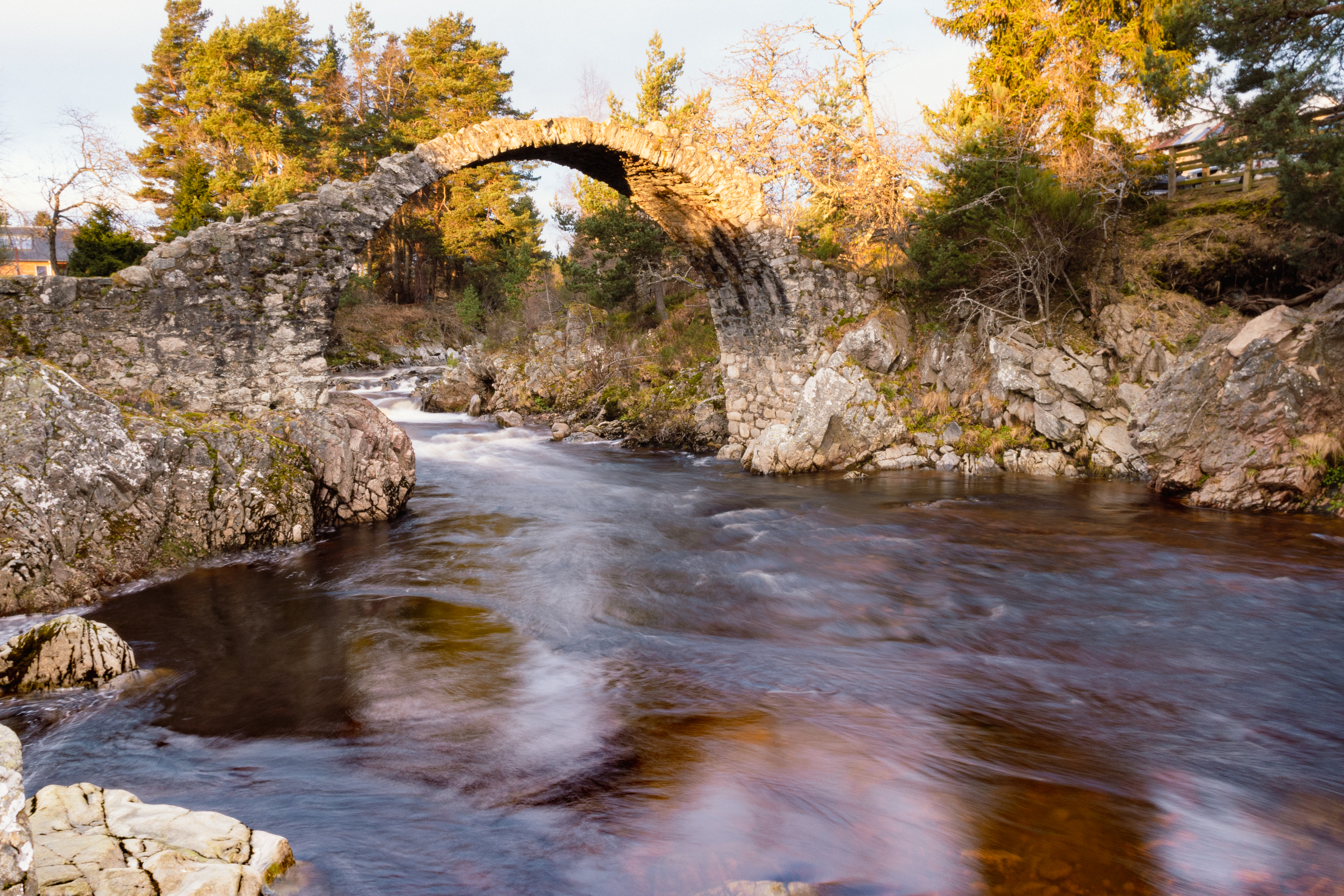
I didn’t know much about Carrbridge except the Old Pack Horse Bridge – the oldest stone bridge in the Highlands – and the annual Porridge Making Championships. After some Slow exploration the other day I discovered that Carrbridge also has a yearly wood carving competition every September. I’ll definitely be returning this autumn to see it for myself, but in the meantime I enjoyed spotting sculptures from previous competitions dotted all over Carrbridge.
Loch Garten
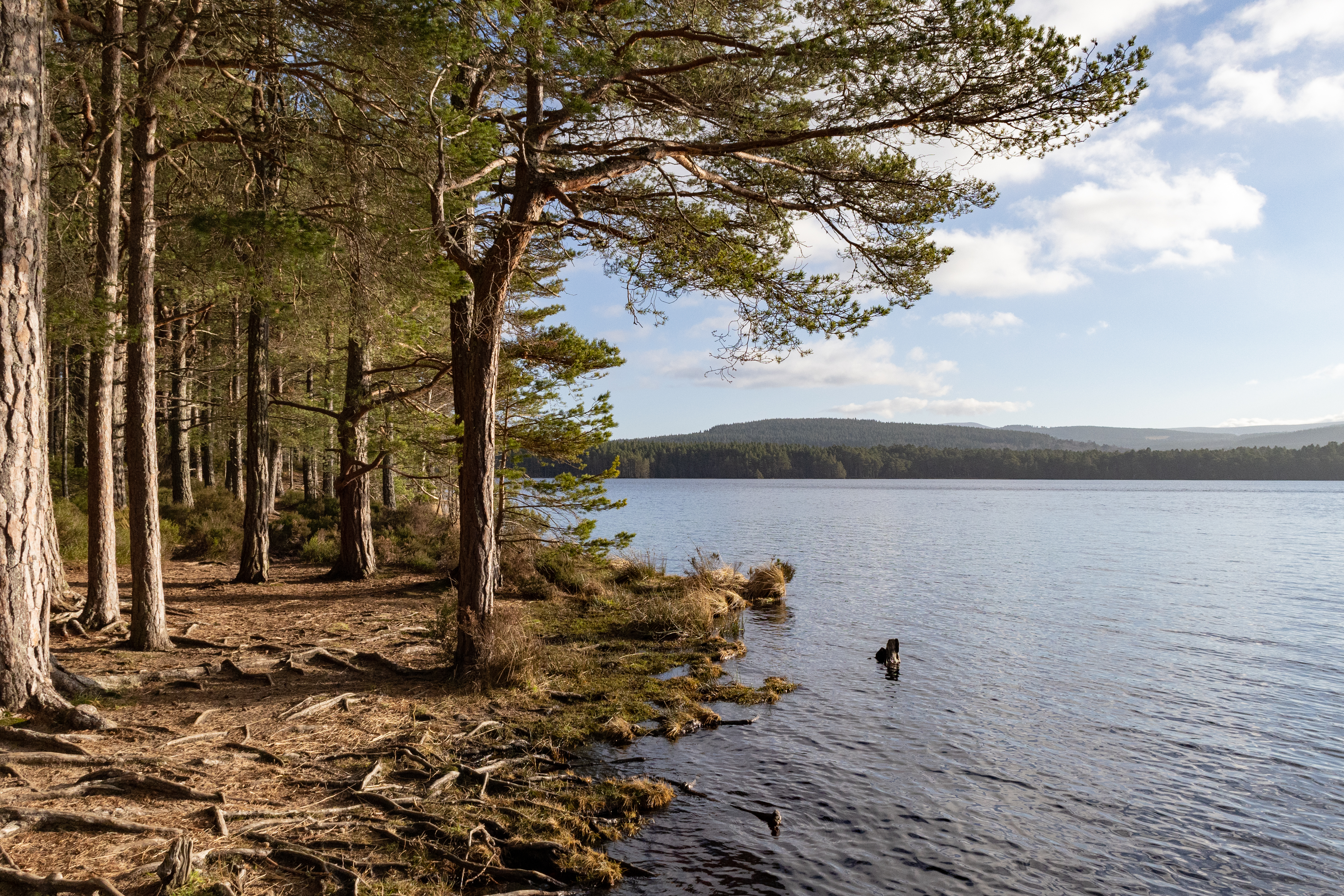
Another day trip for my book this month was to Loch Garten, also in the Cairngorms. I much prefer visiting this loch in winter. Historically it’s known for ospreys that have nested here, but in winter you can actually hand feed the birds. Coal tits are the bravest, but the other day I also fed a dozen great tits and a blue tit.
There’s nothing quite like the feel of a tiny wild bird gripping your palm, trusting you enough to take a seed right in front of you. I could have stood there with my hand in the air all day, but I tore myself away to walk down the west side of Loch Garten to the tip of the smaller Loch Mallachie, then back through the ancient pinewood of Abernethy Forest.
Woodland locations are lovely and quiet in the Cairngorms at the moment and I relished the subtle sounds of water lapping the bank and pine trunks creaking in the wind. And all those birds’ wings of course.
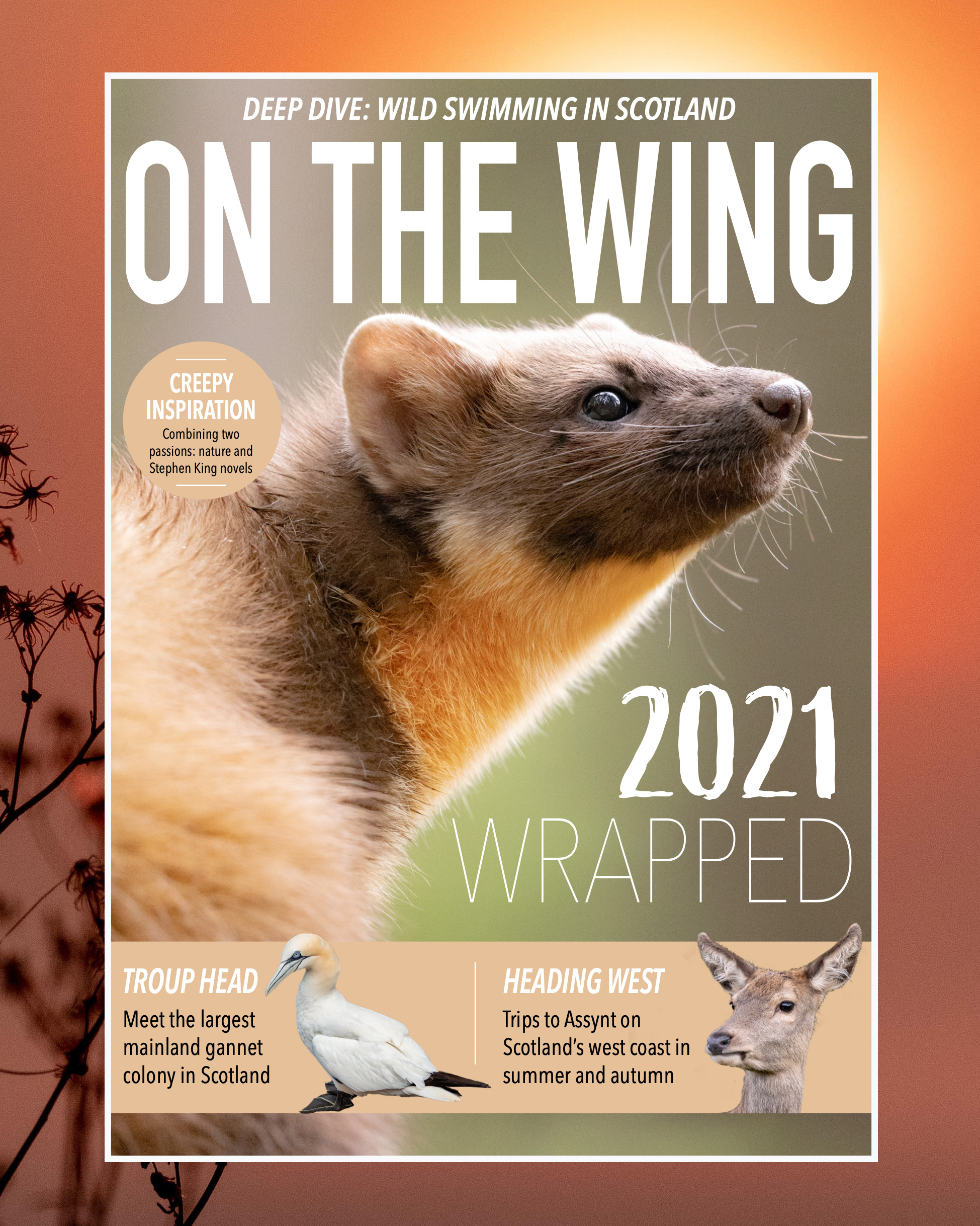
I always like to reflect at the end of the year, and this time I thought I’d summarise my antics in the second issue of my own magazine, which you can read by clicking the image below.
Thank you all so much for your kind comments and support in 2021. I look forward to seeing what 2022 brings.
Christmas always ends up being a hectic whirlwind, but this year I think we’re all looking forward to a bit of festive cheer. However, the festive season can get wasteful and very expensive, so I’ve put together a list of tips for making this Christmas a green one.
While I try to limit my online shopping, it’s inevitable that I’ll order something now and then. Luckily, the cardboard packaging is perfect for trimming down and transforming into homemade cards – ready to be decorated with photos and messages.
If you keep your cards dinky, you can make several from one piece of packaging. For even more crafty points, save the Christmas cards you receive this year and cut them out to decorate your homemade cards next year. You can make your own gift tags this way too!
A selection of last year’s cards ready to be recycled this year
Tree
There’s an ongoing debate about whether it’s better to have a real or artificial tree. While there are pros and cons of each, for fresh trees it’s best to find a locally grown one that supports local businesses and reduces the pollution associated with delivery. To find out where the local retailers are near you, check out the British Tree Growers Association.
To prevent your tree from going to landfill after Christmas, look out for tree recycling schemes which are offered by a lot of local councils. It’s also possible to rent a tree! After enjoying your tree over the Christmas period, you return it to the grower who replants it ready for next year.
There’s nothing better than that Christmas tree smell, but whether you have a real or artificial tree make sure you buy local
Decorations
Once you have your tree, you’re going to want to decorate it. We’ve all seen the countless decorations on display at garden centres but beware: lots of these ornaments are covered in glitter – a harmful microplastic which should be avoided.
For more sustainable decorations, why not make paper chains using brightly coloured cardboard from cereal boxes and other packaging? You could also gather some natural materials such as holly, ivy, pinecones or small pine branches to make your home both festive and wild.
While swapping gifts can be loads of fun, I’m sure we’ve all received some we’d sooner exchange for something else… To avoid any awkwardness on Christmas morning, get your loved ones gifts that are fun and practical – reusable metal straws or plastic-free shampoo bars perhaps.
Check out Not On The High Street for original and often personalised gifts that support small businesses.
Food
We’re all guilty of a little overindulgence at Christmas but that’s perfectly acceptable – it’s Christmas after all! Although, we should be aware of how much food we end up throwing away.
To minimise waste, it’s a good idea to eat all your freezer food during December to make room for leftovers. Everyone knows about turkey sandwiches, but there are lots of other good leftover recipes around including vegetable tray bakes, turkey curry and countless soup flavours.
Photo by George Dolgikh @ Giftpundits.com on Pexels.com
Crackers
Has anyone ever been pleased by what they’ve won in a cracker? Let’s be honest – it’s all tacky plastic tat! A very refreshing trend that’s growing more popular is homemade crackers – this handy guide is easy to follow and doesn’t require many materials, but you can experiment any way you like. Making your own crackers not only cuts down on single-use plastic but also gives you the freedom to choose the gifts. And maybe find some better jokes too.
Do you have nifty ideas for an eco-conscious Christmas? I’d love to hear them!
I couldn’t help a slight eye roll when I read the shower of adjectives on the cover reviews of this book: “powerful… inspiring… mind-blowing…” But it actually ended up being all of those things for me, even the last one.
If Women Rose Rooted is a combination of three topics I care strongly about: nature, women and Celtic mythology. I’ve been directly involved in the first of those since childhood – the natural world is the basis for everything I do, both professionally and personally. But the other two have slowly gained momentum in my mind since moving to Scotland.
In 2019 I was earning minimum wage in the town I grew up in. It was where I’d gone to school, met my best friends and spent every weekend, but I didn’t belong there anymore. I didn’t realise just how much I didn’t belong there until I stayed with my parents for a week in their new house in Moray, northeast Scotland.
After days spent walking along beaches and through forests, spotting red squirrels, stonechats and grey seals, I returned to England with a crash. Scotland had shone a harsh and revealing light on the current state of my life. My writing had dried up, the camera was gathering dust, and most importantly I wasn’t happy.
One morning before work I sat in my car in a multi-storey car park and cried. Proper ugly sobs. I splashed my face with cold water to stop my eyes puffing up in front of the customers.
I felt a toxic mix of emotions: disappointment about leaving university and returning to the same place I was in before; physical and mental discomfort from spending eight hours a day staring at the same four walls, not making any progress in my career whatsoever; longing for a place currently out of reach; and shame that my situation was a lot better than some and I should be grateful I had work at all.
But I couldn’t shake the feeling of displacement, like I wasn’t where I was supposed to be. Scotland was beckoning and each day the pull grew stronger. I made a playlist of inspiring songs and that worked for a while, but I knew in my gut I had to move.
And the universe, being its freaky-deaky self, confirmed that for me when the shop I was working in closed and we were all let go. Everything in me lifted – I swept up my belongings and bolted north.
The effect was immediate. Words flowed out of me, I took hundreds of photos and I walked for hours through my new home. Now, 21 months later, I feel rooted to land for the first time in my life. I’ve developed a fierce love for the place I’m in and the inspiration I soak up from it. I’ve found my home.
Last month I saw If Women Rose Rooted in the library, its back to the wall so its front cover faced me as I browsed. It had been on my list for a while so I gave it a go. Several pages in I felt the strange sensation of someone I didn’t know seemingly talking about my own life.
“I am sitting in a car,” the author Sharon Blackie writes, “outside an ugly office building in a small town… for which I have absolutely no affection. I have no affinity for this part of the world; my internal compass points north and west, and my feet literally feel as if they are in the wrong place.”
It’s in this moment that Sharon hears the Call. Unfortunately for her it comes in the form of a panic attack, but it was this experience that beckoned her to change her life. A year after that incident, she spent two weeks in Ireland and writes: “For the first time in my life I felt as if my feet were in the right place.” The parallels with my own situation were undeniable.
Memories of my own Call came flooding back. I count myself extremely fortunate that my own experience of what Sharon calls the Wasteland was mild and brief compared to hers. I’m grateful that I recognised what I needed to do and was able to do it a lot sooner.
So my new roots continued to grow in Scotland. I was in a place I felt I belonged to – one that resonated with me. After walking the same trails over and over, I picked up on seasonal changes happening around me. I followed the rhythm of the tides and learned where yellowhammers might be and what time of year to expect long-tailed ducks. I tuned into this amazing new place, and that is the essence of Sharon’s book.
“Once up a time,” she writes, “the people of our Celtic nations knew that our fate is inseparable from the fate of the land we live on… There is a Gaelic word for it. In Irish, the word is dúchas; in Scottish Gaelic, dùthchas. It expresses a sense of belonging to a place, to a certain area of land; it expresses a sense of rootedness, by ancient lineage and ancestry, in the community which has responsibility for that place.”
I was born and raised in England but I have both Irish and Scottish lineage and feel drawn to wild Celtic places. I was pulled north to the windswept coast of Moray and I already feel fiercely protective of it. I spend every day working on something to do with nature, whether it’s writing, photography or filmmaking, but I still feel a sense of helplessness that I’m not doing enough. Our planet is sick and I want to do more, but I don’t know what.
Once again, Sharon Blackie leaned out of her book and seemed to speak directly to me. One of the many incredible women she interviews is Scilla Elworthy, who founded an NGO to initiate effective dialogue between nuclear weapons policy-makers, and co-founded Rising Women, Rising World – an international community intent on building a world that works for everyone. She’s been nominated three times for the Nobel Peace Prize.
When speaking to Sharon about her work with Rising Women, Rising World, Scilla says this: “Investigate what breaks your heart. Then ask yourself whether that is where your passion lies, think about what your key skills are, marry the two – then you have your initiative.”
When hearing the Call, leaving the Wasteland and restoring balance to your work, health and daily life, it’s important to find the unique part of yourself that you can bring back to the world.
“It is easy to get disheartened,” Sharon says. “So many of us go through stages of feeling helpless, or believing there’s nothing that can be done. But there’s always something that can be done, no matter how small… The Journey is about accepting that we each have a responsibility for the way we live our lives, for our footprint on the planet.”
Reading that was another comfort, especially as COP26 is still present in my mind. No single person can save the world, but we can all make small changes and inspire others to do the same.
Author and needleworker Alice Starmore, another of the women Sharon talks to, says: “It’s hard to care for what you don’t know.” I aspire to educate and inspire people through words and images, and I will continue to use them to celebrate and encourage the protection of nature.
And even though I’ve been watching and studying wildlife in some form for most of my life, there are obviously still things I don’t know as well. The world of plants and trees is still largely a mystery to me, as are moon cycles, stars and geology. To set my new roots even firmer in the ground, I need to continue learning about the land I belong to and share it with others.
In all the Celtic myths and legends Sharon shares in If Women Rose Rooted, the women knew the land and were deeply connected to it. In our pursuit of progress, we’ve forgotten the importance of being rooted and we’ve lost touch with our heritage.
There are many cyclical elements to Celtic tradition and these circles still surround us today – day and night, the lunar cycle, seasons and tides. Instead of a circle, we’re currently living on a straight line which cannot be maintained. Rediscovering our history and stories will help curve that line back into a circle.
I didn’t expect so much to come pouring out of me when I started writing this. It’s rare for a book to affect me so deeply, but with so many parallels between Sharon Blackie’s Calling and my own, I found myself stunned at many moments while reading this book. I would recommend it to any woman who has lost her way or recently found where she needs to be. We all have work to do, but with each small step we can make change.
It’s about this time of year that I turn into an excitable child again. The moment we cross into November, my mind’s full of frost, knitwear and Christmas. I think it’s linked to the clocks going back. While getting up before the sun can be horrid, I love that my afternoon walks are in the dark now. I’m sure it won’t be long before Christmas lights start appearing up and down the village.
Last winter I was spoilt rotten with over a week of thick, persevering snow. It was unheard of in Burghead, seeing as we jut out into the Moray Firth and the salt air usually prevents anything more than frost from settling. I know I shouldn’t expect another wonderland like that again this year, but the aforementioned excitable child has her fingers crossed!
The natural world is stunning throughout the year but in winter I believe it becomes even more special. Here are some of the things I love most about the silver season.
Frost and ice
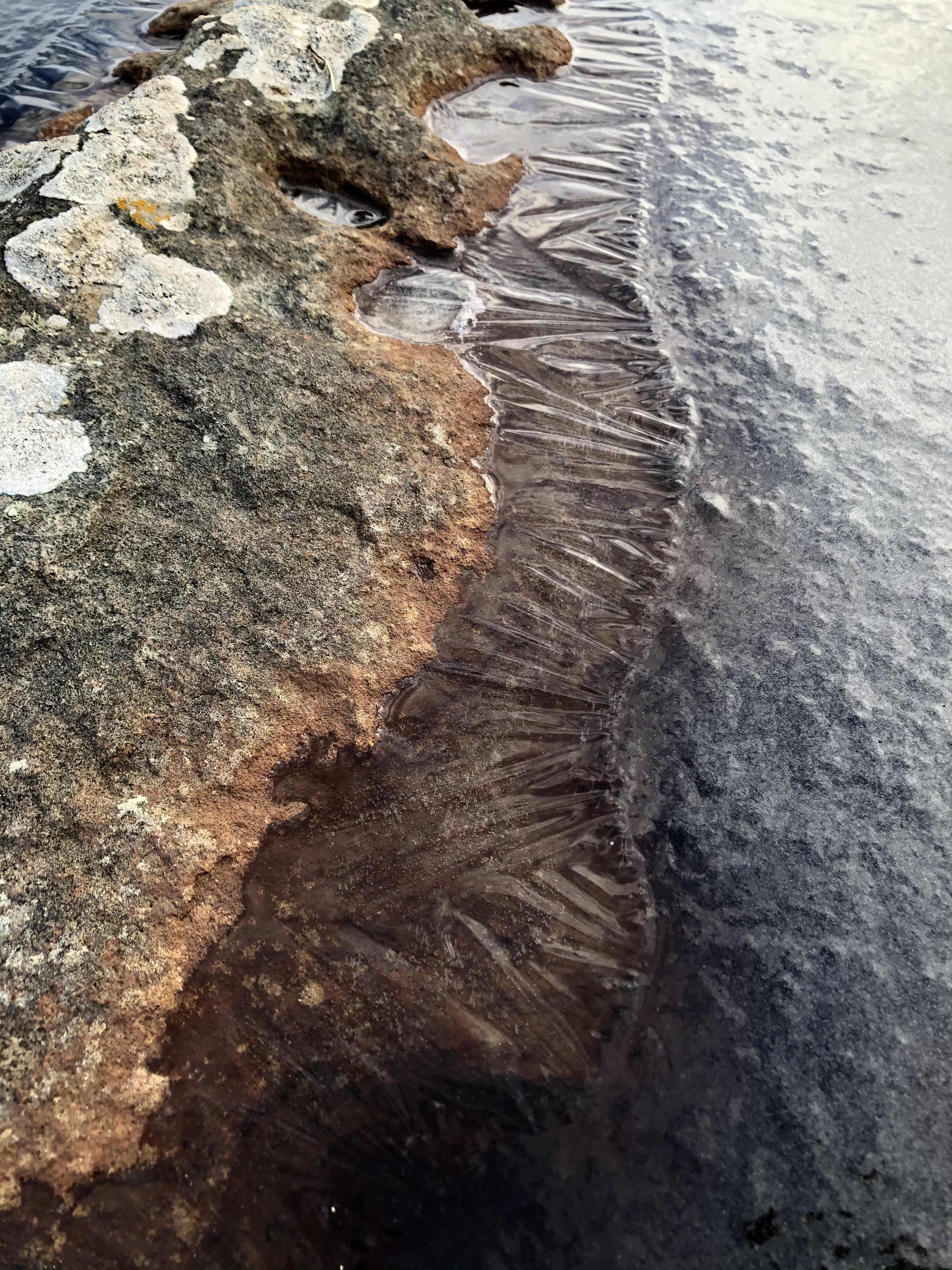
Frost is what first got me interested in macro photography. The sparkly sheets covering the ground look pretty even from afar, but getting right up close to shards of microscopic ice is completely addictive.
It’s not all sharp and jagged either – in the past I’ve photographed a huge range of shapes including swirls, ribbons and bubbles.
Winter sunsets
At this time of year the sun takes on a milky, diluted glow which is just delicious to photograph. I’m not much of a landscape photographer, but on my recent trip to Portknockie I spent hours on the beach capturing Bow Fiddle Rock as the light dimmed.
Initially the rock was bathed in gold but once the sun sunk below the horizon, the sky behind Bow Fiddle glimmered with pinks and blues. It’s a chilly image and I’m really pleased with how it came out.
Northern lights
I count myself extremely lucky to live in a part of the UK where the northern lights occasionally show up. The displays here aren’t as elaborate as they are in Norway or Iceland and they can be tricky to make out with the naked eye, but last weekend there was a particularly good show and I managed to catch a few pillars on camera.
The northern lights remind me of His Dark Materials, which remind me of witches and animal dæmons and all that good stuff. I also believe the aurora is the closest thing to magic we can physically see, and it’s one of my ultimate winter highlights. Even if you don’t live in an aurora zone, you can still watch it real time on this Shetland Webcam. There’s the added bonus of not having to get freezing cold!
Migrant birds
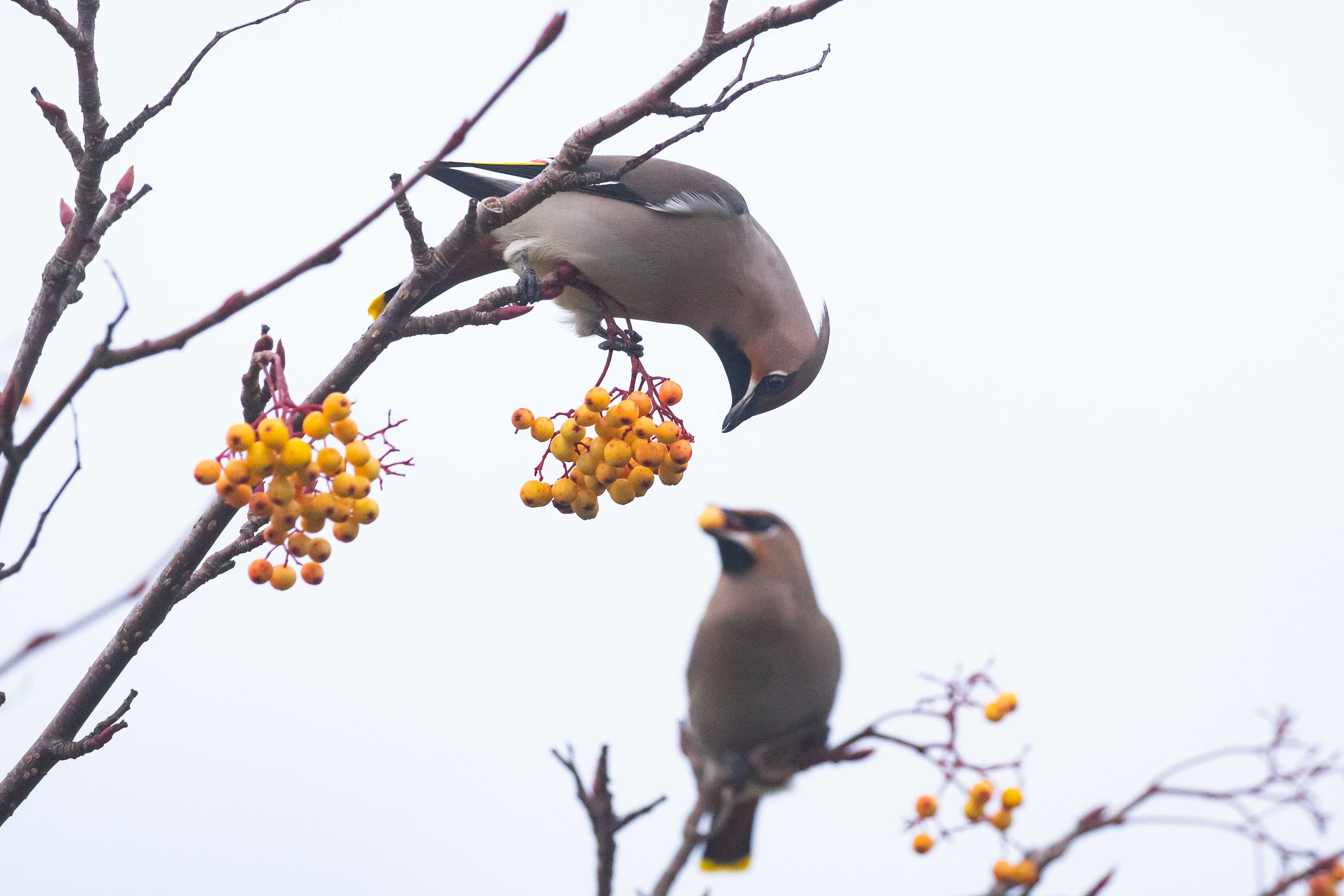
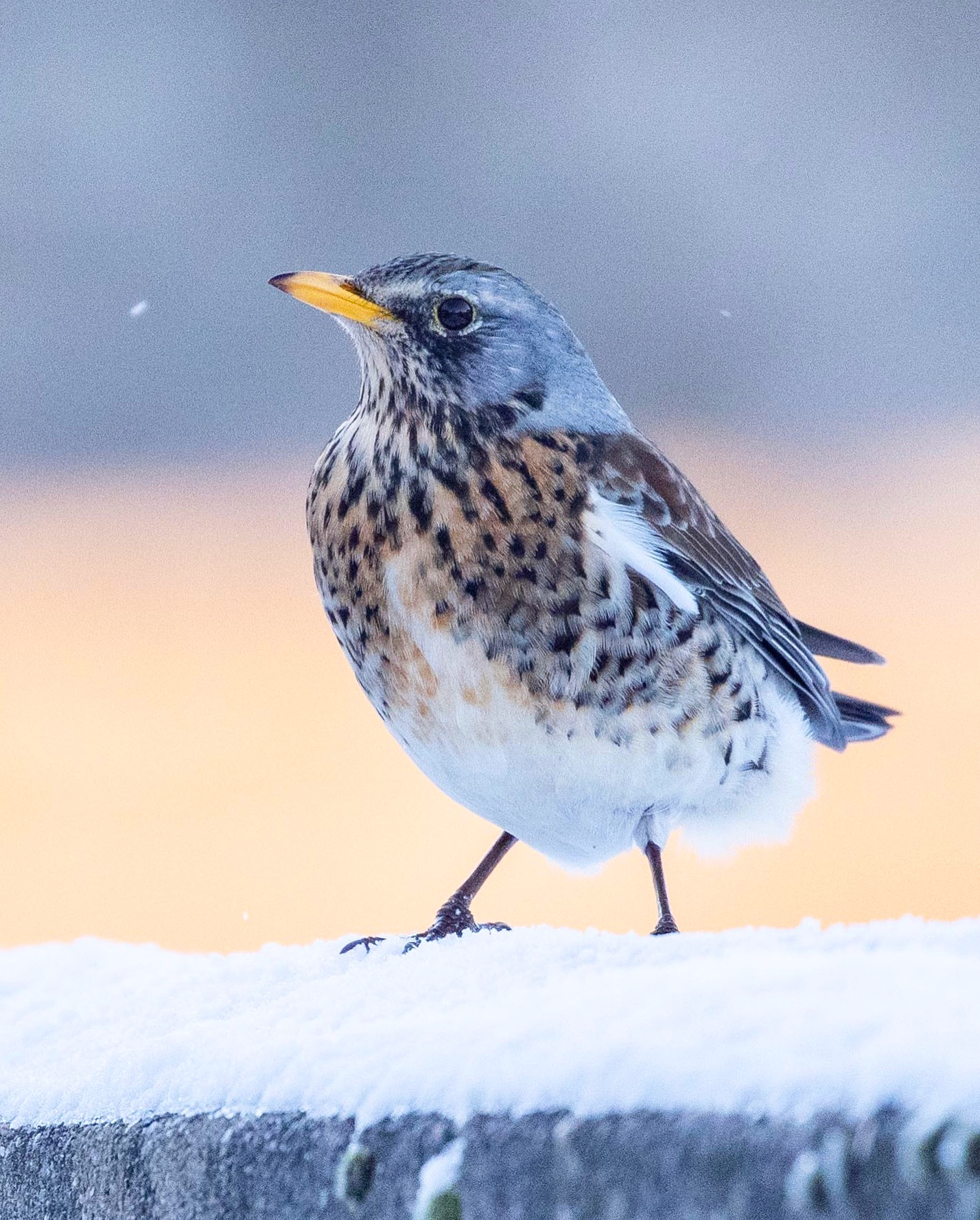
Summer and winter are great times to be a birder as there are new faces to see. While I love the ospreys, swallows and whitethroats that accompany long summer days, I have a soft spot for the winter migrants. I managed to see waxwings last year and I’ve got everything crossed that we’ll get another royal visit from them this time round, but some years they just don’t show. Even without waxwings, we have redwings, fieldfares, bramblings, eider ducks and long-tailed ducks on the cards. So many photo opportunities!
I know a lot of people struggle with the long nights during winter and this is definitely a challenge, but I hope this list will provide some wintery inspiration. There’s plenty still to enjoy in the dark half of the year.
I was in Assynt on the west coast again last week to get footage of the red deer rut for my latest Opticron video. If I wasn’t already in the mood for autumn, there’s nothing like roaring stags, soggy fungi and fiery bracken to get me even more excited for the dark half of the year.
I had to battle the weather at times, but I still managed to see some stunning scenery and wildlife in October sunshine. I brought my mum along and it was the furthest north she’d ever been. I couldn’t wait to introduce her to another part of Scotland that I’m growing more and more attached to.
Before we reached Assynt we stopped off at the Falls of Shin in Lairg to watch the salmon leap. I’d seen it once before almost exactly a year ago, but everything was new to Mum and it was so rewarding seeing her amazement at these massive fish launching themselves into the air.
A couple of miles away from our accommodation we saw a couple taking photos of something in a field beside the road. Lucky they were there, as they were pointing their cameras at a stag resting in the grass! I pulled over and recorded my first footage of the week, which included a bonus bellow from the gorgeous stag. I wondered if this was the same male that had visited the chalet garden back in June when his antlers were still in velvet.
The rest of the week was spent dodging the spells of rain and searching the hills for red deer. Once I’d got all the footage I needed we explored elsewhere, climbing up to the Falls of Kirkaig and walking through Celtic rainforest lush from autumn rains. We beach combed along the bay beside the chalet and found handfuls of frosty sea glass and a mermaid’s purse. I popped into the loch for a chilly and very brief swim. We were also visited almost every night by a hungry badger, who ambled right past the door on his way out!
Towards the end of the week we visited Ardvreck Castle, a crumbly ruin on the edge of Loch Assynt. While strolling along the beach Mum spotted a dipper foraging in the seaweed. I was surprised to see a dipper on the beach and it was the closest encounter I’d had with one – usually my only views are brown blurs as they shoot along the river.
I love visiting a place in different seasons. On my summer visit to Assynt there were black-throated divers on the loch and huge golden-ringed dragonflies clinging to the heather. This time we saw badgers at dinner time and heard stags roaring throughout the night. I’m so pleased I could share this special place with Mum – she was a little sad to leave at the end of the week. I’ve stayed in Assynt during summer and autumn so far – the next visit for me would be in winter, when I would search for shed antlers and hopefully photograph deer in the snow. Until then, it was lovely seeing and hearing those huge animals at the peak of their yearly drama.



























 rebeccaonthewing.com