Doe, A Deer

The first wildlife I encountered when I crossed over the bridge into Tring Park was the grasshoppers. They were everywhere, their electric buzz sounding from every direction. The pale grass in which they were concealed was jungle-thick with a million places to hide, but a particularly noisy individual drew me in and I knelt on the grass and studied the ground intensely. Suddenly I found the culprit, rubbing its legs together with fierce ferocity. I just managed to take a few quick photos before the insect propelled itself into the air, leaving the leaf bouncing with the impact.

IMG_4112

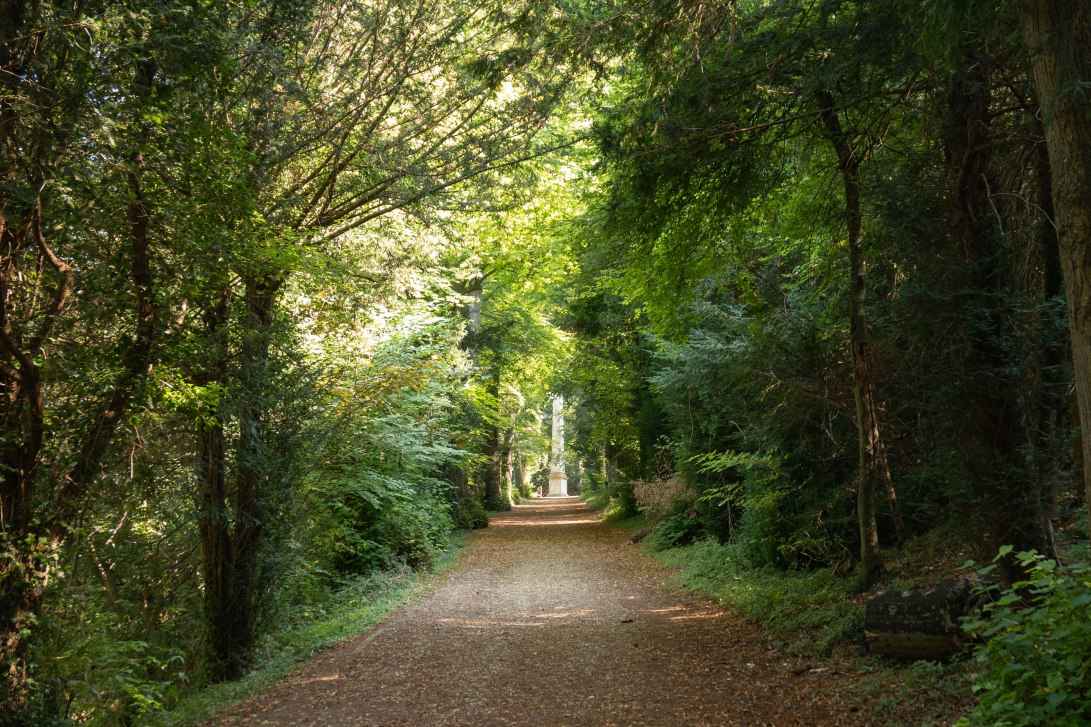
As stunning as the open parkland was – with butterflies flitting through the grass and red kites wheeling in slow circles overhead – I sought the shade of the forest, already beginning to perspire in another bout of sweltering August heat. The cooling cover of the trees was instantaneous and I made my way up the hill. Sloping overhead from left and right, the trees sighed as a breeze whistled through them. The canopy was a blend of greens, browns, oranges and, where the sun was shining, molten gold. Further up the hill I found a small clearing speckled with sun and shade and set down my blanket. Blue tits churred up in the trees and a distant jay screeched into the silence.

The first activity came from two grey squirrels who came darting at full pelt straight through the clearing. One continued right past me but the second wasn’t nearly so trusting. Hopping onto a nearby tree, the squirrel studied me intensely. After a few moments’ deliberation, it decided to take the long way round and shimmied up the tree in fragmented bursts, pausing every so often to stare again, bushy tail twitching. I’d obviously plonked myself in a squirrel playground and this one was making sure I knew it.
P1000474

After the branches had stopped shivering from the squirrels’ antics, the forest fell silent. My eyes kept catching on long lines of spider web that sparkled each time the sun touched them. They were mesmerising; delicate gossamer threads lifted by the breeze. Behind them, voices permeated through the forest and a group of dog walkers marched past, each dog’s nose on overdrive with all the enticing aromas. Another squirrel foraged close by, exploring the leaf litter in small hops and tail twitches.

Every so often a single leaf would fall, twirling slowly to the ground like confetti. It seemed that no animal had disturbed it, so it must already be the beginning of autumn. Soon, the leaves would explode into warm colours and tumble to the ground before the first frost.

P1000495

There was another rustle to my right and I glanced up, expecting to see another dog walker or jogger. An involuntary gasp escaped and I watched in disbelief as a female roe deer headed straight towards me. She briefly disappeared behind a tree and when she emerged suddenly spotted me, stopping dead in her tracks three metres from where I was sat. For several long moments we stared at each other, both equally incredulous. I willed her not to be scared of me but she was naturally rigid with unease. My camera lay right next to me within easy reach, but I knew the second I moved she would bolt. So I ignored my photographer’s instinct and stayed frozen.

We continued to gaze at each other and I took the opportunity to admire her beautiful face with its large, black nose and literal doe eyes. Eventually she skirted around me, falling back to a safer distance and emerging onto the path, her elegant legs moving in long strides. As she retreated I grabbed my camera and snapped just before she disappeared, although of course my real photo opportunity was long gone.

P1000510
Proof that it happened!

There comes a time when an encounter is worth not getting the picture and I believe that was one of those times (or so I kept telling myself afterwards). Not only would reaching for my camera have startled the deer unfairly, but it would have undoubtedly shortened my time with her. For those few precious seconds I ignored all distractions and savoured the thrill of engaging with a wild animal, especially one as naturally wary as a deer. Experiences like that don’t happen every day and sometimes it’s best to simply be in the moment, even if you pass up the possibility of a killer Instagram post.

Long after the deer had gone I buzzed with excitement. The afternoon was warm but goose bumps had risen on my arms as I sat relishing the encounter. I’d always been captivated by the elegance and composed beauty of deer. In a way I found them near mythical. Despite their supposed abundance I very rarely see them, so to experience one so unexpectedly close and without any warning was exhilarating.

The Scourge of the Glen

Our meeting point was a narrow track just outside Aviemore. The light was beginning to fade and the moon shone in a clear sky, fringed by a sprinkling of stars. We threaded our way up the track, keeping an eye out for roe deer in the surrounding fields, and eventually reached the hide: an impressive building with large windows running along each side. The interior was luxurious; carpeted flooring, posters adorning the walls and above all, heating! It was indulgence that I hadn’t had the fortune of experiencing in a lot of hides. This one was positively posh.

Once inside, there was the habitual jostling for the best space as politely as possible. The guide always says that the animals may come from any direction, but we all know some spots are usually better than others. After we were all settled, our guide James left the hide to distribute the food. He explained the importance of only providing a supplement to the animals’ diet to make sure they didn’t become reliant on human assistance. On the menu tonight was a selection of peanuts, raisins, dollops of peanut butter and the ultimate prize: an egg.

So what were we hoping to see at this time of night? To Victorian gamekeepers, they were the “scourge of the glen”, known for stealing the eggs and chicks of ground-nesting birds. In my opinion, they were on par with the unicorn – a creature so stealthy and elusive that although they’re relatively common in Scotland and doing well there, they are very rarely seen. Coming to a hide dedicated to seeing them is your only semi-reliable chance, but of course nothing about wildlife is ever guaranteed. I’m talking about the pine marten.

img_3348
Photo: Jai Redman

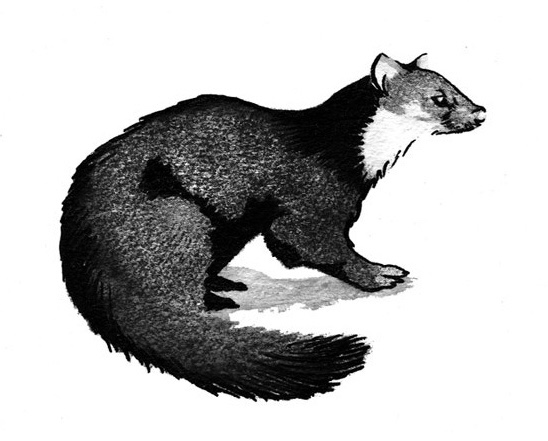
A member of the mustelid family with otters, stoats and weasels, pine martens are cat-like and forest-dwelling. Their coats are a rich, chocolate-brown and each animal has a unique pattern on their bib ranging in colour from yolky yellow to almost white. Pine martens are adept at dispatching grey squirrels, which are slower and less agile than reds. The latter have evolved alongside martens and know how to evade them, which is why there are no grey squirrels in the Highlands and plenty of reds. It’s interesting to think that if pine martens had been abundant across the whole of the UK when grey squirrels were introduced in the 1870s, would we have such a drastic problem with this invasive rodent today?

Once the food was in place, the wait began. Not only were we hoping for martens but also badgers, owls, a deer perhaps. It was a complete lottery, which made the whole thing incredibly exciting. The light was fading fast and my camera struggled to cope. Cranking up the ISO caused a sandstorm of grain to fill the screen, but I wasn’t planning on prize-winning photos on this occasion. This was one of those times when, more than anything, I wanted to watch.

After a short while we had our first visitor. Out of a knot of tree roots came a wood mouse. It appeared as though time had been sped up – the mouse zoomed out into the open, seized a peanut and retreated into its shelter within what seemed to be the blink of an eye. He or she entertained us for a while but before long it was quiet again.

Gazing outside into the dark clearing roused a slight feeling of unease. The longer I looked, the more my eyes played tricks on me. Shadows took on the appearance of strange shapes appearing to move on their own. Coupled with the expectant silence in the hide, the scene was close to eerie.

My eyes kept flicking to a shadowy patch just out of reach of the yellow spotlights. Beyond it the ground dipped into a shallow hill that plunged into complete darkness. I kept picturing a marten cresting the hill and trotting along the track for the tempting egg. I thought if I imagined this hard enough, it just might happen. I appreciated this fantasy had an undeniable whiff of desperation about it.

Suddenly, a flash of pale wings caught my eye. I glanced up and watched a scene unfold in slow motion. A bird catapulted through the air, wheeled tightly around the mouse’s tree and swept straight past the window. A blink-and-miss-it moment. For a few seconds I was stunned. I’d never seen a tawny owl before, and couldn’t believe how small they seemed! Small, yet incredibly skilled hunters. It really was a privilege to get nocturnal wildlife encounters, especially scenes as dramatic as a high-speed fly-by from a tawny.

After that exciting moment, there was a distinct lack of life for quite some time. It was still early days, I reminded myself, eyes flicking once more to the shadowy patch, there was time yet. I leant forwards on my stool, peering so close to the window that my breath fogged up the glass. Martens could approach from anywhere, and being so dark they would be completely concealed apart from their trademark bib.

The other visitors coughed, switched seats, paced up and down and chatted in hushed whispers. Meanwhile, I was glued to my stool. Far from blessed with social prowess at the best of times, I refrained from making conversation and kept my eyes planted firmly outside – there was no way I was missing anything.

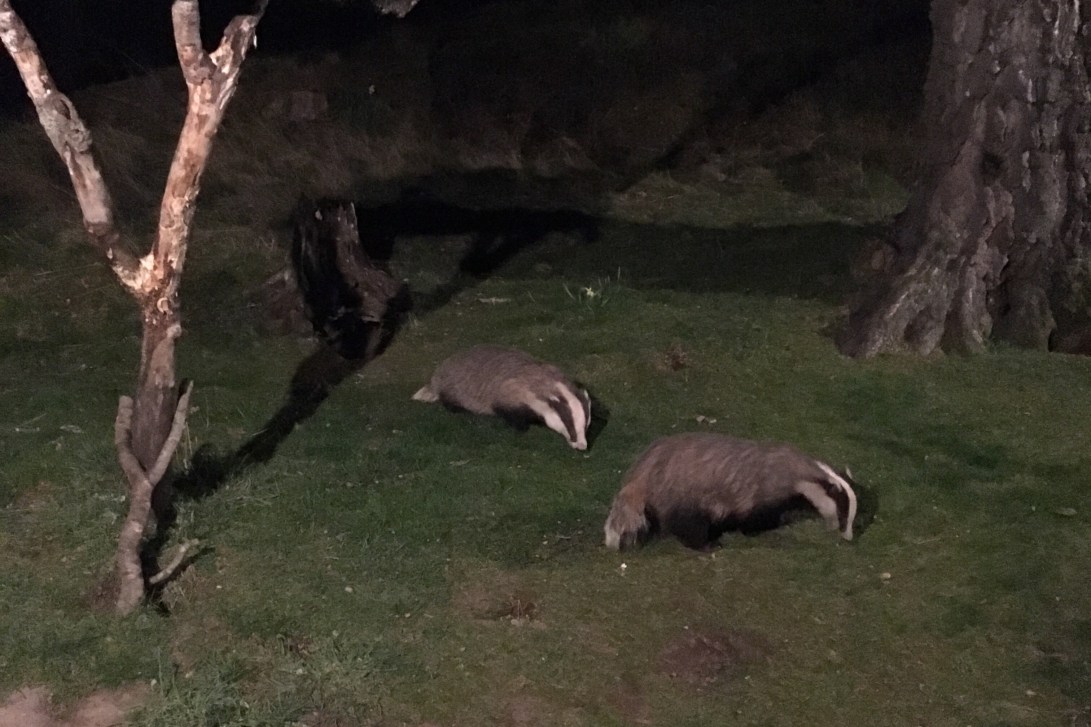
There was a sudden, hushed commotion in the hide and I peered to the side to see a badger had appeared. Badgers have terrible eyesight but an exceptional nose, and mainly use smell to discern their surroundings. The animal picked her way across the grass, fanning her snout over the ground like a metal detector. Tragically, my previous badger experience consisted of road kill and one that I had nearly killed myself when it ran out in front of my car, so to watch a real, live badger going about her nightly business mere feet away was such a treat.

img_3251

After she’d polished off most of the nuts, the female was joined by a male. He was the same size, suggesting he was also the same age if not younger. Adult male badgers typically weigh a kilo more than females and are noticeably more muscular. The two animals completely ignored each other so there was no doubt that they belonged to the same clan. If they hadn’t, there would have been a serious standoff. The male cleared up what the female hadn’t found and one by one they left the way they’d come. The only evidence of their visit was a distinct lack of peanuts.

img_3249

An hour and a half later, my enduring optimism was beginning to turn. I was conscious of the time and that our evening would eventually come to a close, marten or no marten. I started seeing more and more phantom animals out in the gloom. The moon was radiant and my eyes were drawn to its pure white hue. A lone bat darted over the roof of the hide, silhouetted briefly against the lighter sky before disappearing. How anyone got a decent photograph of a bat eluded me. To capture such erratic and rapid flight was seriously impressive.

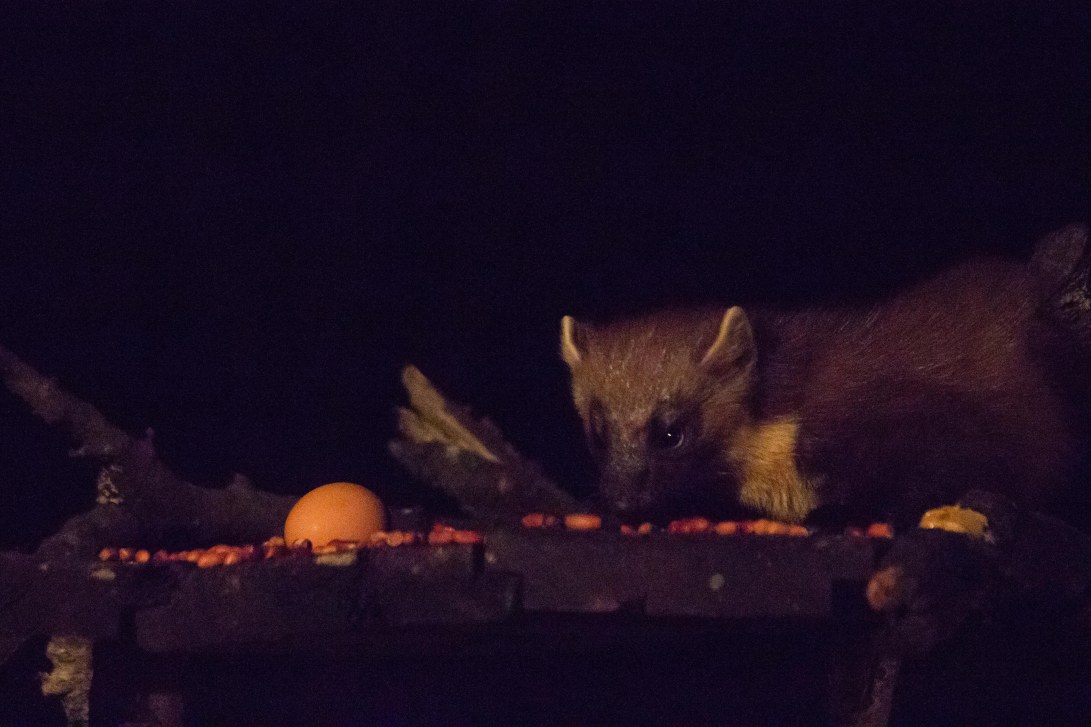
I glanced over at the shadowy patch again and saw a pine marten staring back at me, beady eyes glinting in the light. My insides jolted and as quietly as could I exclaimed, “There’s one!” Everyone knew exactly what I meant and came hurrying in my direction with barely restrained urgency. I couldn’t quite believe what I was watching on the other side of a pane of glass.

img_3262_lively

James told us the marten was a female. Similar to badgers, males were larger and typically had broader faces. Many people underestimate a marten’s size when they see one, imagining something along the lines of a weasel or stoat. I was quite the opposite; the marten was smaller than I’d expected, smaller than most house cats. What couldn’t be disputed was how beautiful she was with her long bushy tail, sleek mocha fur, tiny button nose and white-rimmed ears. I fell instantly in love.

The marten crossed to the other window and we swiftly followed suit. She climbed up onto the table and munched through the peanuts. As stunning as she was, she certainly wasn’t the most ladylike when it came to eating. She took the egg in her mouth and, despite her sharp teeth, carried it delicately down the table onto the grass. After a quick readjustment, she lolloped out of sight.

IMG_1579

We’d spent two hours in darkness and experienced less than a minute of what we’d travelled here to see, but the atmosphere in the hide could only be described as barely contained hysteria, in my corner at least. We made the unanimous decision to end our evening on a fantastic high. Not only had I had my first proper badger sighting, but I’d also seen a Scottish icon. I couldn’t have hoped for better.

img_3345
Mementos


Golden Hour

The light was still faint as I drove through fields of green. Cars tore past in a work-fuelled rush, while I cruised leisurely in the opposite direction. My focus was on the forest today – my only objective to walk through trees and listen to wild sounds.

A flash of copper caught my eye and a stunning red kite appeared in the sky, wheeling over the rolling hill as it hunted for unsuspecting mice. I pulled over in a layby – the mud sticky before the sun reached it – and spotted three more circling in large, overlapping loops. Occasionally there was a squabble, and two birds would tussle in the air, cascading downwards and surging back up. It was easy to forget that bounty hunters and egg collectors almost pushed the red kite to extinction only a few decades ago. Now, you could drive down most country roads in Hertfordshire and see at least one. I had never seen four so closely together, and savoured the opportunity to watch such an inspiring conservation success story in the flesh.

Soon the kites drifted further off, reduced to dark flecks in the sky. I left them to their hunt and drove on, arriving at the edge of the forest before anyone else that day. As lovely as dogs were, I didn’t need their boisterous presence this morning. I pulled on hat and gloves and slung camera and binoculars around my neck, then crossed the road towards the woods.

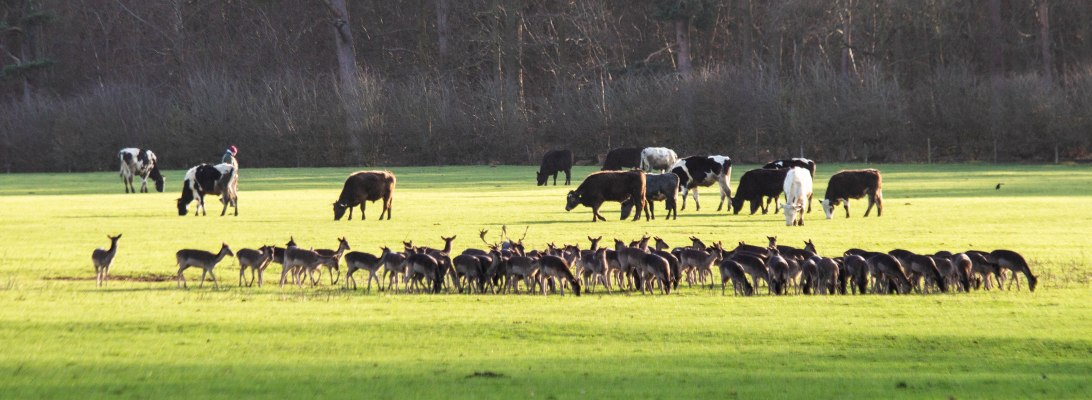
To my delight, the species I’d come to see was already here in abundance. Grazing in a field beside the cows was a herd of fallow deer around seventy-strong. I have always been fascinated by the variation in fallow deer pelts. When I first saw deer at this site, having previously seen photos of white-spotted Bambis, I had thought they were a different species altogether. These fallows were two-tone; dark brown on the top half and a lighter brown on the bottom half, as if they had waded flank-deep in mud. I hastily took to the cover of the trees, creeping as quietly as I could along the fence to get a closer look.

However, these deer were no fools. The next time I stopped and snuck a look through the binoculars, there were several faces turned my way, ears pricked upwards and eyes gazing down the lenses. My cover was blown. I decided to carry on with my approach, heading diagonally and pausing behind each tree. Ears twitched, and after a few more moments of studying me, the herd moved off, first at a trot then at a gentle canter. Among so many deer, there were only two males; as the herd bounded in loose procession across the field I watched two sets of antlers bobbing among dozens of ears.

I continued deeper into the forest, dulling the sound of passing cars with birdsong and wind-rustled leaves. The trees were gently swaying, creaking eerily like squeaky doors. The breeze played tricks on me, sending leaves skittering across my path in a perfect imitation of birds. The thrum of a woodpecker echoed through the cold air. A buzzard called faintly in the distance.

Suddenly there was an invasion of grey squirrels, bounding over the leaf litter and across fallen logs. Two of them darted in a reverse helter-skelter up a thick trunk, their claws scratching wildly in the chase. Another was saving his energy, choosing instead to perch and chew on a shrivelled leaf, twisting and turning it in his tiny hands.

I left the squirrels to their play and headed further along the fence, glancing between the trees to see if the deer might have come back. They hadn’t, but there was a sprinkling of brown birds foraging in the grass, dotted among the cows. For a few moments I couldn’t figure out what they were. Speckled like thrushes, but I’d never seen a large group of thrushes before. Just then the sun appeared, illuminating bright red patches on the birds’ sides. Redwings! My first this winter, and what a show. There were around forty of them, hopping around in the grass. They were too far away for a decent photo, but close enough to watch through the binoculars.

After a while, a startling screech made me jump. The only culprit I could think of was a barn owl, but I was sure they would have finished their night’s hunt by now. I followed the voice further down the trail. It was an ungainly, dinosaur-like squawk that sounded deafening in the tranquil forest. Suddenly, as I was scanning the canopy overhead, a crow-sized bird with white, brown and grey feathers shot out of the leafy cover. I hadn’t seen a jay once when I’d lived in Cumbria, so it had been about four years since my last sighting. I was desperate for a good photo of a jay but this one wouldn’t be cooperating. It darted from tree to tree, pausing only for a few hoarse shrieks before taking to the air again, soon disappearing completely from view. Undoubtedly the prettiest of the corvids, but not the sweetest singer.

Soon the forest was nearly silent again, with just the gusts of wind disturbing the trees. The morning was rolling on, and golden hour had arrived. Between breaks in the cloud, rich yellow light illuminated the trunks, throwing their gnarled, twisted bark into stark relief. It was a glimpse of magic that only lasted until a cloud muffled the sunlight and the forest fell back into shadow.

The cold was beginning to bite my fingertips, and I could already hear the first dog walkers. It was a good time to turn back. I made my way slowly through the woods, past the field and the squirrel tree, looking forward to warming up back home. I was just scanning the trees one last time for any small birds when my eye caught on two more pairs of ears sticking up. The deer were perfectly camouflaged, and after we stood watching each other for a few more moments, the doe stepped out from her hiding place and began picking her way through the foliage. The buck took one more look at me before following her, just as the sun emerged again and made their brown fur shine gold.

There was something undeniably magical about watching deer in a forest. They were elegant and beautiful animals, their habitat just as serene. As I stood watching them stride away out of sight, I felt a strong connection to the forest and the creatures that lived within it. Although I didn’t truly belong here, for just a few short hours I felt at home.

Help For Red Squirrels

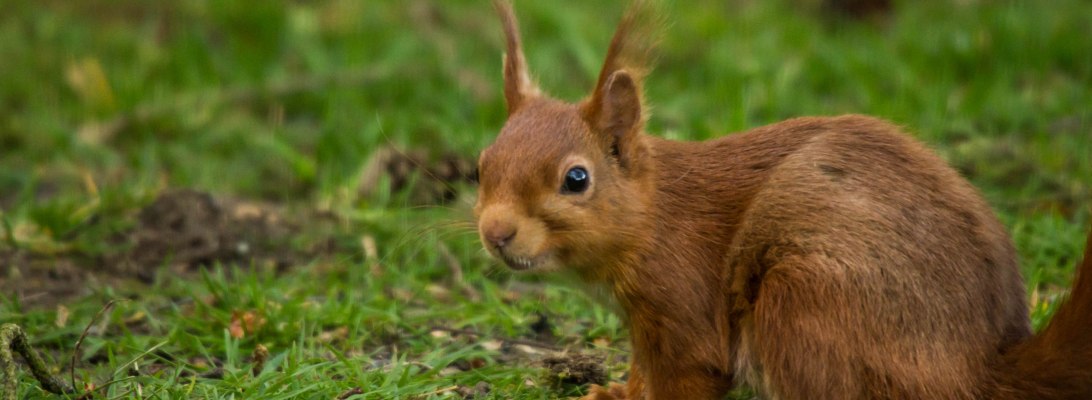
According to Red Squirrels Northern England (RSNE), there are approximately 138,000 red squirrels in the UK. For some people this may sound like a lot, but the grey squirrel population currently stands at 2.5 million. Due to the difficulty of monitoring these animals accurately, this number could be even greater.

Undoubtedly a much-loved aspect of British wildlife, red squirrels have faced many challenges in recent years, predominantly the impact of invasive grey squirrels and the subsequent squirrel pox that has decimated populations. While grey squirrels are immune to the disease, reds have a mortality rate of 100%. The virus causes skin ulcers, swelling and scabbing, and after contracting it, most animals die within two weeks.

However, our native reds still have strongholds in northern England, including Northumberland, North Yorkshire and several sites in Cumbria. For a chance of seeing this elusive mammal, it is important to know where exactly to look. Two particularly good spots for Cumbrian red squirrels are Aira Force on the Glencoyne Farm trail and Grasmere. There was an outbreak of squirrel pox at Grasmere in 2016, with more than ten confirmed cases in the valley. However, as a result of the hard work of the Grasmere Red Squirrel Group, the population of reds pulled through.

IMG_4181
Feeding red squirrel (photographed in Lockerbie)

With the squirrel pox virus having such drastic consequences, it can be difficult to know what the best solution is. In 2012, RSNE established a monitoring programme that samples 300 forests and gardens in northern England each spring, using trail cameras to record where red squirrels can be found. The Wildlife Trusts are working to improve the red squirrel’s favoured habitat of coniferous woodland, initiating reintroduction schemes and combating the presence of grey squirrels in a few carefully selected areas where red squirrels face the greatest risk.

If you are interested in the red squirrels of northern England and want to learn more about their status in Cumbria, Red Squirrels Northern England Project Officer Simon O’Hare is doing a talk on Monday 5th February and will be sharing updates on how red squirrels are faring and explaining why it is so important to protect them. The event is taking place at Kirkby Stephen Friends Meeting House. For more information take a look at the Cumbria Wildlife Trust.

Like this?

Have a read of my post about filming red squirrels in Lockerbie here.