Apparently it’s World Ocean Day! I can never keep up with all these international days, but I was keen to get involved with this one. Since moving to Scotland, the ocean has become a huge part of my local landscape and it never fails to both relax and inspire me.
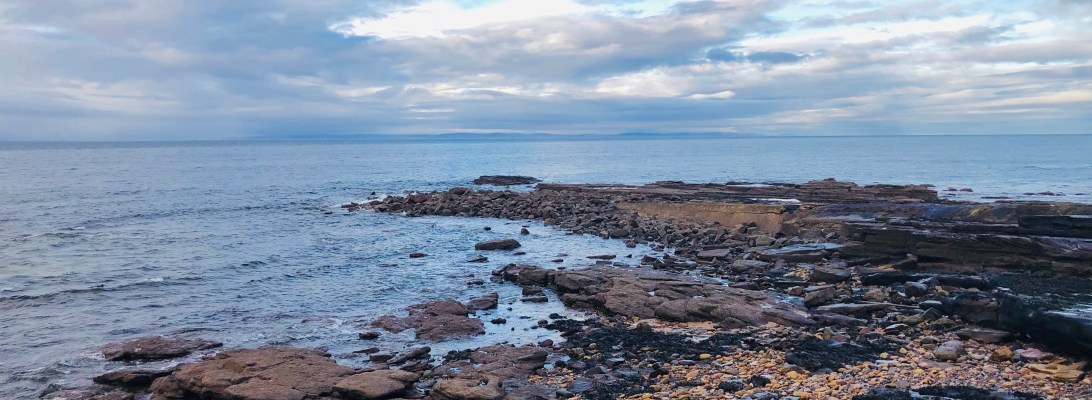
My local patch is a mile-long strip of rocky shore that’s bursting with wildlife – depending on the tide I can see gannets diving for fish, turnstones foraging among the kelp or bottlenose dolphins flinging themselves into the air.
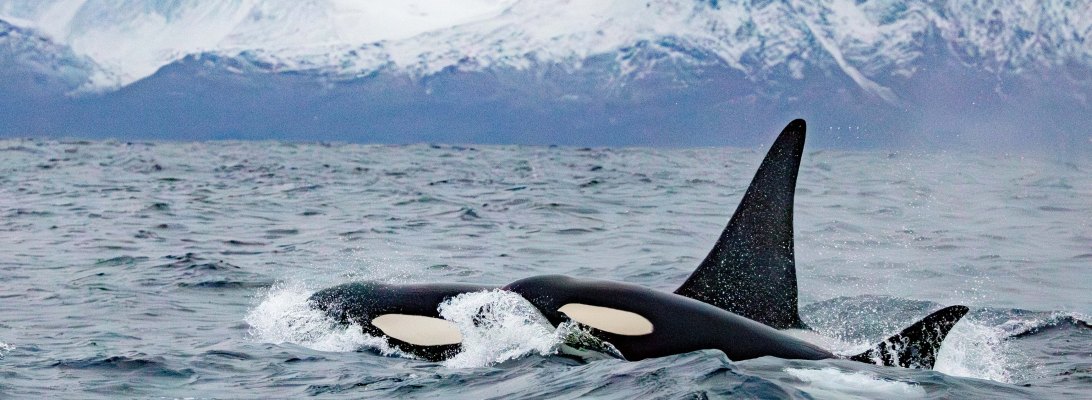
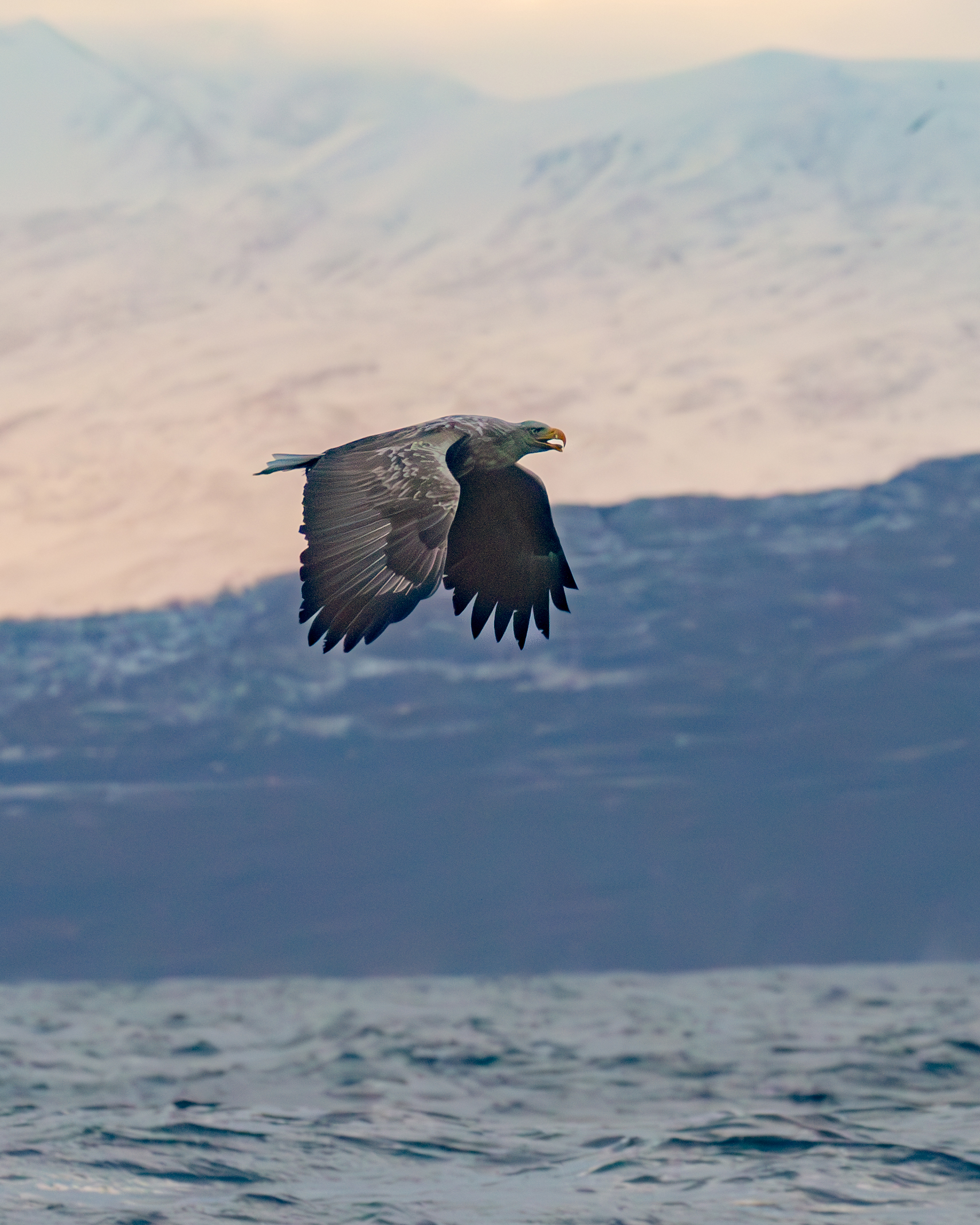
I’ve also been lucky enough to watch marine wildlife in Norway. During an unforgettable trip in 2020, I saw orcas, humpback whales and white tailed eagles – often all at the same time. Despite a dash of seasickness and some very numb toes, it was one of the best experiences of my life. I couldn’t believe I was surrounded by such huge animals, and it was a real privilege to share the icy fjords with them.
Another hectic month! I’ve travelled more over the past few weeks than I have all year. At the end of June I drove down to Hertfordshire, where I’m now staying until mid-August. It’s so strange being in my home town again after a year away – the same old walks I used to do daily are fresh now and I’ve been so surprised how many different birds I’ve been hearing. Since learning a few more bird calls in Scotland I’ve realised there’s more wildlife around here than I thought – it’s just a lot harder to find!
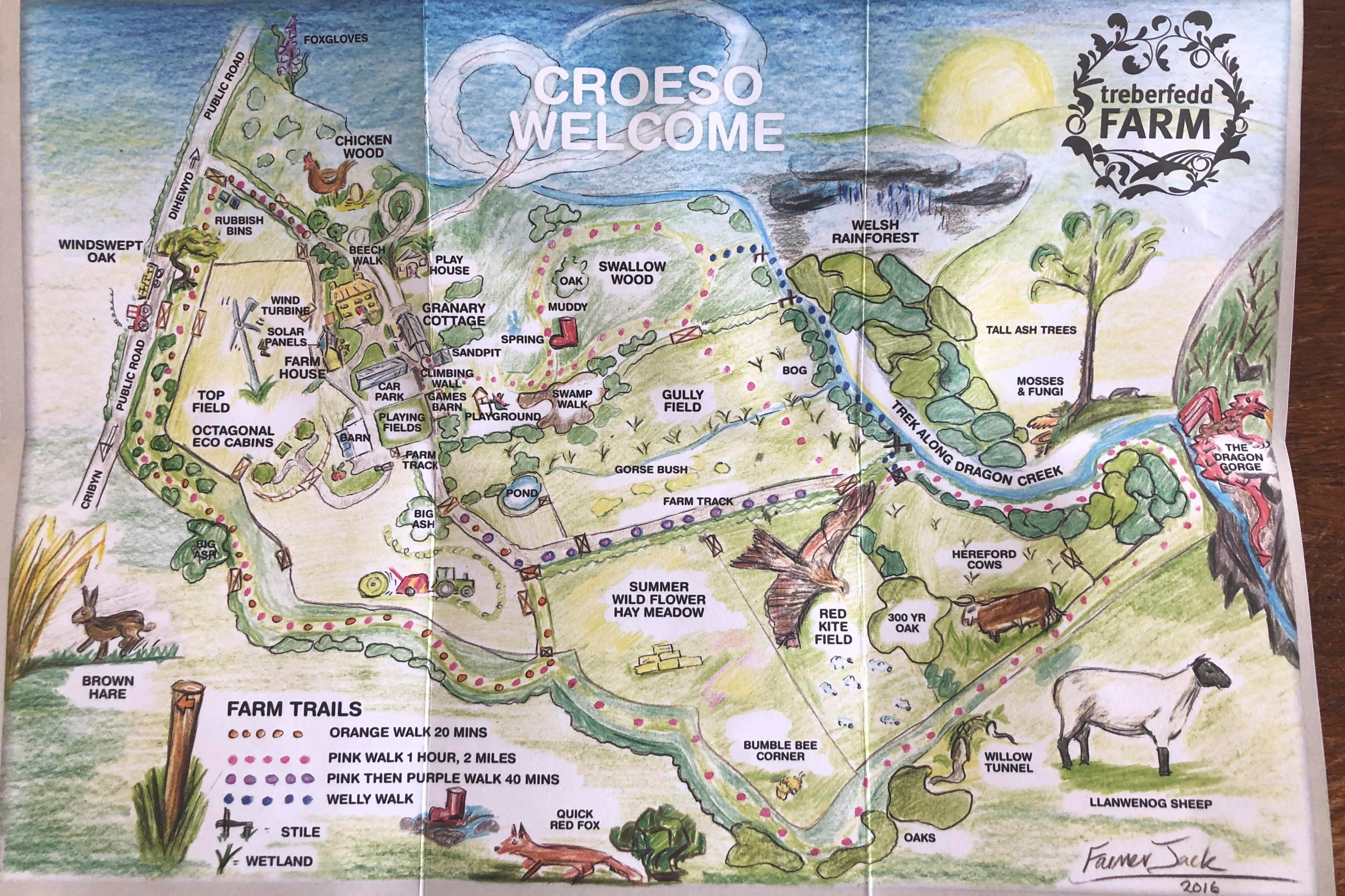
The day after I arrived in Herts I got on a train and headed west. My master’s degree has almost finished but we booked a short stay in Wales for our last residential. I stayed over with a friend in Bristol – seeing my first kingfisher of the year that evening – and the next morning we drove to Treberfedd Holiday Cottages in Lampeter, west Wales – our home for the next five days. This was my first time in Wales so I was excited to see what wildlife was around.
View from The Farmhouse
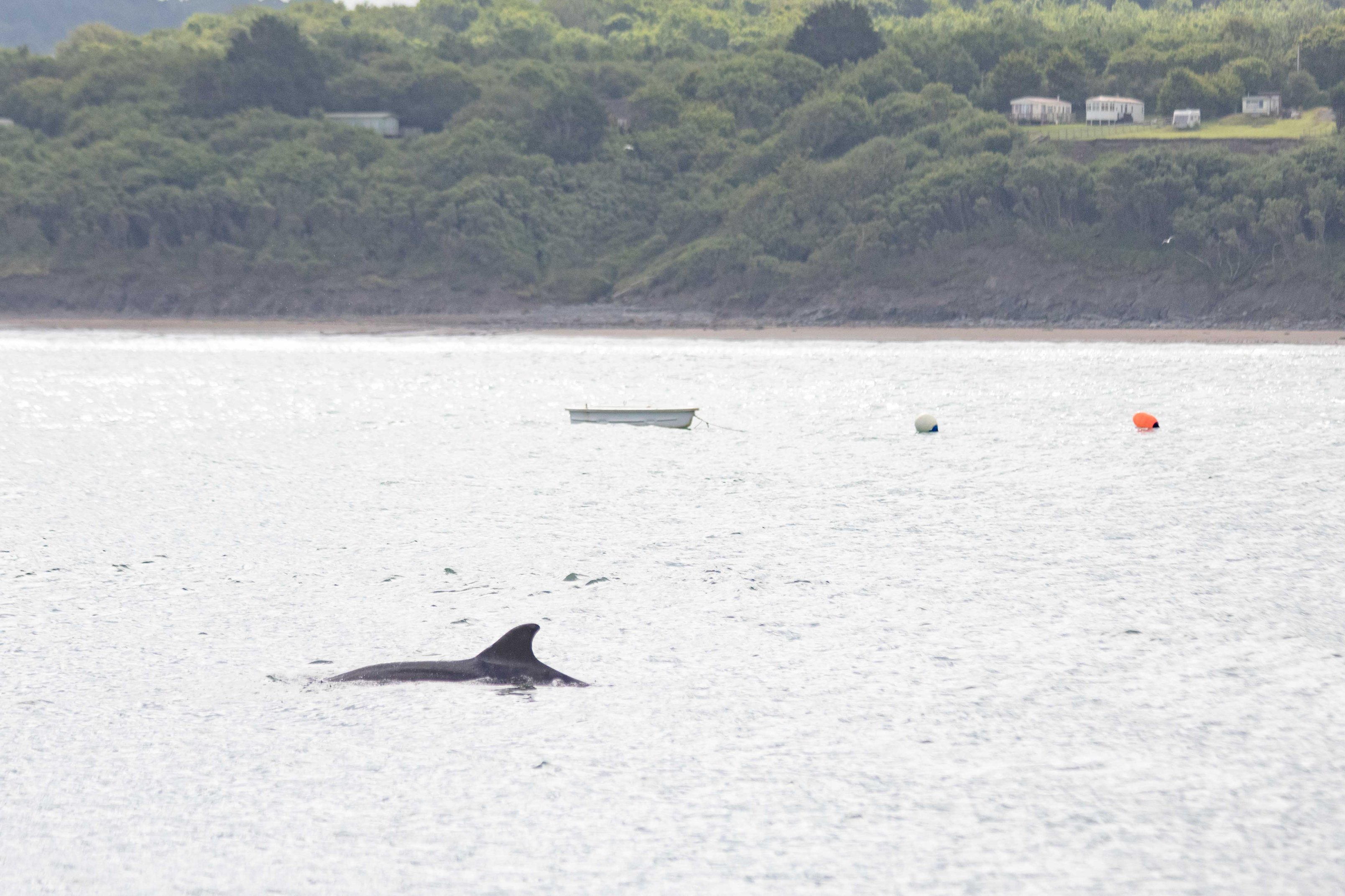
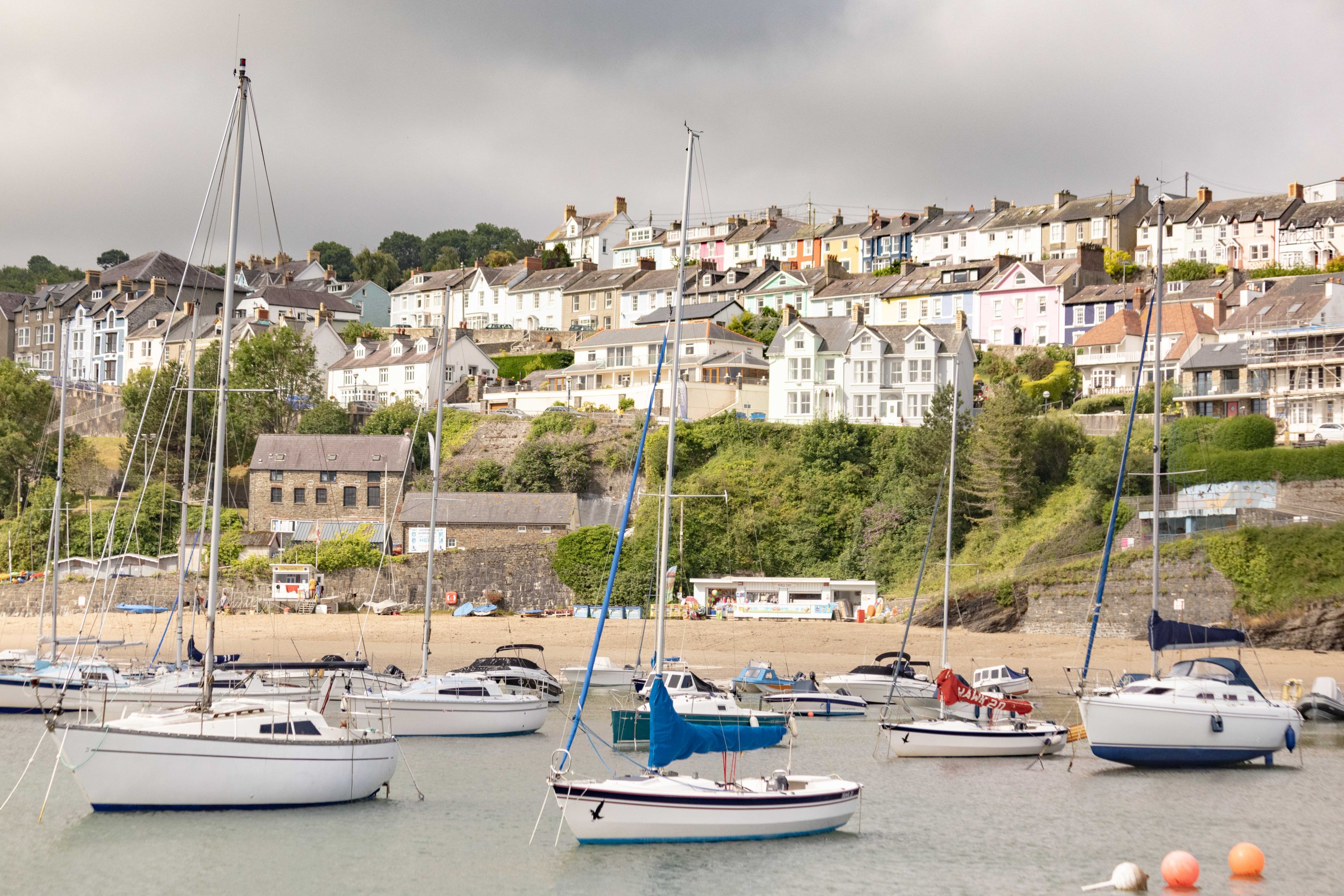
On one of the days we visited the seaside town of New Quay (not Newquay). We’d booked onto a dolphin watching boat trip, but as we stood waiting for the boat to return I spotted a dolphin right next to the harbour! It surfaced leisurely every few seconds and hung around for ages. It was strange to think this was the same species I spot from home, over five hundred miles north. It was great to see everyone else so excited.
Sadly I should have stayed at the harbour… During the boat trip we didn’t better the views we got from land and I had an unexpected bout of seasickness that nearly ruined everyone’s afternoon. I can’t believe how awful on boats I’ve become! I got a case of ‘green face’ in Norway last year, and now I can’t even go an hour on a sightseeing boat without feeling queasy. Note to self: I’m a landlubber now.
New Quay Harbour
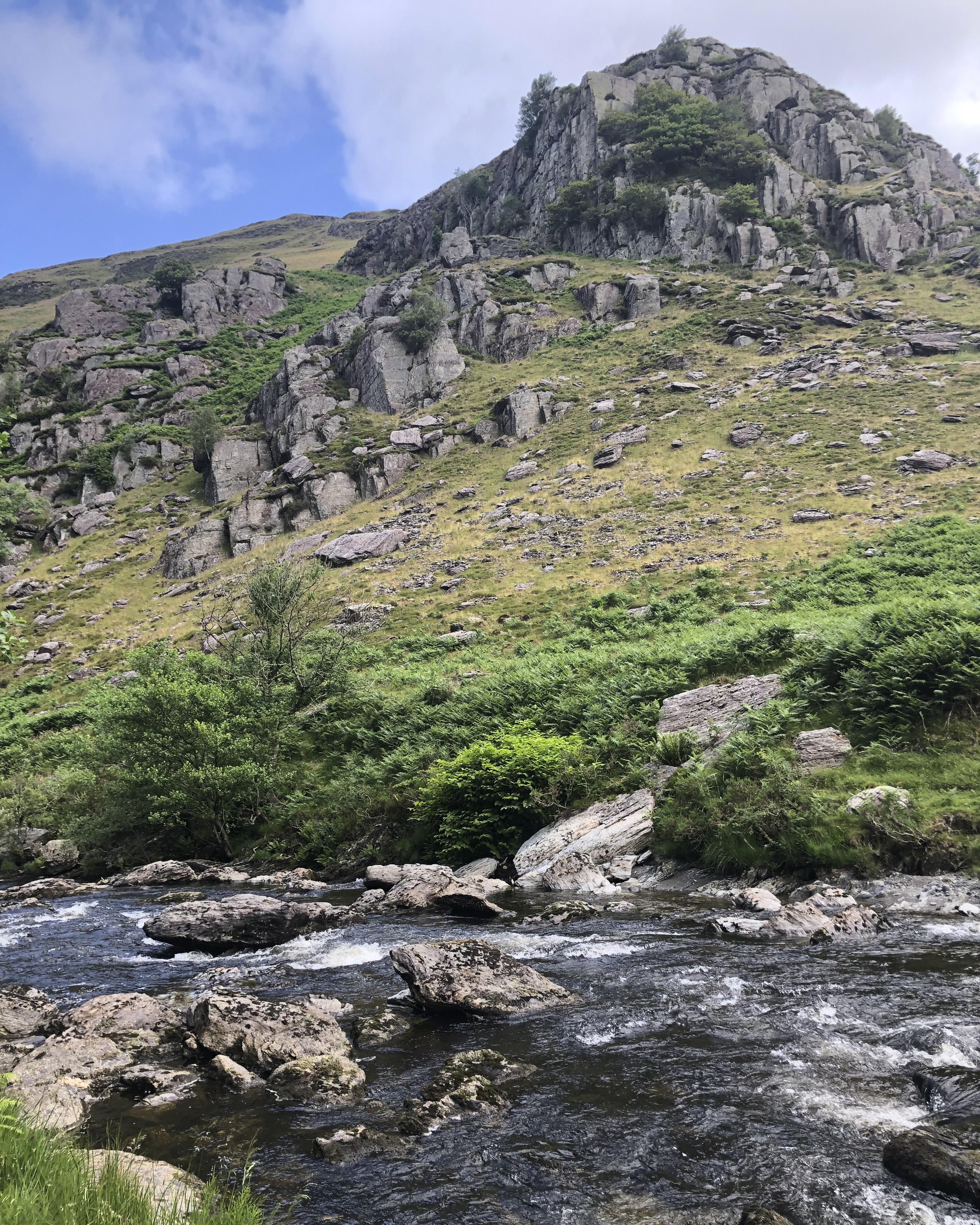
Another of our outings suited me far better. We visited a stunning area of Celtic rainforest called Gwenffrwd-Dinas. Surrounded by steep-sided valleys and threaded through with winding rivers, this was essentially my ideal home and all I needed was a wood cabin. I visited a Celtic rainforest during my time on the west coast and I didn’t realise just how incredible they are. I was dubious about the use of the word ‘rainforest’ but it describes the habitat perfectly – everything is that lush green you expect to see in the Amazon, just with willow warblers instead of howler monkeys.
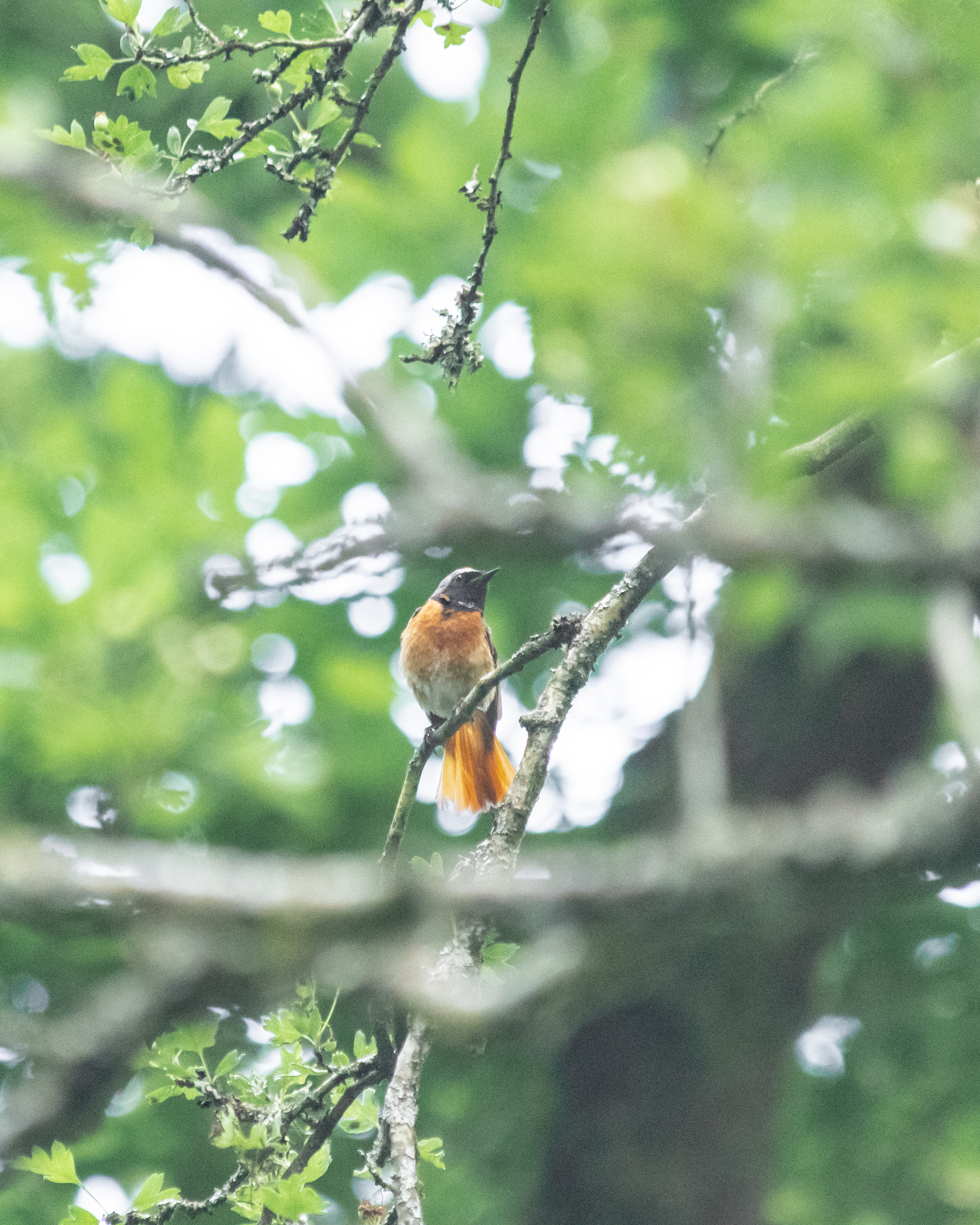
We followed a board walk beside the river – spotting a dipper and a family of grey wagtails along the way – and then clambered up steep rocks embedded in the earth, eventually looping back around. We’d been keeping our eyes peeled for redstarts, which are special summer visitors to the UK that I hadn’t seen before.
With no luck throughout the walk I was ready to accept defeat, but as so often happens we saw a flash of scarlet just before the car park, and there was our redstart! Two in fact – male and female taking it in turns to carry insects into a tree nest hole. I was thrilled to see them both, especially the vibrant male. After one drop-off he flew directly overhead and perched in a perfect gap in the trees. The sun shone through his slightly fanned feathers and I had to bite back a whoop.
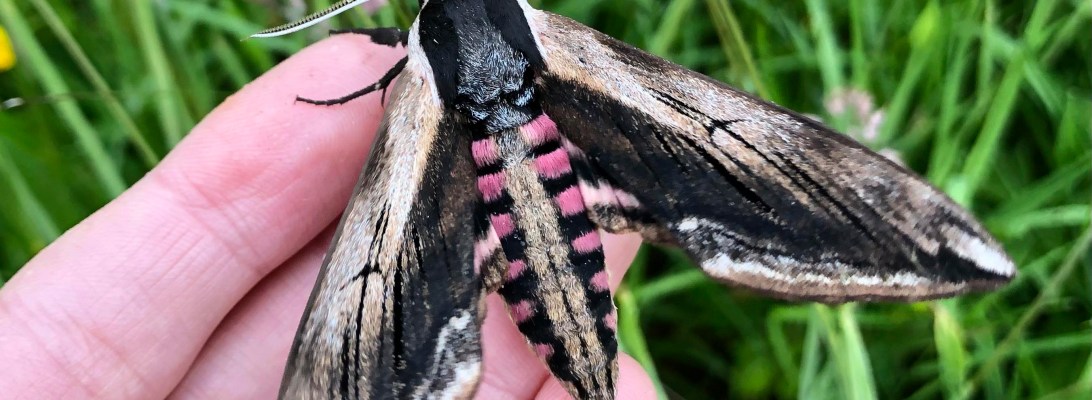
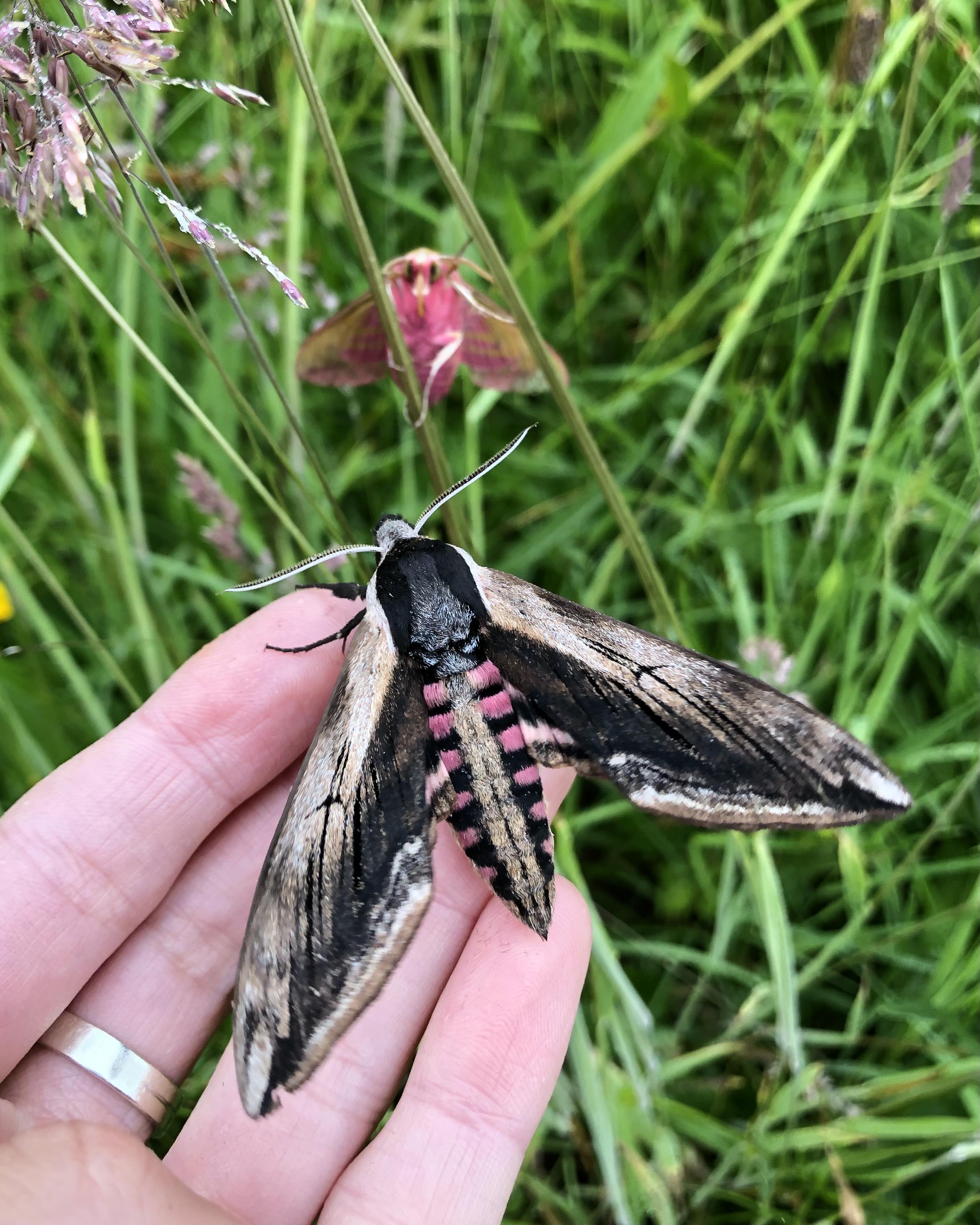
The redstarts were exciting, but my favourite part of the trip came on the last morning. My MA tutor had set a moth trap the previous night, and we headed over first thing to see what he’d managed to get. And what an incredible haul! With the help of the books we identified Blood-vein, Brimstone, Buff ermine, Garden tiger, Green arches, Peach blossom, Peppered, Plain golden Y and three of the most majestic creatures in existence: Poplar hawkmoth, Elephant hawkmoth and Privet hawkmoth. What gorgeous insects! The bubble-gum pink of the Elephant was stunning enough, but my favourite was the Privet.
Privet hawkmoth (with Elephant hawkmoth behind)
I couldn’t believe how big it was as it clung to my hand with sticky feet, flickering wings revealing a black and pink-striped body. After goggling it for several minutes, I was just about to put it carefully into the hedgerow when it took off, fluttered against my face for a few seconds then completely disappeared. Up until now I haven’t been much of an insect person but the hawkmoths gave me a whole new perspective. I left Wales feeling refreshed and with a load of new species to add to my list!
Jasmine brought me the ball again and shook her fur just as I stooped to pick it up, sending a spray of sand up into my face. Since I moved to the coast, sand is now a constant in my life. Every dip in a pocket reveals a new gathering of damp and slightly fishy dust, stuck like glue to every surface. I hurled the ball and Jas pelted after it, her pitter pattering paws the only sound in an otherwise silent evening. I had the beach to myself most days anyway, but recently it had become even more unusual to see another dog walker or jogger. Jas was none the wiser and was soon back at my feet again, tossing the ball up where it splatted against my shin and left a patch of sandy residue.
The evening was gloomy. Clouds were gathering and the little sunlight left was concealed behind the point at the end of the peninsula. My wet dog was getting curlier by the minute so I gave her a treat and put her back on the lead. She picked up her ball and carried it lovingly, ears lolling either side of a sand-clogged beard. I headed up the hill towards the pink splodge that hinted at an impressive sunset and scanned the shore. Herring gulls were gathered together on the rocks while a pair of red breasted mergansers bobbed in the shallows. A cormorant shot over the surface. The usuals.
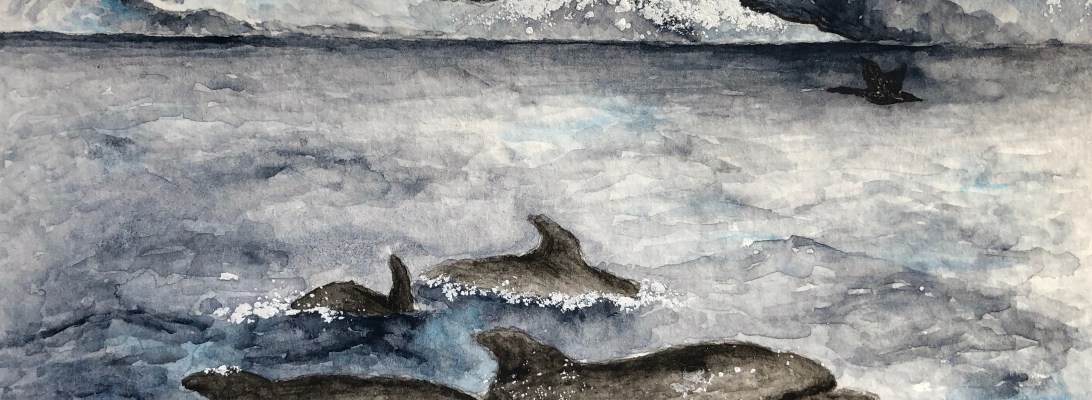
I struggled with the lead, my soggy gloves and a poo bag as I rummaged in my pocket. The vivid sunset paled instantly as my phone decided not to pick up any of the oranges or pinks that I was seeing. Scowling at the phone and the dog as she began to dig a hole at my feet, I contented myself with just watching the sunset, but a black scratch on the water quickly made my stomach flip over. I lifted the binoculars up and yes! A dorsal fin! I could barely believe what I was seeing. For the last month I’d believed that dolphins were mythical creatures and I was more likely to see Nessie. But no, there were multiple bottlenose dolphins out there. As Jas continued to tug at a particularly stubborn tussock, I buzzed with excitement as the dolphins surfaced again. I counted four fins, although it was difficult when they didn’t all appear together. They were heading around the point so I followed them, hurrying along the thin trail that wound around the sheer edge of the hill. If I tripped the wrong way I’d plummet into the sea but I wasn’t too aware of that at the time. Jas followed reluctantly, no doubt wondering what the fuss was about.
Again! Definitely four fins, dark against the pale water. They were out of the sunset now and trickier to spot. Without the bright light, they were swallowed up by the mist already obscuring most of the horizon. They came up again but I could barely make them out. I began to feel rain, the sort of rain you don’t notice until you’re drenched, so I walked back to the house, scanning sideways the whole time, but my dolphins were gone for now.
I am now officially trained as a Shorewatcher for Whale and Dolphin Conservation (WDC). I’ve been wanting to learn more about my local wildlife and contribute to marine conservation now I’m living in Scotland, so when I found out about the Shorewatch programme I was keen to get involved. Luckily I managed to complete my training in Inverness earlier this month, only a couple of weeks before the new regulations that now prevent us from going out for anything other than food shopping and exercise. Although I now won’t be able to start Shorewatching for a while, I’m going to use my time to get better at identifying British cetaceans using books in preparation for when I can get started properly.
Shorewatch is a citizen science project that’s all about scanning an area of ocean for ten minutes and recording the presence or absence of cetaceans (whales, dolphins and porpoises). The areas are especially assigned Shorewatch sites, which are found all over northern Scotland. The data collected is sent to WDC and used to monitor populations of cetaceans and flag up potential problems that may be occurring, such as deep-diving species that are straying into the shallows or a noticeable lack of sightings in an area where we might usually expect them.
Shorewatch is particularly beneficial because it is a completely non-invasive way of surveying. As the volunteers are positioned on the shore instead of in boats, the cetaceans show natural behaviour. WDC also don’t believe in tagging animals, so prominent scars and nicks in dorsal fins are used to identify individuals. For example, the team can recognise Spurtle, a female bottlenose dolphin, from the large area of sunburn on her side.
I haven’t seen any cetaceans in Moray yet, but I’m sure that will change over the coming months. The season will hopefully kick off properly in May, and going by the incredible photography I’ve seen, the bottlenoses really go to town with their acrobatics! However, when all you see is the flick of a tail or the subsequent splash, it can be tricky to figure out what species you’ve seen, so I’m learning how to identify different species in the water. The Moray Firth is famous for its bottlenoses, which are both the largest and most northerly in the world, but many other species have been spotted from Burghead shores including harbour porpoises and even orcas and humpback whales! I would definitely cry if I saw an orca in my local patch, but I shouldn’t get ahead of myself. Hopefully I’ll get to see the resident dolphins soon. We all went to Chanonry Point after our theory training to do a practice Shorewatch, and although there were no dolphins, we saw a common seal and a white-tailed eagle! I haven’t seen one since my trip to Carna in 2016, so to be able to watch the “flying barn door” on the east coast was a real treat and a fabulous introduction to Shorewatching.









 rebeccaonthewing.com