Learning to Dive – Part Two

On the second day of Open Water weekend (read about Day One here), I awoke to the alarm feeling a lot more confident. We were halfway through, with two dives down and two to go. The weather had deteriorated slightly and as I waited for the morning briefing it began to drizzle, but hopefully that meant the day would be slightly warmer (I was clinging to any silver lining).

My wetsuit was still damp from yesterday, so dragging it up my legs was even more impossible than usual. It was the reverse of a snake shedding its skin, and as I hopped about and contorted my limbs I couldn’t help feeling extremely silly. Finally it was on, and I doused myself in hot shower water in a vain attempt to warm up before facing the quarry.

Dive three was the most daunting, as it required a longer list of skills, including the dreaded mask removal. Perhaps I was jittery from nerves, because as I began my descent pain shot through my right ear and I hovered, trying and failing to equalise my ears. As you descend, the increased pressure compresses air spaces in your ears, sinuses and mask. Failing to add air to these spaces can cause serious injuries. I eventually had to resurface until I could equalise, then made my way back down. It was a setback that I tried not to concentrate on, especially with my least favourite skill coming up.

We gathered on the platform and took it in turns to fully flood our mask and take it off. I disliked this skill so much because the air bubbles that gather underneath the nostrils feel like water shooting up your nose. When I attempted this in the pool I had the sensation of not being able to breathe; quite a daunting prospect when you’re seven metres underwater and definitely cannot shoot up like a cork to the surface. In preparation, I’d been putting my face underwater in the bath and breathing through a snorkel, and although it triggered several involuntary swallows I could just about manage it.

Taking a deep breath, I pulled the strap over my head and held my mask away from my face, placing it back over as soon as I was allowed. Feeling very pleased with myself, I ran a finger around my hood to check the seal and cleared the water out ready for the next skill. But as we made to swim off the platform, the mask flooded again. I cleared it, and water immediately trickled back in. I signalled to the instructor who checked the seal and couldn’t find the cause of the problem, so once again we surfaced and I made absolute sure I’d sorted it out.

As I descended for the third time on the same dive, I reflected that I’d encountered an unforeseen problem and dealt with it without panicking; I had made serious progress since my first session in the pool. The rest of the dive passed with no further mishaps, and as I had my fifth hot shower of the day I finally began to relax. Our fourth and final dive wouldn’t be full of tests and I could enjoy the experience of feeling weightless in water and exploring Stoney Cove.

After a brief time on the surface and a delicious cheeseburger at Nemo’s, we took a giant stride back into the quarry. We’d planned dive four ourselves, and led the instructors down to the aircraft cockpit and along the shelf that tumbled down to 22m on the other side. Staying firmly away from the edge, we swam across to the Nautilus again and back to the platform, where we gathered for the last time. Alan, the instructor, had an underwater notebook with him, and one by one turned it to face us. I don’t think I’d ever been so happy to read the words:

“You’ve passed. Congratulations!”


Learning to Dive – Part One

The alarm went off at 6am and my stomach began to churn. Today was the start of Open Water weekend, and if all went well, I would earn my first diving certification. Having struggled with some of the skills in the swimming pool, not to mention the fact I was still getting used to all the kit, I couldn’t help feeling apprehensive as I pulled on my warmest clothes. I hastily gobbled a petrol station flapjack, which tasted like cardboard in my dry mouth. Knowing I shouldn’t be feeling so anxious, I tried to shake the nerves and triple-checked I had everything I needed.

Luckily, the site was only a five-minute drive from the hotel, and I arrived in plenty of time. Stoney Cove used to be a stone quarry that was used in the 1960s and 70s to train commercial divers and test underwater equipment used in oil fields. Now, Stoney Cove has conference rooms, shower facilities, a shop and – most importantly after a tiring dive – a pub called Nemo’s. The actual quarry is a multi-level city of shipwrecks and aquatic life, split up into areas of different depths for divers of all abilities. As this was our first open water dive, we stayed safely in the 7m limit, which still contained a submarine and an aircraft cockpit. Although, I was more interested in the crayfish, perch, roach and pike that called Stoney Cove home.

It was a cold but clear day, with sunlight pouring weakly onto the water. No rain at least, though I suppose rain shouldn’t really be a concern for divers. As I stood at the quarry’s edge watching seagulls floating on the surface, I couldn’t quite believe I would soon be diving several metres beneath it.

Soon it was time to start kitting up. We assembled in buddy pairs and helped each other don scuba kits just like every week at the pool. This time, however, we also had hoods, gloves, compasses and a dive computer. We made our way down to the ramp, where several divers were already in the water. For dive one all we had to do to enter the water was stand on the edge and sit gently back, floating out into the quarry.

Ungainly as always with my cylinder and weights, I felt like a tortoise on its back as I tried to strap on my fins. Eventually I was ready, and made my way hesitantly to the edge of the ramp. I turned, squatted and leaned back. The shock of freezing cold water rushing into my wetsuit wasn’t exactly comfortable, but in a strange way it was exhilarating. This was it, time to dive.

Once everyone was in the water, we began our first descent. As more of my body became submerged, I soon grew numb to the cold and instead focussed on the underwater world we were entering into. I descended to the bottom, making sure to equalise my ears to the increasing pressure, and looked around. The visibility wasn’t superb and the only features I could make out were other divers, but the murkiness only added to the suspense. It still felt strange not to have to work to stay down in the water, instead floating effortlessly.

The instructors led us on a swim, past the Nautilus submarine to a wooden platform where we would perform our skills. An underwater classroom surrounded by shipwrecks and fish; it was quite extraordinary.

After each taking turns to carry out the skills, we started our ascent. For the first time on the dive I looked up, and the sight was breathtaking. Sunlight streamed through the water in slanted shards that lit up our bubbles as they cascaded upwards. I still hadn’t got my head around being able to breathe underwater. It had been a dream of mine as a child, pretending to be a dolphin in the local pool. I wasn’t quite a dolphin yet, but I was closer to the underwater world than ever before.

Coming soon: day two of Open Water weekend!

Fresh Inspiration

Recently I’ve become a writer who doesn’t write much. I have ideas, many a day, of what to write, but somehow I never get round to making them a reality. I’m blaming this latest case of writer’s block on my new occupation, so I’ve decided to write about that. I have been accepted as a volunteer at Paradise Wildlife Park in Broxbourne, Hertfordshire. It was the longest application process for a voluntary position I’d ever experienced, but after interview, induction and trail day I was successful.

Volunteering in a small aquarium in Cumbria could not have prepared me for work in a zoo. Although far from large with only around 400 animals (in comparison with Chester Zoo’s 20,000), Paradise Park still requires plenty of hard work and for me it’s a physically demanding and challenging role. I anticipated this beforehand and should have been ready, and yet I still came home from my first day with aches in every limb, rashes on my arms from the hay and mysterious scratches from the day’s manual labour. As is expected of all volunteers, I spent most of my time with what the animals left behind (you cannot believe how heavy camel poo is) and in the July heat I worked up a significant sweat.

And the funny thing? I loved it. Three years of university has been a mental workout but not so much a physical one. My arms are little more than jointed matchsticks, and just as strong. Volunteering at a zoo will be such a great opportunity to build up some strength. There is also something immensely satisfying about scrubbing a paddock clean, even though the moment the animals are let back in they completely rearrange the fresh bedding and christen it with droppings.

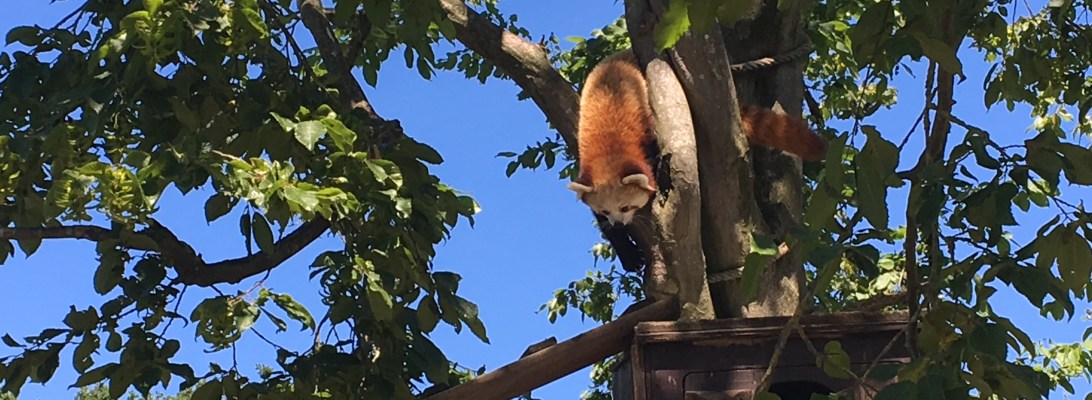
If I had a pound for every time I’ve been asked “So what’s next?” since I came back from university, I could retire without having started a career. I still don’t know what I want to do or where I want to be. While I still love writing and photography, I feel a pull in a new direction – the daily grind of contributing towards a successful and high quality zoo. There is something very appealing to me about caring for wild animals in a place that values them (that’s the important bit) and sharing my passion with other people. I watched the Small Mammals keeper giving a talk as she fed the red pandas and I had an urge to join her, but my knowledge of red pandas is really quite limited. I want to study them, I want to know everything there is to know about these animals, and share that with people. And I believe I can do that by writing but also by being there among them.

I’m fully aware that becoming a zookeeper is an incredibly gruelling and challenging process. I’m also aware that my current academic background will not help me in that mission. Every keeper I’ve spoken to so far has begun by volunteering, and worked their way up the ladder. So I have joined Paradise at the very bottom, and the only way to go is up. I’m inspired by this, and know that I have to pursue it.

A Day in the Fells

As we turned into the car park at Honister Pass, the clouds were grumbling. Geoff Cox appeared and shook my hand in greeting, with the same kindliness he might offer to his closest friend. Having roamed the fells since childhood, the bracing chill and spattering rain are all too familiar to him. A gust of wind blew me sideways as I struggled to catch the flyaway sleeve of my coat and hastily zip it up. Pulling a hat firmly down on my head, I gazed up at the fells. The day was bleak, and an ominous mist obscured the tops of the hills, which would provide a dramatic background for filming.

Today marked the penultimate day of shooting for the second documentary about Geoff’s experiences as a fell runner. During his sixtieth year he attempted to run three notorious Lake District endurance-running rounds: in the Joss Naylor Lakeland Challenge and Gerry Charnley he was successful, but the Bob Graham round defeated him. The film we’d be shooting today was a reflection of this unsuccessful round, and how Geoff found redemption to complete the Charnley. Geoff wrote poems about each round to process these challenging ordeals, and approached filmmaker Richard Berry to transform his words into films. Today, I was joining them to see what happened behind the scenes.

We set off, following Geoff and the other endurance runners up the first incline. Before long it became evident just how comfortable they were on this terrain; while I took my time negotiating uneven and slippy rocks, the rest of the group hiked with confidence and admirable swiftness. As we climbed higher, I was told that the views up here were usually breathtaking, but the fog hung over the entire horizon like an impenetrable curtain. We were completely enclosed, walking along a single clear track with white walls on all sides. “Drifting in the Skiddaw mist”, Geoff wrote in his poem; how apt this line was today.

Now 62, Geoff has been fell running for decades, and can’t remember a specific time when this habit became a continuous routine in his life. “Work and family pressures meant I needed a sport I could focus on which didn’t need other people,” Geoff explained, “With running I could drop everything and go anytime, day or night.”

Fell running in the wilderness of the Lake District is a lonely and secluded past time, something Geoff often welcomes. “I needed a place where I could have a bit of ‘me time’. Society seems to look upon somebody who needs these extended periods of time in isolation as strange and even a bit weird. Long days running in the hills gave me what I needed; something about the independence and self-sufficiency was very appealing.”

In a few hours we reached the right place to begin the day’s filming. Director Richard and camera operator Kerr McNicoll set up and before long shooting was in full swing. Agile as mountain goats, the runners cascaded down the rocky slopes with impressive assertiveness. Surrounded by the silent fells, the only sounds were the cracking of the colliding rocks and soft squelch of mud as feet drove through. Puffs of breath spilled into the sky, and as the runners headed further off, the mist soon swallowed them.

“And again!” Richard shouted, the echo of his words bouncing for miles. After a few moments, the group appeared again. From this distance they looked like small dashes of coloured paint on a white page – the only distinguishable features of the landscape. They looped around a small lake, reflections bouncing on the water. After several takes of this shot it was time for cake – a delicious fruitcake made by Jim, one of the runners. This burst of energy was welcomed with open arms, and once Richard had filmed Geoff scaling a large rocky outcrop on his gimbal, we began to snake back through the fells, gathering footage on the way and constantly referring to Geoff’s poems to capture the essence of his experiences and narrative.

Writing poetry has helped Geoff to process the challenges and obstacles associated with endurance running. “I started writing poetry as a way of processing the mental and emotional garbage floating around in my head, or ‘mental detritus’ as I call it. Prose didn’t work because it has the wrong rhythm. Poetry allowed me to talk about what I’m thinking and meant that I could introduce the pace and metre that matched my memories.”

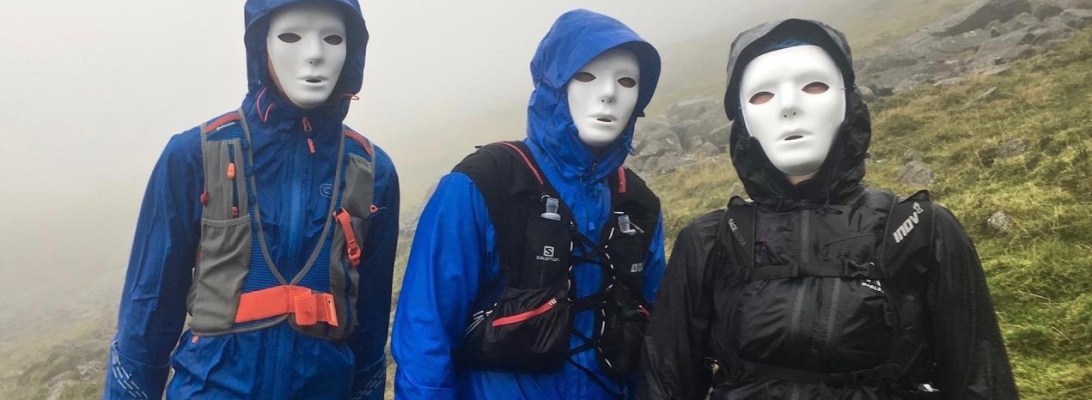
One of these memories took the form of white theatrical masks, worn by three of the runners looking over their shoulders at Geoff while he hung back, exhausted and near defeat. It was an intriguing idea and as we walked back through the fells I asked Geoff why he decided to include masks in the film. “They’re a symbol of how small doubts kick in and grow more insistent as the run goes on” he explained, “So we made them progressively more obvious throughout. ” This feeling of doubt was linked to people coming out to support Geoff while he competes and the pressure of not letting them down, a burden that can hang heavy on a runner under such physical and emotional strain.

I was astonished to hear that the masks were also a representation of hallucinations that Geoff said will be very familiar to long distance fell runners out on the hills for 24 hours or more. This “sleep monster” phenomenon is a result of exhaustion and sleep deprivation. “My particular version seems to be that I find myself running across strips of beautifully patterned Axminster carpet” Geoff told me, “All the time I’m thinking ‘It’s amazing that somebody has been up here and laid this carpet across these mountains!’”

Fell running in the Lake District is not for the faint-hearted. Unpredictable weather, unforgiving terrain, and a vast secluded landscape, and all with a burning in your legs. Even today, after walking seven miles, I returned to the warm café with aching knees. Geoff has proven that age is no match for will and determination, and is continuously training for new rounds to run. For him, fell running is more than exercise but a way of managing stress and even inspiring poetry. Spending time with him and the other runners opened my eyes to a life spent high above the ground, where so few people think to look.