I thought I was reasonably calm about staying in Madrid by myself, but on the train to Gatwick I felt sick to my stomach. After the stressful ordeal of flying to Florida I thought this would be a doddle, but then again I always panic when I travel. I lost count of how times I checked my camera, purse and passport were still in my bag. I knew I wouldn’t be truly relaxed until I checked into the hotel.
I wanted to make this trip the best it could be. Initially I had designed an elaborate agenda for each of the four full days I was in Madrid, pretty much hour by hour, but on reflection I decided just to list a few things in each district that I wanted to see and keep the rest of the time free for happy accidents. Ultimately it was supposed to be a holiday and if I dashed around cramming everything in I would come back needing to book another. There was also the heat. It was over 30°C all week, day and night, and the last thing I wanted to be doing was frogmarching around Madrid ticking off my wish list. I was embracing a little spontaneous.
The flight was delayed by nearly an hour. While we were sat in our seats, the pilot announced that another plane had been parked in their spot and Gatwick’s announcements had been “a mess”. It was nice to hear he was frustrated too. At least I didn’t have a connecting flight, but it meant I had to gaze outside at muggy drizzle for a while longer.
Eventually we took off and it soon became too bright to look out the window. When the clouds parted, the landscape stretched out in a never-ending blanket of blue; ocean blended seamlessly into sky with the horizon nowhere to be seen. A plane passed us, which was a bizarre sight that I’d never experienced before. It looked minuscule and quite surreal as it zoomed back the way we’d come, soon disappearing out of sight. It seemed as small as a bird flying alongside a car.
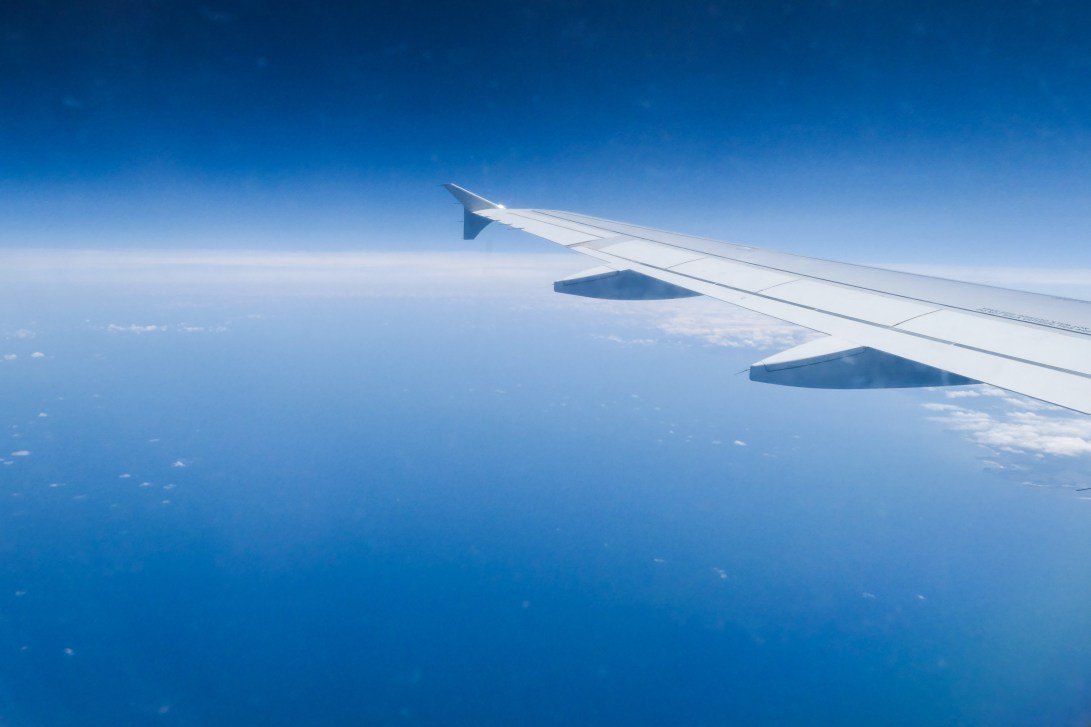
Soon we left the ocean behind and land took its place: a spectrum of browns and pinks swirled in patterns like a gigantic marbled ink painting. Pockets of civilisation sat amongst a jumbled jigsaw of fields, their winding roads linking them in a complex web.
We sank lower and my ears popped. The sandy browns transformed into the greens of a vast expanse of forest, split into dead straight and uniform blocks by white boundary lines. All the while, bulging cumulus clouds slid slowly by. At times they covered the ground completely, puffing up like a worldwide bath full of soapy suds, their dark shadows blooming below them.
After so much open countryside, Madrid sprang up unexpectedly. Large tower blocks loomed over car parks and long bustling streets. I only managed to snatch a quick glimpse before the plane reached the runway and touched down. Once we’d disembarked, we crossed the bridge into the entirety of Madrid–Barajas Airport. Departures and Arrivals were all combined into one chaotic space. Passengers were amassing by the passport check kiosks so I followed, but when it was my turn my passport wasn’t recognised. I was sent to another queue, this one about two hundred-strong. By then I was getting anxious about my case arriving without me, not to mention my poor taxi driver who’d already suffered as a result of my flight’s delay.
The queue inched forwards. A woman in uniform asked to see my passport and told me I needed the other queue. I explained I’d already been rejected there, despite another attendant saying it was for European passports. The woman took me out of the queue and bumped me right to the front. Apparently I’d been in the right place but the machine didn’t recognise a passport if you pressed it down on the sensor, despite the natural instinct to do so.
Eventually I was through and hurried to Baggage Reclaim where I was quite alarmed to see that I shared a luggage belt with two other flights. Luckily my case appeared after only a minute’s wait so I dashed off to meet my driver Santiago, who was all smiles when I spotted him. He took my case, gave me a bottle of water and once we’d reached his car, pointed out the best shopping and tapas on a map. I was pleased to find out that I’d read about most of them during my research, so it was reassuring that a man born in the city recommended the same places.
We left the stress of the airport behind and I finally began to relax. Santiago showed me several landmarks on the way. There was the Wanda Metropolitano Stadium where Madrid-based football team Atlético Madrid play, and the Cuatro Torres Business Area – a business district with the tallest skyscrapers in Spain.
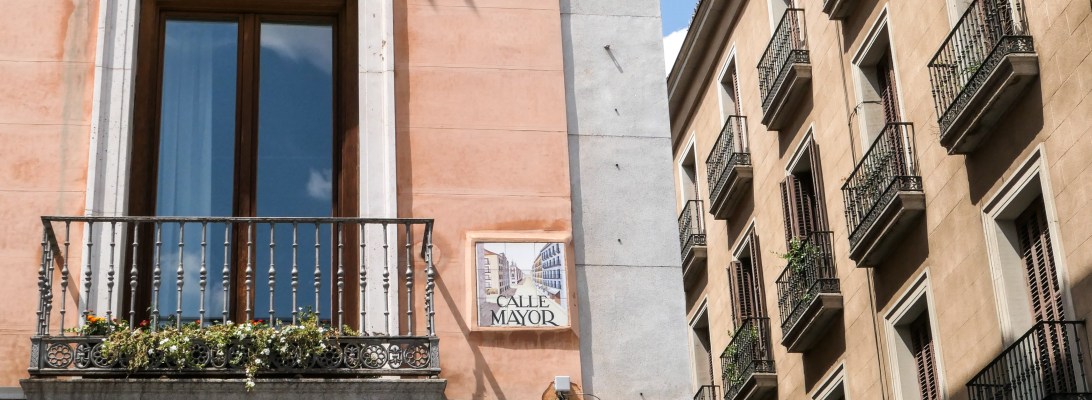
As we drove further into Madrid, the buildings closed in and soon the city had a similar feel to bustling London. I glimpsed zapaterias (shoe shops), panaderias (bakeries) and lots of tapas bars. We dipped down into an underground tunnel and Santiago told me that we were right beneath Plaza Mayor, arguably the heart of Madrid and where I would be staying. When we emerged back into daylight, the architecture changed drastically. In place of the drab, sombre buildings I’d seen on the approach were quaint apartment blocks in pastel shades with tiny wrought-iron balconies and pinstriped awnings. We had suddenly arrived at my hotel: the Petit Palace Plaza Mayor, one of a chain of Petit Palaces found in six other cities across Spain: Barcelona, Bilbao, Valencia, Mallorca, Málaga and Seville.
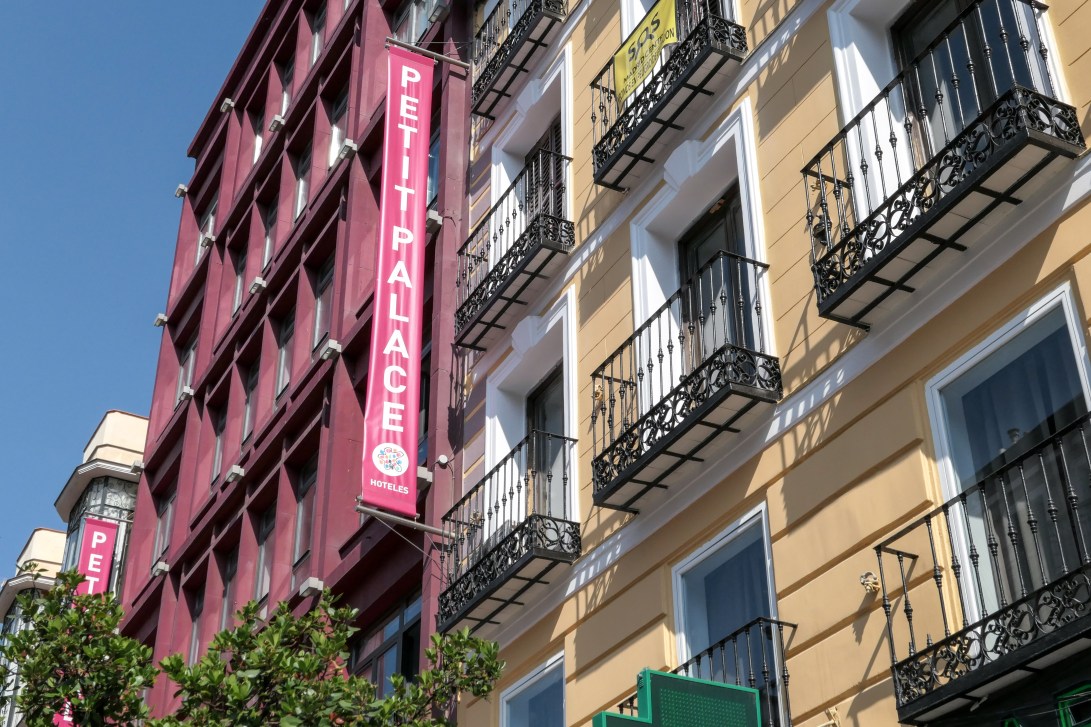
In stark contrast to the bright and gracefully aged Plaza Mayor, the boutique-style hotel’s interior was subdued in colour with a significantly futuristic feel. I told the receptionist in Spanish that I had a reservation in the name of Rebecca Gibson and he proceeded to reply solely in English, which was a shame. One of the main reasons I had chosen Madrid for my destination was to brush up on my rusty Spanish. I knew a lot of tourists weren’t too keen to attempt the language, but I was very eager to talk in Spanish and I hoped that the locals would give me that chance.

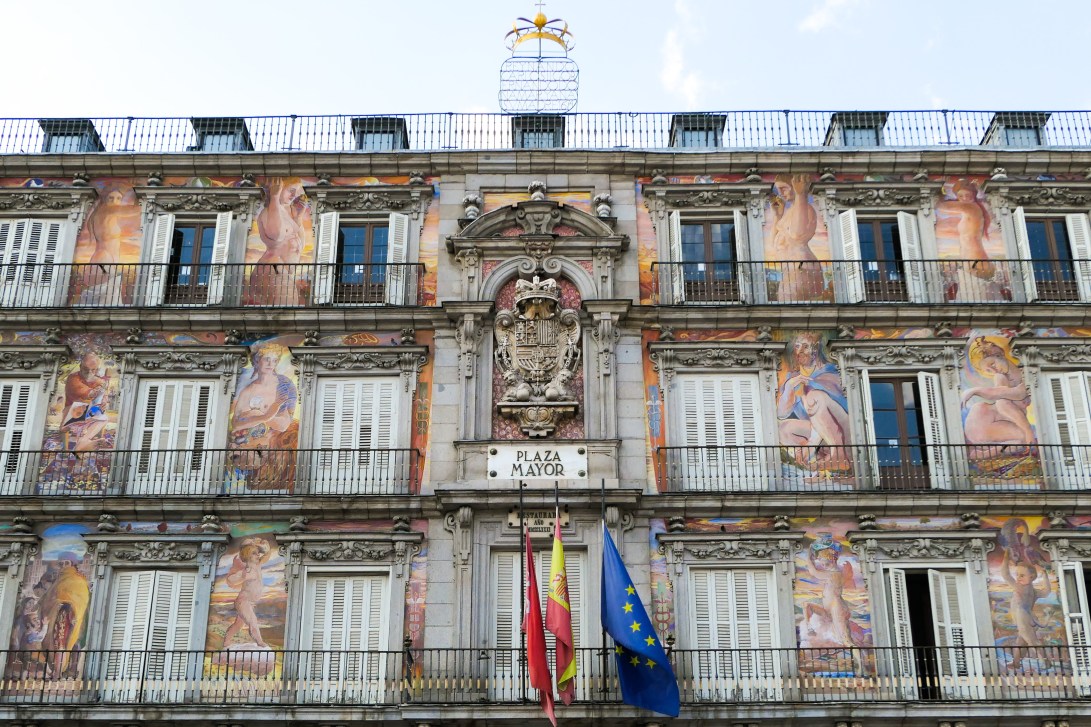
My first trip out was to Plaza Mayor itself, which was only a minute’s walk from the hotel. There were numerous people milling around but the square was spacious and tranquil in the early evening. The plaza was built in the sixteenth century when Madrid became Spain’s capital. It was used for state occasions including executions and bullfights, where the spectators would be crammed into the square and royalty would watch from the balconies. Luckily, the plaza is now filled with restaurants and cafes instead, and hosts a stamp and coin market on Sunday mornings.
On three sides the buildings were terracotta in colour with prim white balconies and shutters. On the fourth side – a building called La Casa de la Panadería (Bakery House) – the bricks were covered with intensely detailed frescoes dating back to only 1988, when the Madrid City Council launched a competition for the design covering the wall. The winner was Carlos Franco, whose artwork incorporating mythological characters was completed in 1992. Each part of the fresco was rich in colour with shocks of marigold yellow, rose pink and dusky orange.
Standing pride of place in the centre of the plaza was King Felipe III on horseback – the subject of hundreds of photos found in Madrid guidebooks. I’d seen him at most angles before I even arrived, but I couldn’t resist taking my own version.

It really was as hot in Madrid as I’d been told. At nearly 8pm, the temperature easily reached the most blistering of summer days in England. I perched on a stone seat to write and had to move to the shady side almost immediately to avoid burnt thighs. I vowed to definitely look into using the metro during my stay, as it was far too hot to walk any considerable distance.
Along with the glamorous architecture were splashes of kitsch, as with any city location that tourists have access to. Headless mannequins donning flamenco dresses stood in lines while people peered from behind them in Madrid’s answer to the Brighton beach scenes you could stick your face through. Mickey Mouse and Pikachu stood idly for no obvious reason, and several traders ambled around selling light-up toys and novelty whistles. All that aside, Plaza Mayor had undeniable charm. Restaurants and cafes lined the entire square’s border, but I’d been warned against their extortionate prices. I’d read that if I ventured only a few streets further afield I would find high-quality and authentic tapas at a fraction of the price.
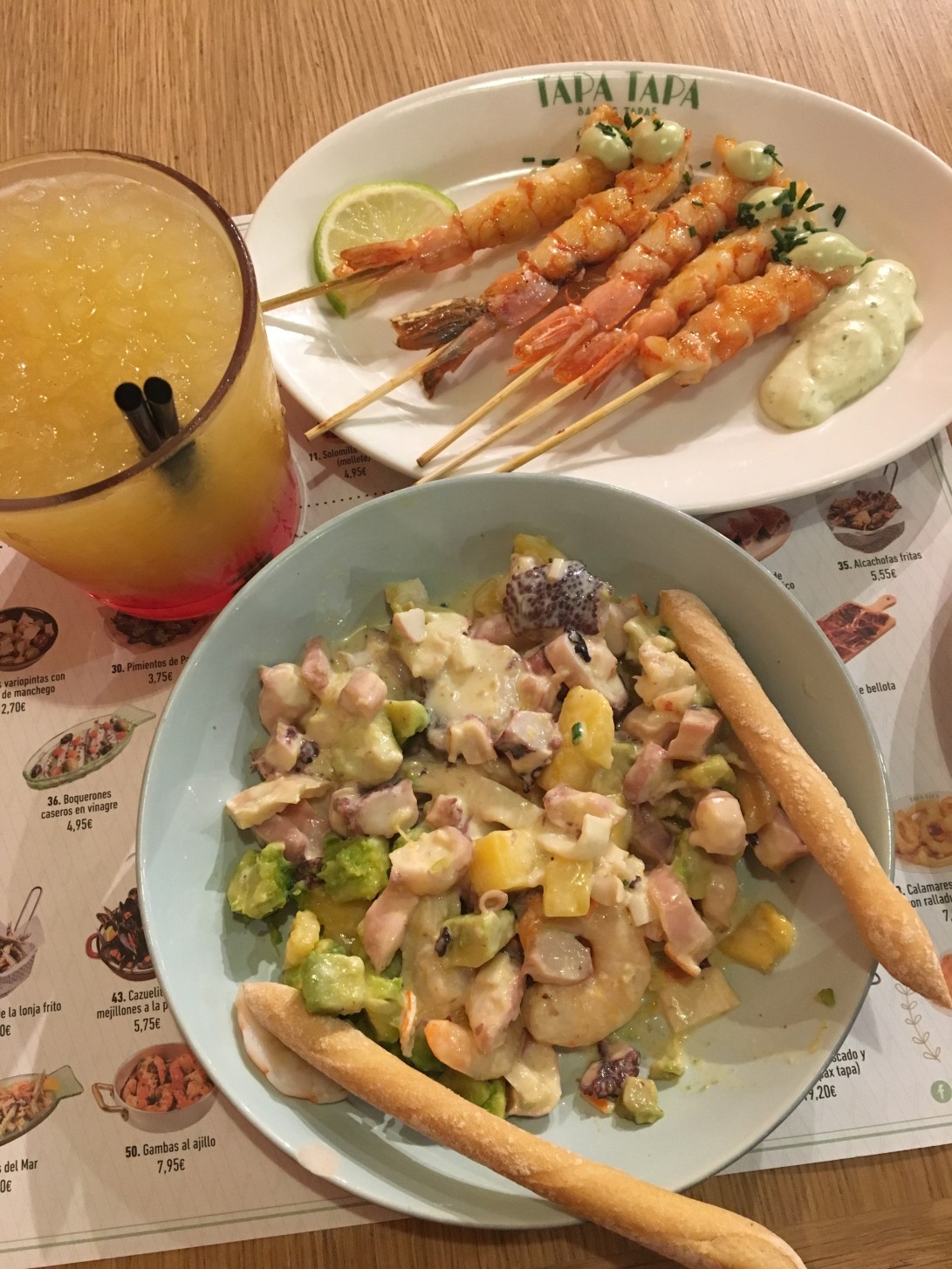
I unintentionally threw myself in at the deep end by going to Casa Revuelta for dinner. It had come highly recommended for its bacalao (cod) tapas, but I soon realised it wasn’t your typical restaurant. There weren’t any menus – a waiter came over and you told him what you wanted. Every bit of food vocabulary flew out of my head and all I could utter was pescado (fish). Luckily, I was brought some of the bacalao, which really was delicious. With no bones, the meat was beautifully smooth and with only a thin covering of batter. I ordered something I saw on my neighbour’s table, which turned out to be bite-sized pieces of pork crackling, which I wasn’t a fan of. It was my fault for not brushing up on my vocab beforehand, but by happy accident (the first of many I hoped!) I had tried my first Spanish delicacy in the bacalao.
After settling up at Casa Revuelta, which was already swelling with hungry customers including many native Spanish speakers – I strolled back through Plaza Mayor. Street entertainers were in full swing and Pikachu now had a throng of children around him. I passed El Restaurante Sobrino de Botín, the oldest restaurant in the world, which already had a queue out the door. The dramatic soundtrack of a flamenco show drifted out of a dimly lit doorway.
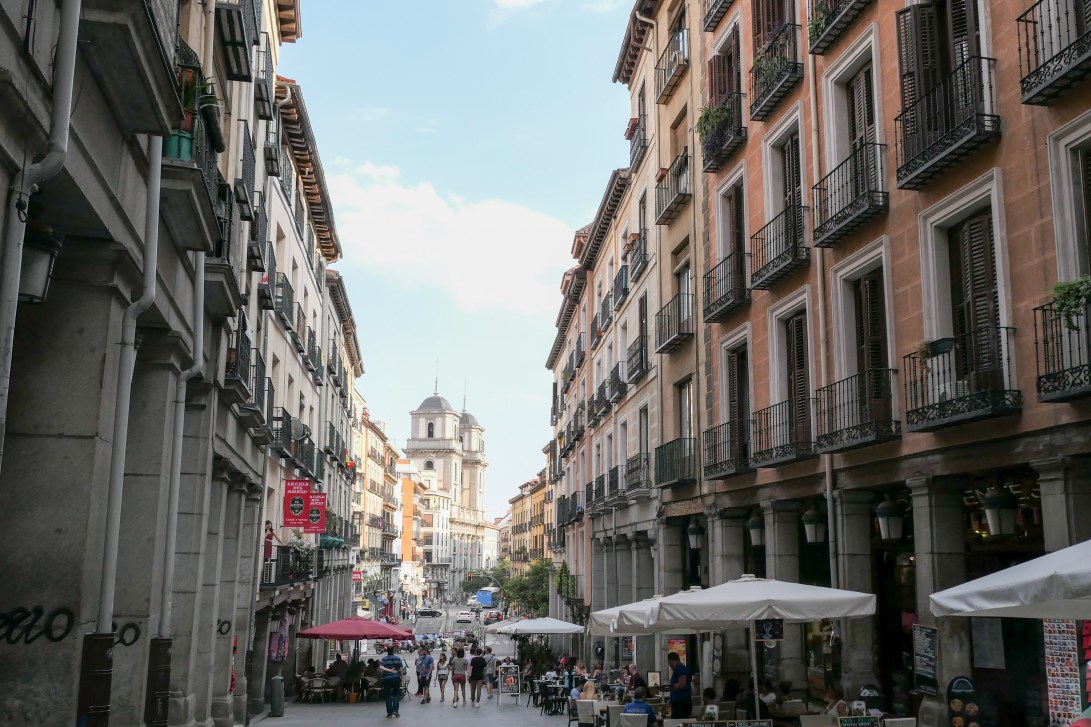
I wandered further on and found myself in Puerta del Sol, which was buzzing with activity. One of the busiest places in Madrid, Puerta del Sol (Gate of the Sun) is home to the clock that chimes during the traditional eating of the twelve grapes and signals the start of the New Year. At the far end was a fun little statue that many people had flocked to for photographs: El Oso y el Madroño (the Bear and the Strawberry Tree). Although reasonably small in size, this intriguing bronze statue weighs twenty tonnes and replicates the similar emblem shown on the Madrid coat of arms. The determined bear stretching for the fruit symbolises the resilience and tenacity of madrileños (people from Madrid). Bears used to be found in many of Madrid’s forests, as well as trees bearing fruit that closely resembled strawberries. Madrid was thought to have once been named Ursa, Latin for bear. You wouldn’t find many foraging bears in Madrid nowadays, but Antonio Navarro Santafé’s sculpture in Puerta del Sol was lively enough.

I decided to get an early night after a long day of travelling so as most madrileños were heading out for the night, I made my way back to the hotel. Casa Revuelta was a bit of a shaky start, but as time went on I knew I would start to find my feet.







 rebeccaonthewing.com