Inspired by a Blowfish

Last weekend I stayed with my grandmother at her lovely house in Frome, Somerset. I love my mini holidays there; my bedroom window overlooks a meandering river, and on the other side is a bustling market and a glimpse of the library through the overhanging trees. I was particularly excited on Saturday morning to discover there was a Christmas fair in full swing. There’s nothing like a fair in late November to get you in the mood for Christmas. Although I still refuse to play festive music before December, a sprinkling of Christmas spirit is more than welcome, especially in such bitterly cold weather.

Once inside, we joined the throng. Shoppers shuffled along tables laden with all sorts of gifts and bric-a-brac. The Cats’ Protection were selling cat-themed stationary, while a young man at the Somerset Wildlife Trust stand was doing his best to sell membership to a middle-aged woman whose attention was slowly waning. I am a firm supporter of the Wildlife Trusts, but membership recruiters have a way of pulling you in for a short (thirty minute) chat and not letting go. Past experience taught me to avoid his gaze, and I spotted the table I’m always searching for: the one covered in books.

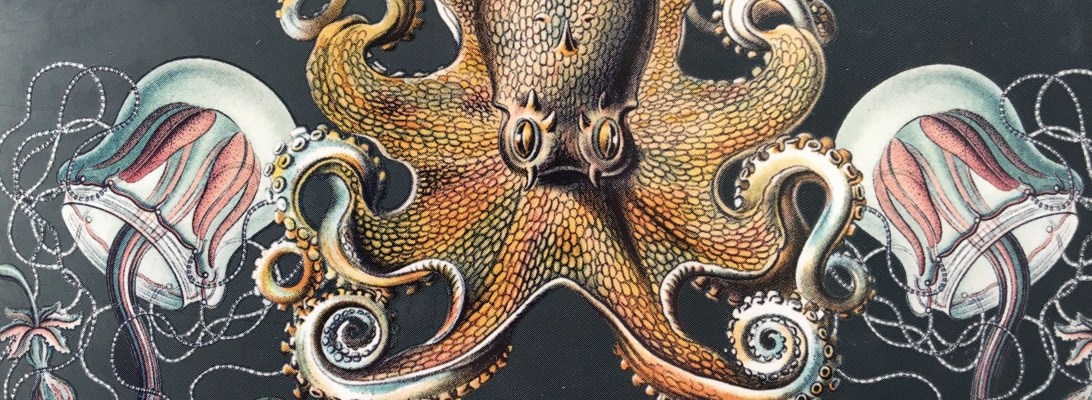
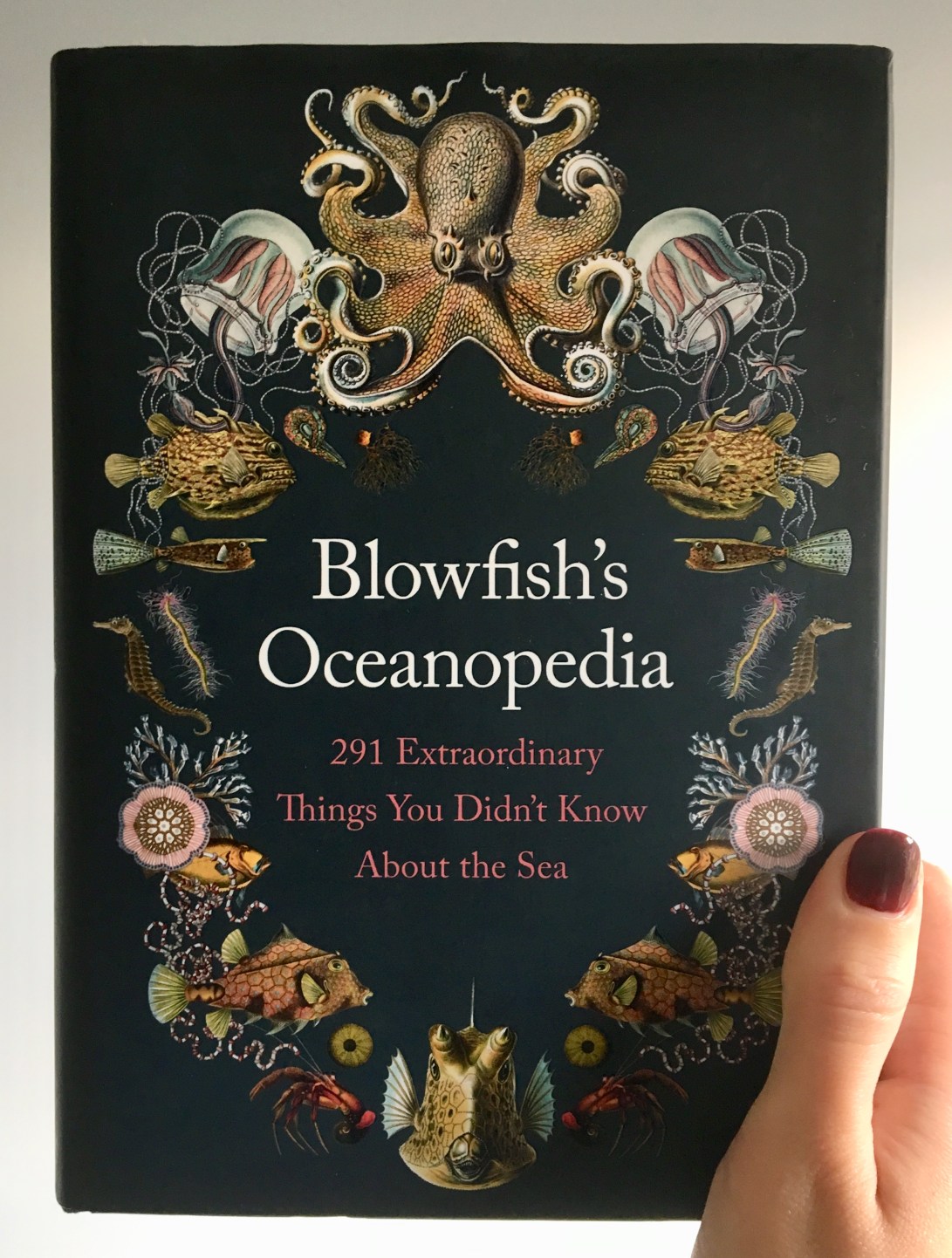
As always, there was a decent selection of dog-eared Maeve Binchy and Danielle Steel paperbacks, but amongst covers showing watercolour landscapes and female silhouettes staring wistfully into the distance was the tail of a fish. I tugged at the fish and my eyes fell on beautiful line drawings of an octopus, jellyfish, seahorses and more. It was such a satisfying cover, and the book was called “Blowfish’s Oceanopedia”. It was one of those dip-in books with titbit information: “extraordinary things you didn’t know about the sea”, it said. As a person who is fascinated by the sea but doesn’t really know anything worthwhile about it, it seemed the perfect read for me.

The price was even better. A brand new book, published last year at £17.99, and I was charged a pound for it. Books were amazing, but books for a pound were magical.
IMG_2408

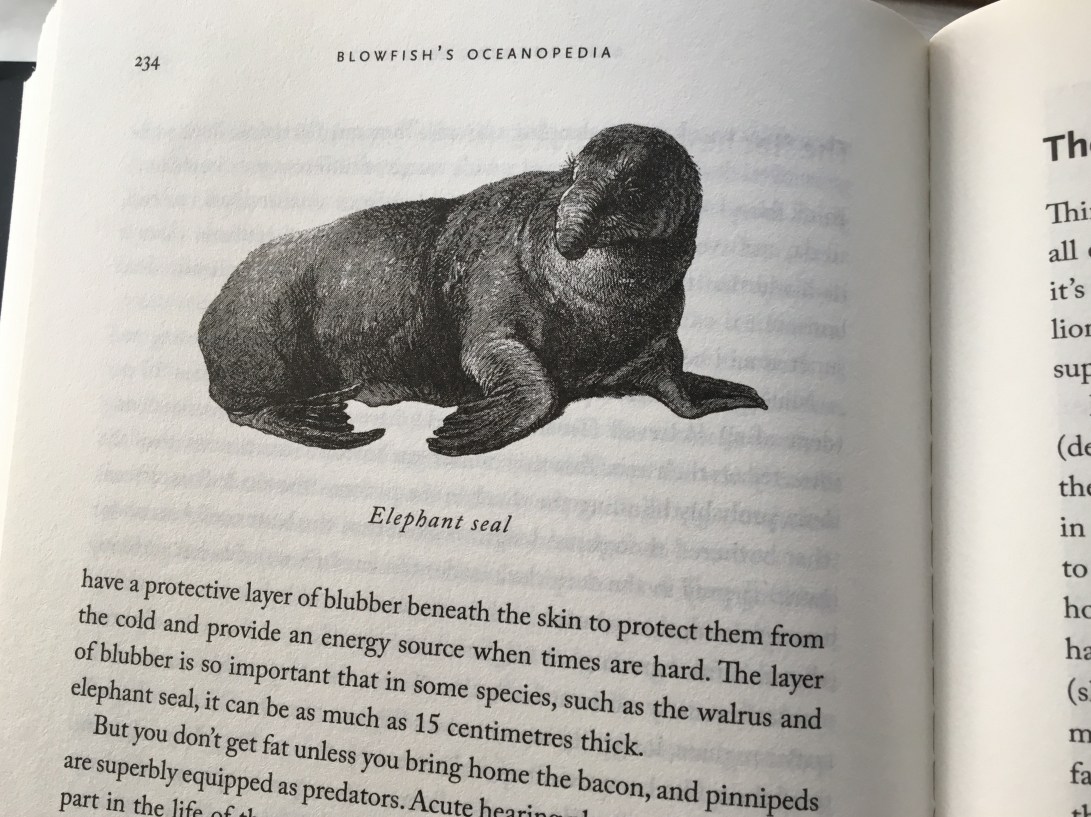
After finishing my loop of the fair – and winning a raffle Christmas present in the process – I returned to my grandmother’s house and instantly curled up in my favourite chair to begin reading. Within minutes I’d learned a decent thing or two about elephant seals. I am quite terrified of elephant seals, but as with my similar unease towards snakes and sharks, I’m also fascinated by them. The Blowfish revealed just how important the southern elephant seal’s “trunk” was to its survival. During the breeding season, males weighing up to 4 tonnes battle it out to win ownership of the harem of females. Understandably, this is a full time job, and prevents males from returning to the water to feed and drink. So, to avoid dangerous dehydration, males use the complex nasal passages and specialised blood vessels in their fleshy trunks to recover around 70% of the water vapour in their exhaled air. It’s a genius example of life-saving recycling.
IMG_2405

This is the sort of book I dream of someday replicating; an instrument to share my knowledge and passion with like-minded people. At the moment I’m not an expert in any one field, but the idea of spending decades of your life learning about something and then teaching others in the form of writing is, to me, the perfect way to preserve your work.

The Blowfish, also known as Tom Hird, is a marine biologist who has a deep love for the ocean and life within it. He’s the perfect voice for a potentially complex subject matter, using humour and everyday situations to diffuse a tricky concept. Speaking in the same language as the layman is something some scientists find extremely challenging. I’m certainly not a marine biologist, but nor am I completely naïve to the science of the natural world, so I often feel my combination of knowledge gives me an advantage. I can understand a lot (not all) of what scientists do, but I also appreciate how that needs to be adapted to inform the public without dumbing down and insulting them. I’m sure there are hundreds of published papers on the adaptations of southern elephant seals which required many hours of hard work, but to the average Joe wanting to find out something interesting about wildlife, a book like the Blowfish’s will be a much bigger success. I believe the key to nature writing, or any writing for that matter, is finding the balance between informing and entertaining. The Blowfish’s Oceanopedia has been a source of great inspiration to me – a writer hoping to one day publish books of my own. The passion and enthusiasm in the author’s prose is infectious, and makes me want to jump in the sea right now and see for myself everything he has had the opportunity to witness.

Learning to Birdlisten

Today marks the beginning of a new project: learning to birdlisten. It’s a much-used cliché but I have been an avid birdwatcher since I was a child. I’d sit out in the garden, hold as still as I possibly could, and after a while birds would begin to show, hopping out from under bushes and descending slowly from the treetops. This gradual emergence, the steady drip-drop of birds, was so exciting to me. The species would usually be very common – robin, dunnock, blackbird – but occasionally a blue tit or great tit would appear, and to my amateur eye these were very special indeed.

As my knowledge gradually improved, I began to notice more species and although the trusty robin and dunnock never grew boring, they lost their shine among more colourful or charismatic varieties. One by one I added birds to my repertoire, and although I didn’t notice my mental list growing, soon I could identify a wide range of species. Although waterfowl and waders had their charm, my favourites were always the passerines, or “perching birds”.

Passerines include a subgroup of species we call songbirds but are more accurately named oscines – birds that establish their territories by means of musical vocalisations. It never occurred to me why the singing birds attracted me most, until I turned my attention to listening for birds instead of looking for them, and then it became abundantly clear.

Birdsong is the soundtrack of nature. Even for me, a keen bird enthusiast, birdsong had blurred into the background of my time spent outdoors, nothing more than a pleasant backing track that accompanied my attempts to birdwatch. Why on earth did I let birdsong become such an unimportant feature of the landscape, no more significant than hold music? It was high time that I paid more attention to it, instead of letting it wash over my ears without acknowledgment. It is so true that we see but don’t observe, but it is also the case that many of us hear but don’t listen.

IMG_8860

Author of “Birdwatching With Your Eyes Closed” Simon Barnes points out that understanding birdsong allows us to see around corners. There’s a bird hidden up in the canopy somewhere, but unless you know its song you’ll never know what it is. I’ve had this frustration many times, when I see the distorted outline of a bird but no characteristic features that give it away. If I hadn’t neglected my auditory senses, I wouldn’t have been disappointed when the bird hopped further out of view.

And so begins my journey to learn the language of birdsong. It seemed a daunting prospect at first; to my untrained ear all chirrups and whistles sounded identical. However, like any problem, it is imperative to break it down, and that makes it far less intimidating.

I have already made progress. First was the robin: an unmistakable bird in appearance, and a good place to start when learning birdsong because of its presence all year round. During the usually hushed winter months, the robin still sings, an isolated soloist filling cold air with thin, gentle melodies. Spring is by far the most frustrating time to begin birdlistening, so to hear the robin on a chilly February morning with no other avian distractions allows us to begin to tune into this new world I for one took for granted.

IMG_8893

The wren also sings in winter, but has a far louder song bordering on rowdy. For such a small bird, the song bursts out of hedgerows, with a telltale trill at the end of some phrases, like a twirl of icing atop a cake. Then there is the two-note song of the great tit, like the squeak of a saw being pulled back and forth.

And so on. Already my ears are filling with birdsong and I’m really listening this time. Acquiring the skill of understanding this rich and varied language will not only help me become a better birdwatcher, but it will pave the way to a clearer understanding of nature as a whole – appreciating nature’s vibrant soundtrack.

IMG_8853


The Freeze

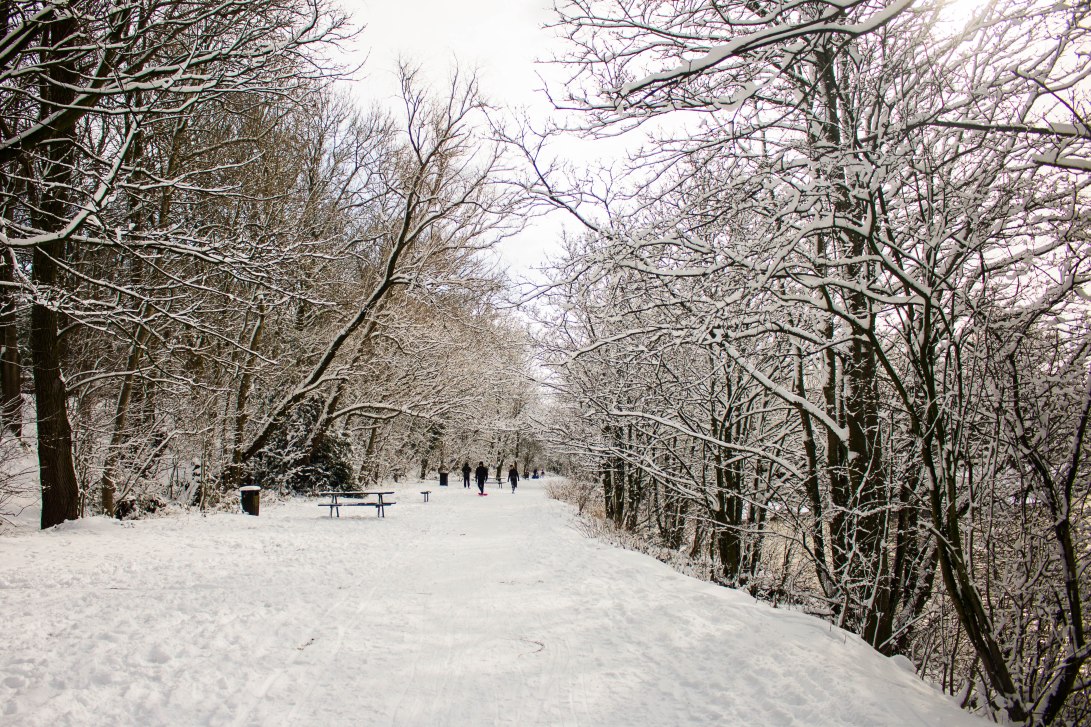
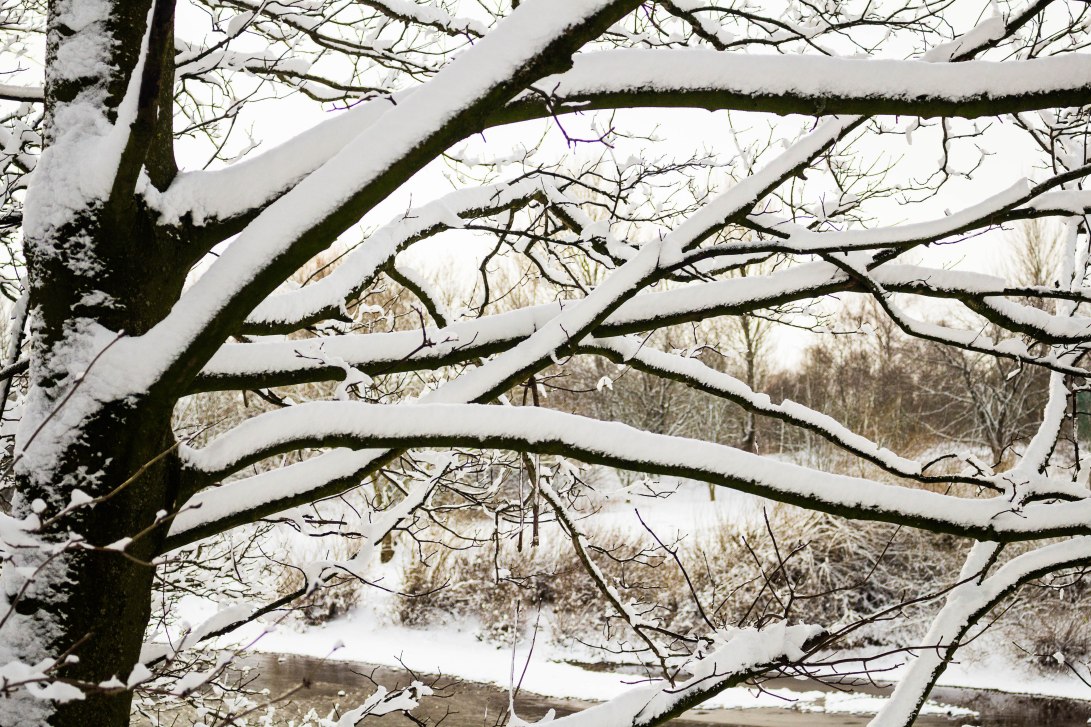
The snow was here again. It descended from the skies in heavy drifts, flakes swirling as they came to rest. All through the night the snow fell, dramatically silent, and when morning came everything was smothered in pristine white icing: irresistible.

IMG_9050

Outside there was a chill that tightened the lungs, so cold was the air that even breathing in felt like getting smothered in snow. Each branch was cloaked, giving the impression of an overly enthusiastic artist splashing every bough with thick white highlights. Undisturbed snow on the sides of the track glistened, catching the light and sparkling with wintery luminescence. On the cusp of March, it was more of a spring wonderland than a winter one, and yet it could have easily been Christmas morning.

IMG_9046

Up in the trees, a whisper of falling snow betrayed the presence of a blackbird, sending tremors up the branch that dislodged loose flakes. A male, black feathers stark against his festive background, spotted with rich red berries and the undersides of dark leaves. He chirruped softly, his song more melancholy than it should be.

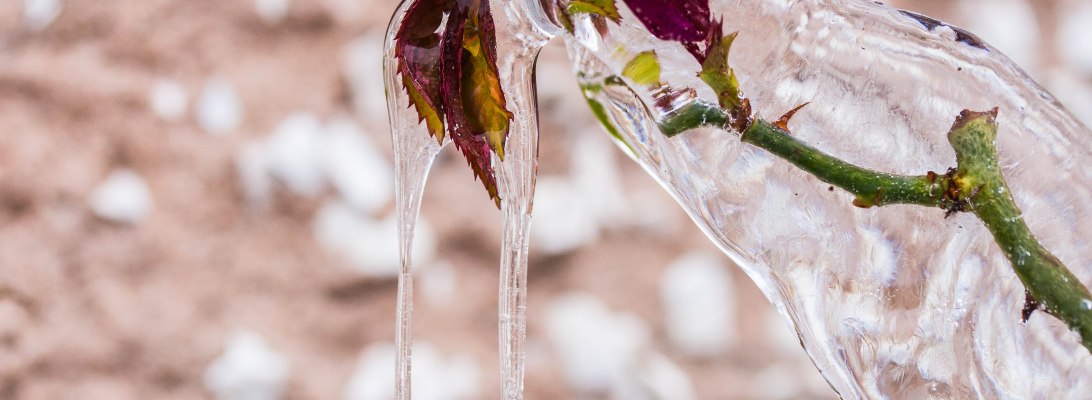
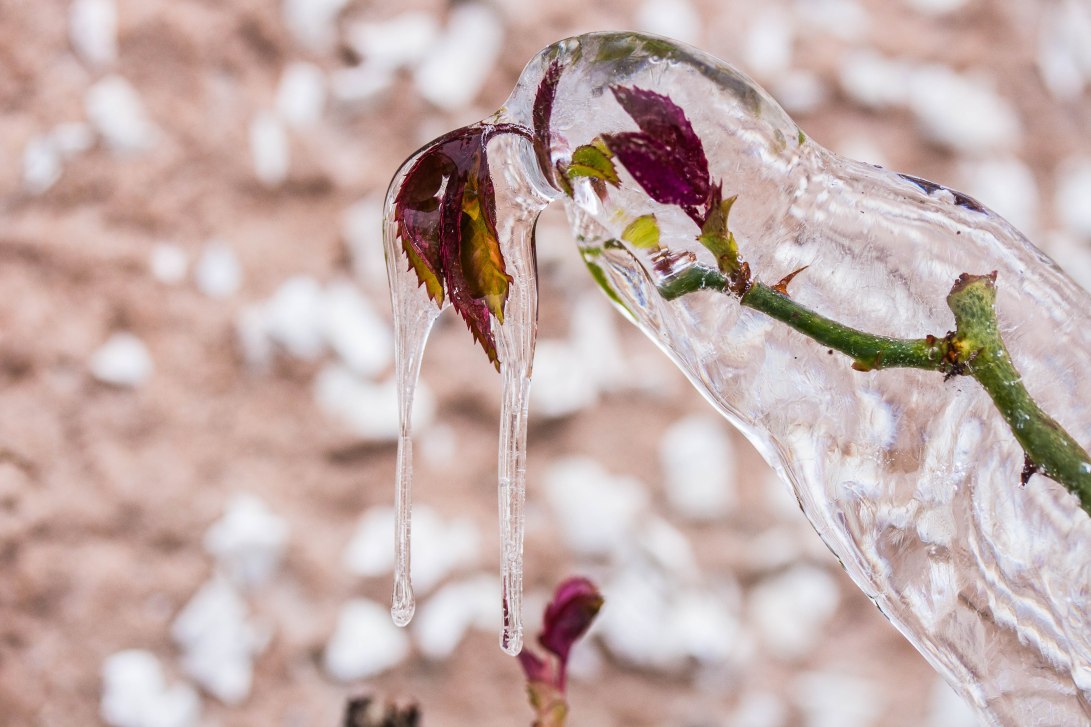
A man passed me on his bicycle, his tyres crackling like static feedback that faded as he disappeared. The landscape quietened again, a deafening silence only found with snow, when the world stops and waits with baited breath for this unexpected phenomenon to pass. It is a time when even nature stands still. Water is stopped in its tracks, defiant of gravity’s pull.

IMG_9063-2

Sloping down the bank to the river was a series of deep tracks, dogs mingled with hopping birds. The ever-falling snow began to repair the damage, forming undulations of half-hidden footsteps with softened edges. A wren sped past, trilling its bold song that seemed too big for its tiny lungs. What must the birds think? Have they anticipated this, read some sign in the climate to help soften the blow? The already challenging task of finding food in winter just became more trying, a test of strength and endurance in such temperatures.

IMG_9012

After a while my feet began to grow numb and my stomach rumbled. As I trudged back up the track, curving away from the coursing, white-framed river, I thought how I would snuggle up in my warm house with something to eat. I glanced back over my shoulder and saw a song thrush foraging. It had a snail pinned in its beak, and was cracking the shell hard on a rock. Such work the birds put in, when all I needed to do was open a can of soup and I’d be warm.

Back at the house, I peered outside and saw the feeder swinging empty again. Thinking of the blackbird, wren and diligent thrush, I hurried into the garden and replenished the feeder with rich fatty seeds, sprinkling some on the ground for those too heavy or timid to feed from the plastic perches. The birds needed all the help they could get.

To Spy a Hawfinch

After our great grey shrike stood us up last week, I was determined to tick a bird off my wishlist. I did some digging and found there were a few good spots for hawfinches down in Kendal. Zahrah and I picked the best day of the week and headed down, this time with Kacper. As usual, when the alarm sounded I was struck by an overwhelming urge to leave the hawfinches to their business and dive back under the covers, but when I snuck a glimpse out the window and saw the bright promise of a beautiful day, I knew we had to go for it.

Despite the rather vibrant sun, a sharp chill met us as we left the warmth of the car, reminding us it was still February. Clutching my fists together in my Sealskinz gloves, we made our way up the track, away from people and towards wilderness. The path wound through a small wood, dappled by sunlight filtering through overhead. What had been squelchy mud was now frozen hard as concrete, and crunched under our footsteps. We were initially prevented from entering the open field due to a very restrictive swing gate. My bulging rucksack got wedged and I had to hold my tripod flush to my chest and reverse through – far from a sophisticated entrance.

The frozen ground stretched further, blades of grass as solid as real blades, and it was strange not to feel the gentle give of soft earth. The sun was trying to warm the landscape, taking every opportunity the clouds allowed it to reach us. Once back in the woods, it was shadier. Muffled conversations sounded in every direction; the proud song of a robin and the chatterings of crows all mingling together. We tried to ignore all of these and listen solely for a piercing whistle. This was the call of our target: the hawfinch.

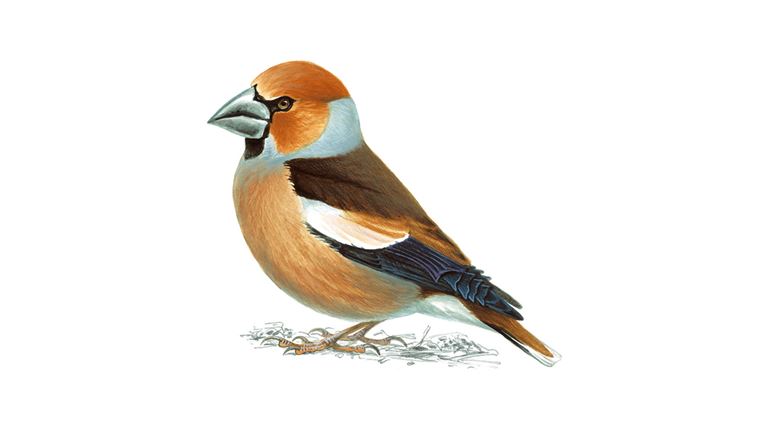
Hawfinches are beautiful and unmistakable birds with striking colouring and formidable conical bills. Usually secretive and shy, they spend most of their time in the topmost branches, making the UK’s largest finch difficult to spot. Typically found in mature deciduous and mixed woodland, hawfinches regularly frequent hornbeam trees. The bill of a hawfinch is highly specialised to cope with the hard seeds and cherry stones that form much of its diet. Once a bird reaches maturity, its skull ossifies and two hard knobs form within each mandible, which are essential for holding a seed still while it is cracked. Findings from an experiment showed that hawfinches can exert a pressure of 60-90 pounds of force, which isn’t bad for a bird smaller than a blackbird.

hawfinch_male_breedingplumage_1200x675
Hawfinch (RSPB)

As hawfinches frequent the tops of trees, spotting them can be a challenge, not to mention their timid calls are often lost among those of the more plucky birds. Although I never want to criticise the sun, it was shining at a rather inconvenient angle, so gazing up meant we could barely see the treetops, let alone brown birds. So, we tried to climb as high as possible to get a better vantage point. Soon we found a large clearing that gave us a 360° perspective of the forest. Seeming like a good place to set up shop for a while, we perched on a fallen tree and scanned with our binoculars.

There’s nothing quite like sitting in silence, listening to wildlife. Upon arrival you think the forest is a quiet and secluded place, and it would be to a person used to the thrum of cities and traffic. But to sit still and listen in a wild place is to hear a whole new language. I don’t understand it yet – something I’m hoping to soon rectify – but I could listen to its lyrical beats and rhythms all day. Understanding birdsong brings a whole new dimension to bird watching. Cain Scrimgeour, someone I consider a bird connoisseur, can hear the slightest chirrup up in the trees and tell you who made the sound. Sure enough, moments later that bird emerges. To me it’s magic. I consider my knowledge of British birds to be competent, but to know their sounds as well as their appearances is a truly incredible skill.

I heard a soft crunching of leaves as Kacper made his way towards me.

“What’s this?” He whispered, holding his camera up for me to look at the image on the screen.

My eyes popped and I bit back a loud gasp, “That’s a hawfinch! Where is it?”

He led me back to where he’d been standing and pointed up. Now began the near-impossible task of explaining to a person which tree in a hundred trees you are looking at. After a painfully long-winded ordeal I found where he was pointing, and with binoculars trained I saw my first hawfinch. Females are only slightly less brightly coloured than males, so to my eye I couldn’t tell which this one was. The bird was perched looking straight towards us, feathers hunched up. It was foraging, and I saw it pick a seed from its branch and arrange it in its bill to crunch down with that extraordinary force. The bill almost seemed too big for the bird’s body. It was like a person with a party hat positioned over their nose and mouth, almost comical.

Zahrah was a way off, so I was incredibly patronising (though I believed it was necessary in this occasion) and made several hasty finger clicks to get her attention. Once she’d arrived Kacper explained the bird’s location again and we all watched. I made the mistake of retrieving my camera from its resting place by the log, and when I returned the bird had retreated to a tree further off. It was joined by three more, and although I tried they were too far off to photograph. This, to my shame, was the result.

IMG_8794
Not exactly Bird Photographer of the Year

There was another rustling of leaves and we turned to see an elderly man making his way down the bank.

“Seen any?” He asked, knowing exactly why we were gathered there.

“A few!” I replied excitedly, and once again Kacper directed the man’s view to the right tree.

“There were 43 here yesterday, so I’m told,” the man said, “The reserve ranger and volunteers saw them, couldn’t believe their eyes.”

Forty-three hawfinches. For a moment I cursed myself for not thinking to come a day earlier, but as I watched a pair perched way up in the topmost branches I was grateful we’d seen any at all, even if the photos were incredibly dodgy.

After a while the finches flew off. I glanced up in our immediate surroundings, wondering if the elusive birds had gathered directly over our heads – it’s something I would do to birdwatchers if I were a pretty finch – but the branches were bare.

“There’s another good spot back the way you came,” the man told us, “In the clearing. I’m walking back home that way I’ll show you.”

So we headed up the track, which by now had begun to thaw, the mud regaining its sticking power. Back in the open field, we were reminded again of the chilly February breeze, and willed the sun to make a reappearance.

We thanked the man as he went on his way, then we settled down to eat our lunch overlooking the open fields. Every time one of us spotted a dark patch in the treetops, we hastily studied it through the bins. But the hawfinches had headed off, submerged once again in their woodland domain.

On the Hunt

After watching Chris and Michaela hunt for great grey shrikes on Winterwatch, I realised what stunning birds they were and that I’d quite like to find one for myself. I asked Cain if he knew of any recent sightings and of course, he did. There was one of these beautiful shrikes in a patch of rural Newcastle that had remained in the area all winter. So, early on Friday morning, Zahrah and I set off to try and track the bird down.

As we made our way east towards Newcastle, the combination of pouring rain and sleet filled me with dread. As usual, the weather forecast had gone awry, and I hoped the grisly sleet would clear up by the time we arrived. Luckily it did, and once parked and heading down the track with eyes peeled, we stayed dry. We were looking for a patch of stark white at the tops of the bare trees. Every so often we would stop and peer across the field, binoculars meticulously scanning each tree. Unfortunately, great grey shrikes are not vocal birds, so there was no telltale call we could listen out for. This would be a case of sharp eyes.

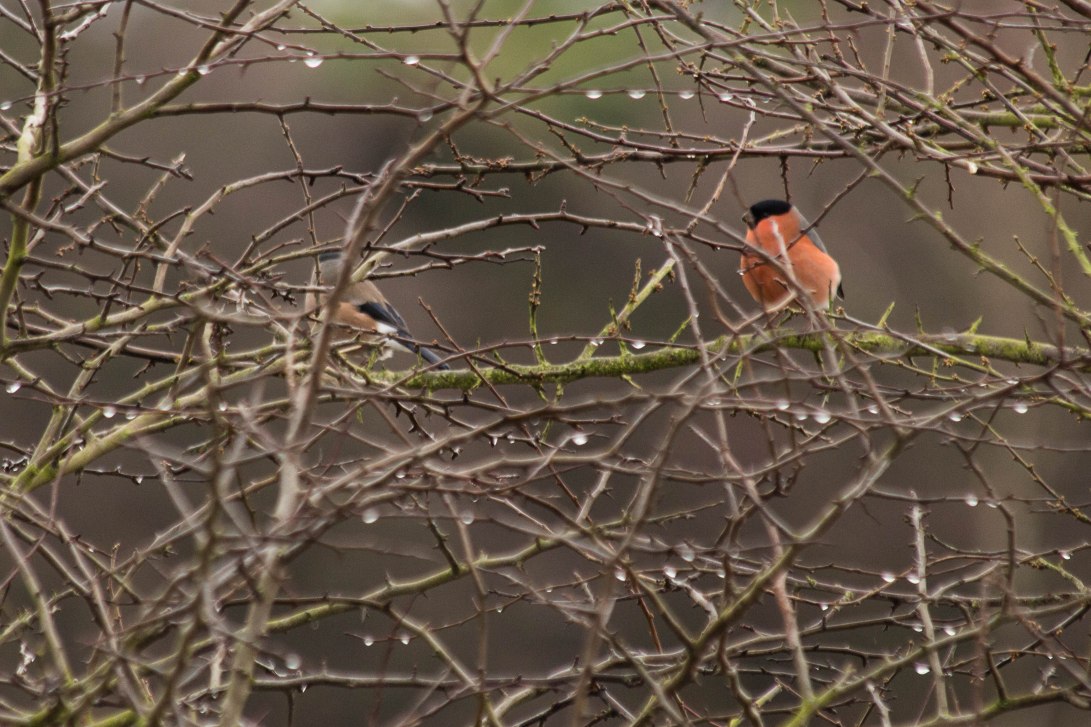
We came across a group of bullfinches – a handsome male and two females – as they foraged in the bushes. I have a soft spot for these vibrantly coloured birds, so stopped to take photos, trying to manoeuvre myself to sneak a clear glimpse of the male through a break in the tangle of twigs. This was only partially successful.

IMG_8729
Bullfinch pair

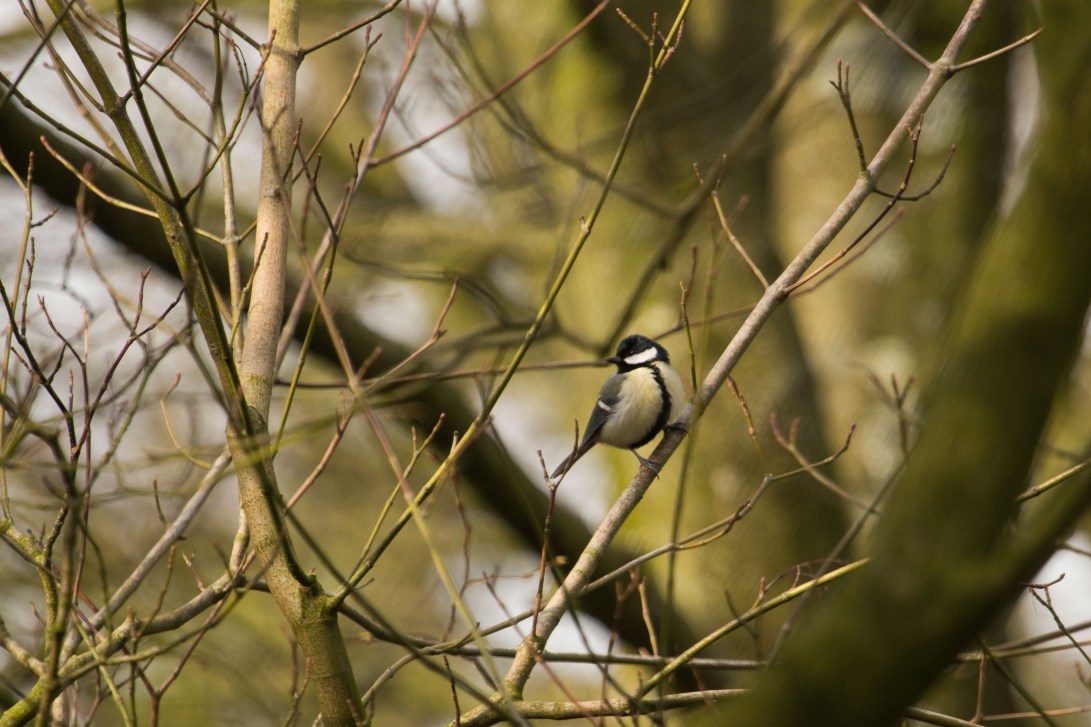
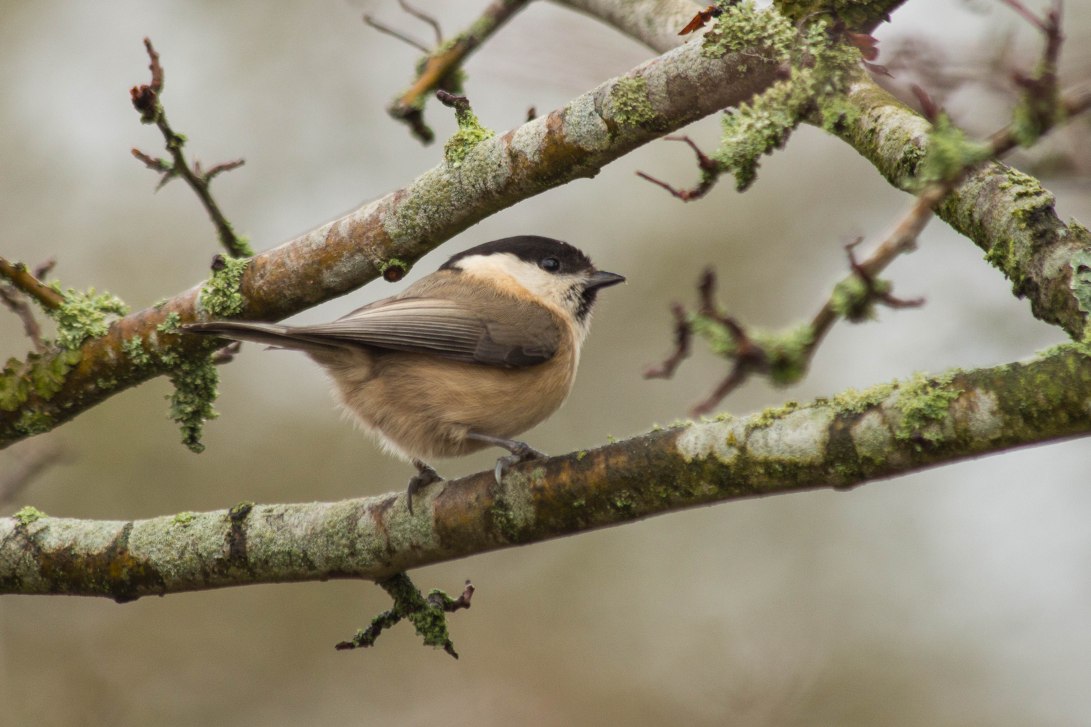
As we trudged up the track, the only sound to be heard was the mud as it sucked on our boots. I found it a challenge to survey the trees for signs of movement while keeping an eye on where my feet were landing. After no sign of the shrike, we decided to try the other stretch of track that hugged the same field. At the crossroads we encountered a vast flooded patch of grass. At first glance it seemed empty, but a look through the binoculars revealed a large gathering of lapwing and golden plover huddled together. Further up the track, a hubbub of activity surrounded the bird feeders hanging from a tree. Great tits, blue tits, robins, a ground-foraging blackbird and a special sighting: a willow tit. I’d never seen one so close – a bird that I find indistinguishable from the marsh tit. According to the BTO, the most reliable way of telling these two species apart is by listening to them, as the birds’ most common calls are quite distinctive from each other. While marsh tits make a sneeze-like “pitchu” call, willow tits have a nasal “chay chay” sound.

IMG_8743
Willow tit
IMG_8753
Great tit

We had come to the joint decision that our shrike would sadly not be making an appearance today. The needle was well hidden in the haystack, and we made our way back to the car. A little way further out was another reserve that we decided to visit. By this time, unexpected sunlight was filtering through the dissolving clouds, and gleamed on the pond, illuminating a flock of wigeon. They chatted to each other but were otherwise motionless. High up in the trees was a buzz of excitement, and yet more beautiful bullfinches! These ones were silhouetted against the sky, so their smart plumage was diluted in the sun. Accompanying them were great tits, siskin and a few goldfinches. A magpie was perched in the topmost branches, feathers ruffling as the wind caught him.

IMG_8760
Magpie

Before long it was golden hour, where the sun began to vanish behind the pond. The trees took on a shimmering glow, every hue heightened. A group of blue tits fluttered around, barely perching for a moment before swooping in another direction. I thought I saw the fluffy brush of a red squirrel’s tail disappearing between two boughs, but after waiting stock-still for it to emerge, I thought perhaps it was just a trick of the golden light.

IMG_8781
Golden hour

Species seen

Blackbird (Turdus merula) Black-headed gull (Larus ridibundus) Blue tit (Cyanistes caeruleus) Bullfinch (Pyrrhula pyrrhula) Buzzard (Buteo buteo) Carrion crow (Corvus corone) Cormorant (Phalacrocorax carbo) Goldcrest (Regulus regulus) Golden plover (Pluvialis apricaria) Goldfinch (Carduelis carduelis) Great tit (Parus major) Grey heron (Ardea cinerea) Lapwing (Vanellus vanellus) Magpie (Pica pica) Mallard (Anas platyrhynchos) Pheasant (Phasianus colchicus) Pied wagtail (Motacilla alba) Reed bunting (Emberiza schoeniclus) Robin (Erithacus rubecula) Siskin (Carduelis spinus) Song thrush (Turdus philomelos) Starling (Sturnus vulgaris) Treecreeper (Certhia familiaris) Wigeon (Anas penelope) Willow tit (Parus montanus) Woodpigeon (Columba palumbus) Wren (Troglodytes troglodytes)

Winter Flora

Chances are, everyone has seen that Christmas is coming. Holly adorns the cards, wreaths hang on the front door and trees are being dragged into the house. Christmas traditions have been part of our culture for many years, but why do we follow them? I wanted to find out, so get yourself another mince pie and discover why exactly certain flora have become such icons of the festive period.

Holly

Holly has been a significant part of Christmas tradition for many thousands of years. The Druids regarded it as the king of winter. It was sacred; while other plants withered during the cold months, holly continued to flourish. As a result, the prickly plant became a symbol of renewal and rejuvenation, maintaining high spirits throughout the difficult winter. Many ancient Europeans brought holly into the home as protection, to ward off ill omens and bring good luck.

Holly also has religious connotations. Early Christians associated the prickly leaves as a crown of thorns and the bright berries as drops of the blood of Christ. According to legends, holly berries were originally white, but were stained red when Christ was crucified.

Ivy

The Druids considered ivy to be the queen to holly’s king. Also an evergreen that endures challenging environments and keeps its healthy green all year, ivy is symbolic of endurance and promise. Thought to possess magical qualities, it was hung in the home to bring luck in the spring.

For a time, ivy was banished by Christians during the festive period because it was able to grow in shade, which was considered a symbol of secrecy and deceit. However, this tradition soon wore off and ivy became a firm part of Christmas culture again.

Mistletoe

Mistletoe has long been regarded as a symbol of freedom – perhaps why it’s suspended rather magically in mid air. Ancient Europeans believed it was a sign of peace, and any time warring Celtics found it in the forests, they would honour the plant and drop their weapons. Today, mistletoe is less of a white flag of surrender, but we still honour it with compassion by sharing a kiss!

Christmas trees

Once again, Christmas trees (typically fir) are evergreens, so were seen as signs of eternal prosperity. They were a symbol of optimism and freshness even in unforgiving environments. By bringing its branches – and more recently, the whole tree – into the home during the Christmas period, it was believed that the evergreen could enliven and invigorate in preparation for the coming year.

So as you are decorating your home with beautifully smelling natural plants this December, remember why exactly they are there and how long these sacred traditions have endured!


A Grand Day Out

On my first day off, I decided to cram in as much natural history as I could. First I went to Bristol Zoo for a spot of nostalgia. Going to the zoo was a thing of great excitement when I was younger – though half the time I was equally excited by the gift shop as by the animals – so considering I’d heard some good things about the Bristol Zoological Society and their conservation programmes, I made the chilly walk over to Clifton.

Unusually for me, I was drawn to the reptile house. Perhaps that was partly so I could warm up, but I also fell in love with the blue poison dart frogs. I’d seen them on TV before, but as is often the case, the screen dilutes the real wonder. Shocking azure and midnight blues and black speckles, with a perfect sheen across their skin. Lacking webbed toes, these beautiful frogs aren’t strong swimmers and instead frequent leaf litter or nooks and crannies in boulders. As their name implies, poison dart frogs release toxins from their skin, so don’t taste half as good as they look.

Other reptiles also caught my eye. There was the mountain chicken frog, so named because of its likeness to poultry when eaten, and the Chinese crocodile lizard that was locally known as the “lizard of great sleepiness”. I was also privileged enough to watch a face-off between a male turquoise dwarf gecko and an olive-coloured female. The pair were rather nonchalantly standing on a vertical wall of the tank, gazing intently at one another. The male twitched his tail and turned his head sharply to the side, perhaps displaying his beautifully chiselled cheekbones in an attempt to woo the female. I watched them with my neck at a unique angle for ages while they continued to stare at one another, until eventually the female headed back down the wall, obviously unimpressed.

I ate lunch on a bench overlooking Bug World. Almost immediately I was joined by a menagerie of birds trying to catch my eye; woodpigeons, blackbirds, and a particularly plucky starling. Just as I was admiring his beautiful plumage, he tried his luck and flew up, snatching a loose prawn from my sandwich. Before I’d even blinked it was down the hatch, leaving a smattering of mayonnaise on his bill. I doubted he’d been introduced to seafood before, and began to worry how he’d digest it. Then I remembered that the starling had in fact stolen from me, and I knew the resilience of urban birds was quite astonishing. The starling perched on the wall behind me, burbling for a while with head twitches this way and that. I finished the rest of my lunch in peace and he heartlessly left.

IMG_9269

After a loop of the zoo, I headed back into town. A man sat playing the accordion with a huge and very contagious smile plastered across his face. Opposite him was another man selling the Big Issue, rather begrudgingly wearing a Santa hat. Lights led the way up Queen’s Road, with shoppers dashing around laden down with bags.

It was undoubtedly winter. There was a chill that tightened my lungs when I gulped the air and my ears were moaning, wondering where my hat was. It had been consistently cold all week and there was a definite hint of trepidation in the air. Snow was waiting in the wings, I was sure of it.

When I reached the museum there was a Pliosaurus waiting for me; a large, blue poster flapping seductively. I couldn’t resist and hurried in. Meandering through an army of taxidermy, I gazed at okapi, kakapo and kingfishers, as well as a sea of dinosaur bones that included miniscule prehistoric teeth laid out in perfect rows. There was also Bristol’s very own dinosaur, Thecodontosaurus, which stood no taller than a Labrador but roamed a tropical habitat during the late Triassic period, 210 million years ago.

After a slice of bakewell cake in the café and customary browse through the shop, I headed back out into the quickly darkening afternoon. As I was trying to make my neck as short as possible in the biting air, my eye caught on £3 bookshop and I veered sharply to the left without a moment’s hesitation. Bristol was amazing! Every wall was lined with books, every one brand new and three pounds or cheaper. I purchased a copy of Moby Dick, but had a sneaking suspicion I’d be back before next week was up.

Winter Migrations

During this time of year, many birds have migrated for the winter. Some, like Partridges, don’t stray more than a kilometre from where they were born, but most birds – at least 4000 species – will migrate to seek new pastures that will see them through the colder months. There are several different types of migration that British birds follow, due to food availability or sometimes their own adaptations.

In an irruption migration, large numbers of birds that do not usually visit the UK arrive in a short space of time. In some years, the population grows too large for the food that is available in the birds’ usual territories, forcing them to relocate. Waxwings (Bombycilla garrulus) migrate in this way; some years we are fortunate enough to see large groups of these striking birds feeding on berries high in the trees, while other years there are none at all.

While many birds travel from north to south or east to west, some make shorter journeys from low to high altitudes and vice versa. Even though this migration may not be as physically demanding, there are still new challenges that come with a change in environment. In the UK, various larks, pipits and buntings are altitudinal migrants, including the Skylark (Alauda arvensis). As well as an altitudinal transition, many Skylarks will change habitat in winter. Having spent most of the year roaming farmland and heathland, coastal marshes become more favourable during the winter months.

Other migrations aren’t as a result of finding new feeding grounds but simply to stay safe. While all birds shed old feathers to grow new ones, species such as the Shelduck (Tadorna tadorna) lose all their flight feathers, making them very vulnerable to predation. In order to increase their chances of surviving while new feathers come through, Shelducks migrate to safer areas in late summer once the breeding season is over. A popular location for Shelducks is the island of Heligoland, situated in the North Sea. This allows the birds to moult with little disturbance.

The Beginnings of Winter

Before I’d even got to the hide there was a chirruping in the bushes and I turned to see a group of juvenile yellowhammers mobbing their parents, hopping between branches for attention. Three birds flew past overhead and I caught the triangular shape of starling wings as they soared over me.

The lake was quiet – a pair of mallards floated in circles on the far side, while mute swans waddled along the bank. Once I was settled inside, they appeared by the feeders, accompanied by the juvenile swans I’d seen last time. The whole family loitered beneath the swinging seed canisters, mopping up anything dropped.

The feeders themselves were a flurry of activity. As usual, the nearby bushes were full of house sparrows, fighting to snatch a mouthful. Blue tits and great tits waited in the queue and I was particularly excited to see a lone greenfinch among the group too; back home in Hertfordshire these birds are becoming scarcer and scarcer.

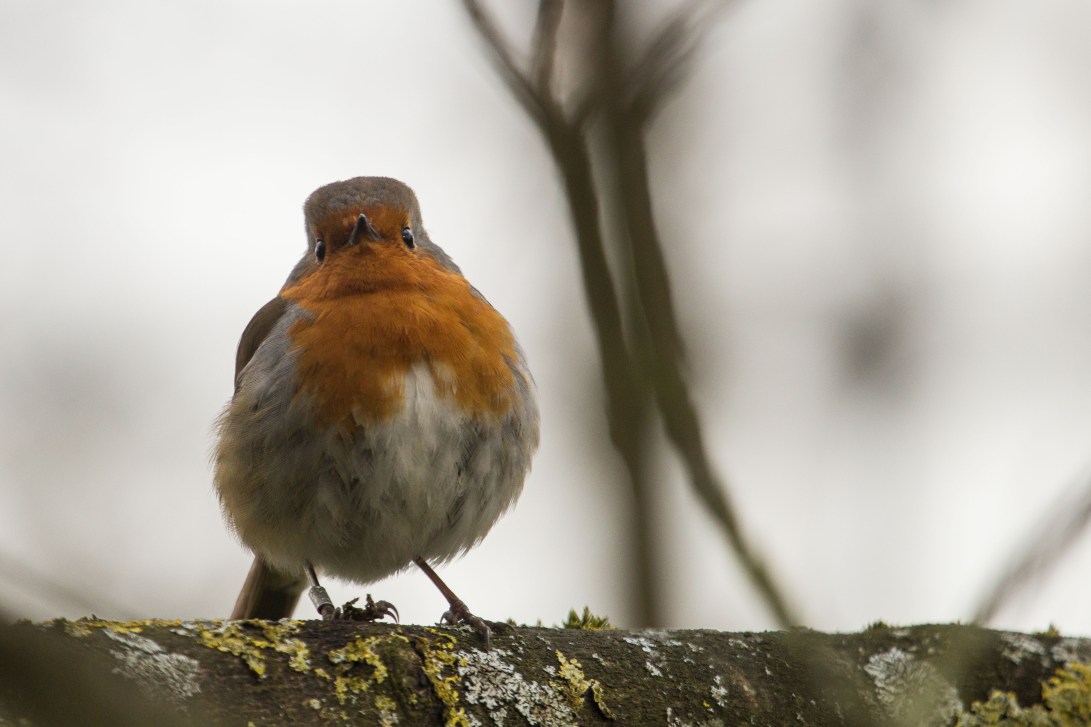
After watching the birds feed for a while, I wandered on. It was a lot colder than usual – dew covered the grass but it wasn’t quite cold enough to freeze it, though perhaps this may soon be the case on early mornings. There were other signs of winter too; bursts of red berries and a fat robin perched on the fence. Even though these birds are around all year, somehow a day in early winter feels like Christmas is a lot closer when you spot one.

As I made my way to the wood the only sound was the usual “whizz-burr” of the turbines as they swung. There was a break in the clouds and beautiful streaks of sunlight shone through at jaunty angles. The forest was gloomy but still inviting, and as I walked round I scanned both sides of the path to see if any fungi were sprouting up. The ground was boggy in places, and when drops of water fell in the puddles, the reflected trees twitched.

IMG_9019

Suddenly, just as I was looping back round to the gate, a woodpigeon exploded out of the trees and made me jump a mile. Why do pigeons love doing this? It must give them a wicked satisfaction to see me clutch my chest and try to get my breath back to normal.

Once I was back in the open, the chill was even stronger. I wrapped my coat tighter around myself and hurried back to the cafe to warm up.