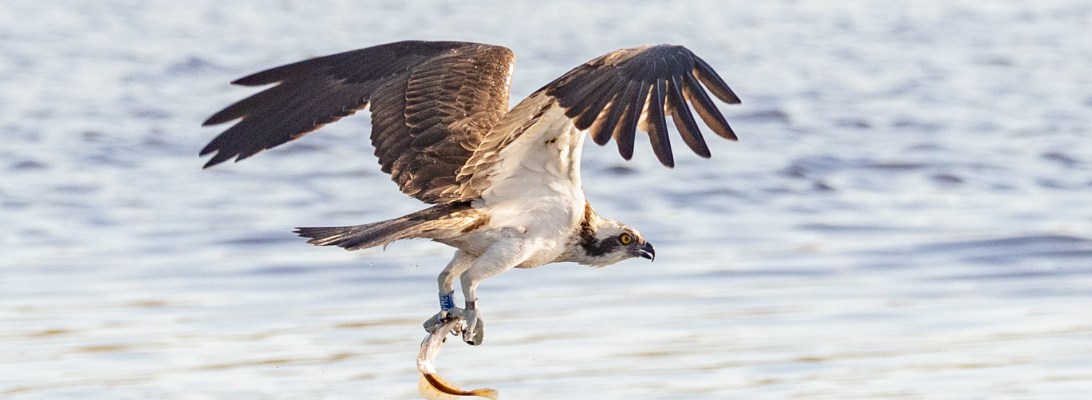
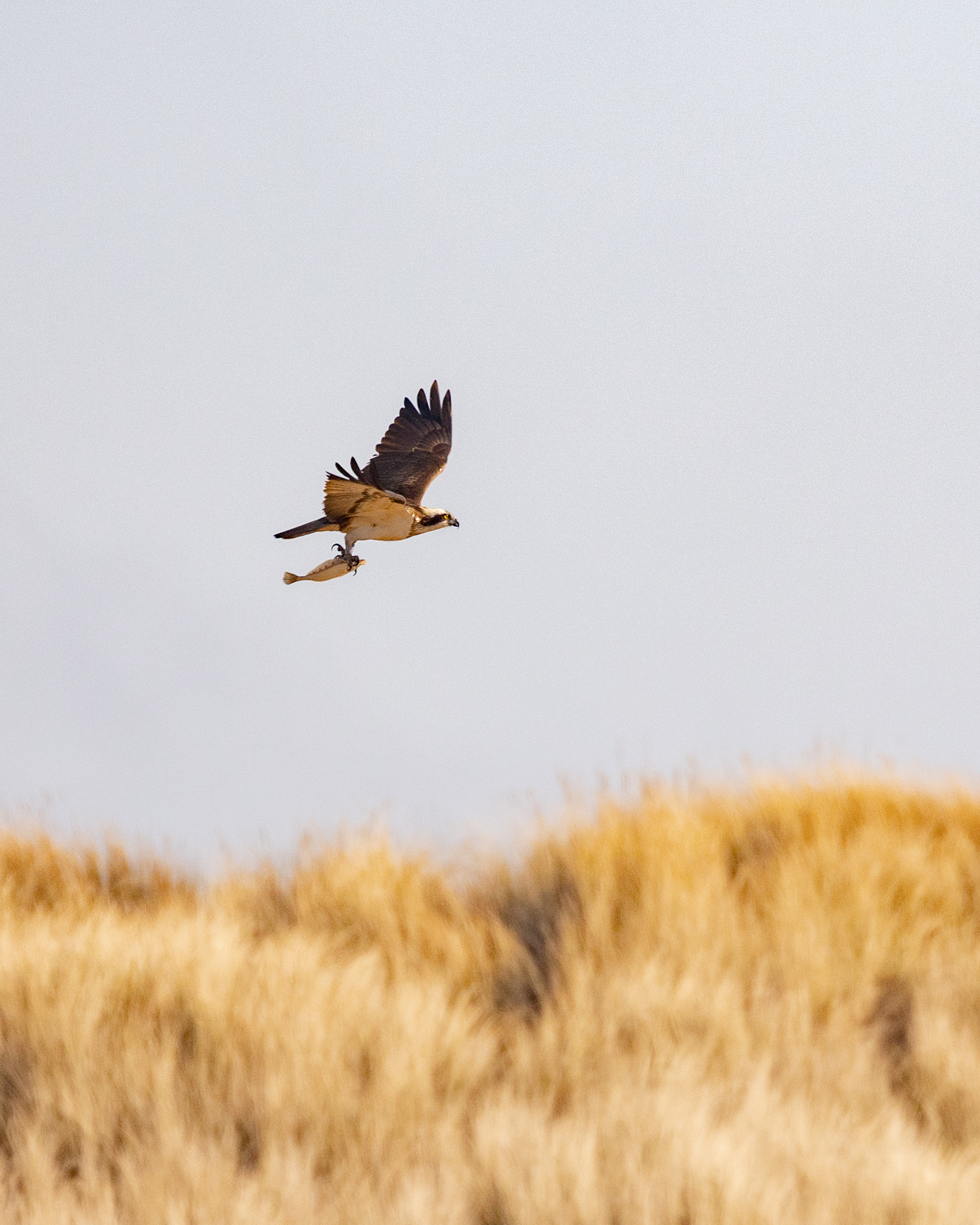
It’s that time of year again! One of my favourite things about spring is watching ospreys plummet into the water and emerge carrying huge flatfish, with the suave flourish of a magician extracting a rabbit.
I’ll be honest – I rarely get excited about larger raptors as they’re usually just a hazy speck in the sky. But ospreys bring all the drama, sometimes appearing out of nowhere and sending nearby herring gulls into a flap.
An osprey will hover high over the water, using its incredible eyesight to track a fish. Then it sidles down through the air, finally slamming into the shallows talons first.
It’s often a game of luck if you’re standing in the right place when they dive (and if you’re nimble enough to catch the actual dive, which I regrettably wasn’t), but you’ll hear the splash even from several hundred yards away.
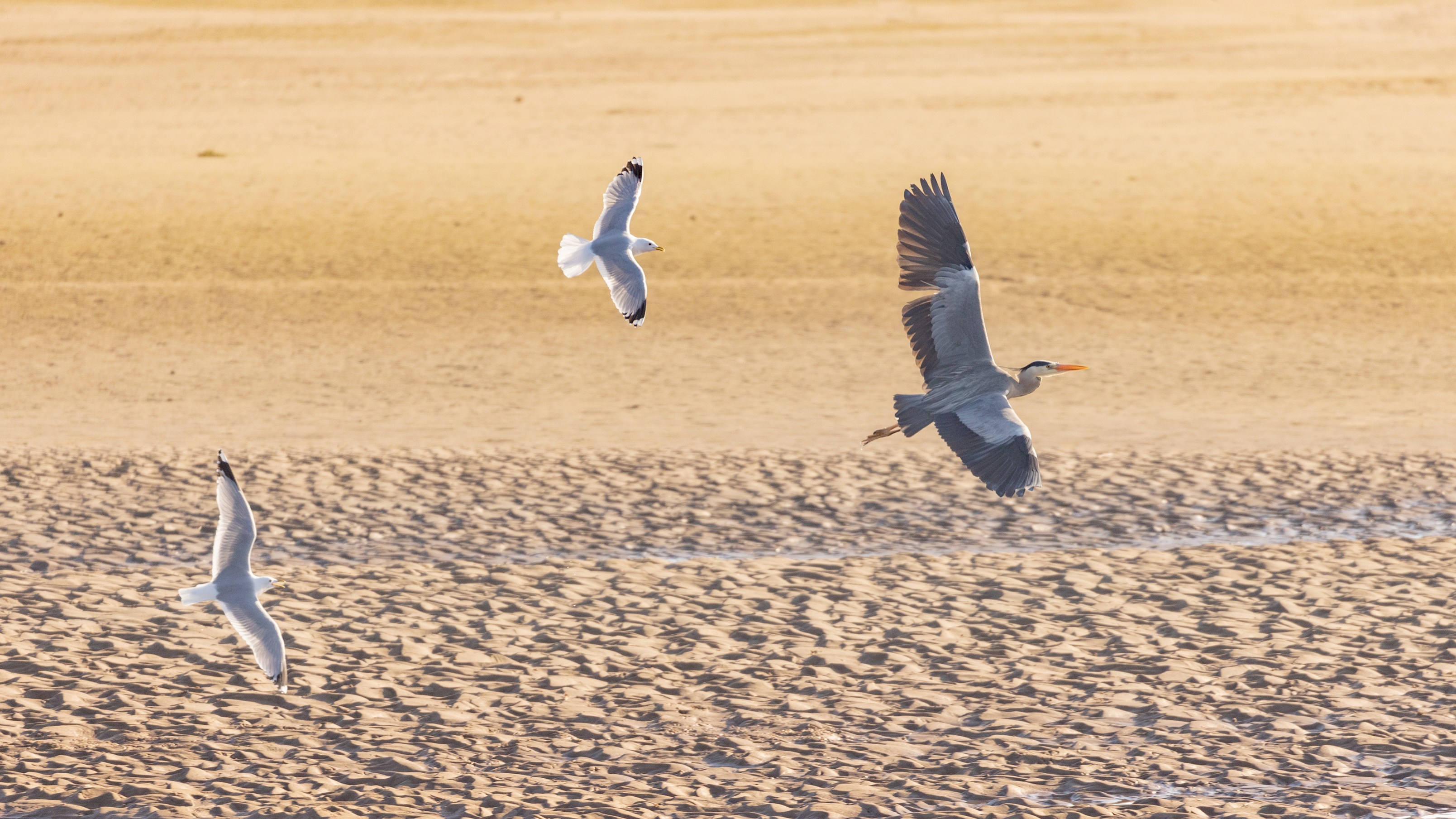
Elsewhere on the water, I was watching a heron minding its own business when it was mobbed by a couple of common gulls. Despite the size difference, the heron was shooed off its patch and raced past me with a reptilian squawk and a sweep of its vast grey wings.
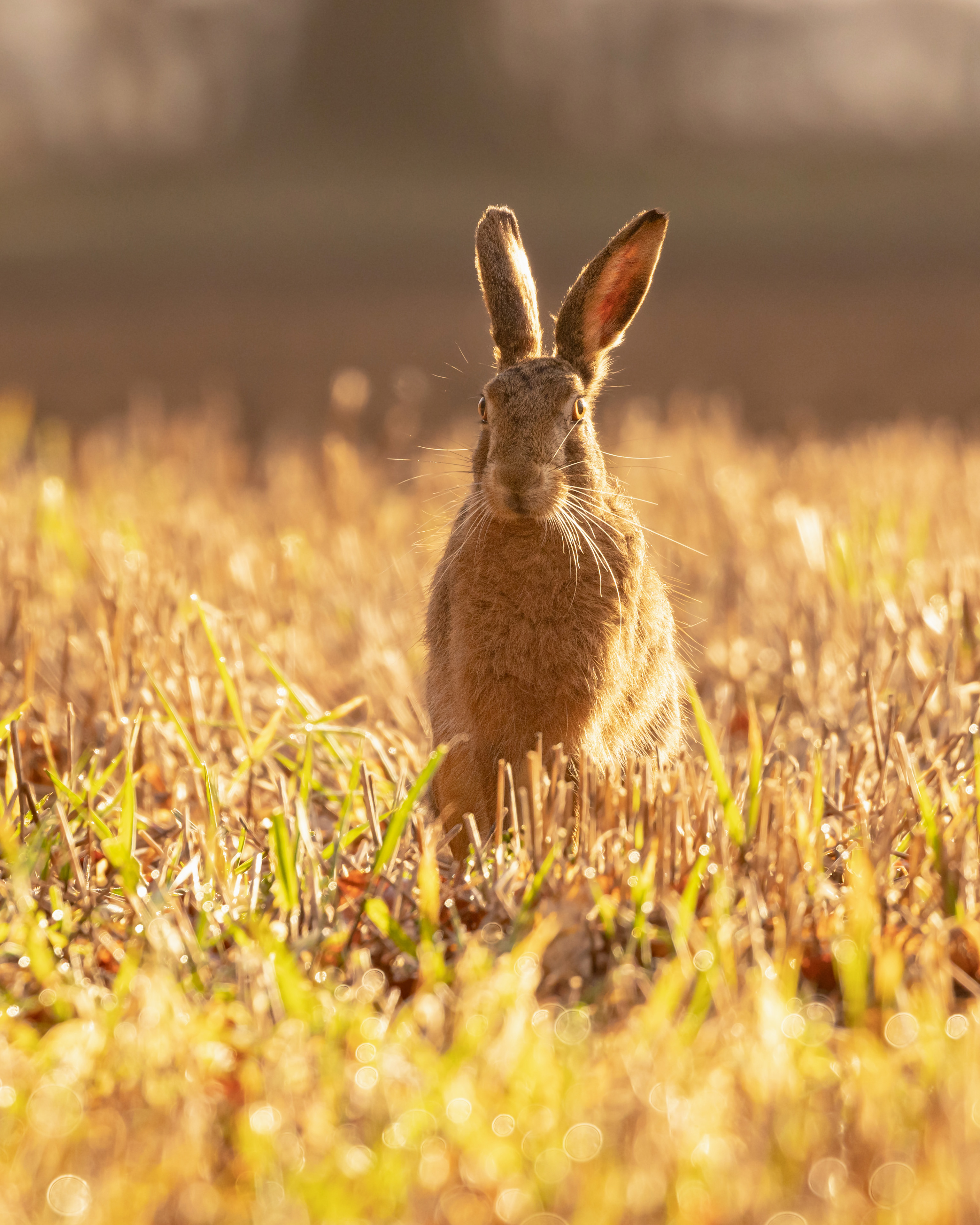
Snow scuppered my last attempt to photograph my local hares, and I didn’t have an opportunity to try again until this week. The conditions couldn’t have been more different, and I arrived in semi-darkness just as a smudge of yellow was blooming to the east.
In my initial binocular scan, I spotted two hares in the far corner of a stubble field, so I made my long way around, keeping to the edge beside the dry stone wall. At a respectable distance, I settled on the ground and wriggled into the comfiest position I could manage in hard yet soggy mud. Soon after, golden hour struck with heaven-like intensity, turning the grass to flame. The hares were perky, lolloping around with the occasional burst of a chase.
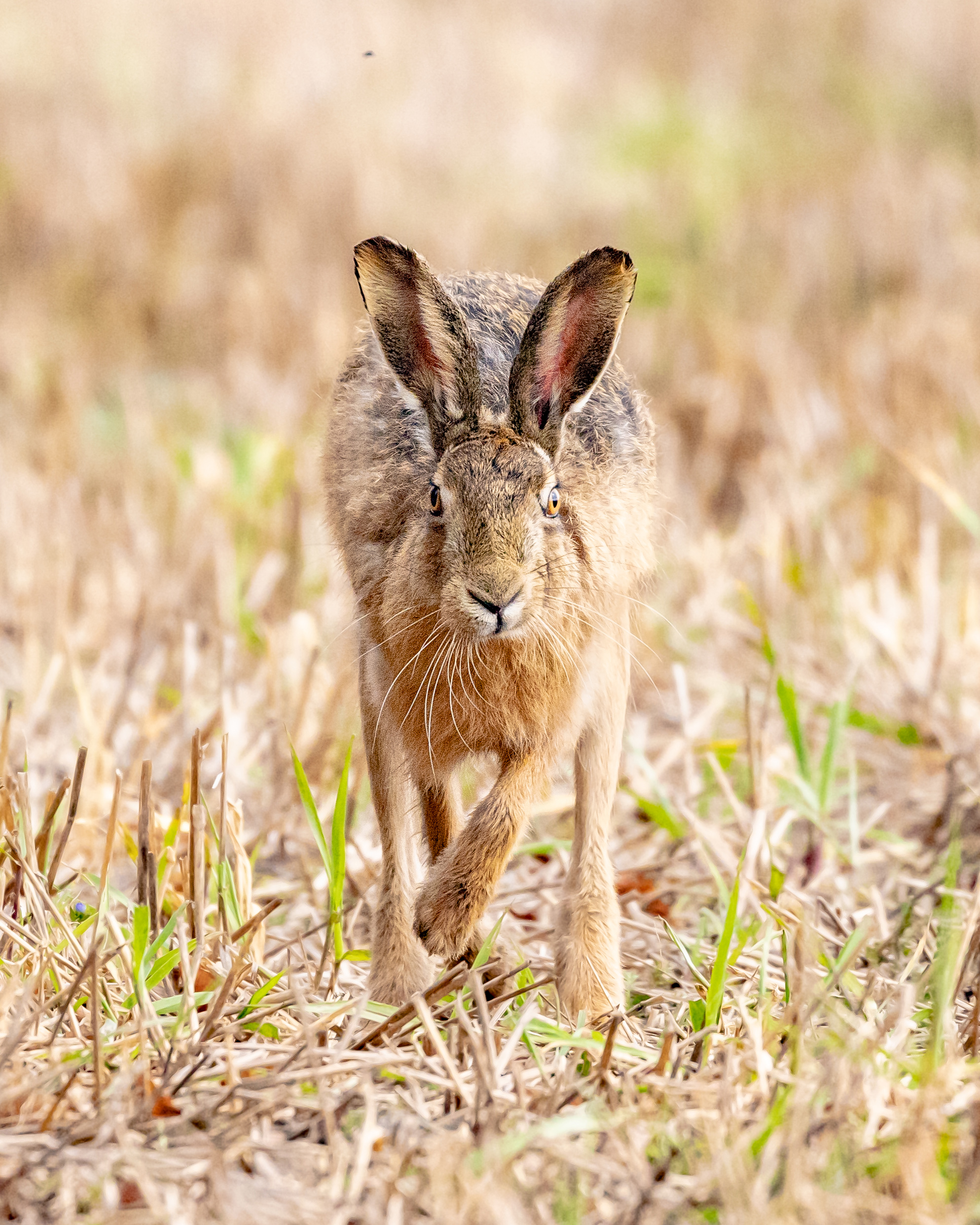
One hare disappeared and the other started foraging far off in the centre of the field. With my camera propped on my knees, I was watching it through the viewfinder when a blurry blob covered my view. The first hare had reappeared some forty feet from my lens, no doubt having watched me with a hare’s version of amusement ever since I’d been willing its companion closer.
Twisting my back in all sorts of wrong ways, I followed the hare as it ambled in a semi-circle around me, sitting for a few moments to have a nosey before disappearing into the long grass.
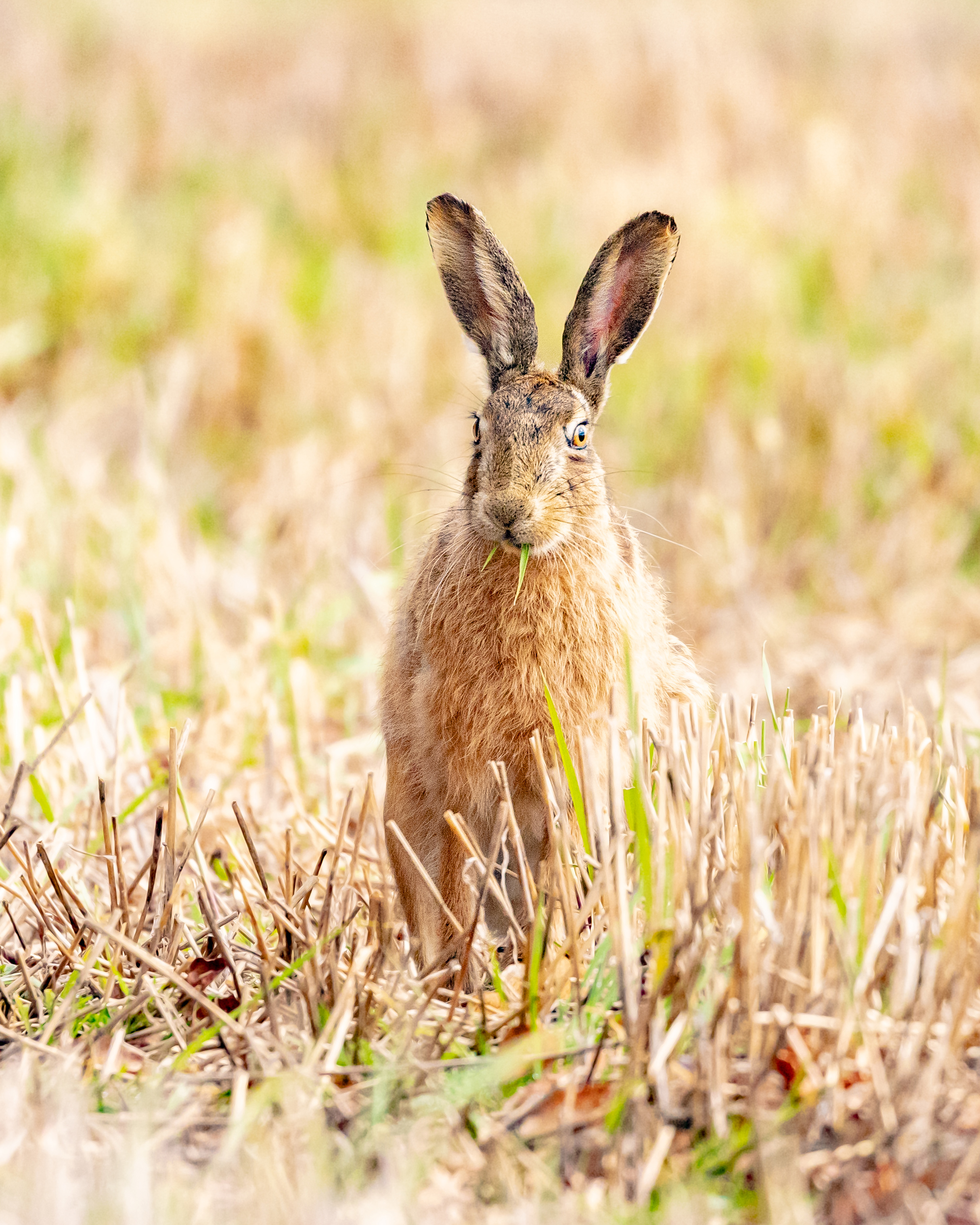
Light that molten was never going to last, but I was already covered in mud so I hung around after golden hour to see what else might happen. And before long another hare hopped over. The key with any wildlife is to let it come to you, and hares are no exception – I’ve discovered they can be curious to the point of full-out snooping. If you sit still, they often sidle over for a closer look.
My special sunrise with the hares was well-timed for Easter this weekend. Hares are said to be the companion animal of Eostre, or Ostara, the Anglo-Saxon goddess of dawn and spring. The link between eggs and the Easter Bunny doesn’t seem to make much sense at first, but one explanation comes from a bit of lapwing ecology.
Unlike rabbits, hares don’t use burrows but instead lay in scratched-out forms on flat ground. Lapwings are ground-nesting birds and often lay their eggs near a hare’s form or even inside it. Seeing lapwing chicks and baby leverets emerging at the same time could have led people to believe that hares laid eggs.
To be fair, hares are stealthy and mysterious animals, and that’s part of their irresistible charm.
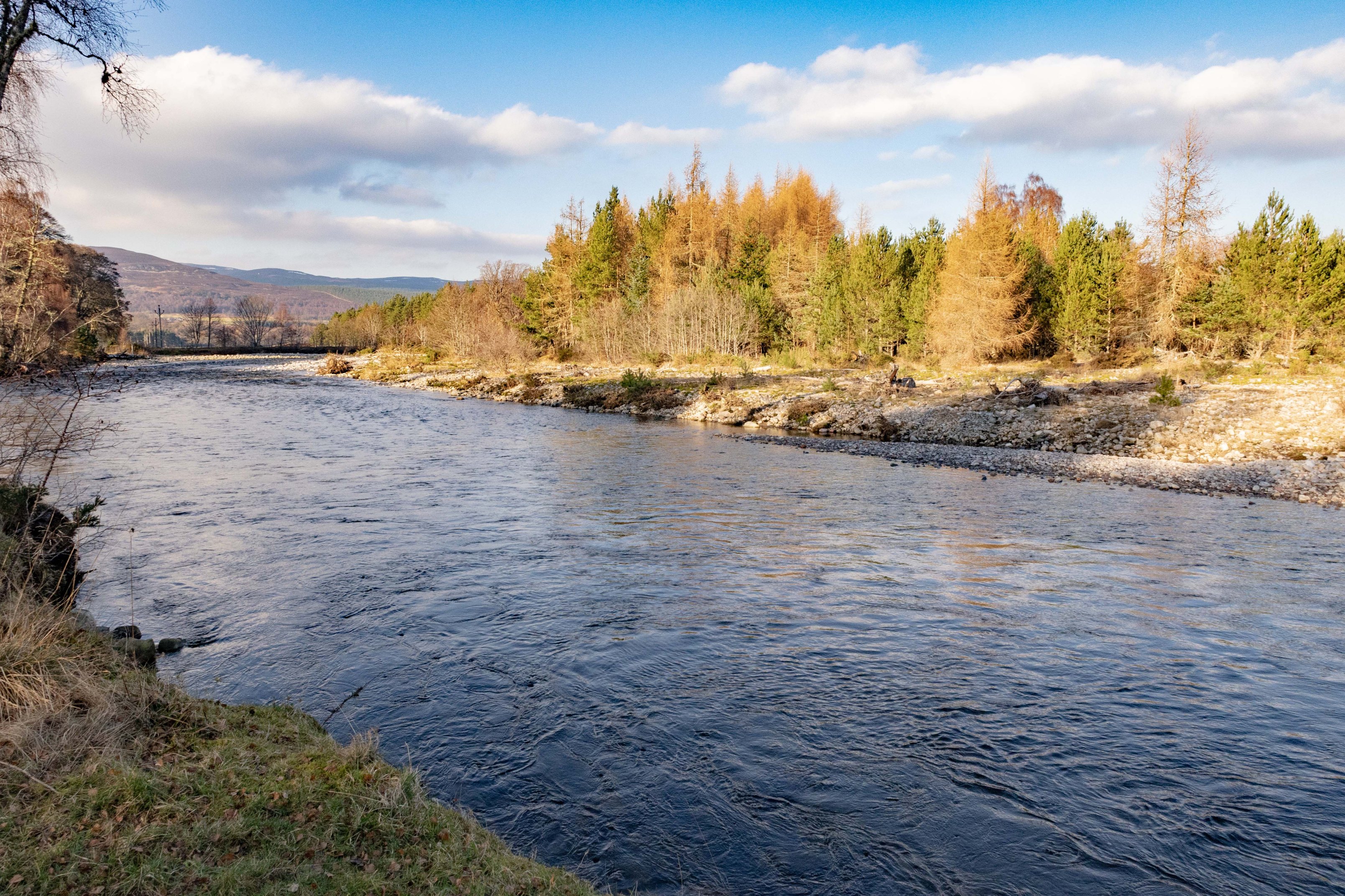
As habitats go, a river is a particular favourite of mine. Not only does it make one of nature’s most soothing sounds, but it’s usually a hub of wildlife activity.
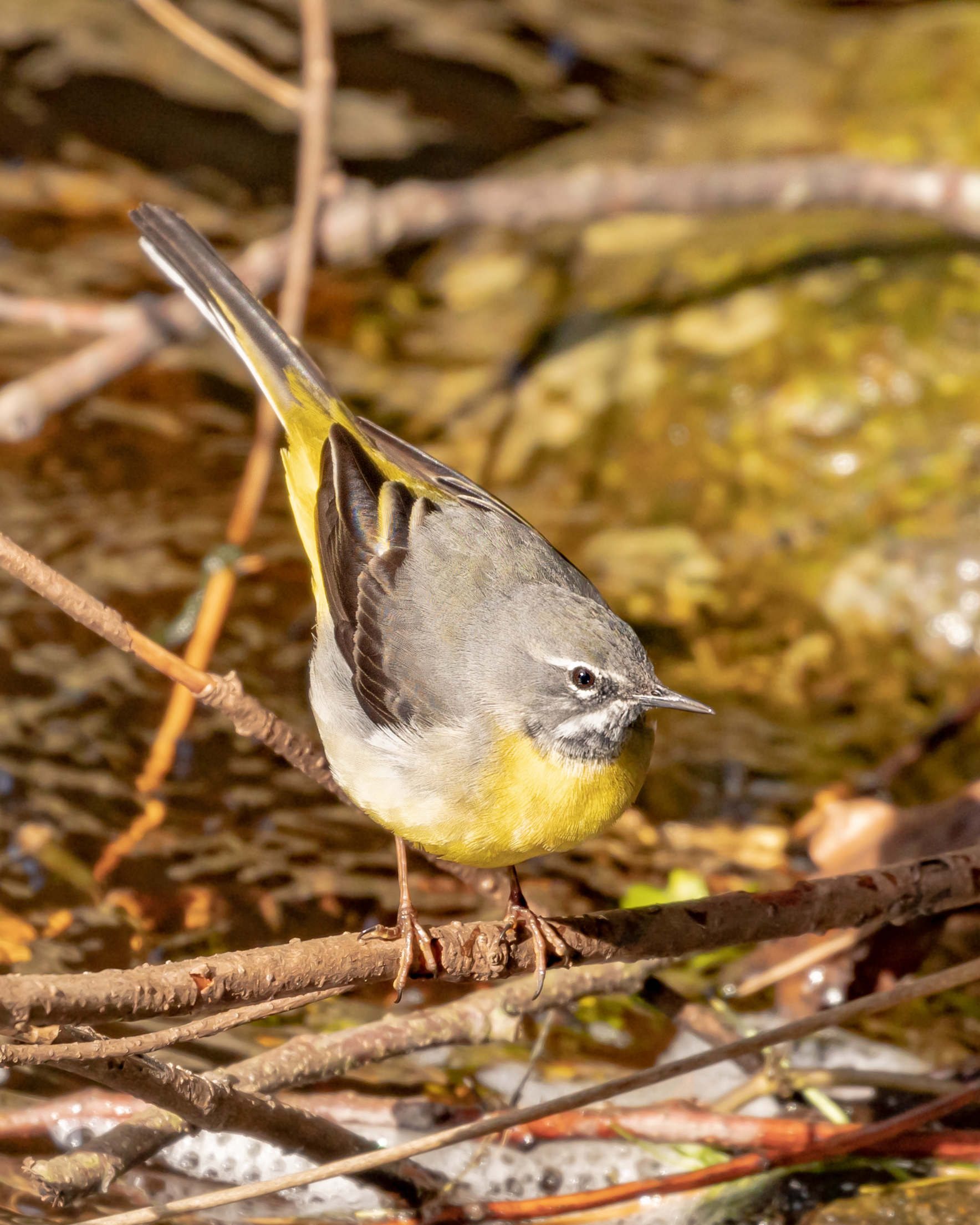
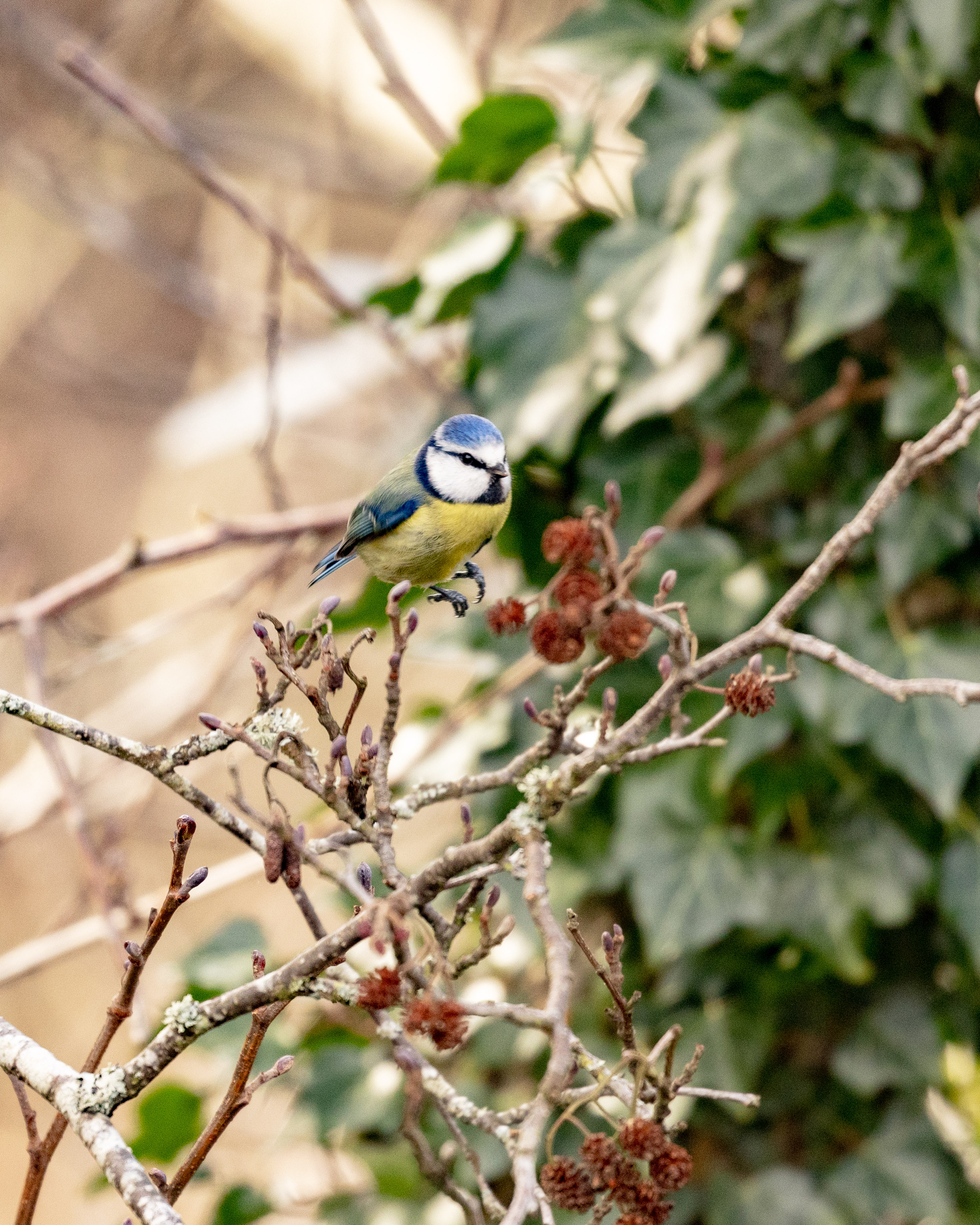
When I arrived, the first bird to catch my eye was a blue tit, which was loudly serenading everyone around it with its ‘tea-tea-lily-lily-lily’ call. Beneath it, flickering from rock to rock, was a grey wagtail. Similar to other river-dwelling birds, grey wagtails have a high-pitched call that cuts through even the chattiest of rivers.
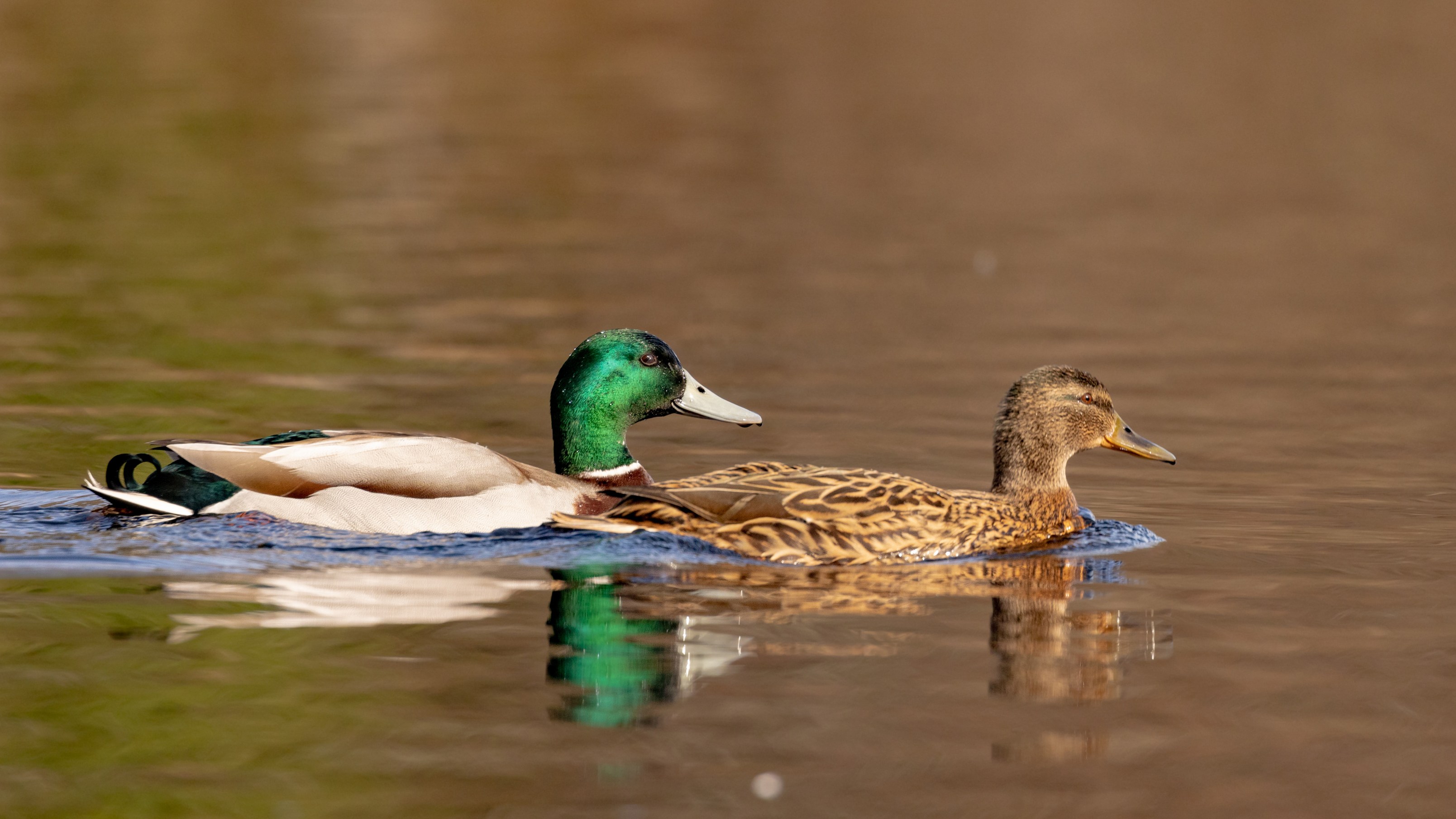
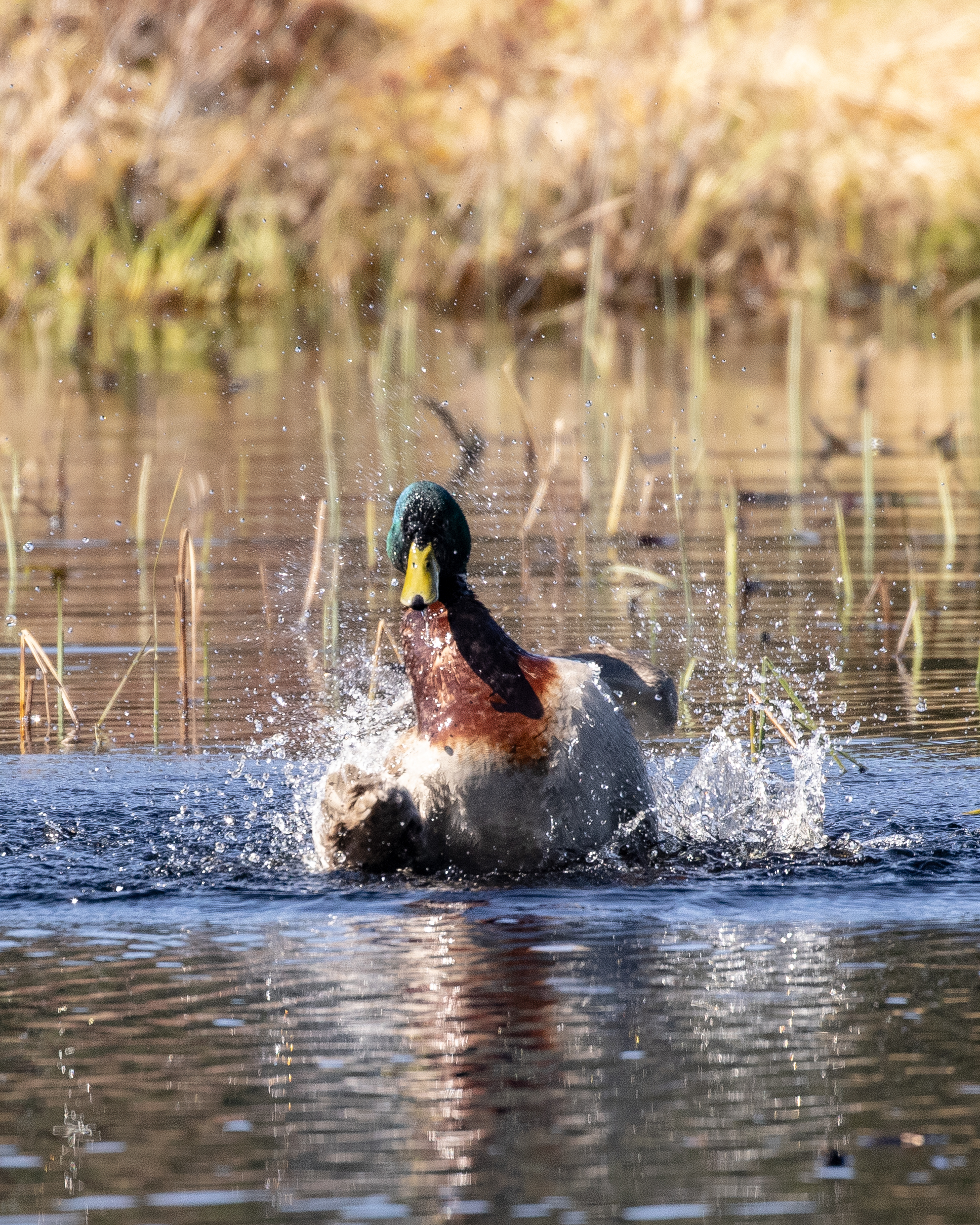
On the calm pond beside the stream, a pair of mallards swept around in slow circles. Surely one of our most under-appreciated beauties, the male mallard shimmers in direct sunlight.
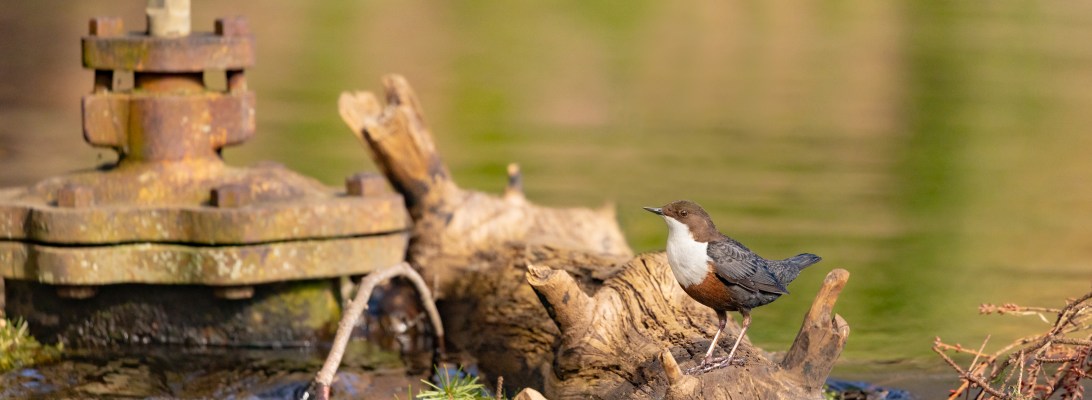
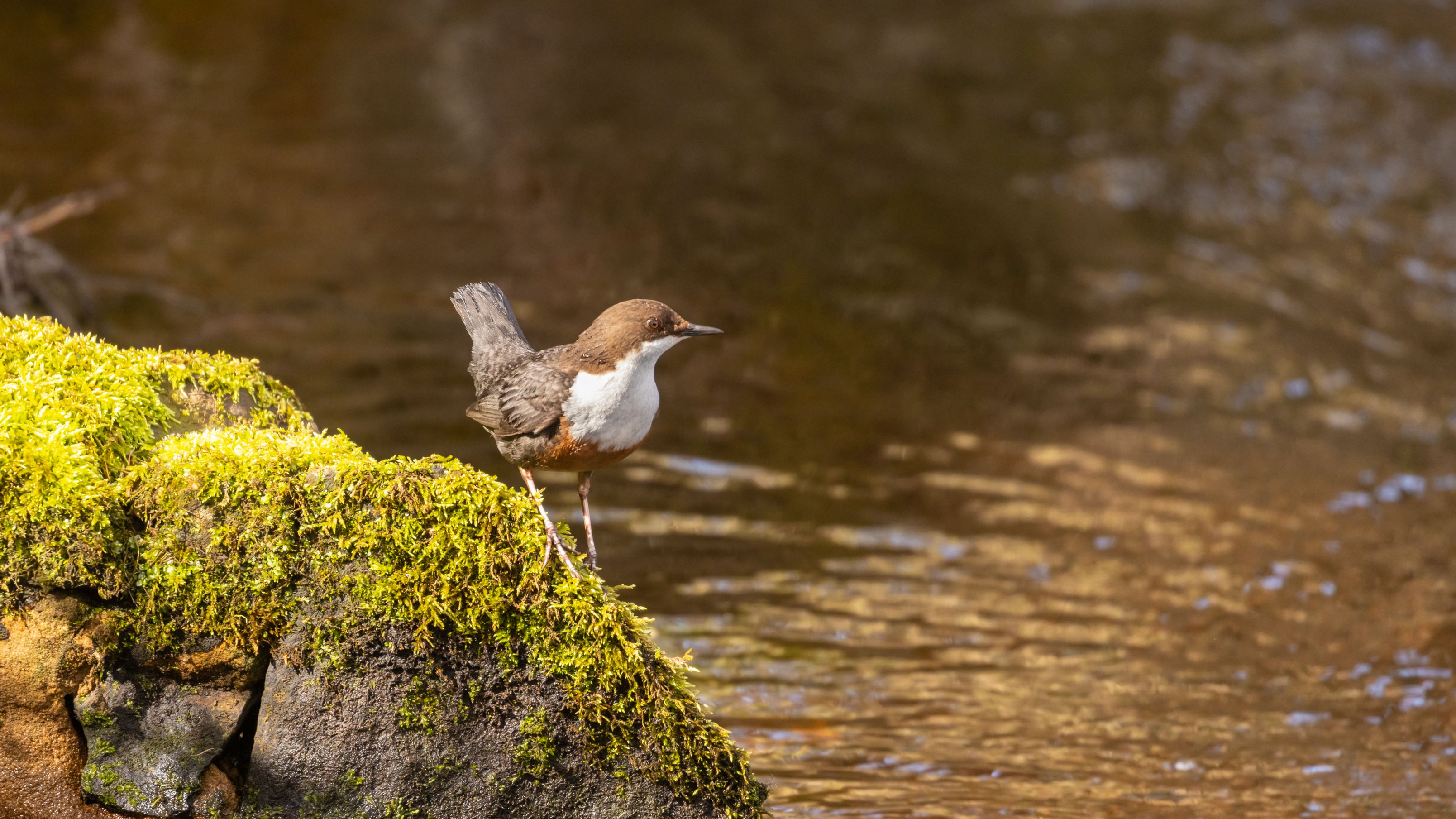
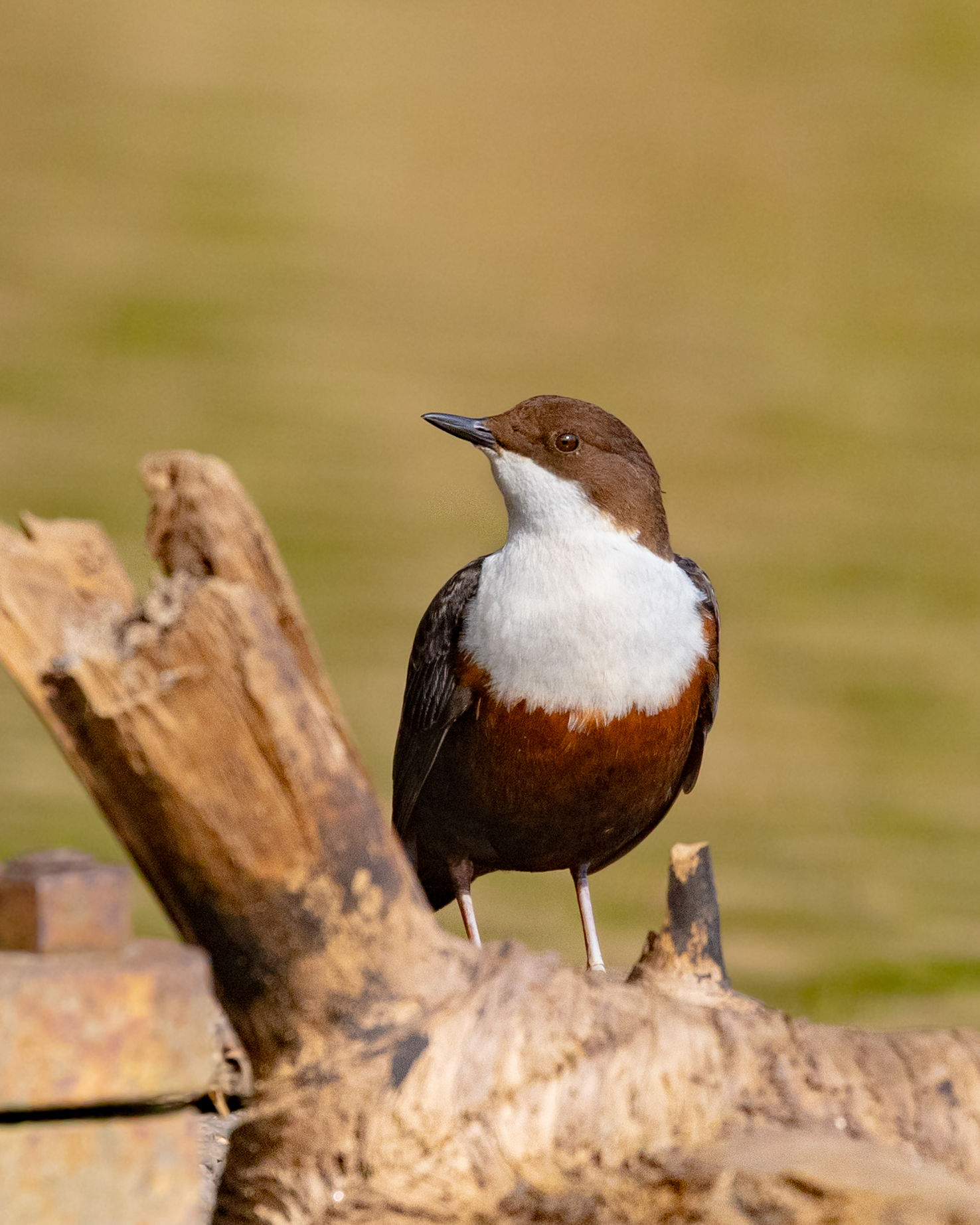
I’d come to the river especially for dippers. This patch has a Rocky Road structure of stones, logs and twigs jutting out of the water, providing countless opportunities for perching and dipping.
On some occasions, I’ve had to settle on the bank and wait a while for the flash of brown and thrum of stumpy wings as a dipper zoomed by, but today I timed my visit perfectly. Just as I was peering along the water channel for a white bib, a dipper came zipping past me and landed several feet away.
I crept closer and watched as it ducked down behind its perch until only the top of its head was visible. It emerged holding an enormous clump of moss in its bill. With another dip, it sped back downstream, returning minutes later without its foraged cache.
For the next hour I watched a pair of dippers gather moss almost continuously. I’m always heartened and impressed by the diligence of some bird parents. Chicks were obviously on the way, and they would have a luxuriously cosy nest ready for them when they arrived.
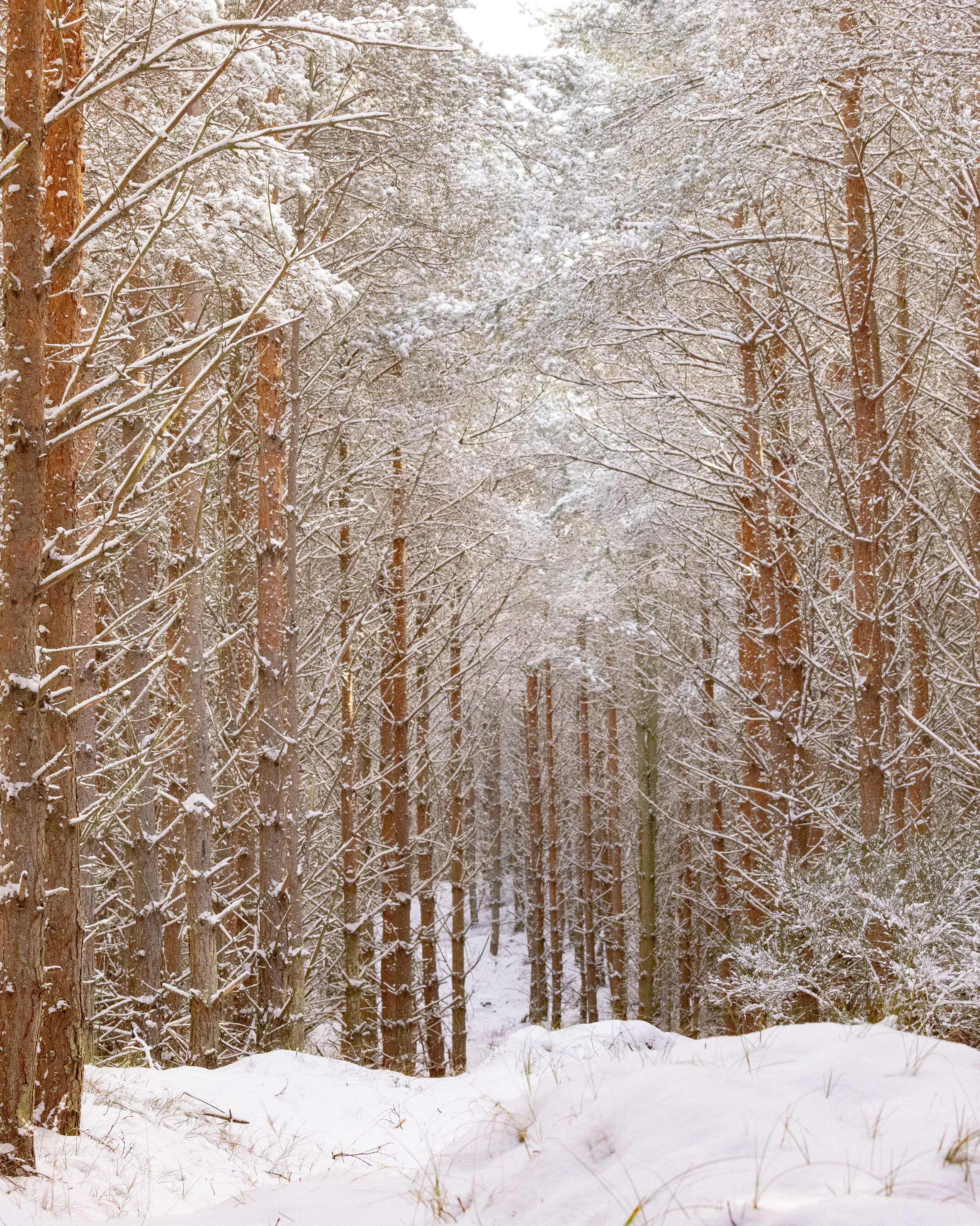
My plan had been to photograph boxing hares. According to the (notoriously unreliable) forecast, it was going to be a cloudless sunrise, so you can imagine how nettled I was to find myself in a mild blizzard at 5:30am, barely able to see 100 yards past my nose.
And of course, that’s when four hares appear out of nowhere and start boxing, just as I’m pawing great hunks of snow out of my eyes. By the time the snowfall subsided the boxing match was over, but a solitary hare was still loitering in the open, just as crazy as I was.
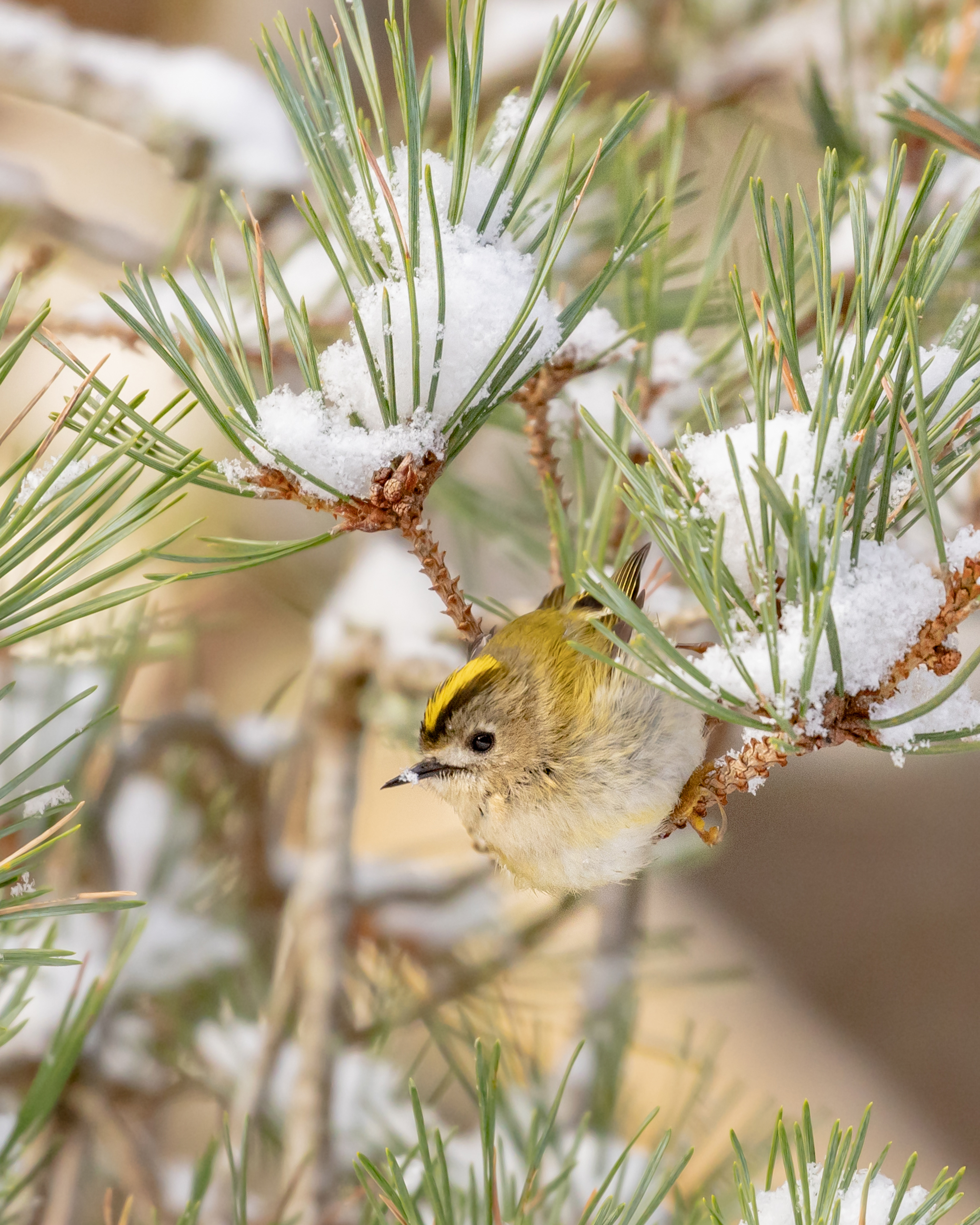
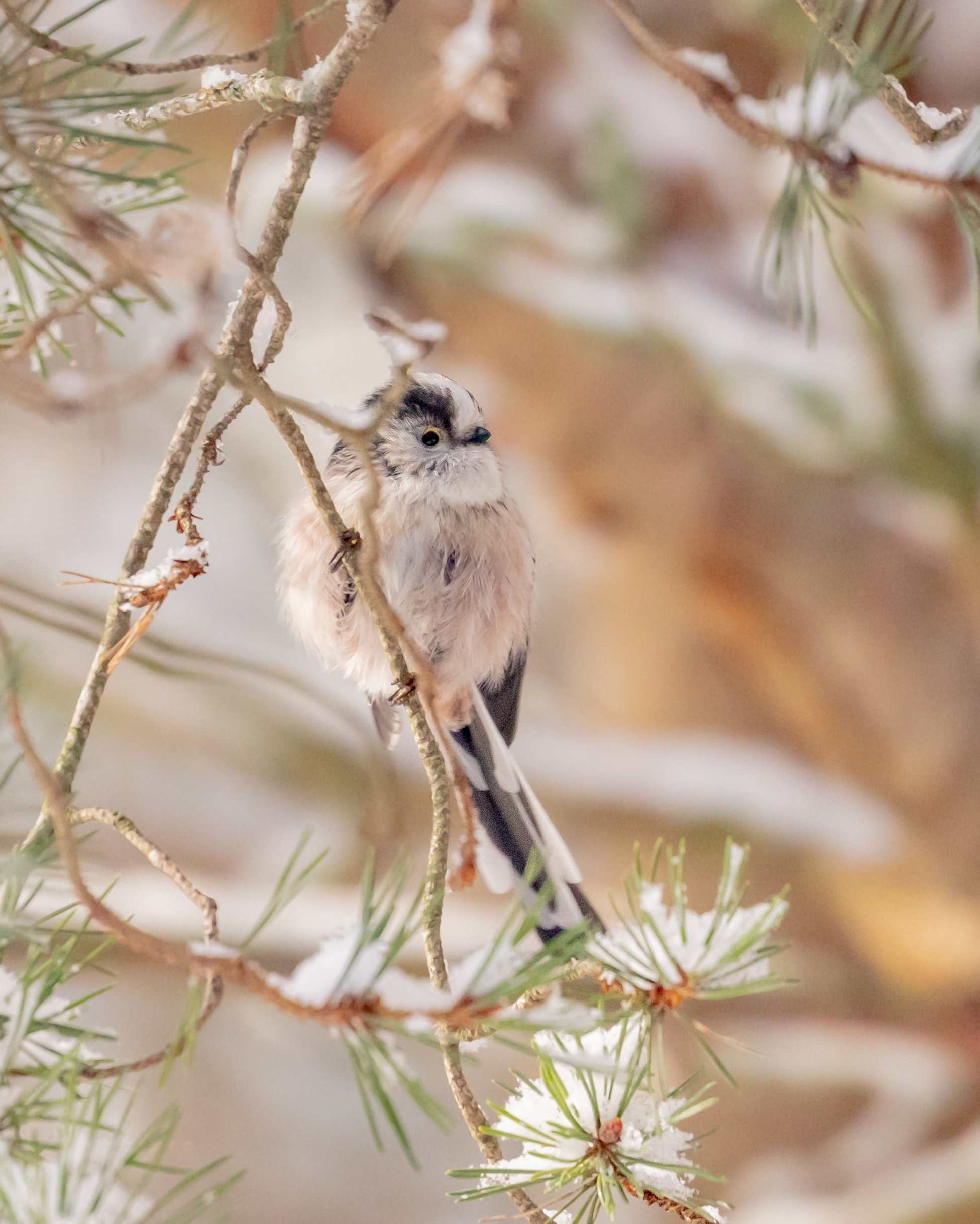
Determined to have more luck elsewhere, I ventured into the forest and found long-tailed tits and goldcrests. These tiny scamps really tested my reflexes, barely pausing for a second before flitting off to another branch.
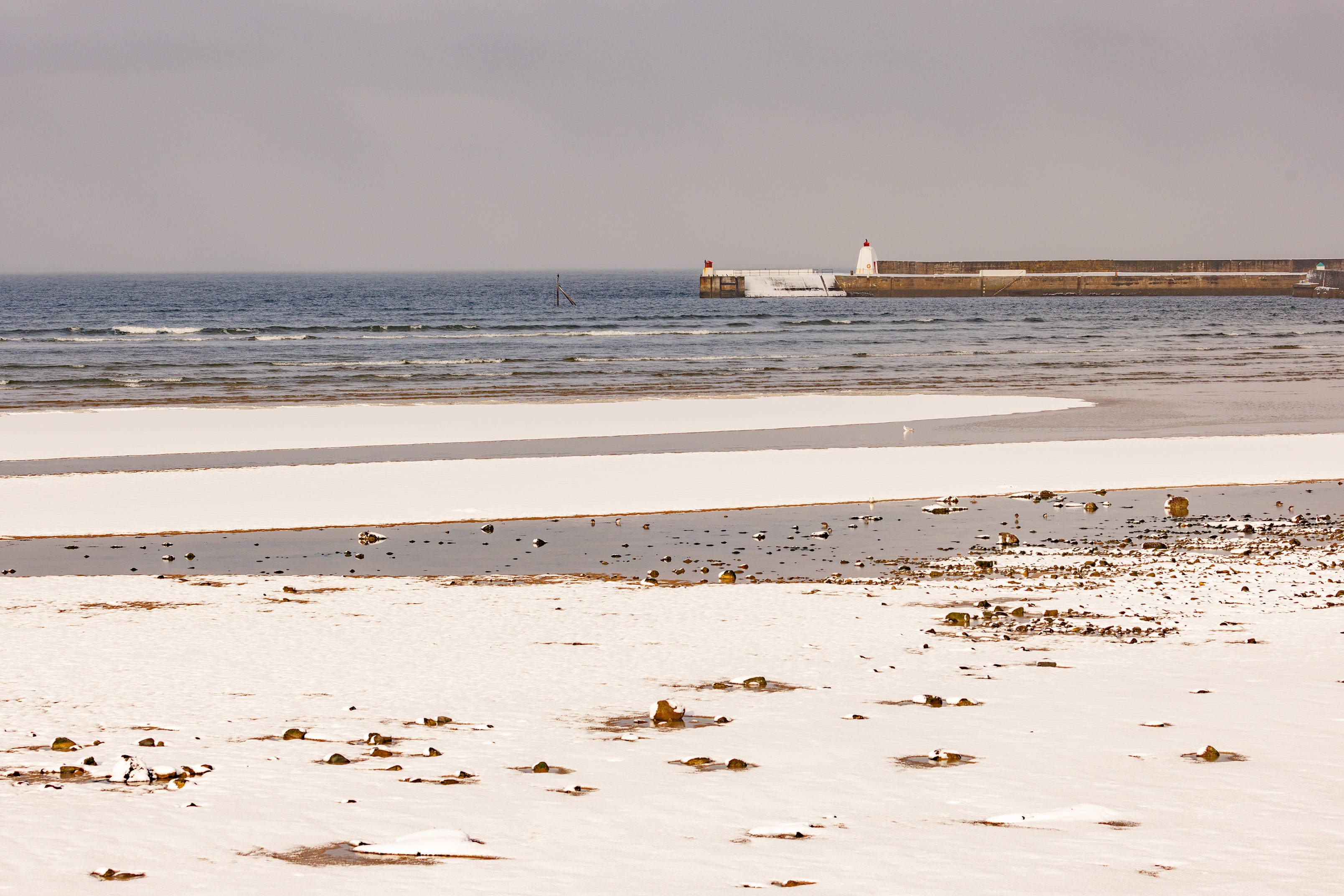
A few hours later my feet were sufficiently numb so I headed back home. I passed the beach on the way, which was just as white as everything else.
Nature is unpredictable at the best of times, let alone when snow is involved. I ended up really pleased with what I managed to photograph though, despite the shaky start to the day. Still, I’ll be back for those mad March hares soon…
Yesterday I attended a conference in Kingussie, down in the Cairngorms National Park, about Scottish community tourism. It was hosted by SCOTO, a collaborative group of community tourism enterprises from all over Scotland.
One of my favourite speakers was Calum Maclean – a presenter, writer and Gaelic language activist who’s probably best known for his wild swimming. He’s just been voted the most influential Scot on TikTok, surpassing the likes of Lewis Capaldi.
What resonated with me about Calum was his enthusiasm. He spoke about ‘the power of localness’ and exploring past the obvious to get a deeper understanding of the places we visit. He also said to go ‘beyond the guidebooks’ that tend to gloss over the juicy, undiscovered places you’d only know about if you were a local, in favour of overpopulated tourist hotspots.
After his talk, I chatted with Calum about my Slow guide and how it was important to me to write a guidebook that included some of those undiscovered locations. I had the privilege of meeting lots of local people during my research and travels, and their contributions have made my book far richer. To reinforce the importance of this kind of immersive travel even more, Slow Travel is the theme for May in VisitScotland’s 2023 marketing calendar – impeccable timing for the release of my book that same month!
Recently, there’s been a surge in awareness of ‘sustainable tourism’. Initially that might make you think of the environment, and how visitors should respect wildlife and wild places while travelling. This is essential of course, but the sustainable mindset also relates to people. Supporting independent businesses instead of big chains, and making an effort to learn the heritage of new places as well as appreciate their beauty, are just as important as being mindful of campfires and taking your litter home.
Again, these are things that a good Slow guide should cover, and I consciously shopped small while I was travelling for my book, discovering fantastic small businesses that gave the places I visited even more colour.
Another excellent speaker at the conference was Scotland blogger, itinerary consultant and podcast host Kathi Kamleitner. Like Calum, Kathi’s passion was infectious and she spoke about connection as an emotional benefit of tourism. This connection can be with those you travel with, those you meet while travelling, and also with yourself.
Currently, one of the biggest travel trends is an interest in ‘localism and authentic experiences’. This links to the ‘staycation’ idea, which became even more prevalent during the pandemic. It was reassuring to see that my book links to this trend – I’ve highlighted many local people and hopefully conveyed enough immersive detail in my descriptions of lochs, forests, castles and distilleries to inspire these memorable and authentic experiences that visitors are looking for.
I’m a huge advocate of Scotland as a travel destination and clearly so is Kathi, who launched her business Watch Me See to help other people discover and fall in love with Scotland just like we both did. I’m always looking to connect with other solo female travellers and it was so lovely to hear Kathi’s perspective.
March is Scottish Tourism Month, so the conference was well-timed. It was a whirlwind of conversations and ideas, not to mention a shock to my system after several years of professional interaction exclusively via Zoom! I left feeling inspired and even more excited about the release of my book, having reaffirmed my belief that Slow is the way to go.
I moved to Scotland three years ago today. It’s not that long really, but both my world and the actual world have changed a huge amount in that time. Nonetheless, my local patch has stayed exactly the same.
If you’ve been following my updates for a while, you’ll know that I grew up in southeast England and went to university in Cumbria, where I lived just a few miles from the Scottish border. While my fellow students spent their weekends in the Lake District, I was pulled north instead. During my degree, my interest in nature became a passion and it took on a decidedly Scottish flavour.
After graduation, I had the unpleasant ‘oh god what now’ realisation and returned home, hoping to figure out what to do with the very expensive piece of paper I’d worked so hard for. Less than a year later, it was apparent that I didn’t belong in southeast England anymore. Having experienced what Scotland had to offer a bird nerd like me, I needed to be back there. On 22nd February 2020 I drove 546 miles to my new home on the Moray Coast.
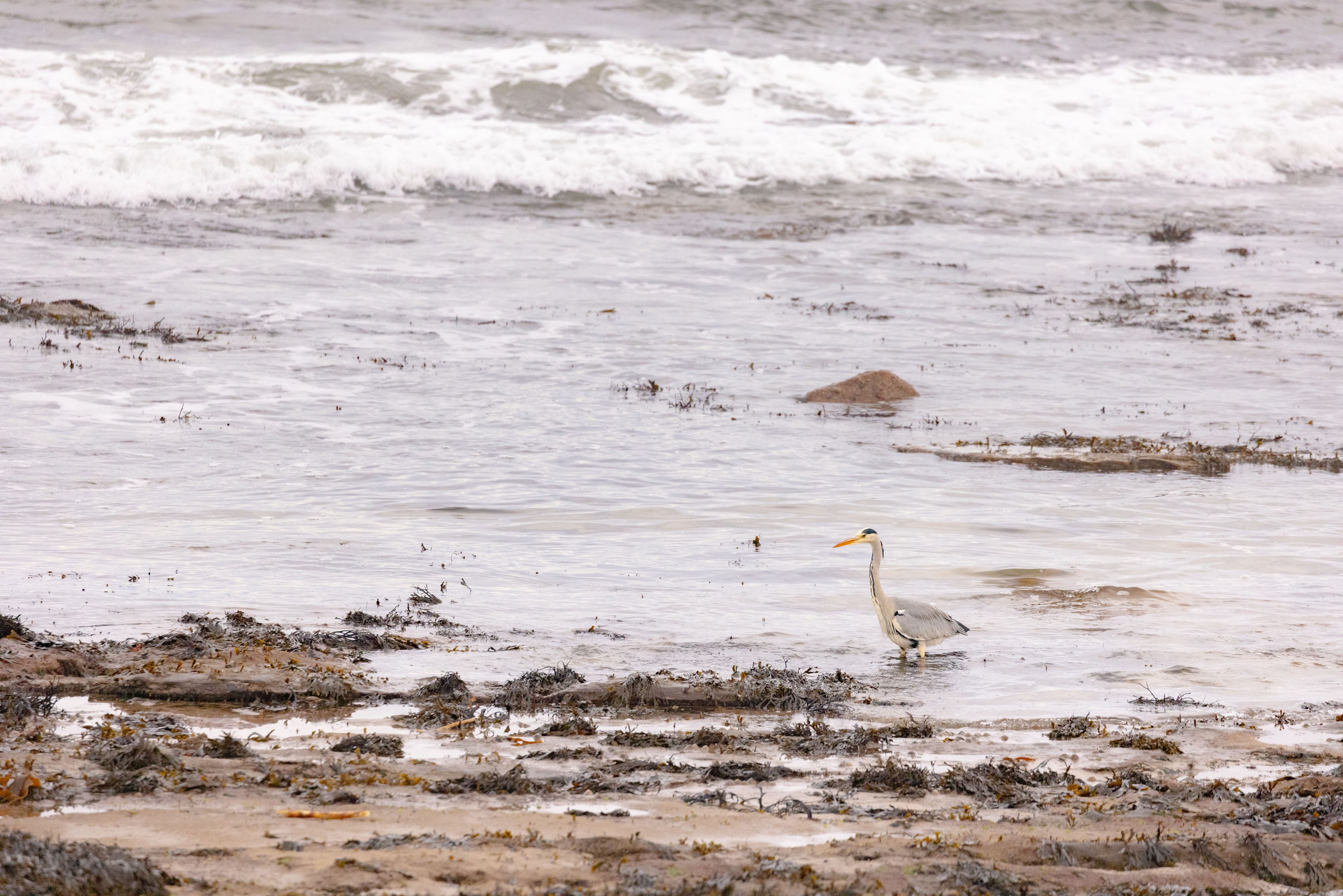
Grey heron
Of course I had no idea what would happen to us all some three weeks later, but even after the first lockdown hit I was fortunate enough to have wildness literally on the doorstep. When restrictions were at their tightest, I walked the same mile of coast path every day.
Because it followed a stretch of rocky shore, no two walks were the same. Sometimes the tide was out, revealing boulders both slick with kelp and crusty with barnacles. They were crowded with oystercatchers, redshanks, turnstones, ringed plovers, rock pipits, herons and bar-tailed godwits – I’d only seen most of these in books before that point. At high tide, deeper waves brought a legion of ducks closer to land including eider, goldeneye and long-tailed ducks, as well as cormorants, red-breasted mergansers and fulmars.
Fulmar
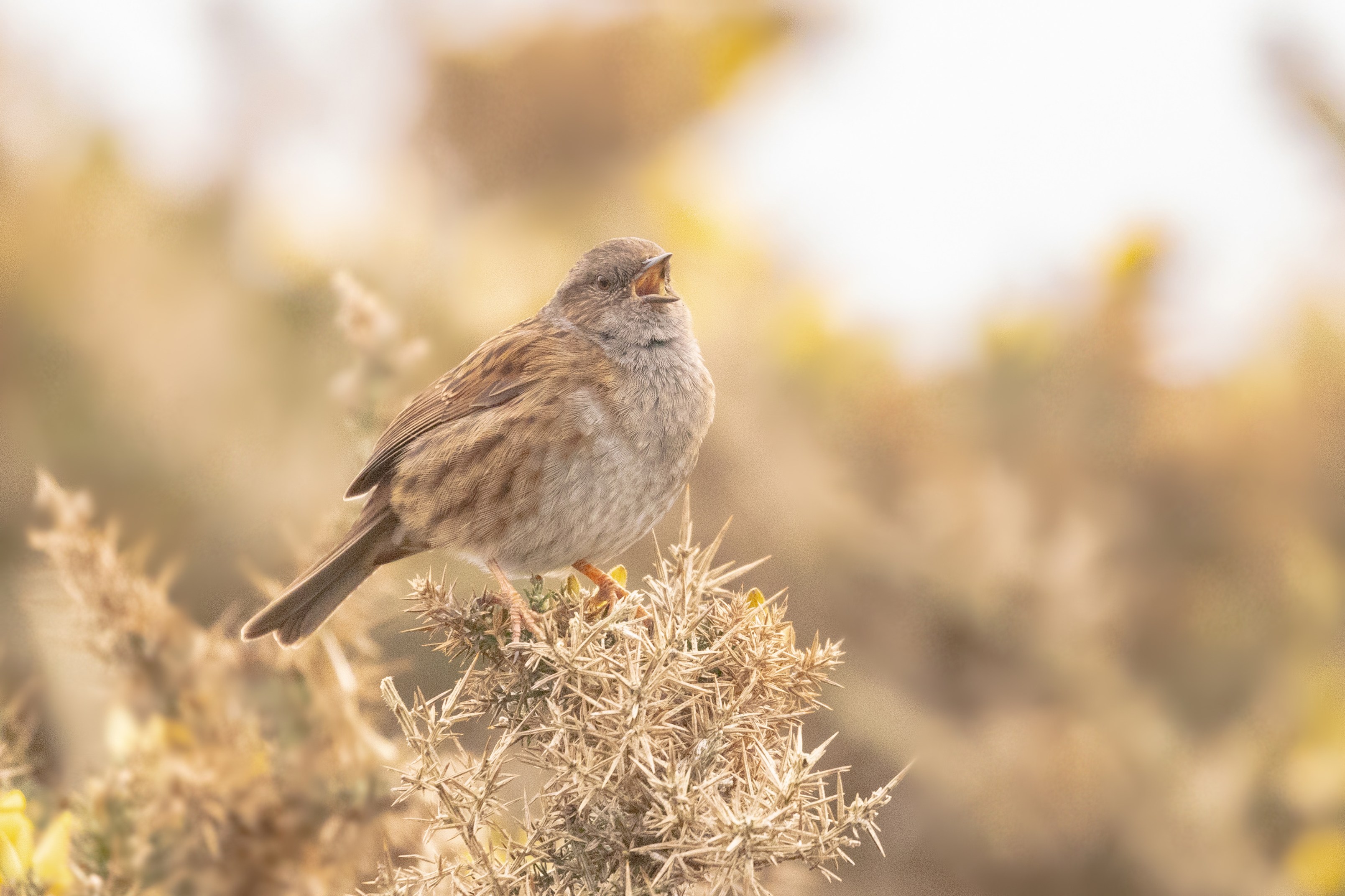
This was all going on in just one direction. If I swivelled to face south instead, my binoculars were full of yellowhammers, linnets, stonechats, dunnocks, wrens, goldfinches, reed buntings and song thrushes, all attracted by the dense shelter of gorse bushes and the stubble field beyond.
As my first spring in Moray became summer, these resident birds were joined by migrating visitors: whitethroats, willow warblers and chiffchaffs perched on the gorse while gannets, swallows and sandwich terns swooped over the water. I’d never seen so much birdlife in one small area, and the coast path remained my regular local patch even after restrictions eased.
Dunnock
However, my eyes naturally wandered and I ventured east into Aberdeenshire and south into the Cairngorms National Park. One thing led to another and less than eight months after moving to North East Scotland I secured a commission to write a book about it which, as you’ll probably know (because I never shut up about it), is what I’ve been grafting away on ever since.
While I was gallivanting all over the place researching my book, I neglected my little patch of coast path. I still walked the dog that way occasionally, but I couldn’t dedicate the same amount of time to watching the birds there as I could when I first moved.
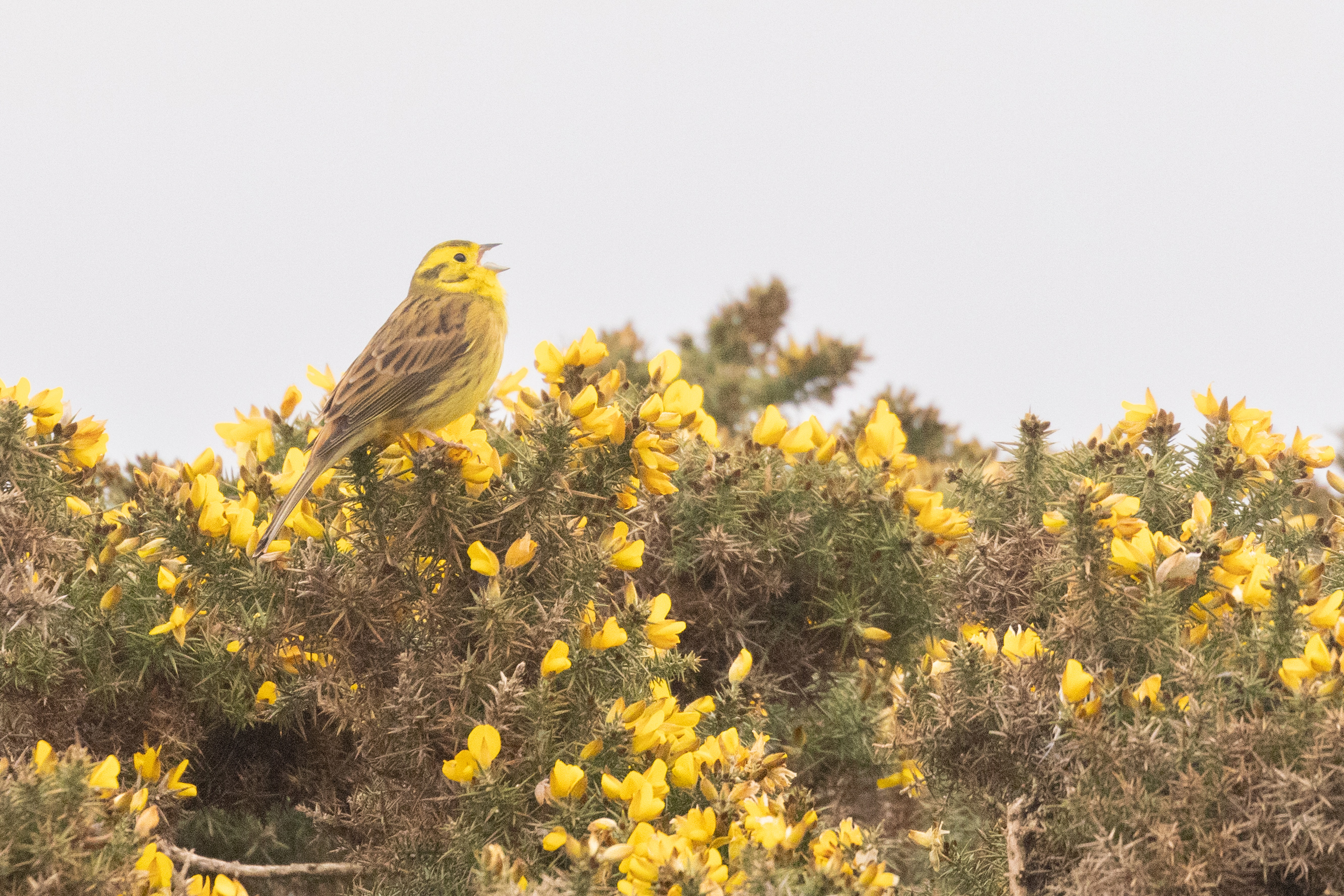
Yellowhammer
My book will be sent off to the typesetter in just over a week’s time, so aside from proofreads and final adjustments, this monumental task I’ve taken on is almost complete. Today, on my third anniversary in my new home, I walked the coast path again, dedicating a whole morning to wandering and watching.
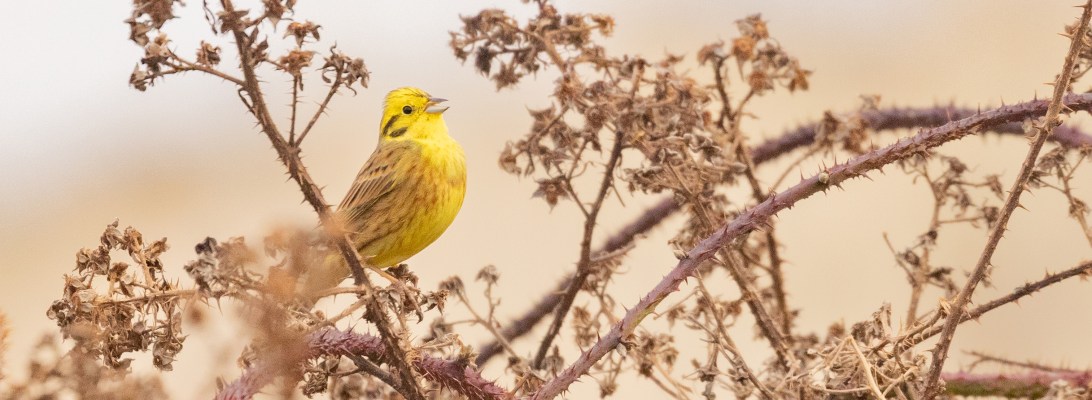
Although I couldn’t spot them all, I knew yellowhammers were everywhere because their distinctive song – ‘a little bit of bread and no cheese!’ – was bouncing around like a bullet in a cave. You wouldn’t think a luminous yellow bird could blend in, but when they’re perched on gorse flowers of a similar shade, they camouflage remarkably well.
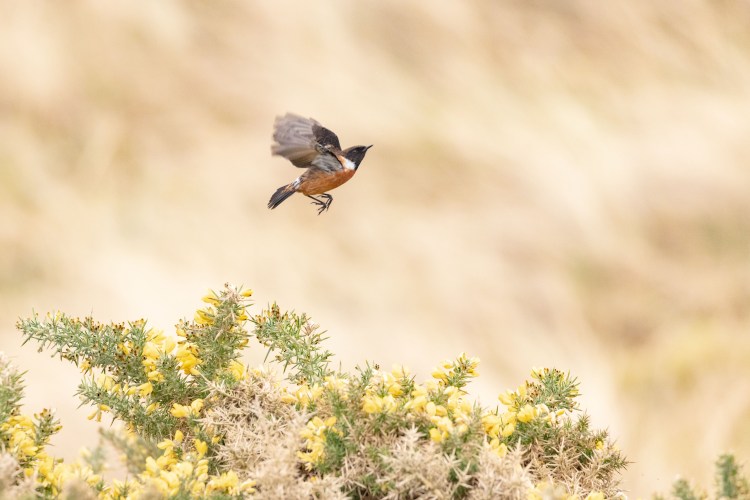
Elsewhere I saw a pair of stonechats on the tallest sprigs of a particular gorse bush, regarding me with a cock of the head and a bob of the tail. It’s fanciful thinking, but seeing as stonechats can live for a handful of years it’s possible that they’re the same ones, occupying the same territory, that I saw on my first forays in 2020.
In three hours, I spotted 33 different bird species – not bad for one mile of coastline before spring has even got going. Of that list, it was the yellowhammers and stonechats that I most enjoyed watching. They were two of the first birds I ever saw in my new home, so they’ve become familiar and even nostalgic – especially when I think back to the surreal times of only being allowed an hour’s outdoor time each day. Luckily for me, that one mile is as bursting with life now as it was back then.
Monday was the perfect combination of winter chill and dazzling sunshine, so I decided to take my mum and the dog to two of my favourite wild spots down in the Cairngorms.
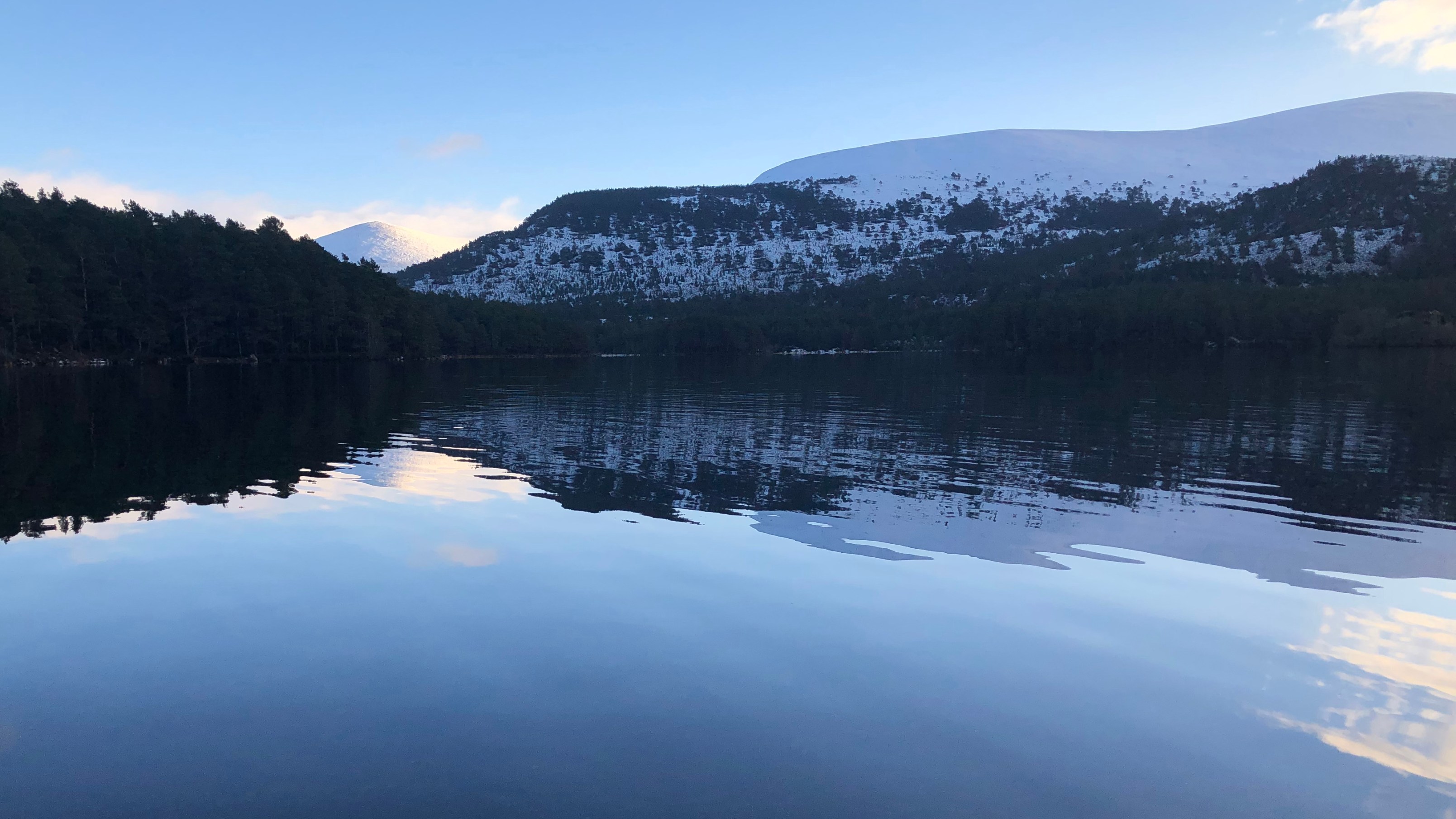
Looking like a blue pawprint when seen on a map, the Uath (pronounced ‘wah’) Lochans are four small pools bordered by pines. Their surfaces are sometimes wobbled by goldeneye ducks but they mostly stay mirror-steady, reflecting the trunks standing around them.
There are two short waymarked trails that can easily be combined into a meandering loop. One threads between the lochans, following compacted earth paths and sections of boardwalk over boggy pools. The other climbs a brief incline, offering an eagle’s eye view over carpets of pine and further into the mountains.
Less than three miles north, the Frank Bruce Sculpture Collection is a series of artworks that have been carved into wood and stone, destined to eventually rot and fade back into their woodland surroundings.
Because the carvings are natural, they have excellent camouflage and some are trickier to find than others. It takes a while for your eyes to adjust before you can pick out sculpted faces and hands among all the other trunks. A needle in haystack situation!
It’s possible to walk a small loop here too, following a stretch of the River Feshie as it tumbles over pale shingle. The river sparkled and the trees beyond shimmered in the winter sunlight.
Although the sun was boiling as it streamed through the car windows, outside was a different matter, so once the chill began to seep through our clothes we returned home. The winter light persisted until the very last moment and I wandered up to the headland to watch the sun set. It’s not often I spend a day without looking at screens, so it was a welcome treat.
Good weather may not be as forthcoming during winter, but I’d argue that winter light is the best of the year, if you can find a break in the clouds.
I checked the forecast and saw a long line of sun symbols, so I donned my thermals and headed out to see what wildlife I could photograph. First I tried for hares at sunrise, but they were otherwise engaged. Frustratingly, golden hour was flaring bright and I was itching to get photos of something, anything, in those syrupy hues.
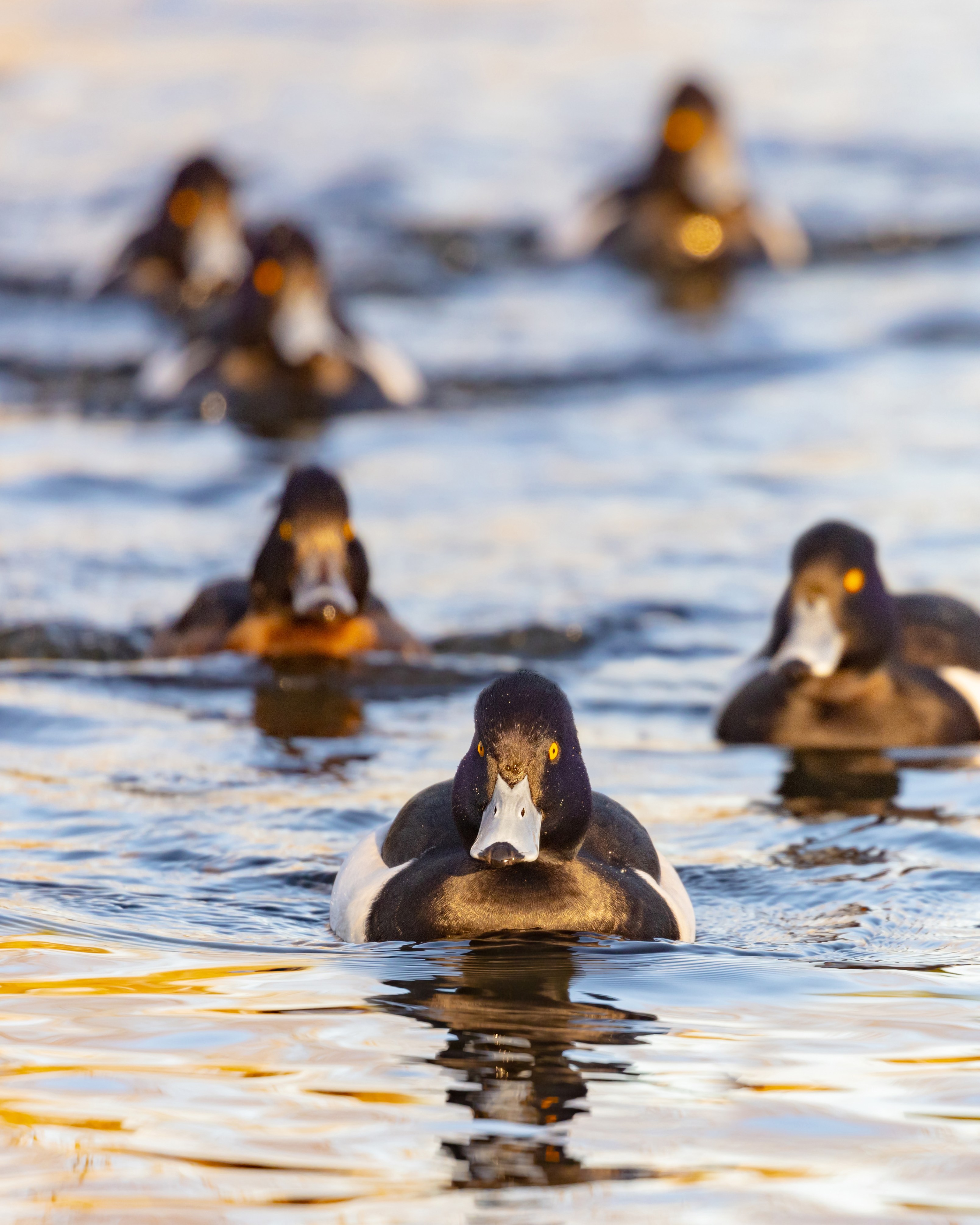
After several hours with a numb bum, looking at diddly squat, I visited the library to return a book and warm up. When I came out, a flock of tufted ducks were bobbing in the city pond. The light was still fantastic, so I lay on the ground and got snapping. Like mallards, tufties have stunning iridescence if you catch them in direct light. I hadn’t set out for ducks, but it was a happy accident and I loved photographing something so closely for a change.
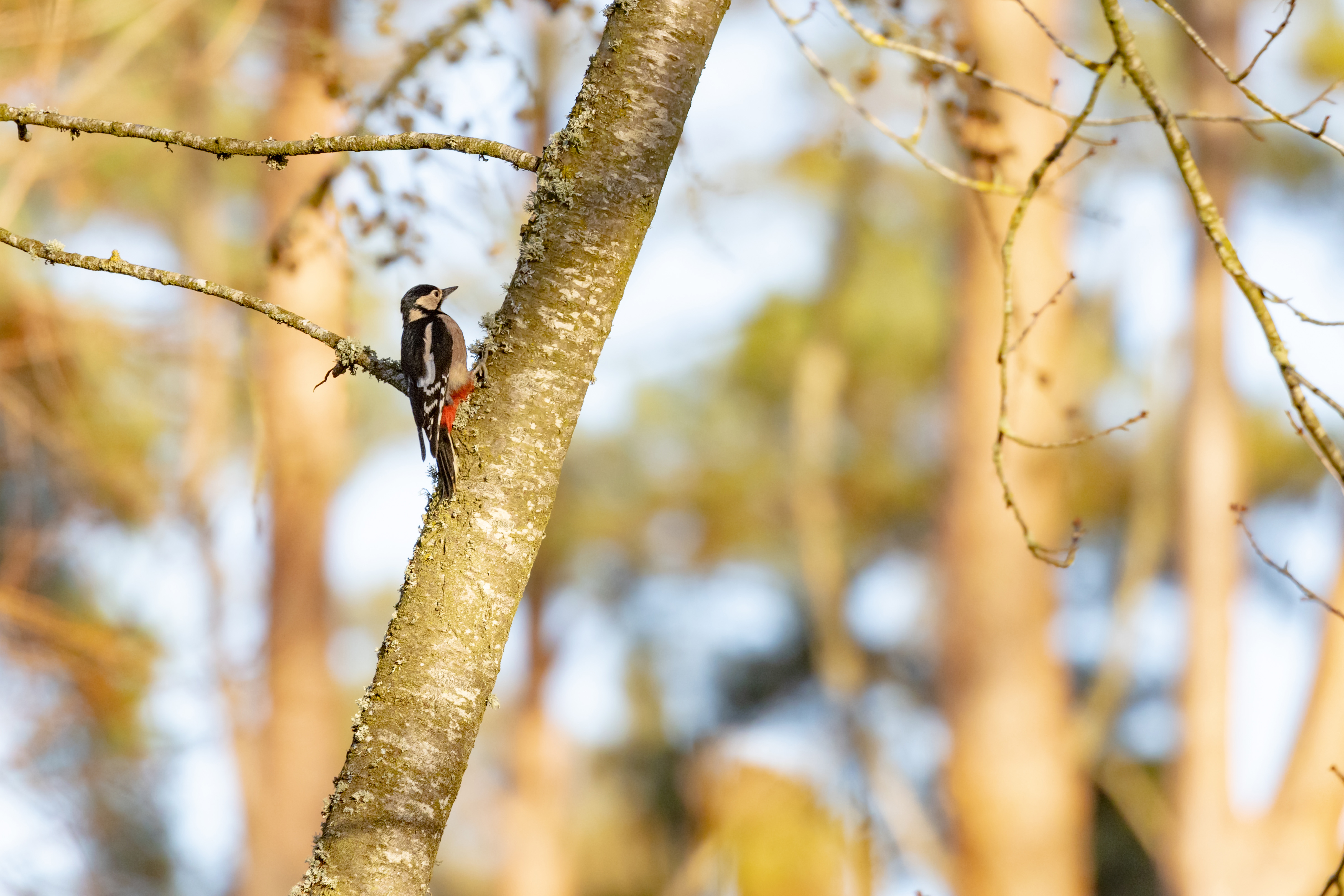
Rejuvenated by my unexpected success with the ducks, I moved on to one of my local lochs, where there’s always some sort of activity. As usual, the feeders were swept up in a feather storm: chaffinches, dunnocks, robins, great tits, long-tailed tits, blackbirds, woodpeckers and song thrushes all muscled in in for a mid-morning snack.
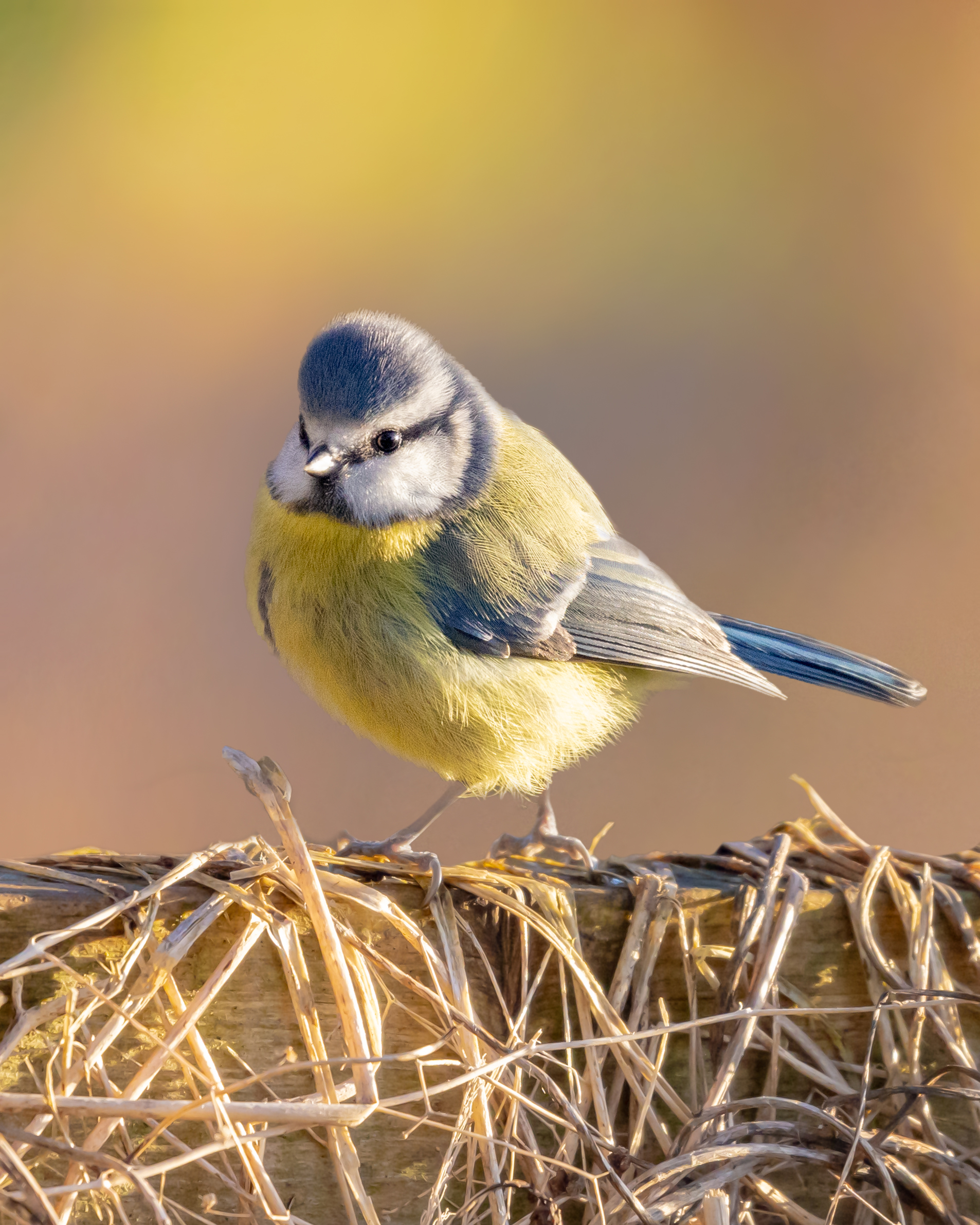
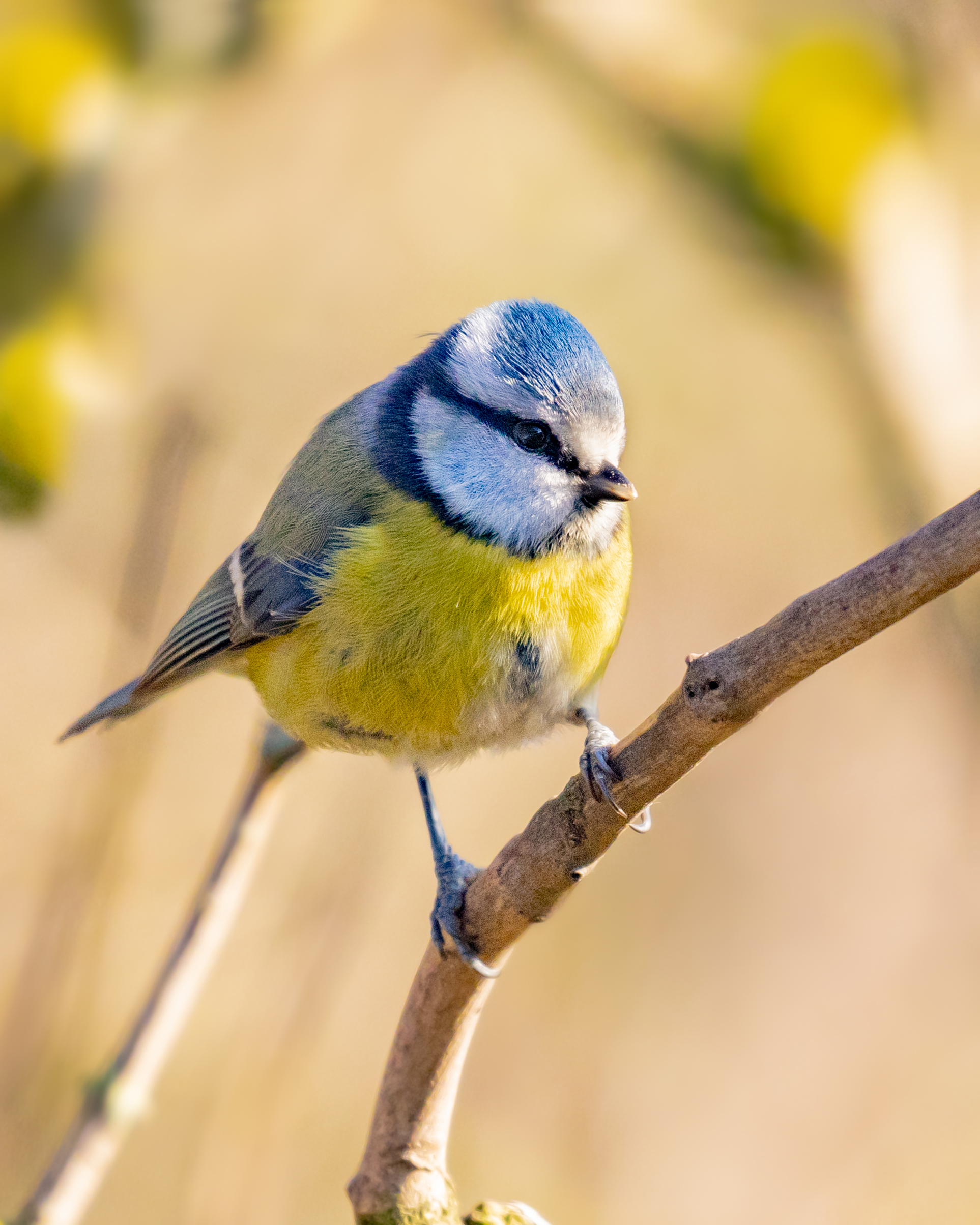
As my eyes snagged on each passing bird, I realised I couldn’t remember the last time I photographed a blue tit. I’m always looking for rarities and don’t appreciate common birds as much as I should. When I actually paid attention to the blue tits that were zinging in the bright sunshine, I appreciated just how multi-coloured they are. A British bird of paradise!
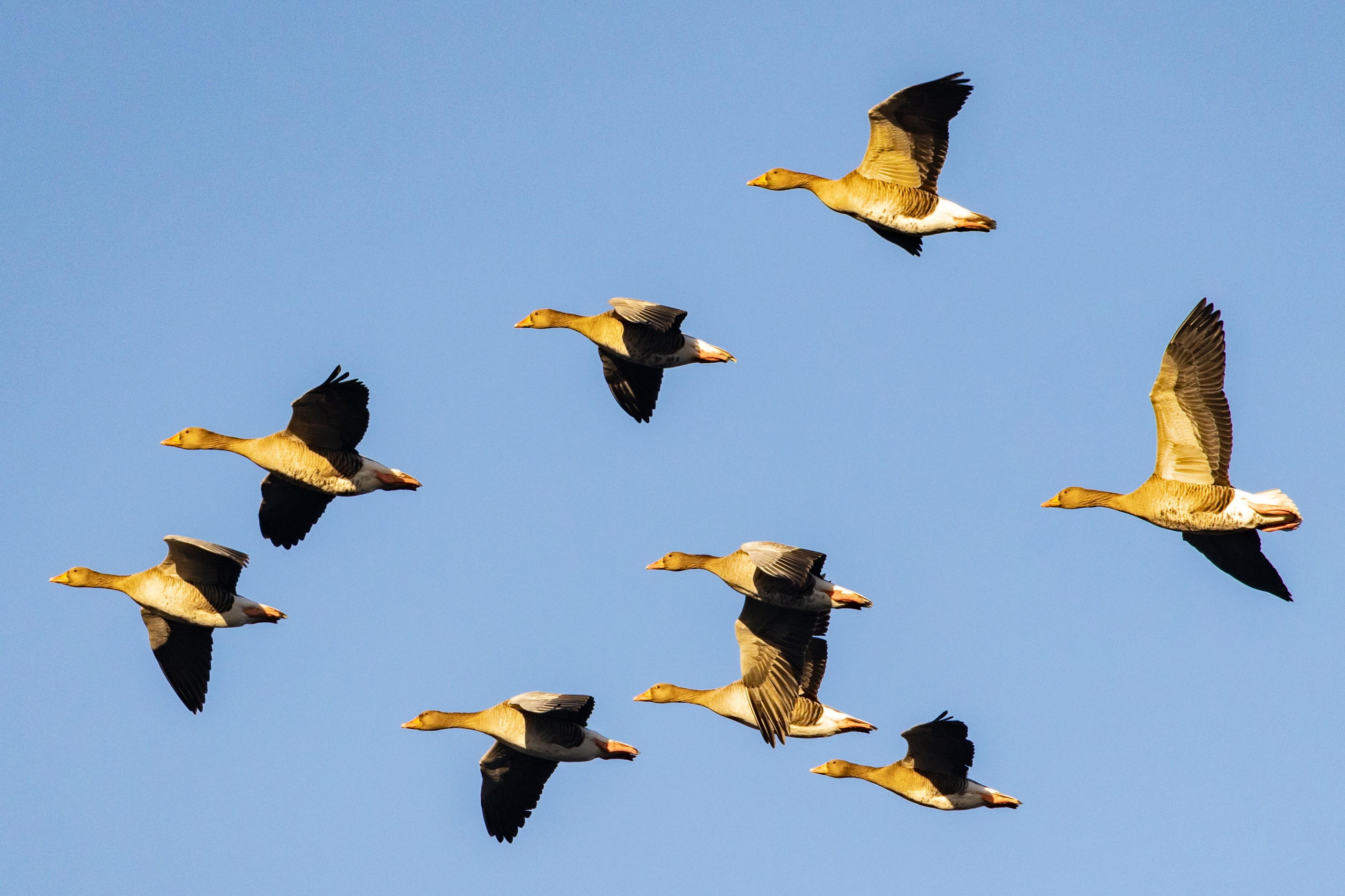
The sunlight may look warm in my photos but it didn’t feel it, and after a while I was ready to retreat for tea. Before I headed home, a small gaggle of greylag geese swept over the loch, dipping in flight until they skidded to a halt on the surface. Luckily for me they were facing the sun, so I caught some high-contrast shots of their smooth landing.
After an uncertain start, my trip became a common bird appreciation day, which I probably needed. I get blinkered looking for the rare and exotic, but with winter light as special as this, every bird looks superb.
The following article was featured in my latest issue of On The Wing magazine, which you can read here. I often see Aberdeen unfairly shrugged off as simply ‘The Granite City’. As with many urban places, there’s so much more to Aberdeen than grey buildings. Here are six of my favourite spots for nature enthusiasts to explore.
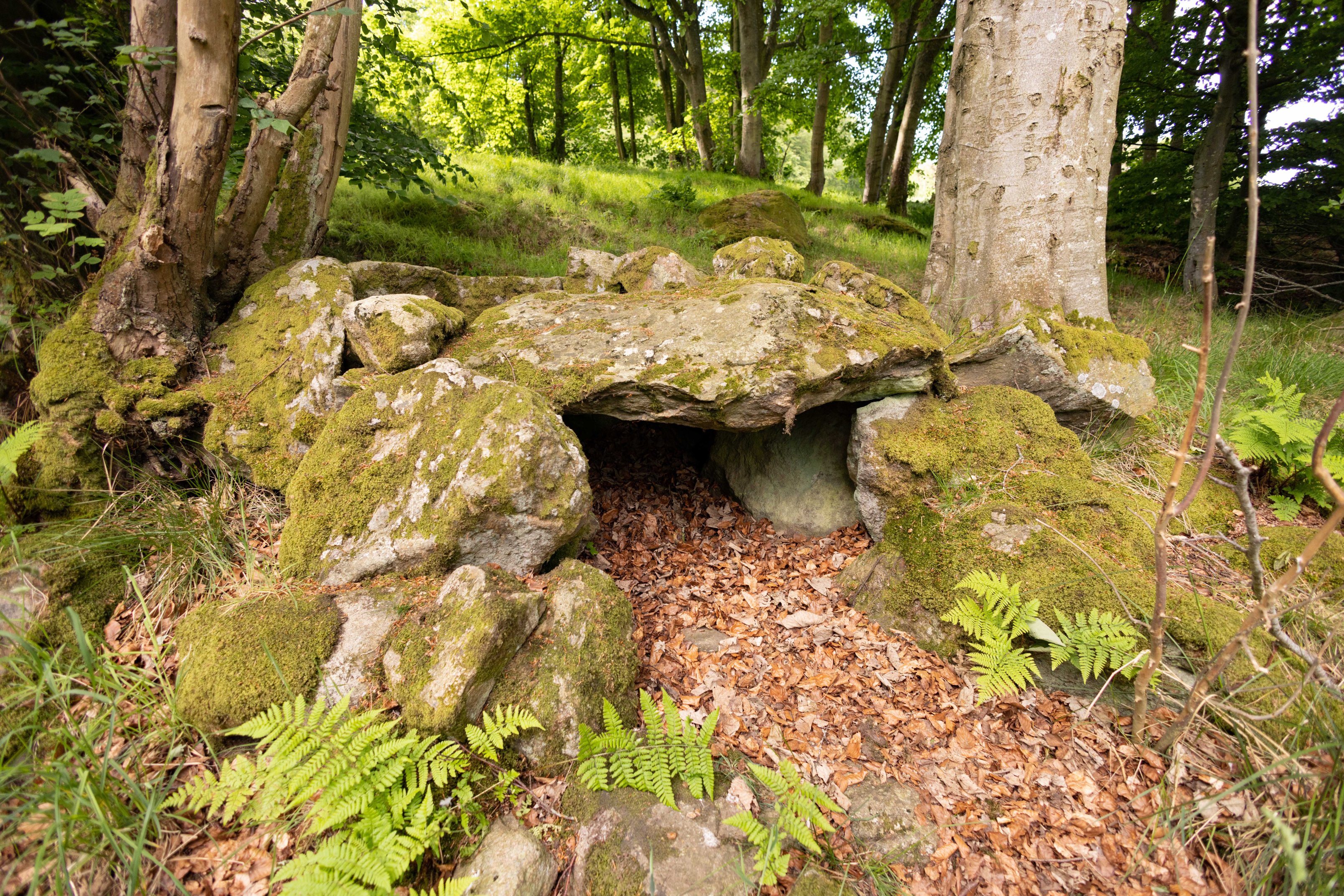
Tollohill Wood
With its deep rocky dells and hip-high bracken, this is what I call a Jurassic forest because it doesn’t take much imagination to picture a dinosaur poking above the foliage. Beeches, birches and rowans line interweaving trails – look out for a Neolithic cairn and a stone monument hidden among the trees.
W3W: flute.saying.plans
Hazlehead Park
Like in all good parks, kids and dogs have open space to run around, but away from the play park area you can sit in a variety of gardens and hear nothing but birdsong. You can also explore Robert the Bruce stone cairns, a sculpture trail and Scotland’s oldest maze here.
Hazlehead Avenue, AB15 8BE
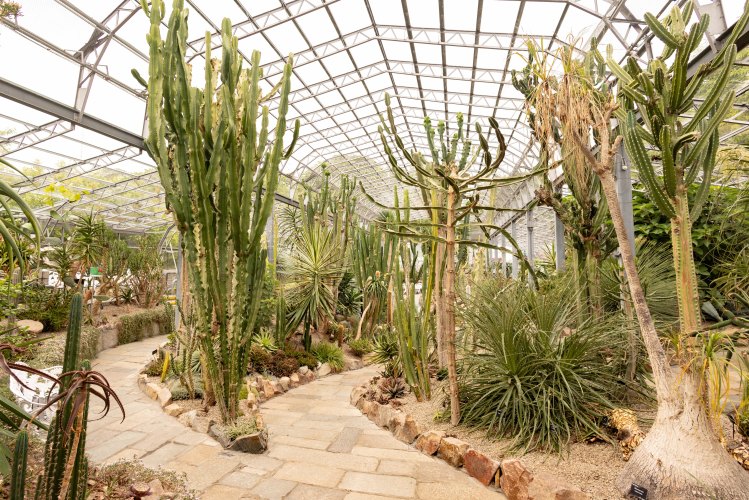
David Welch Winter Gardens
Within Duthie Park, this warren of greenhouses contains tropical flowers, roses, ferns and a squadron of carnivorous plants. I spent an unholy amount of time in the Arid House, where there’s every sort of cactus you could imagine. With more than 750 species, this collection is one of the largest in the UK.
Polmuir Road, AB11 7TH
Open: daily all year round
Entry: free
Greyhope Bay
This small headland forms a curved dell just past Aberdeen’s harbour. A range of seabirds gather in the shallows by the rocks and it’s a great spot to see bottlenose dolphins too. Watch in cosy comfort from the excellent Liberty Café, located within the historic structure of Torry Battery.
Greyhope Road, AB11 8QX
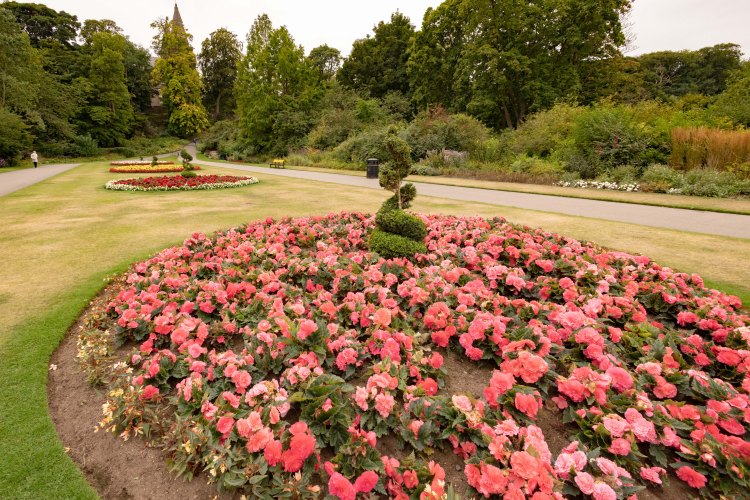
Seaton Park
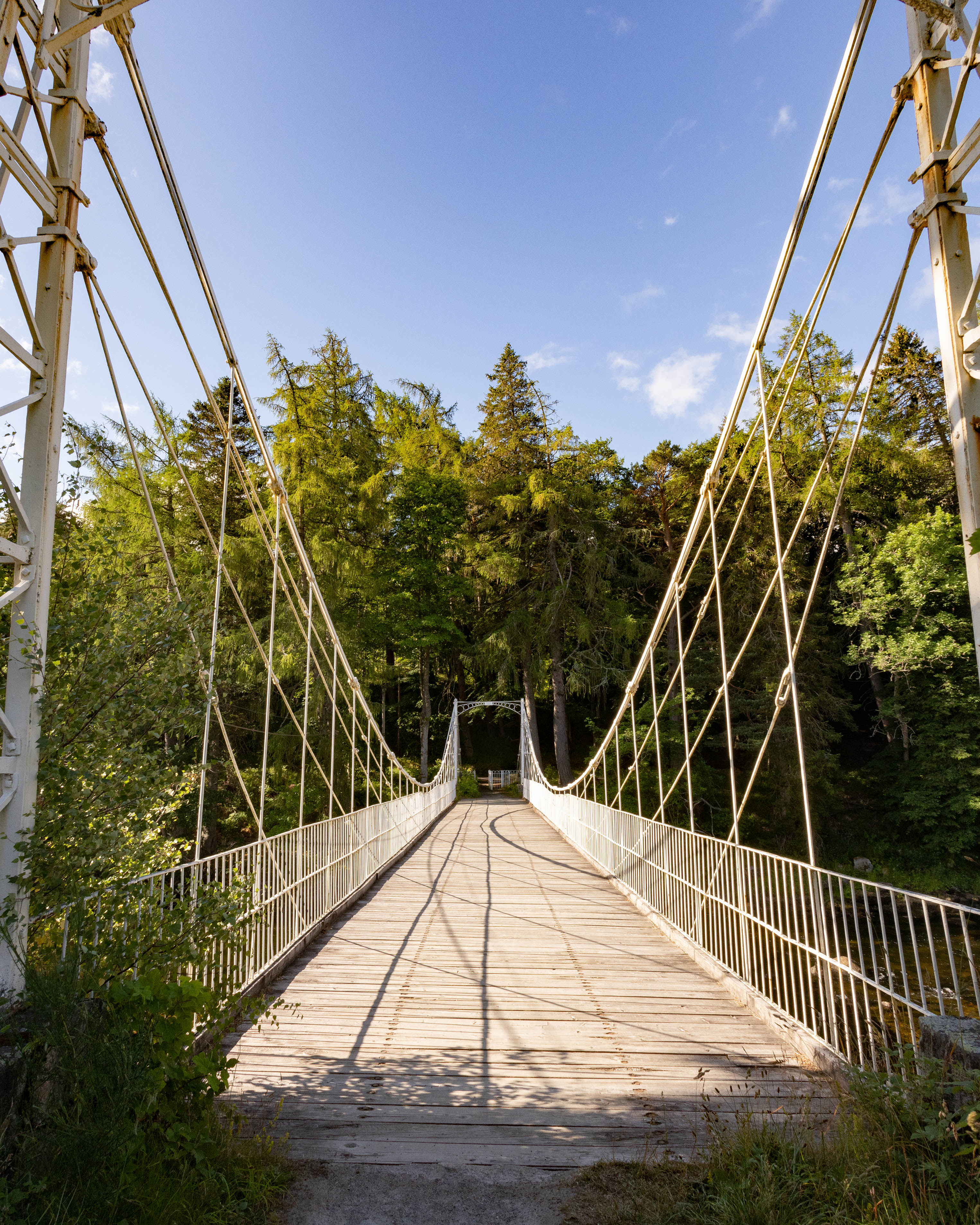
Sitting beside a dangling loop of the River Don, this is the largest green space in Old Aberdeen. Splashes of colour from dramatic flowerbeds, a high quality river footpath leading to a pedestrianised arched bridge, and several concealed features of historical interest make this more intriguing than your average park.
Don Street, AB24 1XS
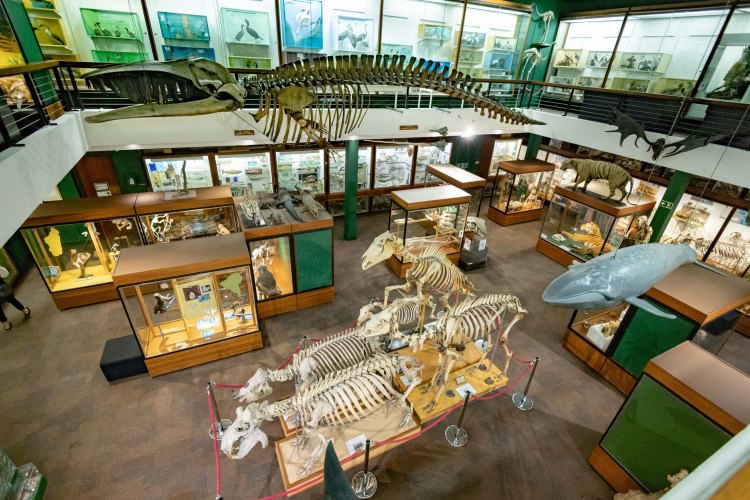
University of Aberdeen Zoology Museum
Scales and fur and feathers oh my! The lower gallery’s skeletons draw the eye first, but also make sure to check out minuscule amphibian bones, corals and a troupe of fish you wouldn’t want to meet down a dark alley. The upper gallery is an ornithologist’s delight, featuring everything from goldcrests to golden eagles.


































 rebeccaonthewing.com