Recently I travelled up to Northumberland to visit friends from university. They are two of the busiest people I know, so I was pleased to be able to steal a few days in October to catch up and visit their local patch.
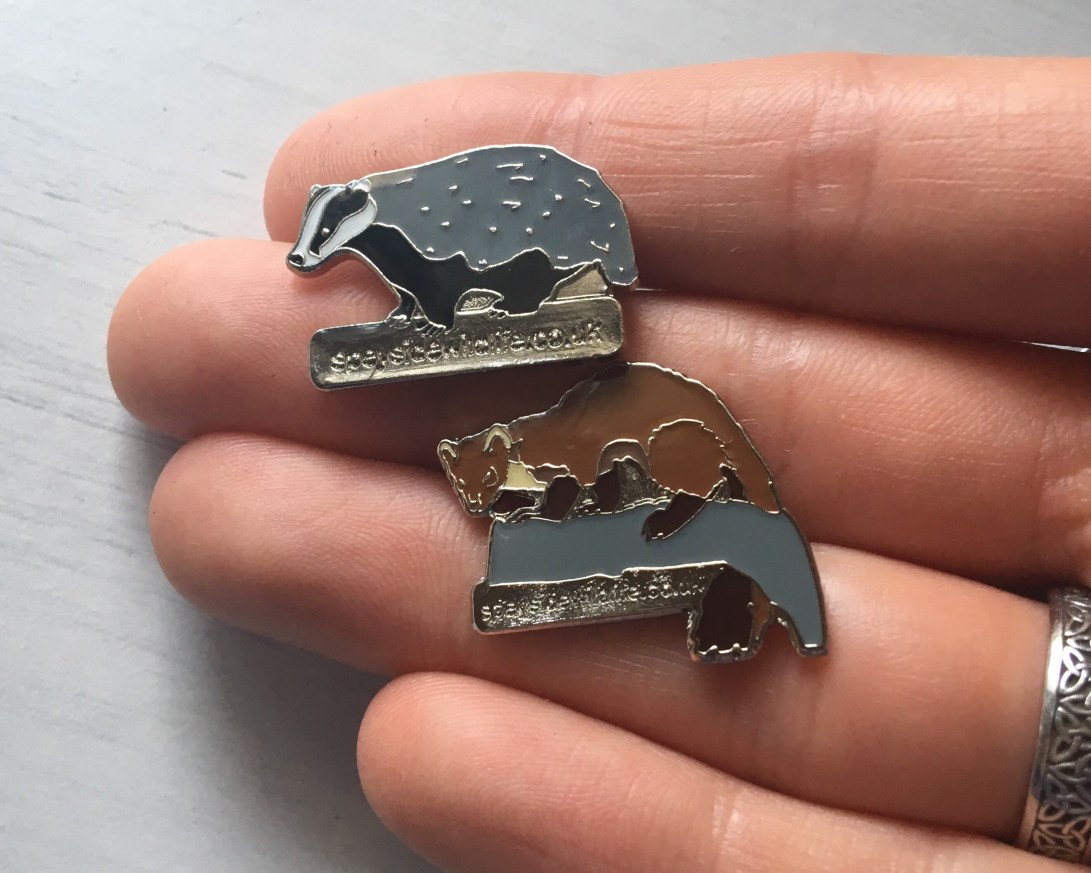
The first thing I experienced was severe house envy. Wildlife art adorned every wall; the sort of beautiful paintings and drawings that I planned to splash all over my own home some day. However, it was the bookshelf that really caught my attention. Sprawled across an entire wall and almost reaching the ceiling, it was crammed with every book on natural history you could want. Not just modern paperbacks but antiquarian hardbacks with leather bound covers and swirling gold titles. In front of every row of books was an envious selection of treasures: pinecones, gannet eggshells, roe deer antlers, pin badges, lino prints, Wade Whimsies, fossils, gemstones, lichens, miniature animal wood carvings and a beautifully preserved badger skull with its lower jaw intact. I spent ages studying everything in turn, gravitating first to the roe antlers. I have a roe buck skull of my own – one of my most prized possessions – but I still long to find dropped antlers too. It was an impressive collection of everything nature, framed by dozens of books from my wish list.
I stayed with my friends for a long weekend and managed to cram quite a lot into those few days. Heather and I visited a fantastic patch of woodland, which was home to not only red squirrels but also pine martens! I knew we probably wouldn’t catch a glimpse of one during the day, but it was still exciting to walk among trees that might be housing a sleeping marten. It was so peaceful and quiet with only faint birdsong punctuating the air. As we searched for fungi to photograph, I found a gorgeous caterpillar making its way along the fence. Later, we discovered it was a buff tip moth caterpillar.
Photo by Heather Devey
The next day I helped Heather with a “Mini Wildlife Adventure” that she was running for a child’s birthday party. The boy was intrigued by nature and so he and his friends spent the morning pond dipping, searching for bugs, finding badger prints and birdwatching in a hide. It was such a fantastic idea for a birthday party, and it was particularly refreshing to see that the boys had good wildlife knowledge and were genuinely excited by what they saw. Educating children about nature at a young age is the key to ensuring they continue to care about it when they grow up. Those boys would have spent hours pond dipping if we’d had the time, and it was so lovely to see.
Here there be badgers
That evening Heather, Cain and I spent a peaceful last evening watching Sherlock with the fire cracking and snapping in the grate. It had been a pretty jam-packed weekend but as always, I felt inspired with a rejuvenated love for nature that always comes after a trip to northern England or Scotland. I sometimes struggle to feel that same passion at home in the south, where there are more people and noise and far fewer pine martens. I love escaping to the wilder parts of the UK and look forward to another wildlife adventure very soon.
I was so excited for last weekend’s A Focus On Nature’s “Now For Nature” conference at London’s Natural History Museum. Specifically aimed at 16-30 year olds, AFON is all about young people in conservation. Wildlife isn’t often popular among young people, so having the chance to meet like-minded individuals my age was a brilliant opportunity. From talks by big names such as Chris Packham and Stephen Moss to productive workshops from successful conservationists, the event was an inspiring weekend full of Conservation Optimism.
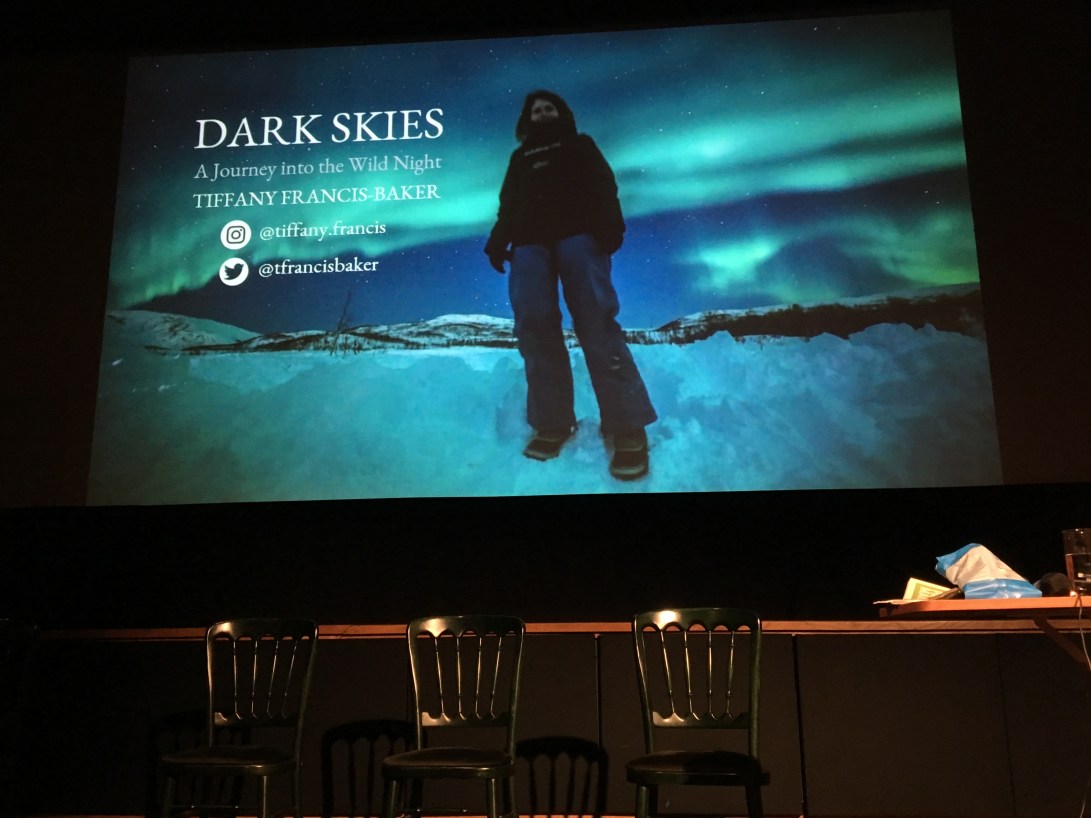
I was particularly pleased to meet Tiffany Francis. At just 27 years old, she has three books published, which is an incredible and inspiring achievement. Her big break came from AFON itself, where she wrote an article on wild foraging that was picked up by Bloomsbury and turned into a book. Tiffany went on to write her second about British goats – taken from her time working on a farm – and her latest book Dark Skies, released only last week, is about our relationship with darkness and wildlife at night. As well as writing the book, Tiffany also produced all the illustrations including the book’s front cover.
Speaking to Tiffany afterwards, I discovered how approachable and open she was. We chatted like we knew each other; in fact, when I gave her business card she said, “Oh you’re rebeccaonthewing!” which was a fantastic feeling.
I told her about the trouble I’ve had finding a specific identity in my writing and establishing a niche without cutting myself off from other readers. I also suffer from overthinking, which ends up being a real obstacle that stops me from writing. One thing I’d like to try is free writing, where I just sit and let thoughts pour onto the page. I’m hoping that not only will this lessen the inhibiting effect of overthinking but it will also generate new ideas. I’ve learnt that getting hung up about writing means you don’t write.
Tiffany’s reply was that I should just write what I enjoy writing. For a while she had conflicting ideas about her own professional identity. Was she a writer or illustrator? At the time she felt she couldn’t be both, which made filling out social media bios a real trial.
She later realised that she didn’t have to label herself as anything. She was a “creative”, which could mean writer, artist, public speaker and a whole range of other things. I’ve experienced this too, deliberating over “writer” and “photographer”, and although they’re not my greatest strengths, I also love painting and drawing which ties in nicely with nature writing as Tiffany has proven. I’ve come to realise that all these skills come together to form my identity as a “creative” and it is constantly changing and adapting. It doesn’t need to fit in a bio box. Tiffany said all that’s important about your work is it pays the bills, makes you happy and makes a difference. While the first may take a while, I can continue with the second and strive for the third.
Recently I was accepted onto the Travel and Nature Writing MA at Bath Spa University, which I’ll be starting later this month. In preparation for this exciting new challenge, I signed up for a travel writing workshop run by Peter Carty, who regularly writes for publications such as The Guardian. Although my focus will definitely be more on the nature half of my MA, there is a lot of overlap with travel and I would love to develop my portfolio in this area.
Peter’s workshop was extremely useful, especially the postcard exercise. Over lunch, we were let loose into London with a blank postcard. The challenge was to find a new and intriguing place and write a short travel piece about it on the postcard, including quotes from people we met along the way. As a wildlife writer I’ve had very little experience with interviews, so approaching strangers and getting quotes was daunting but rewarding. I decided to visit the Grant Museum of Zoology in Fitzrovia, which turned out to be a treasure trove of taxidermy and scientific specimens.
________________
Micrarium
A jar of moles, a penis worm and a dissected rat. These are just some of the specimens on display at the Grant Museum of Zoology. But past the imposing elephant skulls and ominous, pickled jars is an intriguing display of alien-like creatures nobody would notice in the wild.
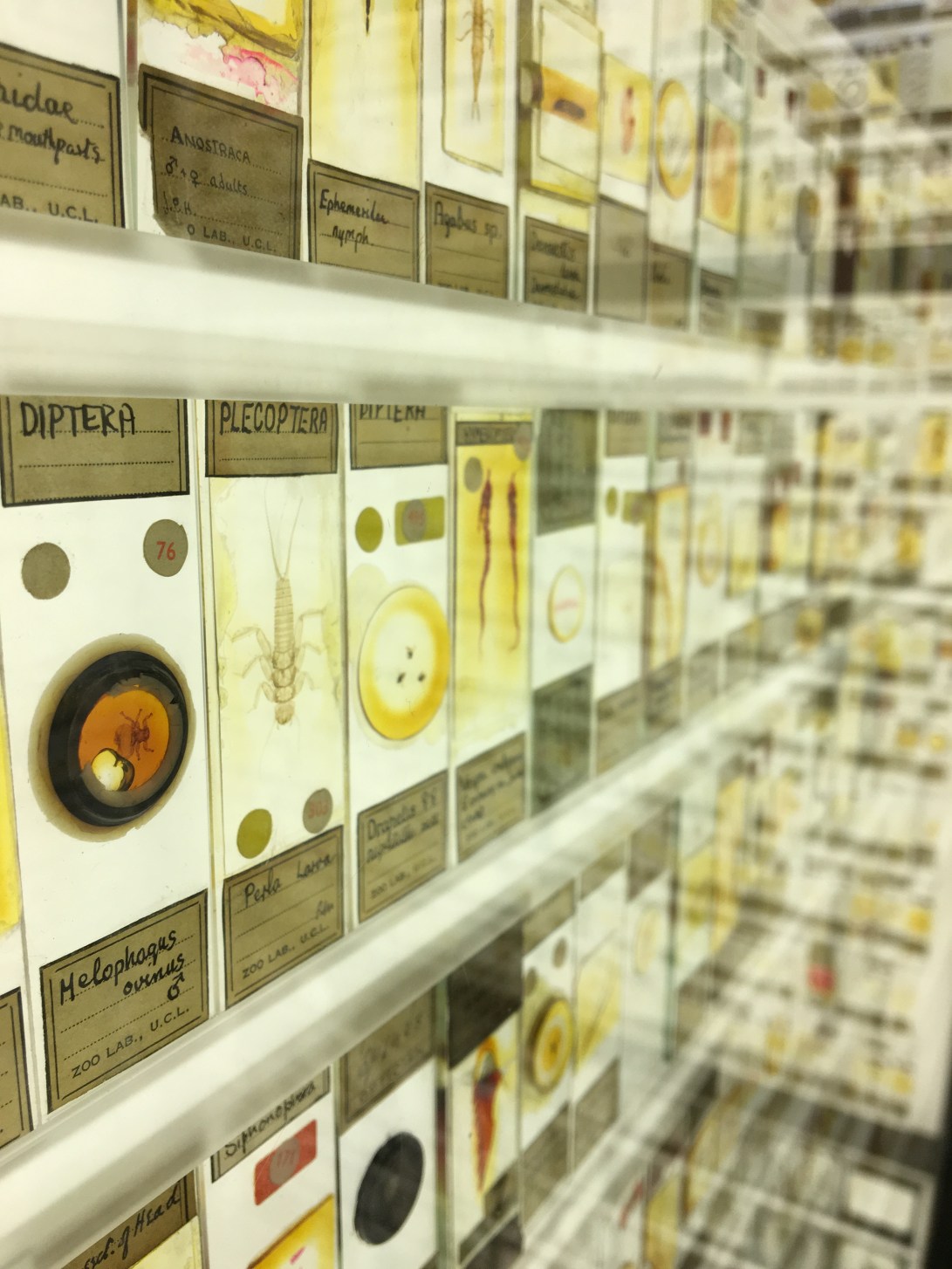
It’s said that 95% of known species of animals are smaller than a human thumb. The Grant Museum, named after British anatomist and zoologist Robert Edmond Grant, sheds light on the mysterious and microscopic in its Micrarium: a seemingly infinite display of backlit microscope slides that are creatively reflected in a mirror mounted on the ceiling. There are 20,000 slides in the whole museum, but the selection of 2000 in the Micrarium exhibit alone is impressive enough.
“It’s probably one of our more popular exhibits,” explained volunteer Margaret, “We get lots of people taking photos for Instagram.”
I can see why. Step inside this bizarre taxidermic phone box and you can observe minute insects and cross sections of tissues in astonishing and multicolour detail, painstakingly plastered across three walls. Among the specimens are the muscly leg of a flea and a whole squid measuring less than a centimetre long.
“While public displays very much focus on larger animals,” said Jack Ashby, manager of the Grant Museum, “Most natural history collections have thousands of very small specimens kept in their storerooms which are rarely shown to the public.”
Once used for research at UCL, the neighbouring university, the Micrarium now enthuses the general public instead, uncovering secrets of the miniature monsters that crawl well out of human sight. It’s not quite the blue whale at the Natural History Museum, but it’s an insight into 95% of animals on our planet, which definitely deserves a second look.
Lucy McRobert lost her mother to cancer when she was sixteen. Although it wasn’t as easily recognised at the time, she feels she suffered from some form of anxiety or depression, which she unconsciously suppressed until university when she rediscovered her love of nature. It was this passion for wildlife that helped her overcome the grief she had kept concealed for all those years.
It’s been proven that spending time outside and connecting with nature improves mental state and wellbeing. “Just like eating a balanced diet and exercising helps our minds and bodies”, Lucy writes, “Wildlife and wild places help us to get active, encourage us to be more social, improve our confidence and creativity and help us cope with stressful life events”. It’s true that nature is free therapy, but it’s also true that with hectic schedules and mundane commitments it can be difficult to get outside, or sometimes even find the motivation to do so.
That’s where 30 Days Wild came in. During her time working for the Wildlife Trusts, Lucy set up the 30 Days Wild campaign to encourage people to do “random acts of wildness” for every day in June. Involvement has grown exponentially since the campaign began five years ago and encourages everyone to take part in wildlife-based activities, whether that’s noticing something new, sharing experiences with others or taking a more practical approach and making positive changes to the environment.
The campaign led to Lucy expanding 30 days into 365 and so came her beautiful new book, published earlier this year. The concept isn’t to climb a mountain or build a pond each day, but instead encourages us to take part in ways as simple as making a daisy chain or buying a reusable coffee cup. When broken down into small steps and prompted by useful hints and ideas, Lucy’s book shows that it’s easy to stay wild even in a technological world.
I’m embarrassed to admit that I signed up for 30 Days Wild a few years ago and abandoned ship within the first week. Now I see that I’d had my sights set too high. Sometimes it’s impossible to walk outside every day, so Lucy recommends stashing back-up plans up your sleeve, such as buying a new field guide or queuing up a Netflix documentary when you’re feeling lacklustre or just lacking the time.
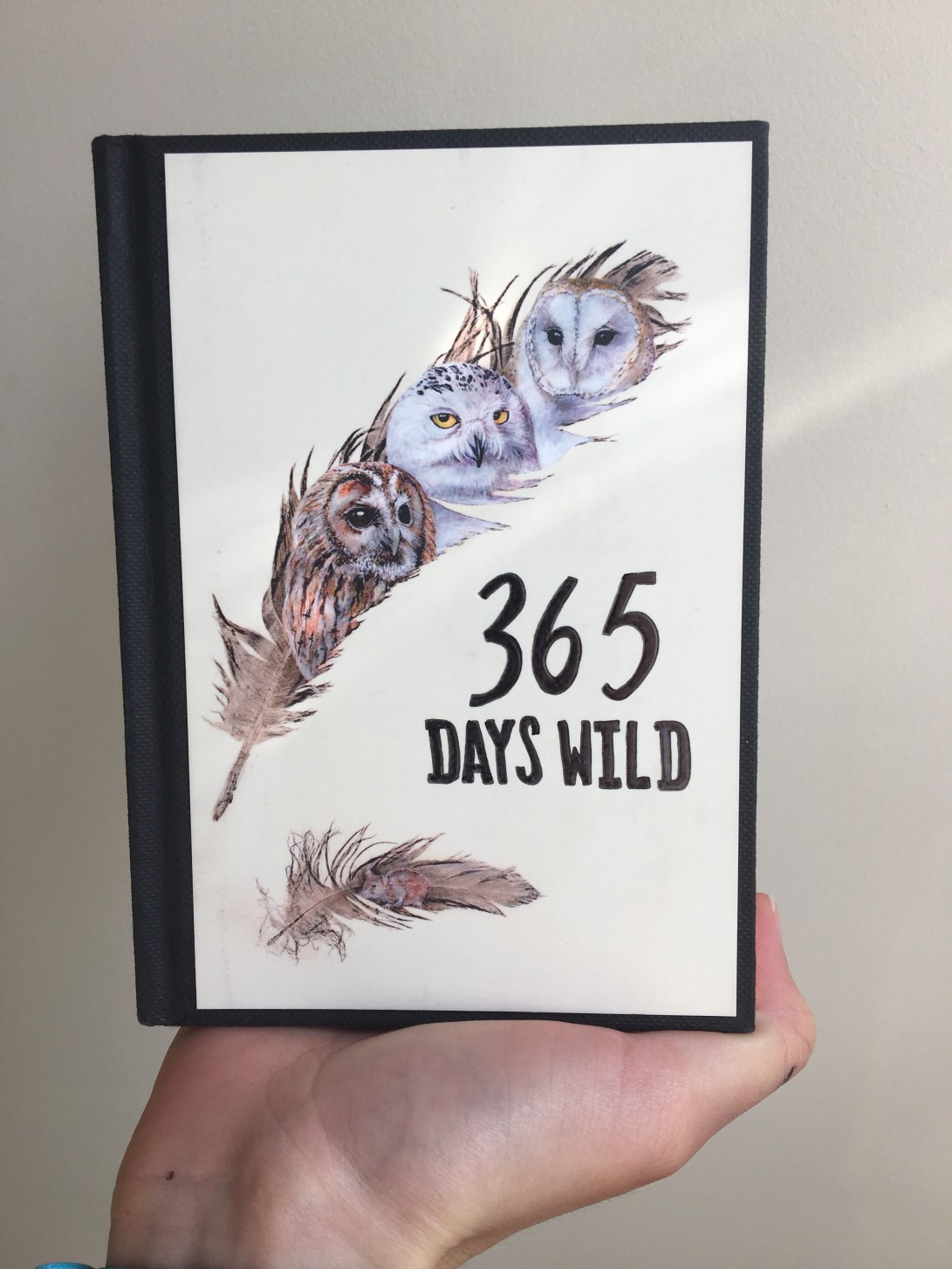
Inspired by Lucy’s passion and eager to give the project another go, I purchased something I’d seen earlier at Birdfair but couldn’t think of anything to use it for. I’d spotted a beautiful hardback sketchbook with stunning artwork from Mandi Baykaa-Murray AKA “The Feather Lady” on the front, who paints extraordinarily detailed bird portraits onto feathers (side note: check out Mandi’s art it’s truly incredible!) Now I had the perfect reason to buy it. Day one: Start a wild diary.
Once I’d pushed my belongings through the campsite in a wheelbarrow, I began the head-scratching task of setting up my tent. I didn’t have much camping experience, but after a practice in the garden earlier in the week I was feeling confident. There was a brief tussle with a stiff breeze, but soon I had everything pegged down and in location. I was in business.
I straightened up to admire my handiwork and locked eyes with a cow twenty feet away, separated from me by a wire-thin fence. I wasn’t entirely thrilled with my neighbour for the weekend and eyed her suspiciously. I’d always been a little wary around cows – a few years ago I’d been crossing a field full of them, which had unfortunately been unavoidable, and when I was halfway across the herd started lumbering towards me at full speed. They say you shouldn’t run from cows, but I had vaulted over that fence with the steely determination of a long jumper. Luckily, this one didn’t seem like she had it in for me, and only stopped long enough to urinate before plodding back towards the herd.
Once everything was in order, I sat in my camping chair and admired the view. The setting sun cast a pink blush over Rutland Water. Although this campsite was slightly further away from Birdfair than the main site, this one had far superior views, not to mention it was blissfully quiet. House martins were out in force, plucking insects from the air and plunging in graceful loops. A little further away a kestrel was hunting, body suspended motionless between two rapidly beating wings. In the stillness, a gaggle of chattering geese passed overhead, but they were too far up for me to recognise the species.
I couldn’t wait for Birdfair to begin. This year would be my third, and I loved being a part of such a prestigious and important event in the wildlife calendar. It’s wonderfully indulgent for bird nerds like me – an impressive gathering of thousands of naturalists, conservationists, photographers and more, not to mention a dizzying range of things to see and do.
Once the sun had set, leaving behind an evening chill, I retreated to the warmth of my tent, snuggling up in my sleeping bag to get a good night’s shut eye in preparation for the first day of the fair.
Although it may not look like it on this blog, a lot has happened over the past few weeks. It’s high time I put out an update, as I was very conscious of the gap between posts getting longer and longer. I’ve been suffering from a crippling case of writer’s block pretty much since my last post from the Grant Arms Wildlife Book Festival in April and it’s been driving me crazy, as The Block has a habit of doing.
Recently my optician told me I have both blepharitis (dry eyes) and Posterior Vitreous Detachment (PVD), which is the reason behind my numerous floaters and flashing episodes. Luckily, neither condition is sinister in my case, but I’ve now become very conscious of straining my eyes from too much screen time. However, as a writer who prefers to type (it’s the only way my hands can keep up with my brain), it’s meant that I’m now reluctant to gaze at my mac screen for hours on end. So, I’ve been considering going full-on retro and getting a typewriter, which honestly is something I’ve dreamed of owning for years. As well as being loads of fun, it would be a screen-free alternative to typing that would give my eyes a rest.
Elsewhere during my long absence, in an attempt to meet new people and also learn new skills, I’ve joined my local writers group and started singing lessons. Verulam Writers has already pushed me out of my comfort zone. I’ve read out several of my pieces during manuscript evenings and got new perspectives on description in a recent workshop. It’s so refreshing to hear how others write because although it’s not always a genre I write in myself, it’s still so useful to hear how different writers approach tackling synopses or developing characters. Although I’m still trying to fight my way out of writer’s block, being around fellow writers has been very reassuring and it’s the right environment for me to get back into it again.
As for singing, I’m having an amazing time. I got back in contact with my piano teacher after a three-year break – it’s hard to believe that the last time I saw her was before the whole whirlwind of university – and asked her about taking up singing lessons, which was one of the best decisions I’ve made. She is an absolute tonic and helps me forget my uneasiness about The Block (and honestly my whole future) for a short time. I love singing; I find it incredibly relaxing and often quite uplifting. To now be able to improve my technique and feel my voice getting stronger is so incredible. After only three lessons I’m already hearing a difference in high notes, which is something I’ve always struggled with.
In addition to singing lessons, I’ve got something else exciting to look forward to: next month I’m going to Madrid! I was determined to make the most of a block of holiday off work and I’ve wanted to go back to Spain and practise the language for ages, so I seized the day and booked myself five nights in Plaza Mayor – bang in the centre of the city. I’ve been shredding through Lonely Planet guides and have assembled a list of landmarks, events and, perhaps most importantly, restaurants that I need to visit. Now I have to schedule a plan of action to see as much as possible without burning myself out. Either way, I’ve indulged in a beautiful new Panasonic compact camera to tuck into my bum bag and capture some of Madrid’s charm.
So, although writing has been agonisingly slow this month, I’m hoping that my new extra-curricular timetable will really help me get inspired. Writer’s block is an inevitable evil that you can try and push through, but I think sometimes it’s best to step back and approach new things that take your mind off it, which can actually help more in the long run. All I can say is bring on Madrid!
Our meeting point was a narrow track just outside Aviemore. The light was beginning to fade and the moon shone in a clear sky, fringed by a sprinkling of stars. We threaded our way up the track, keeping an eye out for roe deer in the surrounding fields, and eventually reached the hide: an impressive building with large windows running along each side. The interior was luxurious; carpeted flooring, posters adorning the walls and above all, heating! It was indulgence that I hadn’t had the fortune of experiencing in a lot of hides. This one was positively posh.
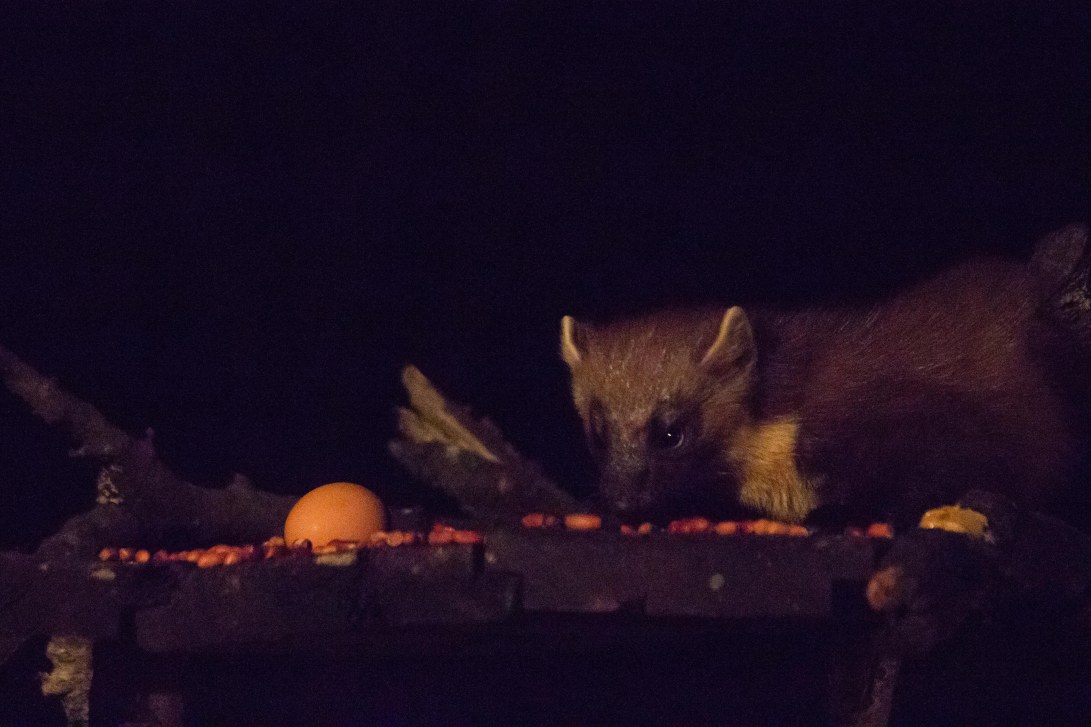
Once inside, there was the habitual jostling for the best space as politely as possible. The guide always says that the animals may come from any direction, but we all know some spots are usually better than others. After we were all settled, our guide James left the hide to distribute the food. He explained the importance of only providing a supplement to the animals’ diet to make sure they didn’t become reliant on human assistance. On the menu tonight was a selection of peanuts, raisins, dollops of peanut butter and the ultimate prize: an egg.
So what were we hoping to see at this time of night? To Victorian gamekeepers, they were the “scourge of the glen”, known for stealing the eggs and chicks of ground-nesting birds. In my opinion, they were on par with the unicorn – a creature so stealthy and elusive that although they’re relatively common in Scotland and doing well there, they are very rarely seen. Coming to a hide dedicated to seeing them is your only semi-reliable chance, but of course nothing about wildlife is ever guaranteed. I’m talking about the pine marten.
Photo: Jai Redman
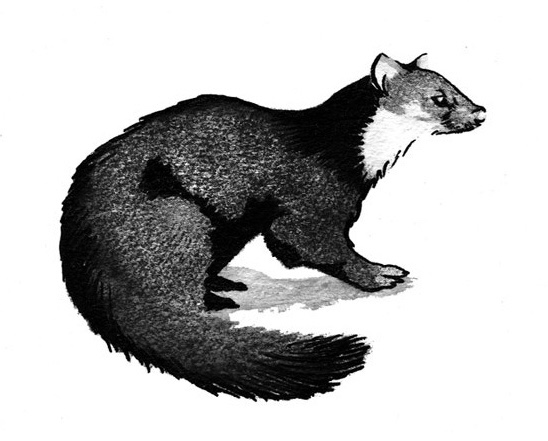
A member of the mustelid family with otters, stoats and weasels, pine martens are cat-like and forest-dwelling. Their coats are a rich, chocolate-brown and each animal has a unique pattern on their bib ranging in colour from yolky yellow to almost white. Pine martens are adept at dispatching grey squirrels, which are slower and less agile than reds. The latter have evolved alongside martens and know how to evade them, which is why there are no grey squirrels in the Highlands and plenty of reds. It’s interesting to think that if pine martens had been abundant across the whole of the UK when grey squirrels were introduced in the 1870s, would we have such a drastic problem with this invasive rodent today?
Once the food was in place, the wait began. Not only were we hoping for martens but also badgers, owls, a deer perhaps. It was a complete lottery, which made the whole thing incredibly exciting. The light was fading fast and my camera struggled to cope. Cranking up the ISO caused a sandstorm of grain to fill the screen, but I wasn’t planning on prize-winning photos on this occasion. This was one of those times when, more than anything, I wanted to watch.
After a short while we had our first visitor. Out of a knot of tree roots came a wood mouse. It appeared as though time had been sped up – the mouse zoomed out into the open, seized a peanut and retreated into its shelter within what seemed to be the blink of an eye. He or she entertained us for a while but before long it was quiet again.
Gazing outside into the dark clearing roused a slight feeling of unease. The longer I looked, the more my eyes played tricks on me. Shadows took on the appearance of strange shapes appearing to move on their own. Coupled with the expectant silence in the hide, the scene was close to eerie.
My eyes kept flicking to a shadowy patch just out of reach of the yellow spotlights. Beyond it the ground dipped into a shallow hill that plunged into complete darkness. I kept picturing a marten cresting the hill and trotting along the track for the tempting egg. I thought if I imagined this hard enough, it just might happen. I appreciated this fantasy had an undeniable whiff of desperation about it.
Suddenly, a flash of pale wings caught my eye. I glanced up and watched a scene unfold in slow motion. A bird catapulted through the air, wheeled tightly around the mouse’s tree and swept straight past the window. A blink-and-miss-it moment. For a few seconds I was stunned. I’d never seen a tawny owl before, and couldn’t believe how small they seemed! Small, yet incredibly skilled hunters. It really was a privilege to get nocturnal wildlife encounters, especially scenes as dramatic as a high-speed fly-by from a tawny.
After that exciting moment, there was a distinct lack of life for quite some time. It was still early days, I reminded myself, eyes flicking once more to the shadowy patch, there was time yet. I leant forwards on my stool, peering so close to the window that my breath fogged up the glass. Martens could approach from anywhere, and being so dark they would be completely concealed apart from their trademark bib.
The other visitors coughed, switched seats, paced up and down and chatted in hushed whispers. Meanwhile, I was glued to my stool. Far from blessed with social prowess at the best of times, I refrained from making conversation and kept my eyes planted firmly outside – there was no way I was missing anything.
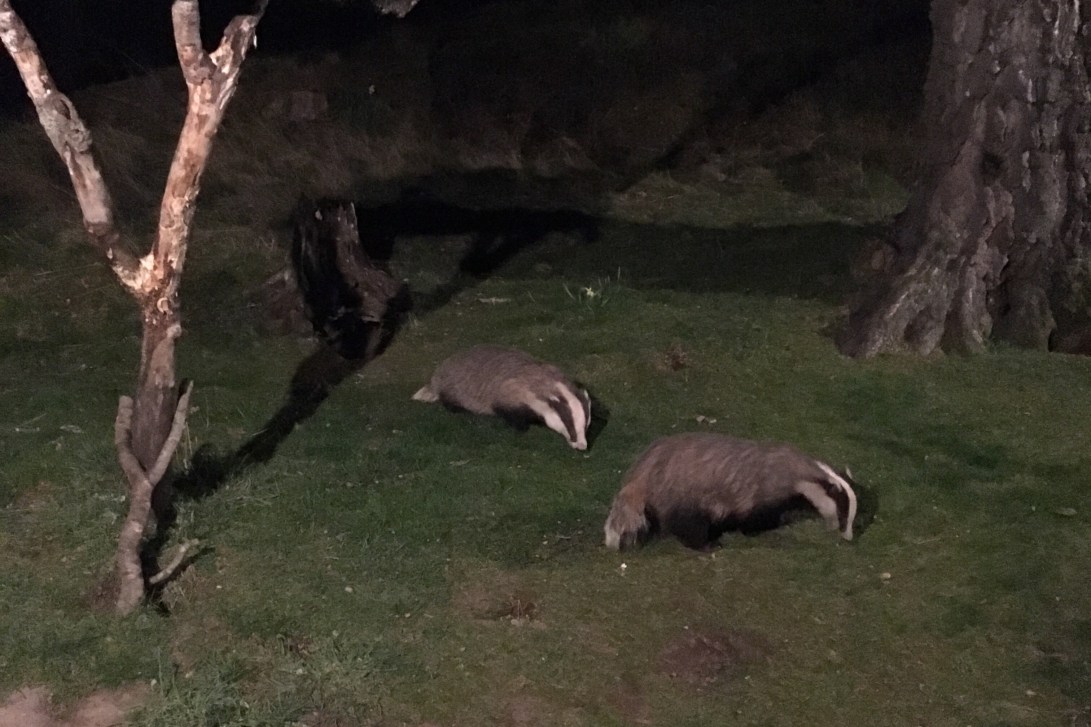
There was a sudden, hushed commotion in the hide and I peered to the side to see a badger had appeared. Badgers have terrible eyesight but an exceptional nose, and mainly use smell to discern their surroundings. The animal picked her way across the grass, fanning her snout over the ground like a metal detector. Tragically, my previous badger experience consisted of road kill and one that I had nearly killed myself when it ran out in front of my car, so to watch a real, live badger going about her nightly business mere feet away was such a treat.
After she’d polished off most of the nuts, the female was joined by a male. He was the same size, suggesting he was also the same age if not younger. Adult male badgers typically weigh a kilo more than females and are noticeably more muscular. The two animals completely ignored each other so there was no doubt that they belonged to the same clan. If they hadn’t, there would have been a serious standoff. The male cleared up what the female hadn’t found and one by one they left the way they’d come. The only evidence of their visit was a distinct lack of peanuts.
An hour and a half later, my enduring optimism was beginning to turn. I was conscious of the time and that our evening would eventually come to a close, marten or no marten. I started seeing more and more phantom animals out in the gloom. The moon was radiant and my eyes were drawn to its pure white hue. A lone bat darted over the roof of the hide, silhouetted briefly against the lighter sky before disappearing. How anyone got a decent photograph of a bat eluded me. To capture such erratic and rapid flight was seriously impressive.
I glanced over at the shadowy patch again and saw a pine marten staring back at me, beady eyes glinting in the light. My insides jolted and as quietly as could I exclaimed, “There’s one!” Everyone knew exactly what I meant and came hurrying in my direction with barely restrained urgency. I couldn’t quite believe what I was watching on the other side of a pane of glass.
James told us the marten was a female. Similar to badgers, males were larger and typically had broader faces. Many people underestimate a marten’s size when they see one, imagining something along the lines of a weasel or stoat. I was quite the opposite; the marten was smaller than I’d expected, smaller than most house cats. What couldn’t be disputed was how beautiful she was with her long bushy tail, sleek mocha fur, tiny button nose and white-rimmed ears. I fell instantly in love.
The marten crossed to the other window and we swiftly followed suit. She climbed up onto the table and munched through the peanuts. As stunning as she was, she certainly wasn’t the most ladylike when it came to eating. She took the egg in her mouth and, despite her sharp teeth, carried it delicately down the table onto the grass. After a quick readjustment, she lolloped out of sight.
We’d spent two hours in darkness and experienced less than a minute of what we’d travelled here to see, but the atmosphere in the hide could only be described as barely contained hysteria, in my corner at least. We made the unanimous decision to end our evening on a fantastic high. Not only had I had my first proper badger sighting, but I’d also seen a Scottish icon. I couldn’t have hoped for better.
I arrived in Grantown-on-Spey at night, so couldn’t see much of the Cairngorms wilderness that pressed heavily on both sides of the winding road. I glimpsed darting rabbits and the elegant form of a pair of deer, but there must have been dozens of other creatures concealed by the dense evergreens.
My accommodation, the Grant Arms Hotel, was beautiful; a formidable building of stone and wide sash windows that could easily be the set for an elaborate period drama. Also called the Wildlife Hotel, the Grant Arms provides guests with easy access to a range of reserves of all different habitats. When I checked in, a large notice board stood pride of place in the foyer, full of lists of upcoming events, guidance on watching wildlife – including the magnificent capercaillie – and sign-up sheets for the week’s guided walks and field trips. An impressive puzzle adorned with a picturesque nature scene lay finished nearby. On the walls were images of puffins, ospreys, black grouse and, in my room, a beautiful fieldfare. I’d never seen so much wildlife-related decor and I absolutely loved it.
As I unpacked, I felt a thrill of eager anticipation for the week to come. I’d never stopped in the Cairngorms before but only passed through, so I couldn’t wait to sample some of the incredible wildlife. I had my sights set in particular on the pine marten – an elusive and nocturnal member of the mustelid family. If I was going to fulfil my New Year’s Resolution and see one in 2019, the Grant Arms Wildlife Book Festival was my best chance.
On The Wing has been quiet recently, not for lack of inspiration but for lack of time. Over the past few months I’ve been busy with a few different projects. I’m close to finishing an annual report for SEZARC, outlining the highlights of their work in 2018. I’ve also moved part-time into the library where I’m filling notebooks with scribblings about Siberia, Russian megafauna, native tribes and the mysteries of shamanism. All this is for my book idea and the more I read, the more I need to read. It’s a constant cycle of finding a book, reading something fascinating and looking up similar books to find out more. I’d love to eventually start the actual writing process, but so far I’m waist-deep in other people’s books and loving every minute.
All of this work has meant that I’ve neglected my camera and seen most of my local wildlife from behind glass recently. However, this week brought the perfect opportunity to get back outside and into nature. It’s the Wildlife Book Festival at the Grant Arms in the Cairngorms. Also called the Wildlife Hotel, the Grant Arms is a beautiful Victorian building within easy reach of dense pine forests, boulder-studded rivers and sweeping mountain valleys. In other words, the perfect place to celebrate British wildlife.
It feels fantastic to be back out there with binoculars around my neck and a crumpled notebook in my hand. It also helps to be in such a stunning location. St Albans is nice, but when you’re woken to the sound of squealing oystercatchers and only need to walk for five minutes before hitting a thousand acre wood (check mate Winnie the Pooh), there is simply no contest.
It’s so easy for me to get caught up in work. I get so engrossed that I forget to ever switch off, which makes this week a very important break. It’s a little telling that I need to travel five hundred miles from home to take that break, but when the scenery is this pretty, I’ve figured it’s alright.










 rebeccaonthewing.com