Aurora Blushing Bright

I couldn’t be less of a night owl. Unless something exceptional is happening, I’m tucked up by 11pm and asleep minutes later. This means that I routinely miss the northern lights, which appear in the sky above my village several times each winter and early spring, and I wake up the following morning kicking myself at the missed opportunity.

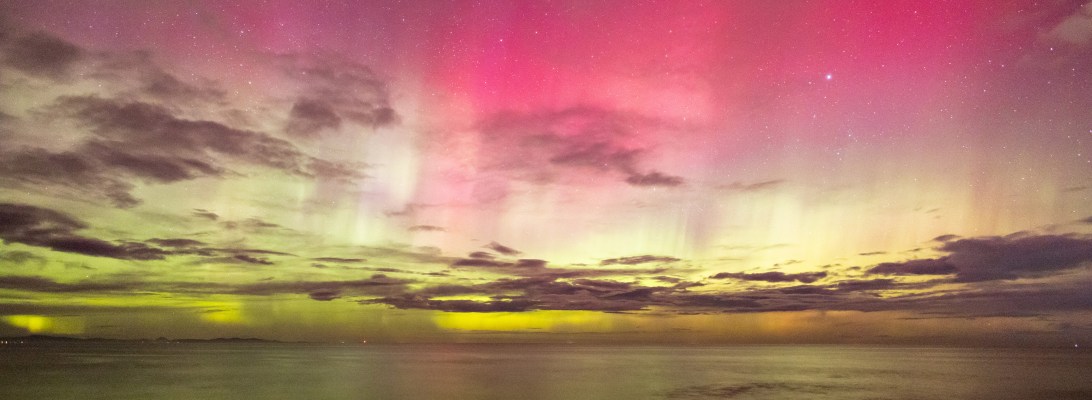
So naturally, when the alert came last week I was already in pyjamas. Luckily I hadn’t yet nodded off, so I scrabbled for thermals, camera and tripod and legged it outside. I could already see pillars of aurora even through the streetlights, so I felt the familiar dread that I’d missed the peak of activity. Still, I was grateful to be seeing this crazy phenomenon that I so often sleep through.

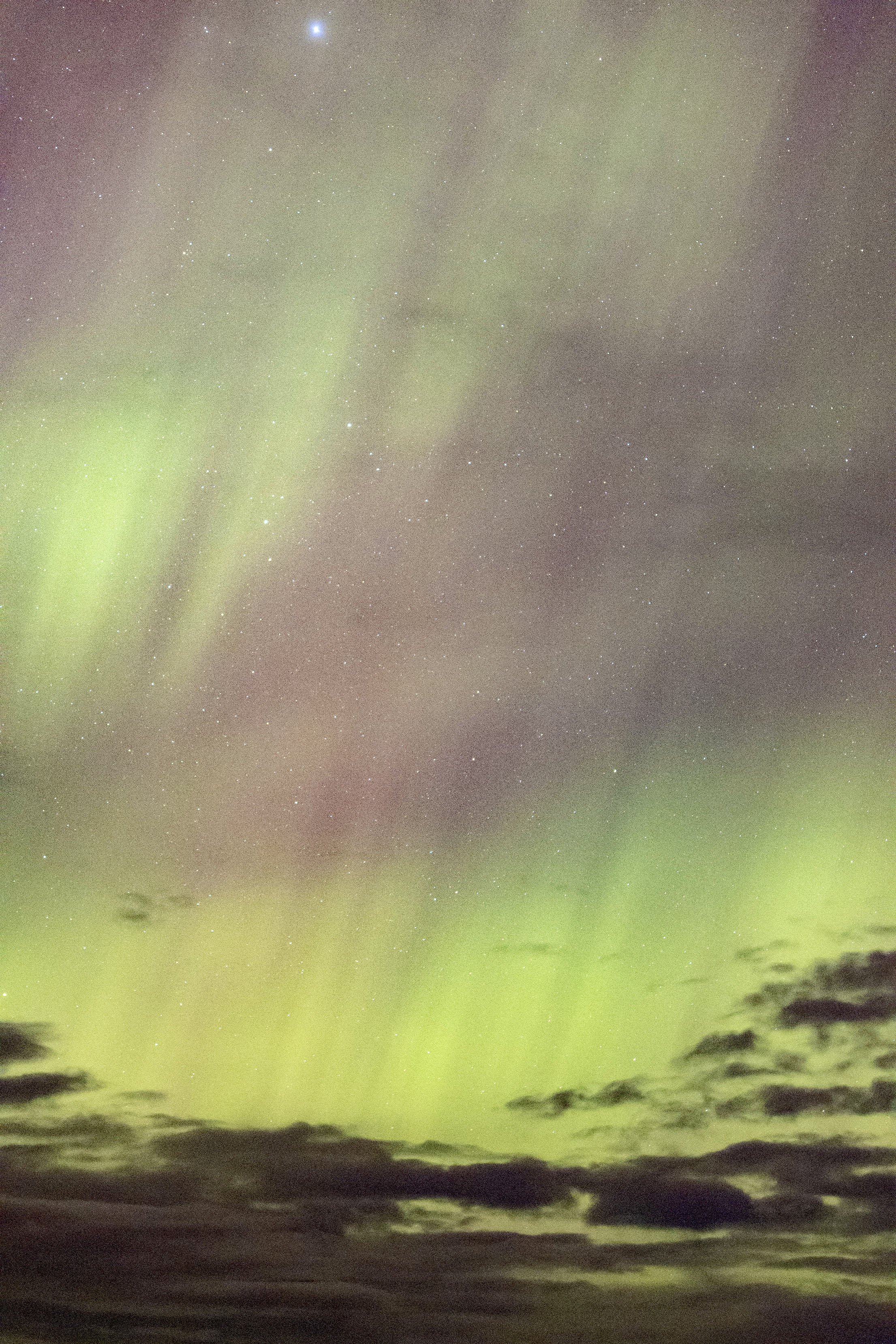
At 23.22 something caught my eye right over my head. I thought it was either a shooting star or one of my extensive collection of eye floaters, but when it didn’t stop I realised it was the aurora. Bizarrely for Scotland, the beams had stretched all the way up the sky and were flickering in so many different directions that I couldn’t look at them all at once. A massive diagonal column slanted to the side of me and a narrow band pulsed above me every few seconds.

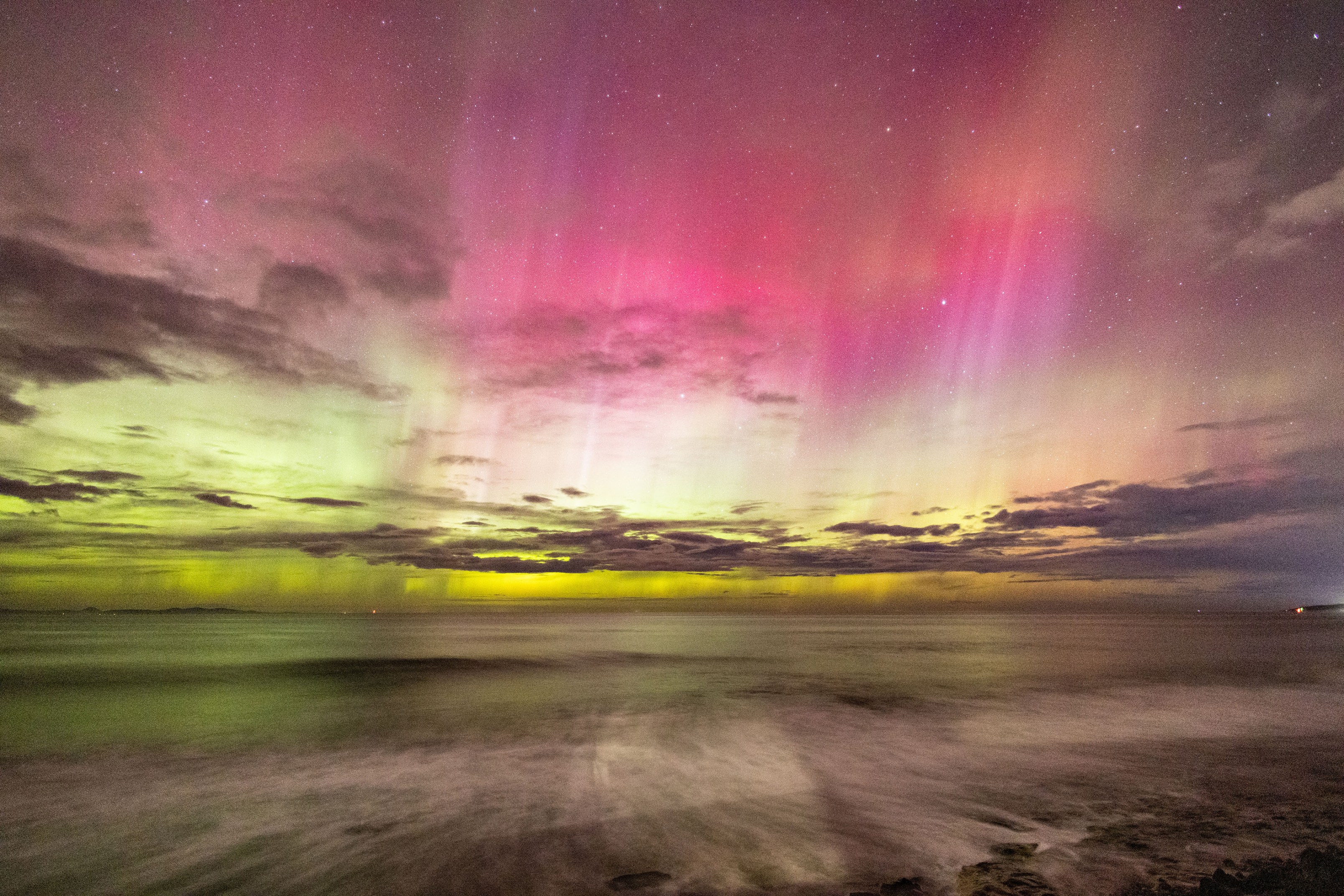
In my bleary-eyed confusion, I’d grabbed a lens that was a bit too cropped for landscapes, and while I got some interesting close-up shots of the pillars, I was keen to photograph the whole sky. So I gallantly ran home (up a very steep hill I might add) to switch lenses. I arrived back just as the sky turned raspberry. I couldn’t see that colour of course, but my camera picked up a vivid blush across the entire horizon, layered above the more usual green aurora.

Some folk say they can see the colours but I’ve never been able to, not even when I watched the northern lights in Arctic Norway. I don’t mind seeing silver instead though – what I love most is the movement. Wisps of light being blown by an undetectable wind is the most surreal thing I’ve ever witnessed, and I jumped up and down in the pitch black with my hands clapped over my mouth until well after 1am.

I said I didn’t stay up late unless something exceptional was happening, and that display qualified. I was a wide-eyed night owl at last. 

Vitamin Sea

Last week there was a film screening event at the Scottish Dolphin Centre in Spey Bay. I didn’t know anyone there but soon found myself chatting to an elderly couple whose fierce pride of Scotland was immediately clear. We chatted about the Moray dolphins and the house that they planned to build with a view out to sea. It was the sort of life I was looking for myself.

The film was “Vitamin Sea”: an hour long documentary that followed ocean advocate and veterinary surgeon Cal Major as she attempted to be the first person to journey from Land’s End to John O’Groats by Stand Up Paddleboard. Cal was raising money for Samaritans and Vet Life in memory of her best friend who lost her battle with depression. I didn’t realise there is a high suicide rate among vets and not enough is currently being done to support them. Cal was also raising awareness of plastic pollution – scooping up hundreds of plastic bottles along the way – and showing how beneficial nature, and the ocean in particular, can be for our emotional wellbeing. If we spend time in an environment and form a relationship with it, Cal says, then people will want to protect it.

What I love about Cal is her positivity. While topics such as plastic and climate change can often bring doom and gloom, she discusses positive solutions and encourages us all to do little things that bring great benefits. Throughout her 900 mile journey Cal meets countless people who donate to her cause, help out with litter picks and show their support in so many other ways. Even in places like Manchester, where plastic pollution was at its worst along Cal’s route, spirits were high and people clearly showed their passion for protecting their natural environment.

IMG_9506

At times the film was very moving. Cal revisited a place where she spent a holiday with her lost friend, and at times broke down from the combination of finding so much litter and experiencing sheer exhaustion. The constant struggles and exertions only made reaching the finishing line more emotional. After two months on the water with a sole purpose, it seemed almost anti-climactic when Cal touched land at the end of her journey. Overwhelmed with emotion, she debated staying with nature at sea and letting it continue to “heal” and “wow” her.

What resonated with me was the “profound sense of joy” that comes with being on the ocean surrounded by natural beauty. Many of us feel an undeniable pull to the ocean – that beautiful, unpredictable element of nature that compels our love and respect. Seeing so much litter clogging beaches where seals and birds roamed was difficult, but knowing that people like Cal are raising awareness with a positive message is so refreshing.

As we watched a drone’s eye view over mountains and stretching ocean at the end of the film, the man beside me leant over and asked, “Do you think you’ll go back again?”

I really don’t think so.

A Day in the Fells

As we turned into the car park at Honister Pass, the clouds were grumbling. Geoff Cox appeared and shook my hand in greeting, with the same kindliness he might offer to his closest friend. Having roamed the fells since childhood, the bracing chill and spattering rain are all too familiar to him. A gust of wind blew me sideways as I struggled to catch the flyaway sleeve of my coat and hastily zip it up. Pulling a hat firmly down on my head, I gazed up at the fells. The day was bleak, and an ominous mist obscured the tops of the hills, which would provide a dramatic background for filming.

Today marked the penultimate day of shooting for the second documentary about Geoff’s experiences as a fell runner. During his sixtieth year he attempted to run three notorious Lake District endurance-running rounds: in the Joss Naylor Lakeland Challenge and Gerry Charnley he was successful, but the Bob Graham round defeated him. The film we’d be shooting today was a reflection of this unsuccessful round, and how Geoff found redemption to complete the Charnley. Geoff wrote poems about each round to process these challenging ordeals, and approached filmmaker Richard Berry to transform his words into films. Today, I was joining them to see what happened behind the scenes.

We set off, following Geoff and the other endurance runners up the first incline. Before long it became evident just how comfortable they were on this terrain; while I took my time negotiating uneven and slippy rocks, the rest of the group hiked with confidence and admirable swiftness. As we climbed higher, I was told that the views up here were usually breathtaking, but the fog hung over the entire horizon like an impenetrable curtain. We were completely enclosed, walking along a single clear track with white walls on all sides. “Drifting in the Skiddaw mist”, Geoff wrote in his poem; how apt this line was today.

Now 62, Geoff has been fell running for decades, and can’t remember a specific time when this habit became a continuous routine in his life. “Work and family pressures meant I needed a sport I could focus on which didn’t need other people,” Geoff explained, “With running I could drop everything and go anytime, day or night.”

Fell running in the wilderness of the Lake District is a lonely and secluded past time, something Geoff often welcomes. “I needed a place where I could have a bit of ‘me time’. Society seems to look upon somebody who needs these extended periods of time in isolation as strange and even a bit weird. Long days running in the hills gave me what I needed; something about the independence and self-sufficiency was very appealing.”

In a few hours we reached the right place to begin the day’s filming. Director Richard and camera operator Kerr McNicoll set up and before long shooting was in full swing. Agile as mountain goats, the runners cascaded down the rocky slopes with impressive assertiveness. Surrounded by the silent fells, the only sounds were the cracking of the colliding rocks and soft squelch of mud as feet drove through. Puffs of breath spilled into the sky, and as the runners headed further off, the mist soon swallowed them.

“And again!” Richard shouted, the echo of his words bouncing for miles. After a few moments, the group appeared again. From this distance they looked like small dashes of coloured paint on a white page – the only distinguishable features of the landscape. They looped around a small lake, reflections bouncing on the water. After several takes of this shot it was time for cake – a delicious fruitcake made by Jim, one of the runners. This burst of energy was welcomed with open arms, and once Richard had filmed Geoff scaling a large rocky outcrop on his gimbal, we began to snake back through the fells, gathering footage on the way and constantly referring to Geoff’s poems to capture the essence of his experiences and narrative.

Writing poetry has helped Geoff to process the challenges and obstacles associated with endurance running. “I started writing poetry as a way of processing the mental and emotional garbage floating around in my head, or ‘mental detritus’ as I call it. Prose didn’t work because it has the wrong rhythm. Poetry allowed me to talk about what I’m thinking and meant that I could introduce the pace and metre that matched my memories.”

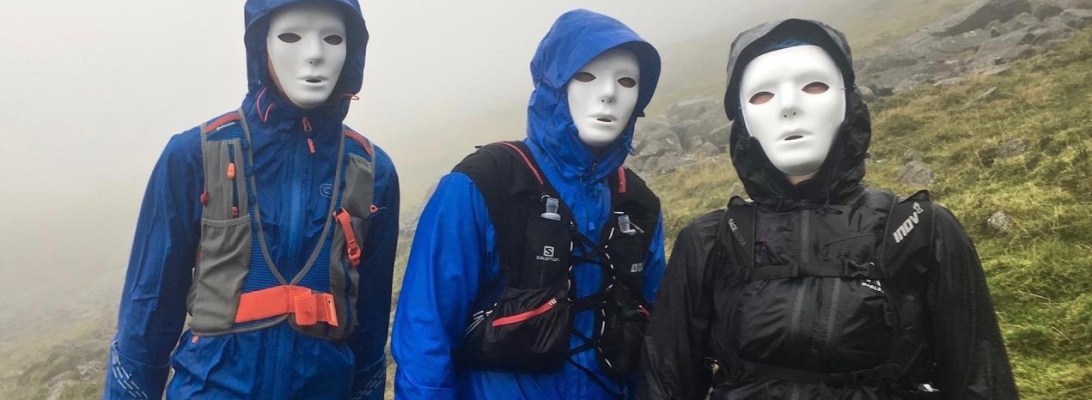
One of these memories took the form of white theatrical masks, worn by three of the runners looking over their shoulders at Geoff while he hung back, exhausted and near defeat. It was an intriguing idea and as we walked back through the fells I asked Geoff why he decided to include masks in the film. “They’re a symbol of how small doubts kick in and grow more insistent as the run goes on” he explained, “So we made them progressively more obvious throughout. ” This feeling of doubt was linked to people coming out to support Geoff while he competes and the pressure of not letting them down, a burden that can hang heavy on a runner under such physical and emotional strain.

I was astonished to hear that the masks were also a representation of hallucinations that Geoff said will be very familiar to long distance fell runners out on the hills for 24 hours or more. This “sleep monster” phenomenon is a result of exhaustion and sleep deprivation. “My particular version seems to be that I find myself running across strips of beautifully patterned Axminster carpet” Geoff told me, “All the time I’m thinking ‘It’s amazing that somebody has been up here and laid this carpet across these mountains!’”

Fell running in the Lake District is not for the faint-hearted. Unpredictable weather, unforgiving terrain, and a vast secluded landscape, and all with a burning in your legs. Even today, after walking seven miles, I returned to the warm café with aching knees. Geoff has proven that age is no match for will and determination, and is continuously training for new rounds to run. For him, fell running is more than exercise but a way of managing stress and even inspiring poetry. Spending time with him and the other runners opened my eyes to a life spent high above the ground, where so few people think to look.
Filming Red Squirrels

It’s been a mad couple of weeks, with my second year at uni finishing this week: three deadlines in four days. The last – and for me the most challenging – is a five minute documentary on anything we can think of. The vagueness could seem like a blessing, but when you have the whole world as your subject matter, it seems impossible to think of anything to fill five short minutes.

After the racking of brains and chewing of fingernails, I decided to combine my project with my first visit to Eskrigg Reserve in Lockerbie. It was infamously known among Wildlife Media students for its resident red squirrels; I’d been meaning to go for the whole two years I’ve been living in Cumbria, and only now with a deadline looming did I decide to visit. I headed up the road mid morning and by late afternoon I was perched in front of the hide, sharing a small open clearing with four foraging red squirrels!

IMG_3621

Jim Rae, the Reserve Manager, is one of the nicest people I’ve met, and incredibly passionate about wildlife. Upon arrival he welcomed me like an old friend, giving me the tour of the reserve before settling down in the hide for the interview. He had prepared four typed pages of notes, and when I sat outside later to film the squirrels he brought me a nutcracker and a box of hazelnuts for me to feed them. I couldn’t believe, after only just seeing a wild red squirrel for the first time in Chesters two months ago, I was now spoilt for choice of animals to film.

IMG_3593

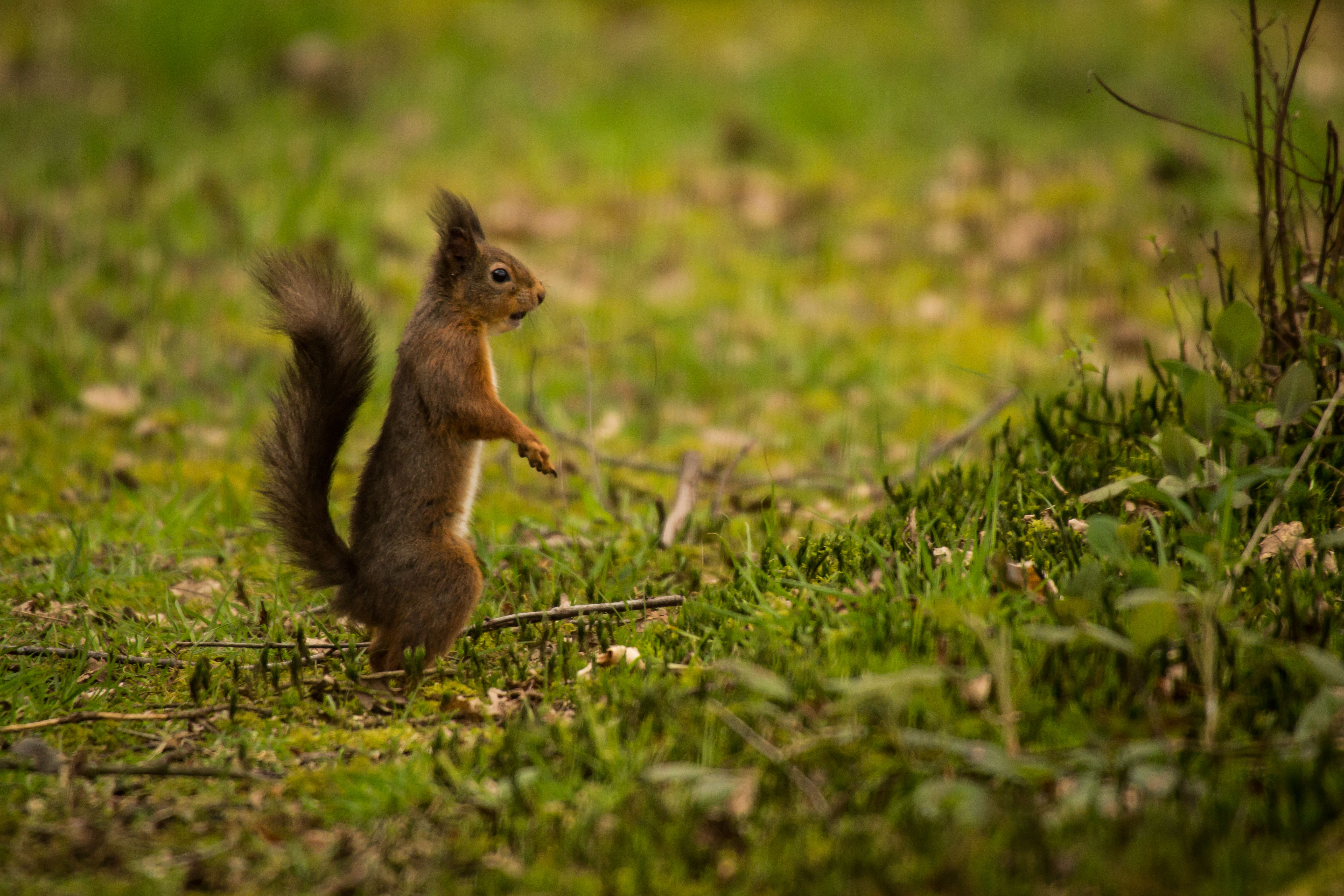
It is not difficult to see why people get so attached to these creatures. A lot smaller than the greys and with delightful little ear tufts, they bound across the grass like furry chestnut bullets – trying to keep them in frame was a nightmare. I’d get one in perfect focus as it paused to claim a nut, then it was off and I was filming empty grass again. I’d never been so challenged as a photographer, but their nippiness provided an excellent opportunity to test my reflexes.

IMG_3559

I could have stayed for hours, but I had a film to edit and countless clips to go through, 90% of which were squirrels. As of today I’m just making the finishing touches ready for the deadline on Friday. Eskrigg is a gem of a reserve, and somewhere I will definitely be revisiting over summer!

IMG_3611

Have a watch of the finished documentary here: