For many wildlife enthusiasts, spring is perhaps the most eagerly anticipated season of the year, especially for birdwatchers. Migrants arrive from their wintering areas and settle back into their breeding grounds. After the cold of winter there is suddenly a buzz of activity, especially for males hoping to attract a female.
While some bird displays leave something to be desired, other individuals put in great effort. As we move into March, birdsong is elevated both in volume and intensity. Greenfinches have a particularly impressive display that involves large bursts of activity. The male, dressed in his finest vivid green plumage, circles in wide loops with emphasised slow wing beats, looking more like a butterfly or a bat than a bird. During these theatrical acrobatics, the males constantly call out to the females with twittering phrases that finish with a long, nasal “dzweee”. If the female is won over, the new pair often perch high in the trees, with the male always in the open to ward off any other potential new suitors.
The arrival of March also brings in the sand martins, one of the UK’s earliest arriving migrants. The smallest of the European hirundines (swallows and martins), sand martins have arrived from Africa, crossing the Sahara desert to reach their nesting colonies and excavate tunnels in sandy vertical banks. Over the past fifty years, populations of sand martins have crashed twice because of drought in their African wintering grounds, which makes protecting their breeding sites in Britain even more important.
Elsewhere in the arrivals gate are chiffchaffs, and from late March to April these plain-looking birds can be heard calling their name in woodland copses and shrubby undergrowth. A tiny warbler no larger than a blue tit, chiffchaffs have spent the winter in the Mediterranean and western Africa. Breeding begins in April to May, when the female builds a domed nest that lies very close to the ground. Incubating eggs and rearing the chicks are solely the female’s responsibility. Chiffchaffs usually leave the UK in September, heading south towards France and occasionally on to West Africa.
Despite the recent snowfall that has smothered the emerging snowdrops and crocuses, keep an eye and ear out for the arrival of spring migrants who will hopefully find some warmth as they prepare to settle in for the breeding season.
Today marks the beginning of a new project: learning to birdlisten. It’s a much-used cliché but I have been an avid birdwatcher since I was a child. I’d sit out in the garden, hold as still as I possibly could, and after a while birds would begin to show, hopping out from under bushes and descending slowly from the treetops. This gradual emergence, the steady drip-drop of birds, was so exciting to me. The species would usually be very common – robin, dunnock, blackbird – but occasionally a blue tit or great tit would appear, and to my amateur eye these were very special indeed.
As my knowledge gradually improved, I began to notice more species and although the trusty robin and dunnock never grew boring, they lost their shine among more colourful or charismatic varieties. One by one I added birds to my repertoire, and although I didn’t notice my mental list growing, soon I could identify a wide range of species. Although waterfowl and waders had their charm, my favourites were always the passerines, or “perching birds”.
Passerines include a subgroup of species we call songbirds but are more accurately named oscines – birds that establish their territories by means of musical vocalisations. It never occurred to me why the singing birds attracted me most, until I turned my attention to listening for birds instead of looking for them, and then it became abundantly clear.
Birdsong is the soundtrack of nature. Even for me, a keen bird enthusiast, birdsong had blurred into the background of my time spent outdoors, nothing more than a pleasant backing track that accompanied my attempts to birdwatch. Why on earth did I let birdsong become such an unimportant feature of the landscape, no more significant than hold music? It was high time that I paid more attention to it, instead of letting it wash over my ears without acknowledgment. It is so true that we see but don’t observe, but it is also the case that many of us hear but don’t listen.
Author of “Birdwatching With Your Eyes Closed” Simon Barnes points out that understanding birdsong allows us to see around corners. There’s a bird hidden up in the canopy somewhere, but unless you know its song you’ll never know what it is. I’ve had this frustration many times, when I see the distorted outline of a bird but no characteristic features that give it away. If I hadn’t neglected my auditory senses, I wouldn’t have been disappointed when the bird hopped further out of view.
And so begins my journey to learn the language of birdsong. It seemed a daunting prospect at first; to my untrained ear all chirrups and whistles sounded identical. However, like any problem, it is imperative to break it down, and that makes it far less intimidating.
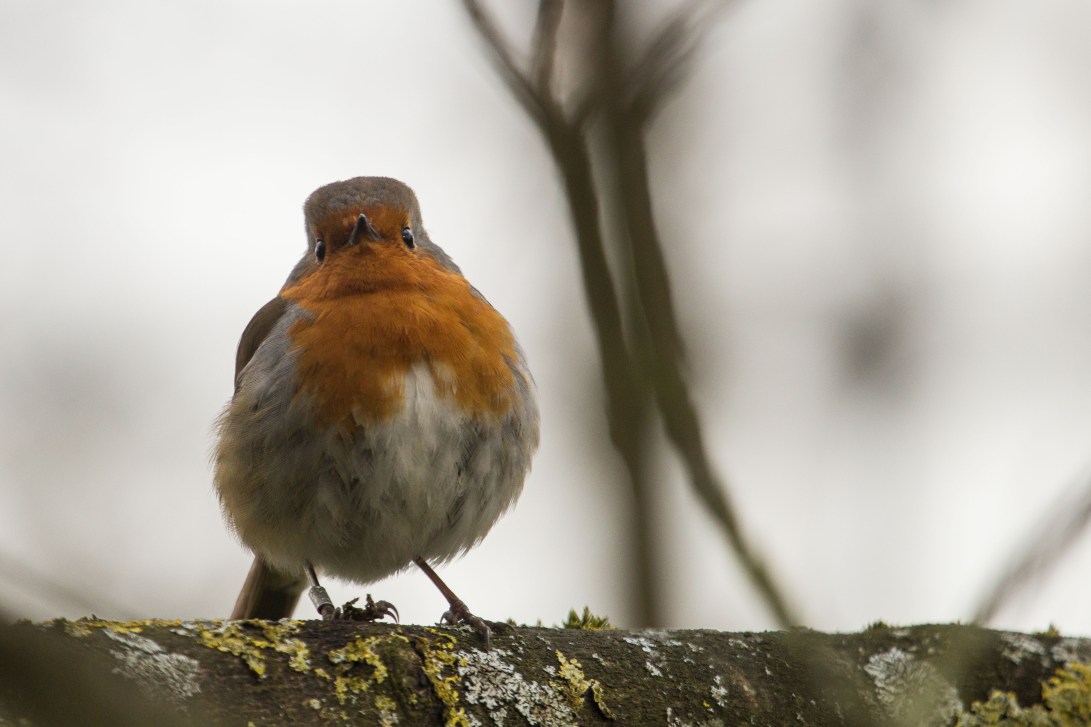
I have already made progress. First was the robin: an unmistakable bird in appearance, and a good place to start when learning birdsong because of its presence all year round. During the usually hushed winter months, the robin still sings, an isolated soloist filling cold air with thin, gentle melodies. Spring is by far the most frustrating time to begin birdlistening, so to hear the robin on a chilly February morning with no other avian distractions allows us to begin to tune into this new world I for one took for granted.
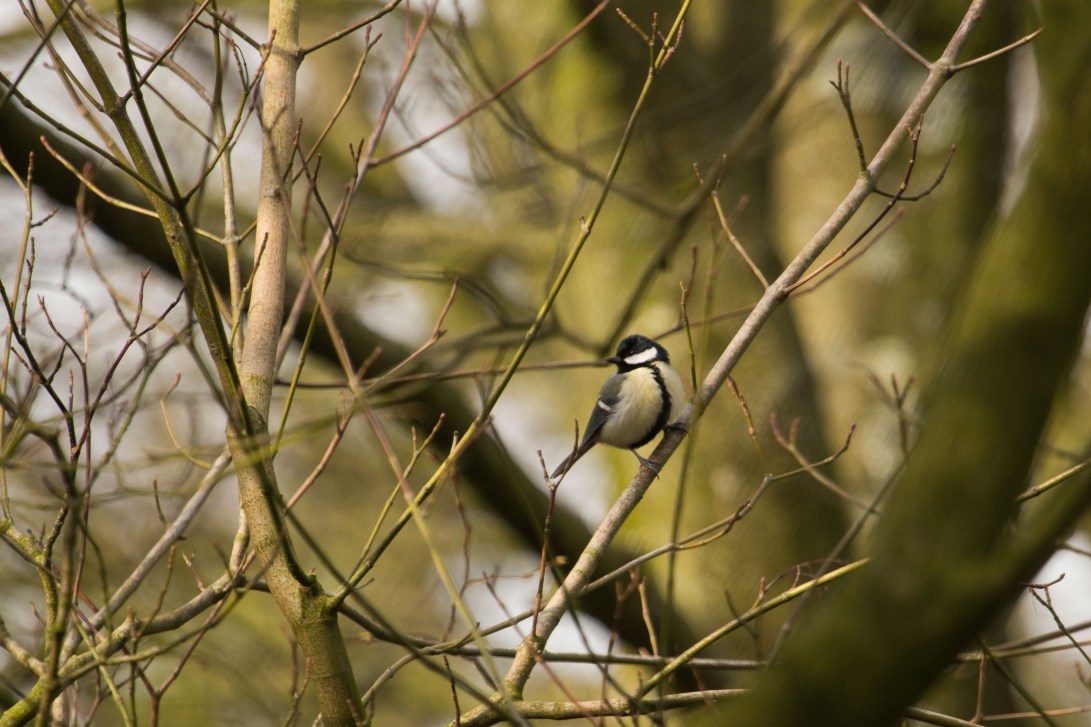
The wren also sings in winter, but has a far louder song bordering on rowdy. For such a small bird, the song bursts out of hedgerows, with a telltale trill at the end of some phrases, like a twirl of icing atop a cake. Then there is the two-note song of the great tit, like the squeak of a saw being pulled back and forth.
And so on. Already my ears are filling with birdsong and I’m really listening this time. Acquiring the skill of understanding this rich and varied language will not only help me become a better birdwatcher, but it will pave the way to a clearer understanding of nature as a whole – appreciating nature’s vibrant soundtrack.
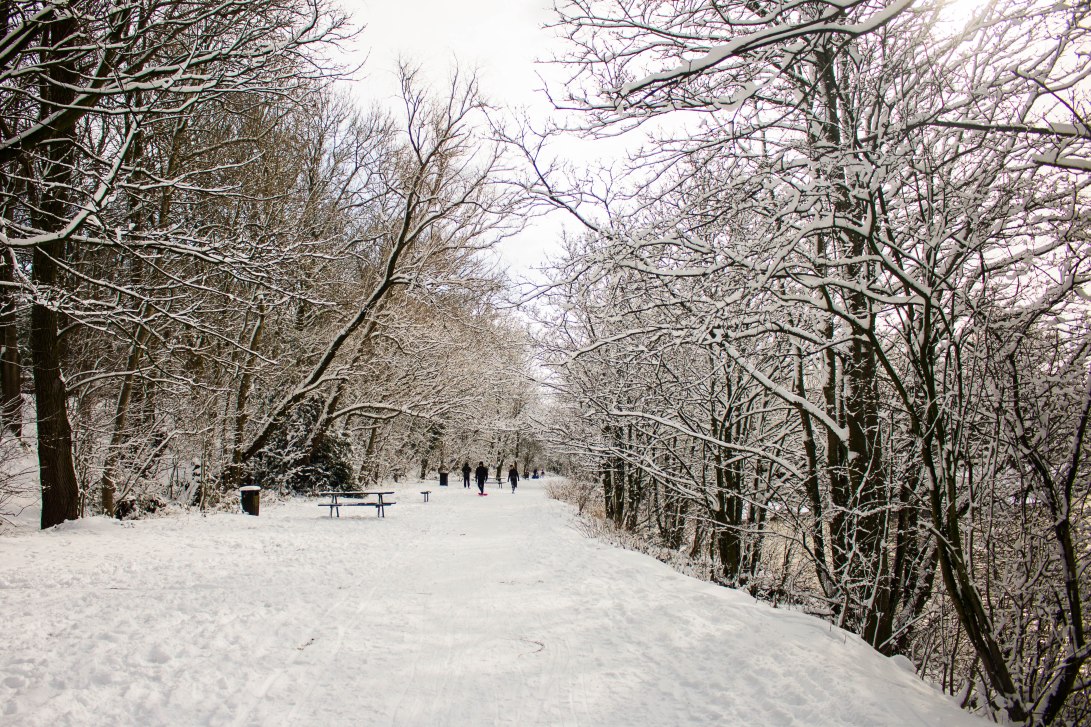
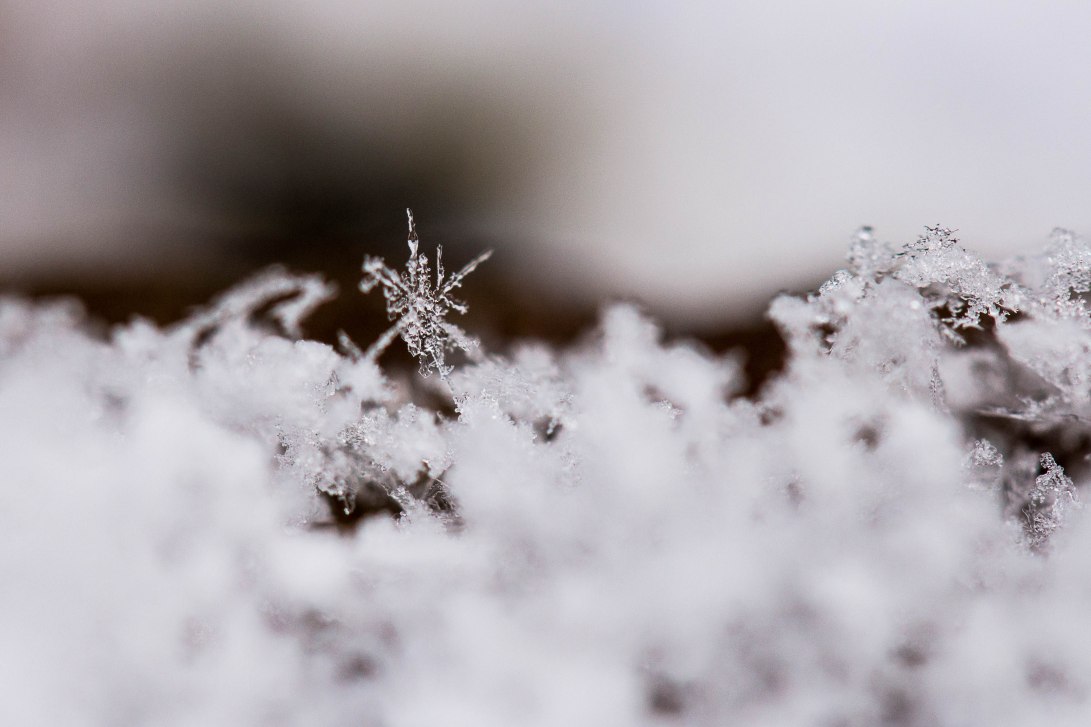
The snow was here again. It descended from the skies in heavy drifts, flakes swirling as they came to rest. All through the night the snow fell, dramatically silent, and when morning came everything was smothered in pristine white icing: irresistible.
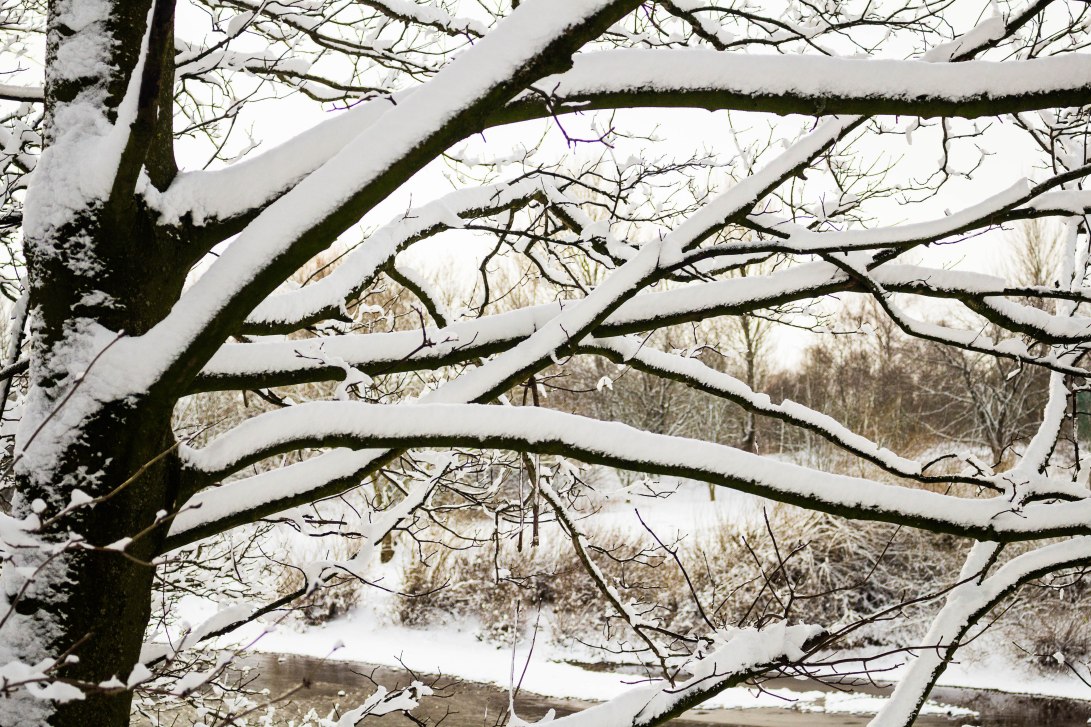
Outside there was a chill that tightened the lungs, so cold was the air that even breathing in felt like getting smothered in snow. Each branch was cloaked, giving the impression of an overly enthusiastic artist splashing every bough with thick white highlights. Undisturbed snow on the sides of the track glistened, catching the light and sparkling with wintery luminescence. On the cusp of March, it was more of a spring wonderland than a winter one, and yet it could have easily been Christmas morning.
Up in the trees, a whisper of falling snow betrayed the presence of a blackbird, sending tremors up the branch that dislodged loose flakes. A male, black feathers stark against his festive background, spotted with rich red berries and the undersides of dark leaves. He chirruped softly, his song more melancholy than it should be.
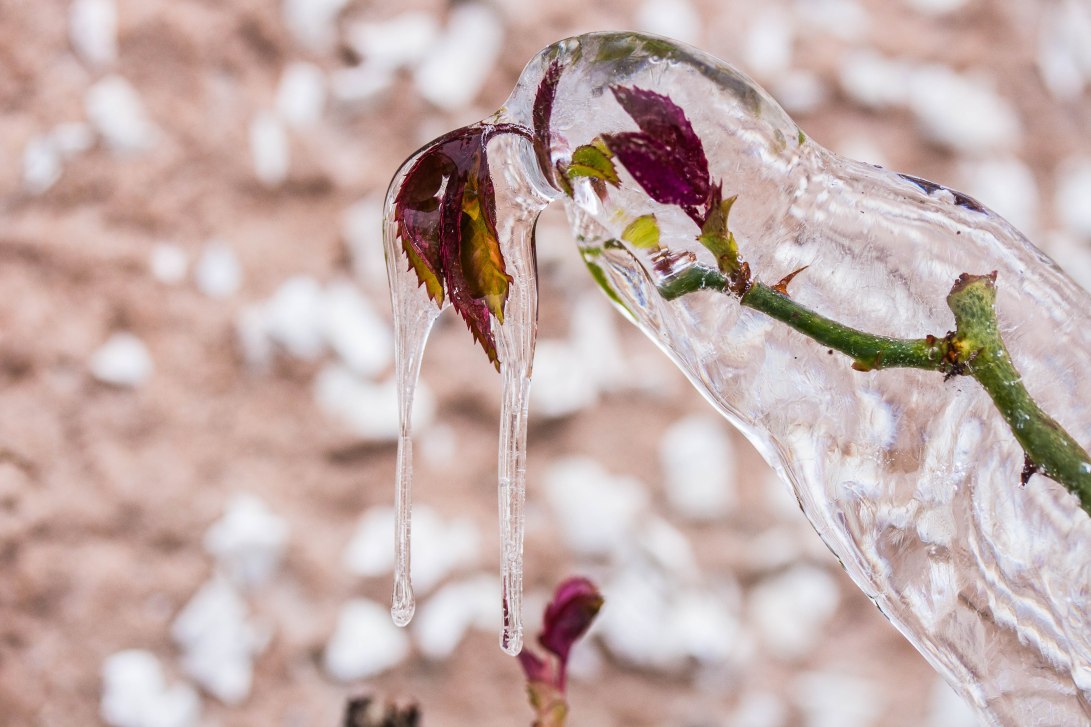
A man passed me on his bicycle, his tyres crackling like static feedback that faded as he disappeared. The landscape quietened again, a deafening silence only found with snow, when the world stops and waits with baited breath for this unexpected phenomenon to pass. It is a time when even nature stands still. Water is stopped in its tracks, defiant of gravity’s pull.
Sloping down the bank to the river was a series of deep tracks, dogs mingled with hopping birds. The ever-falling snow began to repair the damage, forming undulations of half-hidden footsteps with softened edges. A wren sped past, trilling its bold song that seemed too big for its tiny lungs. What must the birds think? Have they anticipated this, read some sign in the climate to help soften the blow? The already challenging task of finding food in winter just became more trying, a test of strength and endurance in such temperatures.
After a while my feet began to grow numb and my stomach rumbled. As I trudged back up the track, curving away from the coursing, white-framed river, I thought how I would snuggle up in my warm house with something to eat. I glanced back over my shoulder and saw a song thrush foraging. It had a snail pinned in its beak, and was cracking the shell hard on a rock. Such work the birds put in, when all I needed to do was open a can of soup and I’d be warm.
Back at the house, I peered outside and saw the feeder swinging empty again. Thinking of the blackbird, wren and diligent thrush, I hurried into the garden and replenished the feeder with rich fatty seeds, sprinkling some on the ground for those too heavy or timid to feed from the plastic perches. The birds needed all the help they could get.
After our great grey shrike stood us up last week, I was determined to tick a bird off my wishlist. I did some digging and found there were a few good spots for hawfinches down in Kendal. Zahrah and I picked the best day of the week and headed down, this time with Kacper. As usual, when the alarm sounded I was struck by an overwhelming urge to leave the hawfinches to their business and dive back under the covers, but when I snuck a glimpse out the window and saw the bright promise of a beautiful day, I knew we had to go for it.
Despite the rather vibrant sun, a sharp chill met us as we left the warmth of the car, reminding us it was still February. Clutching my fists together in my Sealskinz gloves, we made our way up the track, away from people and towards wilderness. The path wound through a small wood, dappled by sunlight filtering through overhead. What had been squelchy mud was now frozen hard as concrete, and crunched under our footsteps. We were initially prevented from entering the open field due to a very restrictive swing gate. My bulging rucksack got wedged and I had to hold my tripod flush to my chest and reverse through – far from a sophisticated entrance.
The frozen ground stretched further, blades of grass as solid as real blades, and it was strange not to feel the gentle give of soft earth. The sun was trying to warm the landscape, taking every opportunity the clouds allowed it to reach us. Once back in the woods, it was shadier. Muffled conversations sounded in every direction; the proud song of a robin and the chatterings of crows all mingling together. We tried to ignore all of these and listen solely for a piercing whistle. This was the call of our target: the hawfinch.
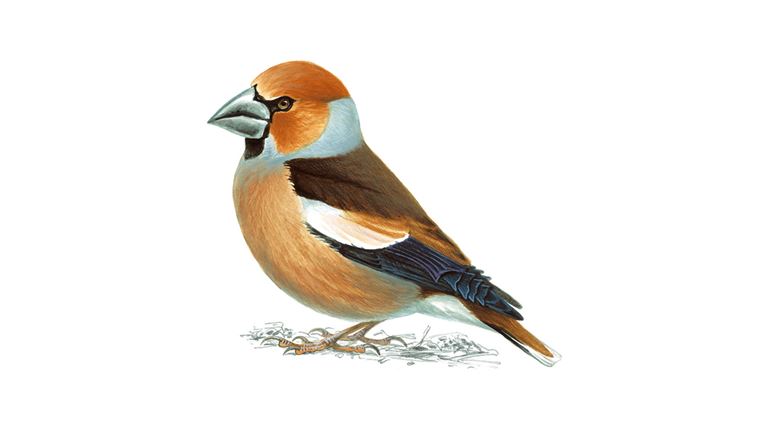
Hawfinches are beautiful and unmistakable birds with striking colouring and formidable conical bills. Usually secretive and shy, they spend most of their time in the topmost branches, making the UK’s largest finch difficult to spot. Typically found in mature deciduous and mixed woodland, hawfinches regularly frequent hornbeam trees. The bill of a hawfinch is highly specialised to cope with the hard seeds and cherry stones that form much of its diet. Once a bird reaches maturity, its skull ossifies and two hard knobs form within each mandible, which are essential for holding a seed still while it is cracked. Findings from an experiment showed that hawfinches can exert a pressure of 60-90 pounds of force, which isn’t bad for a bird smaller than a blackbird.
Hawfinch (RSPB)
As hawfinches frequent the tops of trees, spotting them can be a challenge, not to mention their timid calls are often lost among those of the more plucky birds. Although I never want to criticise the sun, it was shining at a rather inconvenient angle, so gazing up meant we could barely see the treetops, let alone brown birds. So, we tried to climb as high as possible to get a better vantage point. Soon we found a large clearing that gave us a 360° perspective of the forest. Seeming like a good place to set up shop for a while, we perched on a fallen tree and scanned with our binoculars.
There’s nothing quite like sitting in silence, listening to wildlife. Upon arrival you think the forest is a quiet and secluded place, and it would be to a person used to the thrum of cities and traffic. But to sit still and listen in a wild place is to hear a whole new language. I don’t understand it yet – something I’m hoping to soon rectify – but I could listen to its lyrical beats and rhythms all day. Understanding birdsong brings a whole new dimension to bird watching. Cain Scrimgeour, someone I consider a bird connoisseur, can hear the slightest chirrup up in the trees and tell you who made the sound. Sure enough, moments later that bird emerges. To me it’s magic. I consider my knowledge of British birds to be competent, but to know their sounds as well as their appearances is a truly incredible skill.
I heard a soft crunching of leaves as Kacper made his way towards me.
“What’s this?” He whispered, holding his camera up for me to look at the image on the screen.
My eyes popped and I bit back a loud gasp, “That’s a hawfinch! Where is it?”
He led me back to where he’d been standing and pointed up. Now began the near-impossible task of explaining to a person which tree in a hundred trees you are looking at. After a painfully long-winded ordeal I found where he was pointing, and with binoculars trained I saw my first hawfinch. Females are only slightly less brightly coloured than males, so to my eye I couldn’t tell which this one was. The bird was perched looking straight towards us, feathers hunched up. It was foraging, and I saw it pick a seed from its branch and arrange it in its bill to crunch down with that extraordinary force. The bill almost seemed too big for the bird’s body. It was like a person with a party hat positioned over their nose and mouth, almost comical.
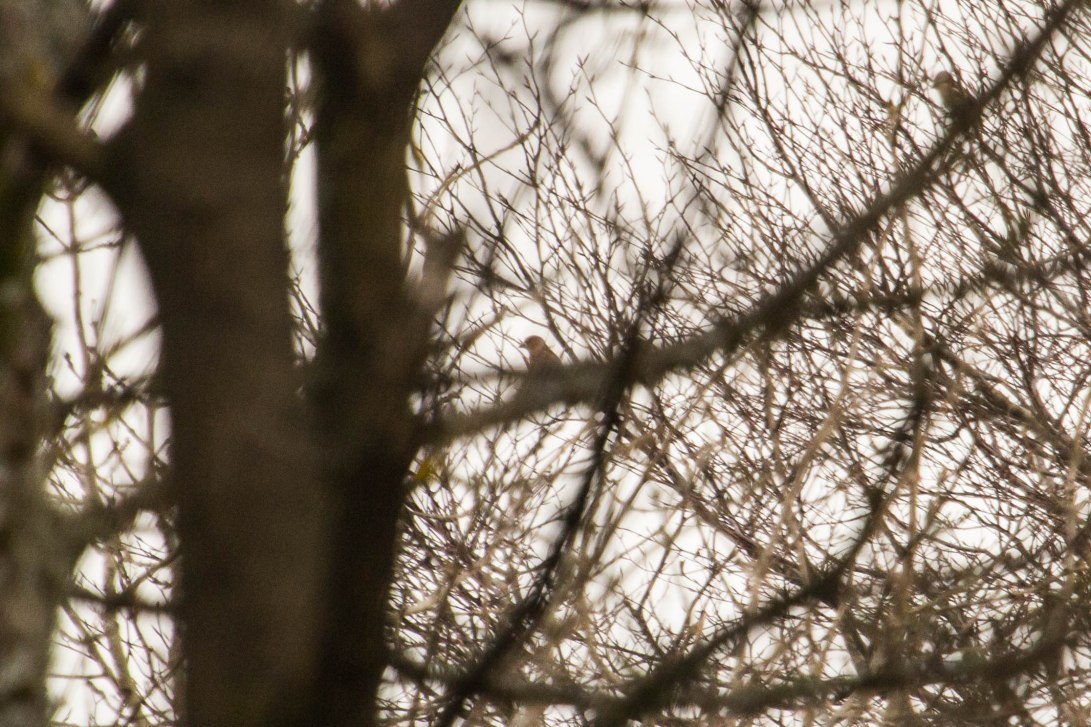
Zahrah was a way off, so I was incredibly patronising (though I believed it was necessary in this occasion) and made several hasty finger clicks to get her attention. Once she’d arrived Kacper explained the bird’s location again and we all watched. I made the mistake of retrieving my camera from its resting place by the log, and when I returned the bird had retreated to a tree further off. It was joined by three more, and although I tried they were too far off to photograph. This, to my shame, was the result.
Not exactly Bird Photographer of the Year
There was another rustling of leaves and we turned to see an elderly man making his way down the bank.
“Seen any?” He asked, knowing exactly why we were gathered there.
“A few!” I replied excitedly, and once again Kacper directed the man’s view to the right tree.
“There were 43 here yesterday, so I’m told,” the man said, “The reserve ranger and volunteers saw them, couldn’t believe their eyes.”
Forty-three hawfinches. For a moment I cursed myself for not thinking to come a day earlier, but as I watched a pair perched way up in the topmost branches I was grateful we’d seen any at all, even if the photos were incredibly dodgy.
After a while the finches flew off. I glanced up in our immediate surroundings, wondering if the elusive birds had gathered directly over our heads – it’s something I would do to birdwatchers if I were a pretty finch – but the branches were bare.
“There’s another good spot back the way you came,” the man told us, “In the clearing. I’m walking back home that way I’ll show you.”
So we headed up the track, which by now had begun to thaw, the mud regaining its sticking power. Back in the open field, we were reminded again of the chilly February breeze, and willed the sun to make a reappearance.
We thanked the man as he went on his way, then we settled down to eat our lunch overlooking the open fields. Every time one of us spotted a dark patch in the treetops, we hastily studied it through the bins. But the hawfinches had headed off, submerged once again in their woodland domain.
After watching Chris and Michaela hunt for great grey shrikes on Winterwatch, I realised what stunning birds they were and that I’d quite like to find one for myself. I asked Cain if he knew of any recent sightings and of course, he did. There was one of these beautiful shrikes in a patch of rural Newcastle that had remained in the area all winter. So, early on Friday morning, Zahrah and I set off to try and track the bird down.
As we made our way east towards Newcastle, the combination of pouring rain and sleet filled me with dread. As usual, the weather forecast had gone awry, and I hoped the grisly sleet would clear up by the time we arrived. Luckily it did, and once parked and heading down the track with eyes peeled, we stayed dry. We were looking for a patch of stark white at the tops of the bare trees. Every so often we would stop and peer across the field, binoculars meticulously scanning each tree. Unfortunately, great grey shrikes are not vocal birds, so there was no telltale call we could listen out for. This would be a case of sharp eyes.
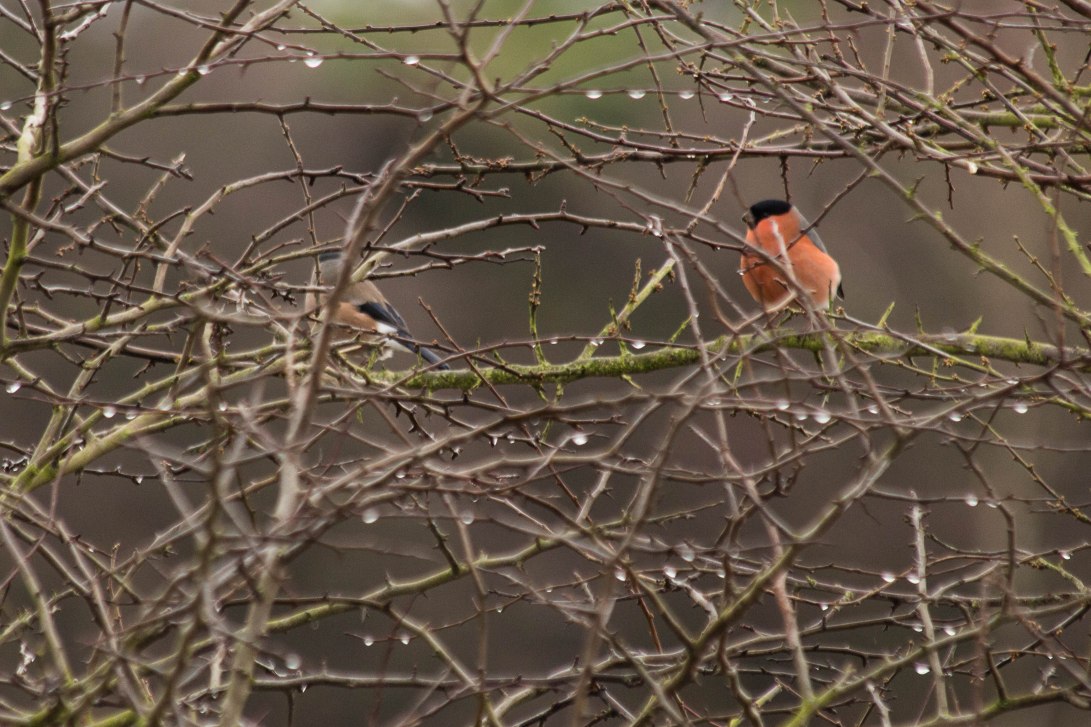
We came across a group of bullfinches – a handsome male and two females – as they foraged in the bushes. I have a soft spot for these vibrantly coloured birds, so stopped to take photos, trying to manoeuvre myself to sneak a clear glimpse of the male through a break in the tangle of twigs. This was only partially successful.
Bullfinch pair
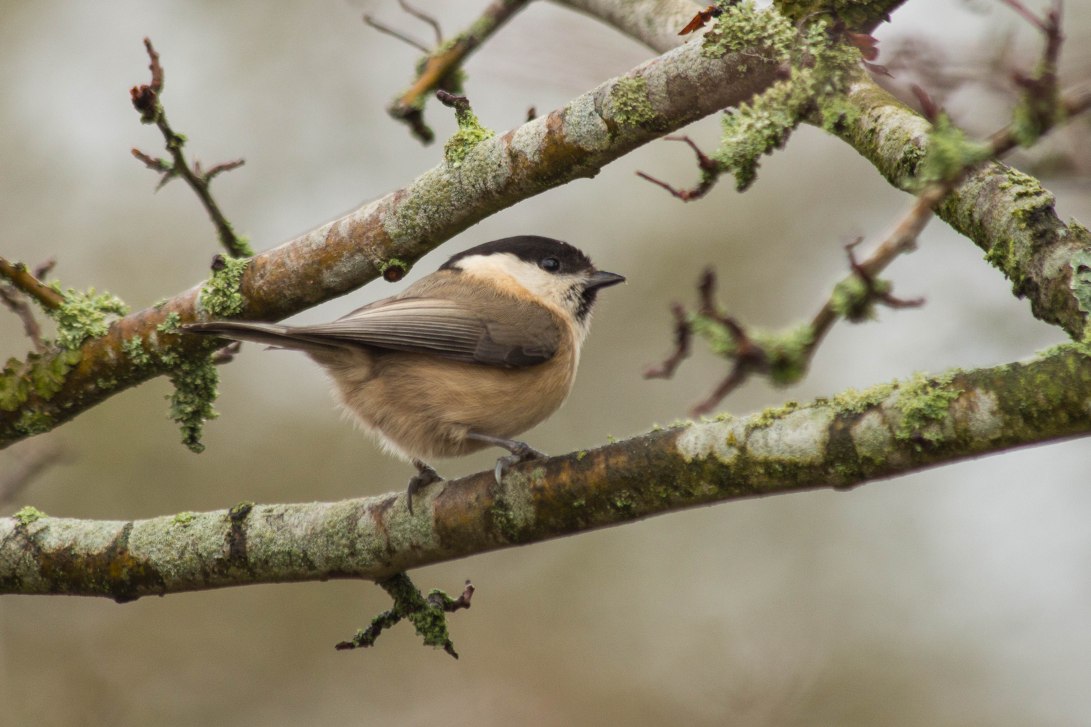
As we trudged up the track, the only sound to be heard was the mud as it sucked on our boots. I found it a challenge to survey the trees for signs of movement while keeping an eye on where my feet were landing. After no sign of the shrike, we decided to try the other stretch of track that hugged the same field. At the crossroads we encountered a vast flooded patch of grass. At first glance it seemed empty, but a look through the binoculars revealed a large gathering of lapwing and golden plover huddled together. Further up the track, a hubbub of activity surrounded the bird feeders hanging from a tree. Great tits, blue tits, robins, a ground-foraging blackbird and a special sighting: a willow tit. I’d never seen one so close – a bird that I find indistinguishable from the marsh tit. According to the BTO, the most reliable way of telling these two species apart is by listening to them, as the birds’ most common calls are quite distinctive from each other. While marsh tits make a sneeze-like “pitchu” call, willow tits have a nasal “chay chay” sound.
Willow titGreat tit
We had come to the joint decision that our shrike would sadly not be making an appearance today. The needle was well hidden in the haystack, and we made our way back to the car. A little way further out was another reserve that we decided to visit. By this time, unexpected sunlight was filtering through the dissolving clouds, and gleamed on the pond, illuminating a flock of wigeon. They chatted to each other but were otherwise motionless. High up in the trees was a buzz of excitement, and yet more beautiful bullfinches! These ones were silhouetted against the sky, so their smart plumage was diluted in the sun. Accompanying them were great tits, siskin and a few goldfinches. A magpie was perched in the topmost branches, feathers ruffling as the wind caught him.
Magpie
Before long it was golden hour, where the sun began to vanish behind the pond. The trees took on a shimmering glow, every hue heightened. A group of blue tits fluttered around, barely perching for a moment before swooping in another direction. I thought I saw the fluffy brush of a red squirrel’s tail disappearing between two boughs, but after waiting stock-still for it to emerge, I thought perhaps it was just a trick of the golden light.
Here is a piece I wrote for ‘A Focus on Nature’, the UK’s Youth Nature Network, where I’ve already met some really interesting writers, photographers and artists. I’m also very proud to say I’ve just been shortlisted for the AFON Pictures of the Week 2017. If you’d like to vote for my photography, follow the instructions on this link. Thank you!
“It is a moment of quickening, of rebirth. The old, lovely story: life surging back, despite everything, once again. However spring finds you – birdsong, blossom or spawn – it is a signal: the earth turning its ancient face back to the sun.” Melissa Harrison
One afternoon as I arrived home from a university lecture I stood at the living room window and peered out into the garden as I always do. As usual, the birdseed I had put out the evening before had already gone, polished off by jackdaw and sparrow alike. Today, however, there was a crucial and very welcome difference – the appearance of the first snowdrops of the year. They were very young, still curled up tight in stiff buds, but I knew before long they would be hesitantly opening, their petals tiny white flags signalling the slow beginning of spring.
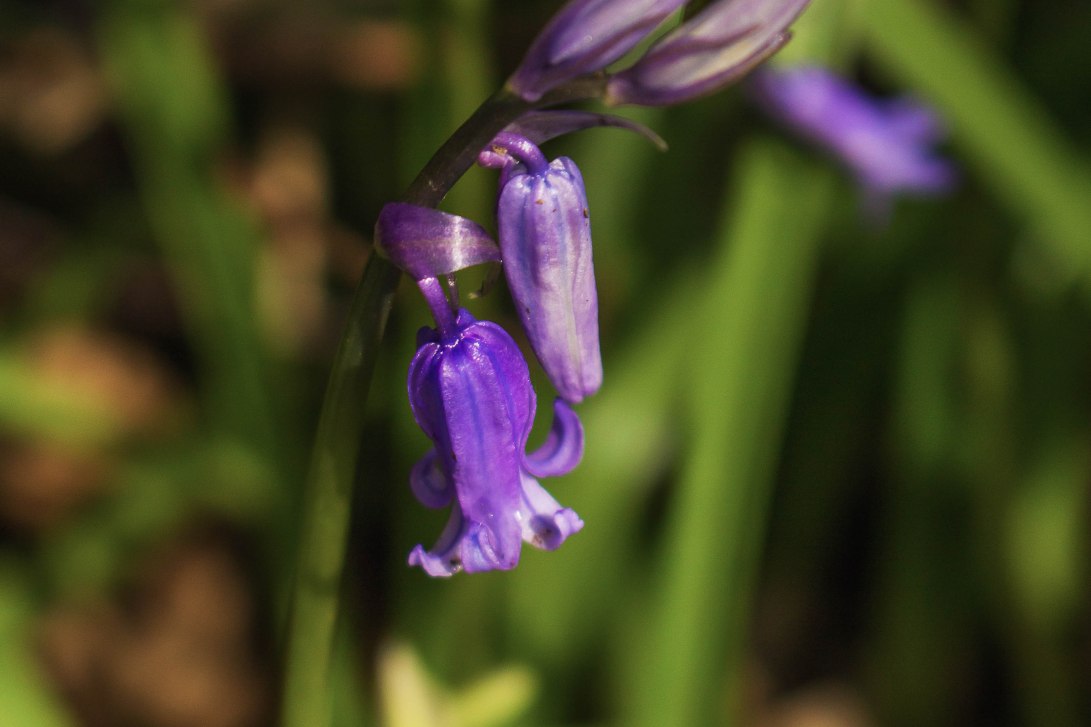
As January draws to a close, the temperature lifts and although the winter rains usually persist, our gardens are brightened by the tentative emergence of wildflowers. Bold snowdrops have led the way, but soon to follow are yellow and early (purple) crocuses, bringing a splash of colour to the repetitive greens of the lawn. Amongst all this emerging beauty is perhaps the true star of spring: the bluebell. A delicate flower more violet than blue; even one alone is a welcome sight after the biting winds and downpours of winter, but a carpet of bluebells is enough to take your breath away.
Two years ago, back home in Hertfordshire, I was stood in a patch of woodland that had long been heralded as a haven for bluebells. I surveyed the scene from a respectable distance, knowing I’d cause significant damage if I strayed from the worn path. The ocean was vast, spanning far in each direction. Together, the bluebells looked like a single blue blanket coating the tree roots, but up close each bell waved independently, and my romantic imagination gave them the quiet tinkling chime of their namesake.
Aside from wildflowers, there are plenty more indications that spring is almost here, from birds to bees to rather odorous plants.
The gathering warmth of February rouses overwintering insects, such as the greenbottle fly, whose unappreciated beauty is something quite wonderful to see up close, even if they’re not always welcome buzzing around indoors.
Early breeding birds such as rooks will be seen gathering nesting material in preparation for the arrival of their broods. The first eggs will appear around early March, so be sure to look out for rookeries high up in the trees and listen for the constant chatter of busy parents-to-be.
One of my favourite spring sounds is the buzz of a busy bumblebee. As wildflowers expose their nectar, bees are quick to make use of the opportunity to gather it in the early part of the season.
The heady scent of wild garlic will soon be filling the air. A walk through my local park often includes a good whiff of this pungent but flavoursome plant. Note: wild garlic is similar in appearance to lily of the valley, which is poisonous, so if in doubt please do not forage to eat.
Spring is undoubtedly a time of rejuvenation – an opportunity to shake off the January blues and be inspired by the emerging life outside. As many of us live in towns and cities, it can be difficult to notice these subtle changes in such busy urban environments. This only emphasises how important it is to stop and look, just for a moment, and you’ll notice that however our world changes, nature will always persevere.
According to Red Squirrels Northern England (RSNE), there are approximately 138,000 red squirrels in the UK. For some people this may sound like a lot, but the grey squirrel population currently stands at 2.5 million. Due to the difficulty of monitoring these animals accurately, this number could be even greater.
Undoubtedly a much-loved aspect of British wildlife, red squirrels have faced many challenges in recent years, predominantly the impact of invasive grey squirrels and the subsequent squirrel pox that has decimated populations. While grey squirrels are immune to the disease, reds have a mortality rate of 100%. The virus causes skin ulcers, swelling and scabbing, and after contracting it, most animals die within two weeks.
However, our native reds still have strongholds in northern England, including Northumberland, North Yorkshire and several sites in Cumbria. For a chance of seeing this elusive mammal, it is important to know where exactly to look. Two particularly good spots for Cumbrian red squirrels are Aira Force on the Glencoyne Farm trail and Grasmere. There was an outbreak of squirrel pox at Grasmere in 2016, with more than ten confirmed cases in the valley. However, as a result of the hard work of the Grasmere Red Squirrel Group, the population of reds pulled through.
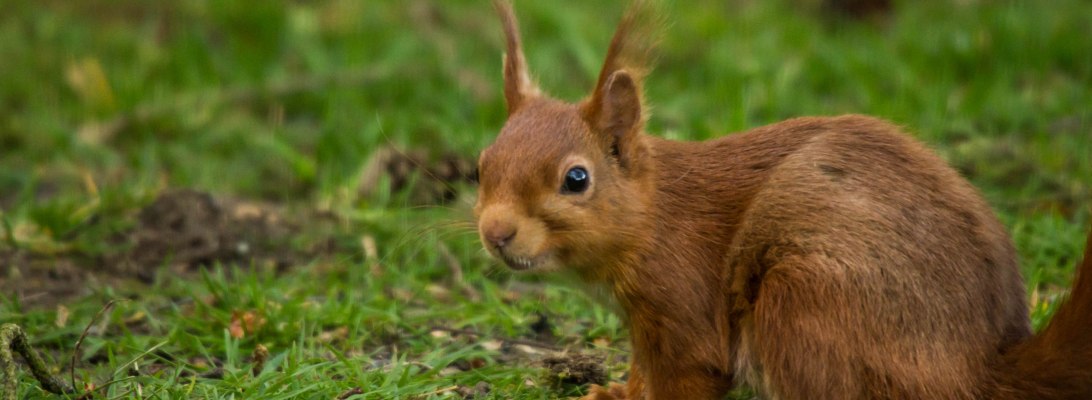
Feeding red squirrel (photographed in Lockerbie)
With the squirrel pox virus having such drastic consequences, it can be difficult to know what the best solution is. In 2012, RSNE established a monitoring programme that samples 300 forests and gardens in northern England each spring, using trail cameras to record where red squirrels can be found. The Wildlife Trusts are working to improve the red squirrel’s favoured habitat of coniferous woodland, initiating reintroduction schemes and combating the presence of grey squirrels in a few carefully selected areas where red squirrels face the greatest risk.
If you are interested in the red squirrels of northern England and want to learn more about their status in Cumbria, Red Squirrels Northern England Project Officer Simon O’Hare is doing a talk on Monday 5th February and will be sharing updates on how red squirrels are faring and explaining why it is so important to protect them. The event is taking place at Kirkby Stephen Friends Meeting House. For more information take a look at the Cumbria Wildlife Trust.
Like this?
Have a read of my post about filming red squirrels in Lockerbie here.
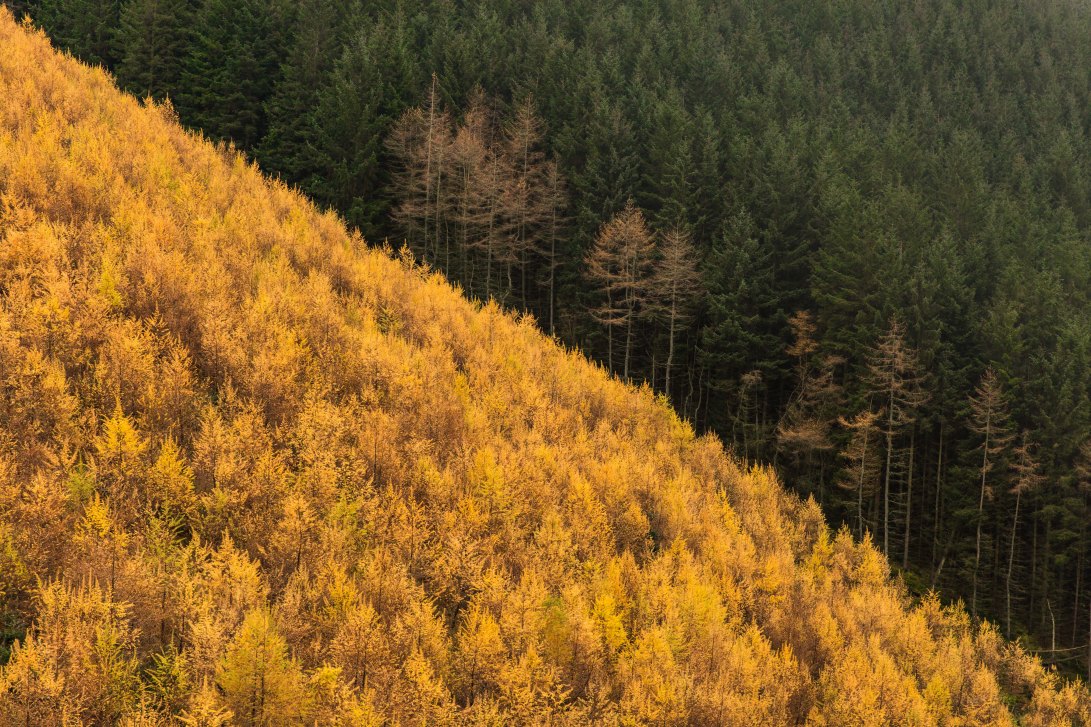
There was no frost today, but the sun was shining brightly and I knew the larches on the hills would be lit up like fiery beacons. We only had the morning, as we were leaving the bothy just after lunch, so first I headed out with Cain to pick up the camera traps. I was wrapped up in my fleece but was soon peeling layers off – the weather was surprisingly warm today with such bright sunshine and little wind.
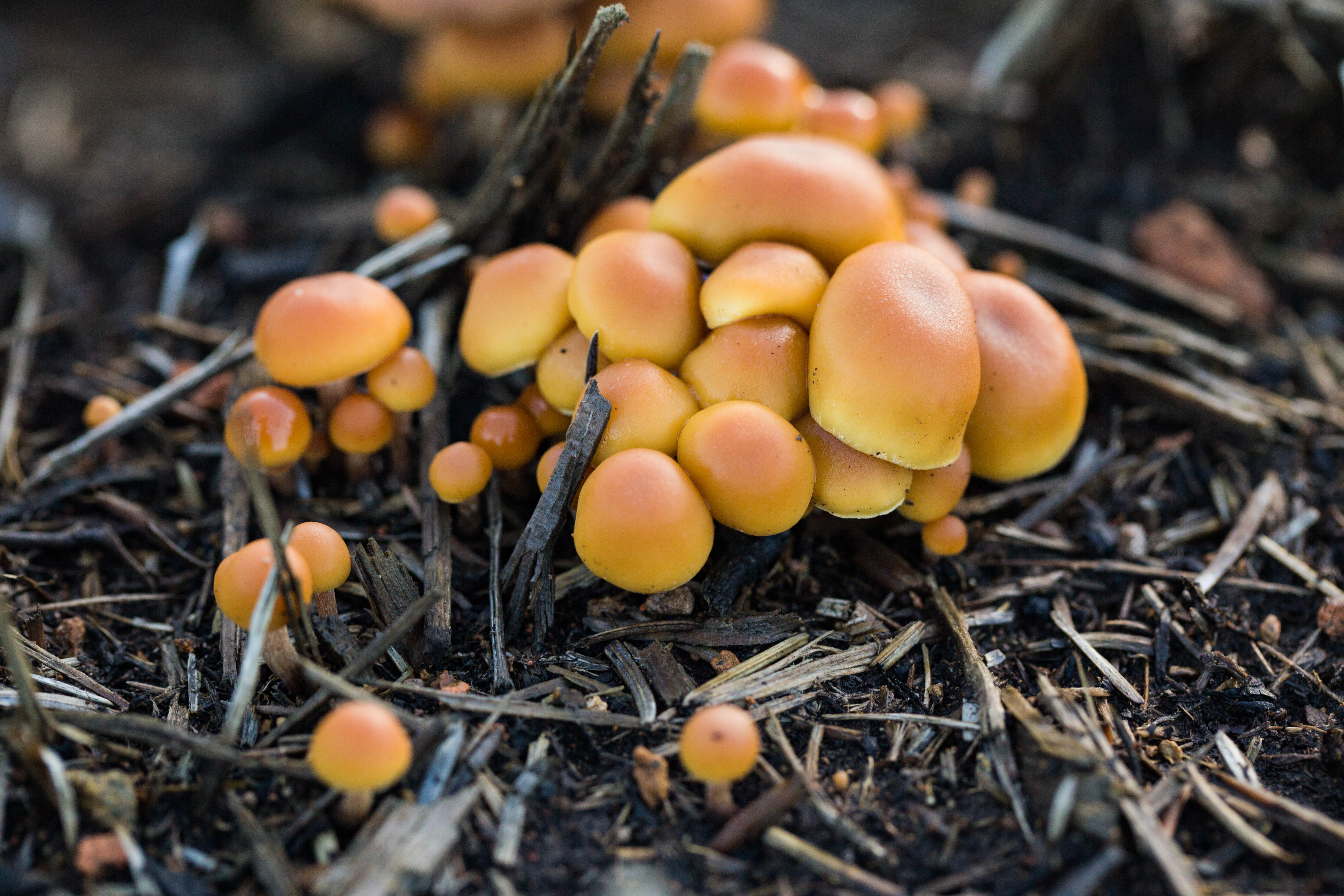
Just before we returned to the bothy to check the footage, Cain took me to see the huge troops of orange fungi up the hill by the clearing. I’d just been saying how little fungi I’d seen, but I was soon proved wrong when I saw how many there were up here. Sprinkled all the way along the track were small orange bulbs of every shape and size. Some were illuminated in patches of sunlight, which made their colours shine even brighter.
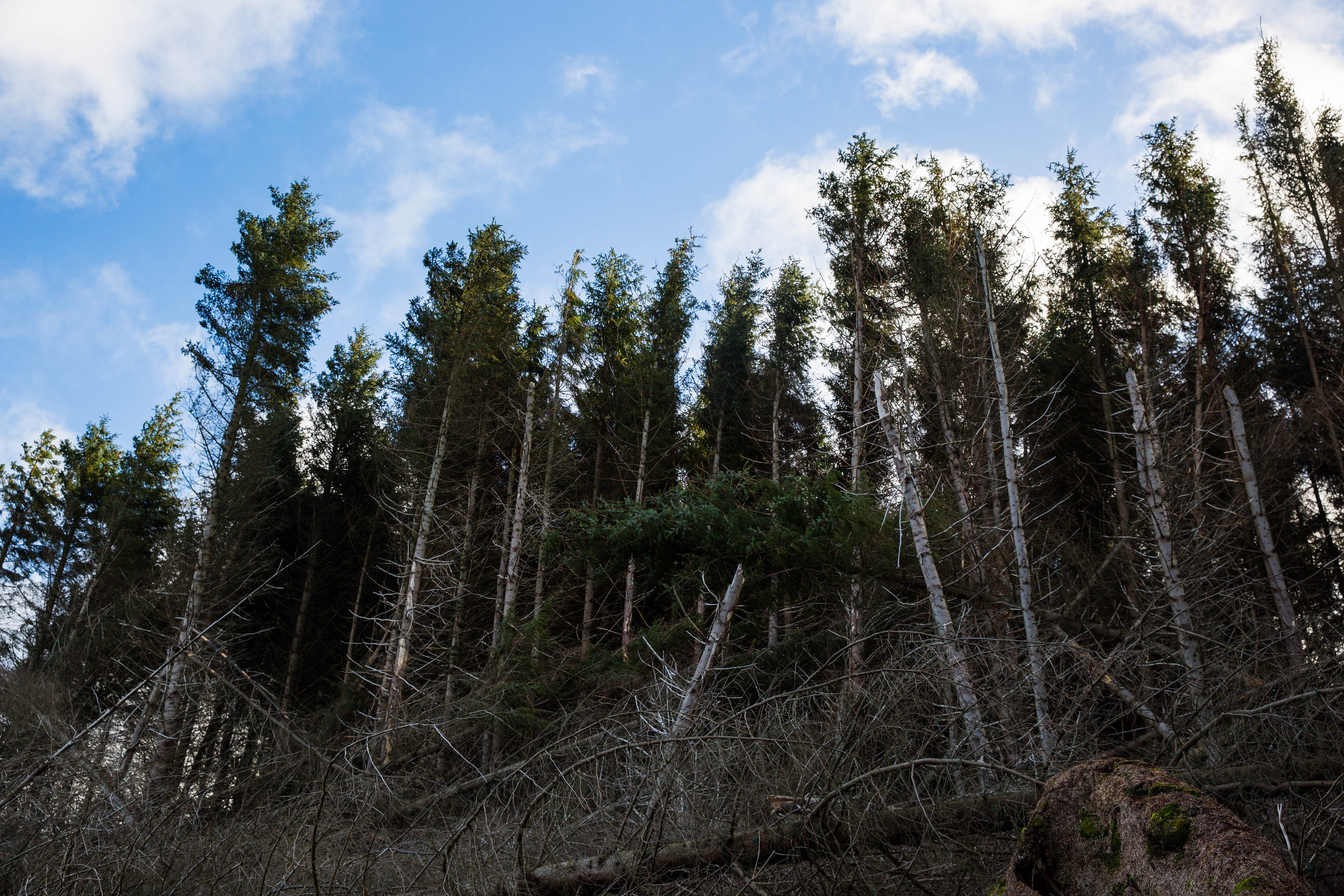
As I was stooped on the ground photographing the fungi, I heard a bizarre sound that reminded me of an angry cat. I turned and saw the outer layer of trees swaying in the growing wind, releasing the most peculiar creaking noises. Cain explained how these trees would usually grow on the inside of the forest, but due to felling they were now on the outer layer and were struggling to cope with the battering elements. Some had already succumbed, and we passed gigantic trees lying flat on the forest floor, their roots larger than tractor wheels.
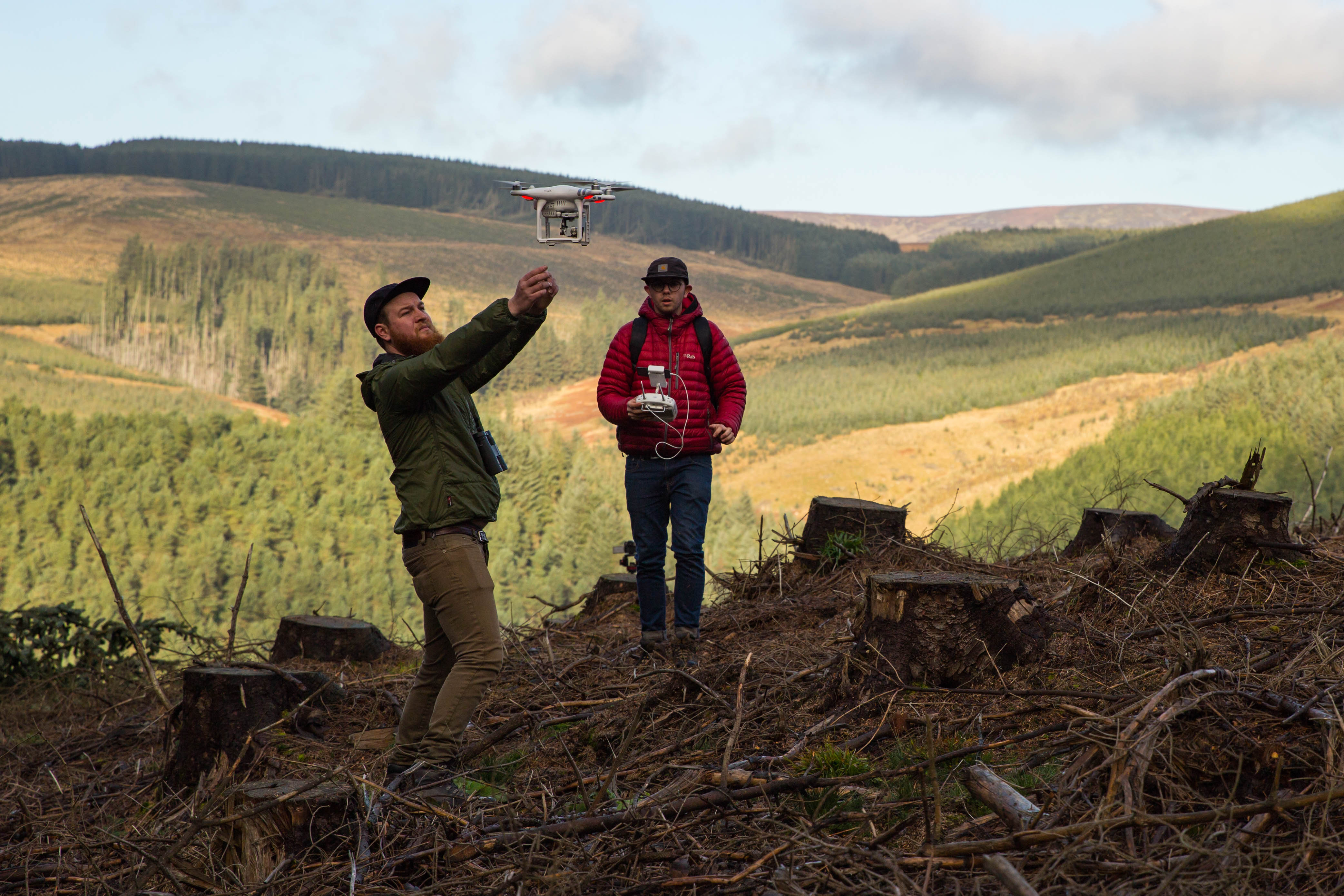
Out in the open, the wind was a lot stronger, so we ducked back down and sought the shelter of the forest. We gathered everyone in the bothy and had a look to see if the traps had been successful. Sadly, the two I had put out only had footage of my bobble hat as I attached and detached the trap from its post. However, Cain had put one in the garden and this had filmed several clips of a bank vole darting in and out of the rock pile. Later in the night, a wood mouse joined the scene, distinguishable by its longer tail and much larger Mickey Mouse ears. So, the traps weren’t a complete disaster, but certainly no pine marten footage.
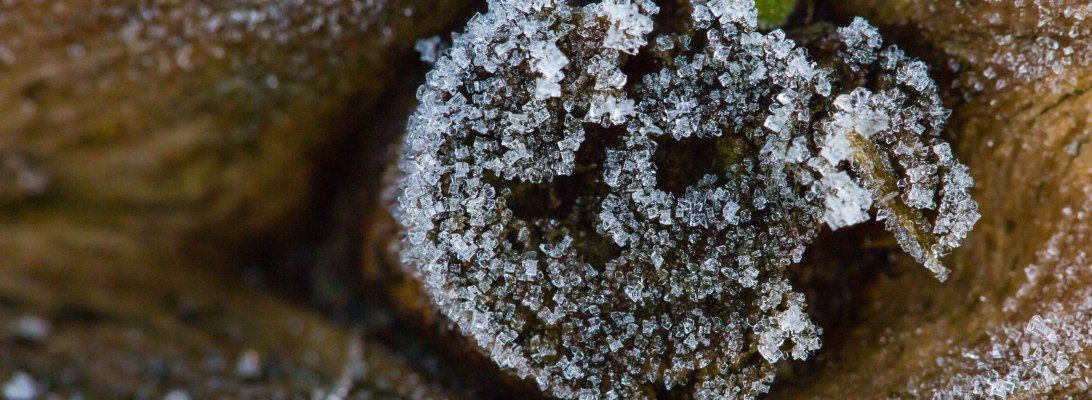
When I woke up the blinds were bright. I had a peek outside and was thrilled to see there was a frost clinging to the grass. I hurried into clothes and headed out into the garden. It had been a full year since my last frost and I was eager to capture some macro photos again. Leaves, twigs and thistles were all coated in a fine layer of silver crystals that, when hit by the sun, twinkled and shone like last night’s stars. Soon I had wet knees from crouching in the grass and the beginnings of a crick in my neck from getting as close as possible. My plan was to crop the photos in to create a repeating abstract texture. As usual, I took far more than I probably needed.
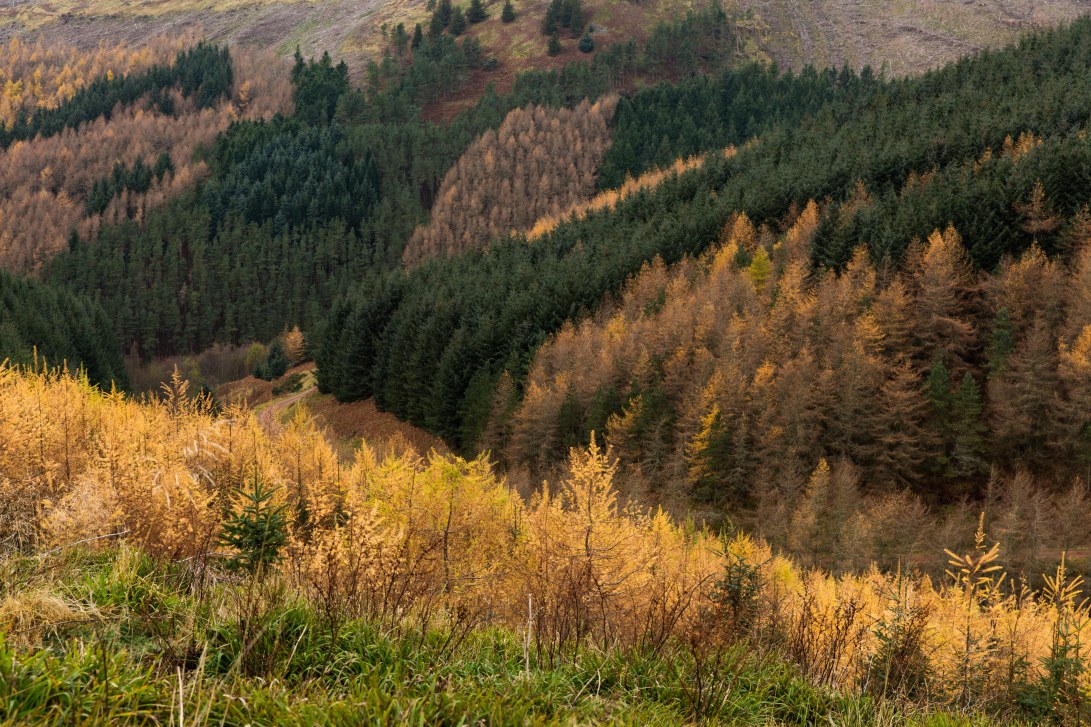
After relaxing for a while in the bothy I headed out again, down one hill and up the next. I passed the tyre swing, but the lack of decent light meant the shots weren’t quite what I imagined. I knew I had to photograph the bright yellow and orange larches that had taken my breath away on the drive in yesterday. Unfortunately the sun that I’d wanted to shine was well and truly concealed behind thick clouds; the light was so diluted I could gaze in its direction without difficulty. However, when I began to shoot, the rusty warm hues still popped. I began to experiment with positioning individual subjects like stray grasses in front of the camera, so the trees bled together and created a vibrant background.
The rest of the day was spent writing beside the fire and recording what I’d seen during the day. I had a sneaky look at my photos so far and was pleased with some of the outcomes. Hopefully there’d be more opportunities on our last day tomorrow.












 rebeccaonthewing.com