A Manic Few Weeks

The past few weeks have been a whirlwind! I have now completely moved out of Carlisle and come back home in Hertfordshire to spend time with my family and Cockapoo puppy, who at five years old is finally starting to calm down.

I’ve been back for a fourth visit to the Warner Bros Studio Tour of Harry Potter, and was throughly impressed by the new Forbidden Forest, not to mention the Butterbeer ice cream. I won’t give away too many spoilers as it’s an incredible place that you need to see to truly believe. I’ve been a Harry Potter fanatic for a million years and always get teary-eyed when I go. Even my Uncle Rod who was indifferent to Harry Potter ended up taking dozens of photos.

IMG_1027

I’ve also had my final results from university and was thrilled to discover I achieved first class honours, though I have to wait until November until graduation! It seems as though I shall need the cap and gown to keep me warm after spending the summer in the much hotter south.

IMG_1048

But I barely had time to celebrate my results before I managed to secure an internship at an animal sanctuary in Florida! I will be working for SEZARC (South East Zoo Alliance for Reproduction and Conservation) and I’ll be getting involved with a lot of lab work. One of SEZARC’s main lines of work is carrying out health studies to try and resolve reproductive issues that rare and endangered animals face when breeding.

It’s such an exciting and important area of conservation and something I’ve never had the chance to get involved with. I’m so excited to begin, but I’ll need to wait a little longer yet. I fly out at the start of August and work for two months before returning at the end of September. Just yesterday I booked all my flights as well as an international driving licence. Driving in America is quite a daunting prospect but seeing as there is no public transport in that part of Florida, I don’t have much choice! I’m quite nervous about going so far alone but I know I’ll love it once I get into the swing of things.

Now I have all of July to continue preparations for my extraordinary expedition! I dread to think how long my packing list will be…

Exhibition Launch!

The past few weeks have been fairly frantic, with preparations for my final showcase in full swing. Campus has been a buzz of activity as we all work on exhibiting our major projects and making them look their absolute best. After creative brainstorming and purchasing countless items and decorative pieces, I have finally finished my display and couldn’t be more proud of it.

IMG_0737

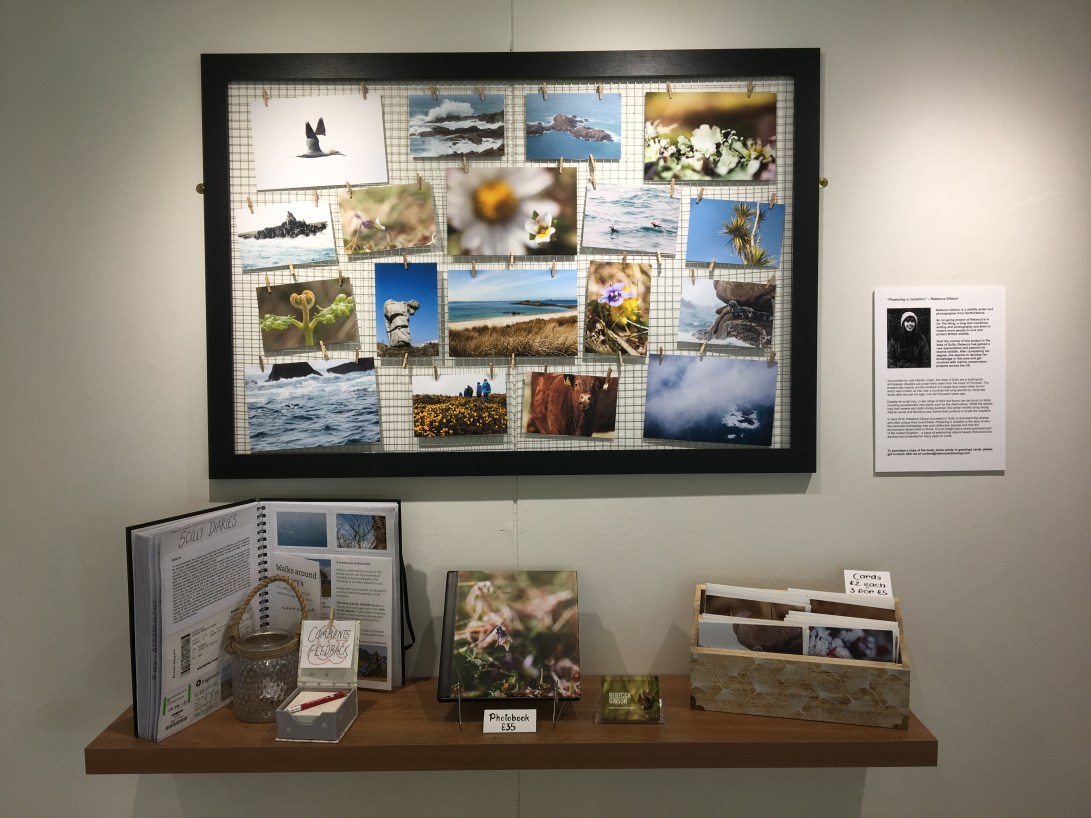
The exhibition will be held at the Vallum Gallery in Carlisle, Cumbria from the 1st to 8th of June. It’s a beautiful space to display work, especially photography where good lighting is so important. As the main part of my project was a printed photo book, I have also mounted a collage frame of snapshots from my expedition to the Isles of Scilly. To find out what I got up to during my time on Scilly, have a read of the start of my journey to this stunning archipelago.

IMG_0731
A peek into the finished photo book
IMG_0733
Some greetings card for sale

If you are interested in purchasing a copy of the photo book, or perhaps a few greetings cards of my photography, please don’t hesitate to get in touch with me at contact@rebeccaonthewing.com and I would be more than happy to provide more information.


A Biotope Weekend

Friday

The trains to Glasgow and Largs and the ferry to the Isle of Cumbrae were all fine. It was when I boarded the bus to the Millport Field Centre that it dawned on me: what on earth had I let myself in for?! I’d booked onto a weekend course run by the Field Studies Council called ‘Marine Species and Habitats: The Biotope Approach’. After volunteering at an aquarium had sparked a new fascination for marine wildlife, I wanted to learn more about what could be found on British shores. I’d done a bit of research using the course’s suggested reading list, and had half an idea what a biotope was, but as I dragged my bags off the bus I wondered if I’d booked myself onto something that would sail completely over my head. I imagined working alongside a team of marine biologists with decades of experience in the field, and here I was with a newborn interest in fish. I was suddenly terrified, and literally marooned on an island for the weekend.

IMG_0596
Blue Mussels (Mytilus edulis)

As I was mulling this over in my head, a girl my age carrying a black hold-all asked me if I was attending the Biotopes course. I was thrilled; fate had brought us together on the same ferry and meant I didn’t have to amble around alone wondering where I needed to be. Our rooms weren’t ready yet so we went for a wander towards the town of Millport. Her name was Abbie, and she was currently part-way through a PhD in non-native seaweeds. This was something I knew literally nothing about, but we chatted about uni and wildlife and all things in between. Meanwhile, it was a chance to see where we’d be spending the weekend, and it was beautiful. Of course, almost everywhere is beautiful in bright sunlight, but even so the Isle of Cumbrae promised a fascinating chance to survey marine wildlife.

IMG_0630
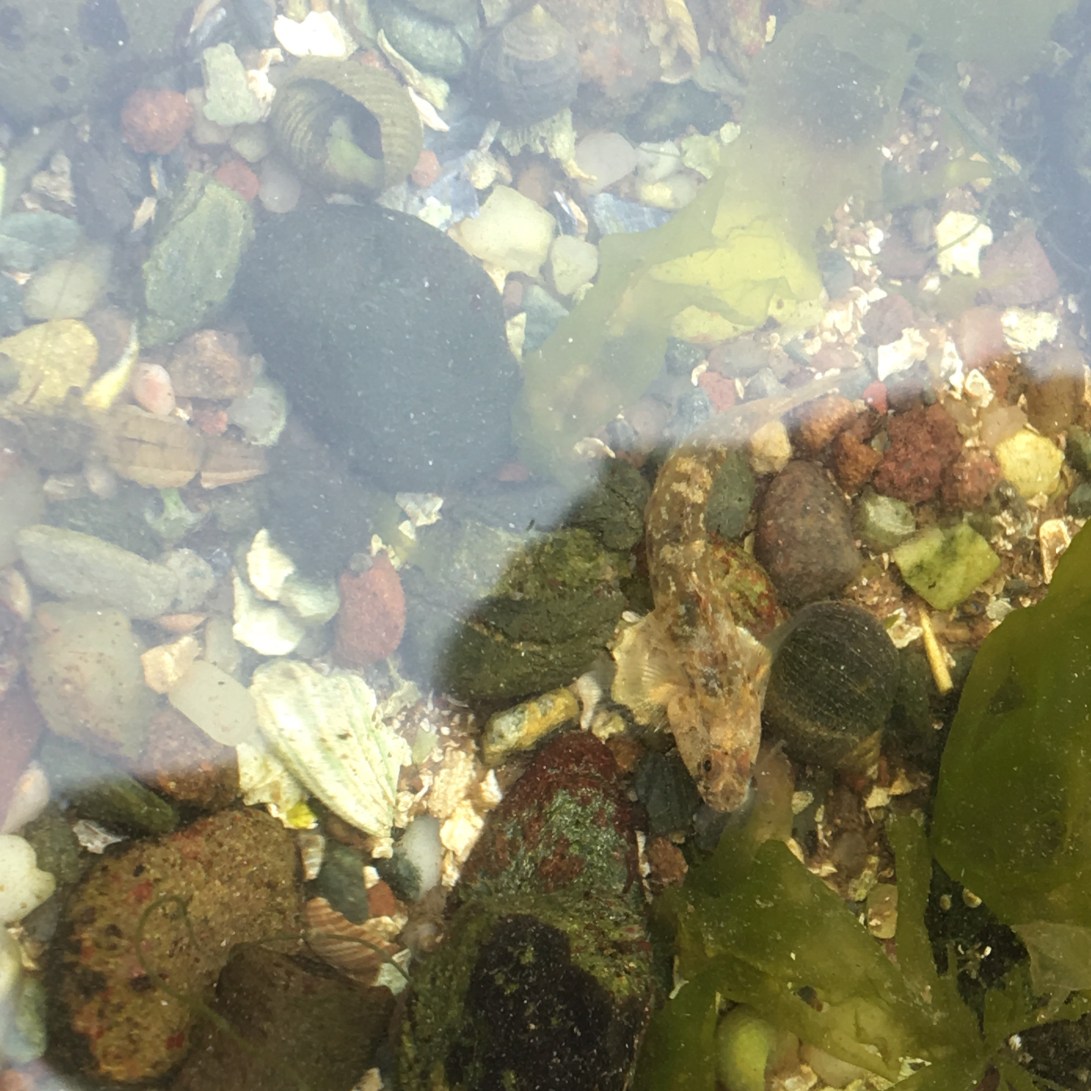
A well camouflaged Sand Goby (Pomatoschistus minutus)

After a loop around the bay we headed back to the Field Centre and took our bags to our rooms. I had feared with some trepidation what the washing facilities would be like, but was very pleasantly surprised to discover a large ensuite shower, not to mention a bed like a cloud. I hastily unpacked then met the rest of the group for our first briefing. Here I met Emily who worked at the Lancashire Wildlife Trust, and before dinner Abbie and I went for a walk with her to the shore to soak up the last sun of the day.

Dinner was macaroni cheese and apple crumble, perhaps one of the most perfect combinations of courses there can be. Then it was time for our first lecture: an introduction to biotopes. My research had prepared me well – a biotope is the combination of a physical habitat and the biological community found living there. Although some of the lecture’s content was lost on me, I left feeling inspired and ready to face new challenges over the weekend. I’d already met lovely people, and all my earlier worries began to feel very insignificant.

IMG_0602
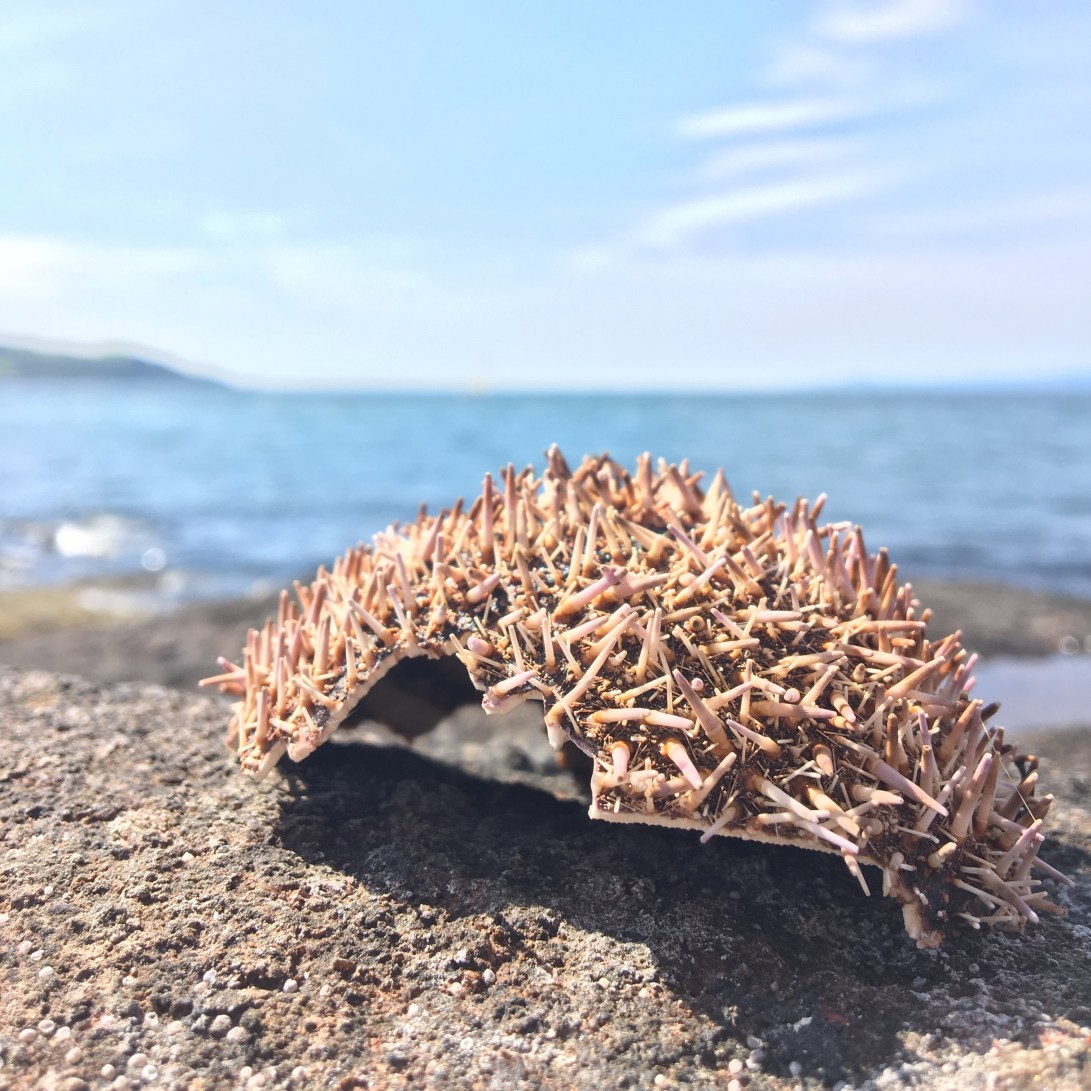
A fragment of broken sea urchin shell

Saturday

Today began early, and by 9am we were down on the beach beginning our first biotope survey. It was a beautiful day for it, and we wasted no time getting stuck in, in my case literally getting my wellies wedged in rock crevices and clinging desperately to my balance. Common species included beadlet anemones, dog whelks and acorn barnacles, but we also found common starfish, hermit crabs, a star ascidian (type of sea squirt) and plenty of seaweed. My knowledge of seaweed species was even smaller than my knowledge of seashore vertebrates, but as Abbie was doing her PhD on them I had a source of very valuable information.

IMG_0570
Star Ascidian (Botryllus schlosseri)
IMG_0621
Common Brittlestar upside down (Ophiothrix fragilis)

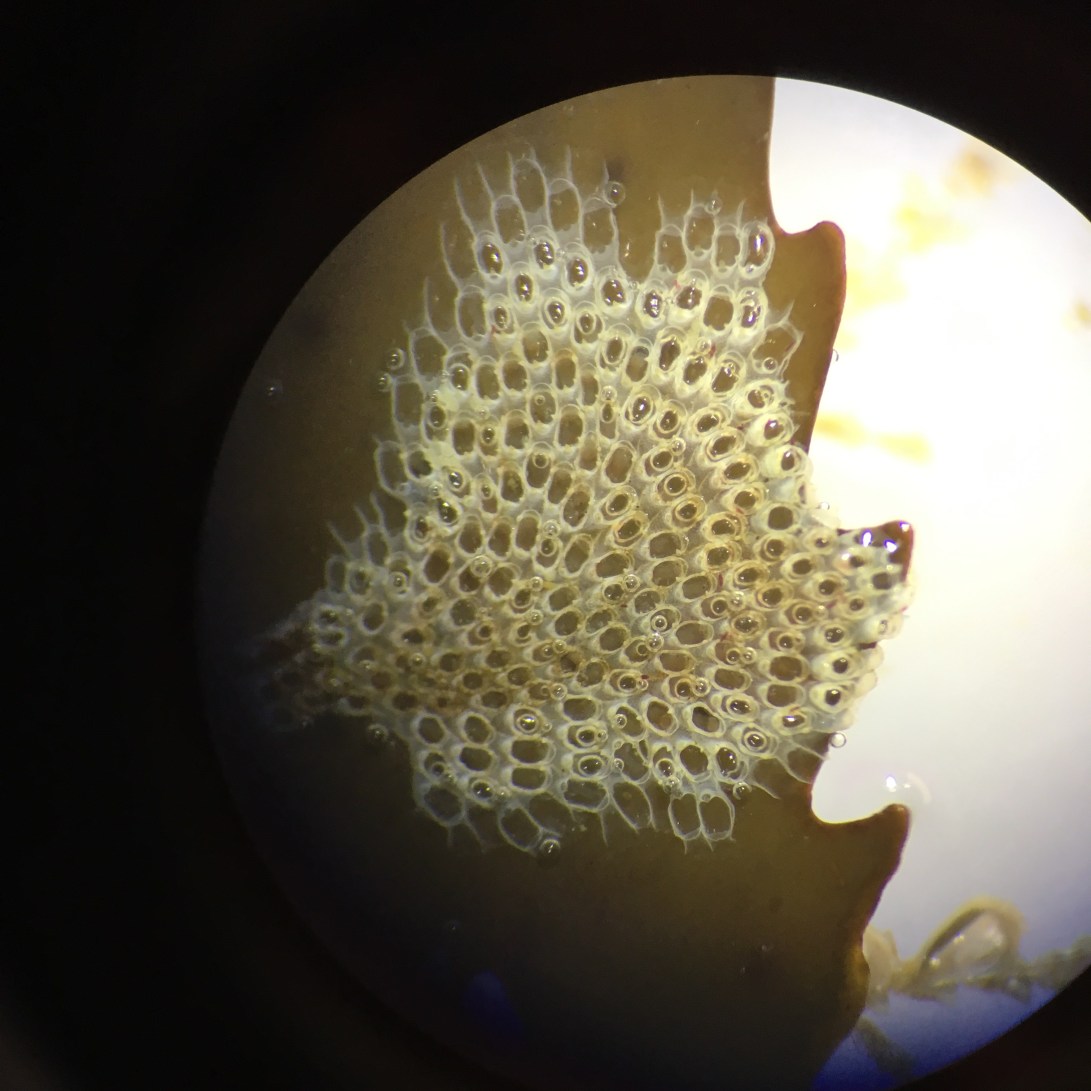
Once we’d covered as much of the bay as we could we ate lunch out in the sun (an excuse for some of the group to catch up with the goings on at the royal wedding) and then headed back to analyse our results and try to determine which biotopes we’d found. This was also an opportunity to play with lab equipment, which I haven’t been able to do since A Level Biology. I had good look at the bryozoa I’d found on a strand of seaweed (below). Bryozoa means “moss animal” and viewed up close reveals an intricate lattice of animals situated closely together. I studied these individuals for a while but couldn’t decide between Sea Mat or Hairy Sea Mat.

IMG_0606
A cluster of bryozoa: either Sea Mat (Membranipora membranacea) or Hairy Sea Mat (Electra pilosa)

After beating the queue and getting served dinner almost first, I went back to my room for much-needed downtime before bed.

Sunday 20th

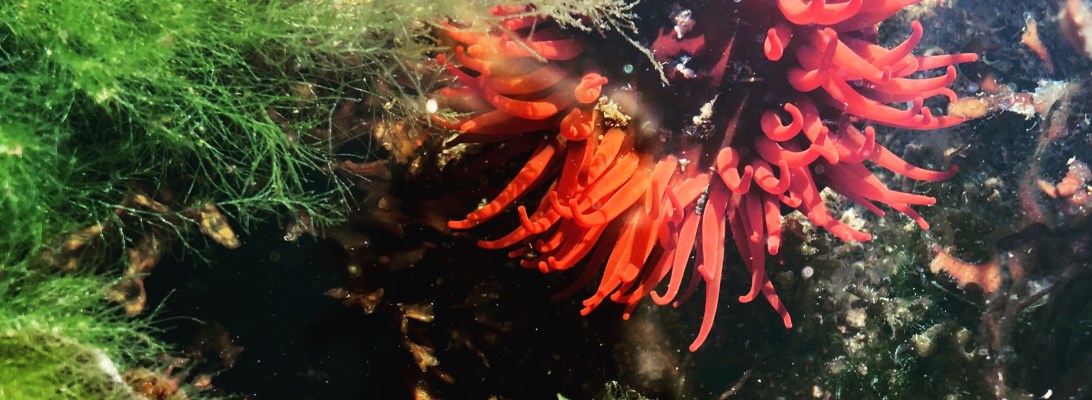
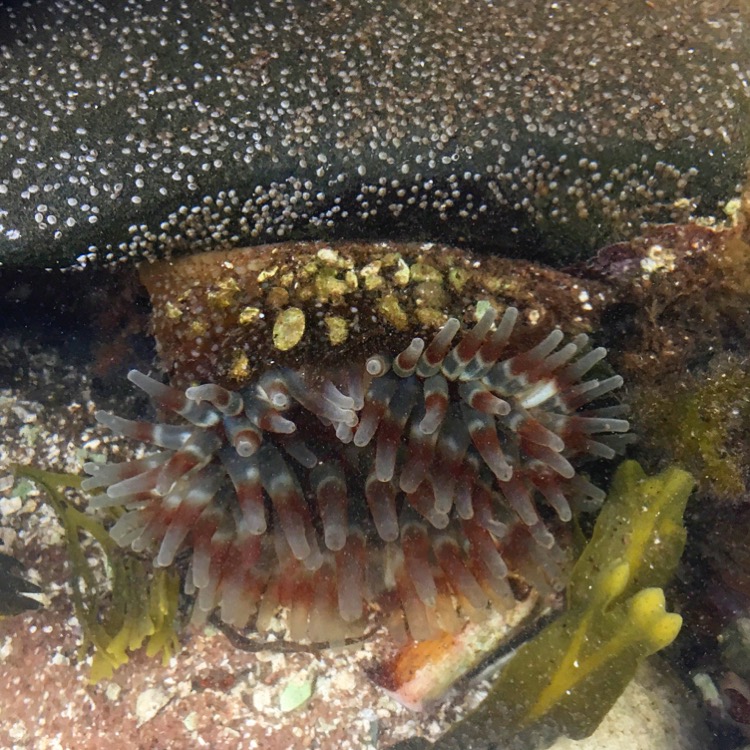
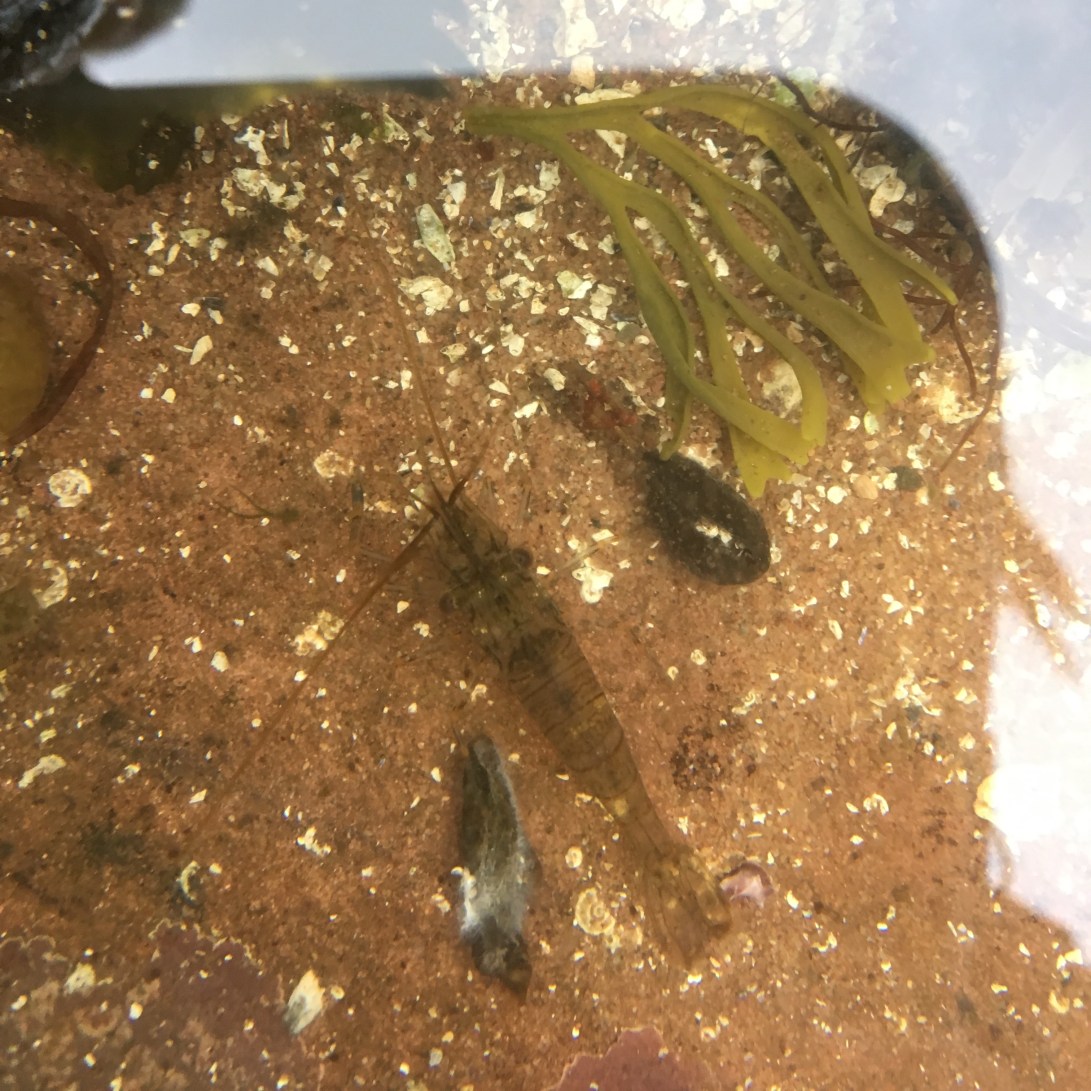
Today was another early start, and this time we drove the short distance to the northern end of Great Cumbrae to a much larger site. The weather was a little dreary but armed with quadrats, transects and clipboards we began to survey the biotopes. Findings started off slowly but once we reached the rock pools things really got exciting. Our course leader Paula found a slug species called a sea lemon – a very pretty blob – and a butterfish. Abbie, Alex and I found a sand goby, sand mason worm, lots of brittlestars, more hermits and beadlets, and my favourite from today: a dahlia anemone. It was the largest anemone I’d seen before, and had beautiful striated and brightly coloured tentacles that slowly emerged again once we’d calmed down to watch it properly. Just as I was squatting to try and get a decent picture, two common prawns appeared underneath a nearby rock. I didn’t know if maybe these were boring sightings but I recognised them from my volunteering at the aquarium so was thrilled to be able to confidently identify something in the field.

IMG_0684
Dahlia Anemone (Urticina felina)
IMG_0648
Common Prawn (Palaemon serratus)

Back at the lab, Abbie got to work identifying her seaweeds and Alex had an ID test to do for his assignment, so I had a bash at identifying today’s biotopes by myself. Once I’d done that, I realised I’d accidentally brought a tiny brittlestar home with my sea urchin shells. With Paula’s help, I identified it as Amphipholis squamata. Later, Paula asked us what we’d found, and Alex and I had got the exact same biotopes! I was so pleased with myself.

Dinner was Sunday roast and sticky toffee pudding. I must have put on about eight stone this weekend – I’ve been fed like a queen and although my brain has been working overtime, my body hasn’t done so much. After dinner we had our last round-up lecture and went to the bar for drinks. I ended up talking to the two guys from Belfast about Father Ted – it was pretty funny talking to Irishmen about it. I would have stayed longer but I was absolutely shattered. So I headed to bed, falling asleep almost instantly.

IMG_0607
Beadlet Anemone (Actinia equina)

Farewell to Scilly

For my last full day on Scilly I was back on St Agnes again, joining a group led by Will Wagstaff on a full day of exploring. Although the weather was still far from bad, today was the murkiest I’d had so far. The sun was well and truly concealed behind thick cloud, and without its warmth the wind blowing off the sea cut through my jacket and made me very grateful I’d decided to bring a jumper this time.

While most of the visitors from the boat headed towards Gugh before the sand bar closed up later in the afternoon, we went the other way, hoping to find more wildlife than people. Before long we heard the sound of a chiffchaff in the bushes, followed by a song thrush and the customary wren. We stopped at Big Pool and watched a pair of shelducks. Both male and female have beautiful and striking plumage, making camouflage on the nest impossible. To counter this, shelducks are often found nesting in burrows out of sight of predators.

IMG_1861

Just as Will was explaining this, one of the visitors interrupted with an exclamation of “redstart!” I’d never seen a redstart, so I was keen to find where the bird was spotted. There, perched proudly on the fence, was a beautiful male; black face, burnt copper breast and a smoky blue back. It was a stunning bird, but as usual didn’t stay still for long.

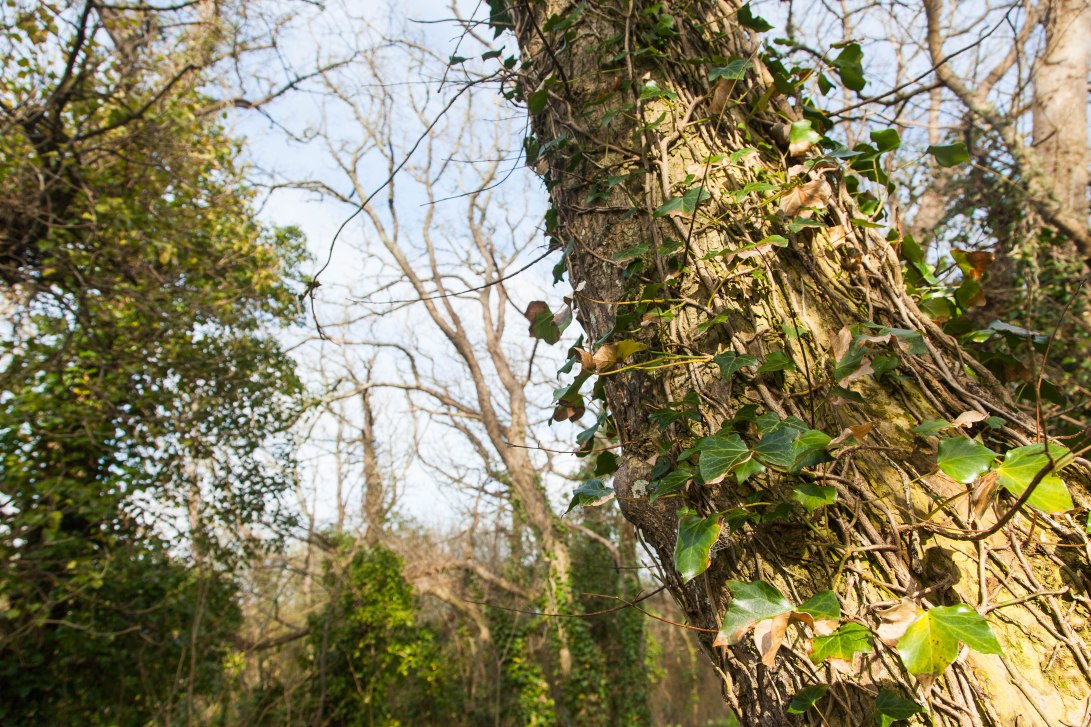
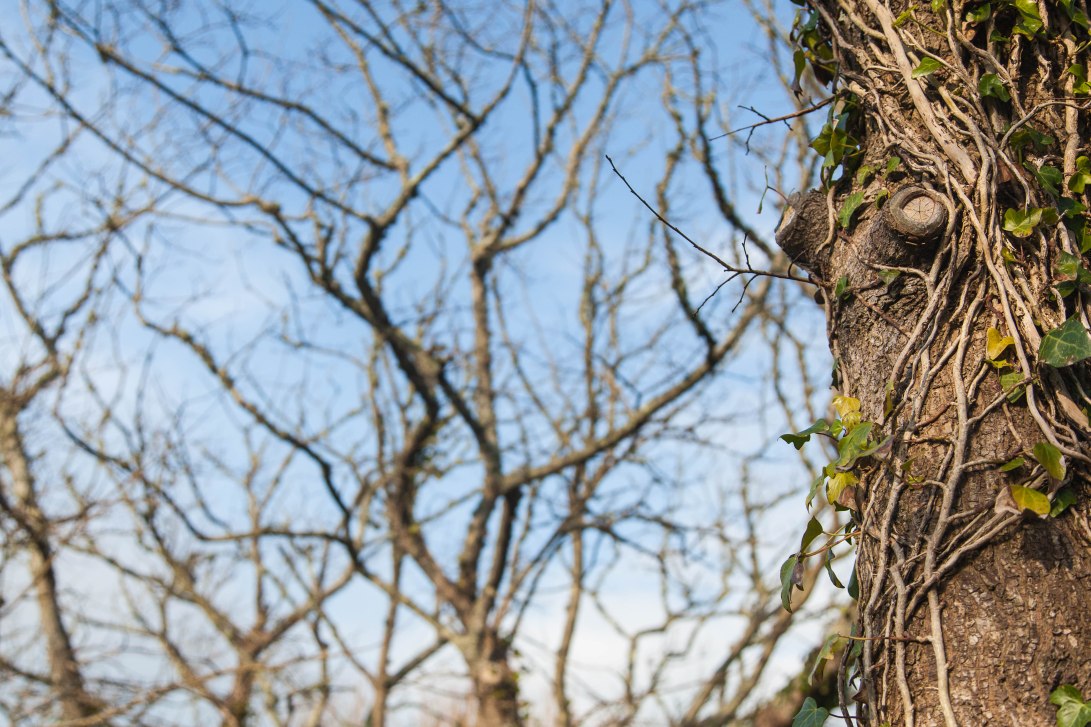
After a loop of the pool we wandered through Lower Town, a tiny street with a post office and a sprinkling of houses. We passed another grove of elm trees, and I asked Will if the ivy – which was also covering these trees – had a detrimental effect on them. To my surprise he said no, and in fact ivy was an essential part of the ecosystem, providing shelter for birds, insects and small mammals. While ivy should be removed from buildings, its presence on trees was of little concern. I was pleased; having survived Dutch elm disease it would be a shame to then lose Scilly’s elms to the ivy.

IMG_1616

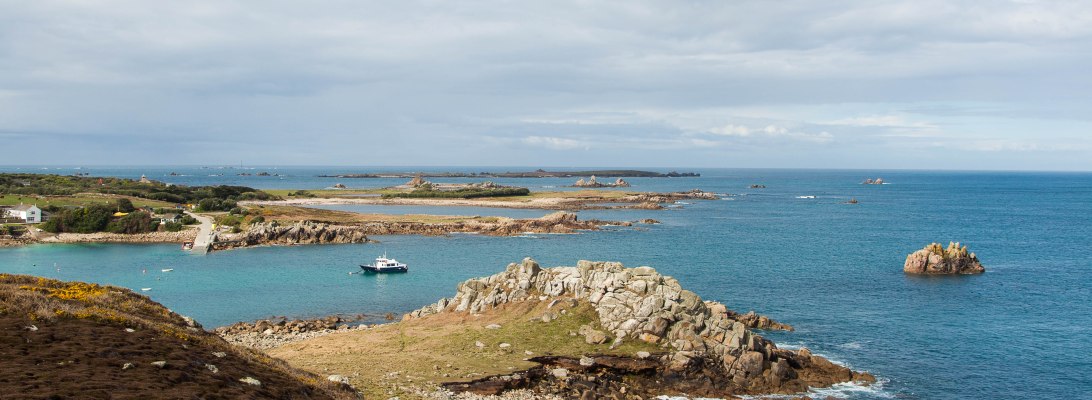
We crossed the beach looking out over Beady Pool and noticed that the sand bar to Gugh was closing fast. At this angle, you could really see how flat the beach was, and Will told us how people had underestimated the tide and had gotten trapped on Gugh in the past. The ocean was a force to be reckoned with, especially out here when the land was so low-lying and water inundation was an ever-present risk.

IMG_0604

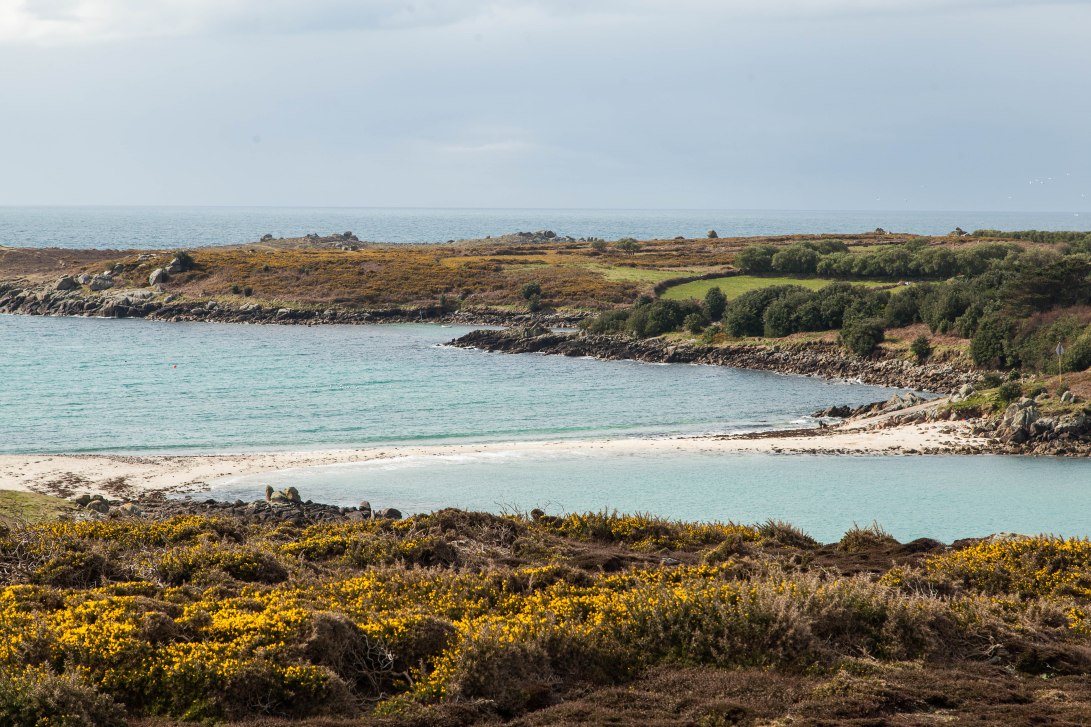
We threaded our way through vast forests of gorse, a bittersweet combination of harsh brambles and delicate yellow blooms. A herd of Ruby Red cattle grazed nearby, mooing into the otherwise silent landscape. The sharp-eyed visitor who’d spotted the redstart alerted our attention to another bird that was perhaps even more special: a woodchat shrike. Admittedly, I’d never heard of the bird before. It was an annual vagrant to Britain from southern Europe, usually seen here from April to October. A bird is considered vagrant if it strays far from its wintering, breeding or migrating grounds. The shrike was perched quite far off, but I could still make out striking black, white and russet plumage. I managed to get some shaky photos of the bird while it remained stationary; although they won’t win any awards, they were proof we saw it.

IMG_1823

The afternoon was racing on. The sun had failed to emerge so up on exposed Wingletang Down we all felt distinctly chilly. Incidentally, there was a café just up the hill, overlooking St Warna’s Cove. While we warmed up with hot chocolate we watched a few fulmars resting on the rocks. Unlike most gulls, fulmars don’t walk well on land, so if not flying the birds are always seen lying on rocks instead of perched on their feet. We all had a look down Will’s telescope, and saw there were distinct pairs set out on the rock. Fulmars, like many other birds, are monogamous and will mate with the same individual throughout their lives.

After we’d warmed up a little it was time to make our way back across St Agnes to the quay. We passed Porth Killier again, which looked vastly different now the tide had swelled. Will spotted a curlew sleeping with its characteristic bill tucked under its wing, and just as we reached the track down to the quay we saw a wheatear posing on the stonewall. We’d amassed quite an extensive bird list during the day, including several I’d never heard of let alone seen. It was always exciting ticking new species off the list, and on my last day in the Isles of Scilly I’d made lots of progress.

IMG_1802

Around St Mary’s

Today was slightly less eventful but still productive. I went for a walk to the Lower Moors of St Mary’s to find elm trees. Being so isolated, the elms on Scilly have successfully avoided Dutch elm disease, which has claimed all living elms on the British mainland. When I arrived at the spot on the map, I was quite shocked to see that although the elms were free of disease, they were covered from top to root in a thick coat of ivy. It was quite a disconcerting sight, but I had come to photograph live elms and here they were, so I experimented with different angles – shooting right against the trunk and looking up, focussing on a close section in the foreground and so on.

IMG_1635

I also found some beautiful patches of lichen so spent a lot of time photographing them too. Abundance of lichen was a good indicator of clean air. There is a distinct lack of dust and pollution on Scilly, and as a result there are forty different species of lichen on the islands. It can be seen growing on almost every surface, whether that’s tree, rock or garden fence. Lichen is what’s known as a composite organism, consisting of a fungal element for structure and an algal element for photosynthesis. This combination allows lichens to grow in a diverse range of habitats and environmental conditions. Sea ivory (Ramalina siliquosa) is a branched lichen – known as fruticose – that is one of the more common varieties, but there are also crustose lichens that form a tightly-clinging crust on rocks and foliose lichens which appear leaf-like, growing in lobes that are more-or-less parallel to the substrate on which they are found. Although I had no hope of identifying the lichen species I found on Lower Moors, it was fascinating to photograph them and see just how diverse they could be.

IMG_1267

A Day at Sea

Like almost every other visitor to the Isles of Scilly, I had my sights set on puffins during my stay, not to mention razorbill, guillemot and perhaps a seal or two. I’d planned on joining the afternoon Sea Safari around Annet, known as the bird sanctuary island, and the Western Rocks.

I wandered down to St Mary’s Quay to check it was going ahead and saw there was a trip to Annet in the morning too. I stood at the harbour and pondered what to do. The weather didn’t look promising – the looming clouds threatened to burst at any moment. So, somewhat recklessly, I bought a ticket for the morning trip and boarded the Sea King. As St Mary’s drifted slowly out of view, I hoped I’d made the right decision.

By the time we reached St Agnes the sun was doing its best to break through. As we headed out towards Annet, our guide pointed out the rock called the Cow, a smaller rock named the Calf beside it. When the tide came up, the Calf disappeared completely, only emphasising the fact that boatmen on Scilly needed their wits about them when navigating such challenging waters. Shags were perched on the Cow with wings held wide. The structure of their wings reduced buoyancy, which made it easier for the birds to chase fish underwater. As a result of this adaptation, however, their feathers were not truly water-repellent, so they needed to hold them up to dry them. Although, I doubted these shags would have much luck drying them in the current temperature. Perhaps it was for another reason; spread-wing postures aid digestion. Birds that adopt this position have low metabolic rates and high rates of heat loss. By positioning themselves with their backs to the sun, shags could increase the rate of thermoregulation, absorbing solar energy to increase their metabolic rate.

IMG_1472

Lesser black-backed and great black-backed gulls wheeled overhead, mouths open as they wailed at us. I had my binoculars scanning the rocks and nearby surf for a glimpse of vibrant, toucan-like beaks and droopy, clown eyes. The skipper slowed the boat suddenly and I sat up straight – a sure sign he’d seen something. A pair of great northern divers cruised into view when a wave subsided – beautiful grey birds not yet in their summer plumage. The divers, as a group, were extremely glamorous, with sleek heads and slender necks and bills.

IMG_1431

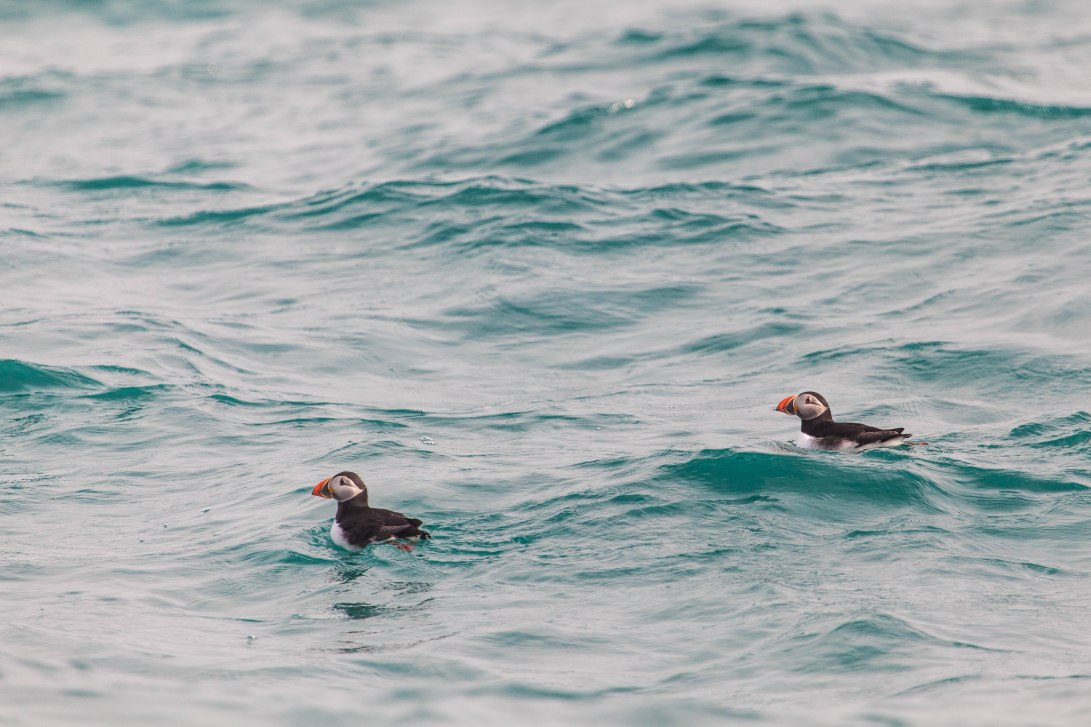
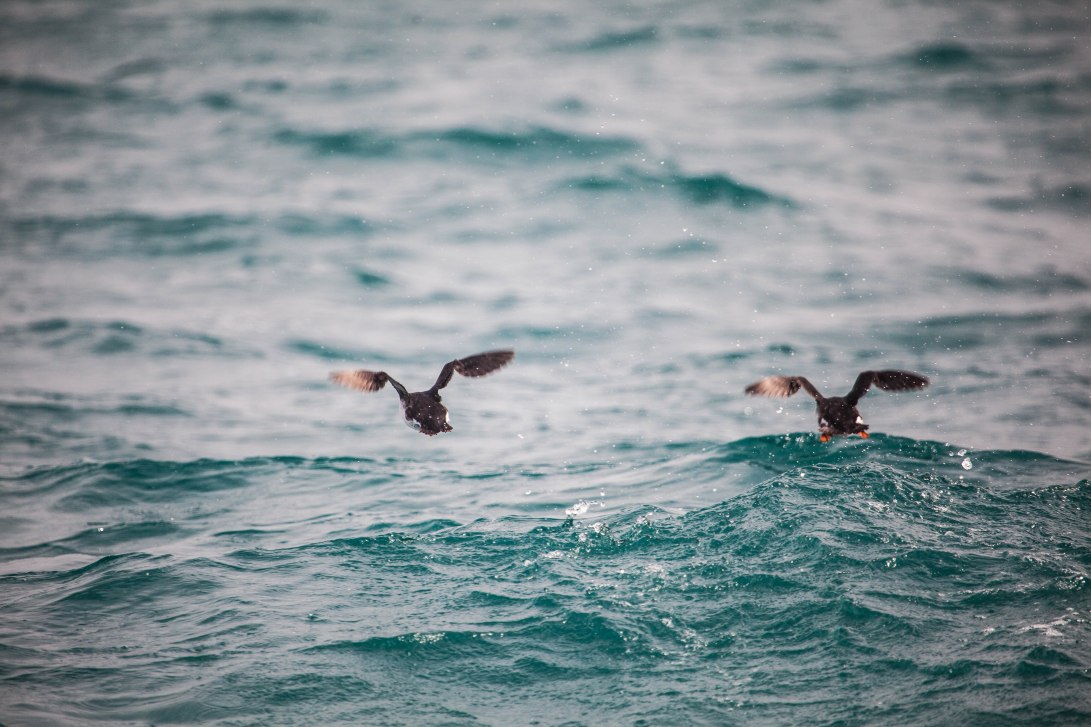
A while after our divers had swum further away, I suddenly found myself looking at my first puffins. Two of them, perhaps a breeding pair. Down the binoculars, all concept of scale was warped, and it was impossible to see how small they were – just 12 inches tall! After a few moments they took to the air and, flapping rather ungainly, they gathered enough momentum to carry them off across the water. I was thrilled.
IMG_1412-2IMG_1413

Leaving Annet behind, we moved into choppier water, the boat swaying beneath us as it negotiated unsteady waves. I was reminded again of how wild and isolated Scilly was, and it was this seclusion that protected and enhanced its flora and fauna. It was an island paradise.

A razorbill – a member of the puffin family – flew into view, wings beating rapidly either side of a stout, monochrome body. It wheeled in a wide circle, zooming back around the boat and away again; a bird’s second glance, too quick to photograph.

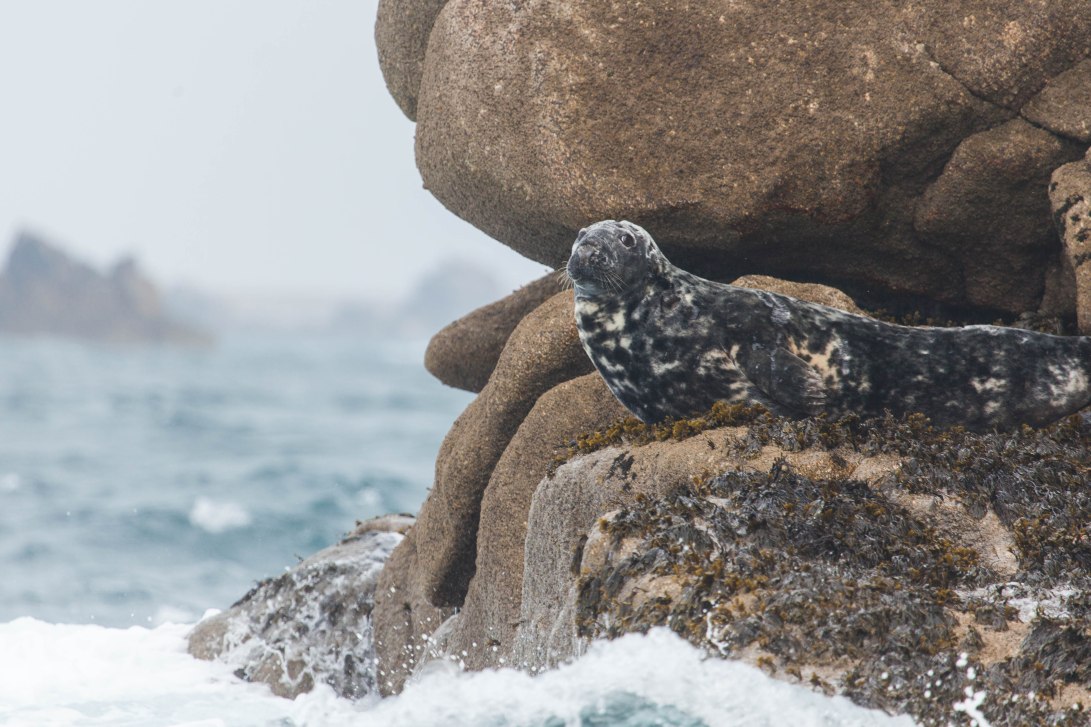
Just before it was time to turn back, a vast herd of forty grey seals appeared, some sprawled across the rocks and others bobbing in the water, long dog-like noses pointing in our direction. There were a range of ages, with some of the seals still sporting very lightly coloured coats and juvenile, inquisitive expressions. They continued to gaze after us until the rocks obscured us from their view, and the skipper took us back to St Agnes.
IMG_1482-2IMG_1525

Once we had all disembarked from the Sea King, it wasn’t long before the Spirit of St Agnes had taken its place, ready to take more eager birdwatchers out to sea. I decided that I rarely had the opportunity to go looking for puffins, so I bought a ticket and left dry land again, excited to be back out on open water.

Amongst the blue-green waves were the white outlines of gannets, looking like swans of the sea with their slender necks and stocky bodies. Britain’s largest seabird, with a formidable wingspan of six feet; not only did they have beautiful plumage and facial markings, but they were truly built for a life at sea. Gannets can dive into the ocean from heights of 40 metres, hitting the water at speeds of almost 60mph. To withstand the pressure of such a dive, gannets have “airbags” that protect their organs on impact. They also breathe through slits, situated where the upper mandible meets the head, which are covered by flaps of hard tissue that prevent water from entering them.
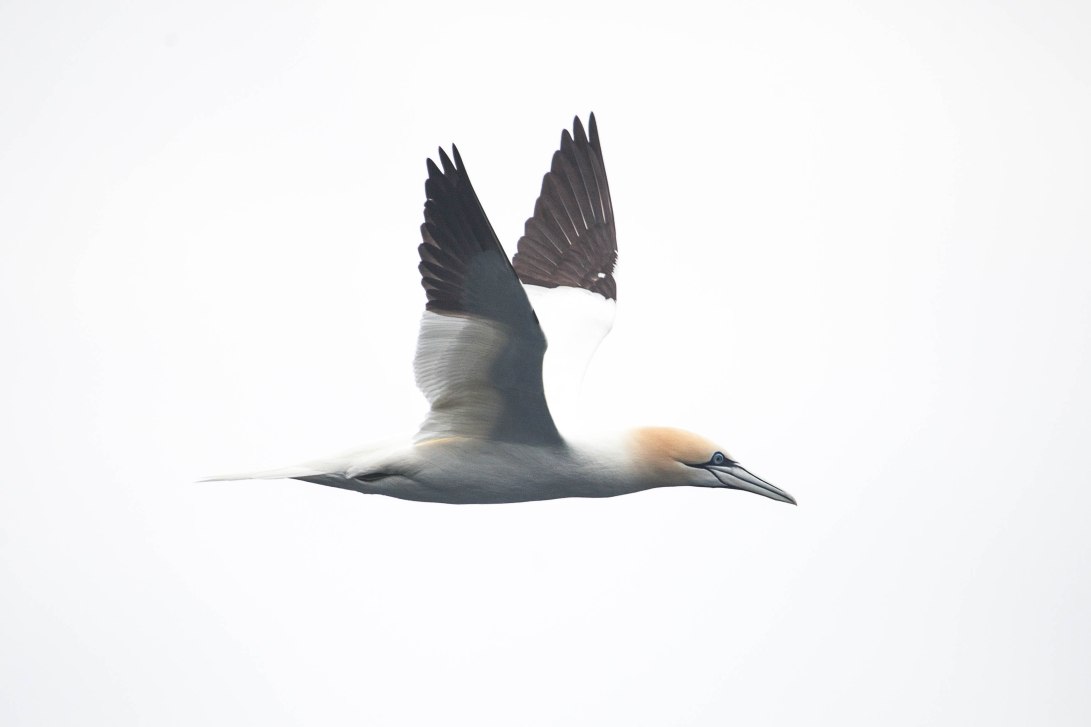
IMG_1575

These gannets weren’t diving, but they were soaring low over the boat, providing beautiful photo opportunities. It was always a challenge trying to focus a fully extended 400mm lens on a rocking boat, but I kept the camera as steady as possible and followed the birds as they glided majestically overhead.

The last bird to make an appearance was a special one; the Manx shearwater. Belonging to the order Procellariiformes along with albatrosses, these birds can live for some sixty years. They only produce one egg a year, so are highly susceptible to predation by rats. To combat this, the Isles of Scilly Seabird Recovery Project was established to eradicate rats from St Agnes, as it was suspected that they could swim the reasonably short distance to Annet, where the Manx shearwater bred. The project was successful, St Agnes was declared rat-free and the birds are now breeding successfully. In 2015, a total of 28 Manxie chicks were seen to be fledging from St Agnes and Gugh. These birds only breed on Scilly and Lundy in the UK, emphasising the importance of protecting the Scillonian population.
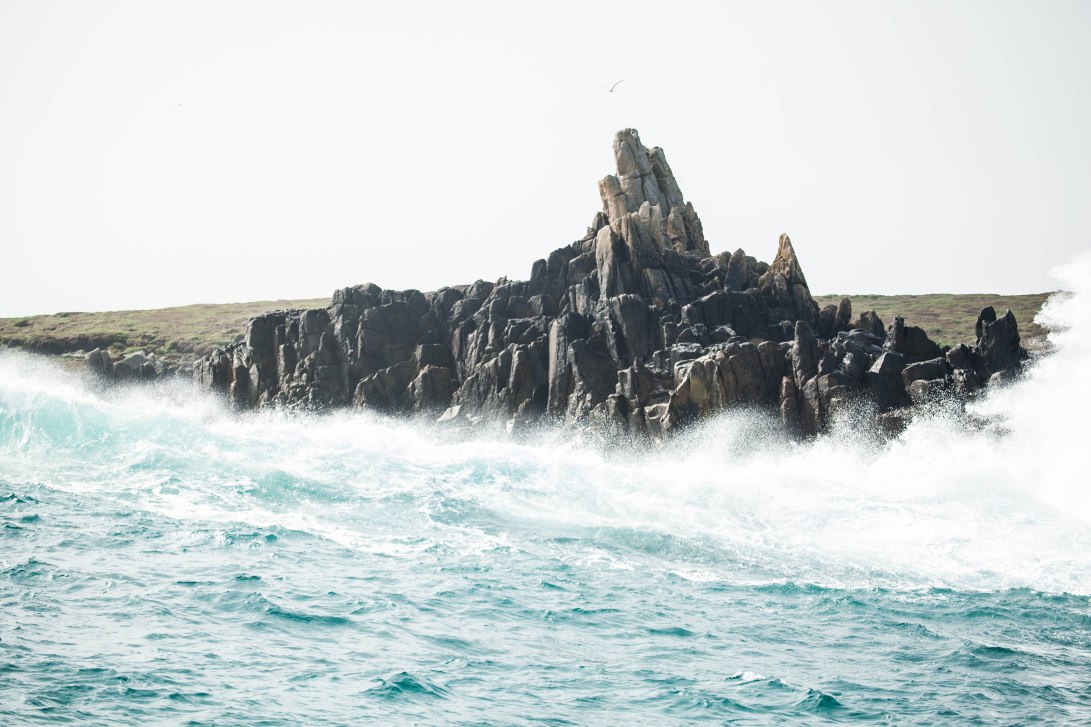
IMG_1397

Before long it was time to leave rugged Annet behind and return to (scarcely) populated St Agnes. Although we’d had Manxies and gannets on this trip, the puffins had eluded us. I spoke to the guide on the journey back and she said they didn’t like bright sunlight. As the clouds had shifted and it had turned into another beautiful day, the puffins were obviously finding shade elsewhere. Later, as I looked through my photos, I felt very fortunate to have gone down to the harbour earlier than planned.

IMG_1497-2

Success!

I was back on Bryher today, having another go at finding the elusive dwarf pansy. As was becoming a daily ritual, I engaged in friendly conversation with my fellow passengers on the Seahorse as it made its leisurely way out of St Mary’s Quay.

“That’s a fancy bit of kit you’ve got there,” one man said, gesturing at the camera hanging from my neck, “What are you hoping to photograph?”

I told them about my mission to find the dwarf pansy, to which the man said, “Ah yes, such a shame about the flowers this year.”

I supposed he was referring to the recent snowfall, which had pushed the growth and emergence of the Scilly wildflowers back a few weeks. Still, I didn’t like his pessimism and although I smiled politely I was feeling confident. The weather had been and still was beautiful, and I was here to find the dwarf pansy. So when the boat docked and I hopped onto dry land I strode towards Rushy Bay with steely confidence. The sun was already beating down and incidentally I would later regret not covering my sore, red ears from that beating sun. Meanwhile, I was on my hands and knees peering at grass and getting some very strange looks from passers-by. I found my tiny purple flower from last visit, which I vowed to ask the tour guide about on my walk that afternoon.

By lunchtime my stomach was rumbling, so I tucked into my sandwiches and rested my sore knees. It really was a stunning day, and I had the beach almost to myself. A couple of holidaymakers were foraging for shells by the water, and every so often a dog appeared with a wide-eyed expression of sheer joy before loping back over the dunes.

IMG_0996-2

I decided to give the area one more scope before it was time to walk back to the quay and meet the tour group. Just behind the high grass was a group of binocular-glad walkers huddled together gazing at something on the ground. My heart leapt into my mouth and I hovered awkwardly where I was standing. Was it cheeky to go over and exploit their find? I hadn’t paid for their walk, after all.

But this was the dwarf pansy, so I made a beeline and gazed between shoulders to see Will Wagstaff pointing at a tiny white speck in the grass. I waited as patiently as I could, hopping from one foot to the other, for the group to take their turns photographing the pansy. Once they’d dispersed, I lay down on the grass and noticed there were two! One was fully open, the other was partially closed but still beautiful; in fact, it was a real stroke of luck to see two different stages beside each other.

The Red Ruby cattle mooed at me as I lay there, trying countless angles and focuses. A man and his son approached me and asked what I was doing. In moments we were talking about the pansy, my uni work, and he was amazed that I’d come all this way for a flower. After he’d moved off another couple appeared from Heathy Hill, and once again I showed them what I was so captivated by. Like all the others, they responded with the courteous “oh really?” and “wow!” but I could tell they weren’t nearly as excited as I was. I wanted to shake them and say they were not found anywhere else in the UK, only this tiny archipelago! I had to share my joy with someone who’d appreciate just how special the sighting was.

IMG_1064

So, as I hurried back to the quay, now nearly late for the walk, I rang my parents and wheezed my good news. They’d shared my worry and calmed my panics on the run-up to the expedition so were thrilled that I’d found what I came for. I was beaming ear to ear.

Once I got to the meeting place and Darren, the guide from the Isles of Scilly Wildlife Trust, told us our route, I realised we weren’t even going through Rushy Bay, so I would have missed the pansy completely! I was hesitant to call it fate, but if I hadn’t eaten my lunch where I did, I’d have been journeying back to St Mary’s very disappointed.

IMG_1167

The Spirit of St Agnes

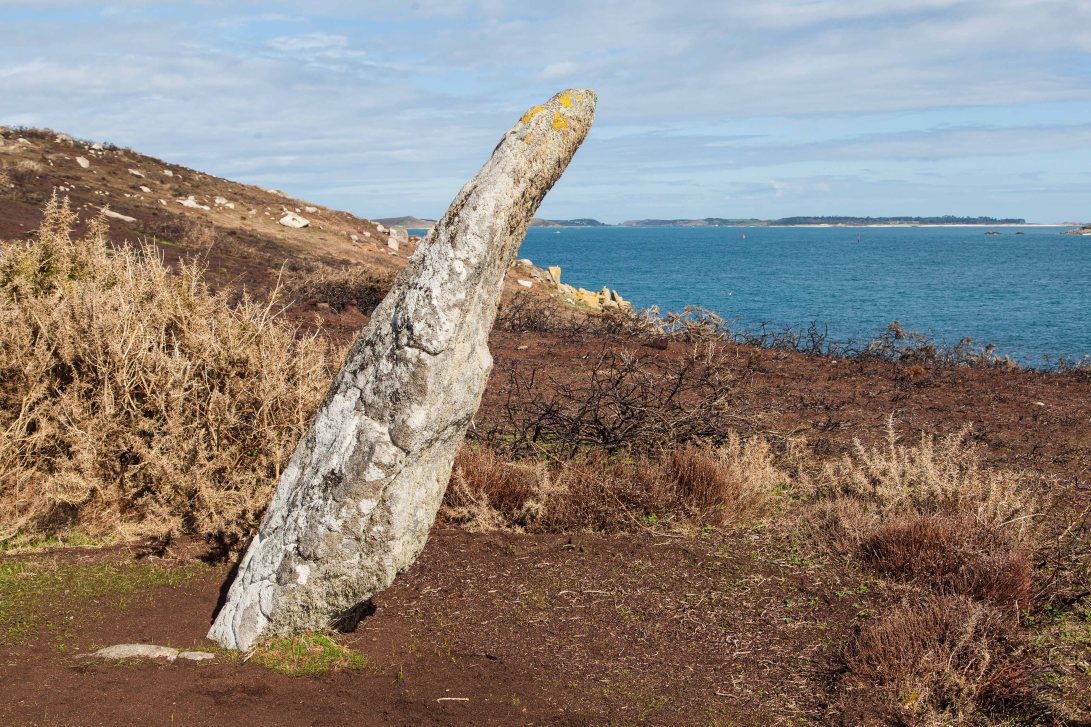
As soon as we docked at St Agnes’ Quay I asked a nearby guide when it was safe to cross over to Gugh, the neighbouring island linked to St Agnes by a sand bridge that disappeared when the tide came in. Getting stranded on an island with two houses and no facilities would be less than ideal. Luckily, the guide told me that the tide would be far enough out to be able to cross all day, so I made my way over to Gugh. My first object of interest was the Old Man of Gugh, a menhir dating back from the Bronze Age. Menhirs are tall upright standing stones erected by people living on the islands many thousands of years ago.

IMG_0619-2

After getting acquainted with the Old Man, I wandered down to Beady Pool, so named because to this day ceramic beads from a 17th century Venetian shipwreck can be found there. Although it was tempting to have a little look, I already had enough miniscule treasure to find, so after eating my lunch looking out to sea (again!) I walked out to Wingletang Down.

IMG_0655

The first thing I noticed – after the forest of gorse that almost completely covered Wingletang Down – was the Devil’s Punchbowl; a curious name for a curious phenomenon. It was described as a rocking stone because it was positioned in such a way that it rocked easily from side to side. Looking loosely like a ball and socket joint, the top of the stone was a sphere cut in half, resting on top of a thick, squat column of stone. What was most intriguing was that the stone was completely natural. Somehow, Mother Nature had created the Devil’s Punchbowl for seemingly no reason other than to exist, perched at the tip of St Agnes.

IMG_0747

Amongst all the orange of the gorse were the delicate flowers of Ornithopus pinnatus, my target wild plant on St Agnes. After nibbling a few Haribo and admiring the Punchbowl a little longer, I began to search for it. However, after seemingly no time I noticed that time was running away from me again, and I headed around St Warna’s Cove towards another peculiarity: the Nag’s Head. Another naturally occurring feature of the landscape fully exposed to the Atlantic, the granite stone has been moulded into unusual shapes by the water and wind, so now it has a likeness to the head of a horse. William Borlase, a Cornish antiquarian saw the strange hollows and shapes of the Nag’s Head and thought the stone had been moulded by ancient cups and bowls, when in fact every mark on the granite is natural. It was yet another feature of the Scilly landscape that gave it its intriguing and quite unique personality.
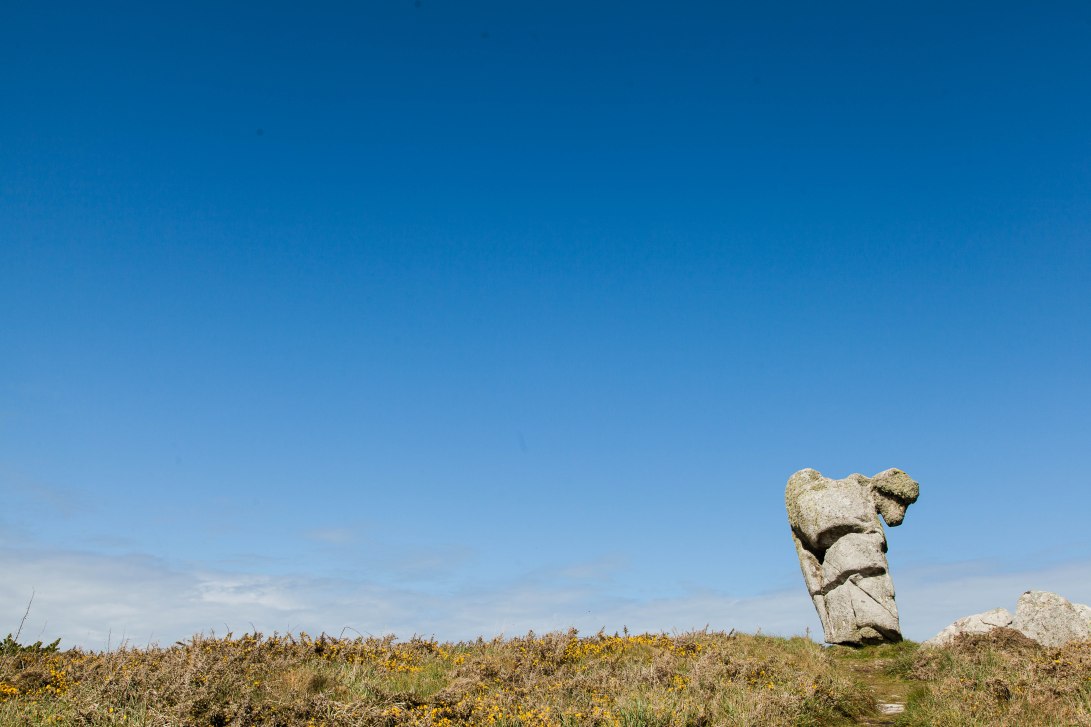
IMG_0778

Exploring Bryher

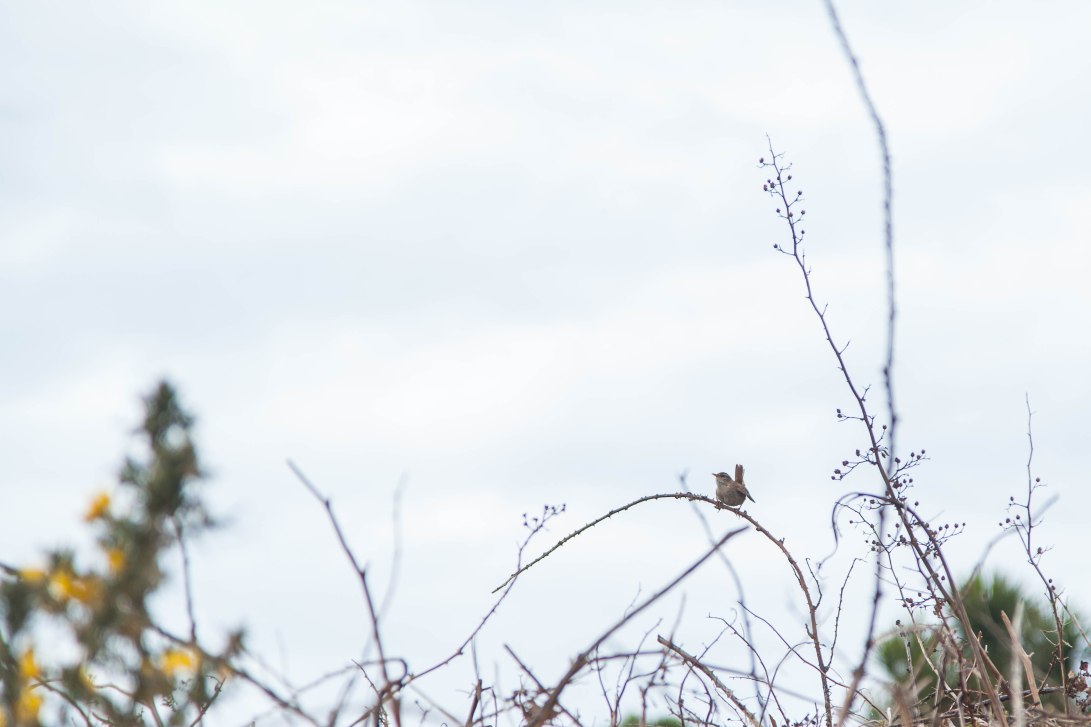
When I arrived on Bryher I was reminded of how scarcely populated the 1½-mile long island was. After an initial buzz of human activity at the quay, tourists and locals dispersed and I suddenly found myself completely alone, except for the ever-present wrens of course. One was perched high against the skyline only a few feet away, trilling with all its might. According to some Scillonians, wrens here are slightly different to those on the mainland. Their songs are different, and their mottled body markings are brighter. Perhaps this is a little Scillonian pride, but the shrews, bee and blackbirds are all unique here so I liked to entertain the possibility that Scilly wrens were just as special.

IMG_0244

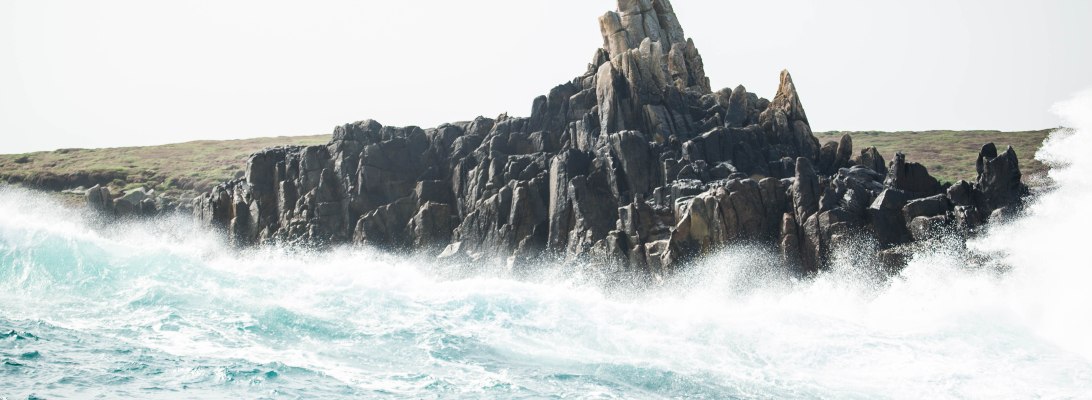
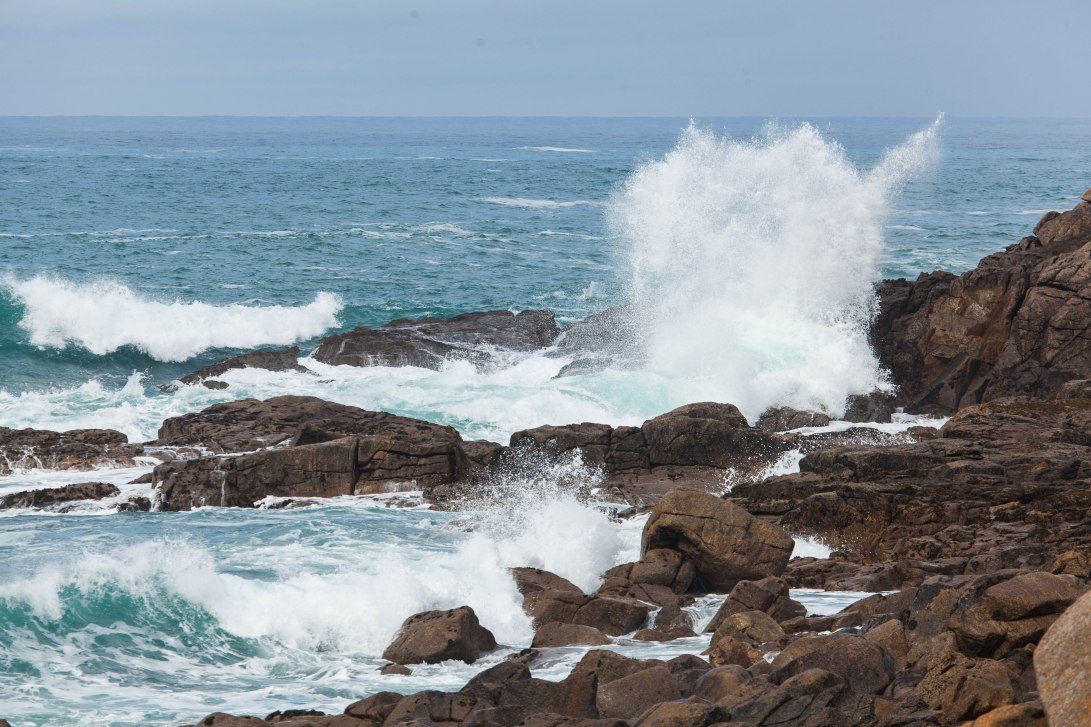
Bolstered by the wren’s enthusiasm, I made my way towards the northern side of the island, where the infamous Hell Bay laid waiting. So called because of its treacherous and unforgiving nature that had caused many a shipwreck in years past, it was hellish and beautiful in equal parts. I perched on a plump cushion of downy grass and watched the show – a dramatic display of rumbling waves, churning currents and seething white froth that surged up as each wave receded. Although each collision was intense, every so often a particularly furious wave thumped the rocks, sending vast plumes of water skywards. Backed as always by the wailing gulls and squealing oystercatchers, it was a feast for all the senses.

IMG_0293

Time was pressing on. Conscious that I didn’t want to miss the only boat back to St Mary’s, I hugged the coast and followed the beaten track down the western stretch of Bryher. Red Ruby Devon cattle watched me cautiously, blinking with big bottomless eyes. Before long I reached Rushy Bay, and the sun was shining beautifully. I ate my lunch on the sand, which as always on Scilly was golden and impeccably clean.

IMG_0587

Replenished, I began the search for what I’d come here to find: the dwarf pansy. With flowers 4-8mm long, I braced myself for a challenge. During my research I’d learned that a good spot on Bryher was “the sandy turf behind Rushy Bay”, which at the time had seemed a doddle. How much sandy turf could there be? I thought, quite deluded. True, the area wasn’t vast, but when you were looking for a flower that could fit several times on your fingernail, the sandy turf seemed to expand tenfold. I’d found the true meaning of “needle in a haystack”.

IMG_0557

Wondering why I’d chosen to torture myself, I began to scour the ground, peering between thick grasses for a glimpse of violet. I found plenty of insects; sandy brown spiders that skittered in and out of sight (small enough not to trigger my panic response luckily), black beetles I couldn’t hope to identify and plenty of ladybirds sitting prettily. No such luck with pansies, though. Soon my knees and back began to ache so I tried my luck on Heathy Hill, another good spot for dwarf pansies and orange birdsfoot, a rare member of the pea family I was also hoping to find.

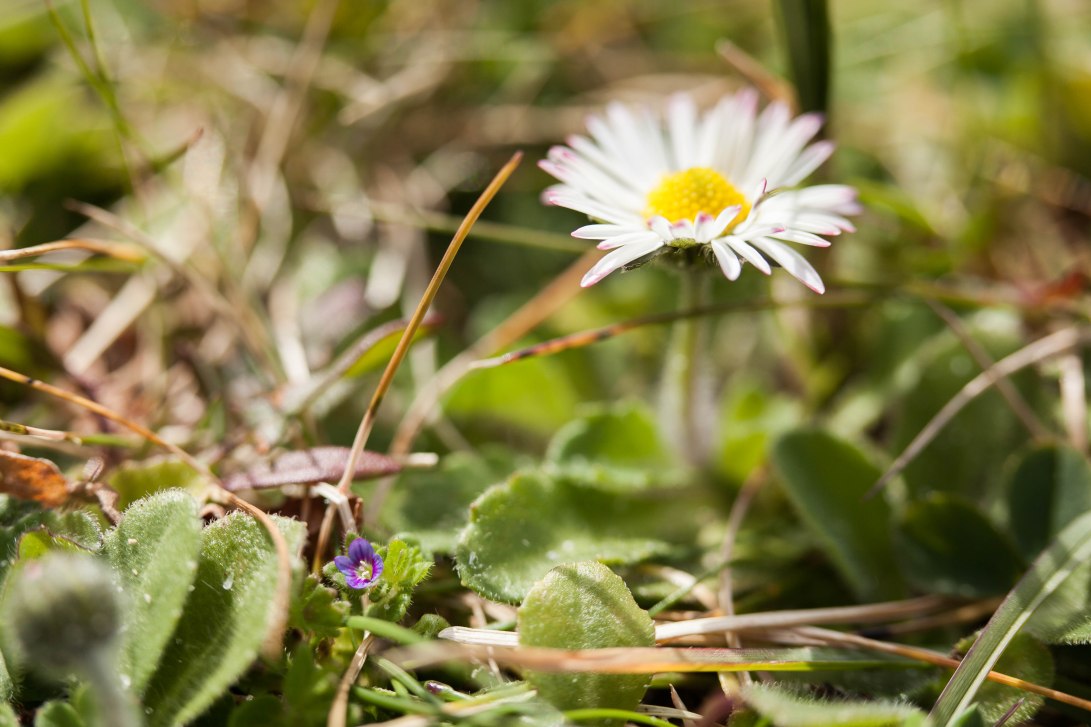
On the way, I stopped to admire the daisies. Interestingly, these common white flowers used to be known as “day’s eye” because they opened during the sunlight hours and closed at night like blinking eyes, but this soon morphed into daisies. By chance, my gaze wandered to a minuscule flower with purple petals that I could barely make out with the naked eye. In a slightly embarrassing lapse of composure I felt tears of joy prick the backs of my eyes, but I remembered that there were a lot of tiny flowers on Scilly. Due to the poor, acidic soil, often only small species could survive here. I knew I shouldn’t get my hopes up. It may not be my prized pansy, but I still lay sprawled on the floor photographing it for a good long while. Just in case.

IMG_0408

I headed further west towards Heathy Hill. Here I found a rather large cluster of blue-violet blooms and once again I was stumped. What if these were dwarf pansies and I hadn’t made full use of the opportunity? So, even though the petals looked a little large, I spent another twenty minutes rolling around in the grass getting very atmospheric photos of what could have been Scilly’s most common wildflower.

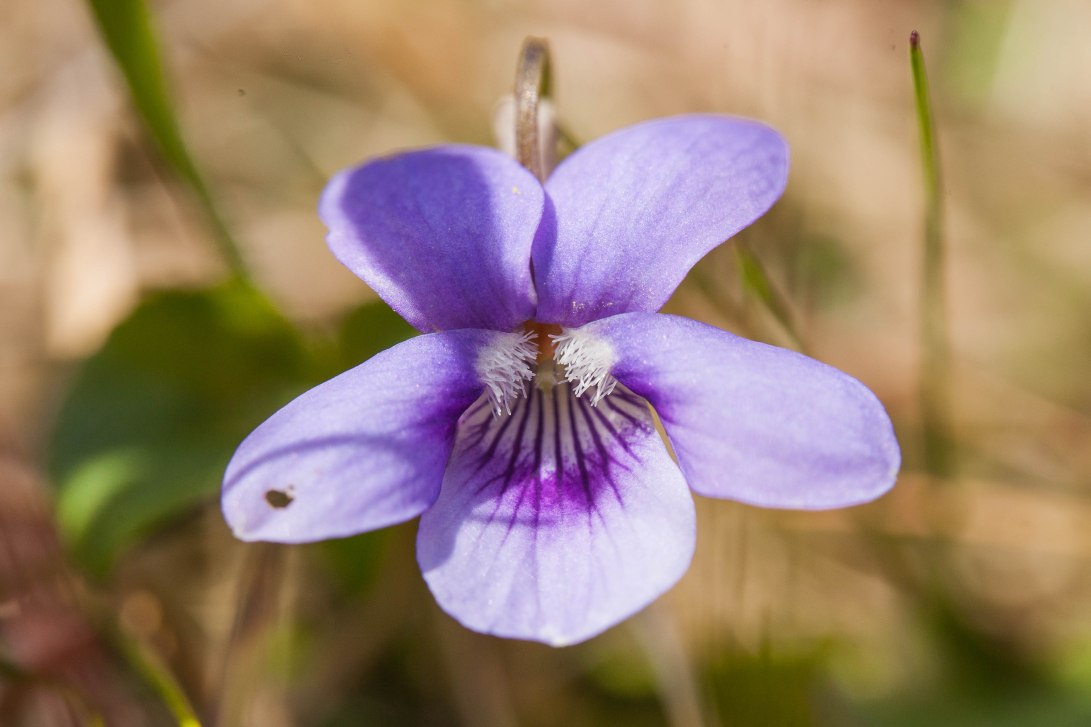
Back on St Mary’s that evening, at a wildlife talk at the village hall, I consulted Scilly naturalist Will Wagstaff about my finds. The second species I had found was dog violet, so not even a pansy sadly, but he couldn’t identify the first flower I found, which was quite intriguing.

IMG_0478