It’s been a while since my last post – the past couple of months have been a whirlwind of planning, packing and stress! Earlier this week I came back from a trip of a lifetime to Arctic Norway, but it nearly didn’t happen at all.
For the past three winters, my partner and his friends have made the journey to Skjervøy, a three hour’s drive north of Tromsø, to go whale watching. Large shoals of herring have been drawn into the fjords of northern Norway, attracting humpback whales and orcas. Every year my partner hires a boat and takes the group out to find them. As soon as they returned in 2019 they booked the house for 2020, obviously unaware of how the year would progress.
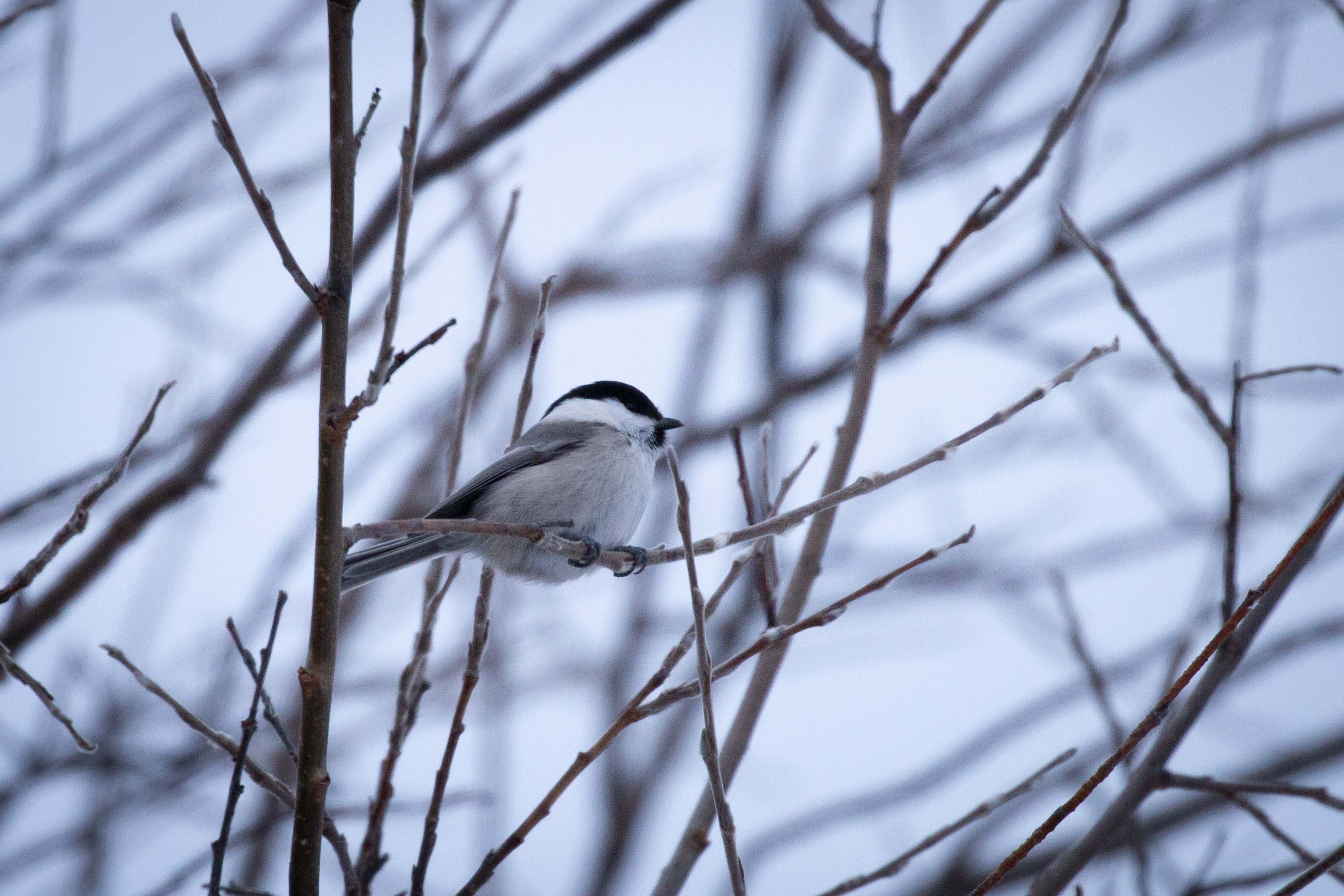
Willow tit
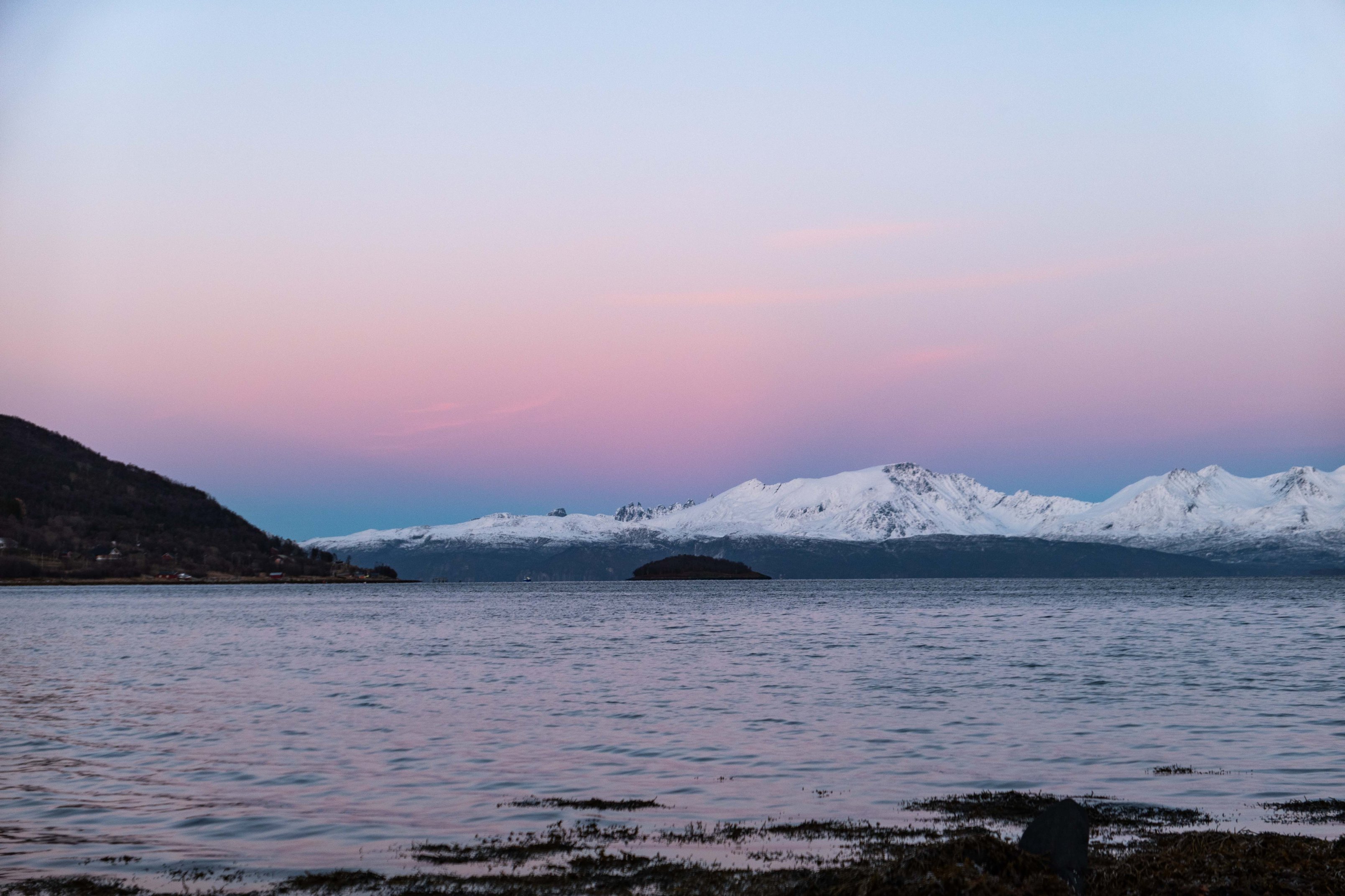
In the lead up to our departure, our flights were cancelled and rearranged three times. What was originally a trip for eighteen people split over three weeks shrunk to just six of us because we all had to arrive at the same time to do our ten day quarantine. Eventually we made it out there and settled into our beautiful house right on the water’s edge.
It was the best quarantine I could have wished for: white tailed eagles flew directly overhead every morning at 10am sharp; willow tits scooped up the seeds beneath the feeder; velvet scoters cruised across the fjord and best of all, the northern lights shimmered in cloudless skies on most evenings. I felt incredibly fortunate to have reached Norway and had such an enjoyable quarantine!
The first ten days could have been a holiday by themselves, but after we were cleared to leave the house it was time to do what we came to Norway for – head out on the boat to look for giants. More coming soon!
For years it’s been a dream of mine to watch Scottish red deer in the autumn so last week my boyfriend Steve and I journeyed to the west coast to find some. We saw deer every day but they were often on the peaks of the hills and too far away for photos. Even if the sights weren’t great, the sounds were fantastic. At night in the chalet I’d pause during dinner after hearing a faint mooing sound from outside. It wasn’t cows but the bellowing of breeding stags on the hill across the loch, working hard to protect their own harems of hinds or attempting to steal someone else’s. They bellowed long into the early hours and several times I woke up disorientated, wondering if I had dreamt it.
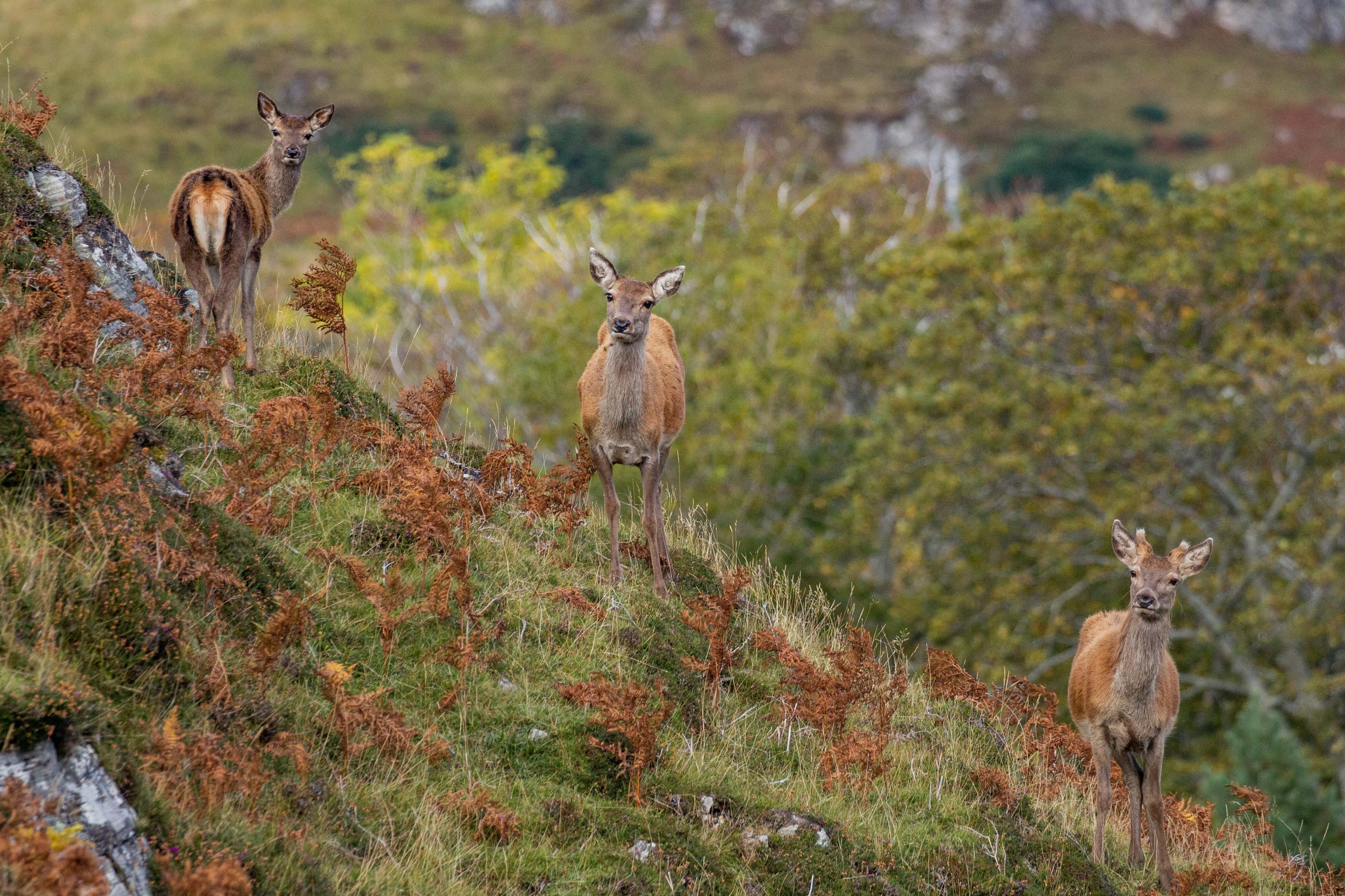
A distant hind on the crest of the hill.
On the last full day of the trip after yet more distant silhouettes on the horizon we turned around and started driving back to the house, just about ready to accept defeat. In an almost cliched “nick of time” moment Steve suddenly spotted a stag with his harem in a field not far from the road. Naturally there was nowhere to pull over so we ditched the car in a layby, walked back up the road and crawled the last few metres on our bellies to avoid scaring the deer.
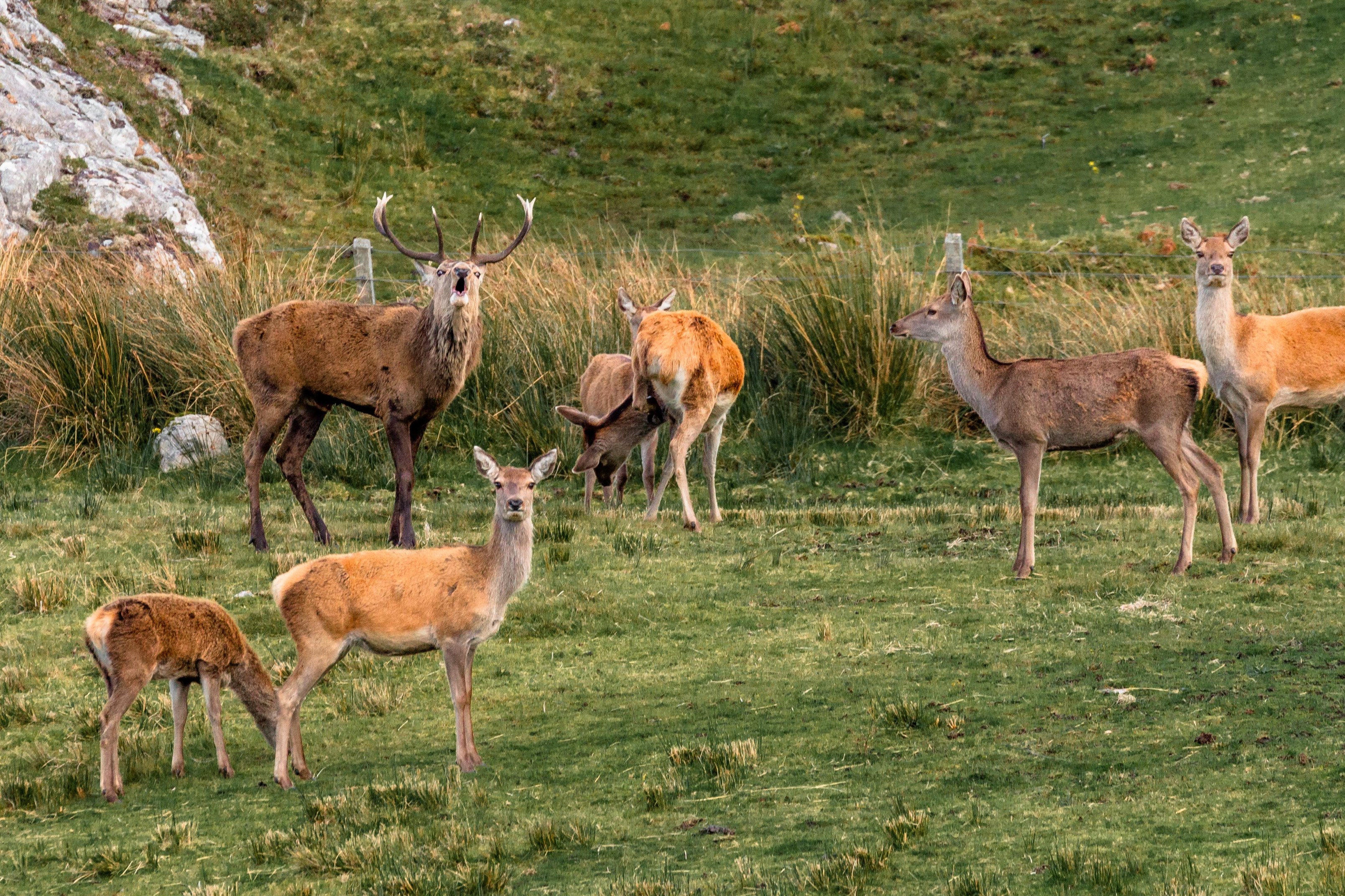
A stag bellows in front of his harem of hinds
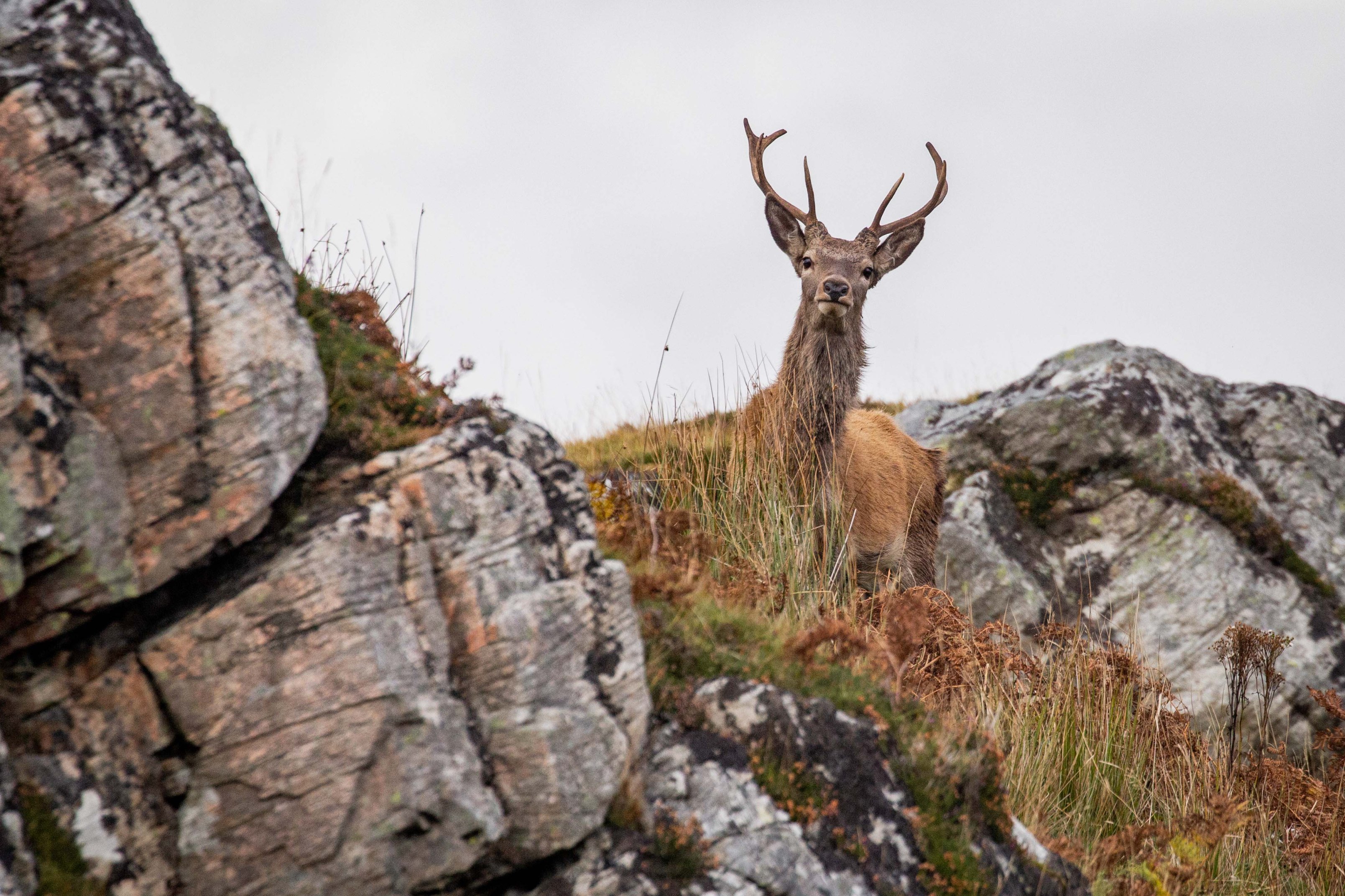
After several minutes of crawling I discovered that my hands were covered in roughly a dozen ticks, all tiny and luckily unattached. However, the ticks, mud and poo were all worth it for the views. The stag in the field below was in full rut mode, bellowing every minute or so and chasing the hinds around. None succumbed to his advances but he persevered, even jumping the hilariously named “deer proof fence” with ease. As well as the larger stag, there were also several younger stags feeding on the hill at eye level with us. They stared us down every time we shifted position but seemed content to carry on as normal and let us watch.
After several days of hearing deer without seeing many, getting to spend a couple of hours being completely surrounded by them was the perfect way to end our trip. Deer are one of those Marmite animals for some people, but I think they’re exceptionally special and I relish every encounter I have with them.
I go through phases when it comes to wildlife watching. For the past couple of months, I’ve been deep in a forest phase and all I’ve wanted to do is wander through trees and look for birds and red squirrels. My Instagram was full of greens and the first hints of autumn oranges.
But then the ocean started pulling me back. After a few weeks with no sightings, bottlenose dolphins started to make appearances along the Moray Firth again. It was looking unlikely that I’d see my first orcas this summer, but I was still looking forward to getting dolphin photos that showed slightly more than the departing splash. I was back in an ocean phase.
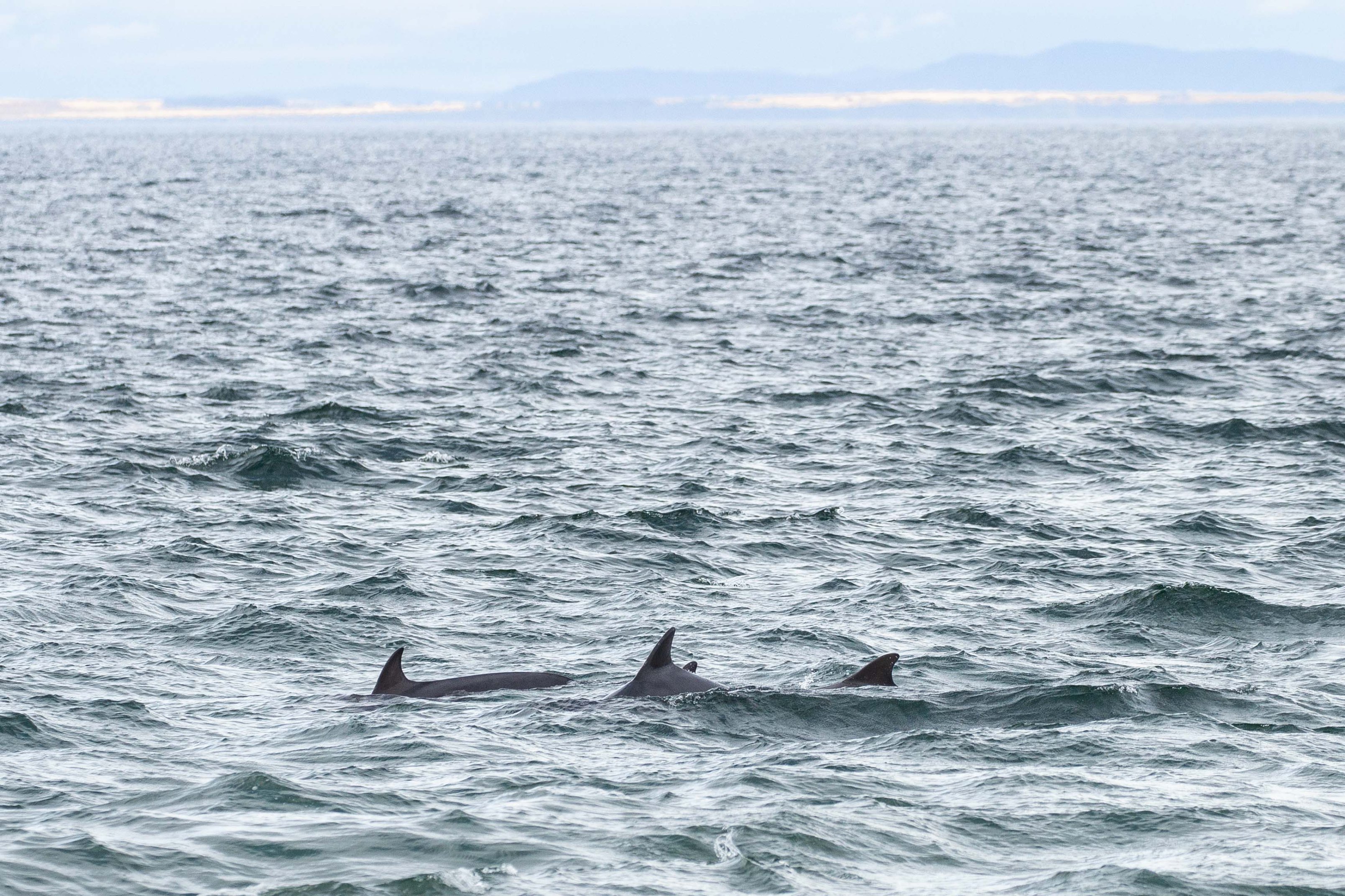
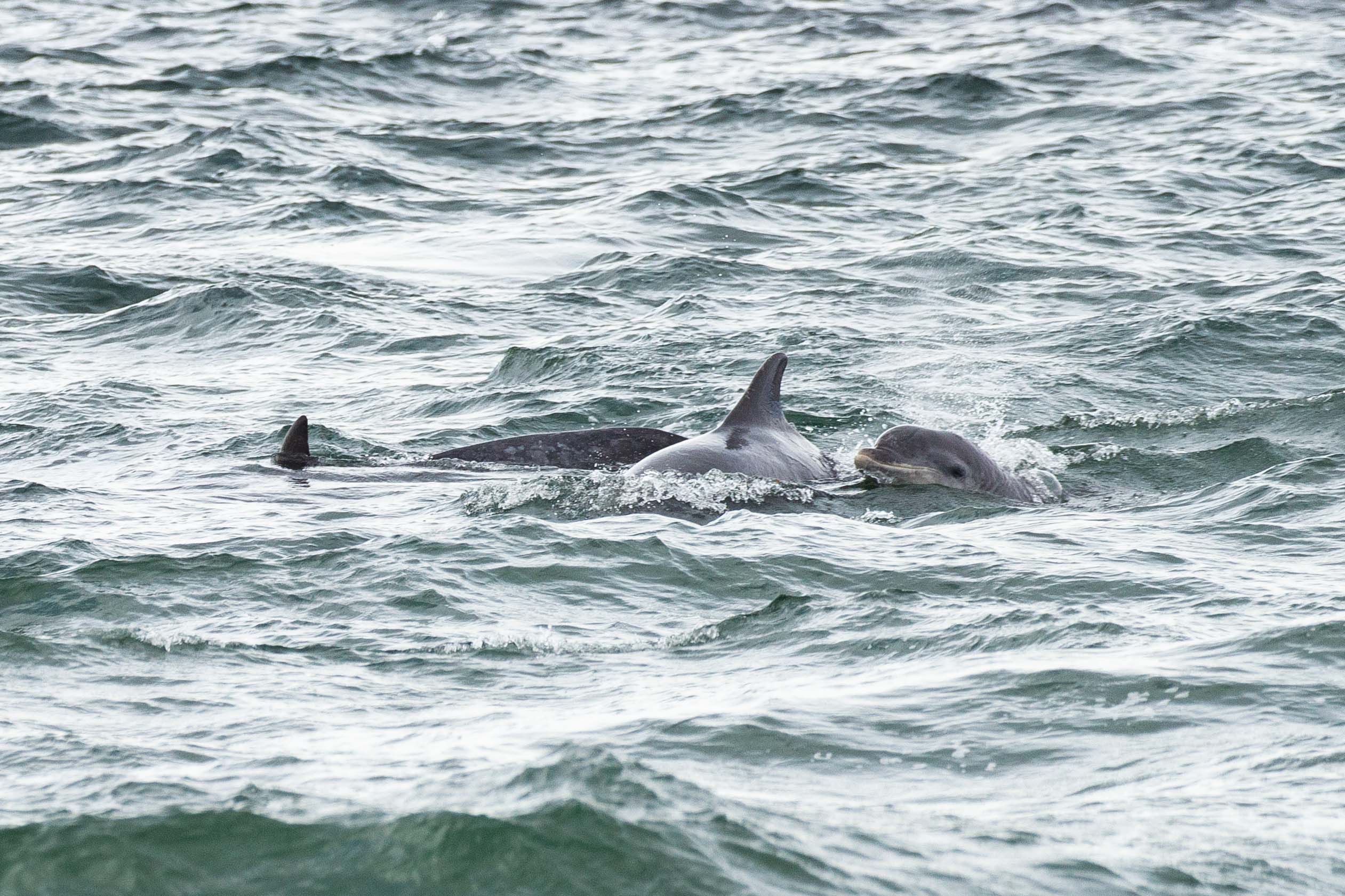
Earlier this month, on a particularly choppy morning, I found myself running full pelt along Burghead harbour to reach the end of the sea wall that juts out conveniently into the sea. From there, I could watch three different pods of bottlenoses as they caught fish. With so many breaking waves and white peaks, I didn’t know what I’d managed to capture until I returned home and uploaded the photos. I was thrilled to discover I’d caught a little face just as it breached the surface.
A few weeks later, I received a text alert from the local shore watchers saying there were bottlenoses heading west around the headland. Snatching up my camera, I made a beeline for my favourite vantage point at the end of the harbour. Unlike last time, the water was completely flat and every flash of fin caught my eye. Unfortunately all the feeding action happened far out, way past the range of my lens, but I did have an unexpected visitor pass close by.
The action continued the next week. Another text alert had me hiking up to the Burghead Visitor Centre at sunset and before long I had my lens pointed at a small pod who were following a jet ski and giving the driver some sensational views! As well as belly flops and tail waves, there were plenty of breaches. It was amazing to see the dolphins so active.
In the last of a flurry of excellent dolphin sightings, I paid Chanonry Point on the Black Isle another visit: one of the prime dolphin watching spots. Within moments of arriving – being sure to time my visit with the rising tide – a pod cruised straight past. Although there were no breaches this time, one particular dolphin dived three times directly in front of the crowd, revealing a distinctive notch in its tail fluke. I was also delighted to see a newborn calf among the adults, sticking closely to Mum as they passed by.
As summer blends into autumn, the dramatic display of emerging fungi will undoubtedly draw me into another forest phase, but I’ve loved having so many marine wildlife encounters this month. I’ve now got plenty more dolphin photos to add to my portfolio too!
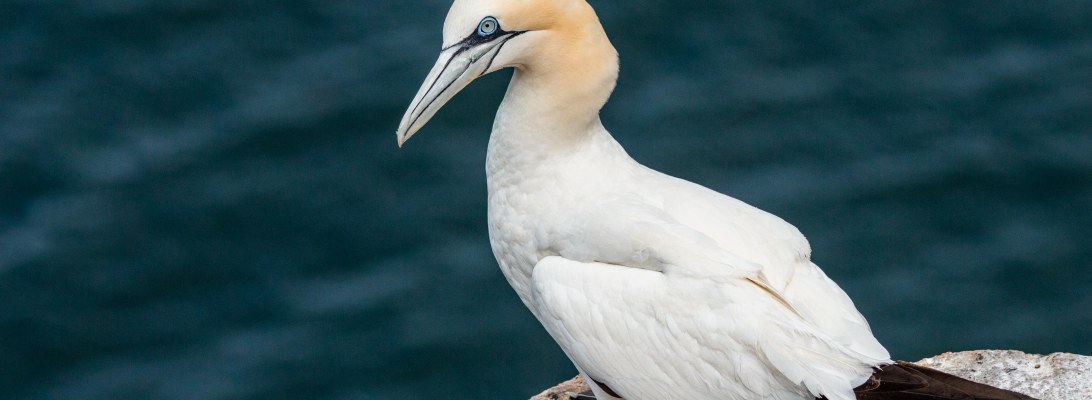
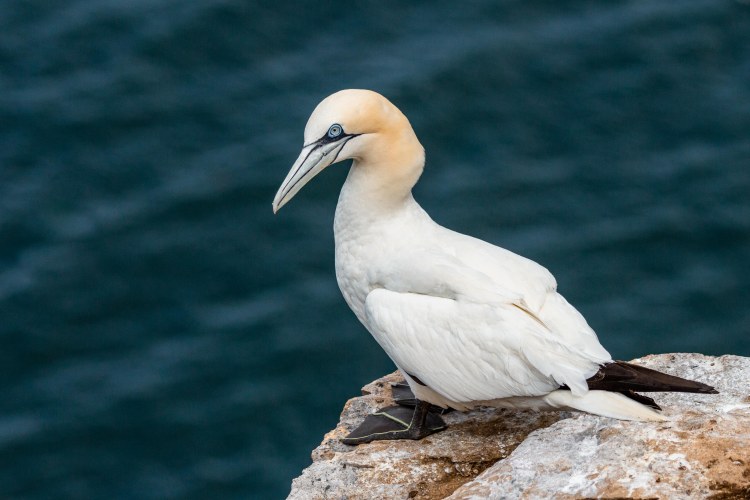
I had seen gannets a few times before; on a trip to the Isles of Scilly they had flown over the boat, and more recently I’d enjoyed watching them dive for fish near where I live in Moray. However, nothing could have prepared me for Troup Head. This RSPB site in Banff, about an hour’s drive from Aberdeen, provides nesting grounds for two thousand pairs of gannets, as well as thousands of other seabirds. During the short walk from the car park to the cliffs, both sounds and smells intensified until they reached a crescendo of squawks and guano pongs.
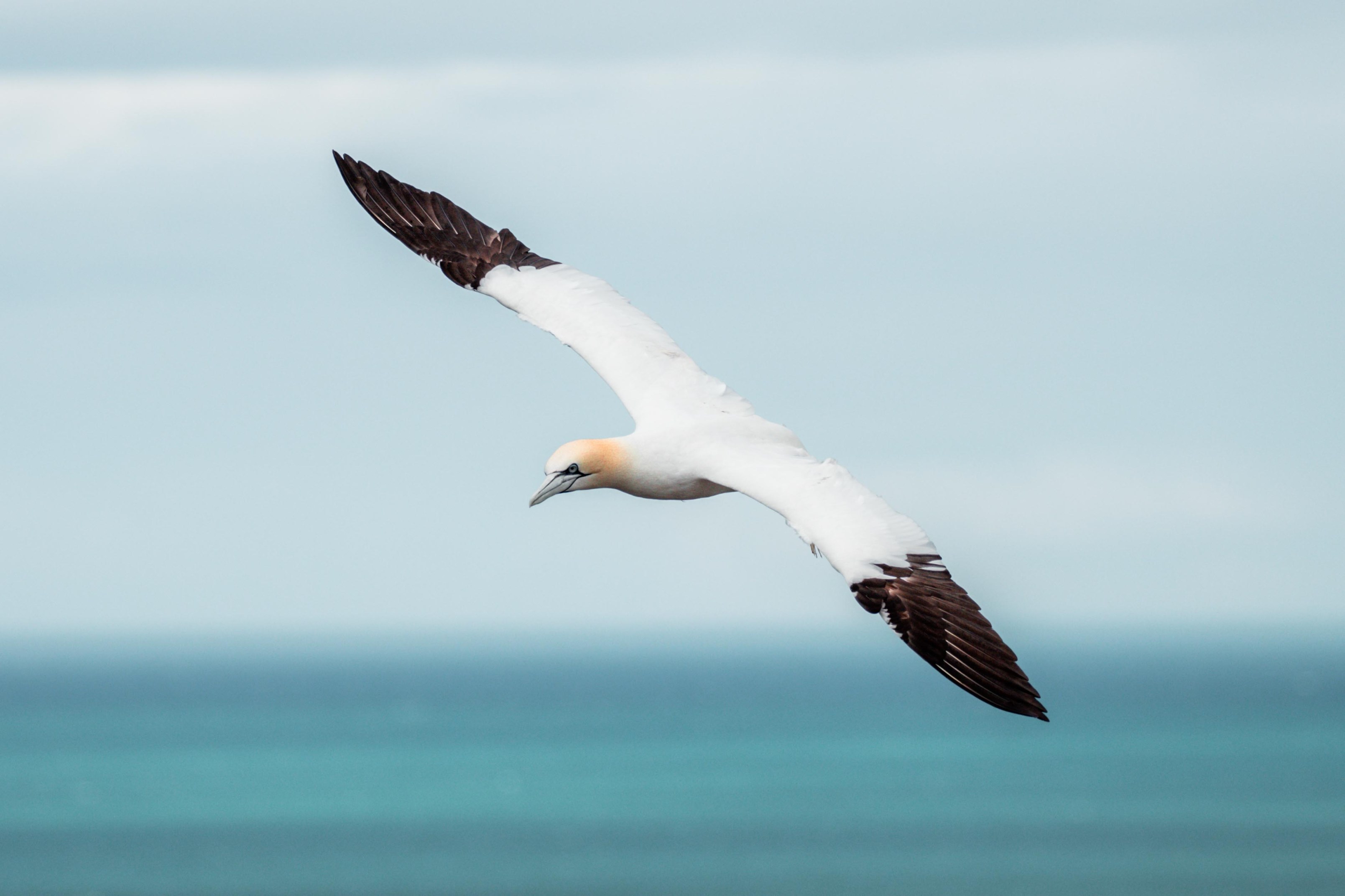
There were gannets everywhere. Without wanting to make them sound like flies, they swarmed around the cliff, gliding in deep circles as they came into land on the rocks. Many of them had chicks – currently clouds of white down with black reptilian heads. Dotted among them were the auks: guillemots, razorbills and the occasional puffin all grappling for a bit of wing room in the tight squeeze. Peering carefully down, I noticed just how high up we were. The swan-sized gannets – Britain’s largest seabird – looked like sparrows at sea level. Even the coastguard helicopter that passed by was below us. Troup Head really was a bird’s eye view.
The site became a significant birdwatching spot when gannets began to colonise it in 1988. Troup Head is now Scotland’s largest mainland gannet colony. We spent seven hours wandering along the track, shuffling across the tussocks to get the right vantage point for photos. Gannets came sweeping in to land in an endless queue, many suspended in mid-air and bobbing in the wind. There was something very duck-like about the way their webbed feet stuck out to the sides, and more than once a bird would crash-land quite unceremoniously with a ruffle of the feathers.
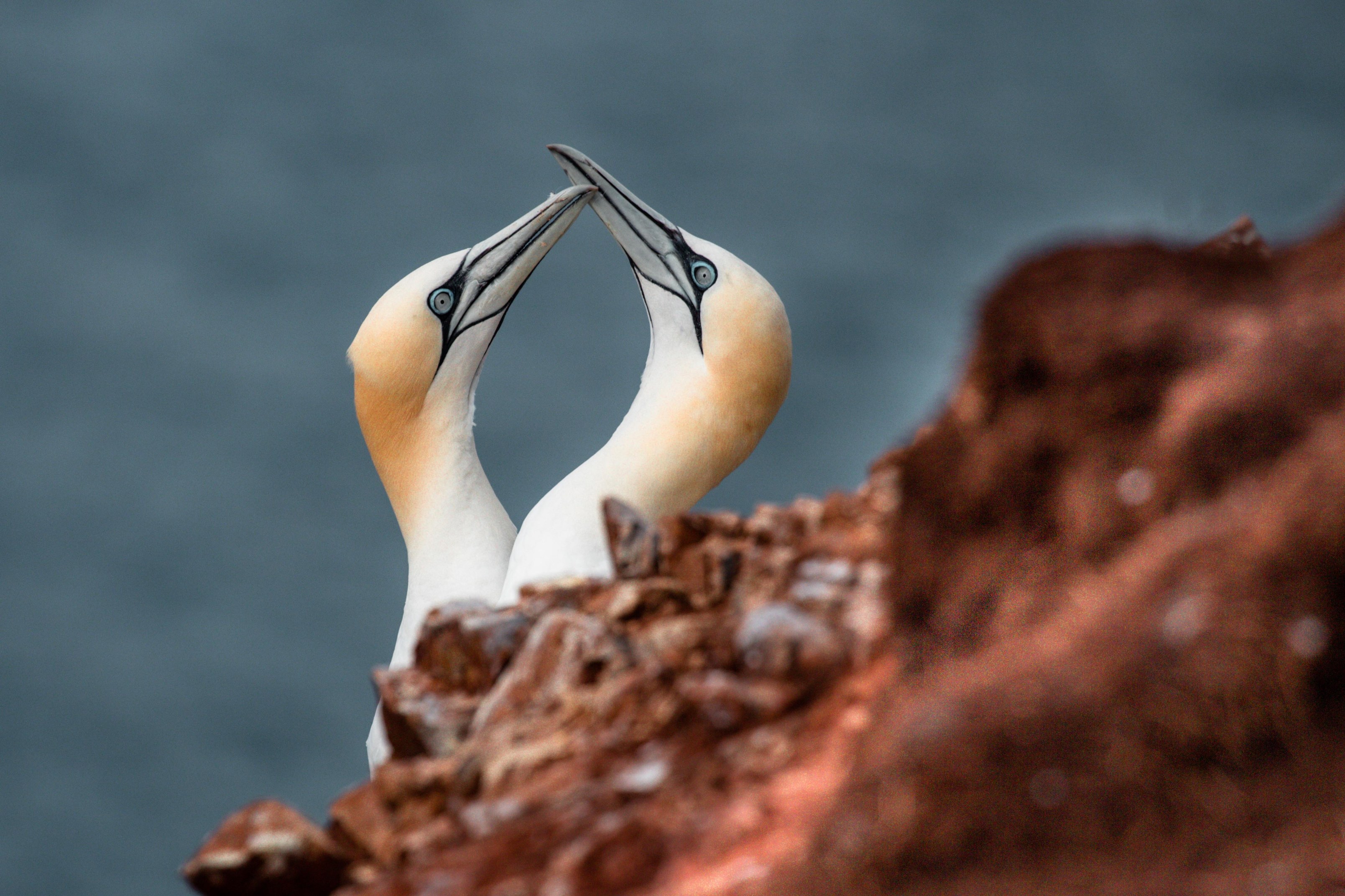
It was interesting to see lots of gannet behaviours up close. The birds pair for life and return to the same nest site each year with the same partner. To cement their pair bond, males and females will ‘fence’ together, clicking their bills from side to side and mutually grooming one another.
‘Fencing’
To ensure that one parent remains on the nest at all times, a gannet will stretch its neck and stare straight upwards in a pose called ‘sky pointing’, which signals to its mate that it is about to take off.
‘Sky Pointing’
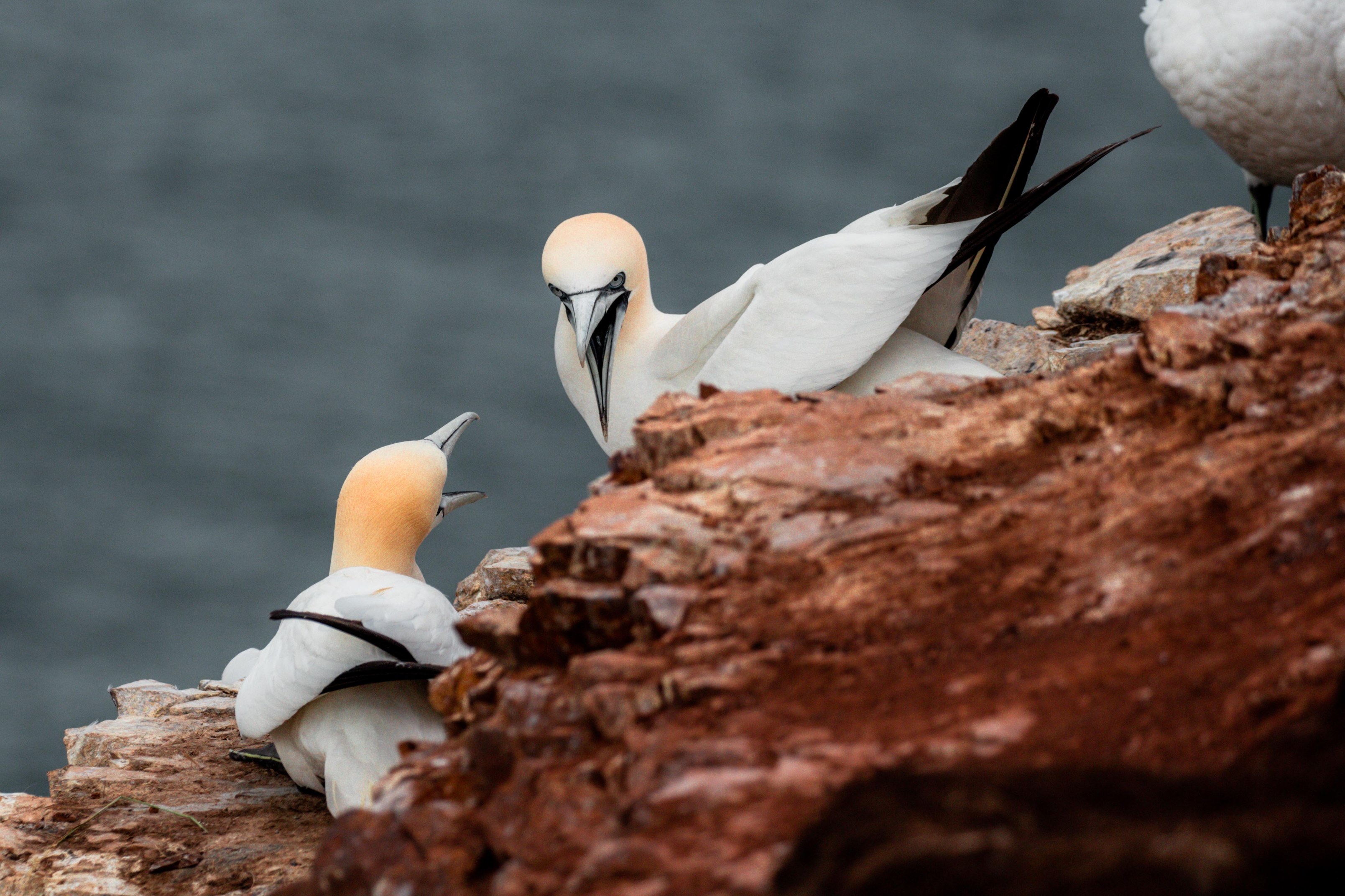
With so many birds on one cliff, it’s inevitable that there will be disputes over space. If a gannet gets too close to a neighbour’s nest, there is a display called ‘menacing’, where the birds will open their bills and lock them together in an attempt to jostle each other off the cliff.
‘Menacing’
While some quarrels are short-lived, others develop into full-blown fights, and with such formidable bills these can be aggressive.
Gannets have been a favourite of mine for many years, so to see such a vast colony so full of activity was a real treat. I was even more impressed that I didn’t get pooed on once!
With all the dolphin excitement recently, I’ve been sticking closely to the shore on my walks and neglecting the forest. I’ve always been worried that I’ll walk for miles and then get an alert saying there are leaping whales in the complete opposite direction.
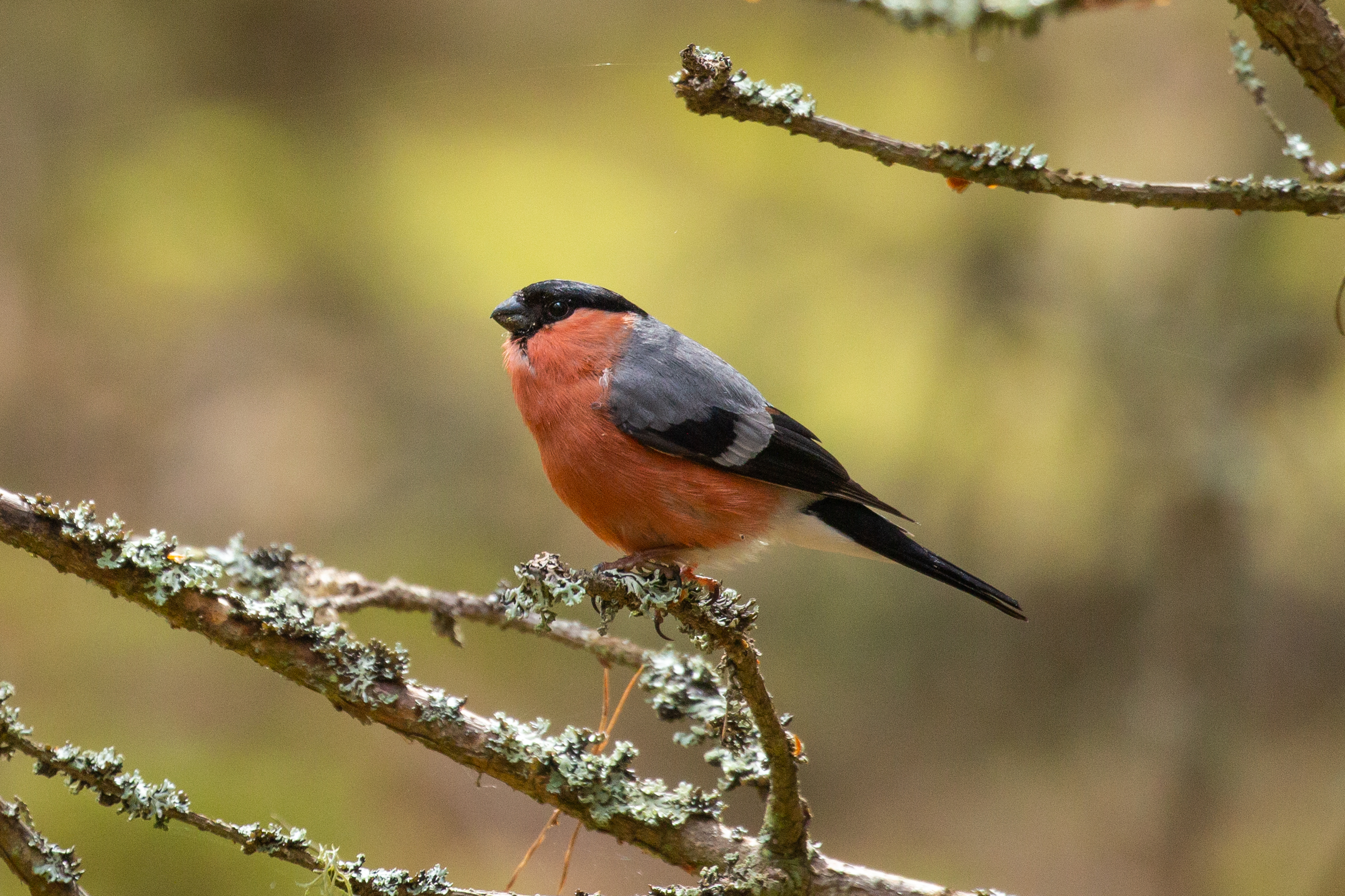
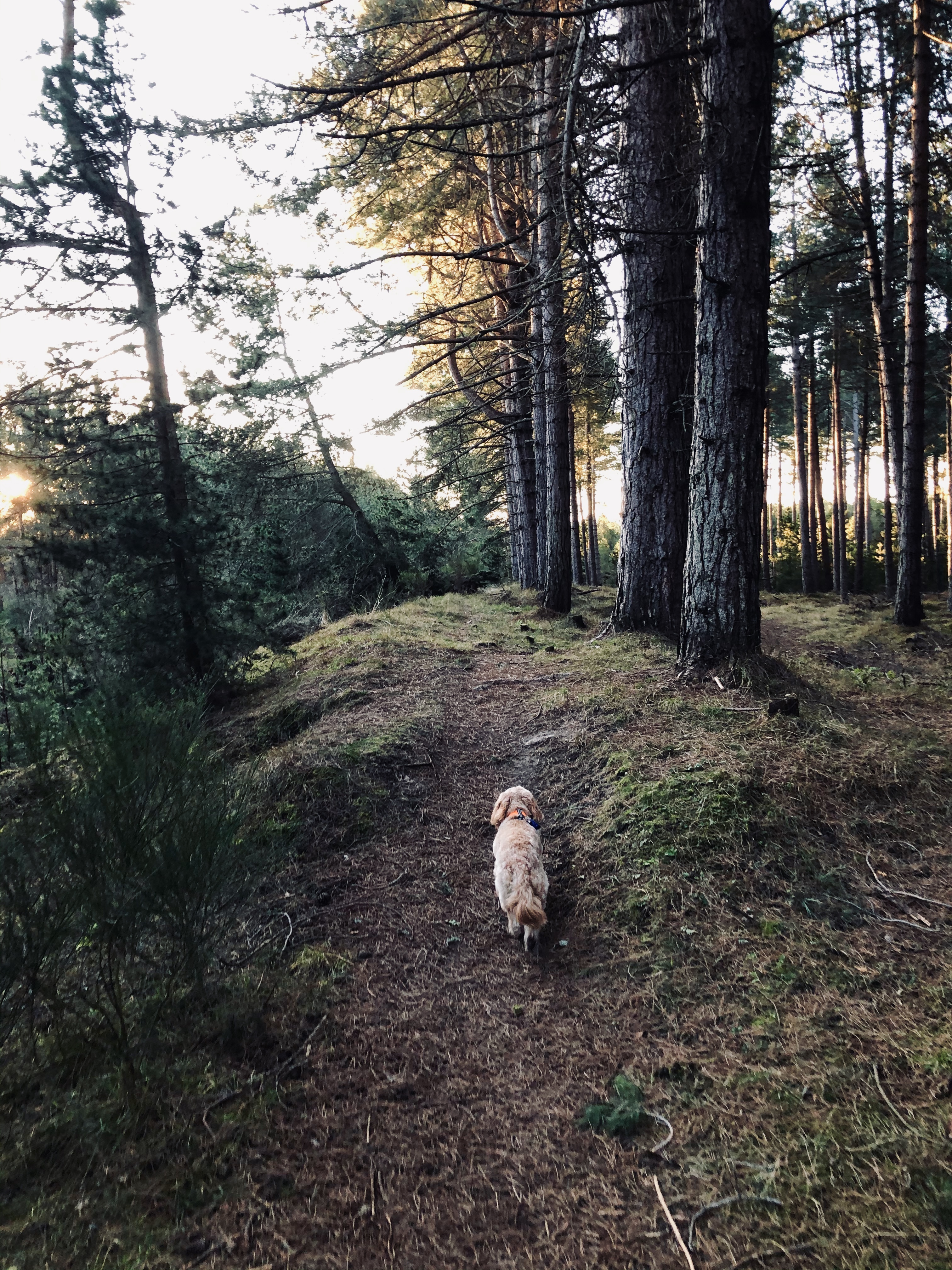
But, the other day I decided to take a chance and walk the dog in the forest for a change. Within five minutes, I saw a flash of rosy red and my heart did the familiar jolt that happens whenever I see something unexpected. And this was certainly unexpected: a pair of bullfinches not twenty feet away from me.
I’ve been trying to get a decent photo of a bullfinch for years. They’re one of my favourite birds but I’ve only seen them a handful of times. On every occasion they’ve either kept their backs to me or been concealed behind branches. I’ve taken a few blurry shots that prove they were there, but they’ve never been good enough to post. Now I was being treated with both male and female. While the male is more conventionally striking, I find the dusty brown plumage of the female just as beautiful. I just love their short, stubby bills, which are perfect for cracking hard seeds.
During the entire encounter my dog was amusing herself elsewhere, completely indifferent to my excitement. I stayed with the bullfinches as they hopped around logs and fluttered up to low branches. I could have sat and watched them for hours, but after a while I left them in peace.
Still buzzing from my sighting later that day, I decided to go back to the forest for an evening walk. There would be fewer humans and hopefully more animals to see. Roe deer were another of my favourites and a few weeks ago I saw a flash of brown fur as a doe pelted past me. I was keen to get a good photo of one – they were another animal that I’d never managed to get a proper glimpse of. So, despite the warm evening I wrapped up and headed out again. The sun wouldn’t be setting until 10pm so I had plenty of daylight left. In fact, it was prime golden hour and the broom – a shrub similar to gorse but without the spines – was glittering.
It seemed I hadn’t run out of good luck. After walking for less five minutes I saw movement through the trees. Four of the skinny saplings weren’t trees at all but slender brown legs. I froze where I was, conscious of every snappable twig by my feet. She was moving slowly, leisurely. I dared myself to tread up a grassy mound for a slightly higher viewpoint. There was so much dense ground foliage that I couldn’t see her very well. She headed to my left, straight towards a clearing between two columns of trees where I’d be able to see her perfectly. I lifted my camera slowly to my face and waited. When the moment came, the click of the first photo caught her attention and she turned to face me. For about ten seconds we stared at one another. Her pricked ears were huge satellite dishes on an otherwise skinny face, punctuated by large eyes and the characteristic roe moustache. The light was fading and I stretched to a slightly higher ISO than I would have liked. I knew the images were going to be a little grainy, but my deer was posing magnificently.
Eventually, human voices cut through my moment (of all the 1700 acres they could have chosen!) and the deer darted back the way she’d come. With such a slow shutter speed I had no hope of capturing her at that pace, so I just watched her springy legs disappear into the trees.
Inspired by such an early sighting, I pressed deeper into the woods, keeping my ears open for any unusual sounds that I wouldn’t hear during the day. The fantastical idea of pine martens popped into my mind but I pushed it away. To see a wild pine marten on my first evening forest walk would something close to miraculous. But a fox or perhaps an owl might be more likely, so I stayed as quiet as I could and did my best to avoid noisy leaf litter, although my stealth skills left a lot to be desired.
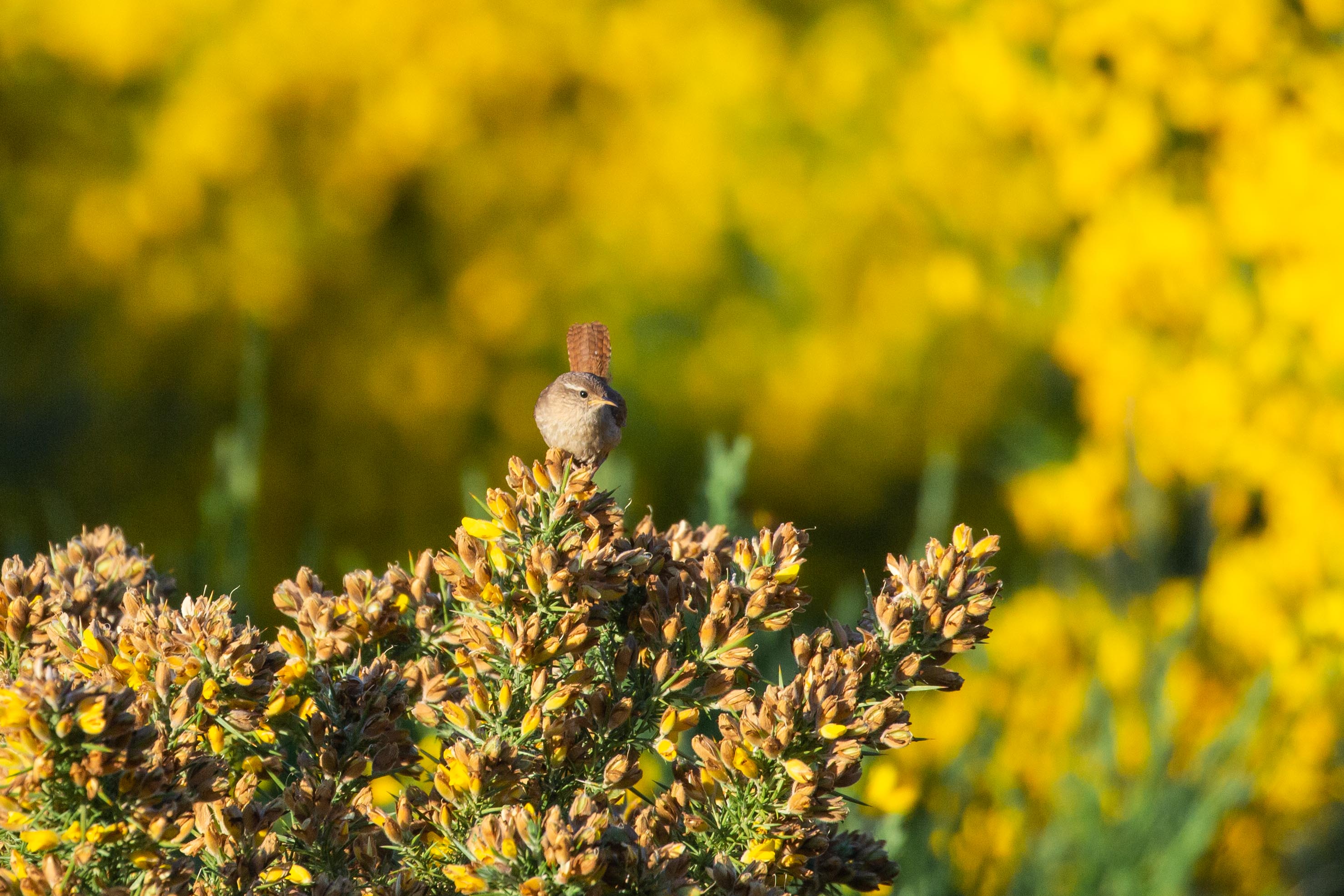
It’s astonishing how soothing a forest can be, if you let yourself align to its peace and quiet. I regularly stopped to listen to the birds, which at 9pm were still going strong. Far off, a blackbird perched on an overhead wire. If I closed my eyes, I could easily have been sat on my garden porch in Hertfordshire. A blackbird used to sing in the holly tree every evening without fail, and the sound became a firm part of my childhood. Elsewhere in the forest tonight was a chaffinch’s downward running tune, a wren’s bolstering trill and a chiffchaff whistling its name. I took recordings on my phone of all the assembled voices.
I walked and sat in the forest for three hours, until eventually at 10:15pm I began to feel the chill. Even so, the light was close to what it had been when I arrived, just without the bright sun – everything was lit with a milky glow that carried on long into the night. Moray is situated on the same latitude line as Gothenburgh in Sweden so during the summer months, the days last much longer and nothing goes completely dark. It’s a phenomenon I haven’t gotten used to yet. Many nights recently I’ve gone to bed and it’s still been light outside.
Taken at 10:17pm
I decided to call it a night. Looping back the way I’d come, I headed down the straight track that was lined on both sides by thick clouds of broom. I glanced briefly through a gap in the foliage and saw a face. Freezing, I stepped slowly back and came eye to eye with a male roe deer. My fingers itched for my camera, but there was no real chance of getting a photo. I could barely make him out with the naked eye. Most of his body was shrouded in shadows cast by the trees, but his face and antlers were dimly lit enough to spot. Again, we stood eyeing each other for a few moments before he took off, bounding down the ditch and up again. Then a sharp, gruff bark broke through the trees, which I realised was the deer! I’d never heard their barks before and couldn’t believe how canine they sounded. I wondered now if perhaps I had heard it and just dismissed it as a dog. It was haunting, especially in an ever darkening forest, but I loved it.
When I broke out of the trees and onto the open field, the spell broke. I felt a physical difference between the forest and civilisation. For hours I’d immersed myself in a place where people weren’t the most abundant presence and it was unbelievably refreshing. I decided, during the summer at least, to make my evening forays a regular thing. Daytime walks are good – I’d seen my bullfinches that morning after all – but there’s something far more mysterious and captivating about the night.
Last week there was a film screening event at the Scottish Dolphin Centre in Spey Bay. I didn’t know anyone there but soon found myself chatting to an elderly couple whose fierce pride of Scotland was immediately clear. We chatted about the Moray dolphins and the house that they planned to build with a view out to sea. It was the sort of life I was looking for myself.
The film was “Vitamin Sea”: an hour long documentary that followed ocean advocate and veterinary surgeon Cal Major as she attempted to be the first person to journey from Land’s End to John O’Groats by Stand Up Paddleboard. Cal was raising money for Samaritans and Vet Life in memory of her best friend who lost her battle with depression. I didn’t realise there is a high suicide rate among vets and not enough is currently being done to support them. Cal was also raising awareness of plastic pollution – scooping up hundreds of plastic bottles along the way – and showing how beneficial nature, and the ocean in particular, can be for our emotional wellbeing. If we spend time in an environment and form a relationship with it, Cal says, then people will want to protect it.
What I love about Cal is her positivity. While topics such as plastic and climate change can often bring doom and gloom, she discusses positive solutions and encourages us all to do little things that bring great benefits. Throughout her 900 mile journey Cal meets countless people who donate to her cause, help out with litter picks and show their support in so many other ways. Even in places like Manchester, where plastic pollution was at its worst along Cal’s route, spirits were high and people clearly showed their passion for protecting their natural environment.
At times the film was very moving. Cal revisited a place where she spent a holiday with her lost friend, and at times broke down from the combination of finding so much litter and experiencing sheer exhaustion. The constant struggles and exertions only made reaching the finishing line more emotional. After two months on the water with a sole purpose, it seemed almost anti-climactic when Cal touched land at the end of her journey. Overwhelmed with emotion, she debated staying with nature at sea and letting it continue to “heal” and “wow” her.
What resonated with me was the “profound sense of joy” that comes with being on the ocean surrounded by natural beauty. Many of us feel an undeniable pull to the ocean – that beautiful, unpredictable element of nature that compels our love and respect. Seeing so much litter clogging beaches where seals and birds roamed was difficult, but knowing that people like Cal are raising awareness with a positive message is so refreshing.
As we watched a drone’s eye view over mountains and stretching ocean at the end of the film, the man beside me leant over and asked, “Do you think you’ll go back again?”
I’ve finally done it. After feeling for the past year that I’ve been in the wrong place, and experiencing a far greater satisfaction every time I visit Scotland, I’ve finally moved there. Last weekend I drove 568 miles and upon arrival collapsed exhausted, filling the house with bags and suitcases. But over the past few days it’s finally started to sink in that I live here now.
The reason I can tell I’m in a much better place is I already feel a connection to the landscape, so much so that I’ve assigned myself a local patch for the first time. Back in Hertfordshire I never felt closely attached to any wild place, and even if I had there was nothing within walking distance of where I lived. Now I can walk for less than two minutes and reach the sprawling north side of the Burghead peninsula, known by the Brochers (Burghead residents) as the backshore. This is my new patch. Not only is it teeming with birds – attracting twitchers from across the Highlands as a result – but it is home to many species I don’t know, which will make the process of monitoring my patch even more rewarding. Having never been in regular contact with marine and coastal habitats before, my knowledge of gulls, ducks and waders is almost non-existent. I’ve been visiting my patch for three consecutive days now and have already learned to recognise six new birds: turnstone, redshank, rock pipit, goldeneye, curlew and long-tailed duck. When I stand on the bank scanning the waves, I think I see around a thousand dolphins breaking the surface, but the ocean is known for playing tricks. As the old saying goes, the harder you work the luckier you get. There are around 130 resident bottlenoses in the Moray Firth, and I’m determined to see some on my patch soon.
A well camouflaged curlew
Having a local patch is a great way to get to know an area intimately. By regularly recording not only the species but also the weather conditions, time and date of visits, you begin to detect changes and ultimately learn wild animal behaviours. On Sunday I went at 4pm and watched waders and gulls foraging amongst the rocks. Yesterday I went at 11am and the tide was completely in, so the waders were absent but there were still ducks and cormorants diving in the shallows. A marine patch is particularly intriguing because it changes drastically in a short space of time. In just a few hours the habitat is transformed, and new birds appear to take advantage of the conditions.
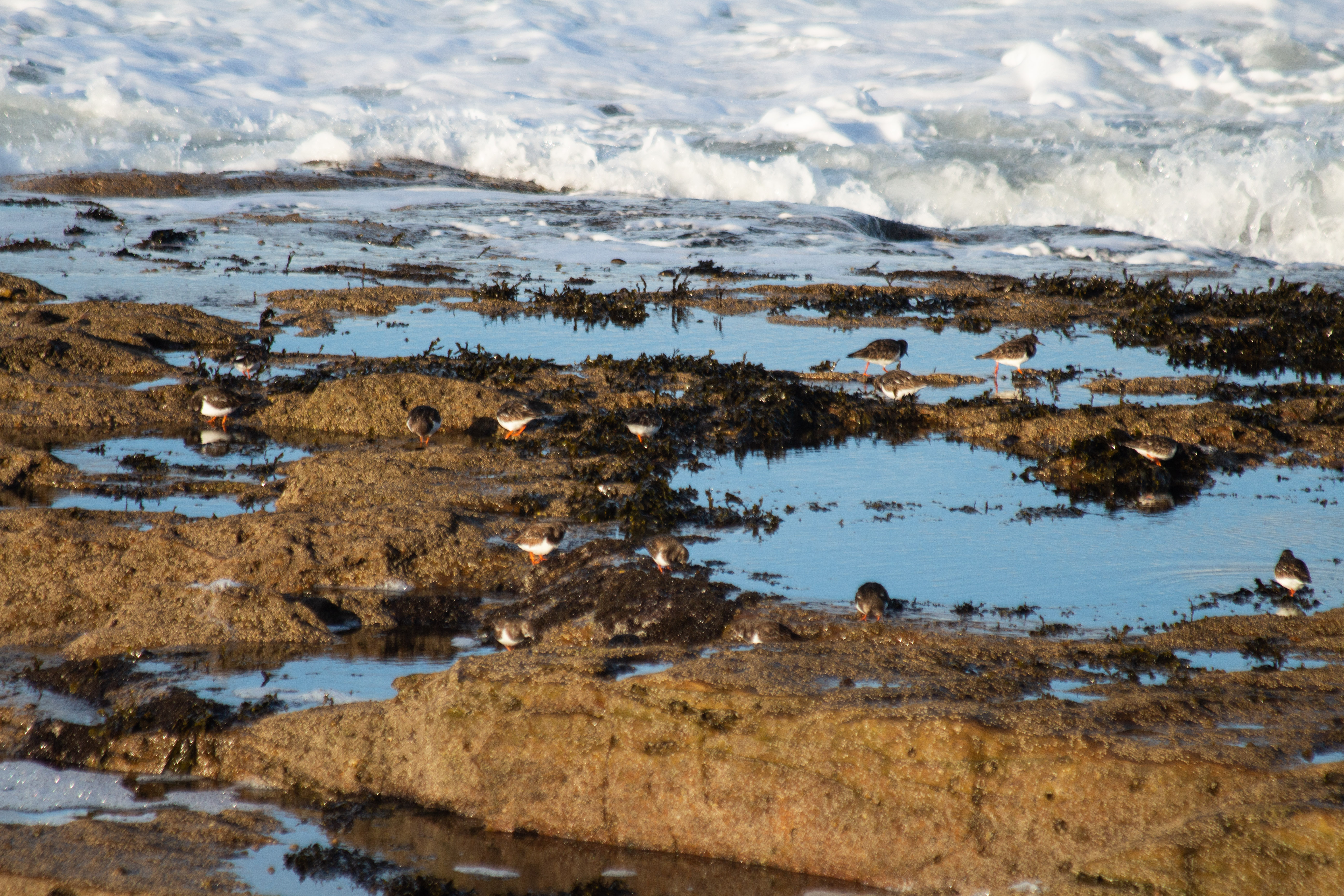
The backshore is full of redshanks
I’ve already met other birders at the backshore, including Steve Reddick from Highland Wildlife and Birdwatch Safaris, who had the added benefit of a scope. He was keen to see purple sandpipers, which are often here during the winter. I learnt most of my six new birds from Steve, and now wish he could help me with a mystery diver I keep spotting. It’s too far away to make out clearly through binoculars, and to my untrained eye the three species of diver seen here – red throated, black throated and great northern diver – all look very similar in winter plumage. Hopefully with a few more sightings I’ll learn the differences and be able to identify them with confidence. I’m particularly looking forward to seeing their summer plumage, which is not only easier to recognise but also stunningly beautiful!
Turnstones are notorious for fidgeting, but it would be nice if they all looked up every now and then!
It’s fantastic to have my passion for birdwatching renewed. I’ve been in a slump for months, so to finally be in a place that inspires and challenges me is both a relief and a privilege. I can’t wait to discover new species this year, not only on the backshore but all over the Moray coast.
I’ve never been able to meditate. I’ve tried it before, frustrated and envious of those people who can sit still and completely disengage from the distractions around them. For a start, I can’t even sit up straight without getting uncomfortable. I know you can meditate lying down, but then I just fall asleep. If I finally do find a comfortable position, I inevitably can’t stop thinking. “Focus on breathing”, all the books and videos say, and I focus on the first three inhalations wonderfully, but soon my mind wanders to my shopping list, deadlines, or reminding myself to put the bins out. I’ve discovered that meditation is just something that not everyone can do, in the conventional way at least.
The other day I went to Rye Meads Nature Reserve in Ware, Hertfordshire. I have quite a lot of things to do at the moment with my MA and the move to Scotland later this month, but I needed some time outside. I find it a real challenge to make time for walks, so I fought my better judgement and put work on hold to sit in a hide and watch birds. I don’t do this much – when I’m out and about I’m either on my way somewhere or keeping an eye on the dog to make sure she’s not getting into mischief, so it was a real indulgence to spend an entire morning ambling around a nature reserve.
I sampled each hide in turn, following muntjac prints in the mud as I walked, and eventually settled in one that overlooked a lake speckled with birds. A group of thirty lapwings were soaring over the water, swinging in a single mass from left to right. Each time they twisted the sunlight caught their backs, illuminating that iridescent green also concealed in magpies and starlings. I watched their display through the binoculars, captivated by the pendulum-like movement. Unlike a lot of wings that end in sharp points, these birds have wings that are loosely shaped like tennis rackets.
Eventually one bold individual decided that was quite enough flying, and as it swooped down to the water its companions followed until the air was empty again. They settled on the rocks alongside a pair of shelducks, shovelers, gadwall and a lone cormorant. The strips of pebbles cut the lake into wedges, separating midnight blue from slate grey. Ripples from bobbing coots sent tiny waves onto the shingle.
“Have you seen the green sandpiper?”
The voice made me jump after such a long silence. It was a member of RSPB staff, brandishing both binoculars and an impressive scope. Shimmying along the bench, I peered down the scope and watched the wader as it scoured the shingle for food on its skinny green legs. I’d have never spotted such a well-camouflaged bird without help. In fact, the green sandpiper was a species that I may have looked at but not noticed many times before.
The man with the scope carefully lowered the window cover and hitched the scope onto his back, heading back out into the sunshine. I carried on watching the lapwings, now foraging with their spiky hairdos fluttering. It occurred to me then that birdwatching was a form of meditation. You have to sit still, as quietly as possible, and often go for hours without speaking. My phone was on silent, buried at the bottom of my bag underneath gloves, sketchbooks and biros. The only connection I had was with the birds. Sure, I was hoping for bitterns, kingfishers and otters (none of which showed), but I found satisfaction in the more common residents. There is undeniable beauty in a young blue tit’s downy feathers, the tight curl of a cormorant’s dive and the vibrancy of a mallard drake’s head, which almost shines yellow in the right light. Maybe I’d denied myself the pleasure of birdwatching too long, but sitting in the hide looking out onto calm water felt like meditating. My work was back at the house and I was in the reserve sharing space with birds.
For the past few months, I’ve had a growing sense of being in the wrong place. I’ve lived in Hertfordshire all my life, but since coming back from university in Cumbria, I haven’t felt like I’ve belonged in the south. Throughout my childhood and adolescence, I’ve been lucky enough to spend a lot of holidays and days out in Scotland, and I’ve started to realise that I’m happiest there. Inspiration comes easier, as does my ability to concentrate. There is a wealth of material to write about and the landscape cries out to be drawn and painted. Although I’ve never lived in a city, there is a feeling of congestion in the south that I’ve been more and more affected by. This feeling completely disappears in Scotland. There are fewer people and more animals, which my inner introvert loves.
So, I can now finally say that I am moving to Scotland. I came to the conclusion that I should do what makes me happy and be in a place where creativity and imagination are enhanced by the land around me. I want to walk in woods where there are pine martens and hike up hills where there are golden eagles! I’ve been lucky enough to see some iconic Scottish species already, including martens and eagles, but others are still mysteries. I doubt I’ll ever catch a glimpse of a Scottish wildcat, but just knowing that they are there somewhere is so exciting.
Every time I drive along the A96 during visits to my parents in Moray, often with dense forest pressing in on both sides, I peer into the shadows and imagine what creatures could be lurking between the trees. Of course, there are many beautiful places in Hertfordshire, but none within walking distance of where I live. I can’t step outside my front door and see the ocean hurtling towards the shore. I can’t walk for five minutes and reach a 1700 acre forest, or look into a sky full of stars and hope for the aurora borealis to show. I can do all of this from my parents’ house, where they live at the end of a peninsula jutting out into rumbling waves.
I’m currently staying with my parents for a few days and I can’t believe that this stunning place will soon be my home. I am studying for my MA until 2021, so the plan is to find some part time work or volunteering in conservation to fill my time alongside my studies and keep the CV fresh. I have so many goals for my new life in Scotland, including:
Do the North Coast 500 – an epic road trip around the entire northern tip of Scotland
Properly see otters – so far I’ve only seen a distant shadowy lump at night
See a basking shark
Go wild swimming – I’ll wait until summer for this one
Go kayaking in a loch
Visit all the major islands starting with Skye, Jura and Islay
See the Northern Lights – seemingly equal to seeing a unicorn but it is actually possible!
Learn some Gaelic – I’m fascinated by Gaelic – my favourite discovery so far is the name for the white-tailed sea eagle “lolaire suile na greine”, which translates as “the eagle with the sunlit eye”
Despite having visited Scotland on and off for the past 17 years, there is still so much I haven’t seen, and when I move I will have complete freedom to explore. After my next residential trip for university in February I shall be ready to leave life in the south behind me and begin a new, and far wilder, chapter in the north.

















 rebeccaonthewing.com